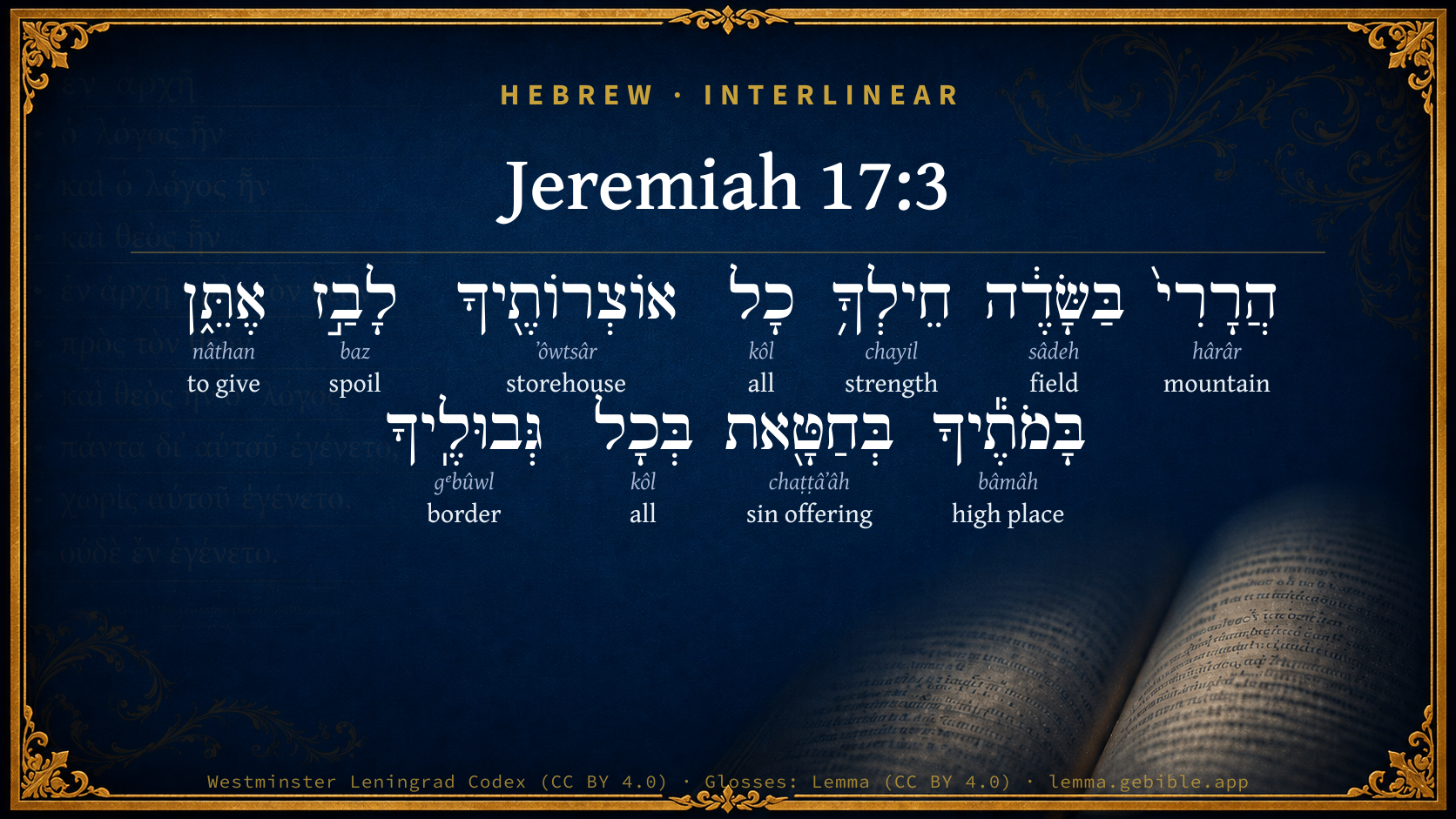
Jeremiah 17:3

Hebrew (Westminster Leningrad Codex) Jeremiah 17:3 appears in the Hebrew Old Testament. The text above is from the Westminster Leningrad Codex. Each word links to its Strong’s number, a concise gloss, and parsing drawn from the Open Scriptures Hebrew Bible morphology. Click any word for its full Brown-Driver-Briggs (BDB) entry.
Download image
Cite this verse

Jeremiah 17:3 (World English Bible). Public Domain. Lemma interlinear Bible study tool, https://lemma.gebible.app/v/jeremiah/17/3.

Show BibTeX & RIS
BibTeX
RIS
English Translation
My mountain in the field, I will give your substance and all your treasures for a spoil, [and] your high places, because of sin, throughout all your borders.
World English Bible · Public Domain
Download a study sheet

One document with this verse’s original text, its word-by-word gloss line, the meaning frame, cross-references with their text, attributed commentary, and full source and license credits — printable, and it pastes into notes with its structure intact.

This verse Autodidact and up

Study sheet (.html) Plain text (.txt)

A passage Seminary Student

Up to 50 verses in one chapter. A passage sheet keeps up to 6 commentary sources and 12 cross-references per verse, in the order this page ranks them, and says so on the sheet whenever that leaves anything out. Ask for a single verse and you get the Autodidact verse sheet above.

Everything on this page stays free to read, with no account — the sheet is a download of what is already on screen, not access to it.

Want to remove ads? Support Godless Engineer
Compare translations 3

The same verse in 3 English versions, stacked beneath the original-language interlinear above. Click any original word for its lexicon entry.

Each is an independent rendering of the whole verse — the interlinear is not word-aligned to these translations.

Highlighted words mark where these versions differ — a whole-verse word diff, not a word-by-word alignment.

  • World English Bible Public Domain
    My mountain in the field, I will give your substance and all your treasures for a spoil, [and] your high places, because of sin, throughout all your borders.
  • King James Version Public Domain
    O my mountain in the field, I will give thy substance and all thy treasures to the spoil, and thy high places for sin, throughout all thy borders.
  • unfoldingWord Literal Text CC BY-SA 4.0
    My mountain in the field, your wealth, all your treasures as plunder I will give, your high places for sin within all your borders.

unfoldingWord Literal Text — © unfoldingWord, licensed CC BY-SA 4.0. Word-aligned USFM3 via Door43 (git.door43.org/unfoldingWord/en_ult).

Versions to compare (up to 4)

3 of 4 selected

Show all 18 translations

Every available English version of this verse, each an independent rendering of the whole verse.

  • World English Bible Public Domain
    My mountain in the field, I will give your substance and all your treasures for a spoil, [and] your high places, because of sin, throughout all your borders.
  • Berean Standard Bible Public Domain
    O My mountain in the countryside, I will give over your wealth and all your treasures as plunder, because of the sin of your high places, within all your borders.
  • Majority Standard Bible Public Domain
    O My mountain in the countryside, I will give over your wealth and all your treasures as plunder, because of the sin of your high places, within all your borders.
  • King James Version Public Domain
    O my mountain in the field, I will give thy substance and all thy treasures to the spoil, and thy high places for sin, throughout all thy borders.
  • American Standard Version (1901) Public Domain
    O my mountain in the field, I will give thy substance and all thy treasures for a spoil, `and' thy high places, because of sin, throughout all thy borders.
  • Revised Version (1885) Public Domain
    O my mountain in the field, I will give thy substance and all thy treasures for a spoil, and thy high places, because of sin, throughout all thy borders.
  • Geneva Bible (1599) Public Domain
    O my mountaine in the fielde, I will giue thy substance, and all thy treasures to be spoyled, for the sinne of thy high places throughout all thy borders.
  • Douay-Rheims (1899) Public Domain
    Sacrificing in the field: I will give thy strength, and all thy treasures to the spoil, and thy high places for sin in all thy borders.
  • Young's Literal Translation Public Domain
    O My mountain in the field -- thy strength, All thy treasures -- for a prey I give, Thy high places for sin in all thy borders.
  • Literal Standard Version CC BY-SA 4.0
    O My mountain in the field—your strength, || All your treasures—I give for a prey, || Your high places for sin in all your borders.
  • Unlocked Literal Bible CC BY-SA 4.0
    My mountain in the open country, and your wealth and all your treasures I will give away as plunder, together with your high places, because of the sin you committed in all your territories.
  • unfoldingWord Literal Text CC BY-SA 4.0
    My mountain in the field, your wealth, all your treasures as plunder I will give, your high places for sin within all your borders.
  • Darby Bible Public Domain
    My mountain in the field, thy substance, all thy treasures will I give for a spoil, -- thy high places, because of sin throughout thy borders.
  • World Messianic Bible Public Domain
    My mountain in the field, I will give your substance and all your treasures for a plunder, and your high places, because of sin, throughout all your borders.
  • Webster's Bible Public Domain
    O my mountain in the field, I will give thy substance and all thy treasures to the spoil, and thy high places for sin, throughout all thy borders.
  • Free Bible Version CC BY-SA 4.0
    on my mountain in the fields. I will hand over your wealth and all your valuable possessions as plunder, because of the sin committed on your pagan high places inside your country.
  • Bible in Basic English Public Domain
    I will give your wealth and all your stores to be taken away in war without a price, because of your sins in every part of your land.
  • JPS Tanakh (1917) Public Domain
    O thou that sittest upon the mountain in the field, I will give thy substance and all thy treasures for a spoil, and thy high places, because of sin, throughout all thy borders.

Literal Standard Version (2020), Covenant Press — licensed CC BY-SA 4.0. Text via the HelloAO Bible API (eBible.org). Unlocked Literal Bible (unfoldingWord) — licensed CC BY-SA 4.0. Text via the HelloAO Bible API (eBible.org). unfoldingWord Literal Text — © unfoldingWord, licensed CC BY-SA 4.0. Word-aligned USFM3 via Door43 (git.door43.org/unfoldingWord/en_ult). Free Bible Version, Dr. Jonathan Gallagher — licensed CC BY-SA 4.0. Text via the HelloAO Bible API (eBible.org).

Word by word

More ways to search: Search by grammar → Find every occurrence → Compare this word →

Practice this passage: Drill this verse → Learn its vocabulary →

הֲרָרִי֙
hârâr
H2042
“mountain · my”
Noun, Common, Masculine, Singular, Construct + Suffix, Personal, 1st Person, Common, Singular
Part of Speech
Noun
Type
Common
Gender
Masculine
Number
Singular
State
Construct
Full BDB Definition

Origin: from an unused root meaning to loom up

TWOT: 517

mountain, hill, hill country, mount
  1. בַּשָּׂדֶ֔ה sâdeh H7704 “in/at the · field” Preposition, Determined + Noun, Common, Masculine, Singular, Absolute
  2. חֵילְךָ֥ chayil H2428 “strength · your” Noun, Common, Masculine, Singular, Construct + Suffix, Personal, 2nd Person, Masculine, Singular
  3. כָל kôl H3605 “all of” Noun, Common, Masculine, Singular, Construct
  4. אוֹצְרוֹתֶ֖יךָ ʼôwtsâr H214 “storehouses · your” Noun, Common, Masculine, Plural, Construct + Suffix, Personal, 2nd Person, Masculine, Singular
  5. לָבַ֣ז baz H957 “to/for · spoil” Preposition + Noun, Common, Masculine, Singular, Absolute
  6. אֶתֵּ֑ן nâthan H5414 “to give” Verb, Qal, Imperfect, 1st Person, Common, Singular
  7. בָּמֹתֶ֕יךָ bâmâh H1116 “high places · your” Noun, Common, Feminine, Plural, Construct + Suffix, Personal, 2nd Person, Masculine, Singular
  8. בְּחַטָּ֖את chaṭṭâʼâh H2403 “in/at · sin offering” Preposition + Noun, Common, Feminine, Singular, Absolute
  9. בְּכָל kôl H3605 “in/at · all of” Preposition + Noun, Common, Masculine, Singular, Construct
  10. גְּבוּלֶֽיךָ gᵉbûwl H1366 “borders · your” Noun, Common, Masculine, Plural, Construct + Suffix, Personal, 2nd Person, Masculine, Singular

About this verse

These counts appear in no published source. They are computed here, from the morphology-tagged text and Lemma’s own curated glosses. What Lemma adds →

11
words
10
distinct lemmas
Prophets
section

Notable vocabulary

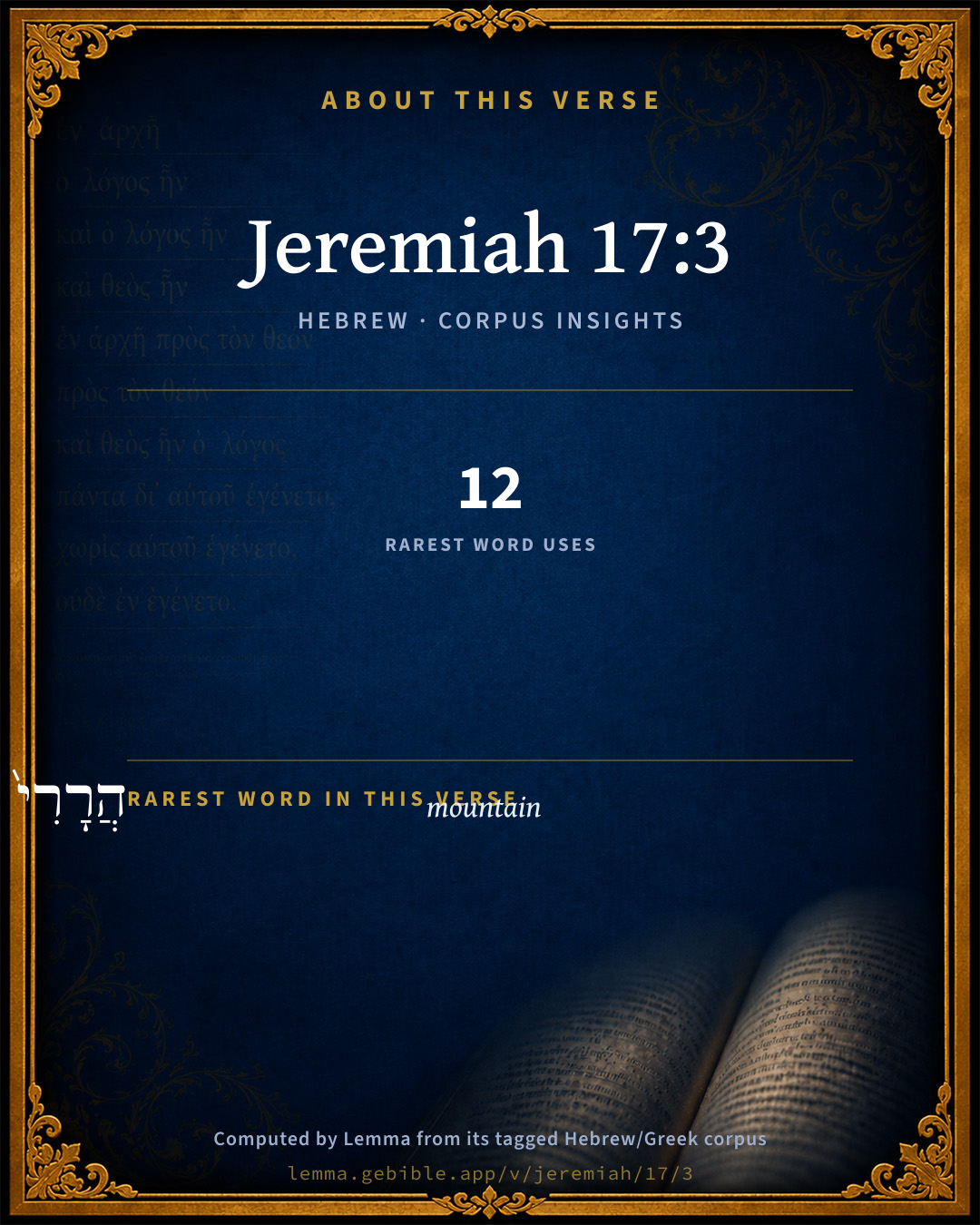
The rarest word here is הֲרָרִי֙ mountain H2042 — appearing just 12 times in the whole Hebrew Bible.

Shared distinctive vocabulary

הֲרָרִי֙ mountain H2042 occurs in 12 verses of the Hebrew Bible. Also found in:

Grammatical profile

  • 1 verb
  • 10 nouns

Verb forms

  • אֶתֵּ֑ן Qal · Imperfect

Repetition

A word recurs within this verse — often emphatic in Hebrew:

Cross-references

17

Topical passages linked to Jeremiah 17:3 in the Treasury of Scripture Knowledge — connected by theme and wording, ordered by reader-vote popularity; previews shown in the World English Bible.

  • Jeremiah 15:13 Your substance and your treasures will I give for a spoil without price, and that for all your sins, even in all your borders.
  • 2 Kings 24:13 He carried out there all the treasures of the house of Yahweh, and the treasures of the king's house, and cut in pieces all the vessels of gold, which Solomon king of Israel had made in the temple of Yahweh, as Yahweh had said.
  • Jeremiah 26:18 Micah the Morashtite prophesied in the days of Hezekiah king of Judah; and he spoke to all the people of Judah, saying, Thus says Yahweh of Hosts: Zion shall be plowed as a field, and Jerusalem shall become heaps, and the mountain of the house as the high places of a forest.
  • Isaiah 39:4–6 Then said he, What have they seen in your house? Hezekiah answered, All that is in my house have they seen: there is nothing among my treasures that I have not shown them.
  • Leviticus 26:30 I will destroy your high places, and cut down your incense altars, and cast your dead bodies upon the bodies of your idols; and my soul will abhor you.
  • 2 Kings 25:13–16 The pillars of brass that were in the house of Yahweh, and the bases and the brazen sea that were in the house of Yahweh, did the Chaldeans break in pieces, and carried the brass of them to Babylon.
  • Isaiah 2:2–3 It shall happen in the latter days, that the mountain of Yahweh's house shall be established on the top of the mountains, And shall be raised above the hills; And all nations shall flow to it.
  • Isaiah 27:9 Therefore by this shall the iniquity of Jacob be forgiven, and this is all the fruit of taking away his sin: that he makes all the stones of the altar as chalk stones that are beaten in sunder, [so that] the Asherim and the sun-images shall rise no more.
  • Jeremiah 12:12 Destroyers are come on all the bare heights in the wilderness; for the sword of Yahweh devours from the one end of the land even to the other end of the land: no flesh has peace.
  • Jeremiah 52:15–20 Then Nebuzaradan the captain of the guard carried away captive of the poorest of the people, and the residue of the people who were left in the city, and those who fell away, who fell to the king of Babylon, and the residue of the multitude.
  • Lamentations 1:10 The adversary has spread out his hand on all her pleasant things: For she has seen that the nations are entered into her sanctuary, Concerning whom you did command that they should not enter into your assembly.
  • Lamentations 5:17–18 For this our heart is faint; For these things our eyes are dim;
  • Ezekiel 6:3 and say, You mountains of Israel, hear the word of the Lord Yahweh: Thus says the Lord Yahweh to the mountains and to the hills, to the watercourses and to the valleys: Behold, I, even I, will bring a sword on you, and I will destroy your high places.
  • Ezekiel 7:20–22 As for the beauty of his ornament, he set it in majesty; but they made the images of their abominations [and] their detestable things therein: therefore have I made it to them as an unclean thing.
  • Ezekiel 16:39 I will also give you into their hand, and they shall throw down your vaulted place, and break down your lofty places; and they shall strip you of your clothes, and take your beautiful jewels; and they shall leave you naked and bare.
  • Micah 1:5–7 "All this is for the disobedience of Jacob, And for the sins of the house of Israel. What is the disobedience of Jacob? Isn't it Samaria? And what are the high places of Judah? Aren't they Jerusalem?
  • Micah 3:12–4:2 Therefore Zion for your sake will be plowed like a field, And Jerusalem will become heaps of rubble, And the mountain of the temple like the high places of a forest.

Cross-references courtesy of OpenBible.info (CC BY 4.0).

Hebrew and Greek witnesses Masoretic Hebrew ↔ Greek Septuagint

The same verse in the two great witnesses to the Old Testament, shown verse-for-verse.

These are two independent witnesses, not word-aligned to each other, and the Septuagint is shown in lemma (dictionary) form.

Hebrew Jeremiah 17:3 Masoretic · Westminster Leningrad Codex

הֲרָרִי֙ בַּשָּׂדֶ֔ה חֵילְךָ֥ כָל אוֹצְרוֹתֶ֖יךָ לָבַ֣ז אֶתֵּ֑ן בָּמֹתֶ֕יךָ בְּחַטָּ֖את בְּכָל גְּבוּלֶֽיךָ

My mountain in the field, I will give your substance and all your treasures for a spoil, [and] your high places, because of sin, throughout all your borders.

World English Bible · Public Domain

Greek LXX Structure differs

In the Septuagint, Jeremiah is about an eighth shorter than the Hebrew and arranges its material differently — the Oracles Against the Nations (Hebrew chapters 46–51) appear in the middle of the Greek book, after 25:13. Because the chapter and verse boundaries do not line up, a verse-for-verse comparison with the Hebrew is not shown.

A verse-for-verse comparison isn’t shown here because the chapters and verses don’t line up. Switch to the LXX edition with the MT / LXX toggle above to read the Greek directly.

Hebrew: Westminster Leningrad Codex (CC BY 4.0). Greek: Septuagint (public domain); English from a public-domain English Septuagint. How the Septuagint differs from the Hebrew →

Targum (Aramaic paraphrase)

1

The Targum is the ancient Jewish Aramaic paraphrase of the Hebrew Scriptures — an interpretive translation, not the Hebrew text itself. Onkelos (literal) and Pseudo-Jonathan (expansive) render the Torah, and Jonathan the Prophets. Coverage is partial: where no permissively-licensed English translation exists for a verse, only the Aramaic is shown. This is verse-level text, not a word-by-word alignment to the Hebrew.

  1. Targum Jonathan Prophets (Joshua–Malachi)
    עַל דִפְלַחְתּוּן עַל טוּרַיָא בְּחַקְלָא נִכְסֵיהוֹן וְכָל בֵּית גִנְזֵיכוֹן לְבַזָא אֶמְסַר בְּחוֹבִין דַהֲוִיתוּן פָּלְחִין לְטַעֲוָתָא בְּכָל תְּחוּמֵיכוֹן:

    (no public-domain English translation for this verse)

    Targum Jonathan — Aramaic: “Mikraot Gedolot” (public domain). English: “Sefaria Community Translation” (CC0 1.0 (public-domain dedication)); “London "Chaldee Paraphrase," 1871” (public domain). Text via Sefaria.

Commentary

Notes on Jeremiah 17:3 from classic Christian and Jewish commentators (each source and its license shown beneath its notes). The classic Christian expositions comment on the surrounding passage and are grouped to its opening verse, so a note may address several verses; the Jewish commentaries on the Tanakh (Rashi and others) are per-verse, so they appear only where the commentator wrote on this verse.

Lemma curates 59 commentaries, every one of them public domain or Creative Commons licensed, each selected and text-cleaned for this edition rather than reprinted as found. About our sources →

Trapp's Complete Commentary

John Trapp

Jer 17:3 O my mountain in the field, I will give thy substance [and] all thy treasures to the spoil, [and] thy high places for sin, throughout all thy borders.

Ver. 3. O my mountain in the field.] Or, O my mountain and field, i.e., O ye mountaineers and fieldlings. Montani fere asperi sunt et inculti: molliores corpore atque moribus pratenses; they should all be spoiled one with another, for the sin of their high places.

John Trapp, A Commentary or Exposition upon All the Books of the Old and New Testament (1647–1656) — public domain. Text from a community e-Sword module.

Joseph Benson's Commentary

Jer 17:3-4. O my mountain in the field — By this expression the prophet is thought, by many interpreters, to intend the temple, which stood on a mountain, called elsewhere, the mountain of the Lord’s house, (Isa 2:2,) and the holy mountain. And this, as being the principal part of Jerusalem, is understood as being put, by way of synecdoche, for the whole city. Michaelis paraphrases it thus: “O Jerusalem, which hast long been situate on my chosen mountain, and surrounded by a most fertile country, the land of Canaan.” But Cocceius thinks that the Jewish people are hereby enigmatically compared with the rest of the world, as a mountain situated in the midst of a level plain, and distinguished with a glory which did not belong to the world in general. And it must be acknowledged that nations and princes of great power and eminence are often figuratively called mountains, in regard to their strength and elevation: see Jer 51:25; Isa 41:15; Zec 4:7. Judah, therefore, in general, as well as Jerusalem in particular, may be here styled God’s mountain, as having been chosen by him, and thereby raised to a degree of elevation above all other people: see a confirmation of this interpretation, Jer 31:23. I will give thy substance, and all thy treasures, to the spoil — Both the products of the country, and the stores of the city, shall be seized by the Chaldeans. Justly are men stripped of that with which they have served their idols, and which has been made the food and fuel of their lusts. And thy high places for sin — You have worshipped your idols on the high places, and now they shall be given for a spoil; in all your borders — See note on Jer 15:13. Observe, reader, what we make an occasion of sin, God will make a matter of spoil; for what comfort can we expect in that wherewith God is dishonoured? And thou, even thyself, shalt discontinue from thy heritage — Shalt intermit the occupation of thy land, as the word שׁמשׂ, here used, signifies, Exo 23:11. The prophet undoubtedly alludes to the seventh year of release, enjoined by Moses, Deu 15:1, which law the Jews had a long time neglected out of covetousness, and refused to observe, even after a solemn engagement to the contrary, Jer 34:8, &c. So here the passage implies, that since they would not release their land nor their servants in the sabbatical years, as God had enjoined them, he would dispossess them of the inheritance which he had given them, and the land shall enjoy her sabbaths, according to the prescription of the law: see Lev 26:34. And I will cause thee to serve thine enemies in the land which thou knowest not — As a punishment for thy compelling thy servants to serve thee in thy own land, when I enjoined thee to set them at liberty. For ye have kindled a fire in mine anger, &c. — By your idolatries and other sins you have increased my wrath to such a fire that it shall burn for a long time in terrible judgments upon you in this world, and shall burn all such as remain impenitent for ever, in the world to come.

Joseph Benson's Commentary on the Old and New Testaments (1811–1818) — public domain. Text from a community e-Sword module.

Tyndale Open Study Notes

Tyndale Open Resources

17:3 The Lord’s holy mountain was the Temple Mount in Jerusalem; wealth and treasures were stored there.

Tyndale Open Study Notes — © Tyndale Open Resources, licensed CC BY-SA 4.0. Text via the HelloAO Bible API.

Geneva Bible (1599)

Geneva Bible translators

Zion that was my mountain, shall now be left as a waste field.

Geneva Bible (1599) marginal notes — public domain. Text via Bolls.life.

Jamieson, Fausset & Brown

Robert Jamieson, A. R. Fausset & David Brown

mountain--Jerusalem, and especially Zion and the temple.

in the field--As Jerusalem was surrounded by mountains (Psa 125:2), the sense probably is, Ye rely on your mountainous position (Jer 3:23), but I will make "My mountain" to become as if it were in a plain (field), so as to give thy substance an easy prey to the enemy [CALVIN]. "Field" may, however, mean all Judea; it and "My mountain" will thus express the country and its capital. (GESENIUS translates, "together with," instead of "in"; as the Hebrew is translated in Jer 11:19; Hos 5:6; but this is not absolutely needed), "the substance" of both of which God "will give to the spoil."

thy high places--corresponding in parallelism to "My mountain" (compare Isa 11:9), as "all thy borders," to "the field" (which confirms the view that "field" means all Judea).

for sin--connected with high places" in English Version, namely, frequented for sin, that is, for idolatrous sacrifices. But Jer 15:13 makes the rendering probable, "I will give thy substance . . . to . . . spoil . . . on account of thy sin throughout all thy borders."

Jamieson, Fausset & Brown — Commentary Critical and Explanatory on the Whole Bible (1871) — public domain (CC PDM 1.0). Text via the HelloAO Bible API.

Adam Clarke's Commentary

Verse 3. O my mountain in the field] The prophet here addresses the land of Judea, which was a mountainous country, De 3:25; but Jerusalem itself may be meant, which is partly built upon hills which, like itself, are elevated above the rest of the country.

Adam Clarke's Commentary on the Bible (1810–1826) — public domain. Text from a community e-Sword/MySword module.

John Calvin's Commentaries

The Prophet again repeats, that punishment was nigh the Jews, and that it availed them nothing to seek for themselves recesses and lurking-places, for God would draw them forth from the mountains and expose them as a prey to their enemies.

Some render הררי, erri, “O my mountain,” etc.; and at the first view this meaning seems appropriate; but as the context requires this to be understood of the Israelites and the Jews, who always resorted to their recesses, when any fear of enemies assailed them, I prefer another rendering. Since then at times of distress they betook themselves to their hiding-places, the Prophet says, that they would in vain attempt to escape, for the mountains would be like the fields: I will expose, he says, as in the field, or the plain, your riches and treasures, that they may become a prey to your enemies. The meaning is, that the Prophet denounces vengeance on the Jews, and at the same time shakes off their foolish confidence, which rendered them secure, so as to despise all the threatenings of God: “Ye think,” he says, “that there will be a safe refuge for you on the mountains; but God will draw forth from thence all your possessions, and expose them on the open field, so that they may become an easy prey.”

He again repeats what he had said, that God would inflict a just punishment on the Jews, because they had sinned very greatly on their high places. By high places he doubtless means all their ungodly and corrupt modes of worship. For God had chosen for himself a Temple on Mount Sion; he designed sacrifices to be offered there: but they, carried away by a foolish zeal, had built for thenlselves many altars, so that there was no hill where they had not set up some altar or another. By stating then a part for the whole, the Prophet here refers to every thing that was inconsistent with the law of God: and in order to amplify their sin, he says, In all thy borders; that is, their impiety was widely and extensively diffused, so that no part of the land was free from their corrupt superstition. Since then the land was throughout contaminated, justly does the Prophet say, “In all thy borders;” he declares that there would be no refuge for them, to preserve them and their treasures from becoming a prey to their enemies. It follows —

John Calvin's Commentaries (1540-1563) — public domain. Text from the Calvin Translation Society English edition (1840s-50s) via the Christian Classics Ethereal Library (ccel.org). Calvin's coverage is partial (roughly two-thirds of the Bible); uncommented books and verses are honest gaps, never fabricated. The 19th-century editor's footnotes and remarks are omitted so the notes are faithfully Calvin's own voice.

Ellicott's Commentary for English Readers

(3) My mountain in the field.—As in Jer_21:13; Isa_2:2; Mic_4:2, a poetic phrase for Jerusalem or Zion, its greatness consisting not in its material elevation above the “field” or surrounding country, but in being “my mountain,” i.e., the mountain of Jehovah. The words predict the plunder of the city, perhaps specially the plunder of the Temple.

Thy high places.—As having been from the time of Samuel onward the chief scene of the false worship of the people. The threat is repeated almost verbally from Jer_15:13.

A Bible Commentary for English Readers, edited by Charles John Ellicott (1878–1897) — public domain. Text from a community e-Sword module.

The Cambridge Bible for Schools and Colleges

gen. ed. J. J. S. Perowne

3. See on Jer_17:2 for amended reading, which is adopted by Du. and Co. The rendering in the text makes the “mountain” to apply to Jerusalem. But as a designation for the city it has a strange appearance, and Jer_21:13, quoted in its support, is precarious.

thy substance … (Jer_17:4) for ever] See on Jer_15:13 f. where the greater part of this passage has occurred in a form somewhat less well preserved.

The Cambridge Bible for Schools and Colleges (gen. ed. J. J. S. Perowne; Cambridge University Press, 1878–1918) — public domain. Text from a community e-Sword module.

John Gill's Exposition

O my mountain in the midst of the field,.... Meaning either the temple, called the mountain of the house, and of the Lord's house, Mic 3:12, or else Jerusalem, which stood on a hill in the midst of a plain, surrounded with fruitful fields and gardens; or in the midst of a land like a field. The Targum is,

"because thou worshippest idols upon the mountains in the field:''

I will give thy substance and all thy treasures to the spoil; all the riches of the city and temple to be the spoil and plunder of the enemy; See Gill on Jer 15:13.

and thy high places for sin, throughout all thy borders. The sense is, that all their substance and treasure throughout their borders, the riches of the whole land, as well as of the city and temple, Jer 15:13 and all their high places throughout the land, which were used for sin, for idolatrous practices, on account thereof, should become the spoil of the enemy.

John Gill's Exposition of the Whole Bible (1746–1763) — public domain (CC PDM 1.0). Text via the HelloAO Bible API.

Albert Barnes' Notes on the Bible

O my mountain in the field - i. e., Jerusalem or Zion, called the Rock of the Plain in Jer 21:13. “The field” is the open unenclosed country, here contrasted with the privileged height of Zion.

Or sin - i. e., because of thy sin.

Albert Barnes' Notes on the Bible (1834–1885) — public domain. Text from a community e-Sword/MySword module.

Haydock's Catholic Bible Commentary

Sin of idolatry, chap. xv. 13.

George Leo Haydock (1774–1849), Haydock's Catholic Family Bible and Commentary, 1859 edition — public domain. Excludes Psalms (Douay-Rheims chapter numbering differs from Protestant) and Deuterocanonical books (Catholic canon only).

Matthew Poole's English Annotations

O my mountain in the field; O Mount Zion; for though Jerusalem stood in a plain, yet it was at the foot of a hill, and part of it was built upon the side of the hill, upon the top of which hills Were many pleasant fields. Or, O Judah; which was a country full of mountains. God calls it his mountain, because of the particular favour he had to this country. He threateneth to give all the riches of the inhabitants of Judah and Jerusalem as a spoil, and all the high places where they had committed idolatry throughout all their country into the enemies’ hands.

Matthew Poole's English Annotations on the Holy Bible (1683–1685) — public domain. Text from a community e-Sword/MySword module.

Whedon's Commentary on the Bible

Daniel D. Whedon

3. My mountain in the field — Jerusalem, or Zion. (See also Jer_21:13, for another similar designation — “rock of the plain.”) Keil and Nagelsbach construe it as an accusative co-ordinate with substance; others, as in the common version. The term “field” is a comprehensive designation of the land as cultivated, and hence kindred with substance and treasures. Zion is called a “mountain,” both because of its physical elevation and its moral height as the throne and altar of the land.

Daniel D. Whedon (gen. ed.), Commentary on the Old and New Testaments (1874–1909) — public domain. Text from a community e-Sword module.

The Pulpit Commentary

O my mountain in the field; a still more obscure passage. The question is whether "my mountain in the field" is a vocative or an accusative dependent on "I will give." If the former, then the phrase will mean Jerusalem. (comp. "rock of the plain," Jer_21:13) This,however, does not suit with the second half of the verse ("thy high places," etch), and still less with ver. 4, which evidently refers to the people of Judah. Added to this, if Jerusalem were here addressed we should certainly expect feminine suffixes. It remains to take "my mountain," etc., as an accusative. It describes, not Jerusalem, but Mount Zion as the site of the temple, the mountain of the house of Jehovah. (Isa_2:3 Psa_24:3) Render, therefore, my mountain in the field will I give. The prophet magnifies Zion into a mountain with a widely extended prospect. (comp. ver. 12 and Jer_21:13) Thy substance and all thy treasures; i.e. these of the people. The part of the verse which begins here is almost the same as Jer_15:13 (see note). And thy high places for sin. Keil explains, Jehovah declares that he will, on account of the sinful practices upon them, deliver up the high places throughout the land. Gesenius, "He will deliver up the high places with the sin attaching to them;" Hitzig, "as a sin offering." There is a question, however, whether there is not a corruption in the text, and whether we should not read, with Ewald, "without price for thy sins". (as in the parallel passage, Jer_15:13)

The Pulpit Commentary (1880–1919), ed. H.D.M. Spence-Jones & Joseph S. Exell — public domain. Text from a community e-Sword module.

John Wesley's Explanatory Notes

My mountain - Jerusalem stood at the foot of an hill, and part of it on the side of it, upon the top of which hills, were many pleasant fields.

John Wesley, Explanatory Notes Upon the Whole Bible (1754–1765) — public domain. Text via the GEBible commentary corpus.

unfoldingWord translationNotes

Door43 World Missions Community

your wealth and all your treasures

The words "wealth" and "treasures" mean the same thing and refer to anything that they consider valuable. (See: Doublet)

plunder

This refers to things that people steal or take by force.

You will lose the inheritance that I gave to you

Yahweh speaks of the land as if it were an inheritance that he had given to the people of Judah as a permanent possession. AT: "You will lose the land that I have given to you as an inheritance" (See: Metaphor)

you have ignited a fire in my wrath, which will burn forever

Yahweh speaks of the fierceness of his anger as if his anger were a fire that burns those with whom he is angry. AT: "you have made me so angry that my anger will be like a fire that will burn forever" (See: Metaphor)

translationWords

inherit

servant

adversary

know

fire

wrath

eternity

unfoldingWord translationNotes — © Distant Shores Media and the Door43 World Missions Community, licensed CC BY-SA 4.0. Source: git.door43.org/Door43/en_tn.

Rashi

Rabbi Shlomo Yitzchaki (Rashi)

You, who sit upon the mountain in the field Jerusalem that is situated on the mountain of the plain. All around the city is a fielded plain. The structure of הֲרָרִי is like עֲרָבִי, called so because he dwells in the plain (עֲרָבָה) (montanyers in O.F), mountain dwellers (other versions: a mountain dweller).

your substance like מָמוֹנְךָ, your money.

Your high places are made for sin Your high places are made in sin for the purpose of idolatry within all your borders.

Rashi on the Tanakh — English translations: “The Judaica Press complete Tanach with Rashi, translated by A. J. Rosenberg” (CC BY 4.0); “Pentateuch with Rashi's commentary by M. Rosenbaum and A.M. Silbermann, 1929-1934” (public domain); “The Metsudah Tanach series, Lakewood, N.J” (CC BY 4.0); and “The Book of Joshua, Metsudah Publications, 1997” (CC BY 4.0). Text via Sefaria.

Lesson kit

Teaching starters — assembled from the data on this page, not authored interpretation. Every prompt links to the verse data it draws on. Edit before teaching.

Jeremiah, in the Prophets, opens this verse with 11 words (10 distinct Hebrew lemmas). Its most distinctive word is hârâr (“mountain”). A historical commentator’s framing appears above. Read the whole chapter for the surrounding context.

Discussion questions

  1. What does “mountain” (hârâr) contribute to the verse as a whole?
  2. Numbers 23:7 shares the word «mountain» with this verse. How do the two illuminate each other?
  3. “all” occurs 2× in this one verse. What is the effect of the repetition?
  4. These translations render this verse differently. What is at stake in choosing one wording over another?
  5. The verb «אֶתֵּ֑ן» is Qal Imperfect. How does its form color the action?
  6. Reading how Trapp's Complete Commentary and Joseph Benson's Commentary read this verse, where do the two commentators agree and where do they part?

Things to notice

Reading settings

Reading text

Shown beneath each verse's original-language words.

Old Testament
Old Testament edition

Read the OT as the Masoretic Hebrew (MT) or the Greek Septuagint (LXX).

English shown for the Greek Septuagint (in the Hebrew ↔ Greek comparison).

Comparing translations? Open the Compare panel on any verse page to stack up to four side by side.