2 Kings 6:14

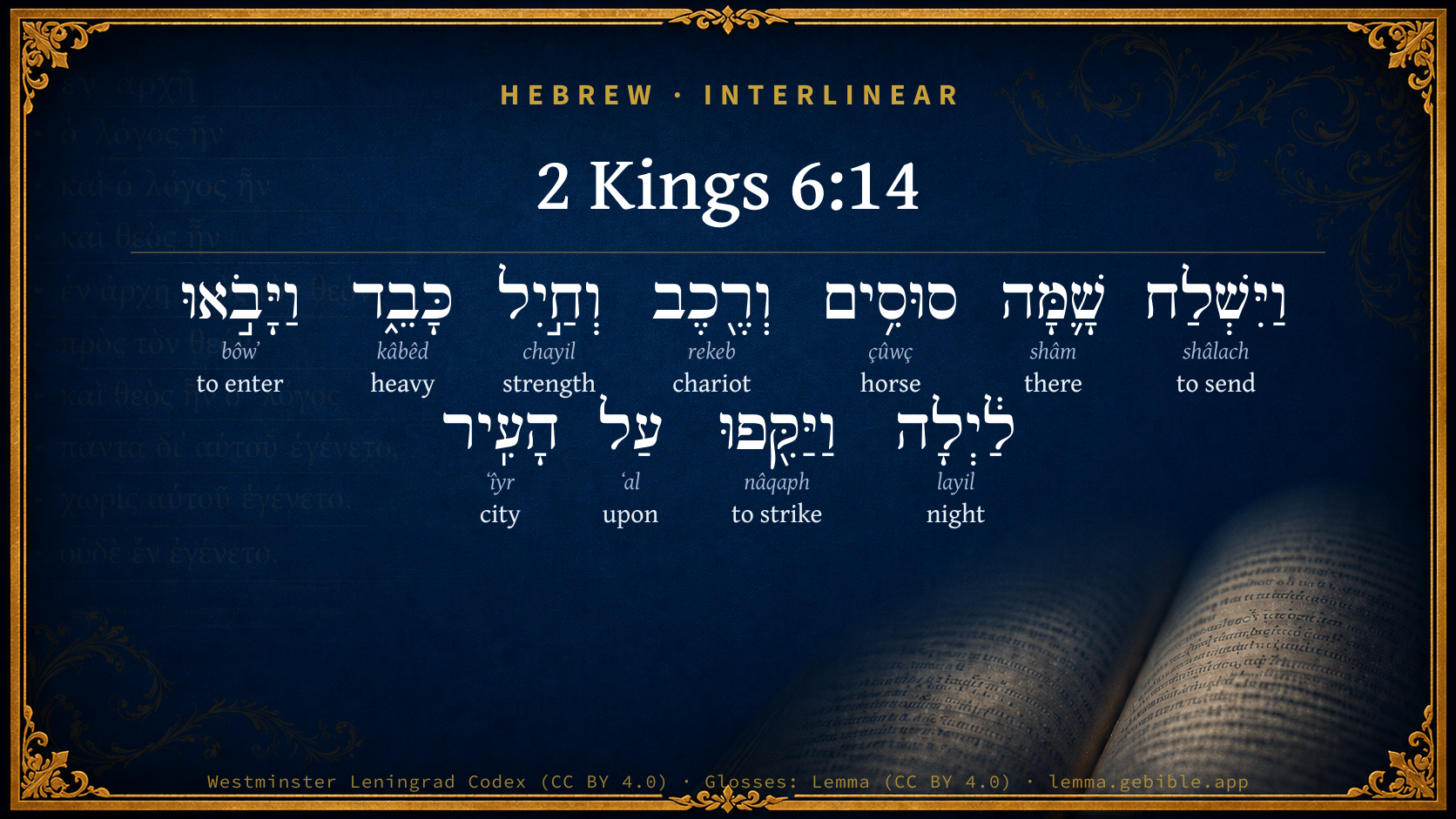
Hebrew (Westminster Leningrad Codex) 2 Kings 6:14 appears in the Hebrew Old Testament. The text above is from the Westminster Leningrad Codex. Each word links to its Strong’s number, a concise gloss, and parsing drawn from the Open Scriptures Hebrew Bible morphology. Click any word for its full Brown-Driver-Briggs (BDB) entry.
Download image
Cite this verse

2 Kings 6:14 (World English Bible). Public Domain. Lemma interlinear Bible study tool, https://lemma.gebible.app/v/2-kings/6/14.

Show BibTeX & RIS
BibTeX
RIS
English Translation
Therefore sent he there horses, and chariots, and a great host: and they came by night, and surrounded the city.
World English Bible · Public Domain
Download a study sheet

One document with this verse’s original text, its word-by-word gloss line, the meaning frame, cross-references with their text, attributed commentary, and full source and license credits — printable, and it pastes into notes with its structure intact.

This verse Autodidact and up

Study sheet (.html) Plain text (.txt)

A passage Seminary Student

Up to 50 verses in one chapter. A passage sheet keeps up to 6 commentary sources and 12 cross-references per verse, in the order this page ranks them, and says so on the sheet whenever that leaves anything out. Ask for a single verse and you get the Autodidact verse sheet above.

Everything on this page stays free to read, with no account — the sheet is a download of what is already on screen, not access to it.

Want to remove ads? Support Godless Engineer
Compare translations 3

The same verse in 3 English versions, stacked beneath the original-language interlinear above. Click any original word for its lexicon entry.

Each is an independent rendering of the whole verse — the interlinear is not word-aligned to these translations.

Highlighted words mark where these versions differ — a whole-verse word diff, not a word-by-word alignment.

  • World English Bible Public Domain
    Therefore sent he there horses, and chariots, and a great host: and they came by night, and surrounded the city.
  • King James Version Public Domain
    Therefore sent he thither horses, and chariots, and a great host: and they came by night, and compassed the city about.
  • unfoldingWord Literal Text CC BY-SA 4.0
    And he sent horses and chariotry and a heavy army to there, and they came night, and they surrounded around the city.

unfoldingWord Literal Text — © unfoldingWord, licensed CC BY-SA 4.0. Word-aligned USFM3 via Door43 (git.door43.org/unfoldingWord/en_ult).

Versions to compare (up to 4)

3 of 4 selected

Show all 18 translations

Every available English version of this verse, each an independent rendering of the whole verse.

  • World English Bible Public Domain
    Therefore sent he there horses, and chariots, and a great host: and they came by night, and surrounded the city.
  • Berean Standard Bible Public Domain
    the king of Aram sent horses, chariots, and a great army. They went there by night and surrounded the city.
  • Majority Standard Bible Public Domain
    the king of Aram sent horses, chariots, and a great army. They went there by night and surrounded the city.
  • King James Version Public Domain
    Therefore sent he thither horses, and chariots, and a great host: and they came by night, and compassed the city about.
  • American Standard Version (1901) Public Domain
    Therefore sent he thither horses, and chariots, and a great host: and they came by night, and compassed the city about.
  • Revised Version (1885) Public Domain
    Therefore sent he thither horses, and chariots, and a great host: and they came by night, and compassed the city about.
  • Geneva Bible (1599) Public Domain
    So he sent thither horses, and charets, and a mightie hoste: and they came by night, and compassed the citie.
  • Douay-Rheims (1899) Public Domain
    Therefore he sent thither horses and chariots, and the strength of an army: and they came by night, and beset the city.
  • Young's Literal Translation Public Domain
    And he sendeth thither horses and chariot, and a heavy force, and they come in by night, and go round against the city.
  • Literal Standard Version CC BY-SA 4.0
    And he sends horses and chariot, and a heavy force there, and they come in by night, and go around against the city.
  • Unlocked Literal Bible CC BY-SA 4.0
    So the king sent to Dothan horses, chariots, and a large army. They came by night and surrounded the city.
  • unfoldingWord Literal Text CC BY-SA 4.0
    And he sent horses and chariotry and a heavy army to there, and they came night, and they surrounded around the city.
  • Darby Bible Public Domain
    And he sent thither horses and chariots, and a great host, and they came by night and surrounded the city.
  • World Messianic Bible Public Domain
    Therefore he sent horses, chariots, and a great army there. They came by night and surrounded the city.
  • Webster's Bible Public Domain
    Therefore he sent thither horses, and chariots, and a great host: and they came by night, and encompassed the city.
  • Free Bible Version CC BY-SA 4.0
    So he sent horses, chariots, and a large army. They came at night and surrounded the town.
  • Bible in Basic English Public Domain
    So he sent there horses and carriages and a great army; and they came by night, circling the town.
  • JPS Tanakh (1917) Public Domain
    Therefore sent he thither horses, and chariots, and a great host; and they came by night, and compassed the city about.

Literal Standard Version (2020), Covenant Press — licensed CC BY-SA 4.0. Text via the HelloAO Bible API (eBible.org). Unlocked Literal Bible (unfoldingWord) — licensed CC BY-SA 4.0. Text via the HelloAO Bible API (eBible.org). unfoldingWord Literal Text — © unfoldingWord, licensed CC BY-SA 4.0. Word-aligned USFM3 via Door43 (git.door43.org/unfoldingWord/en_ult). Free Bible Version, Dr. Jonathan Gallagher — licensed CC BY-SA 4.0. Text via the HelloAO Bible API (eBible.org).

Word by word

More ways to search: Search by grammar → Find every occurrence → Compare this word →

Practice this passage: Drill this verse → Learn its vocabulary →

וַיַּקִּ֖פוּ
nâqaph
H5362
“and · to strike”
Conjunction + Verb, Hiphil, Sequential Imperfect, 3rd Person, Masculine, Plural
Part of Speech
Conjunction + Verb
Stem
Hiphil
Form
Sequential Imperfect
Person
3rd Person
Gender
Masculine
Number
Plural
Full BDB Definition

Origin: a primitive root

TWOT: 1415 , 1416

to strike, strike off - (Piel) to strike off skin - to go around, compass, round - (Qal) to go around - (Hiphil) - to go around, surround, encompass, enclose - to make the round, complete the circuit - to make round, round off
  1. וַיִּשְׁלַח shâlach H7971 “and · to send” Conjunction + Verb, Qal, Sequential Imperfect, 3rd Person, Masculine, Singular
  2. שָׁ֛מָּה shâm H8033 “there · toward” Adverb + Suffix, Demonstrative
  3. סוּסִ֥ים çûwç H5483 “horses” Noun, Common, Masculine, Plural, Absolute
  4. וְרֶ֖כֶב rekeb H7393 “and · chariot” Conjunction + Noun, Common, Masculine, Singular, Absolute
  5. וְחַ֣יִל chayil H2428 “and · strength” Conjunction + Noun, Common, Masculine, Singular, Absolute
  6. כָּבֵ֑ד kâbêd H3515 “heavy” Adjective, Adjective, Masculine, Singular, Absolute
  7. וַיָּבֹ֣אוּ bôwʼ H935 “and · to enter” Conjunction + Verb, Qal, Sequential Imperfect, 3rd Person, Masculine, Plural
  8. לַ֔יְלָה layil H3915 “night” Noun, Common, Masculine, Singular, Absolute
  9. עַל ʻal H5921 “upon” Preposition
  10. הָעִֽיר ʻîyr H5892 “the · city” Particle, Definite Article + Noun, Common, Feminine, Singular, Absolute

About this verse

These counts appear in no published source. They are computed here, from the morphology-tagged text and Lemma’s own curated glosses. What Lemma adds →

11
words
11
distinct lemmas
Historical
section

Notable vocabulary

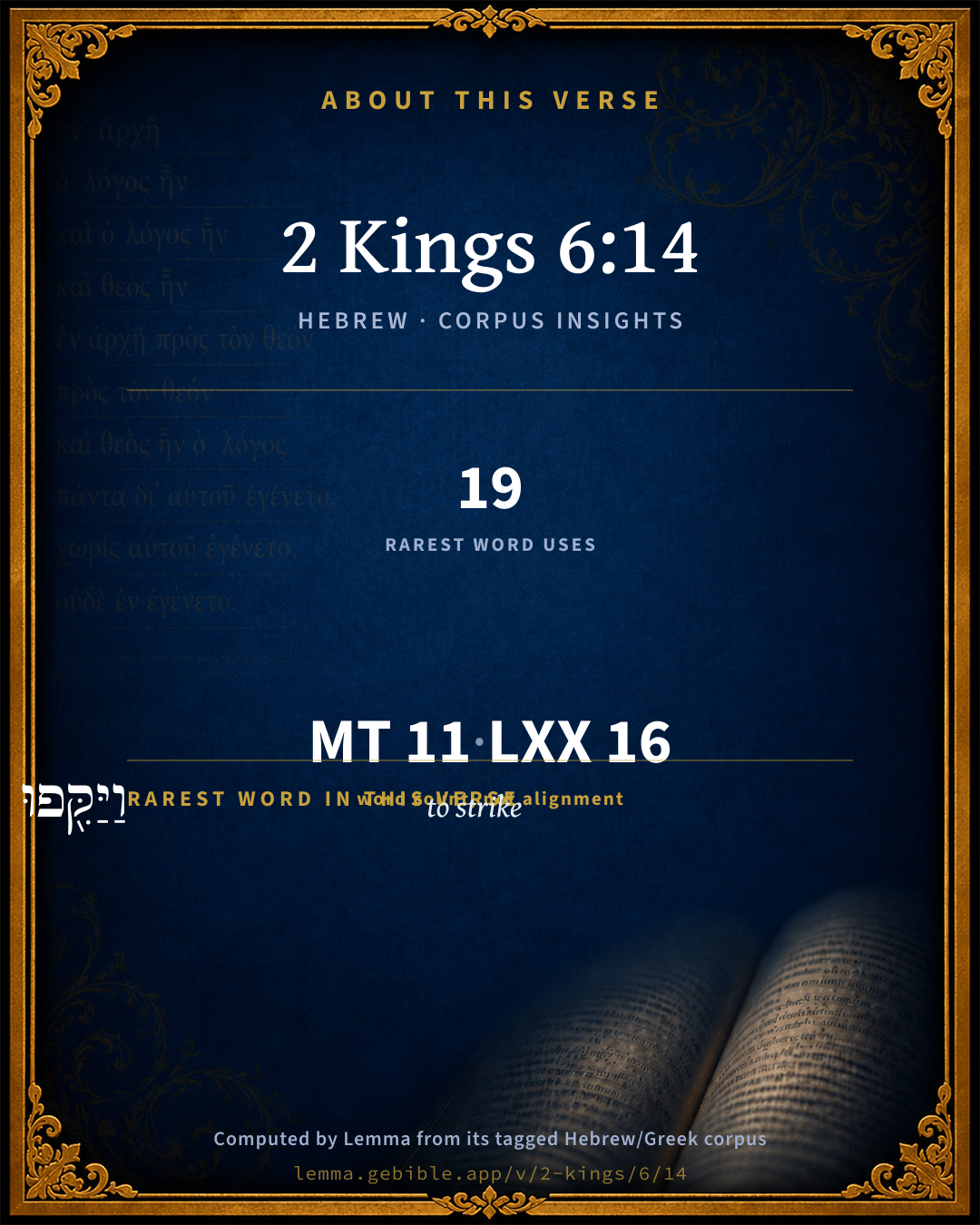
The rarest word here is וַיַּקִּ֖פוּ to strike H5362 — appearing just 19 times in the whole Hebrew Bible.

Shared distinctive vocabulary

וַיַּקִּ֖פוּ to strike H5362 occurs in 19 verses of the Hebrew Bible. Also found in:

Grammatical profile

  • 3 verbs
  • 5 nouns
  • 1 adjective
  • 1 preposition
  • 1 adverb

Verb forms

  • וַיִּשְׁלַח Qal · Sequential Imperfect
  • וַיָּבֹ֣אוּ Qal · Sequential Imperfect
  • וַיַּקִּ֖פוּ Hiphil · Sequential Imperfect

Hebrew & Septuagint length

In English translation the verse runs 20 words from the Hebrew and 21 from the Septuagint (LXX English) — closely comparable.

A rough comparison of the two English renderings, which tokenize alike — not a word-level alignment.

Word counts can differ between the Hebrew and the Greek without any difference in meaning — e.g. the Hebrew direct-object marker אֵת has no separate Greek word, and Greek often adds the article ὁ.

In the original languages it is 11 Hebrew tokens and 16 Greek tokens — but the two are counted differently (Hebrew bundles its prefixes and suffixes into one token; the Greek is in lemma form), so that isn’t a like-for-like length.

Cross-references

7

Topical passages linked to 2 Kings 6:14 in the Treasury of Scripture Knowledge — connected by theme and wording, ordered by reader-vote popularity; previews shown in the World English Bible.

  • 1 Samuel 23:26 Saul went on this side of the mountain, and David and his men on that side of the mountain: and David made haste to get away for fear of Saul; for Saul and his men compassed David and his men round about to take them.
  • 1 Samuel 24:2 Then Saul took three thousand chosen men out of all Israel, and went to seek David and his men on the rocks of the wild goats.
  • 2 Kings 18:17 The king of Assyria sent Tartan and Rabsaris and Rabshakeh from Lachish to king Hezekiah with a great army to Jerusalem. They went up and came to Jerusalem. When they were come up, they came and stood by the conduit of the upper pool, which is in the highway of the fuller's field.
  • Matthew 26:47 While he was still speaking, behold, Judas, one of the twelve, came, and with him a great multitude with swords and clubs, from the chief priest and elders of the people.
  • Matthew 26:55 In that hour Jesus said to the multitudes, "Have you come out as against a robber with swords and clubs to seize me? I sat daily in the temple teaching, and you didn't arrest me.
  • John 18:3–6 Judas then, having taken a detachment of soldiers and officers from the chief priests and the Pharisees, came there with lanterns, torches, and weapons.
  • 2 Kings 1:9–13 Then [the king] sent to him a captain of fifty with his fifty. He went up to him: and, behold, he was sitting on the top of the hill. He spoke to him, man of God, the king has said, Come down.

Cross-references courtesy of OpenBible.info (CC BY 4.0).

Hebrew and Greek witnesses Masoretic Hebrew ↔ Greek Septuagint

The same verse in the two great witnesses to the Old Testament, shown verse-for-verse.

These are two independent witnesses, not word-aligned to each other, and the Septuagint is shown in lemma (dictionary) form.

Hebrew 2 Kings 6:14 Masoretic · Westminster Leningrad Codex

וַיִּשְׁלַח שָׁ֛מָּה סוּסִ֥ים וְרֶ֖כֶב וְחַ֣יִל כָּבֵ֑ד וַיָּבֹ֣אוּ לַ֔יְלָה וַיַּקִּ֖פוּ עַל הָעִֽיר

Therefore sent he there horses, and chariots, and a great host: and they came by night, and surrounded the city.

World English Bible · Public Domain

Greek LXX 2 Kings 6:14 Septuagint · lemma form

καί ἀποστέλλω ἐκεῖ ἵππος καί ἅρμα καί δύναμις βαρύς καί ἔρχομαι νύξ καί περικυκλόω ὁ πόλις

And he sent there horses, and chariots, and a mighty host: and they came by night, and compassed about the city.

LXX2012 (modern English Septuagint) · Public Domain

Hebrew: Westminster Leningrad Codex (CC BY 4.0). Greek: Septuagint (public domain); English from LXX2012 (modern English Septuagint) (Public Domain). How the Septuagint differs from the Hebrew →

Targum (Aramaic paraphrase)

1

The Targum is the ancient Jewish Aramaic paraphrase of the Hebrew Scriptures — an interpretive translation, not the Hebrew text itself. Onkelos (literal) and Pseudo-Jonathan (expansive) render the Torah, and Jonathan the Prophets. Coverage is partial: where no permissively-licensed English translation exists for a verse, only the Aramaic is shown. This is verse-level text, not a word-by-word alignment to the Hebrew.

  1. Targum Jonathan Prophets (Joshua–Malachi)
    וּשְׁלַח תַּמָן סוּסְוָן וּרְתִיכִין וּמַשִׁרְיַן סַגִיאִין וַאֲתוֹ בְלֵילְיָא וַאֲקִיפוּ עַל קַרְתָּא:

    (no public-domain English translation for this verse)

    Targum Jonathan — Aramaic: “Mikraot Gedolot” (public domain). English: “Sefaria Community Translation” (CC0 1.0 (public-domain dedication)); “London "Chaldee Paraphrase," 1871” (public domain). Text via Sefaria.

Commentary

Notes on 2 Kings 6:14 from classic Christian and Jewish commentators (each source and its license shown beneath its notes). The classic Christian expositions comment on the surrounding passage and are grouped to its opening verse, so a note may address several verses; the Jewish commentaries on the Tanakh (Rashi and others) are per-verse, so they appear only where the commentator wrote on this verse.

Lemma curates 59 commentaries, every one of them public domain or Creative Commons licensed, each selected and text-cleaned for this edition rather than reprinted as found. About our sources →

Trapp's Complete Commentary

John Trapp

2Ki 6:14 Therefore sent he thither horses, and chariots, and a great host: and they came by night, and compassed the city about.

Ver. 14. Therefore sent he thither horses, and chariots.] To wage war with God himself, whose power he must needs behold in this his prophet; and yet fears not, giant-like, to oppose it. See the like done by Ahaziah, {2Ki 1:1-17} and know, that as there were many Marii in one Caesar, so there are many Benhadads and Ahaziahs in the best by nature. We are all Theomachi, fighters against God.

John Trapp, A Commentary or Exposition upon All the Books of the Old and New Testament (1647–1656) — public domain. Text from a community e-Sword module.

Geneva Bible (1599)

Geneva Bible translators

Though it had been nothing in man’s judgment to have taken Elisha, yet the wicked ever doubt, and think they are never able to prepare power enough, though it be but against one or a few.

Geneva Bible (1599) marginal notes — public domain. Text via Bolls.life.

Adam Clarke's Commentary

Verse 14. He sent thither horses] It is strange he did not think that he who could penetrate his secrets with respect to the Israelitish army, could inform himself of all his machinations against his own life.

Adam Clarke's Commentary on the Bible (1810–1826) — public domain. Text from a community e-Sword/MySword module.

Ellicott's Commentary for English Readers

(14) A great host.—Of infantry. Not, however, an army but a company. (See 2Ki_6:23.)

They came by night.—So as to take the city by surprise.

A Bible Commentary for English Readers, edited by Charles John Ellicott (1878–1897) — public domain. Text from a community e-Sword module.

The Cambridge Bible for Schools and Colleges

gen. ed. J. J. S. Perowne

14. a great host] Greatness is comparative. Here was a company such as could be led by Elisha to Samaria, and fed easily when they reached that city. But no doubt they were formidable when employed for the capture of a single man of peace like Elisha, and they had taken up their position by night.

compassed the city about] i.e. beset all the gates, so that none could escape without their knowledge.

The Cambridge Bible for Schools and Colleges (gen. ed. J. J. S. Perowne; Cambridge University Press, 1878–1918) — public domain. Text from a community e-Sword module.

John Gill's Exposition

And when the servant of the man of God was risen early, and gone forth,.... Either out of his master's house, or out of the city upon some business to be done early in the morning; this was not Gehazi, but a new servant:

behold, an host compassed the city, both with horses and chariots; which he could see at the door of his master's house, the city being built upon an eminence; or which he perceived, as soon as he came out of the gates of the city, or was about so to do:

and his servant said unto him; Elisha being with him; or else he returned to his master on the sight of such an army, and not being able to go forward:

alas, my master! how shall we do? to get out of the city, and through this host, and proceed on our intended journey; and if he understood that the intention of this formidable host was to take his master, his concern might be the greater; and the more as he was a new servant, and not so well acquainted with his master's being possessed of a power of doing miracles.

John Gill's Exposition of the Whole Bible (1746–1763) — public domain (CC PDM 1.0). Text via the HelloAO Bible API.

Haydock's Catholic Bible Commentary

Of an, or, "of the army." To take one man was judged of such consequence; and Benadad feared lest the Israelites should rise up in his defence. (Haydock)

George Leo Haydock (1774–1849), Haydock's Catholic Family Bible and Commentary, 1859 edition — public domain. Excludes Psalms (Douay-Rheims chapter numbering differs from Protestant) and Deuterocanonical books (Catholic canon only).

The Pulpit Commentary

Therefore sent he thither horses, and chariots, and a great host; rather, and a strong force. The expression, dbeK; lyij, is used by the historical writers with a good deal of vagueness-sometimes of a really great army, sometimes merely of a large retinue (1Ki_10:2) or of a moderate force. (2Ki_18:17) We must assign it its meaning according to the context. And they came by night, and compassed the city about. A night march was made, to take the prophet by surprise, and the city was encompassed, that it might be impossible for him to escape.

The Pulpit Commentary (1880–1919), ed. H.D.M. Spence-Jones & Joseph S. Exell — public domain. Text from a community e-Sword module.

unfoldingWord translationNotes

Door43 World Missions Community

So the king

This refers to the king of Aram.

the man of God

"Elisha" or "Elisha the man of God"

behold

The word "behold" here shows that the servant was surprised by what he saw.

had risen early and gone outside, behold

"got up early in the morning and went outside, and he saw"

His servant said to him

The servant went back inside the house to tell Elisha what he had seen. AT: "The servant went back inside and said to Elisha" (See: Assumed Knowledge and Implicit Information)

those who are with us are more than those who are with them

"To be with someone" in battle means to fight for their side. AT: "those who are on our side in the battle are more than those who are on their side" (See: Idiom)

translationWords

king

horse

chariot

fear

unfoldingWord translationNotes — © Distant Shores Media and the Door43 World Missions Community, licensed CC BY-SA 4.0. Source: git.door43.org/Door43/en_tn.

Lesson kit

Teaching starters — assembled from the data on this page, not authored interpretation. Every prompt links to the verse data it draws on. Edit before teaching.

2 Kings, in the Historical, opens this verse with 11 words (11 distinct Hebrew lemmas). Its most distinctive word is nâqaph (“to strike”). A historical commentator’s framing appears above. Read the whole chapter for the surrounding context.

Discussion questions

  1. What does “to strike” (nâqaph) contribute to the verse as a whole?
  2. How does Leviticus 19:27, which shares the word «to strike», read alongside this verse?
  3. These translations render this verse differently. What is at stake in choosing one wording over another?
  4. «וַיִּשְׁלַח» is a Qal Sequential Imperfect verb. How does that grammatical form shape the action described?
  5. Compare how Trapp's Complete Commentary and Geneva Bible (1599) read this verse. Where do they agree or differ?

Things to notice

Reading settings

Reading text

Shown beneath each verse's original-language words.

Old Testament
Old Testament edition

Read the OT as the Masoretic Hebrew (MT) or the Greek Septuagint (LXX).

English shown for the Greek Septuagint (in the Hebrew ↔ Greek comparison).

Comparing translations? Open the Compare panel on any verse page to stack up to four side by side.