
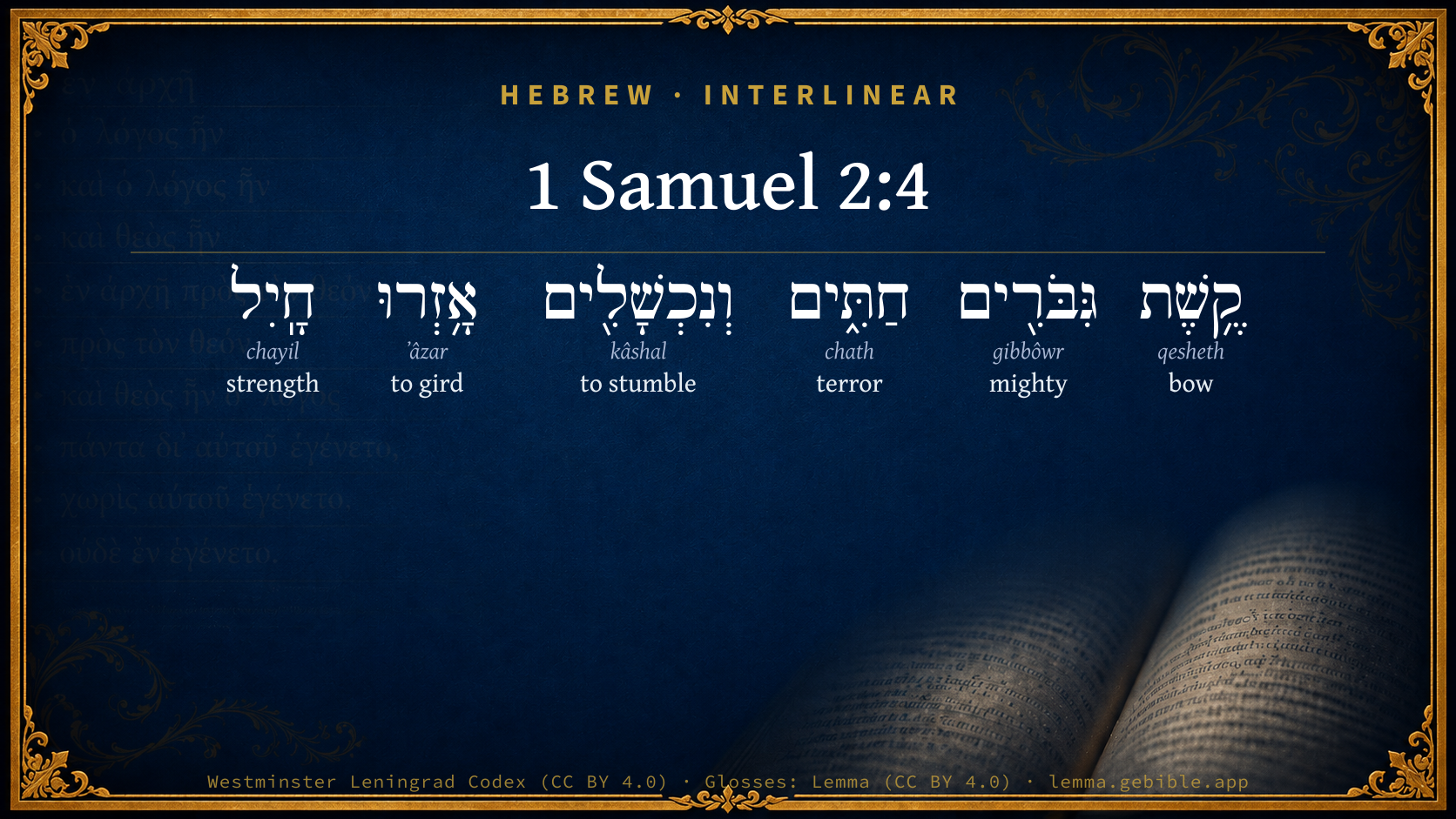
1 Samuel 2:4

Hebrew (Westminster Leningrad Codex) 1 Samuel 2:4 appears in the Hebrew Old Testament. The text above is from the Westminster Leningrad Codex. Each word links to its Strong’s number, a concise gloss, and parsing drawn from the Open Scriptures Hebrew Bible morphology. Click any word for its full Brown-Driver-Briggs (BDB) entry.
Download image
Cite this verse

1 Samuel 2:4 (World English Bible). Public Domain. Lemma interlinear Bible study tool, https://lemma.gebible.app/v/1-samuel/2/4.

Show BibTeX & RIS
BibTeX
RIS
English Translation
The bows of the mighty men are broken; Those who stumbled are girded with strength.
World English Bible · Public Domain
Highlights
  • 1 first appearance in the Hebrew Bible
Full analysis ↓
Download a study sheet

One document with this verse’s original text, its word-by-word gloss line, the meaning frame, cross-references with their text, attributed commentary, and full source and license credits — printable, and it pastes into notes with its structure intact.

This verse Autodidact and up

Study sheet (.html) Plain text (.txt)

A passage Seminary Student

Up to 50 verses in one chapter. A passage sheet keeps up to 6 commentary sources and 12 cross-references per verse, in the order this page ranks them, and says so on the sheet whenever that leaves anything out. Ask for a single verse and you get the Autodidact verse sheet above.

Everything on this page stays free to read, with no account — the sheet is a download of what is already on screen, not access to it.

Want to remove ads? Support Godless Engineer
Compare translations 3

The same verse in 3 English versions, stacked beneath the original-language interlinear above. Click any original word for its lexicon entry.

Each is an independent rendering of the whole verse — the interlinear is not word-aligned to these translations.

Highlighted words mark where these versions differ — a whole-verse word diff, not a word-by-word alignment.

  • World English Bible Public Domain
    The bows of the mighty men are broken; Those who stumbled are girded with strength.
  • King James Version Public Domain
    The bows of the mighty men are broken, and they that stumbled are girded with strength.
  • unfoldingWord Literal Text CC BY-SA 4.0
    The bow of the mighty are broken, but the stumbling ones gird on strength.

unfoldingWord Literal Text — © unfoldingWord, licensed CC BY-SA 4.0. Word-aligned USFM3 via Door43 (git.door43.org/unfoldingWord/en_ult).

Versions to compare (up to 4)

3 of 4 selected

Show all 18 translations

Every available English version of this verse, each an independent rendering of the whole verse.

  • World English Bible Public Domain
    The bows of the mighty men are broken; Those who stumbled are girded with strength.
  • Berean Standard Bible Public Domain
    The bows of the mighty are broken, but the feeble are equipped with strength.
  • Majority Standard Bible Public Domain
    The bows of the mighty are broken, but the feeble are equipped with strength.
  • King James Version Public Domain
    The bows of the mighty men are broken, and they that stumbled are girded with strength.
  • American Standard Version (1901) Public Domain
    The bows of the mighty men are broken; And they that stumbled are girded with strength.
  • Revised Version (1885) Public Domain
    The bows of the mighty men are broken, and they that stumbled are girded with strength.
  • Geneva Bible (1599) Public Domain
    The bow and the mightie men are broken, and the weake haue girded themselues with strength.
  • Douay-Rheims (1899) Public Domain
    The bow of the mighty is overcome, and the weak are girt with strength.
  • Young's Literal Translation Public Domain
    Bows of the mighty are broken, And the stumbling have girded on strength.
  • Literal Standard Version CC BY-SA 4.0
    Bows of the mighty are broken, || And the stumbling have girded on strength.
  • Unlocked Literal Bible CC BY-SA 4.0
    The bow of the mighty men are broken, but those who stumble put on strength like a belt.
  • unfoldingWord Literal Text CC BY-SA 4.0
    The bow of the mighty are broken, but the stumbling ones gird on strength.
  • Darby Bible Public Domain
    The bow of the mighty is broken, and they that stumbled are girded with strength.
  • World Messianic Bible Public Domain
    “The bows of the mighty men are broken. Those who stumbled are armed with strength.
  • Webster's Bible Public Domain
    The bows of the mighty men are broken, and they that stumbled are girded with strength.
  • Free Bible Version CC BY-SA 4.0
    The weapons of the powerful are shattered, while those who stumble along are made strong.
  • Bible in Basic English Public Domain
    The bows of the men of war are broken, and the feeble are clothed with strength.
  • JPS Tanakh (1917) Public Domain
    The bows of the mighty men are broken, and they that stumbled are girded with strength.

Literal Standard Version (2020), Covenant Press — licensed CC BY-SA 4.0. Text via the HelloAO Bible API (eBible.org). Unlocked Literal Bible (unfoldingWord) — licensed CC BY-SA 4.0. Text via the HelloAO Bible API (eBible.org). unfoldingWord Literal Text — © unfoldingWord, licensed CC BY-SA 4.0. Word-aligned USFM3 via Door43 (git.door43.org/unfoldingWord/en_ult). Free Bible Version, Dr. Jonathan Gallagher — licensed CC BY-SA 4.0. Text via the HelloAO Bible API (eBible.org).

Word by word

More ways to search: Search by grammar → Find every occurrence → Compare this word →

Practice this passage: Drill this verse → Learn its vocabulary →

About this verse

These counts appear in no published source. They are computed here, from the morphology-tagged text and Lemma’s own curated glosses. What Lemma adds →

6
words
6
distinct lemmas
Historical
section

Notable vocabulary

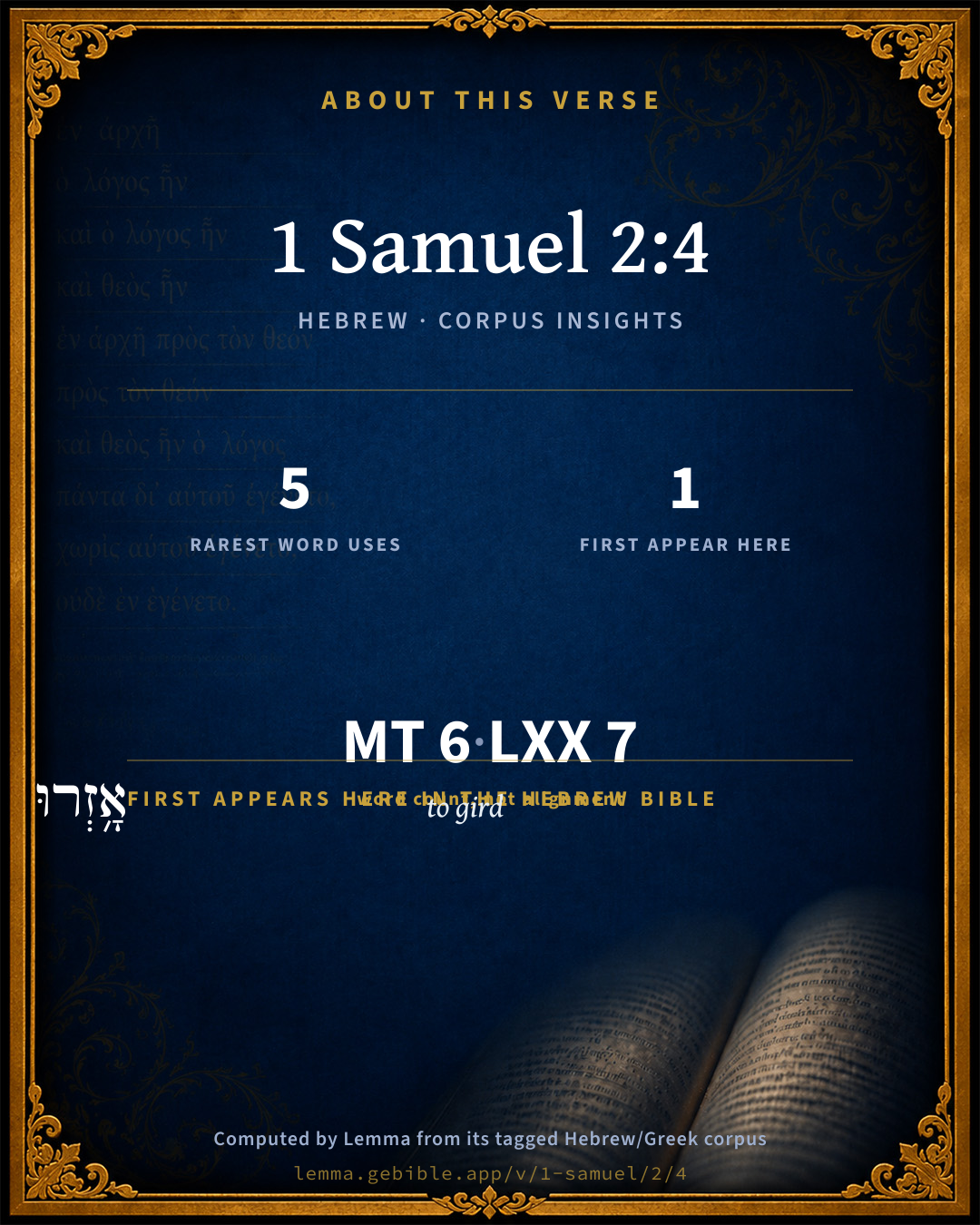
The rarest word here is חַתִּ֑ים terror H2844 — appearing just 5 times in the whole Hebrew Bible.

First appearance in Scripture

This word makes its first canonical appearance in the Hebrew Bible here:

  • אָ֥זְרוּ to gird H247

Shared distinctive vocabulary

חַתִּ֑ים terror H2844 occurs in 5 verses of the Hebrew Bible. Also found in:

Grammatical profile

  • 2 verbs
  • 2 nouns
  • 2 adjectives

Verb forms

  • וְנִכְשָׁלִ֖ים Niphal · Participle Active
  • אָ֥זְרוּ Qal · Perfect

Hebrew & Septuagint length

In English translation the verse runs 15 words from the Hebrew and 16 from the Septuagint (LXX English) — closely comparable.

A rough comparison of the two English renderings, which tokenize alike — not a word-level alignment.

Word counts can differ between the Hebrew and the Greek without any difference in meaning — e.g. the Hebrew direct-object marker אֵת has no separate Greek word, and Greek often adds the article ὁ.

In the original languages it is 6 Hebrew tokens and 7 Greek tokens — but the two are counted differently (Hebrew bundles its prefixes and suffixes into one token; the Greek is in lemma form), so that isn’t a like-for-like length.

Cross-references

11

Topical passages linked to 1 Samuel 2:4 in the Treasury of Scripture Knowledge — connected by theme and wording, ordered by reader-vote popularity; previews shown in the World English Bible.

  • Psalms 37:15 Their sword shall enter into their own heart. Their bows shall be broken.
  • Psalms 76:3 There he broke the flaming arrows of the bow, The shield, and the sword, and the weapons of war. Selah.
  • Psalms 46:9 He makes wars cease to the end of the earth. He breaks the bow, and shatters the spear. He burns the chariots in the fire.
  • Philippians 4:13 I can do all things through Christ, who strengthens me.
  • Psalms 37:17 For the arms of the wicked shall be broken, But Yahweh upholds the righteous.
  • Isaiah 10:4 They shall only bow down under the prisoners, and shall fall under the slain. For all this his anger is not turned away, but his hand is stretched out still.
  • 2 Corinthians 12:9 He has said to me, "My grace is sufficient for you, for my power is made perfect in weakness." Most gladly therefore I will rather glory in my weaknesses, that the power of Christ may rest on me.
  • Hebrews 11:34 quenched the power of fire, escaped the edge of the sword, from weakness were made strong, grew mighty in war, and turned to flight armies of aliens.
  • Jeremiah 37:10 For though you had struck the whole army of the Chaldeans who fight against you, and there remained but wounded men among them, yes would they rise up every man in his tent, and burn this city with fire.
  • 2 Corinthians 4:9–10 pursued, yet not forsaken; struck down, yet not destroyed;
  • Ephesians 6:14 Stand therefore, having the utility belt of truth buckled around your waist, and having put on the breastplate of righteousness,

Cross-references courtesy of OpenBible.info (CC BY 4.0).

Hebrew and Greek witnesses Masoretic Hebrew ↔ Greek Septuagint

The same verse in the two great witnesses to the Old Testament, shown verse-for-verse.

These are two independent witnesses, not word-aligned to each other, and the Septuagint is shown in lemma (dictionary) form.

Hebrew 1 Samuel 2:4 Masoretic · Westminster Leningrad Codex

קֶ֥שֶׁת גִּבֹּרִ֖ים חַתִּ֑ים וְנִכְשָׁלִ֖ים אָ֥זְרוּ חָֽיִל

The bows of the mighty men are broken; Those who stumbled are girded with strength.

World English Bible · Public Domain

Greek LXX 1 Samuel 2:4 Septuagint · lemma form

τόξον δυνατός ἀσθενέω καί ἀσθενέω περιζώννυμι δύναμις

The bow of the mighty has waxed feeble, and the weak have girded themselves with strength.

LXX2012 (modern English Septuagint) · Public Domain

On this verse, Haydock's Catholic Bible Commentary discusses the Septuagint’s reading. Read the note in Commentary ↓

Hebrew: Westminster Leningrad Codex (CC BY 4.0). Greek: Septuagint (public domain); English from LXX2012 (modern English Septuagint) (Public Domain). How the Septuagint differs from the Hebrew →

Targum (Aramaic paraphrase)

1

The Targum is the ancient Jewish Aramaic paraphrase of the Hebrew Scriptures — an interpretive translation, not the Hebrew text itself. Onkelos (literal) and Pseudo-Jonathan (expansive) render the Torah, and Jonathan the Prophets. Coverage is partial: where no permissively-licensed English translation exists for a verse, only the Aramaic is shown. This is verse-level text, not a word-by-word alignment to the Hebrew.

  1. Targum Jonathan Prophets (Joshua–Malachi)
    עַל מַלְכוּת מַקְדוֹן אִתְנַבִּיאַת וַאֲמַרַת קַשְׁתַּת דְגִבָּרֵי מִקְדוּנָאֵי יִתַּבְּרִין וּדְבֵית חַשְׁמוֹנָאֵי דַהֲווֹ חַלָשִׁין יִתְעַבְּדָן לְהוֹן נִסִין וּגְבוּרָן:

    (no public-domain English translation for this verse)

    Targum Jonathan — Aramaic: “Mikraot Gedolot” (public domain). English: “Sefaria Community Translation” (CC0 1.0 (public-domain dedication)); “London "Chaldee Paraphrase," 1871” (public domain). Text via Sefaria.

Commentary

Notes on 1 Samuel 2:4 from classic Christian and Jewish commentators (each source and its license shown beneath its notes). The classic Christian expositions comment on the surrounding passage and are grouped to its opening verse, so a note may address several verses; the Jewish commentaries on the Tanakh (Rashi and others) are per-verse, so they appear only where the commentator wrote on this verse.

Lemma curates 59 commentaries, every one of them public domain or Creative Commons licensed, each selected and text-cleaned for this edition rather than reprinted as found. About our sources →

Trapp's Complete Commentary

John Trapp

1Sa 2:4 The bows of the mighty men [are] broken, and they that stumbled are girded with strength.

Ver. 4. The bows of the mighty men are broken,] i.e., The bows of Peninnah and her children, who did shoot reproachful words at Hannah. Some gather hence that Peninnah bore no more children, but lost those she had, as 1Sa 2:5.

They that stumbled.] To the same sense singeth the holy Virgin in Luk 1:46-55

John Trapp, A Commentary or Exposition upon All the Books of the Old and New Testament (1647–1656) — public domain. Text from a community e-Sword module.

Joseph Benson's Commentary

1Sa 2:4. The bows of the mighty are broken — The strength of which they boasted. They that stumbled — Or, were weak and feeble. The great sense she had of God’s power, branches out itself into an humble acknowledgment of this glorious attribute, in divers instances. And, first, in vanquishing the most victorious; for bows were a principal part of warriors’ weapons, Psa 44:6; and their girdles, being an important part of the military habit, are elegantly interpreted to signify strength and warlike prowess.

Joseph Benson's Commentary on the Old and New Testaments (1811–1818) — public domain. Text from a community e-Sword module.

Tyndale Open Study Notes

Tyndale Open Resources

2:4-8 Hannah celebrated God’s sovereign ability to radically reverse human circumstances.

Tyndale Open Study Notes — © Tyndale Open Resources, licensed CC BY-SA 4.0. Text via the HelloAO Bible API.

Adam Clarke's Commentary

Verse 4. The bows of the mighty] The Targum considers the first verse as including a prophecy against the Philistines; the second verse, against Sennacherib and his army; the third, against Nebuchadnezzar and the Chaldeans; the fourth, against the Greeks; the fifth, against Haman and his posterity; and the tenth, against Magog, and the enemies of the Messiah.

Adam Clarke's Commentary on the Bible (1810–1826) — public domain. Text from a community e-Sword/MySword module.

Ellicott's Commentary for English Readers

(4) The bows of the mighty men are broken.—God reverses human conditions, bringing low the wicked, and raising up the righteous.

Von Gerlach writes of these verses that “Every power which will be something in itself is destroyed by the Lord: every weakness which despairs of itself is transformed into power.” “The bows of the heroes,” that is to say, the heroes of the bow, the symbol of human power being poetically put first instead of the bearer of the symbol. The next line contains the antithesis: while the heroes rejoicing in their strength are shattered, the tottering, powerless ones are by Him made strong for battle.

A Bible Commentary for English Readers, edited by Charles John Ellicott (1878–1897) — public domain. Text from a community e-Sword module.

The Cambridge Bible for Schools and Colleges

gen. ed. J. J. S. Perowne

4. The bows of the mighty men are broken, &c.] The bow was one of the chief weapons of war (2Sa_1:22). Its being broken is a natural symbol of defeat. “To be girded with strength” (Psa_18:39) is a figure derived from the practice of “girding up the loins” in preparation for active exertion.

4, 5. This knowledge and justice apportion to all their due, and reverse conditions of life contrary to all expectation. Sennacherib’s host is annihilated: Gideon’s handful triumphs.

The Cambridge Bible for Schools and Colleges (gen. ed. J. J. S. Perowne; Cambridge University Press, 1878–1918) — public domain. Text from a community e-Sword module.

John Gill's Exposition

The bows of the mighty men are broken,.... Hannah, from relating gracious experiences, and celebrating, the divine perfections of holiness, omniscience, and sovereignty, passes on to take notice of the dealings of God with men in providence and grace; bows are here put for all military arms, which men of might and war make use of, and which God can easily break in pieces, and so make war to cease in the earth, and hinder warlike men from doing what they design and attempt; they are enfeebled and weakened by him, and their hands cannot perform their enterprises: so the bows of Satan, and his principalities and powers, are broken, and his fiery darts are quenched, and the people of the Lord enabled to stand against him, and wrestle with him and them, being strong in the Lord, and in the power of his might, as it follows:

and they that stumbled are girt with strength; who, through weakness, are ready to stumble at everything they meet with in the way; yet, being girded with strength by the Lord, are able to do great exploits, as David did, that being his case, Psa 18:29, so such as are weak in grace, in faith, in knowledge, and ready to stumble at every trial and exercise, let it come from what quarter it will; yet being girded by the Lord with strength, are able to exercise grace, perform duty, go through every service they are called to, whether in a way of doing or suffering, to bear the yoke and cross of Christ, to oppose every enemy, to walk on in the ways of God, and to persevere in faith and holiness to the end.

John Gill's Exposition of the Whole Bible (1746–1763) — public domain (CC PDM 1.0). Text via the HelloAO Bible API.

Haydock's Catholic Bible Commentary

Overcome. Hebrew, "broken." Septuagint, "he has weakened the bow," having deprived it of its elasticity.

George Leo Haydock (1774–1849), Haydock's Catholic Family Bible and Commentary, 1859 edition — public domain. Excludes Psalms (Douay-Rheims chapter numbering differs from Protestant) and Deuterocanonical books (Catholic canon only).

Matthew Poole's English Annotations

This notes either,

1. The strength of which they boasted. See Psa 44:6; 46:9. Or,

2. Their malicious or mischievous designs. See Psa 7:12; 11:2; 37:14. Or,

3. Their virulent tongues, which are compared to

bows that shoot their arrows, even bitter words; as it is said Psa 64:3; compare Jer 9:3. Or,

4. Their procreating virtue, which may well be compared to a bow, both because it is called a man’s strength, Gen 49:3, and because children, which are the effects of it, and are as it were shot from that bow, are compared to arrows, Psa 127:4,5. And this seems best to agree with the following verse.

They that stumbled; or, were weak, or feeble, in body and spirit, that had no strength to conceive, which was once Sarah’s case, Heb 11:11; or to bring forth, which was Israel’s condition under Hezekiah, 2Ki 19:3.

Are girt with strength; are enabled both to conceive and to bring forth, as the church was, Isa 66:9.

Matthew Poole's English Annotations on the Holy Bible (1683–1685) — public domain. Text from a community e-Sword/MySword module.

Whedon's Commentary on the Bible

Daniel D. Whedon

4. Bow-heroes — Heroes armed with the bow. Hebrew, קשׁת גברים חתים, bow of heroes dismayed, the participle dismayed (חתים) agreeing (by attraction) with heroes, not bow. The Israelitish mind was familiar with the instruments and imagery of war, and when the devout Hannah sings the triumphs of her soul she naturally uses imagery like this.

Tottering ones — Those who are weary, feeble, faint, and just ready to fall, as Hannah was when the comforting words of the high priest (1Sa_1:17) inspired her with new strength. See note on 1Sa_1:23.

Daniel D. Whedon (gen. ed.), Commentary on the Old and New Testaments (1874–1909) — public domain. Text from a community e-Sword module.

John Wesley's Explanatory Notes

Bows - The strength of which they boasted. Stumbled - Or, were weak, or feeble, in body and spirit.

John Wesley, Explanatory Notes Upon the Whole Bible (1754–1765) — public domain. Text via the GEBible commentary corpus.

Rashi

Rabbi Shlomo Yitzchaki (Rashi)

The bows of the mighty are broken… This is the custom of the Holy One, Blessed is He. He weakens the mighty and strengthens the weak, He sates the hungry and starves the sated.

Rashi on the Tanakh — English translations: “The Judaica Press complete Tanach with Rashi, translated by A. J. Rosenberg” (CC BY 4.0); “Pentateuch with Rashi's commentary by M. Rosenbaum and A.M. Silbermann, 1929-1934” (public domain); “The Metsudah Tanach series, Lakewood, N.J” (CC BY 4.0); and “The Book of Joshua, Metsudah Publications, 1997” (CC BY 4.0). Text via Sefaria.

Radak

Rabbi David Kimhi (Radak)

The bow of the mighty ones are broken: The understanding of broken is that is referring to the mighty, not to the bow. For it would have [otherwise] have had to say, "is broken." And the explanation of broken is [that it is referring to both] them and their bows. And like this is (II Samuel 10:9), "the face of war was upon him" (face in Hebrew is plural and war is singular; "was," referring to war); (Job 29:10), "The voice of princes were hushed" ("were hushed," referring to princes); and the [cases] similar to them that we wrote in the Sefer Mikhlol.

Girded with strength: The strength and the power are girded.

Radak on the Tanakh — English translations: “Sefaria Community Translation” (CC0 1.0 (public-domain dedication)); “Eliyahu Munk, HaChut Hameshulash” (CC BY 4.0); “Rabbi Mike Feuer, Jerusalem Anthology” (CC BY 4.0); and “R. David Kimhi on the first book of Psalms, Translated by R.G. Finch, London, 1919” (public domain). Text via Sefaria.

Lesson kit

Teaching starters — assembled from the data on this page, not authored interpretation. Every prompt links to the verse data it draws on. Edit before teaching.

1 Samuel, in the Historical, opens this verse with 6 words (6 distinct Hebrew lemmas). Its most distinctive word is chath (“terror”). A historical commentator’s framing appears above. Read the whole chapter for the surrounding context.

Discussion questions

  1. How does “terror” (chath) shape what this verse is saying?
  2. The word “to gird” first appears here in Scripture. What is being introduced at this debut?
  3. Genesis 9:2 shares the word «terror» with this verse. How do the two illuminate each other?
  4. The translations on this page render this verse differently — a whole-verse word diff, not a word-by-word alignment. What might account for the different wordings?
  5. The verb «וְנִכְשָׁלִ֖ים» is Niphal Participle Active. How does its form color the action?
  6. Reading how Trapp's Complete Commentary and Joseph Benson's Commentary read this verse, where do the two commentators agree and where do they part?

Things to notice

Reading settings

Reading text

Shown beneath each verse's original-language words.

Old Testament
Old Testament edition

Read the OT as the Masoretic Hebrew (MT) or the Greek Septuagint (LXX).

English shown for the Greek Septuagint (in the Hebrew ↔ Greek comparison).

Comparing translations? Open the Compare panel on any verse page to stack up to four side by side.