Jeremiah 43:4

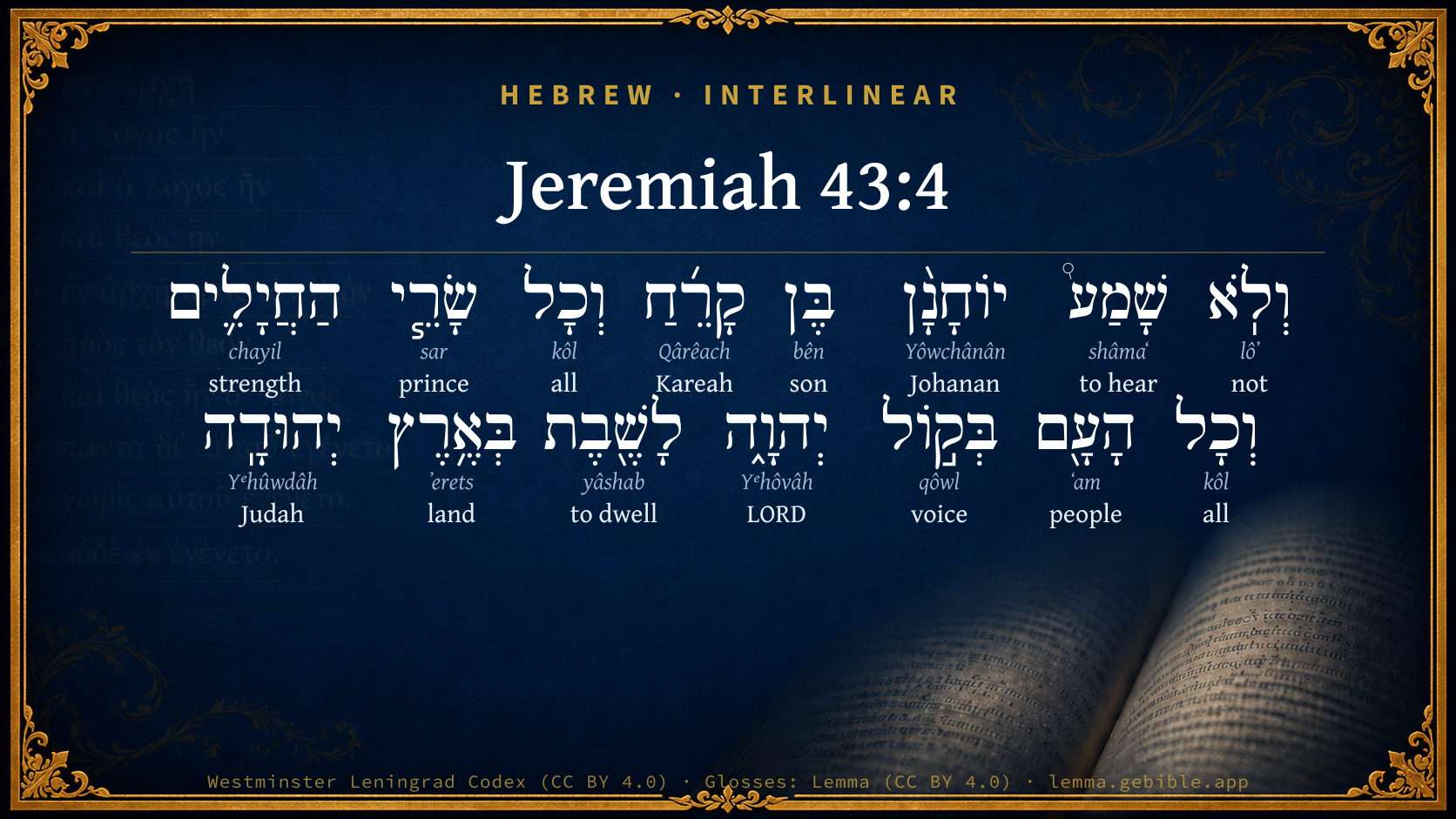
Hebrew (Westminster Leningrad Codex) Jeremiah 43:4 appears in the Hebrew Old Testament. The text above is from the Westminster Leningrad Codex. Each word links to its Strong’s number, a concise gloss, and parsing drawn from the Open Scriptures Hebrew Bible morphology. Click any word for its full Brown-Driver-Briggs (BDB) entry.
Download image
Cite this verse

Jeremiah 43:4 (World English Bible). Public Domain. Lemma interlinear Bible study tool, https://lemma.gebible.app/v/jeremiah/43/4.

Show BibTeX & RIS
BibTeX
RIS
English Translation
So Johanan the son of Kareah, and all the captains of the forces, and all the people, didn't obey the voice of Yahweh, to dwell in the land of Judah.
World English Bible · Public Domain
Download a study sheet

One document with this verse’s original text, its word-by-word gloss line, the meaning frame, cross-references with their text, attributed commentary, and full source and license credits — printable, and it pastes into notes with its structure intact.

This verse Autodidact and up

Study sheet (.html) Plain text (.txt)

A passage Seminary Student

Up to 50 verses in one chapter. A passage sheet keeps up to 6 commentary sources and 12 cross-references per verse, in the order this page ranks them, and says so on the sheet whenever that leaves anything out. Ask for a single verse and you get the Autodidact verse sheet above.

Everything on this page stays free to read, with no account — the sheet is a download of what is already on screen, not access to it.

Want to remove ads? Support Godless Engineer
Compare translations 3

The same verse in 3 English versions, stacked beneath the original-language interlinear above. Click any original word for its lexicon entry.

Each is an independent rendering of the whole verse — the interlinear is not word-aligned to these translations.

Highlighted words mark where these versions differ — a whole-verse word diff, not a word-by-word alignment.

  • World English Bible Public Domain
    So Johanan the son of Kareah, and all the captains of the forces, and all the people, didn't obey the voice of Yahweh, to dwell in the land of Judah.
  • King James Version Public Domain
    So Johanan the son of Kareah, and all the captains of the forces, and all the people, obeyed not the voice of the LORD, to dwell in the land of Judah.
  • unfoldingWord Literal Text CC BY-SA 4.0
    So Johanan son of Kareah, all the princes of the army, and all the people refused to listen to Yahweh’s voice to live in the land of Judah.

unfoldingWord Literal Text — © unfoldingWord, licensed CC BY-SA 4.0. Word-aligned USFM3 via Door43 (git.door43.org/unfoldingWord/en_ult).

Versions to compare (up to 4)

3 of 4 selected

Show all 18 translations

Every available English version of this verse, each an independent rendering of the whole verse.

  • World English Bible Public Domain
    So Johanan the son of Kareah, and all the captains of the forces, and all the people, didn't obey the voice of Yahweh, to dwell in the land of Judah.
  • Berean Standard Bible Public Domain
    So Johanan son of Kareah and all the commanders of the forces disobeyed the command of the LORD to stay in the land of Judah.
  • Majority Standard Bible Public Domain
    So Johanan son of Kareah and all the commanders of the forces disobeyed the command of the LORD to stay in the land of Judah.
  • King James Version Public Domain
    So Johanan the son of Kareah, and all the captains of the forces, and all the people, obeyed not the voice of the LORD, to dwell in the land of Judah.
  • American Standard Version (1901) Public Domain
    So Johanan the son of Kareah, and all the captains of the forces, and all the people, obeyed not the voice of Jehovah, to dwell in the land of Judah.
  • Revised Version (1885) Public Domain
    So Johanan the son of Kareah, and all the captains of the forces, and all the people, obeyed not the voice of the LORD, to dwell in the land of Judah.
  • Geneva Bible (1599) Public Domain
    So Iohanan the sonne of Kareah, and all the captaines of the hoste, and all the people obeied not the voyce of the Lord, to dwell in the lande of Iudah.
  • Douay-Rheims (1899) Public Domain
    So Johanan the son of Caree, and all the captains of the soldiers, and all the people, obeyed not the voice of the Lord, to remain in the land of Juda.
  • Young's Literal Translation Public Domain
    And Johanan son of Kareah, and all the heads of the forces, and all the people, have not hearkened to the voice of Jehovah, to dwell in the land of Judah;
  • Literal Standard Version CC BY-SA 4.0
    And Johanan son of Kareah, and all the heads of the forces, and all the people, have not listened to the voice of YHWH, to dwell in the land of Judah;
  • Unlocked Literal Bible CC BY-SA 4.0
    So Johanan son of Kareah, all the princes of the army, and all the people refused to listen to Yahweh's voice to live in the land of Judah.
  • unfoldingWord Literal Text CC BY-SA 4.0
    So Johanan son of Kareah, all the princes of the army, and all the people refused to listen to Yahweh’s voice to live in the land of Judah.
  • Darby Bible Public Domain
    So Johanan the son of Kareah, and all the captains of the forces, and all the people, hearkened not unto the voice of Jehovah to abide in the land of Judah;
  • World Messianic Bible Public Domain
    So Yochanan the son of Kareah, and all the captains of the forces, and all the people, didn’t obey the LORD’s voice, to dwell in the land of Judah.
  • Webster's Bible Public Domain
    So Johanan the son of Kareah, and all the captains of the forces, and all the people, obeyed not the voice of the LORD, to dwell in the land of Judah.
  • Free Bible Version CC BY-SA 4.0
    So Johanan son of Kareah and all the army commanders refused to obey the Lord's command to stay in the land of Judah.
  • Bible in Basic English Public Domain
    So Johanan, the son of Kareah, and all the captains of the forces, and all the people, did not give ear to the order of the Lord that they were to go on living in the land of Judah.
  • JPS Tanakh (1917) Public Domain
    So Johanan the son of Kareah, and all the captains of the forces, and all the people, hearkened not to the voice of the LORD, to dwell in the land of Judah.

Literal Standard Version (2020), Covenant Press — licensed CC BY-SA 4.0. Text via the HelloAO Bible API (eBible.org). Unlocked Literal Bible (unfoldingWord) — licensed CC BY-SA 4.0. Text via the HelloAO Bible API (eBible.org). unfoldingWord Literal Text — © unfoldingWord, licensed CC BY-SA 4.0. Word-aligned USFM3 via Door43 (git.door43.org/unfoldingWord/en_ult). Free Bible Version, Dr. Jonathan Gallagher — licensed CC BY-SA 4.0. Text via the HelloAO Bible API (eBible.org).

Word by word

More ways to search: Search by grammar → Find every occurrence → Compare this word →

Practice this passage: Drill this verse → Learn its vocabulary →

קָרֵ֜חַ
Qârêach
H7143
“Kareah”
Noun, Proper
Part of Speech
Noun
Type
Proper
Full BDB Definition

Origin: from H7139

TWOT: None

Kareah = "bald" - father of Johanan and Jonathan who supported Gedaliah's authority and avenged his murder
  1. וְלֹֽא lôʼ H3808 “and · not” Conjunction + Particle, Negative
  2. שָׁמַע֩ shâmaʻ H8085 “to hear” Verb, Qal, Perfect, 3rd Person, Masculine, Singular
  3. יוֹחָנָ֨ן Yôwchânân H3110 “Johanan” Noun, Proper
  4. בֶּן bên H1121 “son of” Noun, Common, Masculine, Singular, Construct
  5. וְכָל kôl H3605 “and · all of” Conjunction + Noun, Common, Masculine, Singular, Construct
  6. שָׂרֵ֧י sar H8269 “princes of” Noun, Common, Masculine, Plural, Construct
  7. הַחֲיָלִ֛ים chayil H2428 “the · forces” Particle, Definite Article + Noun, Common, Masculine, Plural, Absolute
  8. וְכָל kôl H3605 “and · all of” Conjunction + Noun, Common, Masculine, Singular, Construct
  9. הָעָ֖ם ʻam H5971 “the · people” Particle, Definite Article + Noun, Common, Masculine, Singular, Absolute
  10. בְּק֣וֹל qôwl H6963 “in/at · voice of” Preposition + Noun, Common, Masculine, Singular, Construct
  11. יְהוָ֑ה Yᵉhôvâh H3068 “LORD” Noun, Proper
  12. לָשֶׁ֖בֶת yâshab H3427 “to dwell” Preposition + Verb, Qal, Infinitive Construct
  13. בְּאֶ֥רֶץ ʼerets H776 “in/at · land of” Preposition + Noun, Common, Both, Singular, Construct
  14. יְהוּדָֽה Yᵉhûwdâh H3063 “Judah” Noun, Proper

About this verse

These counts appear in no published source. They are computed here, from the morphology-tagged text and Lemma’s own curated glosses. What Lemma adds →

15
words
14
distinct lemmas
Prophets
section

Notable vocabulary

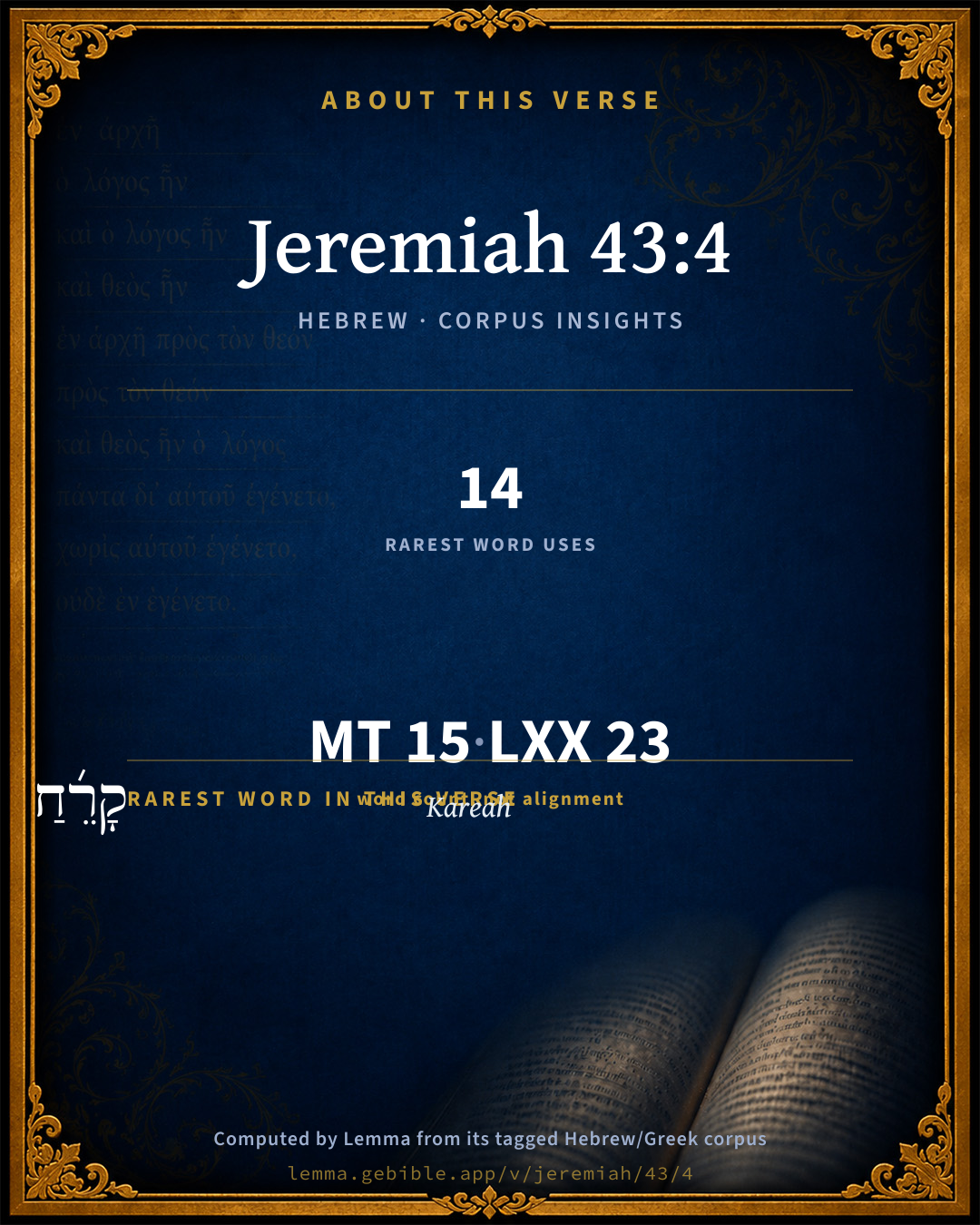
The rarest word here is קָרֵ֜חַ Kareah H7143 — appearing just 14 times in the whole Hebrew Bible.

Shared distinctive vocabulary

קָרֵ֜חַ Kareah H7143 occurs in 14 verses of the Hebrew Bible. Also found in:

Grammatical profile

  • 2 verbs
  • 12 nouns
  • 1 particle

Verb forms

  • שָׁמַע֩ Qal · Perfect
  • לָשֶׁ֖בֶת Qal · Infinitive Construct

Repetition

A word recurs within this verse — often emphatic in Hebrew:

  • וְכָל all H3605 ×2

Hebrew & Septuagint length

In the original languages it is 15 Hebrew tokens and 23 Greek tokens — but the two are counted differently (Hebrew bundles its prefixes and suffixes into one token; the Greek is in lemma form), so that isn’t a like-for-like length.

Cross-references

6

Topical passages linked to Jeremiah 43:4 in the Treasury of Scripture Knowledge — connected by theme and wording, ordered by reader-vote popularity; previews shown in the World English Bible.

  • Jeremiah 42:5–6 Then they said to Jeremiah, Yahweh be a true and faithful witness among us, if we don't do according to all the word with which Yahweh your God shall send you to us.
  • 2 Chronicles 25:16 It happened, as he talked with him, that [the king] said to him, Have we made you of the king's counsel? Stop! Why should you be struck down? Then the prophet stopped, and said, I know that God has determined to destroy you, because you have done this, and have not listened to my counsel.
  • Psalms 37:3 Trust in Yahweh, and do good. Dwell in the land, and enjoy safe pasture.
  • Jeremiah 44:5 But they didn't listen, nor inclined their ear to turn from their wickedness, to burn no incense to other gods.
  • Ecclesiastes 9:16 Then said I, Wisdom is better than strength. Nevertheless the poor man's wisdom is despised, and his words are not heard.
  • Jeremiah 42:10–13 If you will still abide in this land, then will I build you, and not pull you down, and I will plant you, and not pluck you up; for I repent me of the evil that I have done to you.

Cross-references courtesy of OpenBible.info (CC BY 4.0).

Hebrew and Greek witnesses Masoretic Hebrew ↔ Greek Septuagint

The same verse in the two great witnesses to the Old Testament, shown verse-for-verse.

These are two independent witnesses, not word-aligned to each other, and the Septuagint is shown in lemma (dictionary) form.

Hebrew Jeremiah 43:4 Masoretic · Westminster Leningrad Codex

וְלֹֽא שָׁמַע֩ יוֹחָנָ֨ן בֶּן קָרֵ֜חַ וְכָל שָׂרֵ֧י הַחֲיָלִ֛ים וְכָל הָעָ֖ם בְּק֣וֹל יְהוָ֑ה לָשֶׁ֖בֶת בְּאֶ֥רֶץ יְהוּדָֽה

So Johanan the son of Kareah, and all the captains of the forces, and all the people, didn't obey the voice of Yahweh, to dwell in the land of Judah.

World English Bible · Public Domain

Greek LXX Structure differs

In the Septuagint, Jeremiah is about an eighth shorter than the Hebrew and arranges its material differently — the Oracles Against the Nations (Hebrew chapters 46–51) appear in the middle of the Greek book, after 25:13. Because the chapter and verse boundaries do not line up, a verse-for-verse comparison with the Hebrew is not shown.

A verse-for-verse comparison isn’t shown here because the chapters and verses don’t line up. Switch to the LXX edition with the MT / LXX toggle above to read the Greek directly.

Hebrew: Westminster Leningrad Codex (CC BY 4.0). Greek: Septuagint (public domain); English from a public-domain English Septuagint. How the Septuagint differs from the Hebrew →

Targum (Aramaic paraphrase)

1

The Targum is the ancient Jewish Aramaic paraphrase of the Hebrew Scriptures — an interpretive translation, not the Hebrew text itself. Onkelos (literal) and Pseudo-Jonathan (expansive) render the Torah, and Jonathan the Prophets. Coverage is partial: where no permissively-licensed English translation exists for a verse, only the Aramaic is shown. This is verse-level text, not a word-by-word alignment to the Hebrew.

  1. Targum Jonathan Prophets (Joshua–Malachi)
    וְלָא קַבֵיל יוֹחָנָן בַּר קָרַחַ וְכָל רַבָּנֵי חֵילְוָתָא וְכָל עַמָא לְמֵימְרָא דַייָ לְמִתַּב בְּאַרְעָא דְבֵית יְהוּדָה:

    (no public-domain English translation for this verse)

    Targum Jonathan — Aramaic: “Mikraot Gedolot” (public domain). English: “Sefaria Community Translation” (CC0 1.0 (public-domain dedication)); “London "Chaldee Paraphrase," 1871” (public domain). Text via Sefaria.

Commentary

Notes on Jeremiah 43:4 from classic Christian and Jewish commentators (each source and its license shown beneath its notes). The classic Christian expositions comment on the surrounding passage and are grouped to its opening verse, so a note may address several verses; the Jewish commentaries on the Tanakh (Rashi and others) are per-verse, so they appear only where the commentator wrote on this verse.

Lemma curates 59 commentaries, every one of them public domain or Creative Commons licensed, each selected and text-cleaned for this edition rather than reprinted as found. About our sources →

Trapp's Complete Commentary

John Trapp

Jer 43:4 So Johanan the son of Kareah, and all the captains of the forces, and all the people, obeyed not the voice of the LORD, to dwell in the land of Judah.

Ver. 4. So Johanan the son of Kareah, &c.] Nothing is more audacious and desperate than a hypocrite when once discovered. Now these subdoli show themselves in their colours, appear in their likeness, going on end with their work.

John Trapp, A Commentary or Exposition upon All the Books of the Old and New Testament (1647–1656) — public domain. Text from a community e-Sword module.

Joseph Benson's Commentary

Jer 43:4-7. So Johanan and all the captains, &c., obeyed not, &c. — That is, they resolved not to obey the message God had sent them by Jeremiah; but took all the remnant of Judah that were returned, &c. — The resolution which they had formed they presently put in practice. Though Jeremiah and Baruch, and probably many of the people, were not willing to go along with them, yet these rebellious captains forced them to go; so that the prophet and his pious friends were now a kind of prisoners to their own countrymen. So they came into the land of Egypt — Their great inclination to go into Egypt arose, as has been intimated, from a supposition that they should be safer there from the Babylonians, who, they thought, might injure them at any time while they stayed in Judea; but would not venture to attack Egypt, on account of its strongly fortified cities, which commanded the passes into the country, and the various channels of the Nile, which were great obstructions to the march of an army. Thus they came even to Tahpanhes — One of the principal cities of Egypt, and a place of residence for their kings. The word is contracted to Hanes, Isa 30:4, and joined with Zoan, the chief city of the kingdom. Tahpanhes gave a name to a queen of Egypt, (1Ki 11:19,) and is supposed by many to be the same city which was afterward called Daphnæ Pelusiacæ. In this behaviour of the Jews we have an instance of great impiety joined to hypocrisy. They had promised with an oath to follow the advice of the prophet; but, because his counsel was not agreeable to their inclinations, they went down into Egypt, and even charged the prophet with speaking falsely in the name of the Lord. In these Jews we see a picture of those persons who, upon some occasions, express their zeal and good intentions, but reject the most wholesome counsels when those counsels thwart their passions, and are in opposition to what they have secretly purposed. With respect to Jeremiah, it may be observed, God suffered him to be carried to Egypt, that he might there denounce the ruin of the Egyptians as well as of the Jews, who had put their trust in them. Wherever the wicked are, the hand of God finds them out; and those who think, by disobeying him, to avoid the evils which they dread, and to that end make use of unlawful means, fall by those very means into the evils they expect to shun, and are confounded in their hope.

Joseph Benson's Commentary on the Old and New Testaments (1811–1818) — public domain. Text from a community e-Sword module.

John Calvin's Commentaries

The Prophet had sufficiently shewn that John the son of Kareah and the rest had not in good faith inquired of the Prophet what the will of God was; for when they saw that God’s counsel did not harmonize with their wicked and foolish desire, they rose up against the Prophet. But he now more clearly condemns their obstinacy in not obeying God; and it is said emphatically, that they did not obey the voice of God, because they denied that God had spoken. Though then they sought to evade, Jeremiah on the other hand declares, that he was a true interpreter of God’s will, that he had announced nothing but what had come from God. He then brings them all in as guilty, the leaders and the whole people, that no man might think it strange that innocent men, willing to submit to God, were driven into Egypt. Hence the Prophet shews here that they were all implicated in the same sin, since the leaders alone did not resist the oracle, but also the whole people. It now follows,

John Calvin's Commentaries (1540-1563) — public domain. Text from the Calvin Translation Society English edition (1840s-50s) via the Christian Classics Ethereal Library (ccel.org). Calvin's coverage is partial (roughly two-thirds of the Bible); uncommented books and verses are honest gaps, never fabricated. The 19th-century editor's footnotes and remarks are omitted so the notes are faithfully Calvin's own voice.

John Gill's Exposition

So Johanan the son of Kareah, and all the captains of the forces, and all the people,.... The generality of them, at least, all agreed together, were of the same mind, and in the same sentiment and practice: and so

obeyed not the voice of the Lord, to dwell in the land of Judah; it was the command of the Lord they should dwell there, and not go into Egypt; but they would not believe this was the voice of the Lord, only a scheme concerted between the prophet and Baruch; or which the former was instigated to deliver as the word of the Lord by the latter, and therefore would not give heed unto it; though the truth of the matter was, it was contrary to their inclination and resolution, and therefore, though they had reason to believe it was the will of God they should abide in their own land, yet they were determined they would not, but go into Egypt, as they, did.

John Gill's Exposition of the Whole Bible (1746–1763) — public domain (CC PDM 1.0). Text via the HelloAO Bible API.

Albert Barnes' Notes on the Bible

All the people - Many, nevertheless, would be unwilling agents, compelled to do what their unscrupulous leaders forced upon the community.

Albert Barnes' Notes on the Bible (1834–1885) — public domain. Text from a community e-Sword/MySword module.

Matthew Poole's English Annotations

That is, they resolved not to obey the message God had sent them by Jeremiah.

Matthew Poole's English Annotations on the Holy Bible (1683–1685) — public domain. Text from a community e-Sword/MySword module.

Keil & Delitzsch

C. F. Keil & F. Delitzsch

Thereupon Johanan and the other captains took "all the remnant of Judah, that had returned from all the nations whither they had been driven, to dwell in the land of Judah-the men and women and children, the king's daughters, and all the souls whom Nebuzaradan, chief of the body-guard, had committed to Gedaliah...and Jeremiah the prophet, and Baruch the son of Neriah, - and went to the land of Egypt - for they did not hearken to the voice of Jahveh - and came to Tahpanhes." In this enumeration of those who were conducted to Egypt, Hitzig, Graf, and others distinguish two classes: (1) the men, women, children, etc., who had been in Mizpah with Gedaliah, and had been led to Gibeon, after the murder of the latter, by Ishmael, but had afterwards been brought to Bethlehem by Johanan and the other captains (Jer 43:6, cf. Jer 40:7; Jer 41:10, Jer 41:16); (2) those who had returned from the foreign countries whither they had fled, but who had hitherto lived in the country, scattered here and there, and who must have joined the company led by Johanan to Bethlehem during the ten days of halt at that resting-place (Jer 43:5, cf. Jer 40:11-12). There is no foundation, however, for this distinction. Neither in the present chapter is there anything mentioned of those who had been dispersed through the land joining those who had marched to Bethlehem; nor are the Jews who had returned from Moab, Ammon, Edom, and other countries to their own home distinguished, in Jer 40 and 41, as a different class from those who had been with Gedaliah in Mizpah; but on the other hand, according to Jer 40:12, these returned Jews also came to Gedaliah at Mizpah, and gathered grapes and fruit. Besides, in these verses the distinction can only be made after the insertion into the text of the conjunction ו before את־הגּברים. To "all the remnant of Judah who had returned from the nations" belong the men, women, children, etc., whom Nebuzaradan had committed to the care of Gedaliah. The enumeration in Jer 43:6 gives only one specification of the "whole remnant of Judah," as in Jer 41:16. "And all the souls;" as if it were said, "and whoever else was still left alive;" cf. Jos 10:28. Tahpanhes was a frontier town of Egypt on the Pelusian branch of the Nile, and named Δάφναι by the Greeks; see on Jer 2:16. Here, on the borders of Egypt, a halt was made, for the purpose of coming to further resolutions regarding their residence in that country. Here, too, Jeremiah received a revelation from God regarding the fate now impending on Egypt.

Keil & Delitzsch — Biblical Commentary on the Old Testament (1861–1891) — public domain (CC PDM 1.0). Text via the HelloAO Bible API. (Old Testament only.)

unfoldingWord translationNotes

Door43 World Missions Community

all the people

This probably did not include every individual there. The word "all" is a generalization that means many people. AT: "many of the people" (See: Hyperbole and Generalization)

refused to listen to Yahweh's voice

Here "voice" represents commands. And here "to listen" means "to obey." AT: "would not obey Yahweh's command" (See: Metonymy)

where they had been scattered

This can be stated in active form. AT: "where Yahweh had scattered them" (See: Active or Passive)

Nebuzaradan

See how you translated this man's name in Jeremiah 39:9. (See: How to Translate Names)

Gedaliah ... Ahikam ... Shaphan

See how you translated these men's names in Jeremiah 39:14. (See: How to Translate Names)

Tahpanhes

See how you translated the name of this city in Jeremiah 2:16. (See: How to Translate Names)

translationWords

prince

voice

kingdom of Judah

commander

remnant

nation

prophet

unfoldingWord translationNotes — © Distant Shores Media and the Door43 World Missions Community, licensed CC BY-SA 4.0. Source: git.door43.org/Door43/en_tn.

Lesson kit

Teaching starters — assembled from the data on this page, not authored interpretation. Every prompt links to the verse data it draws on. Edit before teaching.

Jeremiah, in the Prophets, opens this verse with 15 words (14 distinct Hebrew lemmas). Its most distinctive word is Qârêach (“Kareah”). A historical commentator’s framing appears above. Read the whole chapter for the surrounding context.

Discussion questions

  1. How does “Kareah” (Qârêach) shape what this verse is saying?
  2. 2 Kings 25:23 shares the word «Kareah» with this verse. How do the two illuminate each other?
  3. “all” occurs 2× in this one verse. What is the effect of the repetition?
  4. These translations render this verse differently. What is at stake in choosing one wording over another?
  5. The verb «שָׁמַע֩» is Qal Perfect. How does its form color the action?
  6. Reading how Trapp's Complete Commentary and Joseph Benson's Commentary read this verse, where do the two commentators agree and where do they part?

Things to notice

Reading settings

Reading text

Shown beneath each verse's original-language words.

Old Testament
Old Testament edition

Read the OT as the Masoretic Hebrew (MT) or the Greek Septuagint (LXX).

English shown for the Greek Septuagint (in the Hebrew ↔ Greek comparison).

Comparing translations? Open the Compare panel on any verse page to stack up to four side by side.