
2 Chronicles 28:6

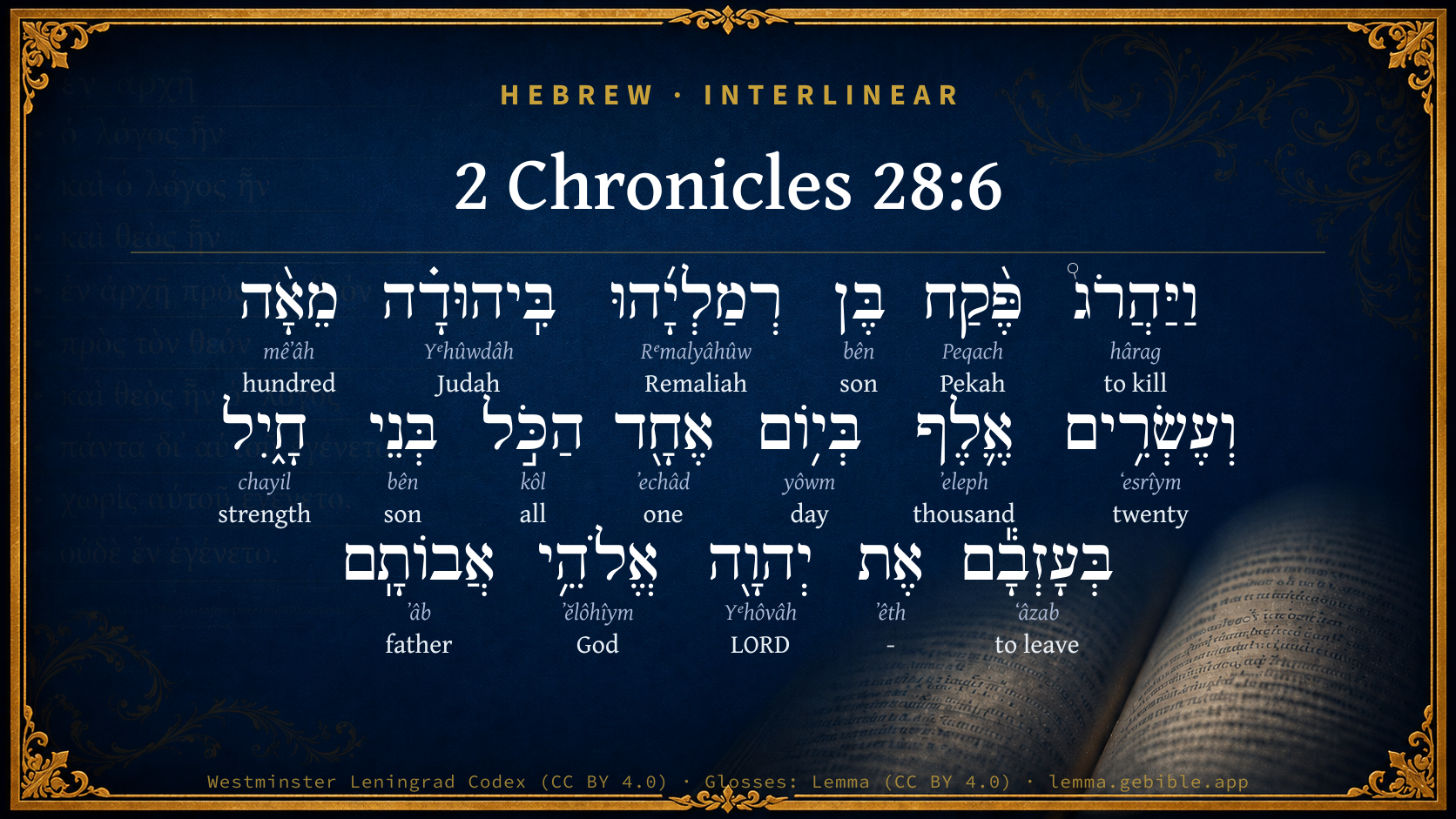
Hebrew (Westminster Leningrad Codex) 2 Chronicles 28:6 appears in the Hebrew Old Testament. The text above is from the Westminster Leningrad Codex. Each word links to its Strong’s number, a concise gloss, and parsing drawn from the Open Scriptures Hebrew Bible morphology. Click any word for its full Brown-Driver-Briggs (BDB) entry.
Download image
Cite this verse

2 Chronicles 28:6 (World English Bible). Public Domain. Lemma interlinear Bible study tool, https://lemma.gebible.app/v/2-chronicles/28/6.

Show BibTeX & RIS
BibTeX
RIS
English Translation
For Pekah the son of Remaliah killed in Judah one hundred twenty thousand in one day, all of them valiant men; because they had forsaken Yahweh, the God of their fathers.
World English Bible · Public Domain
Download a study sheet

One document with this verse’s original text, its word-by-word gloss line, the meaning frame, cross-references with their text, attributed commentary, and full source and license credits — printable, and it pastes into notes with its structure intact.

This verse Autodidact and up

Study sheet (.html) Plain text (.txt)

A passage Seminary Student

Up to 50 verses in one chapter. A passage sheet keeps up to 6 commentary sources and 12 cross-references per verse, in the order this page ranks them, and says so on the sheet whenever that leaves anything out. Ask for a single verse and you get the Autodidact verse sheet above.

Everything on this page stays free to read, with no account — the sheet is a download of what is already on screen, not access to it.

Want to remove ads? Support Godless Engineer
Compare translations 3

The same verse in 3 English versions, stacked beneath the original-language interlinear above. Click any original word for its lexicon entry.

Each is an independent rendering of the whole verse — the interlinear is not word-aligned to these translations.

Highlighted words mark where these versions differ — a whole-verse word diff, not a word-by-word alignment.

  • World English Bible Public Domain
    For Pekah the son of Remaliah killed in Judah one hundred twenty thousand in one day, all of them valiant men; because they had forsaken Yahweh, the God of their fathers.
  • King James Version Public Domain
    For Pekah the son of Remaliah slew in Judah an hundred and twenty thousand in one day, which were all valiant men; because they had forsaken the LORD God of their fathers.
  • unfoldingWord Literal Text CC BY-SA 4.0
    And Pekah the son of Remaliah killed in Judah 120,000 in one day, all sons of strength, when they abandoned Yahweh the God of their fathers.

unfoldingWord Literal Text — © unfoldingWord, licensed CC BY-SA 4.0. Word-aligned USFM3 via Door43 (git.door43.org/unfoldingWord/en_ult).

Versions to compare (up to 4)

3 of 4 selected

Show all 18 translations

Every available English version of this verse, each an independent rendering of the whole verse.

  • World English Bible Public Domain
    For Pekah the son of Remaliah killed in Judah one hundred twenty thousand in one day, all of them valiant men; because they had forsaken Yahweh, the God of their fathers.
  • Berean Standard Bible Public Domain
    For in one day Pekah son of Remaliah killed 120,000 valiant men in Judah. This happened because they had forsaken the LORD, the God of their fathers.
  • Majority Standard Bible Public Domain
    For in one day Pekah son of Remaliah killed 120,000 valiant men in Judah. This happened because they had forsaken the LORD, the God of their fathers.
  • King James Version Public Domain
    For Pekah the son of Remaliah slew in Judah an hundred and twenty thousand in one day, which were all valiant men; because they had forsaken the LORD God of their fathers.
  • American Standard Version (1901) Public Domain
    For Pekah the son of Remaliah slew in Judah a hundred and twenty thousand in one day, all of them valiant men; because they had forsaken Jehovah, the God of their fathers.
  • Revised Version (1885) Public Domain
    For Pekah the son of Remaliah slew in Judah an hundred and twenty thousand in one day, all of them valiant men; because they had forsaken the LORD, the God of their fathers.
  • Geneva Bible (1599) Public Domain
    For Pekah the sonne of Remaliah slewe in Iudah sixe score thousand in one day, all valiant men, because they had forsaken the Lord God of their fathers.
  • Douay-Rheims (1899) Public Domain
    For Phacee the son of Romelia slew of Juda a hundred and twenty thousand in one day, all valiant men: because they had forsaken the Lord the God of their fathers.
  • Young's Literal Translation Public Domain
    And Pekah son of Remaliah slayeth in Judah a hundred and twenty thousand in one day (the whole `are' sons of valour), because of their forsaking Jehovah, God of their fathers.
  • Literal Standard Version CC BY-SA 4.0
    And Pekah son of Remaliah slays one hundred and twenty thousand in Judah in one day (the whole [are] sons of valor), because of their forsaking YHWH, God of their fathers.
  • Unlocked Literal Bible CC BY-SA 4.0
    For Pekah son of Remaliah in one day killed 120,000 soldiers in Judah and all of them were powerful men, because they had forsaken Yahweh the God of their ancestors.
  • unfoldingWord Literal Text CC BY-SA 4.0
    And Pekah the son of Remaliah killed in Judah 120,000 in one day, all sons of strength, when they abandoned Yahweh the God of their fathers.
  • Darby Bible Public Domain
    And Pekah the son of Remaliah slew in Judah a hundred and twenty thousand in one day, all valiant men, because they had forsaken Jehovah the God of their fathers.
  • World Messianic Bible Public Domain
    For Pekah the son of Remaliah killed in Judah one hundred twenty thousand in one day, all of them valiant men, because they had forsaken the LORD, the God of their fathers.
  • Webster's Bible Public Domain
    For Pekah the son of Remaliah slew in Judah a hundred and twenty thousand in one day, who were all valiant men; because they had forsaken the LORD God of their fathers.
  • Free Bible Version CC BY-SA 4.0
    In just one day, Pekah, son of Remaliah, killed 120,000 fighting men in Judah, because they had abandoned the Lord, the God of their fathers.
  • Bible in Basic English Public Domain
    For Pekah, the son of Remaliah, in one day put to death a hundred and twenty thousand men of Judah, all of them good fighting-men; because they had given up the Lord, the God of their fathers.
  • JPS Tanakh (1917) Public Domain
    For Pekah the son of Remaliah slew in Judah a hundred and twenty thousand in one day, all of them valiant men; because they had forsaken the LORD, the God of their fathers.

Literal Standard Version (2020), Covenant Press — licensed CC BY-SA 4.0. Text via the HelloAO Bible API (eBible.org). Unlocked Literal Bible (unfoldingWord) — licensed CC BY-SA 4.0. Text via the HelloAO Bible API (eBible.org). unfoldingWord Literal Text — © unfoldingWord, licensed CC BY-SA 4.0. Word-aligned USFM3 via Door43 (git.door43.org/unfoldingWord/en_ult). Free Bible Version, Dr. Jonathan Gallagher — licensed CC BY-SA 4.0. Text via the HelloAO Bible API (eBible.org).

Word by word

More ways to search: Search by grammar → Find every occurrence → Compare this word →

Practice this passage: Drill this verse → Learn its vocabulary →

פֶּ֨קַח
Peqach
H6492
“Pekah”
Noun, Proper
Part of Speech
Noun
Type
Proper
Full BDB Definition

Origin: from H6491

TWOT: None

Pekah = "opened" - son of Remaliah, originally a captain of king Pekahiah of Israel, murdered Pekahiah, usurped the throne and became the 18th king of the northern kingdom of Israel
  1. וַיַּהֲרֹג֩ hârag H2026 “and · to kill” Conjunction + Verb, Qal, Sequential Imperfect, 3rd Person, Masculine, Singular
  2. בֶּן bên H1121 “son of” Noun, Common, Masculine, Singular, Construct
  3. רְמַלְיָ֜הוּ Rᵉmalyâhûw H7425 “Remaliah” Noun, Proper
  4. בִּֽיהוּדָ֗ה Yᵉhûwdâh H3063 “in/at · Judah” Preposition + Noun, Proper
  5. מֵאָ֨ה mêʼâh H3967 “hundred” Adjective, Cardinal number, Both, Singular, Absolute
  6. וְעֶשְׂרִ֥ים ʻesrîym H6242 “and · twenty” Conjunction + Adjective, Cardinal number, Both, Plural, Absolute
  7. אֶ֛לֶף ʼeleph H505 “thousand” Adjective, Cardinal number, Both, Singular, Absolute
  8. בְּי֥וֹם yôwm H3117 “in/at · day” Preposition + Noun, Common, Masculine, Singular, Absolute
  9. אֶחָ֖ד ʼechâd H259 “one” Adjective, Cardinal number, Masculine, Singular, Absolute
  10. הַכֹּ֣ל kôl H3605 “the · all” Particle, Definite Article + Noun, Common, Masculine, Singular, Absolute
  11. בְּנֵי bên H1121 “sons of” Noun, Common, Masculine, Plural, Construct
  12. חָ֑יִל chayil H2428 “strength” Noun, Common, Masculine, Singular, Absolute
  13. בְּעָזְבָ֕ם ʻâzab H5800 “in/at · to leave · them” Preposition + Verb, Qal, Infinitive Construct + Suffix, Personal, 3rd Person, Masculine, Plural
  14. אֶת ʼêth H853 “-” Particle, Direct Object
  15. יְהוָ֖ה Yᵉhôvâh H3068 “LORD” Noun, Proper
  16. אֱלֹהֵ֥י ʼĕlôhîym H430 “God(s) of” Noun, Common, Masculine, Plural, Construct
  17. אֲבוֹתָֽם ʼâb H1 “fathers · their” Noun, Common, Masculine, Plural, Construct + Suffix, Personal, 3rd Person, Masculine, Plural

About this verse

These counts appear in no published source. They are computed here, from the morphology-tagged text and Lemma’s own curated glosses. What Lemma adds →

18
words
17
distinct lemmas
Historical
section

Notable vocabulary

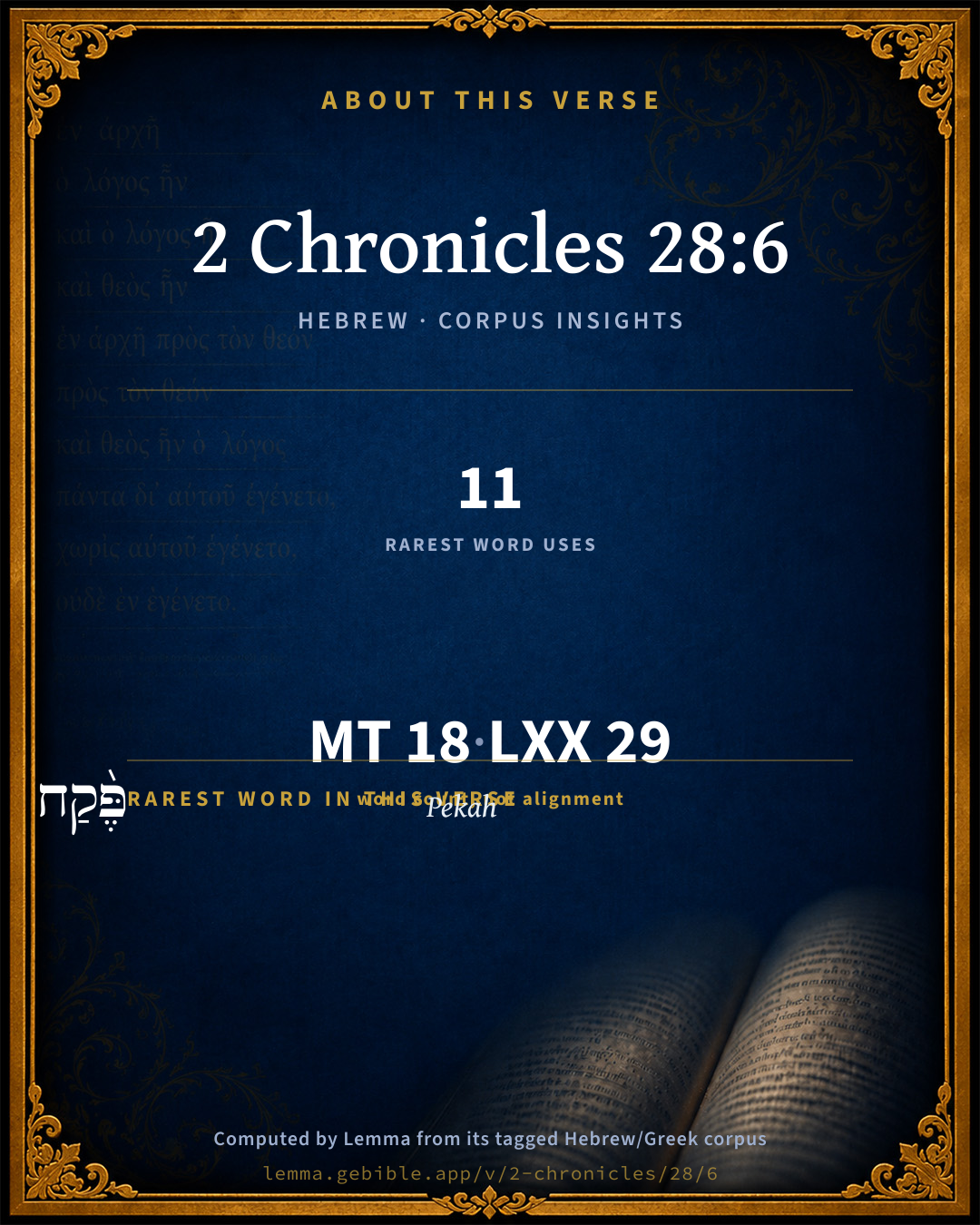
The rarest word here is פֶּ֨קַח Pekah H6492 — appearing just 11 times in the whole Hebrew Bible.

Shared distinctive vocabulary

פֶּ֨קַח Pekah H6492 occurs in 11 verses of the Hebrew Bible. Also found in:

Grammatical profile

  • 2 verbs
  • 11 nouns
  • 4 adjectives
  • 1 particle

Verb forms

  • וַיַּהֲרֹג֩ Qal · Sequential Imperfect
  • בְּעָזְבָ֕ם Qal · Infinitive Construct

Repetition

A word recurs within this verse — often emphatic in Hebrew:

Hebrew & Septuagint length

In English translation the verse runs 31 words from the Hebrew and 32 from the Septuagint (LXX English) — closely comparable.

A rough comparison of the two English renderings, which tokenize alike — not a word-level alignment.

Word counts can differ between the Hebrew and the Greek without any difference in meaning — e.g. the Hebrew direct-object marker אֵת has no separate Greek word, and Greek often adds the article ὁ.

In the original languages it is 18 Hebrew tokens and 29 Greek tokens — but the two are counted differently (Hebrew bundles its prefixes and suffixes into one token; the Greek is in lemma form), so that isn’t a like-for-like length.

Cross-references

20

Topical passages linked to 2 Chronicles 28:6 in the Treasury of Scripture Knowledge — connected by theme and wording, ordered by reader-vote popularity; previews shown in the World English Bible.

  • Jeremiah 15:6 You have rejected me, says Yahweh, you are gone backward: therefore have I stretched out my hand against you, and destroyed you; I am weary with repenting.
  • Isaiah 1:28 But the destruction of transgressors and sinners shall be together, And those who forsake Yahweh shall be consumed.
  • Jeremiah 2:19 Your own wickedness shall correct you, and your backsliding shall reprove you: know therefore and see that it is an evil thing and a bitter, that you have forsaken Yahweh your God, and that my fear is not in you, says the Lord, Yahweh of Hosts.
  • Joshua 24:20 If you forsake Yahweh, and serve foreign gods, then he will turn and do you evil, and consume you, after that he has done you good.
  • 2 Kings 15:27 In the two and fiftieth year of Azariah king of Judah Pekah the son of Remaliah began to reign over Israel in Samaria, [and reigned] twenty years.
  • Isaiah 9:21 Manasseh, Ephraim; and Ephraim, Manasseh; and they together shall be against Judah. For all this his anger is not turned away, but his hand is stretched out still.
  • Deuteronomy 6:14–15 You shall not go after other gods, of the gods of the peoples who are round about you;
  • Deuteronomy 28:15 But it shall come to pass, if you will not listen to the voice of Yahweh your God, to observe to do all his commandments and his statutes which I command you this day, that all these curses shall come on you, and overtake you.
  • Deuteronomy 28:25 Yahweh will cause you to be struck before your enemies; you shall go out one way against them, and shall flee seven ways before them: and you shall be tossed back and forth among all the kingdoms of the earth.
  • Deuteronomy 29:24–26 even all the nations shall say, Why has Yahweh done thus to this land? what means the heat of this great anger?
  • Deuteronomy 31:16–17 Yahweh said to Moses, Behold, you shall sleep with your fathers; and this people will rise up, and play the prostitute after the strange gods of the land, where they go to be among them, and will forsake me, and break my covenant which I have made with them.
  • Deuteronomy 32:20 He said, I will hide my face from them, I will see what their end shall be: For they are a very perverse generation, Children in whom is no faithfulness.
  • Joshua 23:16 When you disobey the covenant of Yahweh your God, which he commanded you, and go and serve other gods, and bow down yourselves to them; then will the anger of Yahweh be kindled against you, and you shall perish quickly from off the good land which he has given to you.
  • 2 Kings 15:37 In those days Yahweh began to send against Judah Rezin the king of Syria, and Pekah the son of Remaliah.
  • 2 Kings 16:5 Then Rezin king of Syria and Pekah son of Remaliah king of Israel came up to Jerusalem to war: and they besieged Ahaz, but could not overcome him.
  • 2 Chronicles 13:17 Abijah and his people killed them with a great slaughter: so there fell down slain of Israel five hundred thousand chosen men.
  • 2 Chronicles 15:2 and he went out to meet Asa, and said to him, Hear you me, Asa, and all Judah and Benjamin: Yahweh is with you, while you are with him; and if you seek him, he will be found of you; but if you forsake him, he will forsake you.
  • Isaiah 7:4–5 Tell him, 'Be careful, and keep calm. Don't be afraid, neither let your heart be faint because of these two tails of smoking firebrands, for the fierce anger of Rezin and Syria, and of the son of Remaliah.
  • Isaiah 7:9 and the head of Ephraim is Samaria, and the head of Samaria is Remaliah's son. If you will not believe, surely you shall not be established.'"
  • Isaiah 24:5–6 The earth also is polluted under the inhabitants of it; because they have transgressed the laws, violated the statutes, broken the everlasting covenant.

Cross-references courtesy of OpenBible.info (CC BY 4.0).

Hebrew and Greek witnesses Masoretic Hebrew ↔ Greek Septuagint

The same verse in the two great witnesses to the Old Testament, shown verse-for-verse.

These are two independent witnesses, not word-aligned to each other, and the Septuagint is shown in lemma (dictionary) form.

Hebrew 2 Chronicles 28:6 Masoretic · Westminster Leningrad Codex

וַיַּהֲרֹג֩ פֶּ֨קַח בֶּן רְמַלְיָ֜הוּ בִּֽיהוּדָ֗ה מֵאָ֨ה וְעֶשְׂרִ֥ים אֶ֛לֶף בְּי֥וֹם אֶחָ֖ד הַכֹּ֣ל בְּנֵי חָ֑יִל בְּעָזְבָ֕ם אֶת יְהוָ֖ה אֱלֹהֵ֥י אֲבוֹתָֽם

For Pekah the son of Remaliah killed in Judah one hundred twenty thousand in one day, all of them valiant men; because they had forsaken Yahweh, the God of their fathers.

World English Bible · Public Domain

Greek LXX 2 Chronicles 28:6 Septuagint · lemma form

καί ἀποκτείνω φακεε ὁ ὁ ρομελιας βασιλεύς ἰσραήλ ἐν ἰουδά ἐν εἷς ἡμέρα ἑκατόν εἴκοσι χιλίας ἀνήρ δυνατός ἰσχύς ἐν ὁ αὐτός καταλείπω ὁ κύριος θεός ὁ πατήρ αὐτός

And Phakee the son of Romelias king of Israel, killed in Juda in one day one hundred and twenty thousand mighty men; because they had forsaken the Lord God of their fathers.

LXX2012 (modern English Septuagint) · Public Domain

Hebrew: Westminster Leningrad Codex (CC BY 4.0). Greek: Septuagint (public domain); English from LXX2012 (modern English Septuagint) (Public Domain). How the Septuagint differs from the Hebrew →

Commentary

Notes on 2 Chronicles 28:6 from classic Christian and Jewish commentators (each source and its license shown beneath its notes). The classic Christian expositions comment on the surrounding passage and are grouped to its opening verse, so a note may address several verses; the Jewish commentaries on the Tanakh (Rashi and others) are per-verse, so they appear only where the commentator wrote on this verse.

Lemma curates 59 commentaries, every one of them public domain or Creative Commons licensed, each selected and text-cleaned for this edition rather than reprinted as found. About our sources →

Matthew Henry's Commentary

We have here,

I. Treacherous Judah under the rebukes of God's providence, and they are very severe. Never was such bloody work made among them since they were a kingdom, and by Israelites too. Ahaz walked in the ways of the kings of Israel, and the king of Israel was the instrument God made use of for his punishment. It is just with God to make those our plagues whom we make our patterns or make ourselves partners with in sin. A war broke out between Judah and Israel, in which Judah was worsted. For, 1. There was a great slaughter of men in the field of battle. Vast numbers (120,000 men, and valiant men too at other times) were slain (Ch2 28:6) and some of the first rank, the king's son for one. He had sacrificed some of this sons to Moloch; justly therefore is this sacrificed to the divine vengeance. Here is another that was next the king, his friend, the prime-minister of state, or perhaps next him in the battle, so that the king himself had a narrow escape, Ch2 28:7. The kingdom of Israel was not strong at this time, and yet strong enough to bring this great destruction upon Judah. But certainly so many men, great men, stout men, could not have been cut off in one day if they had not been strangely dispirited both by the consciousness of their own guilt and by the righteous hand of God upon them. Even valiant men were numbered as sheep for the slaughter, and became an easy prey to the enemy because they had forsaken the Lord God of their fathers, and he had therefore forsaken them. 2. There was a great captivity of women and children, Ch2 28:8. When the army in the field was routed, the cities, and towns, and country villages, were all easily stripped, the inhabitants taken for slaves, and their wealth for a prey.

II. Even victorious Israel under the rebuke of God's word for the bad principle they had gone upon in making war with Judah and the bad use they had made of their success, and the good effect of this rebuke. Here is,

1. The message which God sent them by a prophet, who went out to meet them, not to applaud their valour or congratulate them on their victory, though they returned laden with spoils and triumphs, but in God's name to tell them of their faults and warn them of the judgments of God.

(1.) He told them how they came by this victory of which they were so proud. It was not because God favoured them, or that they had merited it at his hand, but because he was wroth with Judah, and made them the rod of his indignation. Not for your righteousness, be it known to you, but for their wickedness (Deu 9:5) they are broken off; therefore be not you high-minded, but fear lest God also spare not you, Rom 11:20, Rom 11:21.

(2.) He charged them with the abuse of the power God had given them over their brethren. Those understand not what victory is who think it gives them authority to do what they will, and that the longest sword is the clearest claim to lives and estates (Jusque datum sceleri - might is right); no, as it is impolitic not to use a victory, so it is impious to abuse it. The conquerors are here reproved, [1.] For the cruelty of the slaughter they had made in the field. They had indeed shed the blood of war in war; we suppose that to be lawful, but it turned into sin to them, because they did it from a bad principle of enmity to their brethren and after a bad manner, with a barbarous fury, a rage reaching up to heaven, that is, that cried to God for vengeance against such bloody men, that delighted in military execution. Those that serve God's justice, if they do it with rage and a spirit of revenge, make themselves obnoxious to it, and forfeit the honour of acting for him; for the wrath of man worketh not the righteousness of God. [2.] For the imperious treatment they gave their prisoners. "You now purpose to keep them under, to use them or sell them as slaves, though they are your brethren and free-born Israelites." God takes notice of what men purpose, as well as of what they say and do.

(3.) He reminded them of their own sins, by which they also were obnoxious to the wrath of God: Are there not with you, even with you, sins against the Lord your God? Ch2 28:10. He appeals to their own consciences, and to the notorious evidence of the thing. "Though you are now made the instruments of correcting Judah for sin, yet do not think that you are therefore innocent yourselves; no, you also are guilty before God." This is intended as a check, [1.] To their triumph in their success. "You are sinners, and it ill becomes sinners to be proud; you have carried the day now, but be not secure, the wheel may ere long return upon yourselves, for, if judgment begin thus with those that have the house of God among them, what shall be the end of such as worship the calves?" [2.] To their severity towards their brethren. "You have now got them under, but you ought to show mercy to them, for you yourselves are undone if you do not find mercy with God. It ill becomes sinners to be cruel. You have transgressions enough to answer for already, and need not add this to the rest."

(4.) He commanded them to release the prisoners, and to send them home again carefully (Ch2 28:11); "for you having sinned, the fierce wrath of God is upon you, and there is no other way of escaping it than by showing mercy."

2. The resolution of the princes thereupon not to detain the prisoners. They stood up against those that came from the war, though flushed with victory, and told them plainly that they should not bring their captives into Samaria, Ch2 28:12, Ch2 28:13. They had sin enough already to answer for, and would have nothing done to add to their trespass. In this they discovered an obedient regard to the word of God by his prophet and a tender compassion towards their brethren, which was wrought in them by the tender mercy of God; for he regarded the affliction of this poor people, and hears their cry, and made them to be pitied of all those that carried them captive, Psa 106:44, Psa 106:46.

3. The compliance of the soldiers with the resolutions of the princes in this matter, and the dismission of the captives thereupon. (1.) The armed men, though being armed they might be force have maintained their title to what they got by the sword, acquiesced, and left their captives and the spoil to the disposal of the princes (Ch2 28:14), and herein they showed more truly heroic bravery than they did in taking them. It is a great honour for any man to yield to the authority of reason and religion against his interest. (2.) The princes very generously sent home the poor captives well accommodated, Ch2 28:15. Those that hope to find mercy with God must learn hence with what tenderness to carry themselves towards those that lie at their mercy. It is strange that these princes, who in this instance discovered such a deference to the word of God, and such an influence upon the people, had not so much grace as, in obedience to the calls of God by so many prophets, to root idolatry out of their kingdom, which, soon after this, was the ruin of it.

Matthew Henry's Commentary on the Whole Bible (1708–1710) — public domain (CC PDM 1.0). Text via the HelloAO Bible API.

Trapp's Complete Commentary

John Trapp

2Ch 28:6 For Pekah the son of Remaliah slew in Judah an hundred and twenty thousand in one day, [which were] all valiant men; because they had forsaken the LORD God of their fathers.

Ver. 6. For Pekah the son of Remaliah.] Here was aliud ex alio malum: the other evil from other man, but these hammers of the Most High did but beat upon cold iron. See 2Ki 15:27.

John Trapp, A Commentary or Exposition upon All the Books of the Old and New Testament (1647–1656) — public domain. Text from a community e-Sword module.

Joseph Benson's Commentary

2Ch 28:6. Pekah slew in Judah a hundred and twenty thousand in one day — Never was such bloody work made among them before, since they were a nation, and that by Israelites too! The kingdom of Israel was not strong at this time, and yet strong enough, it appears, to bring this great destruction upon Judah. But certainly so many men, valiant men, could not have been cut off in one day, if they had not been strangely dispirited, both by the consciousness of their own guilt, and the righteous hand of God upon them. Because they had forsaken the Lord God of their fathers — Ahaz walked in the ways of the kings of Israel, and God chose the kings of Israel for his scourge: it is just with God, to make them a plague to us, whom we have made our patterns, or partners in sin.

Joseph Benson's Commentary on the Old and New Testaments (1811–1818) — public domain. Text from a community e-Sword module.

Geneva Bible (1599)

Geneva Bible translators

Who was king of Israel.

Hebrew, sons of strength.

Geneva Bible (1599) marginal notes — public domain. Text via Bolls.life.

Adam Clarke's Commentary

Verse 6. A hundred and twenty thousand] It is very probable that there is a mistake in this number. It is hardly possible that a hundred and twenty thousand men could have been slain in one day; yet all the versions and MSS. agree in this number. The whole people seem to have been given up into the hands of their enemies.

Adam Clarke's Commentary on the Bible (1810–1826) — public domain. Text from a community e-Sword/MySword module.

Ellicott's Commentary for English Readers

(6) For.—And, i.e., so.

Pekah . . . slew in Judah an hundred . . . in one day.—Details of what is generally stated in the last sentence of 2Ch_28:5. The totals of slain and of captives (2Ch_28:8) are both round numbers. The figures 120,000, if accurate, would show that about a third of the Jewish host (2Ch_26:13) had fallen in the battle and pursuit. The ruthlessness of the foe is borne out by the words of the prophet Oded in 2Ch_28:9 : “Ye have slain them in a rage that reacheth up to heaven.” Isa_7:6 proves that the allies designed to break wholly the independence of Judah, by abolishing the Davidic monarchy, and setting up a Syrian vassal king.

In one day.—In one great engagement. Among the Hebrews and Arabs the word “day” often bears the special force of “day of battle;” e.g., “the day of Midian” (Isa_9:4).

Because they had forsaken.—2Ch_27:2. Moreover, the idolatrous example of Ahaz would be eagerly followed by large numbers of the people, whose average religious condition was far below the standard which the prophets of Jehovah demanded. The prophetical writings demonstrate this.

A Bible Commentary for English Readers, edited by Charles John Ellicott (1878–1897) — public domain. Text from a community e-Sword module.

The Cambridge Bible for Schools and Colleges

gen. ed. J. J. S. Perowne

6. an hundred and twenty thousand] i.e. more than a third of the host as reckoned in 2Ch_26:13.

which were all] R.V. all of them.

the Lord God] R.V. the LORD, the God. “The LORD” stands here for the proper name “Jehovah”; cp. 2Ch_21:10, 2Ch_24:18; 2Ch_24:24.

The Cambridge Bible for Schools and Colleges (gen. ed. J. J. S. Perowne; Cambridge University Press, 1878–1918) — public domain. Text from a community e-Sword module.

John Gill's Exposition

For Pekah son of Remaliah,.... Who was at this time king of Israel:

slew in Judah an hundred and twenty thousand in one day, which were all

valiant men; a great slaughter to be made at one time, and of valiant men, but not so great as that in Ch2 13:17,

because they had forsaken the Lord God of their fathers; this was not a reason with Pekah for slaying them, he himself being an idolater, but why the Lord suffered them to be slain by him.

John Gill's Exposition of the Whole Bible (1746–1763) — public domain (CC PDM 1.0). Text via the HelloAO Bible API.

Albert Barnes' Notes on the Bible

The fearful loss here described may have been due to a complete defeat followed by panic.

Albert Barnes' Notes on the Bible (1834–1885) — public domain. Text from a community e-Sword/MySword module.

The Pulpit Commentary

(See foregoing note.) A hundred and twenty thousand. The number is large, but, the uncertainty of very many of these figures notwithstanding, it is impossible absolutely to pronounce it incredible. Because they had forsaken. The now frequent refrain of the writer.

The Pulpit Commentary (1880–1919), ed. H.D.M. Spence-Jones & Joseph S. Exell — public domain. Text from a community e-Sword module.

John Wesley's Explanatory Notes

Forsaken - Ahaz walked in the ways of the kings of Israel, and God chose the king of Israel for his scourge: it is just with God, to make them a plague to us, whom we have made our patterns, or partners in sin.

John Wesley, Explanatory Notes Upon the Whole Bible (1754–1765) — public domain. Text via the GEBible commentary corpus.

Lesson kit

Teaching starters — assembled from the data on this page, not authored interpretation. Every prompt links to the verse data it draws on. Edit before teaching.

2 Chronicles, in the Historical, opens this verse with 18 words (17 distinct Hebrew lemmas). Its most distinctive word is Peqach (“Pekah”). A historical commentator’s framing appears above. Read the whole chapter for the surrounding context.

Discussion questions

  1. How does “Pekah” (Peqach) shape what this verse is saying?
  2. 2 Kings 15:25 shares the word «Pekah» with this verse. How do the two illuminate each other?
  3. “son” occurs 2× in this one verse. What is the effect of the repetition?
  4. The translations on this page render this verse differently — a whole-verse word diff, not a word-by-word alignment. What might account for the different wordings?
  5. The verb «וַיַּהֲרֹג֩» is Qal Sequential Imperfect. How does its form color the action?
  6. Reading how Matthew Henry's Commentary and Trapp's Complete Commentary read this verse, where do the two commentators agree and where do they part?

Things to notice

Reading settings

Reading text

Shown beneath each verse's original-language words.

Old Testament
Old Testament edition

Read the OT as the Masoretic Hebrew (MT) or the Greek Septuagint (LXX).

English shown for the Greek Septuagint (in the Hebrew ↔ Greek comparison).

Comparing translations? Open the Compare panel on any verse page to stack up to four side by side.