
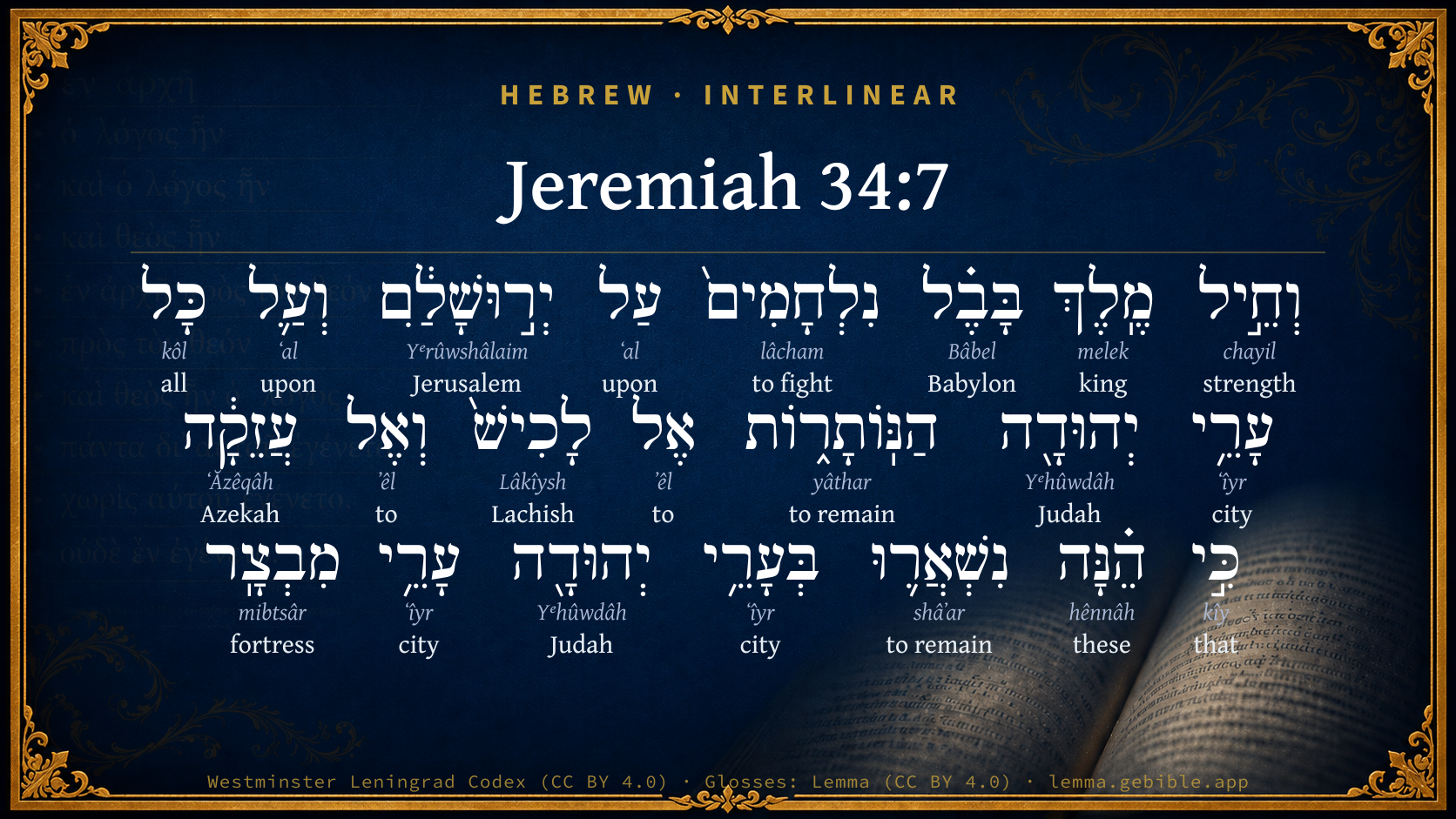
Jeremiah 34:7

Hebrew (Westminster Leningrad Codex) Jeremiah 34:7 appears in the Hebrew Old Testament. The text above is from the Westminster Leningrad Codex. Each word links to its Strong’s number, a concise gloss, and parsing drawn from the Open Scriptures Hebrew Bible morphology. Click any word for its full Brown-Driver-Briggs (BDB) entry.
Download image
Cite this verse

Jeremiah 34:7 (World English Bible). Public Domain. Lemma interlinear Bible study tool, https://lemma.gebible.app/v/jeremiah/34/7.

Show BibTeX & RIS
BibTeX
RIS
English Translation
when the king of Babylon's army was fighting against Jerusalem, and against all the cities of Judah that were left, against Lachish and against Azekah; for these [alone] remained of the cities of Judah [as] fortified cities.
World English Bible · Public Domain
Download a study sheet

One document with this verse’s original text, its word-by-word gloss line, the meaning frame, cross-references with their text, attributed commentary, and full source and license credits — printable, and it pastes into notes with its structure intact.

This verse Autodidact and up

Study sheet (.html) Plain text (.txt)

A passage Seminary Student

Up to 50 verses in one chapter. A passage sheet keeps up to 6 commentary sources and 12 cross-references per verse, in the order this page ranks them, and says so on the sheet whenever that leaves anything out. Ask for a single verse and you get the Autodidact verse sheet above.

Everything on this page stays free to read, with no account — the sheet is a download of what is already on screen, not access to it.

Want to remove ads? Support Godless Engineer
Compare translations 3

The same verse in 3 English versions, stacked beneath the original-language interlinear above. Click any original word for its lexicon entry.

Each is an independent rendering of the whole verse — the interlinear is not word-aligned to these translations.

Highlighted words mark where these versions differ — a whole-verse word diff, not a word-by-word alignment.

  • World English Bible Public Domain
    when the king of Babylon's army was fighting against Jerusalem, and against all the cities of Judah that were left, against Lachish and against Azekah; for these [alone] remained of the cities of Judah [as] fortified cities.
  • King James Version Public Domain
    When the king of Babylon's army fought against Jerusalem, and against all the cities of Judah that were left, against Lachish, and against Azekah: for these defenced cities remained of the cities of Judah.
  • unfoldingWord Literal Text CC BY-SA 4.0
    The army of the king of Babylon made war against Jerusalem and all the remaining cities of Judah: Lachish and Azekah. These cities of Judah remained as fortified cities.

unfoldingWord Literal Text — © unfoldingWord, licensed CC BY-SA 4.0. Word-aligned USFM3 via Door43 (git.door43.org/unfoldingWord/en_ult).

Versions to compare (up to 4)

3 of 4 selected

Show all 18 translations

Every available English version of this verse, each an independent rendering of the whole verse.

  • World English Bible Public Domain
    when the king of Babylon's army was fighting against Jerusalem, and against all the cities of Judah that were left, against Lachish and against Azekah; for these [alone] remained of the cities of Judah [as] fortified cities.
  • Berean Standard Bible Public Domain
    as the army of the king of Babylon was fighting against Jerusalem and the remaining cities of Judah—against Lachish and Azekah. For these were the only fortified cities remaining in Judah.
  • Majority Standard Bible Public Domain
    as the army of the king of Babylon was fighting against Jerusalem and the remaining cities of Judah—against Lachish and Azekah. For these were the only fortified cities remaining in Judah.
  • King James Version Public Domain
    When the king of Babylon's army fought against Jerusalem, and against all the cities of Judah that were left, against Lachish, and against Azekah: for these defenced cities remained of the cities of Judah.
  • American Standard Version (1901) Public Domain
    when the king of Babylon's army was fighting against Jerusalem, and against all the cities of Judah that were left, against Lachish and against Azekah; for these `alone' remained of the cities of Judah `as' fortified cities.
  • Revised Version (1885) Public Domain
    when the king of Babylon’s army fought against Jerusalem, and against all the cities of Judah that were left, against Lachish and against Azekah; for these alone remained of the cities of Judah as fenced cities.
  • Geneva Bible (1599) Public Domain
    (When the King of Babels hoste fought against Ierusalem, and against all the cities of Iudah, that were left, euen against Lachish, and against Azekah: for these strong cities remained of the cities of Iudah)
  • Douay-Rheims (1899) Public Domain
    And the army of the king of Babylon fought against Jerusalem, and against all the cities of Juda that were left, against Lachis, and against Azecha: for these remained of the cities of Juda, fenced cities.
  • Young's Literal Translation Public Domain
    and the forces of the king of Babylon are fighting against Jerusalem, and against all the cities of Judah that are left -- against Lachish, and against Azekah, for these have been left among the cities of Judah, cities of fortresses.
  • Literal Standard Version CC BY-SA 4.0
    and the forces of the king of Babylon are fighting against Jerusalem, and against all the cities of Judah that are left—against Lachish, and against Azekah, for these have been left among the cities of Judah, cities of fortresses.
  • Unlocked Literal Bible CC BY-SA 4.0
    The army of the king of Babylon made war against Jerusalem and all the remaining cities of Judah: Lachish and Azekah. These cities of Judah remained as fortified cities.
  • unfoldingWord Literal Text CC BY-SA 4.0
    The army of the king of Babylon made war against Jerusalem and all the remaining cities of Judah: Lachish and Azekah. These cities of Judah remained as fortified cities.
  • Darby Bible Public Domain
    And the king of Babylon's army fought against Jerusalem, and against all the cities of Judah that were left, against Lachish, and against Azekah; for these were amongst the cities of Judah, the fenced cities that were left.
  • World Messianic Bible Public Domain
    when the king of Babylon’s army was fighting against Jerusalem and against all the cities of Judah that were left, against Lachish and against Azekah; for these alone remained of the cities of Judah as fortified cities.
  • Webster's Bible Public Domain
    When the king of Babylon's army fought against Jerusalem, and against all the cities of Judah that were left, against Lachish, and against Azekah: for these fortified cities remained of the cities of Judah.
  • Free Bible Version CC BY-SA 4.0
    At that time the king of Babylon's army was attacking the city and the Judean towns of Lachish and Azekah. These were the only fortified cities that had not yet been conquered in Judah.
  • Bible in Basic English Public Domain
    When the army of the king of Babylon was fighting against Jerusalem and against all the towns of Judah which had not been taken, against Lachish and against Azekah; for these were the last of the walled towns of Judah.
  • JPS Tanakh (1917) Public Domain
    when the king of Babylon's army fought against Jerusalem, and against all the cities of Judah that were left, against Lachish and against Azekah; for these alone remained of the cities of Judah as fortified cities.

Literal Standard Version (2020), Covenant Press — licensed CC BY-SA 4.0. Text via the HelloAO Bible API (eBible.org). Unlocked Literal Bible (unfoldingWord) — licensed CC BY-SA 4.0. Text via the HelloAO Bible API (eBible.org). unfoldingWord Literal Text — © unfoldingWord, licensed CC BY-SA 4.0. Word-aligned USFM3 via Door43 (git.door43.org/unfoldingWord/en_ult). Free Bible Version, Dr. Jonathan Gallagher — licensed CC BY-SA 4.0. Text via the HelloAO Bible API (eBible.org).

Word by word

More ways to search: Search by grammar → Find every occurrence → Compare this word →

Practice this passage: Drill this verse → Learn its vocabulary →

עֲזֵקָ֔ה
ʻĂzêqâh
H5825
“Azekah”
Noun, Proper
Part of Speech
Noun
Type
Proper
Full BDB Definition

Origin: from H5823

TWOT: None

Azekah = "dug over" - a town in the lowlands of Judah
  1. וְחֵ֣יל chayil H2428 “and · strength of” Conjunction + Noun, Common, Masculine, Singular, Construct
  2. מֶֽלֶךְ melek H4428 “king of” Noun, Common, Masculine, Singular, Construct
  3. בָּבֶ֗ל Bâbel H894 “Babylon” Noun, Proper
  4. נִלְחָמִים֙ lâcham H3898 “fighting” Verb, Niphal, Participle Active, Masculine, Plural, Absolute
  5. עַל ʻal H5921 “upon” Preposition
  6. יְר֣וּשָׁלִַ֔ם Yᵉrûwshâlaim H3389 “Jerusalem” Noun, Proper
  7. וְעַ֛ל ʻal H5921 “and · upon” Conjunction + Preposition
  8. כָּל kôl H3605 “all of” Noun, Common, Masculine, Singular, Construct
  9. עָרֵ֥י ʻîyr H5892 “cities of” Noun, Common, Feminine, Plural, Construct
  10. יְהוּדָ֖ה Yᵉhûwdâh H3063 “Judah” Noun, Proper
  11. הַנּֽוֹתָר֑וֹת yâthar H3498 “the · remaining” Particle, Definite Article + Verb, Niphal, Participle Active, Feminine, Plural, Absolute
  12. אֶל ʼêl H413 “to” Preposition
  13. לָכִישׁ֙ Lâkîysh H3923 “Lachish” Noun, Proper
  14. וְאֶל ʼêl H413 “and · to” Conjunction + Preposition
  15. כִּ֣י kîy H3588 “that” Conjunction
  16. הֵ֗נָּה hênnâh H2007 “these” Pronoun, Personal, 3rd Person, Feminine, Plural
  17. נִשְׁאֲר֛וּ shâʼar H7604 “to remain” Verb, Niphal, Perfect, 3rd Person, Common, Plural
  18. בְּעָרֵ֥י ʻîyr H5892 “in/at · cities of” Preposition + Noun, Common, Feminine, Plural, Construct
  19. יְהוּדָ֖ה Yᵉhûwdâh H3063 “Judah” Noun, Proper
  20. עָרֵ֥י ʻîyr H5892 “cities of” Noun, Common, Feminine, Plural, Construct
  21. מִבְצָֽר mibtsâr H4013 “fortress” Noun, Common, Masculine, Singular, Absolute

About this verse

These counts appear in no published source. They are computed here, from the morphology-tagged text and Lemma’s own curated glosses. What Lemma adds →

22
words
17
distinct lemmas
Prophets
section

Notable vocabulary

The rarest word here is עֲזֵקָ֔ה Azekah H5825 — appearing just 7 times in the whole Hebrew Bible.

Shared distinctive vocabulary

עֲזֵקָ֔ה Azekah H5825 occurs in 7 verses of the Hebrew Bible. Also found in:

Grammatical profile

  • 3 verbs
  • 13 nouns
  • 1 pronoun
  • 4 prepositions
  • 1 conjunction

Verb forms

  • נִלְחָמִים֙ Niphal · Participle Active
  • הַנּֽוֹתָר֑וֹת Niphal · Participle Active
  • נִשְׁאֲר֛וּ Niphal · Perfect

Repetition

Words recur within this verse — often emphatic in Hebrew:

  • עָרֵ֥י city H5892 ×3
  • עַל upon H5921 ×2
  • יְהוּדָ֖ה Judah H3063 ×2
  • אֶל to H413 ×2

Cross-references

15

Topical passages linked to Jeremiah 34:7 in the Treasury of Scripture Knowledge — connected by theme and wording, ordered by reader-vote popularity; previews shown in the World English Bible.

  • Joshua 10:3 Therefore Adoni-zedek king of Jerusalem sent to Hoham king of Hebron, and to Piram king of Jarmuth, and to Japhia king of Lachish, and to Debir king of Eglon, saying,
  • Joshua 15:35 Jarmuth, and Adullam, Socoh, and Azekah,
  • 2 Kings 18:13–14 Now in the fourteenth year of king Hezekiah did Sennacherib king of Assyria come up against all the fortified cities of Judah, and took them.
  • 2 Chronicles 11:5–10 Rehoboam lived in Jerusalem, and built cities for defense in Judah.
  • Jeremiah 4:5 Declare you in Judah, and publish in Jerusalem; and say, Blow you the trumpet in the land: cry aloud and say, Assemble yourselves, and let us go into the fortified cities.
  • Deuteronomy 28:52 They shall besiege you in all your gates, until your high and fortified walls come down, in which you trusted, throughout all your land; and they shall besiege you in all your gates throughout all your land, which Yahweh your God has given you.
  • Joshua 10:10–11 Yahweh confused them before Israel, and he killed them with a great slaughter at Gibeon, and chased them by the way of the ascent of Beth Horon, and struck them to Azekah, and to Makkedah.
  • Joshua 12:11 the king of Jarmuth, one; the king of Lachish, one;
  • Joshua 15:39 Lachish, and Bozkath, and Eglon,
  • 2 Kings 19:8 So Rabshakeh returned, and found the king of Assyria warring against Libnah; for he had heard that he was departed from Lachish.
  • 2 Chronicles 27:4 Moreover he built cities in the hill-country of Judah, and in the forests he built castles and towers.
  • Jeremiah 8:14 Why do we sit still? assemble yourselves, and let us enter into the fortified cities, and let us be silent there; for Yahweh our God has put us to silence, and given us water of gall to drink, because we have sinned against Yahweh.
  • Jeremiah 11:12 Then shall the cities of Judah and the inhabitants of Jerusalem go and cry to the gods to which they offer incense: but they will not save them at all in the time of their trouble.
  • Jeremiah 34:1 The word which came to Jeremiah from Yahweh, when Nebuchadnezzar king of Babylon, and all his army, and all the kingdoms of the earth that were under his dominion, and all the peoples, were fighting against Jerusalem, and against all the cities of it, saying:
  • Micah 1:13 Harness the chariot to the swift steed, inhabitant of Lachish. She was the beginning of sin to the daughter of Zion; For the transgressions of Israel were found in you.

Cross-references courtesy of OpenBible.info (CC BY 4.0).

Hebrew and Greek witnesses Masoretic Hebrew ↔ Greek Septuagint

The same verse in the two great witnesses to the Old Testament, shown verse-for-verse.

These are two independent witnesses, not word-aligned to each other, and the Septuagint is shown in lemma (dictionary) form.

Hebrew Jeremiah 34:7 Masoretic · Westminster Leningrad Codex

וְחֵ֣יל מֶֽלֶךְ בָּבֶ֗ל נִלְחָמִים֙ עַל יְר֣וּשָׁלִַ֔ם וְעַ֛ל כָּל עָרֵ֥י יְהוּדָ֖ה הַנּֽוֹתָר֑וֹת אֶל לָכִישׁ֙ וְאֶל עֲזֵקָ֔ה כִּ֣י הֵ֗נָּה נִשְׁאֲר֛וּ בְּעָרֵ֥י יְהוּדָ֖ה עָרֵ֥י מִבְצָֽר

when the king of Babylon's army was fighting against Jerusalem, and against all the cities of Judah that were left, against Lachish and against Azekah; for these [alone] remained of the cities of Judah [as] fortified cities.

World English Bible · Public Domain

Greek LXX Structure differs

In the Septuagint, Jeremiah is about an eighth shorter than the Hebrew and arranges its material differently — the Oracles Against the Nations (Hebrew chapters 46–51) appear in the middle of the Greek book, after 25:13. Because the chapter and verse boundaries do not line up, a verse-for-verse comparison with the Hebrew is not shown.

A verse-for-verse comparison isn’t shown here because the chapters and verses don’t line up. Switch to the LXX edition with the MT / LXX toggle above to read the Greek directly.

On this verse, The Cambridge Bible for Schools and Colleges discusses the Septuagint’s reading. Read the note in Commentary ↓

Hebrew: Westminster Leningrad Codex (CC BY 4.0). Greek: Septuagint (public domain); English from a public-domain English Septuagint. How the Septuagint differs from the Hebrew →

Targum (Aramaic paraphrase)

1

The Targum is the ancient Jewish Aramaic paraphrase of the Hebrew Scriptures — an interpretive translation, not the Hebrew text itself. Onkelos (literal) and Pseudo-Jonathan (expansive) render the Torah, and Jonathan the Prophets. Coverage is partial: where no permissively-licensed English translation exists for a verse, only the Aramaic is shown. This is verse-level text, not a word-by-word alignment to the Hebrew.

  1. Targum Jonathan Prophets (Joshua–Malachi)
    וּמַשִׁרְיַת מַלְכָּא דְבָבֶל מַגִיחִין קְרָבָא עַל יְרוּשְׁלֵם וְעַל כָּל קִרְוַיָא דְבֵית יְהוּדָה דְאִשְׁתְּאָרָא עַל לָכִישׁ וְעַל עֲזֵקָה אֲרֵי אִינוּן אִשְׁתְּאָרָא בְּקִרְוַיָא דְבֵית יְהוּדָה קִרְוִין כְּרִיכָן:

    (no public-domain English translation for this verse)

    Targum Jonathan — Aramaic: “Mikraot Gedolot” (public domain). English: “Sefaria Community Translation” (CC0 1.0 (public-domain dedication)); “London "Chaldee Paraphrase," 1871” (public domain). Text via Sefaria.

Commentary

Notes on Jeremiah 34:7 from classic Christian and Jewish commentators (each source and its license shown beneath its notes). The classic Christian expositions comment on the surrounding passage and are grouped to its opening verse, so a note may address several verses; the Jewish commentaries on the Tanakh (Rashi and others) are per-verse, so they appear only where the commentator wrote on this verse.

Lemma curates 59 commentaries, every one of them public domain or Creative Commons licensed, each selected and text-cleaned for this edition rather than reprinted as found. About our sources →

Trapp's Complete Commentary

John Trapp

Jer 34:7 When the king of Babylon’s army fought against Jerusalem, and against all the cities of Judah that were left, against Lachish, and against Azekah: for these defenced cities remained of the cities of Judah.

Ver. 7. And against all the cities of Judah which were left.] These were not many, for the Chaldean conqueror, as an overflowing scourge, had passed through Judah, and gone over all, reaching even to the neck. {as Isa 8:8}

John Trapp, A Commentary or Exposition upon All the Books of the Old and New Testament (1647–1656) — public domain. Text from a community e-Sword module.

Joseph Benson's Commentary

Jer 34:7. When the king of Babylon fought against Lachish and against Azekah — See 2Ki 18:13; 2Ki 19:8. These two cities were not far from Jerusalem, and had been fortified by Rehoboam, for the defence of his kingdom, 2Ch 11:9. After that Zedekiah had made a covenant with the people to proclaim liberty, &c. — “By the law of Moses, (Exo 21:2; Deu 15:12,) the Israelites were not allowed to detain their brethren of the Hebrew race in perpetual bondage, but were required to let them go free after having served six years. This law had, it seems, fallen into disuse; but King Zedekiah, upon the approach of the Chaldean army, whether from religious motives, or a political view to employ the men who were set free in the service of the war, engaged the people in a covenant to act conformably to the law; and they released their brethren accordingly. But no sooner were their fears abated, by the retreat of the Chaldeans, than, in defiance of every principle of religion, honour, and humanity, they imposed the yoke of servitude anew upon those unhappy persons. Archbishop Usher computes the ninth year of Zedekiah’s reign to have been the sabbatical year, and supposes that, on this account, the covenant of general release was entered into at the beginning of that year. But the sabbatical year, which was every seventh year from that in which the Israelites entered into the possession of the land of Canaan, had nothing at all to do with the release of servants. In the year of sabbath they were only restrained from sowing their ground, and pruning their vineyards. But every seventh year, from the beginning of their service, the Hebrew bond-slaves were to be discharged. Six years were they to serve, and in the seventh they were to go out free. Only the fiftieth year, or year of jubilee, was also to be a time of general release, Lev 25:39-41. But, that the sabbatical year was so, I see not the least reason to conclude, but quite the contrary.” — Blaney.

Joseph Benson's Commentary on the Old and New Testaments (1811–1818) — public domain. Text from a community e-Sword module.

Jamieson, Fausset & Brown

Robert Jamieson, A. R. Fausset & David Brown

these . . . retained--alone (compare Ch2 11:5, Ch2 11:9).

Jamieson, Fausset & Brown — Commentary Critical and Explanatory on the Whole Bible (1871) — public domain (CC PDM 1.0). Text via the HelloAO Bible API.

Adam Clarke's Commentary

Verse 7. Against Lachish, and against Azekah] These were two cities of Judah of considerable importance: they had been strongly fortified by Rehoboam, 2Ch 11:9-11; 2Ch 32:9.

Adam Clarke's Commentary on the Bible (1810–1826) — public domain. Text from a community e-Sword/MySword module.

John Calvin's Commentaries

He again repeats that Jerusalem was then surrounded by the army of the king of Babylon, as well as the other cities of Judah, which he names, even Lachish and Azekah. He seems, therefore, indirectly to reprove the arrogance of Zedekiah, for he still retained his high spirits, when yet he was reduced to such straits. All the cities of Judah, — how many were they? Two, says the Prophet. This, then, was no unsuitable way of indirectly exposing to ridicule the vain confidence of the king, who still thought that he could overcome the enemy, though he was master only of three cities, that is, Jerusalem, Lachish, and Azekah. But the Prophet gives a reason why these cities did not immediately fall into the hands of the king of Babylon, because they were fortified. It hence follows, that the other cities were taken without trouble, or that they surrendered of their own accord. Zedekiah the king was then deprived of his power, and yet he had not relinquished the ferocity of his mind, nor was he terrified by the threatenings of the Prophet; and this was a proof of extreme madness. For he hence appears that he was alienated in mind; for. the dreadful hand of God was put forth against him, and yet he rushed headlong to his own ruin as a wild beast destitute of reason. Let us proceed, —

John Calvin's Commentaries (1540-1563) — public domain. Text from the Calvin Translation Society English edition (1840s-50s) via the Christian Classics Ethereal Library (ccel.org). Calvin's coverage is partial (roughly two-thirds of the Bible); uncommented books and verses are honest gaps, never fabricated. The 19th-century editor's footnotes and remarks are omitted so the notes are faithfully Calvin's own voice.

Ellicott's Commentary for English Readers

(7) Against Lachish, and against Azekah . . .—The two cities are named in this book for the first time. Lachish was one of the strongest towns of the Amorites in the time of Joshua (Jos_10:3; Jos_10:5), and was situated in the Shephelah, or lowland district (Jos_15:39). It was restored or fortified by Rehoboam, as a defence against the northern kingdom (2Ch_11:9). Amaziah took refuge there on his flight from the conspiracy at Jerusalem (2 Chron. 14:19; 2Ch_25:27). It was taken by Sennacherib on his way from Assyria to Egypt, and made the monarch’s headquarters (2Ch_32:9; 2Ki_18:17). A slab at Kouyunjik (Layard’s Nineveh and Babylon, 149-152; Monuments of Nineveh, 2nd Series, Plates xxi, 24) represents the siege of Lakhisha by the armies of Sennacherib, and gives something like a ground-plan of the city. Its site has not been identified with certainty, but ruins still known as Um-lakis are found between Gaza and Eleutheropolis. It is mentioned here as being, next to Jerusalem, one of the strongest fortresses of the kingdom of Judah, which as yet had resisted the attack of Nebuchadnezzar’s armies. Azekah, less conspicuous in history, was also in the Shephelah region, and is named with other cities in Jos_10:10-11; Jos_15:35. The Philistines were encamped between it and Shochoh in the days of Saul (1Sa_17:1). It also was fortified by Rehoboam (2Ch_11:9). Its site has not been ascertained, but Eusebius and Jerome speak of it as lying between Eleutheropolis and Jerusalem.

A Bible Commentary for English Readers, edited by Charles John Ellicott (1878–1897) — public domain. Text from a community e-Sword module.

The Cambridge Bible for Schools and Colleges

gen. ed. J. J. S. Perowne

7. all … that were left] The LXX give some support to the probability that this part of the v. is an interpolation, seeing that “all” resolves itself into two only.

Lachish] now Tell el-Ḥesy, about 35 miles S.W. of Jerusalem. Azekah has not been identified, but it was probably about 15 miles S.W. of Jerusalem. See Jos_15:35; 1Sa_17:1.

The Cambridge Bible for Schools and Colleges (gen. ed. J. J. S. Perowne; Cambridge University Press, 1878–1918) — public domain. Text from a community e-Sword module.

John Gill's Exposition

When the king of Babylon's army fought against Jerusalem,.... Had laid close siege to it, and still continued it:

and against all the cities of Judah that were left; unconquered by him; when he invaded the land, he fought against, and took, and ravished all the cities that lay in his way; and it seems there were none that stood out against him but Jerusalem, now besieged by him, and two others, next mentioned:

against Lachish, and against Azekah; for these defenced cities remained of the cities of Judah; two cities that had been fortified by Rehoboam, Ch2 11:9; and were the only ones besides Jerusalem, which as yet had not fallen into the hands of the king of Babylon.

John Gill's Exposition of the Whole Bible (1746–1763) — public domain (CC PDM 1.0). Text via the HelloAO Bible API.

Albert Barnes' Notes on the Bible

This marks the exact time, that it was early in the campaign, while the outlying fortresses still occupied the attention of Nebuchadnezzars army. Lachish and Azekah were strong cities in the plain toward Egypt and must be taken before the Chaldseans could march upon Jerusalem: otherwise the Egyptians might collect there and fall upon them.

Albert Barnes' Notes on the Bible (1834–1885) — public domain. Text from a community e-Sword/MySword module.

Haydock's Catholic Bible Commentary

Lachis, near Hebron. Detachments were sent to different places.

George Leo Haydock (1774–1849), Haydock's Catholic Family Bible and Commentary, 1859 edition — public domain. Excludes Psalms (Douay-Rheims chapter numbering differs from Protestant) and Deuterocanonical books (Catholic canon only).

Matthew Poole's English Annotations

The prophet was not afraid to go and do the message God had intrusted him with to the king, upon which he was imprisoned, as we read before, Jer 32:3; the time it should seem was after that the king of Babylon had invaded the country, and, taken the greatest part of it; only three fortified places remained, which he was besieging, viz. Jerusalem, which was the chief city of that country, and Lachish, of the conquest of which we read Jos 10:31, disposed of to the tribe of Judah. Jos 15:39, and Azekah, which was a city of Judah, of which we read in the same chapters.

Matthew Poole's English Annotations on the Holy Bible (1683–1685) — public domain. Text from a community e-Sword/MySword module.

Whedon's Commentary on the Bible

Daniel D. Whedon

7. Against Lachish, etc. — Lachish and Azekah were both situated in the south-western part of Judah, on the Philistine plain, and were both fortified by Rehoboam. 2Ch_11:9. The siege of Lachish by Sennacherib (2Ki_18:14; 2Ki_18:17, et al) is supposed by Layard to be depicted on certain slabs disinterred from the ruins of Nineveh. (Cowles.) The general meaning of the passage is that these cities remained; but it is hardly true that the passage requires us to conclude that these alone remained.

Daniel D. Whedon (gen. ed.), Commentary on the Old and New Testaments (1874–1909) — public domain. Text from a community e-Sword module.

Lesson kit

Teaching starters — assembled from the data on this page, not authored interpretation. Every prompt links to the verse data it draws on. Edit before teaching.

Jeremiah, in the Prophets, opens this verse with 22 words (17 distinct Hebrew lemmas). Its most distinctive word is ʻĂzêqâh (“Azekah”). A historical commentator’s framing appears above. Read the whole chapter for the surrounding context.

Discussion questions

  1. The word ʻĂzêqâh carries the sense “Azekah.” How does it shape the verse?
  2. How does Joshua 10:10, which shares the word «Azekah», read alongside this verse?
  3. What does the repetition of “city” (3× in this one verse) do in this verse?
  4. These translations render this verse differently; the difference is in the English rendering, not the original. What questions does that raise?
  5. «נִלְחָמִים֙» is a Niphal Participle Active verb. How does that grammatical form shape the action described?
  6. Compare how Trapp's Complete Commentary and Joseph Benson's Commentary read this verse. Where do they agree or differ?

Things to notice

Reading settings

Reading text

Shown beneath each verse's original-language words.

Old Testament
Old Testament edition

Read the OT as the Masoretic Hebrew (MT) or the Greek Septuagint (LXX).

English shown for the Greek Septuagint (in the Hebrew ↔ Greek comparison).

Comparing translations? Open the Compare panel on any verse page to stack up to four side by side.