
Deuteronomy 8:18

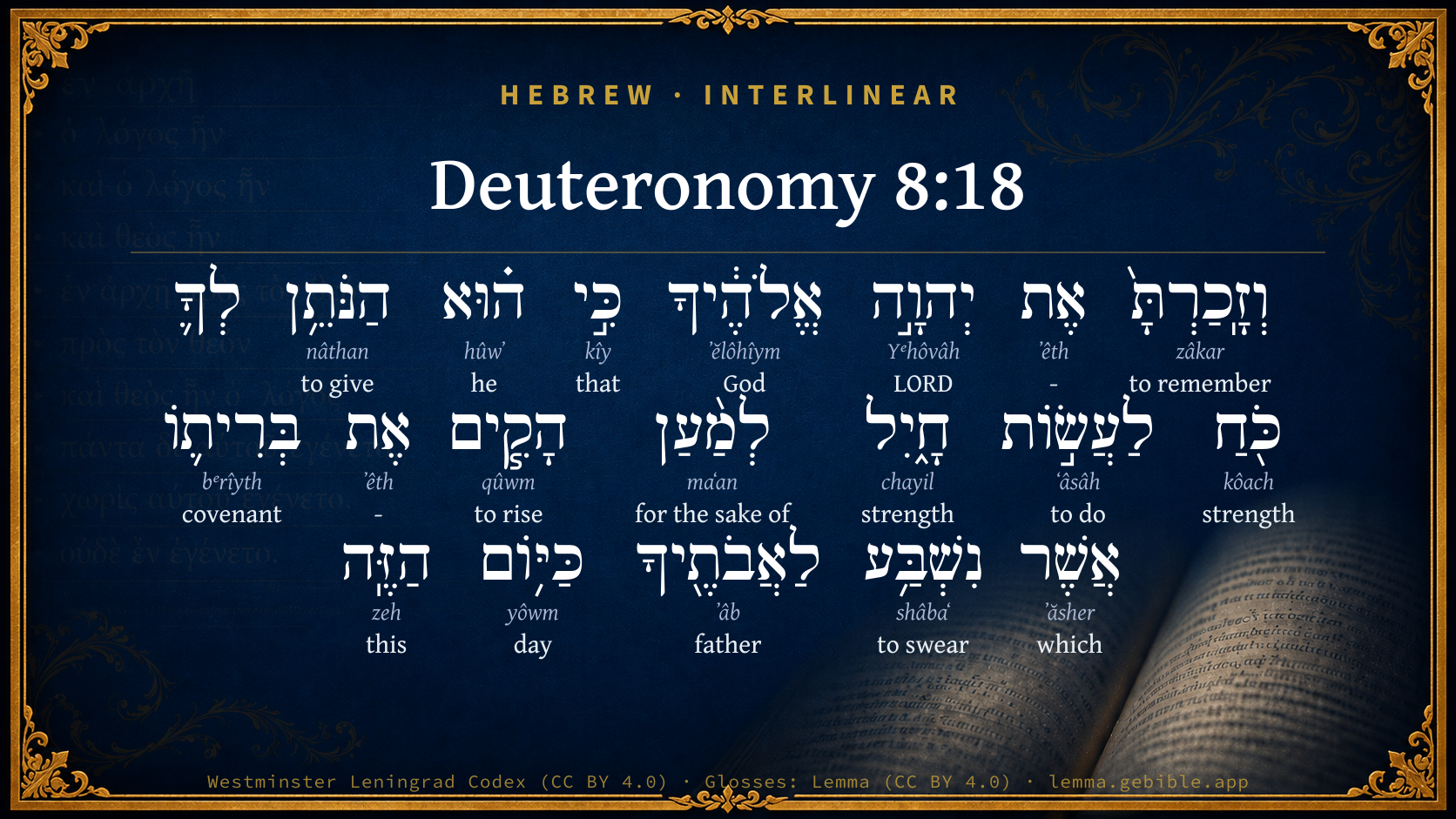
Hebrew (Westminster Leningrad Codex) Deuteronomy 8:18 appears in the Hebrew Old Testament. The text above is from the Westminster Leningrad Codex. Each word links to its Strong’s number, a concise gloss, and parsing drawn from the Open Scriptures Hebrew Bible morphology. Click any word for its full Brown-Driver-Briggs (BDB) entry.
Download image
Cite this verse

Deuteronomy 8:18 (World English Bible). Public Domain. Lemma interlinear Bible study tool, https://lemma.gebible.app/v/deuteronomy/8/18.

Show BibTeX & RIS
BibTeX
RIS
English Translation
But you shall remember Yahweh your God, for it is he who gives you power to get wealth; that he may establish his covenant which he swore to your fathers, as at this day.
World English Bible · Public Domain
Download a study sheet

One document with this verse’s original text, its word-by-word gloss line, the meaning frame, cross-references with their text, attributed commentary, and full source and license credits — printable, and it pastes into notes with its structure intact.

This verse Autodidact and up

Study sheet (.html) Plain text (.txt)

A passage Seminary Student

Up to 50 verses in one chapter. A passage sheet keeps up to 6 commentary sources and 12 cross-references per verse, in the order this page ranks them, and says so on the sheet whenever that leaves anything out. Ask for a single verse and you get the Autodidact verse sheet above.

Everything on this page stays free to read, with no account — the sheet is a download of what is already on screen, not access to it.

Want to remove ads? Support Godless Engineer
Compare translations 3

The same verse in 3 English versions, stacked beneath the original-language interlinear above. Click any original word for its lexicon entry.

Each is an independent rendering of the whole verse — the interlinear is not word-aligned to these translations.

Highlighted words mark where these versions differ — a whole-verse word diff, not a word-by-word alignment.

  • World English Bible Public Domain
    But you shall remember Yahweh your God, for it is he who gives you power to get wealth; that he may establish his covenant which he swore to your fathers, as at this day.
  • King James Version Public Domain
    But thou shalt remember the LORD thy God: for it is he that giveth thee power to get wealth, that he may establish his covenant which he sware unto thy fathers, as it is this day.
  • unfoldingWord Literal Text CC BY-SA 4.0
    And you shall remember Yahweh your God, for he is the one who gives to you power to make wealth so that he may establish his covenant that he swore to your fathers, as this day.

unfoldingWord Literal Text — © unfoldingWord, licensed CC BY-SA 4.0. Word-aligned USFM3 via Door43 (git.door43.org/unfoldingWord/en_ult).

Versions to compare (up to 4)

3 of 4 selected

Show all 18 translations

Every available English version of this verse, each an independent rendering of the whole verse.

  • World English Bible Public Domain
    But you shall remember Yahweh your God, for it is he who gives you power to get wealth; that he may establish his covenant which he swore to your fathers, as at this day.
  • Berean Standard Bible Public Domain
    But remember that it is the LORD your God who gives you the power to gain wealth, in order to confirm His covenant that He swore to your fathers even to this day.
  • Majority Standard Bible Public Domain
    But remember that it is the LORD your God who gives you the power to gain wealth, in order to confirm His covenant that He swore to your fathers even to this day.
  • King James Version Public Domain
    But thou shalt remember the LORD thy God: for it is he that giveth thee power to get wealth, that he may establish his covenant which he sware unto thy fathers, as it is this day.
  • American Standard Version (1901) Public Domain
    But thou shalt remember Jehovah thy God, for it is he that giveth thee power to get wealth; that he may establish his covenant which he sware unto thy fathers, as at this day.
  • Revised Version (1885) Public Domain
    But thou shalt remember the LORD thy God, for it is he that giveth thee power to get wealth; that he may establish his covenant which he sware unto thy fathers, as at this day.
  • Geneva Bible (1599) Public Domain
    But remember the Lord thy God: for it is he which giueth thee power to get substance to establish his couenant which he sware vnto thy fathers, as appeareth this day.
  • Douay-Rheims (1899) Public Domain
    But remember the Lord thy God, that he hath given thee strength, that he might fulfil his covenant, concerning which he swore to thy fathers, as this present day sheweth.
  • Young's Literal Translation Public Domain
    `And thou hast remembered Jehovah thy God, for He it `is' who is giving to thee power to make wealth, in order to establish His covenant which He hath sworn to thy fathers as `at' this day.
  • Literal Standard Version CC BY-SA 4.0
    And you have remembered your God YHWH, for it [is] He who is giving power to you to make wealth, in order to establish His covenant which He has sworn to your fathers, as [at] this day.
  • Unlocked Literal Bible CC BY-SA 4.0
    But you will call to mind Yahweh your God, for it is he who gives you the power to get wealth; that he may establish his covenant that he swore to your fathers, as it is today.
  • unfoldingWord Literal Text CC BY-SA 4.0
    And you shall remember Yahweh your God, for he is the one who gives to you power to make wealth so that he may establish his covenant that he swore to your fathers, as this day.
  • Darby Bible Public Domain
    But thou shalt remember Jehovah thy God, that it is he who giveth thee power to get wealth, that he may establish his covenant which he swore unto thy fathers, as it is this day.
  • World Messianic Bible Public Domain
    But you shall remember the LORD your God, for it is he who gives you power to get wealth, that he may establish his covenant which he swore to your fathers, as it is today.
  • Webster's Bible Public Domain
    But thou shalt remember the LORD thy God: for it is he that giveth thee power to get wealth, that he may establish his covenant which he swore to thy fathers, as it is this day.
  • Free Bible Version CC BY-SA 4.0
    But remember it's the Lord your God who gives you the ability to become rich, in order to fulfill his agreement he promised to your forefathers that still exists today.
  • Bible in Basic English Public Domain
    But keep in mind the Lord your God: for it is he who gives you the power to get wealth, so that he may give effect to the agreement which he made by his oath with your fathers, as at this day.
  • JPS Tanakh (1917) Public Domain
    But thou shalt remember the LORD thy God, for it is He that giveth thee power to get wealth, that He may establish His covenant which He swore unto thy fathers, as it is this day.

Literal Standard Version (2020), Covenant Press — licensed CC BY-SA 4.0. Text via the HelloAO Bible API (eBible.org). Unlocked Literal Bible (unfoldingWord) — licensed CC BY-SA 4.0. Text via the HelloAO Bible API (eBible.org). unfoldingWord Literal Text — © unfoldingWord, licensed CC BY-SA 4.0. Word-aligned USFM3 via Door43 (git.door43.org/unfoldingWord/en_ult). Free Bible Version, Dr. Jonathan Gallagher — licensed CC BY-SA 4.0. Text via the HelloAO Bible API (eBible.org).

Word by word

More ways to search: Search by grammar → Find every occurrence → Compare this word →

Practice this passage: Drill this verse → Learn its vocabulary →

כֹּ֖חַ
kôach
H3581
“strength”
Noun, Common, Masculine, Singular, Absolute
Part of Speech
Noun
Type
Common
Gender
Masculine
Number
Singular
State
Absolute
Full BDB Definition

Origin: from an unused root meaning to be firm

TWOT: 973 . 1

strength, power, might - human strength - strength (of angels) - power (of God) - strength (of animals) - strength, produce, wealth (of soil) - a small reptile, probably a kind of lizard, which is unclean - perhaps an extinct animal, exact meaning is unknown
  1. וְזָֽכַרְתָּ֙ zâkar H2142 “and · to remember” Conjunction + Verb, Qal, Sequential Perfect, 2nd Person, Masculine, Singular
  2. אֶת ʼêth H853 “-” Particle, Direct Object
  3. יְהוָ֣ה Yᵉhôvâh H3068 “LORD” Noun, Proper
  4. אֱלֹהֶ֔יךָ ʼĕlôhîym H430 “God(s) · your” Noun, Common, Masculine, Plural, Construct + Suffix, Personal, 2nd Person, Masculine, Singular
  5. כִּ֣י kîy H3588 “that” Conjunction
  6. ה֗וּא hûwʼ H1931 “he” Pronoun, Personal, 3rd Person, Masculine, Singular
  7. הַנֹּתֵ֥ן nâthan H5414 “the · giving” Particle, Definite Article + Verb, Qal, Participle Active, Masculine, Singular, Absolute
  8. לַעֲשׂ֣וֹת ʻâsâh H6213 “to do” Preposition + Verb, Qal, Infinitive Construct
  9. חָ֑יִל chayil H2428 “strength” Noun, Common, Masculine, Singular, Absolute
  10. לְמַ֨עַן maʻan H4616 “for the sake of” Preposition
  11. הָקִ֧ים qûwm H6965 “to rise” Verb, Hiphil, Infinitive Construct
  12. אֶת ʼêth H853 “-” Particle, Direct Object
  13. בְּרִית֛וֹ bᵉrîyth H1285 “covenant · his” Noun, Common, Feminine, Singular, Construct + Suffix, Personal, 3rd Person, Masculine, Singular
  14. אֲשֶׁר ʼăsher H834 “which” Particle, Relative
  15. נִשְׁבַּ֥ע shâbaʻ H7650 “to swear” Verb, Niphal, Perfect, 3rd Person, Masculine, Singular
  16. לַאֲבֹתֶ֖יךָ ʼâb H1 “to/for · fathers · your” Preposition + Noun, Common, Masculine, Plural, Construct + Suffix, Personal, 2nd Person, Masculine, Singular
  17. כַּיּ֥וֹם yôwm H3117 “like/as the · day” Preposition, Determined + Noun, Common, Masculine, Singular, Absolute
  18. הַזֶּֽה zeh H2088 “the · this” Particle, Definite Article + Pronoun, Demonstrative, Masculine, Singular

About this verse

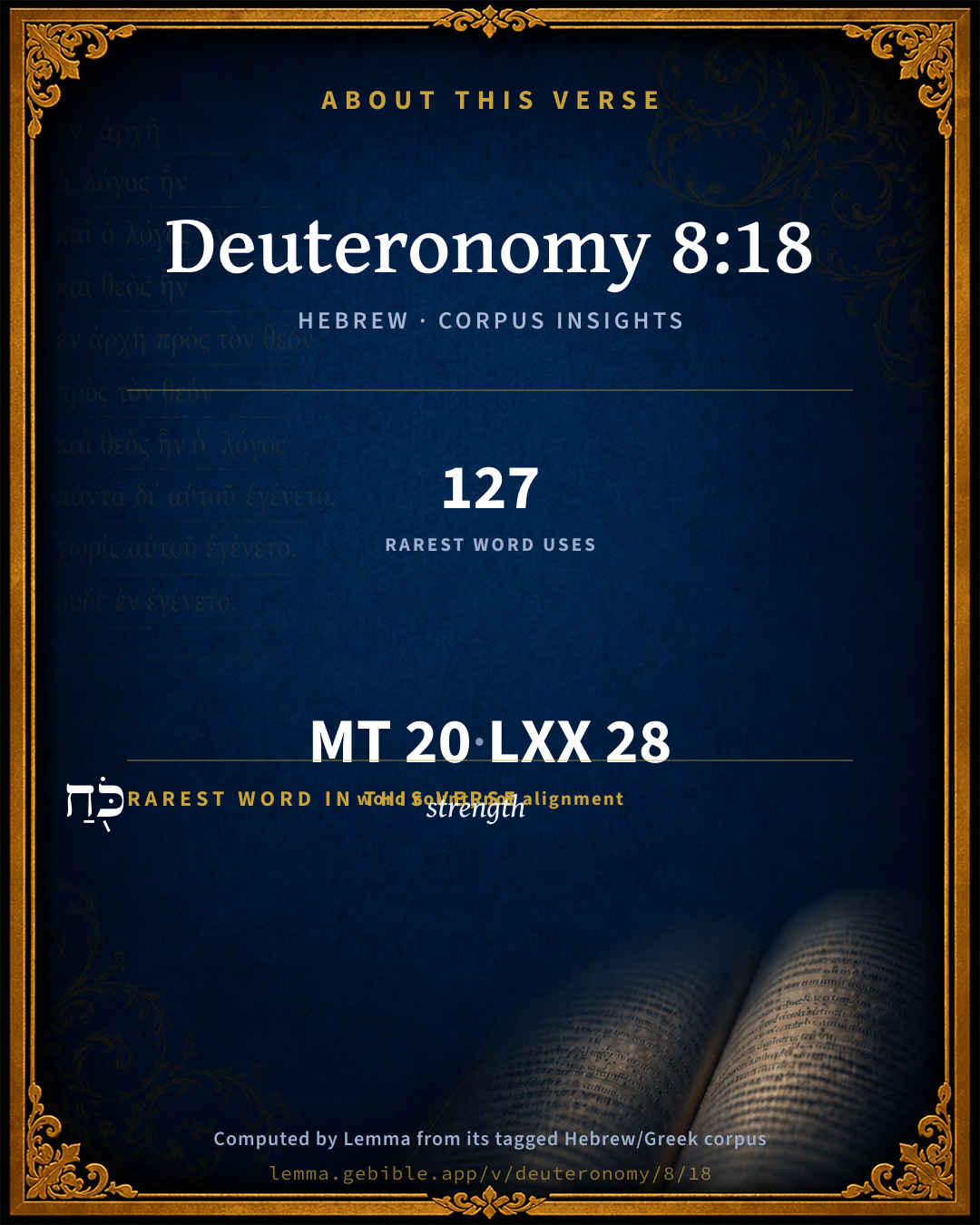
These counts appear in no published source. They are computed here, from the morphology-tagged text and Lemma’s own curated glosses. What Lemma adds →

20
words
18
distinct lemmas
Pentateuch
section

Grammatical profile

  • 5 verbs
  • 7 nouns
  • 2 pronouns
  • 2 prepositions
  • 1 conjunction
  • 3 particles

Verb forms

  • וְזָֽכַרְתָּ֙ Qal · Sequential Perfect
  • הַנֹּתֵ֥ן Qal · Participle Active
  • לַעֲשׂ֣וֹת Qal · Infinitive Construct
  • הָקִ֧ים Hiphil · Infinitive Construct
  • נִשְׁבַּ֥ע Niphal · Perfect

Hebrew & Septuagint length

In English translation the verse runs 34 words from the Hebrew and 34 from the Septuagint (LXX English) — the same length.

A rough comparison of the two English renderings, which tokenize alike — not a word-level alignment.

Word counts can differ between the Hebrew and the Greek without any difference in meaning — e.g. the Hebrew direct-object marker אֵת has no separate Greek word, and Greek often adds the article ὁ.

In the original languages it is 20 Hebrew tokens and 28 Greek tokens — but the two are counted differently (Hebrew bundles its prefixes and suffixes into one token; the Greek is in lemma form), so that isn’t a like-for-like length.

Cross-references

6

Topical passages linked to Deuteronomy 8:18 in the Treasury of Scripture Knowledge — connected by theme and wording, ordered by reader-vote popularity; previews shown in the World English Bible.

  • Proverbs 10:22 Yahweh's blessing brings wealth, And he adds no trouble to it.
  • Hosea 2:8 For she did not know that I gave her the grain, the new wine, and the oil, And multiplied to her silver and gold, which they used for Baal.
  • Deuteronomy 7:8 but because Yahweh loves you, and because he would keep the oath which he swore to your fathers, has Yahweh brought you out with a mighty hand, and redeemed you out of the house of bondage, from the hand of Pharaoh king of Egypt.
  • Psalms 127:1–2 Unless Yahweh builds the house, They labor in vain who build it. Unless Yahweh watches over the city, The watchman guards it in vain.
  • Deuteronomy 7:12 It shall happen, because you listen to these ordinances, and keep and do them, that Yahweh your God will keep with you the covenant and the loving kindness which he swore to your fathers:
  • Psalms 144:1 Blessed be Yahweh, my rock, Who teaches my hands to war, And my fingers to battle:

Cross-references courtesy of OpenBible.info (CC BY 4.0).

Hebrew and Greek witnesses Masoretic Hebrew ↔ Greek Septuagint

The same verse in the two great witnesses to the Old Testament, shown verse-for-verse.

These are two independent witnesses, not word-aligned to each other, and the Septuagint is shown in lemma (dictionary) form.

Hebrew Deuteronomy 8:18 Masoretic · Westminster Leningrad Codex

וְזָֽכַרְתָּ֙ אֶת יְהוָ֣ה אֱלֹהֶ֔יךָ כִּ֣י ה֗וּא הַנֹּתֵ֥ן לְךָ֛ כֹּ֖חַ לַעֲשׂ֣וֹת חָ֑יִל לְמַ֨עַן הָקִ֧ים אֶת בְּרִית֛וֹ אֲשֶׁר נִשְׁבַּ֥ע לַאֲבֹתֶ֖יךָ כַּיּ֥וֹם הַזֶּֽה

But you shall remember Yahweh your God, for it is he who gives you power to get wealth; that he may establish his covenant which he swore to your fathers, as at this day.

World English Bible · Public Domain

Greek LXX Deuteronomy 8:18 Septuagint · lemma form

καί μιμνήσκω κύριος ὁ θεός σύ ὅτι αὐτός σύ δίδωμι ἰσχύς ὁ ποιέω δύναμις καί ἵνα ἵστημι ὁ διαθήκη αὐτός ὅς ὄμνυμι κύριος ὁ πατήρ σύ ὡς σήμερον

But you shall remember the Lord your God, that he gives you strength to get wealth; even that he may establish his covenant, which the Lord swore to your fathers, as at this day.

LXX2012 (modern English Septuagint) · Public Domain

Hebrew: Westminster Leningrad Codex (CC BY 4.0). Greek: Septuagint (public domain); English from LXX2012 (modern English Septuagint) (Public Domain). How the Septuagint differs from the Hebrew →

Targum (Aramaic paraphrase)

2

The Targum is the ancient Jewish Aramaic paraphrase of the Hebrew Scriptures — an interpretive translation, not the Hebrew text itself. Onkelos (literal) and Pseudo-Jonathan (expansive) render the Torah, and Jonathan the Prophets. Coverage is partial: where no permissively-licensed English translation exists for a verse, only the Aramaic is shown. This is verse-level text, not a word-by-word alignment to the Hebrew.

  1. Targum Onkelos Torah (Genesis–Deuteronomy)
    וְתִדְכַּר יָת יְיָ אֱלָהָךְ אֲרֵי הוּא יָהֵב לָךְ עֵצָה לְמִקְנֵי נִכְסִין בְּדִיל לְקַיָמָא יָת קְיָמֵהּ דִי קַיִים לְאֲבָהָתָךְ כְּיוֹמָא הָדֵין

    (no public-domain English translation for this verse)

    Targum Onkelos — Aramaic: “Onkelos Genesis” (public domain); “Onkelos Exodus” (public domain); “Onkelos Leviticus” (public domain); “Onkelos Numbers” (public domain); “Onkelos Deuteronomy” (public domain). English: “Sefaria Community Translation” (CC0 1.0 (public-domain dedication)); “J.W. Etheridge. The Targums of Onkelos and Jonathan Ben Uzziel on the Pentateuch. London: Longmans, Green, 1862” (public domain). Text via Sefaria.

  2. Targum Pseudo-Jonathan Torah (Genesis–Deuteronomy)
    וְתֶהֱווֹן דְּכִירִין יַת יְיָ אֱלָהָכוֹן אֲרוּם הוּא דִּיהַב לְכוֹן מִלְכָּא לְמִקְנֵי נִיכְסִין מִן בִּגְלַל לְקַיָימָא יַת קְיָימֵיהּ דְּקַיֵּים לְאַבְהַתְכוֹן כִּזְמַן יוֹמָא הָדֵין

    but remember the Lord your God; for He it is who giveth thee counsel whereby to get wealth; that He may confirm the covenant which He sware to your fathers at the time of this day.

    Targum Pseudo-Jonathan — Aramaic: “Targum Jonathan on Genesis” (public domain); “Targum Jonathan on Exodus” (public domain); “Targum Jonathan on Leviticus” (public domain); “Targum Jonathan on Numbers” (public domain); “Targum Jonathan on Deuteronomy” (public domain). English: “The Targum of Jonathan ben Uzziel, trans. J. W. Etheridge, London, 1862” (public domain). Text via Sefaria.

Commentary

Notes on Deuteronomy 8:18 from classic Christian and Jewish commentators (each source and its license shown beneath its notes). The classic Christian expositions comment on the surrounding passage and are grouped to its opening verse, so a note may address several verses; the Jewish commentaries on the Tanakh (Rashi and others) are per-verse, so they appear only where the commentator wrote on this verse.

Lemma curates 59 commentaries, every one of them public domain or Creative Commons licensed, each selected and text-cleaned for this edition rather than reprinted as found. About our sources →

The Biblical Illustrator

Joseph S. Exell

Deu_8:18

Remember the Lord thy God, for it is He that giveth thee power to get wealth.

To remember God is the way to get wealth

1. The duty enjoined. Thou shalt remember the Lord, etc.

1. In point of contemplation to remember Him, that is, to think of Him, and to have Him often in our minds. Theres no man that forgets his treasure; wherever that is, there will be also his heart, as our Saviour tells us. We need not call upon worldly men to remember their gold and silver and riches, they will think upon these of their own accord, and all because such things as these are dear with them. In like manner will it be with us to God; if He be our treasure, we shall remember and daily think of Him, as it is fitting for us to do.

2. As in point of contemplation, so also in point of affection. We are said to remember anyone, not when barely we think upon him, but when we think upon him with respect, when he is not only in our thoughts but in our hearts. And thus likewise are we said to remember God.

3. In point of obedience to remember God is to be subject to Him, and to do that which He requires. Those that Walk in ways of opposition and contrariety to God, they are said to forget Him. Consider this ye that forget God (Psa_50:22).

4. In point of address and seeking to Him, and reliance and dependence upon Him. When anything is to be done by us, or for us, that we be sure to call upon God Himself for the prospering of it to us (Pro_3:5-6).

5. In point of thankfulness and acknowledgment we are then said to remember God, when we own Him in all the mercies which we enjoy from Him. This is the proper drift of this present Scripture, as we may see by the context, in Deu_8:10-11, etc., of this chapter. When thou hast eaten and art full, thou shalt bless the Lord thy God for the good land which He hath given thee. Beware that thou forget not the Lord thy God, in not keeping His commandments and His judgments, etc. Because, indeed, it is that which we are naturally and commonly too prone and subject unto.

(1) From His sovereignty, that He is the Lord, we should remember Him for that, and accordingly yield all respect and acknowledgment to Him.

(2) From the word of propriety, and that interest which He has in us and we in Him: Thy God.

II. The reason annexed. For it is He that giveth thee power to get wealth, which passage may be considered two ways. First, in its absolute consideration; and, secondly, in its connexion. We will look upon it first of all in the former consideration, as it is absolute, and by way of proposition.

1. Emphatically. When it is said here He gives power, this power, it may be said, laid forth according to sundry explications.

(1) He gives the skill and faculty which does tend and conduce hereunto. All your arts and trades of your several societies in the city, and ability for the managing of them, God is the author and giver of them. And being the giver of them, He is also consequently the giver of that wealth that comes by them. He gives thee power to get wealth, while He gives thee skill and understanding. And this again not only in the general habit, but also as to the particular act and improvement and the exercise of that habit which is in Him.

(2) He gives thee power to get wealth, that is, He gives thee occasion and opportunity to do so. Thus in a way of husbandry, there is the seasonableness of the weather. Thus in a way of merchandise, there is the favourableness of the seas and waters and winds, which are at Gods command and disposing.

(3) The power of success: it is He that gives this likewise, when all things are prepared in the means as much as can be, yet there is a further blessing which is required for the perfecting of them. And this is also from God Himself. It is the blessing of the Lord that makes rich, and adds no sorrow with it, as Solomon tells us (Pro_10:22).

(4) It is God that gives thee power to get wealth; that is, that gives thee grace, and makes thy gettings to he lawful to thee. To get wealth in Gods way and according to His approbation; this is power to get wealth indeed. And this also, together with all the former, is the gift of God.

2. Exclusively. When it is said here that He gives this power, this is to be taken not only emphatically, but exclusively; and so there are these intimations in it.

(1) That wealth and riches and great estates they are not matters of mere accident, and casualty, and chance; but that there is a special hand of Providence in them.

(2) It is not from ourselves neither, that we do any time come to be rich and to Increase in wealth. It is the gilt of God.

(3) It is not from other men neither, it is exclusive of them. Parents and friends and progenitors, and such as these. Indeed, Solomon tells us in one place that houses and riches are the inheritance of fathers (Pro_19:14). But this must be understood so far as they are able to make them, which is not absolutely, but with its restriction. How many have there been in the world who, though they have had great estates left them by others, yet notwithstanding have been poor themselves; and have not known either how to increase or how to keep that which has been left them. We have seen how He does it emphatically; He is not wanting in doing it; we have seen also how He does it exclusively. There is none to purpose that does it but He. First, He gives thee power to keep it; and, secondly, He gives thee power to use it. (T. Horton, D. D.)

The theology of money

What a blow this text strikes at one of the most popular and mischievous fallacies in common life, namely, that man is the maker of his own money! Men who can see God in the creation of worlds cannot see Him suggesting an idea in business, smiling on the plough, guiding the merchants pen, and bringing summer into a brain long winter-bound and barren. Lebanon and Bashan are not more certainly Divine creations than are the wool and flax which cover the nakedness of man. To the religious contemplation, the sanctified and adoring mind, the whole world is one sky-domed church, and there is nothing common or unclean. God wishes this fact to be kept in mind by His people. In this instance, as in many others, God makes His appeal to recollection: Thou shalt remember. The fact is to be ever present to the memory; it is to be as a star by which our course upon troubled waters is to be regulated; it is to be a mystic cloud in the daytime, a guiding fire in the night season. The rich memory should create a rich life. An empty memory is a continual temptation. Mark the happy consequences of this grateful recollection. First of all, God and wealth are ever to be thought of together. The silver and the gold are Mine. There is but one absolute proprietor. We hold our treasures on loan; we occupy a stewardship. Consequent upon this is a natural and most beautiful humility. What hast thou that thou hast not received? When the trader sits down in the evening to count his days gains, he is to remember that the Lord his God gave him power to get wealth. When the workman throws down the instrument of his labour that he may receive the reward of his toil, he is to remember that the Lord his God gave him power to get wealth. When the young man receives the first payment of his industry, he is to remember that the Lord his God gave him power to get wealth. Thus the getting of money becomes a sacred act. This, then, is the fundamental principle upon which Christians are to proceed, namely, that God giveth man power to get wealth, and consequently that God sustains an immediate relation to the property of the world. Take the case of a young man just entering business. If his heart is uneducated and unwatched, he will regard business as a species of gambling; if his heart be set upon right principles, lie will esteem business as a moral service, as the practical side of his prayers, a public representation of his best desires and convictions. In course of time the young man realises money on his own account. Looking at his gold and silver, he says, I made that. There is a glow of honest pride on his cheek. He looks upon the reward of his industry, and his eyes kindle with joy. Whilst he looks upon his first-earned gold, the Bible says to him gently and persuasively, Thou shalt remember the Lord thy God; for it is He that giveth thee power to get wealth. Instantly his view of property is elevated, enlarged, sanctified. He was just about to say that his own arm had gotten him the victory, and to forget that, through the image, is Caesars yet the gold is Gods. What, then, is the natural line of thought through which the successful man would run under such circumstances? It would lie in some such direction as this: What can be the meaning of this word remember? Does it not call me to gratitude? Is it not intended to turn my heart and my eye heavenward? As God has given me power to get wealth, am I not bound to return some recognition of His goodness and mercy? Honour the Lord with thy substance, and with the first fruits, of all thine increase. Supposing this to be done, what is the result which is promised to accrue? That result is stated in terms that are severely logical: So shall thy barns be filled with plenty, and thy presses shall burst out with new wine. The text has called us to an act of remembrance, and in doing so has suggested the inquiry whether there is any such act of remembrance on the part of God Himself? The Scripture is abundant in its replies to this inquiry: For God is not unrighteous to forget your work and labour of love, which ye have showed towards His name, in that ye have ministered to the saints, and do minister. Jesus Christ Himself has laid down the same encouragement with even minuter allusion: Whosoever shall give to drink unto one of these little ones a cup of cold water only in the name of a disciple, verily I say unto you, he shall in no wise lose his reward. (J. Parker, D. D.)

The philosophy of worldly success

1. How worldly success is to be obtained. By strict obedience to Gods laws; by this only. Work is what He demands, and work is the only condition under which the prize may be won.

2. The nature of the profit we are to look for. Not merely worldly profit. No life so dreary, so deadly as that of the mere millionaire. The joys of the true mans life he cannot taste; the holy fellowships of spiritual being he cannot enter,: God stamps him reprobate. There is a vast wealth of faculty in him, fusting from want of use. And power unused soon gets acrid, and mordant, and gnaws and wears within.

3. Why we should remember the Lord God. Because--

(1) It will bring us out at once into the glad sunlight, and will make even our toil lightsome.

(2) It will spare us all wearing and crushing anxieties.

(3) It will save us the shame and anguish of finding ourselves bankrupt at last and forever. (J. B. Brown, B. A.)

God acknowledged

When Speaker Crooke was presented to Queen Elizabeth in the House of Lords on the occasion of his election, he said that England had been defended against the Spaniards and their Armada by Her Majestys mighty arm. The Queen interrupted him and from her throne, said: No; but by the mighty hand of God, Mr. Speaker.

God the original source of wealth

He that would thus critically examine his estate upon interrogatories, put every part of it upon the rack and torture to confess without any disguise from whence it came, whether down the ladder from heaven, or up out of the deep--for there it seems by the poets Plutus or riches hath a residence also--by what means it was conveyed, by whose directions it travelled into that coast, and what the end of its coming is, and so learn the genealogy as it were of all his wealth, would certainly acknowledge that he were fallen upon a most profitable inquiry. For beside that he would find out all the ill-gotten treasure, that gold of Toulouse that is so sure to help melt all the rest, that which is gotten by sacrilege, by oppression, by extortion, and so take timely advice to purge his lawful inheritance from such noisome unwholesome acquisitions, and thrive the better forever after the taking so necessary a purgation--he will, I say, over and above see the original of all his wealth, all that is worthy to be called such, either immediately or mediately from God, immediately without any cooperation of ours, as that which is left to us by inheritance from honest parents--our fortunes and our Christianity together, mediately as that which our lawful labour, our planting and watering hath brought down upon us, wholly from Gods prospering or giving of increase.

The Biblical Illustrator, edited by Joseph S. Exell (c. 1880s–1900s) — public domain. Text from a community e-Sword module.

Tyndale Open Study Notes

Tyndale Open Resources

8:18 This was not the covenant that God made with the previous generation of Israelites at Sinai but the one he first made with Abraham (Gen 15:1-21; 17:1-21), then Isaac (Gen 26:1-5) and Jacob (Gen 28:1-4, 13-15; 46:1-4). • In order to be legal and proper, a covenant had to be sworn to with an oath that all parties to the agreement uttered. Although by his very nature God could never rescind a promise, he honored the protocol (see Deut 7:12).

Tyndale Open Study Notes — © Tyndale Open Resources, licensed CC BY-SA 4.0. Text via the HelloAO Bible API.

Geneva Bible (1599)

Geneva Bible translators

If things concerning this life, proceed only of God’s mercy: much more spiritual gifts and life everlasting.

Geneva Bible (1599) marginal notes — public domain. Text via Bolls.life.

Adam Clarke's Commentary

Verse 18. God - giveth thee power to get wealth] Who among the rich and wealthy believes this saying? Who gives wisdom, understanding, skill, bodily strength, and health? Is it not God? And without these, how can wealth be acquired? Whose is providence? Who gives fertility to the earth? And who brings every proper purpose to a right issue? Is it not God? And without these also can wealth be acquired? No. Then the proposition in the text is self-evident: it is God that giveth power to get wealth, and to God the wealthy man must account for the manner in which he has expended the riches which God hath given him.

Adam Clarke's Commentary on the Bible (1810–1826) — public domain. Text from a community e-Sword/MySword module.

The Cambridge Bible for Schools and Colleges

gen. ed. J. J. S. Perowne

18. Renewed emphasis on the writer’s chief principle that Jehovah is the author of the people’s blessings and that because of His faithfulness Deu_7:9; Deu_7:12 ff., etc., etc.

as at this day] The writer again betrays his date; it is when Israel is securely established in the enjoyment of the wealth promised them: cp. Deu_2:30.

The Cambridge Bible for Schools and Colleges (gen. ed. J. J. S. Perowne; Cambridge University Press, 1878–1918) — public domain. Text from a community e-Sword module.

John Gill's Exposition

And it shall be, if thou do at all forget the Lord thy God,.... Either the mercies they received from him, not acknowledging they came from him, but ascribing them to themselves; or their duty to him, to whom they were so greatly obliged: and walk after other gods, and serve them, and worship them; which would be to forget him indeed, forsaking his worship, and giving homage and adoration to idols, which is what is intended by these expressions:

I testify against you this day that ye shall surely perish; by one judgment and calamity or another, as the sword, famine, pestilence, and captivity; there being nothing more provoking to God than idolatry, which so much detracts from his honour and glory: and which besides, in such a people, so highly favoured of God, it argued the basest ingratitude.

John Gill's Exposition of the Whole Bible (1746–1763) — public domain (CC PDM 1.0). Text via the HelloAO Bible API.

Matthew Poole's English Annotations

To get wealth; so this word is used, Num 24:18; Job 20:18; Pro 31:29.

Matthew Poole's English Annotations on the Holy Bible (1683–1685) — public domain. Text from a community e-Sword/MySword module.

unfoldingWord translationNotes

Door43 World Missions Community

General Information:

Moses continues to speak to the Israelites as if they are one person. (See: Forms of You)

But you will call to mind

This idiom is a command. AT: "But remember" (See: Idiom)

that he may establish

Possible meanings are 1) "in this way he establishes" or 2) "in this way he is faithful to establish."

that he may

"so he can"

establish

cause to stand or to remain

as it is today

"as he is doing now" or "as he is establishing his covenant now"

walk after other gods

Walking is a metaphor for obeying. AT: "serve other gods" (See: Metaphor)

against you ... you will ... before you ... you perish ... you would not ... your God

All these instances of "you" are plural. (See: Forms of You)

I testify against you

"I warn you" or "I tell you in front of witnesses"

you will surely perish

"you will certainly die"

before you

"in front of you"

would not listen to the voice of Yahweh

Here "the voice of Yahweh" means what Yahweh tells his people to do. AT: "would not obey Yahweh's commandments" (See: Metonymy)

translationWords

mind

power

covenant

oath

ancestor

walk

false god

worship

testimony

perish

nation

voice

unfoldingWord translationNotes — © Distant Shores Media and the Door43 World Missions Community, licensed CC BY-SA 4.0. Source: git.door43.org/Door43/en_tn.

Ramban (Nachmanides)

Rabbi Moshe ben Nachman (Ramban / Nachmanides)

AND THOU SHALT REMEMBER THE ETERNAL THY G-D, FOR IT IS HE WHO GIVETH THEE POWER TO GET WEALTH. It is known that Israelites are mighty men, valiant men for the war because they were likened to lions and to a ravenous wolf, Verse 27. and they vanquished the Canaanite kings in battle. Therefore he said, “If you should think, ‘my power and the might of my hand hath gotten me this wealth,’ you should remember G-d Who brought you forth from Egypt where you had no power or might of hand at all. You should further remember that He provided all your needs for you in the wilderness, where you had nought in the power of thy hand to survive. If so [concerning] this wealth which you have won by your strength as well, [you should bear in mind that] it is G-d Who gave you the power [that was necessary for you] to accumulate the wealth; and if you forget G-d He will consume thy flesh and thy body and you will perish, just as [the nations before you] perished, for all that forsake the Eternal shall be consumed. And then Moses reverted to bring yet another proof that you should not think ‘my power and the might of my hand etc.,’ and he said Hear, O Israel a true word from my mouth, that these nations are greater and mightier than thyself, and how will you vanquish them in battle? Besides, they have cities great and fortified up to the high heavens, and how will you capture them? Moreover, there is a people great and tall, the sons of the Anakim, whom thou knowest, Verse 2. from the spies who saw them, and of whom thou hast heard, Verse 2. from days of yore that no man can stand up against them. And when all this becomes clear to you, you should realize and believe from this day on that you will be unable to go over [the Jordan to do battle] before them at all until you know in your heart that the Eternal thy G-d is He Who goeth over before thee as a devouring fire, and He will destroy them, and He will bring them down., Verse 3. It is not the power and the might of hand He gave you, but the hand of G-d that did this to the mighty ones among them. This is an allusion to what is stated, and the Eternal cast down great stones from heaven upon them, and similarly it is said there, And there was no day like that before it or after it, that the Eternal hearkened unto the voice of a man; for the Eternal fought for Israel., Verse 14. The reference to the fortified cities he mentioned here is an allusion to the wall of Jericho that fell before the ark. This is what David said, For not by their own sword did they get the Land in possession, neither did their own arm save them; but Thy right hand, and Thine arm, and the light of Thy countenance, because Thou wast favorable unto them — the right hand of G-d and His [left] arm fought against their mighty ones, and the light of His countenance that was favorable unto them [the Israelites] gave them power over those who were slain in battle. Scripture refers to this in saying further, And I destroyed the Amorite before them, whose height was like the height of the cedars, and he was strong as the oaks; yet I destroyed his fruit from above, and his roots from beneath. He [the prophet Amos] singled out the Amorite because it was the mightiest [nation] among them, and it was G-d Who destroyed it.

Ramban (Nachmanides) on the Tanakh — English translation: “Commentary on the Torah by Ramban (Nachmanides). Translated and annotated by Charles B. Chavel. New York, Shilo Pub. House, 1971-1976” (CC BY 4.0). Text via Sefaria.

Lesson kit

Teaching starters — assembled from the data on this page, not authored interpretation. Every prompt links to the verse data it draws on. Edit before teaching.

Deuteronomy, in the Pentateuch, opens this verse with 20 words (18 distinct Hebrew lemmas). Its most distinctive word is kôach (“strength”). A historical commentator’s framing appears above. Read the whole chapter for the surrounding context.

Discussion questions

  1. The word kôach carries the sense “strength.” How does it shape the verse?
  2. Proverbs 10:22 shares this passage’s theme. How do the two illuminate each other?
  3. The translations on this page render this verse differently — a whole-verse word diff, not a word-by-word alignment. What might account for the different wordings?
  4. The verb «וְזָֽכַרְתָּ֙» is Qal Sequential Perfect. How does its form color the action?
  5. Reading how The Biblical Illustrator and Tyndale Open Study Notes read this verse, where do the two commentators agree and where do they part?

Things to notice

Reading settings

Reading text

Shown beneath each verse's original-language words.

Old Testament
Old Testament edition

Read the OT as the Masoretic Hebrew (MT) or the Greek Septuagint (LXX).

English shown for the Greek Septuagint (in the Hebrew ↔ Greek comparison).

Comparing translations? Open the Compare panel on any verse page to stack up to four side by side.