
1 Chronicles 12:8

Hebrew (Westminster Leningrad Codex) 1 Chronicles 12:8 appears in the Hebrew Old Testament. The text above is from the Westminster Leningrad Codex. Each word links to its Strong’s number, a concise gloss, and parsing drawn from the Open Scriptures Hebrew Bible morphology. Click any word for its full Brown-Driver-Briggs (BDB) entry.
Download image
Cite this verse

1 Chronicles 12:8 (World English Bible). Public Domain. Lemma interlinear Bible study tool, https://lemma.gebible.app/v/1-chronicles/12/8.

Show BibTeX & RIS
BibTeX
RIS
English Translation
Of the Gadites there separated themselves to David to the stronghold in the wilderness, mighty men of valor, men trained for war, that could handle shield and spear; whose faces were like the faces of lions, and they were as swift as the roes on the mountains;
World English Bible · Public Domain
Download a study sheet

One document with this verse’s original text, its word-by-word gloss line, the meaning frame, cross-references with their text, attributed commentary, and full source and license credits — printable, and it pastes into notes with its structure intact.

This verse Autodidact and up

Study sheet (.html) Plain text (.txt)

A passage Seminary Student

Up to 50 verses in one chapter. A passage sheet keeps up to 6 commentary sources and 12 cross-references per verse, in the order this page ranks them, and says so on the sheet whenever that leaves anything out. Ask for a single verse and you get the Autodidact verse sheet above.

Everything on this page stays free to read, with no account — the sheet is a download of what is already on screen, not access to it.

Want to remove ads? Support Godless Engineer
Compare translations 3

The same verse in 3 English versions, stacked beneath the original-language interlinear above. Click any original word for its lexicon entry.

Each is an independent rendering of the whole verse — the interlinear is not word-aligned to these translations.

Highlighted words mark where these versions differ — a whole-verse word diff, not a word-by-word alignment.

  • World English Bible Public Domain
    Of the Gadites there separated themselves to David to the stronghold in the wilderness, mighty men of valor, men trained for war, that could handle shield and spear; whose faces were like the faces of lions, and they were as swift as the roes on the mountains;
  • King James Version Public Domain
    And of the Gadites there separated themselves unto David into the hold to the wilderness men of might, and men of war fit for the battle, that could handle shield and buckler, whose faces were like the faces of lions, and were as swift as the roes upon the mountains;
  • unfoldingWord Literal Text CC BY-SA 4.0
    And from the Gadite, they separated themselves to David at the stronghold in the wilderness, warriors of valor, men of the army for battle, arrayers of the shield and spear, and faces of lions their faces, and like gazelles on the hills for hastening:

unfoldingWord Literal Text — © unfoldingWord, licensed CC BY-SA 4.0. Word-aligned USFM3 via Door43 (git.door43.org/unfoldingWord/en_ult).

Versions to compare (up to 4)

3 of 4 selected

Show all 18 translations

Every available English version of this verse, each an independent rendering of the whole verse.

  • World English Bible Public Domain
    Of the Gadites there separated themselves to David to the stronghold in the wilderness, mighty men of valor, men trained for war, that could handle shield and spear; whose faces were like the faces of lions, and they were as swift as the roes on the mountains;
  • Berean Standard Bible Public Domain
    Some Gadites defected to David at his stronghold in the desert. They were mighty men of valor, trained for battle, experts with the shield and spear, whose faces were like the faces of lions and who were as swift as gazelles on the mountains:
  • Majority Standard Bible Public Domain
    Some Gadites defected to David at his stronghold in the wilderness. They were mighty men of valor, trained for battle, experts with the shield and spear, whose faces were like the faces of lions and who were as swift as gazelles on the mountains:
  • King James Version Public Domain
    And of the Gadites there separated themselves unto David into the hold to the wilderness men of might, and men of war fit for the battle, that could handle shield and buckler, whose faces were like the faces of lions, and were as swift as the roes upon the mountains;
  • American Standard Version (1901) Public Domain
    And of the Gadites there separated themselves unto David to the stronghold in the wilderness, mighty men of valor, men trained for war, that could handle shield and spear; whose faces were like the faces of lions, and they were as swift as the roes upon the mountains;
  • Revised Version (1885) Public Domain
    And of the Gadites there separated themselves unto David to the hold in the wilderness, mighty men of valour, men trained for war, that could handle shield and spear; whose faces were like the faces of lions, and they were as swift as the roes upon the mountains;
  • Geneva Bible (1599) Public Domain
    And of the Gadites there separated them selues some vnto Dauid into the holde of the wildernesse, valiant men of warre, and men of armes, and apt for battel, which coulde handle speare and shielde, and their faces were like the faces of lyons, and were like the roes in the mountaines in swiftnesse,
  • Douay-Rheims (1899) Public Domain
    From Gaddi also there went over to David, when he lay hid in the wilderness most valiant men, and excellent warriors, holding shield and spear: whose faces were like the faces of a lion, and they were swift like the roebucks on the mountains.
  • Young's Literal Translation Public Domain
    And of the Gadite there have been separated unto David, to the fortress, to the wilderness, mighty of valour, men of the host for battle, setting in array target and buckler, and their faces the face of the lion, and as roes on the mountains for speed:
  • Literal Standard Version CC BY-SA 4.0
    And of the Gadite there have been separated to David, to the fortress, to the wilderness, mighty men of valor, men of the host for battle, setting in array buckler and spear, and their faces [are as] the face of the lion, and as roes on the mountains for speed:
  • Unlocked Literal Bible CC BY-SA 4.0
    Some Gadites joined David at the stronghold in the wilderness. They were fighting men, men trained for battle, who could handle shield and spear; whose faces were as fierce as the faces of lions. They were as swift as gazelles on the mountains.
  • unfoldingWord Literal Text CC BY-SA 4.0
    And from the Gadite, they separated themselves to David at the stronghold in the wilderness, warriors of valor, men of the army for battle, arrayers of the shield and spear, and faces of lions their faces, and like gazelles on the hills for hastening:
  • Darby Bible Public Domain
    And of the Gadites, there separated themselves to David in the stronghold in the wilderness mighty men of valour, men fit for the service of war, armed with shield and spear; whose faces were [like] the faces of lions, and who were swift as the gazelles upon the mountains:
  • World Messianic Bible Public Domain
    Some Gadites joined David in the stronghold in the wilderness, mighty men of valor, men trained for war, who could handle shield and spear; whose faces were like the faces of lions, and they were as swift as the gazelles on the mountains:
  • Webster's Bible Public Domain
    And of the Gadites there separated themselves to David in the hold in the wilderness men of might, and men of war fit for the battle, that could handle shield and buckler, whose faces were like the faces of lions, and were as swift as the roes upon the mountains;
  • Free Bible Version CC BY-SA 4.0
    Some warriors from the tribe of Gad went over to David's side when he was at the stronghold in the desert. They were strong and experienced warriors, battle-hardened, experts in the use of shields and spears. Their faces looked as fierce as lions, and they ran as fast as gazelles in the mountains.
  • Bible in Basic English Public Domain
    And some of the Gadites, siding with David, went to his strong place in the waste land, great and strong men, trained for war, expert in the use of arms, whose faces were like the faces of lions, and they were quick-footed like roes on the mountains;
  • JPS Tanakh (1917) Public Domain
    (12-9) And of the Gadites there separated themselves unto David to the stronghold in the wilderness, mighty men of valour, men trained for war, that could handle shield and spear; whose faces were like the faces of lions, and they were as swift as the roes upon the mountains;

Literal Standard Version (2020), Covenant Press — licensed CC BY-SA 4.0. Text via the HelloAO Bible API (eBible.org). Unlocked Literal Bible (unfoldingWord) — licensed CC BY-SA 4.0. Text via the HelloAO Bible API (eBible.org). unfoldingWord Literal Text — © unfoldingWord, licensed CC BY-SA 4.0. Word-aligned USFM3 via Door43 (git.door43.org/unfoldingWord/en_ult). Free Bible Version, Dr. Jonathan Gallagher — licensed CC BY-SA 4.0. Text via the HelloAO Bible API (eBible.org).

Word by word

More ways to search: Search by grammar → Find every occurrence → Compare this word →

Practice this passage: Drill this verse → Learn its vocabulary →

לַמְצַ֨ד
mᵉtsad
H4679
“to/for the · stronghold”
Preposition, Determined + Noun, Common, Feminine, Singular, Absolute
Part of Speech
Preposition + Noun
Type
Common
Gender
Feminine
Number
Singular
State
Absolute
Full BDB Definition

Origin: from H6679

TWOT: 1885c

fort, stronghold, fastness - mountain-fastness - stronghold
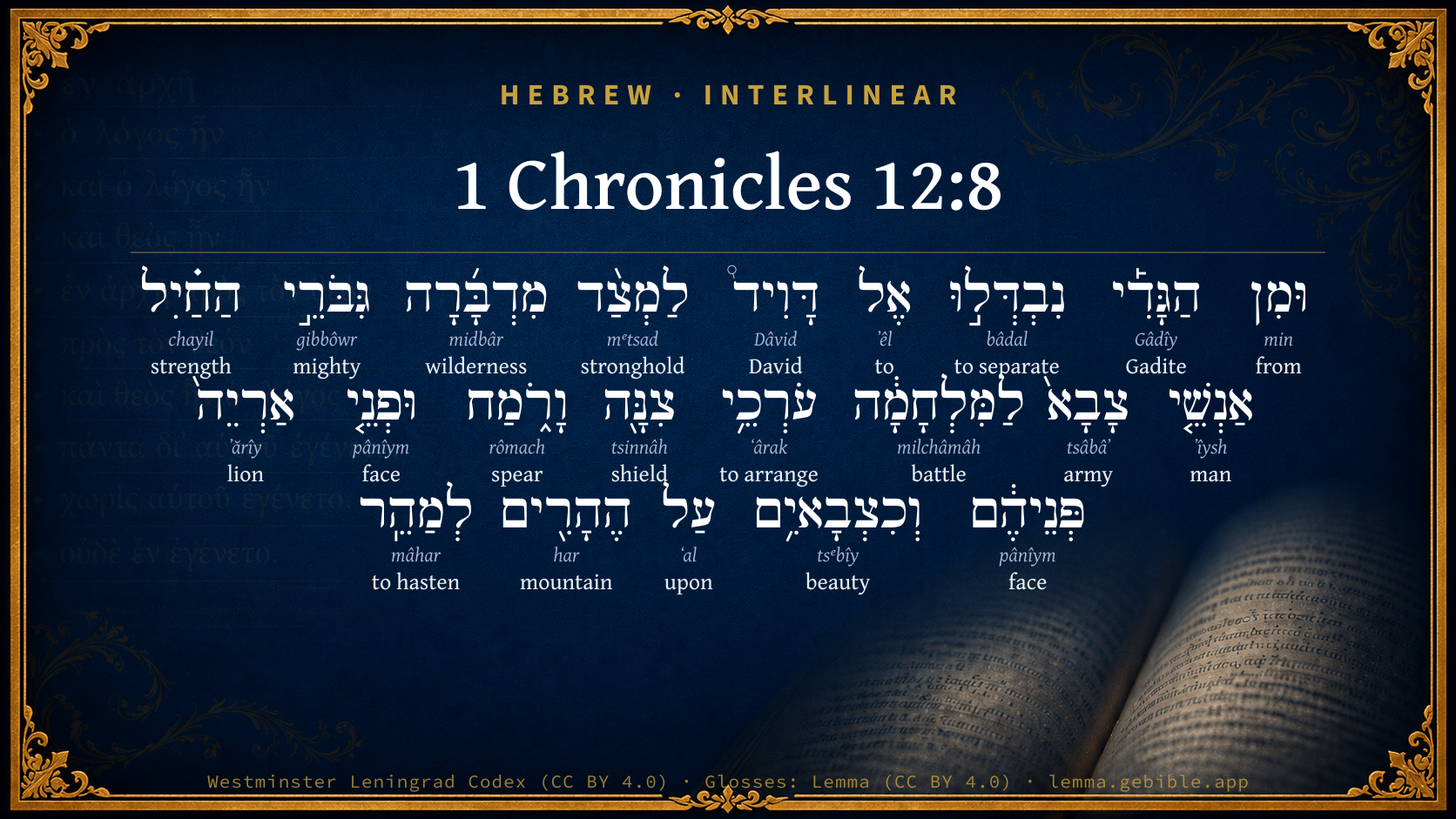
  1. וּמִן min H4480 “and · from” Conjunction + Preposition
  2. הַגָּדִ֡י Gâdîy H1425 “the · Gadite” Particle, Definite Article + Noun, Gentilic, Masculine, Singular, Absolute
  3. נִבְדְּל֣וּ bâdal H914 “to separate” Verb, Niphal, Perfect, 3rd Person, Common, Plural
  4. אֶל ʼêl H413 “to” Preposition
  5. דָּוִיד֩ Dâvid H1732 “David” Noun, Proper
  6. מִדְבָּ֜רָה midbâr H4057 “wilderness · toward” Noun, Common, Masculine, Singular, Absolute + Suffix, Demonstrative
  7. גִּבֹּרֵ֣י gibbôwr H1368 “mighty of” Adjective, Adjective, Masculine, Plural, Construct
  8. הַחַ֗יִל chayil H2428 “the · strength” Particle, Definite Article + Noun, Common, Masculine, Singular, Absolute
  9. אַנְשֵׁ֤י ʼîysh H376 “men of” Noun, Common, Masculine, Plural, Construct
  10. צָבָא֙ tsâbâʼ H6635 “army” Noun, Common, Both, Singular, Absolute
  11. לַמִּלְחָמָ֔ה milchâmâh H4421 “to/for the · battle” Preposition, Determined + Noun, Common, Feminine, Singular, Absolute
  12. עֹרְכֵ֥י ʻârak H6186 “arranging” Verb, Qal, Participle Active, Masculine, Plural, Construct
  13. צִנָּ֖ה tsinnâh H6793 “shield” Noun, Common, Feminine, Singular, Absolute
  14. וָרֹ֑מַח rômach H7420 “and · spear” Conjunction + Noun, Common, Masculine, Singular, Absolute
  15. וּפְנֵ֤י pânîym H6440 “and · face(s) of” Conjunction + Noun, Common, Both, Plural, Construct
  16. אַרְיֵה֙ ʼărîy H738 “lion” Noun, Common, Masculine, Singular, Absolute
  17. פְּנֵיהֶ֔ם pânîym H6440 “face(s) · their” Noun, Common, Both, Plural, Construct + Suffix, Personal, 3rd Person, Masculine, Plural
  18. וְכִצְבָאיִ֥ם tsᵉbîy H6643 “and · like/as · gazelles” Conjunction + Preposition + Noun, Common, Both, Plural, Absolute
  19. עַל ʻal H5921 “upon” Preposition
  20. הֶהָרִ֖ים har H2022 “the · mountains” Particle, Definite Article + Noun, Common, Masculine, Plural, Absolute
  21. לְמַהֵֽר mâhar H4116 “to hasten” Preposition + Verb, Piel, Infinitive Construct

About this verse

These counts appear in no published source. They are computed here, from the morphology-tagged text and Lemma’s own curated glosses. What Lemma adds →

22
words
21
distinct lemmas
Historical
section

Notable vocabulary

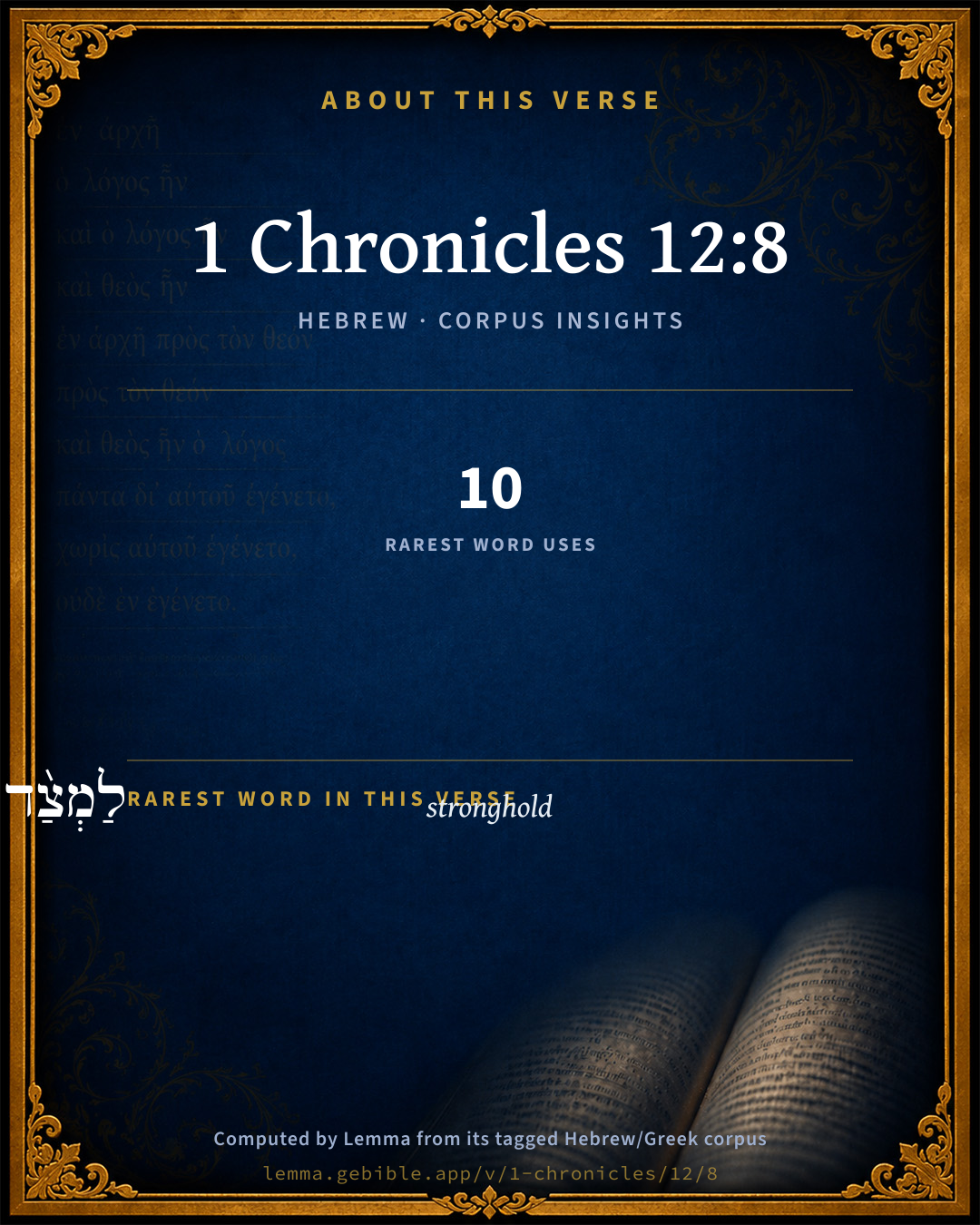
The rarest word here is לַמְצַ֨ד stronghold H4679 — appearing just 10 times in the whole Hebrew Bible.

Shared distinctive vocabulary

לַמְצַ֨ד stronghold H4679 occurs in 10 verses of the Hebrew Bible. Also found in:

Grammatical profile

  • 3 verbs
  • 15 nouns
  • 1 adjective
  • 3 prepositions

Verb forms

  • נִבְדְּל֣וּ Niphal · Perfect
  • עֹרְכֵ֥י Qal · Participle Active
  • לְמַהֵֽר Piel · Infinitive Construct

Repetition

A word recurs within this verse — often emphatic in Hebrew:

  • וּפְנֵ֤י face H6440 ×2

Hebrew & Septuagint length

In English translation the verse runs 47 words from the Hebrew and 41 from the Septuagint (LXX English) — closely comparable.

A rough comparison of the two English renderings, which tokenize alike — not a word-level alignment.

Word counts can differ between the Hebrew and the Greek without any difference in meaning — e.g. the Hebrew direct-object marker אֵת has no separate Greek word, and Greek often adds the article ὁ.

Cross-references

15

Topical passages linked to 1 Chronicles 12:8 in the Treasury of Scripture Knowledge — connected by theme and wording, ordered by reader-vote popularity; previews shown in the World English Bible.

  • 2 Samuel 2:18 The three sons of Zeruiah were there, Joab, and Abishai, and Asahel: and Asahel was as light of foot as a wild gazelle.
  • 2 Samuel 17:10 Even he who is valiant, whose heart is as the heart of a lion, will utterly melt; for all Israel knows that your father is a mighty man, and those who are with him are valiant men.
  • 2 Samuel 23:20 Benaiah the son of Jehoiada, the son of a valiant man of Kabzeel, who had done mighty deeds, he killed the two [sons of] Ariel of Moab: he went down also and killed a lion in the midst of a pit in time of snow.
  • 1 Samuel 23:14 David abode in the wilderness in the strongholds, and remained in the hill-country in the wilderness of Ziph. Saul sought him every day, but God didn't deliver him into his hand.
  • 1 Samuel 23:29 David went up from there, and lived in the strongholds of En Gedi.
  • 1 Samuel 24:22 David swore to Saul. Saul went home; but David and his men got them up to the stronghold.
  • 2 Samuel 1:23 Saul and Jonathan were lovely and pleasant in their lives, In their death they were not divided: They were swifter than eagles, They were stronger than lions.
  • 1 Chronicles 11:16 David was then in the stronghold, and the garrison of the Philistines was then in Bethlehem.
  • 1 Chronicles 11:22 Benaiah the son of Jehoiada, the son of a valiant man of Kabzeel, who had done mighty deeds, he killed the two [sons of] Ariel of Moab: he went down also and killed a lion in the midst of a pit in time of snow.
  • 1 Chronicles 12:16 There came of the children of Benjamin and Judah to the stronghold to David.
  • 2 Chronicles 25:5 Moreover Amaziah gathered Judah together, and ordered them according to their fathers' houses, under captains of thousands and captains of hundreds, even all Judah and Benjamin: and he numbered them from twenty years old and upward, and found them three hundred thousand chosen men, able to go forth to war, who could handle spear and shield.
  • Proverbs 6:5 Free yourself, like a gazelle from the hand of the hunter, Like a bird from the snare of the fowler.
  • Proverbs 28:1 The wicked flee when no one pursues; But the righteous are as bold as a lion.
  • Song of Solomon 8:14 Come away, my beloved! Be like a gazelle or a young stag on the mountains of spices!
  • Jeremiah 46:9 Go up, you horses; and rage, you chariots; and let the mighty men go forth: Cush and Put, who handle the shield; and the Ludim, who handle and bend the bow.

Cross-references courtesy of OpenBible.info (CC BY 4.0).

Hebrew and Greek witnesses Masoretic Hebrew ↔ Greek Septuagint

The same verse in the two great witnesses to the Old Testament, shown verse-for-verse.

These are two independent witnesses, not word-aligned to each other, and the Septuagint is shown in lemma (dictionary) form.

Hebrew 1 Chronicles 12:8 Masoretic · Westminster Leningrad Codex

וּמִן הַגָּדִ֡י נִבְדְּל֣וּ אֶל דָּוִיד֩ לַמְצַ֨ד מִדְבָּ֜רָה גִּבֹּרֵ֣י הַחַ֗יִל אַנְשֵׁ֤י צָבָא֙ לַמִּלְחָמָ֔ה עֹרְכֵ֥י צִנָּ֖ה וָרֹ֑מַח וּפְנֵ֤י אַרְיֵה֙ פְּנֵיהֶ֔ם וְכִצְבָאיִ֥ם עַל הֶהָרִ֖ים לְמַהֵֽר

Of the Gadites there separated themselves to David to the stronghold in the wilderness, mighty men of valor, men trained for war, that could handle shield and spear; whose faces were like the faces of lions, and they were as swift as the roes on the mountains;

World English Bible · Public Domain

Greek LXX 1 Chronicles 12:8 Septuagint · lemma form

καί ελια καί ζαβαδια υἱός ιρααμ υἱός ὁ γεδωρ

And from Gad these separated themselves to David from the wilderness, strong mighty men of war, bearing shields and spears, and their faces were as the face of a lion, and they were nimble as roes upon the mountains in speed.

LXX2012 (modern English Septuagint) · Public Domain

Hebrew: Westminster Leningrad Codex (CC BY 4.0). Greek: Septuagint (public domain); English from LXX2012 (modern English Septuagint) (Public Domain). How the Septuagint differs from the Hebrew →

Commentary

Notes on 1 Chronicles 12:8 from classic Christian and Jewish commentators (each source and its license shown beneath its notes). The classic Christian expositions comment on the surrounding passage and are grouped to its opening verse, so a note may address several verses; the Jewish commentaries on the Tanakh (Rashi and others) are per-verse, so they appear only where the commentator wrote on this verse.

Lemma curates 59 commentaries, every one of them public domain or Creative Commons licensed, each selected and text-cleaned for this edition rather than reprinted as found. About our sources →

The Cambridge Bible for Schools and Colleges

gen. ed. J. J. S. Perowne

8–15. Gadite Adherents of David

8. And of the Gadites] The Gadites had the name of marauders (Gen_49:19), and David’s mode of life would attract them. Chronologically 1Ch_12:8 should precede 1Ch_12:1; David was first “in the hold” and afterwards in Ziklag.

separated themselves] i.e. left their brethren E. of Jordan and came W. to join David.

into the hold to the wilderness] R.V. to the hold in the wilderness. It is uncertain whether this hold be or be not the cave of Adullam. See 1Ch_11:15-16, notes.

men of might, and men of war fit for the battle] R.V. mighty men of valour, men trained for war.

that could handle] Lit “ordering.”

shield and buckler] R.V. shield and spear. A.V. follows a mistake of several early editions of the printed Heb. text. There is hardly any MS. authority for buckler. The reference is to the manner of fighting in David’s day. At the threat of an attack an army was drawn up in close array, shield touching shield and spears at the charge. Only in a high state of discipline could men quickly and effectively handle shield and spear thus (1Sa_17:2; 1Sa_17:8; 1Sa_17:21). See Smith, Bib. Dict., ed. 2, pp. 875, 6 for illustrations.

and were as swift] R.V. and they were as swift.

as the roes] In David’s lament (2 Samuel 1) Jonathan is compared to a lion (1Ch_12:23) and to a gazelle (1Ch_12:19 marg., the same Heb. word as for roe here).

The Cambridge Bible for Schools and Colleges (gen. ed. J. J. S. Perowne; Cambridge University Press, 1878–1918) — public domain. Text from a community e-Sword module.

Trapp's Complete Commentary

John Trapp

1Ch 12:8 And of the Gadites there separated themselves unto David into the hold to the wilderness men of might, [and] men of war [fit] for the battle, that could handle shield and buckler, whose faces [were like] the faces of lions, and [were] as swift as the roes upon the mountains;

Ver. 8. There separated themselves unto David,] sc., From Saul. So did the noble army of martyrs unto Christ from Antichrist, and are therefore worthily renowned and registered.

Whose faces were like the faces of lions.] Undaunted, fierce, and terrible to their enemies. They durst look death itself in the face upon great adventures in the field.

John Trapp, A Commentary or Exposition upon All the Books of the Old and New Testament (1647–1656) — public domain. Text from a community e-Sword module.

The Biblical Illustrator

Joseph S. Exell

1Ch_12:8-15

And of the Gadites there separated themselves unto David.

David and his volunteers

David, compelled to flee from his own country, and to hide himself from the malice of Saul, was eminently a type of our Lord Jesus Christ, who, in the days when He dwelt here among men, was despised and rejected of men. All who would repair to Him must go forth likewise, bearing His reproach. These eleven Gadites--all of them remarkable men--espoused the cause of David when he was in his very worst condition; they left the ease and comfort, the honours and emoluments, of their own home to associate themselves with him when he was regarded as an outlaw under the ban of society. And to this day every Christian who is faithful to his profession must separate himself from his fellow-men to be a follower of the despised Jesus.

I. The leader, whom we regard as a type of our Lord Jesus Christ, was David, the son of Jesse; and in tracing out some points of analogy we begin by noticing--

1. That, like David, our Lord was anointed of God to be the leader of His people. It is an honour to follow one who has the highest sanction of heaven in taking the command and exercising the authority that pertains to him.

2. Jesus was like David, too, in that He was personally fit to be a leader. David, alike by his character and his deeds of prowess, had become the foremost man of his times. So our blessed Lord, as to His person, is just such a King as one might desire to obey; and, as for His achievements, O tell what His arm hath done--what spoils from death His right hand won! Let His fame be spread over all the earth! He stood in the gap when there was none to help. He vanquished the foe who threatened our destruction.

3. But our Lord, though anointed of God and meriting the distinction which He gained, was, nevertheless, like David, rejected of men. So the seed of the serpent hates the seed of the woman. But notwithstanding the pains and penalties they incurred in those dark days, the really good and pious people in Israel rallied to the standard of David. I know it is said that those who were in debt and discontented came to David. That is quite true; and when it typifies the abject condition of those poor sinners who come to Christ for refuge; but many of those Israelites were reduced in circumstances and brought into debt through the bad government of Saul. There was with David, Abiathar the high priest. With David likewise there was Gad the prophet. Does not the like thing happen among those who ally themselves with the Son of David at this day? Although He whom we worship is despised and rejected of men, yet unto you who believe He is precious. We need not be ashamed to side with Jesus, for we shall be in good company.

4. Despised as David was among men, yet, being anointed of God, his cause in the end was successful. He did come to the throne: and so it is with our Lord Jesus Christ. Notwithstanding all the opposition that still rages against His cause, it must prosper and prevail.

II. Having thus drawn your attention to the Leader, whom David the son of Jesse prefigured, let me turn now to speak a little of those who gathered round him and enlisted in his service. The recruits who came to David were eleven in number. The first characteristic we read about them is that they were separated. Of the Gadites, there separated themselves unto David eleven persons.

1. They were separated. Observe that. They separated themselves. They seem to have been captains of the militia of their tribe. The very least among them was over a hundred, and the greatest over a thousand. But they separated themselves from their commands over their tribes--separated themselves from their brethren and their kinsfolk. I daresay many of their friends said to them, Why, what fools you are! You must be mad to espouse the cause of a fellow like David! and then they would call David ell manner of foul, opprobrious names. In these times it is most important that every one who is a Christian should understand that he must separate himself from the world. Ye cannot serve Christ and the world too. You cannot be of the world and of Christs Church. It is in his intercourse with the world that the Christian shows the morel forces of his character. There it comes out because it cannot be hid. If his trade has become used to tricks and stratagems which will not bear the light, he cannot conform to them; he will shrink from them with abhorrence: he must keep a clean conscience.

2. But observe that these people separated themselves unto David. You may separate yourself and not separate yourself unto Christ; and if not, you only change from one form of worldly-mindedness to another. We ere not to separate ourselves unto self-righteousness, or unto affectation, or unto a sect, but unto Christ. These people got away from their friends that they might get to David. We are to get away from the world that we may get closer to Christ.

3. And then, as you read that they separated themselves unto David in the wilderness, let me entreat you to ask yourselves it you are ready to take part with a rejected, crucified Christ. Tens of thousands would separate themselves to David if he were in Hebron on the throne of Israel. If the truth should lead us down into the hovel, where we could only associate with the very lowest of the low, if they were the Lords people, they should be our delight.

4. Note, next, about these men that they were men of might. It is said of them that they were men of might, whose faces were like faces of lions, and they were as swift as the roes upon the mountains. All that came to David were not like that. David had some women and children to protect, but he was glad to receive others that were men of might. Now there came to Jesus, the greater David in His day, the weak ones of the flock, and He never rejected them. He was glad to receive even the feeblest; but there did come to our Lord and Master eleven men who, by His grace, were like these Gadites. Truly, I may say of His apostles, after our Divine Lord had filled them with His Spirit, that they had faces like lions and feet like hinds feet, so swift were they for service and so strong for combat. The grace of God can make us brave as lions, so that wherever we are we can hold our own, or rather can hold our Lords truth, and never blush nor be ashamed to speak a good word for Him at all times.

5. But it is worth noticing that they were men of war, inured to discipline--men fit for the battle, that could handle shield and buckler. Now there are some men of might who do not seem to be good men of war, because they cannot keep rank. What exploits they may do they must needs do alone, for they cannot march with the army. There are some brethren I know who are most excellent people as individuals, but they seem never to be meant to march in the ranks; they must every one of them lead, they cannot be second to anybody; neither can they be under any discipline or rule.

6. These Gadites likewise furnish us with a noble example of strong resolution. When the eleven men determined to join David they were living the other side of a deep river, which at that season of the year had overflowed its banks, so that it was extremely deep and broad. But they were not to be kept from joining David, when he wanted them, by the river. They swam through the river that they might come to David. Do you stand back and shrink from avowing your attachment to the standard of Gods anointed because it would involve loss of reputation, displeasure of friends, the frowns of your associates in the world, or the heartbreaks of anguish of those you tenderly love? Know, then, that our Lord is worthy of all the troubles you incur, and all the risks you run; and be assured that the peace which a soul enjoys that once joins Christ in the hold, and abides with Him in the wilderness, well repays a man for all that he has to part with in getting to his Lord and Master. Now, it would appear that after they had got across the river they were attacked, but we are told that they put to flight all them of the valleys, both toward the east and toward the west. O ye that love the Lord and Master, I beseech you in this evil day, this day of blasphemy and rebuke, stand not back: be not craven. (C. H. Spurgeon.)

Fitness for service

The secret of success religiously is precisely the same as the secret of success in ordinary things. Look at the splendid qualities that go to the making of a successful housebreaker. Audacity, resource, secrecy, promptitude, persistence, skill of hand, and a hundred others, are put into play before a man can break into your back kitchen and steal your goods. Look at the qualities that go to the making of a successful amuser of people. Men will spend endless time and pains, and devote concentration, persistence, self-denial, diligence to learning how to play upon some instrument, how to swing upon a trapeze, how to twist themselves into abnormal contortions. Jugglers and fiddlers, and circusriders and dancers, and people of that sort, spend far more time upon efforts to perfect themselves in their profession than ninety-nine out of every hundred professing Christians do to make themselves true followers of Jesus Christ. They know that nothing is to be got without working for it, and there is nothing to be got in the Christian life without working for it any more than in any other. (A. Maclaren, D. D.)

The Biblical Illustrator, edited by Joseph S. Exell (c. 1880s–1900s) — public domain. Text from a community e-Sword module.

Joseph Benson's Commentary

1Ch 12:8. There separated themselves — From Saul, to whom they had hitherto adhered, and from their brethren of their own tribe, who yet maintained Saul’s cause; and from their families, and the places where they lived, from whom they went to David. Into the hold to the wilderness —

Or rather, into the hold of the wilderness; that is, either to the cave of Adullam or Engedi, or rather to Ziklag, which was in the wilderness of Judah, and may be here called the hold or fortress, for the same reason for which that name is given to the city of David, 1Ch 11:7, (see the Hebrew,) namely, because it was a strong, well-fortified place. Whose faces were like the faces of lions — Who were full of courage, and by the majesty and fierceness of their countenances terrified their adversaries. As swift as the roes upon the mountains — As their very looks daunted their enemies, and put them to flight, so they could easily pursue, and overtake, and destroy them in their flight.

Joseph Benson's Commentary on the Old and New Testaments (1811–1818) — public domain. Text from a community e-Sword module.

Geneva Bible (1599)

Geneva Bible translators

Meaning, fierce and terrible.

Or, buckler.

Geneva Bible (1599) marginal notes — public domain. Text via Bolls.life.

Jamieson, Fausset & Brown

Robert Jamieson, A. R. Fausset & David Brown

of the Gadites there separated themselves unto David--that is, from the service of Saul and from the rest of the Gadites who remained steadfast adherents of his cause.

into the hold--or fortress, that is, of Ziklag, which was in the wilderness of Judah.

whose faces were like the faces of lions, &c.--A fierce, lion-like countenance (Sa2 1:23), and great agility in pursuit (Sa2 2:18), were qualities of the highest estimation in ancient warfare.

Jamieson, Fausset & Brown — Commentary Critical and Explanatory on the Whole Bible (1871) — public domain (CC PDM 1.0). Text via the HelloAO Bible API.

Adam Clarke's Commentary

Verse 8. And were as swift as the roes] That swiftness was considered to be a grand accomplishment in a warrior, appears from all ancient writings which treat of military affairs.

Adam Clarke's Commentary on the Bible (1810–1826) — public domain. Text from a community e-Sword/MySword module.

Ellicott's Commentary for English Readers

(8) Separated themselves from the royalists of Gad, who clung to Saul.

Into the hold to (towards) the wilderness.—Perhaps the cave of Adullam (1Sa_22:1; 1Sa_22:4), or one of David’s other haunts, the wooded Mount of Hachilah (1Sa_23:19), or the crag of Maon, or the rocks of En-gedi (1Sa_23:25; 1Sa_23:29). “Caves and holds” are mentioned together as refuges (Jdg_6:2). In the earlier period of his outlawry, David found refuge in the natural fastnesses of Judæa.

Men of might.—“Mighty men of valour” (1Ch_5:24), and “valiant men of might” (1Ch_7:2). Heb., “the valiant warriors,” whose names follow.

Men of war fit for the battle.—Literally, men of service or training, i.e., veterans, for the war.

That could handle shield and buckler.—Heb., wielding (or presenting) shield and spear, (Comp. Jer_46:3.)

Buckler (mâgên) is the reading of some old editions, but against the MSS., which have rômah (lance).

Whose faces were like the faces of lions.—Literally,

“And face of the lion, their face;

And like gazelles on the mountains they speed.”

The poetic style of this betrays its ancient source. The chronicler is clearly borrowing from some contemporary record. (Comp. David’s own description of Saul and Jonathan, 2Sa_1:23; and the term Ariel, lion of God, i.e., hero or champion, 1Ch_11:22; and Isa_29:1.)

Swift as the roes.—Comp. what is said of Asahel (2Sa_2:18).

(8-18) A. list of Gadites, and an account of a band of Judæans and Benjammites who joined David in the stronghold (1Ch_11:14) towards the desert of Judah.

A Bible Commentary for English Readers, edited by Charles John Ellicott (1878–1897) — public domain. Text from a community e-Sword module.

John Gill's Exposition

These are they that went over Jordan in the first month,.... The month Nisan or Ab; as they must come over Jordan to come to David, since they dwelt on the other side of it:

when it had overflown all its banks; as it did at this time of the year, see Jos 3:15 which is observed to show both the time of the year when they came over, and their zeal and ardour to assist David, and their boldness and intrepidity; fearless of danger, they threw themselves into Jordan, and swam over it, in all probability when the waters of it were so deep they could not ford it, and so rapid that they were in danger of being carried away with them:

and they put to flight all them of the valleys, both towards the east, and towards the west; who dwelt in the valleys, or plains of Jordan east and west; who seeing a number of men come over, took them for enemies, and fled, so Kimchi; or, as others think, these were the Philistines, who, on the defeat of Saul, took possession of the cities of Israel, in the valleys forsaken by them, Sa1 31:7 or rather these were the Moabites or Arabs, who made incursions into the land of Israel for prey, the Gadites met with, when they came over Jordan.

John Gill's Exposition of the Whole Bible (1746–1763) — public domain (CC PDM 1.0). Text via the HelloAO Bible API.

Albert Barnes' Notes on the Bible

Into the hold to the wilderness - Rather, “into the hold toward the wilderness.” Some understand by this Ziklag, some En-gedi 1Sa 24:1-2; but it seems most probable that here and in 1Ch 12:16 the stronghold of Adullam is intended 1Ch 11:15-16.

Albert Barnes' Notes on the Bible (1834–1885) — public domain. Text from a community e-Sword/MySword module.

Haydock's Catholic Bible Commentary

Gaddi, a city of the tribe of Gad, (2 Kings xxiii.) from which many went to join David, when he was in the country of Moab, (Menochius) as others of the Gadites did, ver. 14. --- Mountains. A fierce countenance and swiftness were much commended in soldiers. "The eyes are always first conquered." Primi in omnibus præliis oculi vincuntur, says Tacitus, Mor. Germ. (Calmet) See Proverbs xxx. 30., and 2 Kings ii. 18. (Menochius)

George Leo Haydock (1774–1849), Haydock's Catholic Family Bible and Commentary, 1859 edition — public domain. Excludes Psalms (Douay-Rheims chapter numbering differs from Protestant) and Deuterocanonical books (Catholic canon only).

Matthew Poole's English Annotations

Separated themselves from Saul, to whom they had hitherto adhered; and from their brethren of their own tribe, who yet maintained Saul’s cause; and from their families, and the places where they lived, from whom they went to David.

Into the hold to the wilderness, or, into the hold of the wilderness, i.e. either to the cave of Adullam or Engedi; or rather to Ziklag, as appears from 1Ch 12:1, which was in the wilderness of Judah, which is here called the hold, or the fortress, which name is also given to the city of David, 1Ch 11:7, the Hebrew word being the same both here and there.

Whose faces were like the faces of lions; who were full of courage, and by the majesty and fierceness of their countenances terrified their adversaries.

As swift as the roes upon the mountains: as their very looks daunted their enemies, and put them to flight, so they could easily pursue and overtake and destroy them in their flight.

Matthew Poole's English Annotations on the Holy Bible (1683–1685) — public domain. Text from a community e-Sword/MySword module.

Whedon's Commentary on the Bible

Daniel D. Whedon

8. The Gadites… unto David into the hold to the wilderness — The “hold” here referred to is most probably the cave of Adullam; see on 1Sa_22:1-2. It may, however, be understood generally of the several holds or fastnesses in which David hid himself at various times.

Daniel D. Whedon (gen. ed.), Commentary on the Old and New Testaments (1874–1909) — public domain. Text from a community e-Sword module.

The Pulpit Commentary

As ver. 1 is introduced by the description of those who came together "to David to Ziklag" at a certain time, so it seems evident that this verse introduces the mention of certain others who befriended David at another time, by coming to him into the hold to the wilderness. These others were Gadites in part, and the hold none more likely than that of Adullam (ver. 16 of last chapter), although the word here employed (dxml) for "hold" is a different form of the word (hdWxm) found both there and in the parallel. (2Sa_23:14) There is, however, nothing to negative the choice of other spots and occasions (1Sa_22:5 1Sa_23:14, 1Sa_23:19, 1Sa_23:24, 1Sa_23:29, Authorized Version; 24:1, Authorized Version). This graphic description of the military and indeed native qualities of these Gadites, is in harmony with many other glimpses we get of them and their character (1Ch_5:19-22; 2Sa_1:23 2Sa_2:18)

HOMILIES BY J.R. THOMSON

Vers. 8-15.

The Gadites.

Like gathers to like the brave to the brave, the good to the good. It is human nature at its best which recognizes and rejoices in superiority. Homage and obedience should be freely rendered where they are justly claimed and truly deserved. Observe the qualities and exploits of these sons of Gad who gathered to David and offered him their swords. They were men of might, bold as lions, swift as eagles; men skilful in the use of their weapons, apt for war, brave in danger, "good at need;" men whose deeds were in the lips of a nation, memorable and unforgotten. We may discern in the qualities of these valiant Gadites the qualities which (mutatis mutandis) should characterize Christians as the soldiers of Christ and combatants in the "holy war.

I THE SOLDIERS OF THE CROSS ARE DEVOTEDLY ATTACHED TO THEIR COMMANDER. As the Gadites "separated themselves unto David," so Christians are drawn by the Divine Spirit to the standard of Immanuel. It is distinctive of Christianity that it involves personal attachment and allegiance to the Redeemer. Christ is "the Captain of our salvation." To him we owe our loyalty; at his summons we draw the spiritual sword; in his cause we fight.

II THE SOLDIERS OF THE CROSS ARE DIVINELY QUALIFIED FOR THE CONFLICT. Their heavenly Leader alike provides them with weapons and breathes courage into their souls. When he enlists them in his spiritual host, he disciplines and trains them for the warfare. He imparts those moral qualities of endurance and boldness, promptness and devotion, by which alone they can be qualified to "fight the good fight of faith.

III THE SOLDIERS OF THE CROSS ARE EXPECTED, BY DIVINE AID, TO ACHIEVE GREAT EXPLOITS. The enemy is indeed formidable, his opposition is fierce. "We wrestle with principalities and powers." Within and without we encounter a foe whose craft and power we must not under-estimate. Yet have the soldiers of Christ no reason for discouragement. The weapons of their warfare, though not carnal, are mighty. Their Leader has conquered, and has taken his seat upon his victorious throne; and thence he inspirits, directs, and helps them. The giant forms and mighty forces of error and ignorance, of superstition and infidelity, of vice, crime, and sin, are all destined to give way before the onset of the spiritual forces of Immanuel. It is a "holy war" to which Christians are summoned. Certain victory awaits the faithful combatant.

CONCLUDING APPEAL. Christ calls upon every hearer of the gospel to enlist under his banner.

The Son of God goes forth to war, A kingly crown to gain; His blood-red banner streams afar: Who follows in his train?

T.

The Pulpit Commentary (1880–1919), ed. H.D.M. Spence-Jones & Joseph S. Exell — public domain. Text from a community e-Sword module.

Keil & Delitzsch

C. F. Keil & F. Delitzsch

These are they that went over Jordan in the first month,.... The month Nisan or Ab; as they must come over Jordan to come to David, since they dwelt on the other side of it:

when it had overflown all its banks; as it did at this time of the year, see Jos 3:15 which is observed to show both the time of the year when they came over, and their zeal and ardour to assist David, and their boldness and intrepidity; fearless of danger, they threw themselves into Jordan, and swam over it, in all probability when the waters of it were so deep they could not ford it, and so rapid that they were in danger of being carried away with them:

and they put to flight all them of the valleys, both towards the east, and towards the west; who dwelt in the valleys, or plains of Jordan east and west; who seeing a number of men come over, took them for enemies, and fled, so Kimchi; or, as others think, these were the Philistines, who, on the defeat of Saul, took possession of the cities of Israel, in the valleys forsaken by them, Sa1 31:7 or rather these were the Moabites or Arabs, who made incursions into the land of Israel for prey, the Gadites met with, when they came over Jordan.

Keil & Delitzsch — Biblical Commentary on the Old Testament (1861–1891) — public domain (CC PDM 1.0). Text via the HelloAO Bible API. (Old Testament only.)

unfoldingWord translationNotes

Door43 World Missions Community

General Information:

This begins a list of the men from the tribe of Gad who joined David. (See: How to Translate Names)

whose faces were as fierce as the faces of lions

Here the word "faces" represents the men and the lions. Their faces express the fierceness with which they fight battles. AT: "who were as fierce in battle as lions hunting prey" (See: Synecdoche and Assumed Knowledge and Implicit Information)

They were as swift as gazelles on the mountains

This hyperbole compares how swiftly these men were able to run with how swiftly gazelles are able to run over rugged mountain terrain. (See: Hyperbole and Generalization)

gazelles

animals similar to deer that can run quickly over hills and rough ground

translationWords

Gad

stronghold

desert

shield

spear

face

lions

unfoldingWord translationNotes — © Distant Shores Media and the Door43 World Missions Community, licensed CC BY-SA 4.0. Source: git.door43.org/Door43/en_tn.

Lesson kit

Teaching starters — assembled from the data on this page, not authored interpretation. Every prompt links to the verse data it draws on. Edit before teaching.

1 Chronicles, in the Historical, opens this verse with 22 words (21 distinct Hebrew lemmas). Its most distinctive word is mᵉtsad (“stronghold”). A historical commentator’s framing appears above. Read the whole chapter for the surrounding context.

Discussion questions

  1. What does “stronghold” (mᵉtsad) contribute to the verse as a whole?
  2. Judges 6:2 shares the word «stronghold» with this verse. How do the two illuminate each other?
  3. “face” occurs 2× in this one verse. What is the effect of the repetition?
  4. These translations render this verse differently. What is at stake in choosing one wording over another?
  5. The verb «נִבְדְּל֣וּ» is Niphal Perfect. How does its form color the action?
  6. Reading how The Cambridge Bible for Schools and Colleges and Trapp's Complete Commentary read this verse, where do the two commentators agree and where do they part?

Things to notice

Reading settings

Reading text

Shown beneath each verse's original-language words.

Old Testament
Old Testament edition

Read the OT as the Masoretic Hebrew (MT) or the Greek Septuagint (LXX).

English shown for the Greek Septuagint (in the Hebrew ↔ Greek comparison).

Comparing translations? Open the Compare panel on any verse page to stack up to four side by side.