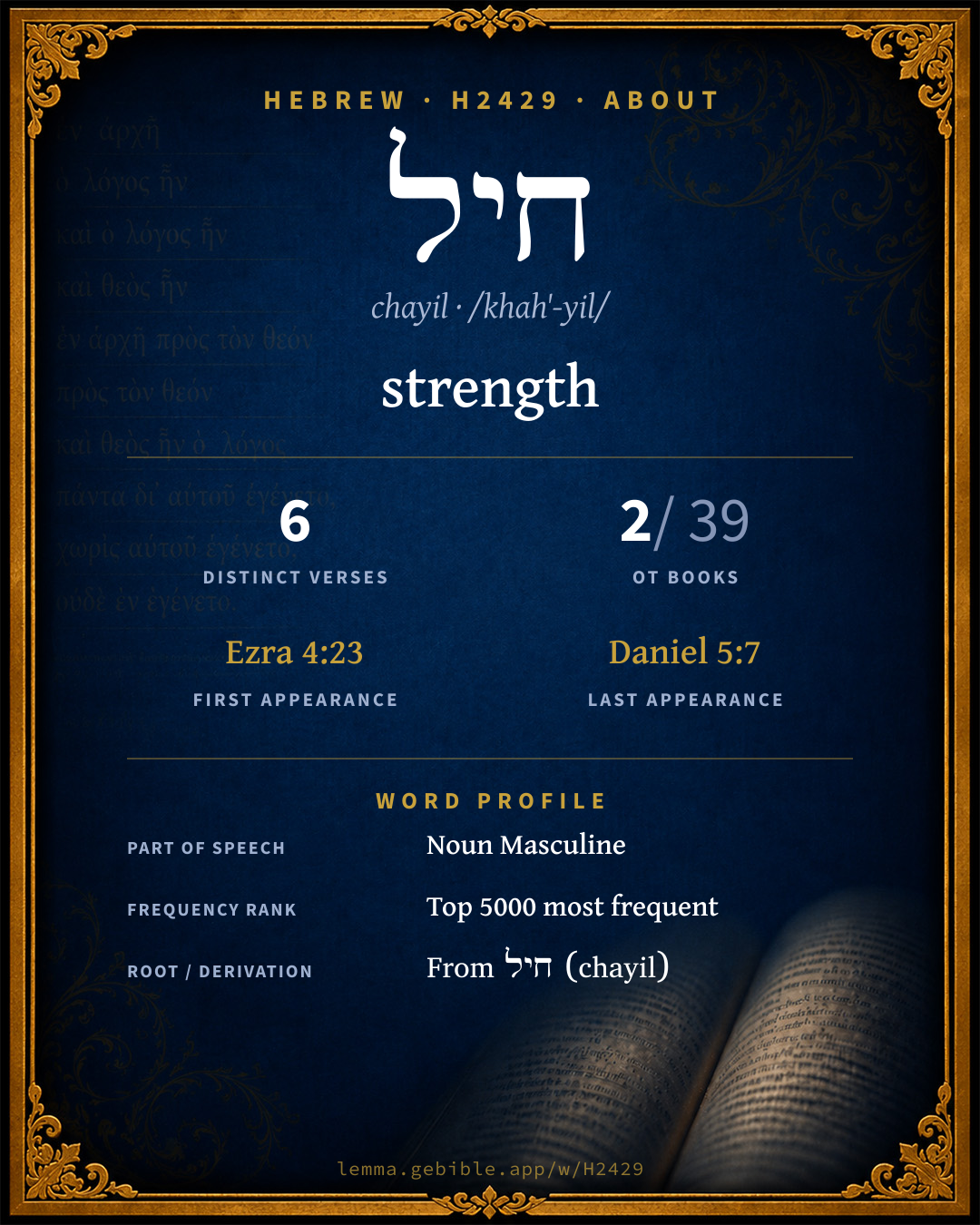
חַ֫יִל
strength
also: army, power fuller range ↓
Full lexicon entry — Brown-Driver-Briggs (BDB)
From Brown-Driver-Briggs (BDB)
Where this word appears
See every Absolute-state word in the Hebrew Bible →
Grammar key — what these labels mean
Part of speech
- Noun
- A naming word — a person, place, thing, or idea.
Noun type
- Common
- A common noun — a general class of person, place, or thing (“king,” “city,” “water”), not a specific name.
State
- Absolute
- The independent form of a noun, not bound to a following word.
- Construct
- A noun bound to a following noun in a possessive / “of” relationship (the construct chain).
Gender
- Masculine
- Grammatically masculine.
Number
- Singular
- One.
Grammatical forms
- Noun, Common, Masculine, Singular, Absolute 5 times (71%)
- Noun, Common, Masculine, Singular, Construct 2 times (29%)
Parsed forms decoded from the imported morphology (morphhb / Westminster Leningrad Codex — WLC text public domain, morphhb tagging CC BY 4.0), counted across 7 parsed occurrences — not distinct verses.
Every verse where H2429 appears — 6 distinct verses across 2 books. Click any verse to open its interlinear word-by-word view. Verse text shown in the World English Bible for context — . Each verse’s Hebrew form is shown with its reference; the English is not keyword-highlighted, since the data carries no word-level English alignment. Use “Compare translations” on any verse to read it across multiple English versions. This concordance covers the Hebrew Bible; Septuagint (Greek Old Testament) occurrences are not indexed here.
Ezra 1 verse
Daniel 5 verses
- Daniel 3:4 בְ/חָ֑יִל prep + n c ms Then the herald cried aloud, To you it is commanded, peoples, nations, and languages,
- Daniel 3:20 חַ֨יִל֙ בְ/חַיְלֵ֔/הּ n c ms prep + n c ms cs + sfx pers 3ms He commanded certain mighty men who were in his army to bind Shadrach, Meshach, and Abednego, [and] to cast them into the burning fiery furnace.
- Daniel 4:14 בְ/חַ֜יִל prep + n c ms He cried aloud, and said thus, Hew down the tree, and cut off its branches, shake off its leaves, and scatter its fruit: let the animals get away from under it, and the fowls from its branches.
- Daniel 4:35 בְּ/חֵ֣יל prep + n c ms cs All the inhabitants of the earth are reputed as nothing; and he does according to his will in the army of heaven, and among the inhabitants of the earth; and none can stay his hand, or tell him, What do you?
- Daniel 5:7 בְּ/חַ֔יִל prep + n c ms The king cried aloud to bring in the enchanters, the Chaldeans, and the soothsayers. The king spoke and said to the wise men of Babylon, Whoever shall read this writing, and show me the interpretation of it, shall be clothed with purple, and have a chain of gold about his neck, and shall be the third ruler in the kingdom.
About this entry
At a glance — auto-summarized from this page’s data, not written by a person. Every figure links to its source below. This summary describes the numbers; it doesn’t interpret them.
At its core, חיל (chayil) means “strength.” The word gravitates to Daniel (83%), then Ezra. It appears 6 verses across 2 books of the Hebrew Bible, among its uncommon vocabulary. Scripture first uses it in Ezra 4:23. Beyond its headline sense, its full sense range takes in “army” and “power”. Each statement above links to its evidence; the full detail follows below.
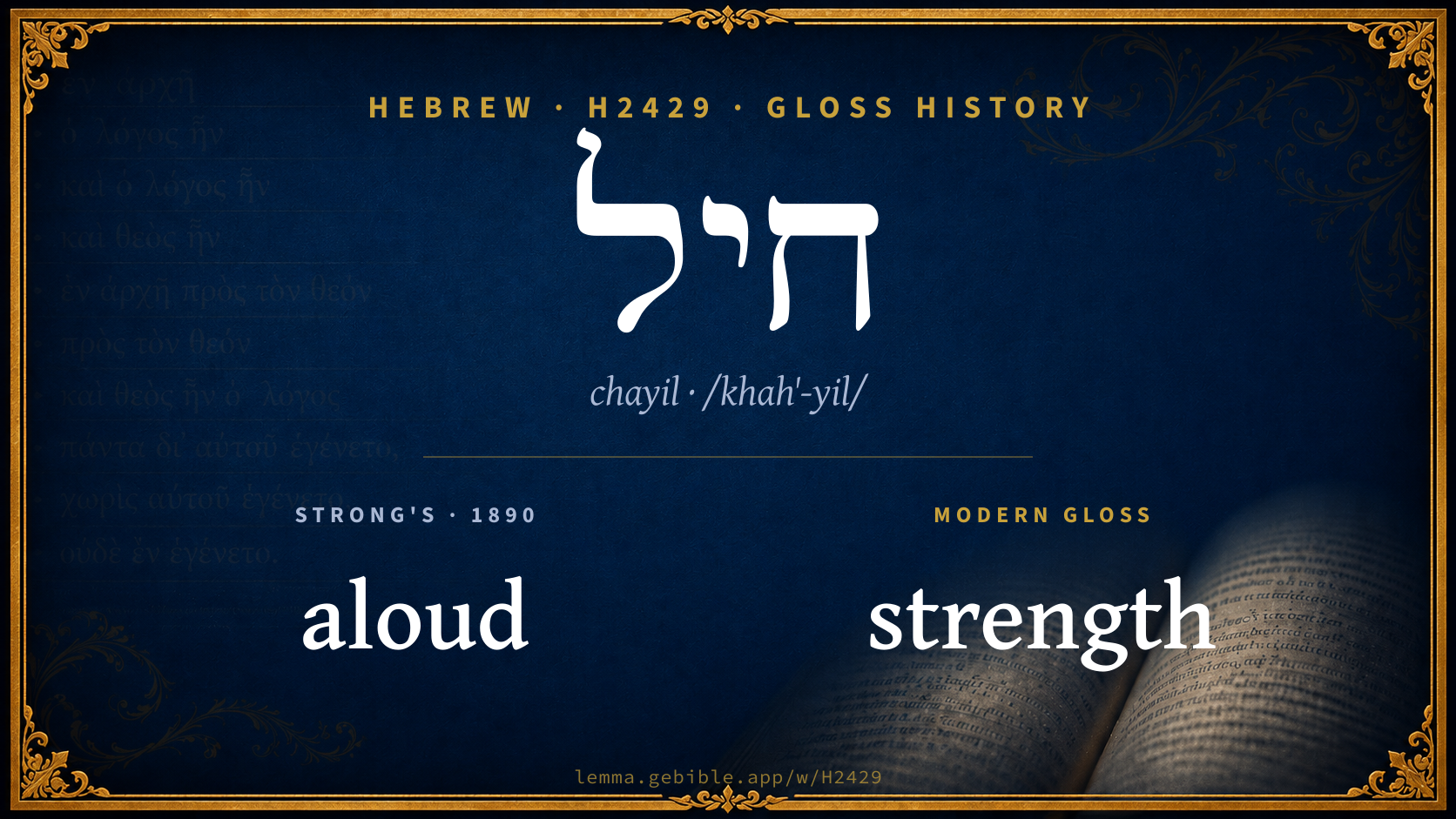
Gloss history
Strong's 1890 vs modern scholarship
About this word
Strong's H2429 catalogs a Hebrew word from the Hebrew Old Testament.
These counts are not copied from any lexicon or concordance. They are computed here, from the morphology-tagged Hebrew Old Testament. What Lemma adds →
- 6
- distinct verses
- The word appears in 6 distinct verses.
- 2 / 39
- OT books
- The word appears in 2 of 39 Old Testament books.
- #2,835
- by frequency
- Top 5000 most frequent Hebrew words (rank 2,835 of 8,640 Hebrew words by occurrence).
View all 6 occurrences in the concordance →
By traditional corpus
Conventional, traditional groupings — biblical authorship is debated, so this is a traditional corpus grouping, not an authorship claim. Each share is this word’s portion of its verses in that division of the Hebrew canon. Each figure is a share of the word’s 6 distinct verses.
- Writings (Ketuvim) 6 verses · 100%
How translations render this word
Counts come from each version’s own published word-to-Strong’s tagging or interlinear alignment — an approximate guide to how each version renders this word, not a word-level alignment the data otherwise carries. Because each total is that version’s own tagged count, the per-version totals vary from one another and need not match the appearance or distinct-verse counts above. These counts may also differ from a printed concordance because Lemma counts each distinctly tagged rendering and does not collapse phrase taggings into a single head-word total. This is a fixed set of word-tagged versions (KJV, ASV, BSB, ULT) and does not change with the reading translation you choose elsewhere. Each version’s license is shown beside its name below (and on Sources).
BDB lists this Strong’s number as 2 distinct words (homographs). Each count above pools all of them and is not split by sense — see the Senses section below. A low-frequency rendering may belong to a different one of those words, not the primary meaning.
- King James Version†: Aloud 3×
- American Standard Version†: Aloud 3×
- Berean Standard Bible†: Army 2×
- unfoldingWord Literal Text†: Aloud 2×
King James Version Public Domain
Renders H2429 across 7† tagged occurrences — most commonly:
Plus 4 renderings that appear only once — usually multi-word phrases or single function words the recovered tagging swept in, not distinct renderings.
American Standard Version Public Domain
Renders H2429 across 7† tagged occurrences — most commonly:
Plus 4 renderings that appear only once — usually multi-word phrases or single function words the recovered tagging swept in, not distinct renderings.
Berean Standard Bible Public Domain
Renders H2429 across 5† tagged occurrences — most commonly:
Plus 3 renderings that appear only once — usually multi-word phrases or single function words the recovered tagging swept in, not distinct renderings. Not rendered by a distinct English word in 2 further occurrences.
unfoldingWord Literal Text CC BY-SA 4.0
Renders H2429 across 7† tagged occurrences — most commonly:
Plus 5 renderings that appear only once — usually multi-word phrases or single function words the recovered tagging swept in, not distinct renderings.
7 senses and sub-senses in the full BDB
What do BDB’s symbols mean?
BDB uses these scholarly abbreviations:
| Symbol | Meaning |
|---|---|
| 𝔊 | the Septuagint (the ancient Greek translation, LXX) |
| 𝔙 | the Vulgate (the Latin translation) |
| 𝔖 | the Syriac version (the Peshitta) |
| 𝔗 | the Targum (the Aramaic translation) |
| ψ | the Psalms |
| √ | root (the underlying root or stem) |
| ‖ | parallel passage (a synonymous or contrasted parallel) |
| † | the dagger: every passage where the word occurs is cited |
The 7 senses and sub-senses the full Brown-Driver-Briggs lexicon distinguishes for this word, in lexicon order (not ranked by frequency), with BDB’s own verbatim wording and sub-sense lettering. Shown in Hebrew script with BDB’s own scholarly abbreviations. The condensed entry is in the Lexicon Entry tab. See also the Forms in the corpus table below.
- 1. strength, usually physical:
- a. seld. alone (chiefly poet.) 1 S 2:4 ψ 18:33, 40 = 2 S 22:33, 40; also גָּֽבְרוּ ח׳ Jb 21:7, cf. Ec 10:10; מֵחַיִל אֶל־חָ֑יִל ψ 84:8; בְּכֹחַ ח׳ 2 Ch 26:13; of virility Pr 31:3; of י׳’s power ψ 59:12; 110:3, cf. Hb 3:19; strength of horse ψ 33:17; fig. of product of vine and fig-tree Jo 2:22 (‖ פְּרִי). e.g. 1 Samuel 2:4
- b. of result or display of strength עשׂה ח׳ achieve might = do valiantly Nu 24:18 (JE), 1 S 14:48 ψ 60:14 = 108:14, 118:15, 16. e.g. Numbers 24:18
- c. often in phrases גִּבּוֹר(הַ)ח׳, גִּבּוֹרֵי(הַ)ח׳ hero(es) of strength, mighty man (men) of valour Jos 1:14 (D), 6:2; 8:3; 10:7 (all JE), Ju 6:12; 11:1; 1 S 9:1 16:18 1 K 11:28 2 K 5:1; 15:20; 24:14, 16 1 Ch 5:24; 7:2, 9; 8:40 + (very freq. in Ch), note especially הַגִּבּוֹרִים וכל גבורי ח׳ 28:1; also ג׳ ח׳ 2 Ch 13:3 (‖ ג׳ מלחמה); ג׳ (הַ)חֲיָלִים 1 Ch 7:5, 7, 11, 40; 11:26 (v. also גִּבּוֹר, p. 150); בֶּן־(הַ)ח׳, בְּנֵי(הַ)ח׳ Dt 3:18 Ju 18:2 + (v. בֵּן 8, p. 121); אִישׁ ח׳, אַנְשֵׁי ח׳ Ju 3:29; 20:44, 46 1 S 31:12; 2 S 11:16; 23:20; (Qr; Kt חי, on phr. בן־אישׁ חיל cf. Dr) = 1 Ch 11:22 (Kt חיל), 2 S 24:9 Na 2:4 Je 48:14 1 Ch 10:12 Ne 11:6 ψ 76:6; ironical א׳ ח׳ לִמְסֹךְ שֵׁבָר Is 5:22 (‖ גבורים לשׁתות יין); Ec 12:3 metaph. of legs. e.g. Joshua 1:14
- 2. ability, efficiency, often involving moral worth אַנְשֵׁי ח׳ Gn 47:6 (J), Ex 18:21, 25 (both E); of a woman אֵשֶׁת ח׳ Pr 12:4; 31:10 Ru 3:11; cf. 1 K 1:42, 52 (opp. רעה), and especially אַנְשֵׁי ח׳ יִרְאֵי אלהים אַנְשֵׁי אֱמֶת שׂנְאֵי בָּ֑צַע Ex 18:21 (E); עָשָׂה היל Pr 31:29 do worthily, efficiently, perhaps also Ru 4:11; late (with weakened meaning of גִּבּוֹר) גִּבּוֹרֵי חֵיל מְלֶאכֶת עֲבוֹדַת בֵּית הָאלהים 1 Ch 9:13, cf. אישׁ ח׳ בַּכֹּחַ לַעֲכֹדָה 26:8. So also 1 S 10:26 (read בְּנֵי ח׳, v. 𝔊 We Dr, men of worth, opp. בני בליעל v 27).for MT ח׳ force, band. e.g. Genesis 47:6
- 3. wealth Gn 34:29 Nu 31:9 (both P), Dt 8:17, 18; 33:11 Is 8:4; 10:14; 30:6 (‖ אוֹצְרֹתָם), 60:5 (‖ הֲמוֹן יָם), v 11; 61:6 Mi 4:13 Je 15:13; 17:3 (both ‖ אצרות), Zp 1:13 Ez 26:12; 28:4, 5(×2) Zc 14:14 Jb 5:5; 15:29; 20:15, 18; 31:25 ψ 49:7, 11; 62:11; 73:12 Pr 13:22. e.g. Genesis 34:29
- 4. force, army, very often Ex 14:4, 9, 17, 28 (all P), 15:4 (song), 1 S 17:20; 2 S 8:9 2 K 6:4, 15; 25:1, 5(×2), 10 2 Ch 13:3 (בְּחַיִל גִּבּוֹרֵי מלחמה), 14:7; 16:7; 23:14 +; so usually Jer.: Je 32:2; 34:1 +; freq. Ezek.: Ez 17:17; 27:10 +; Dn 11:7, 13, 25(×2), 26; = a band 1 S 10:26 (MT, but v. 2, ad fin.); of queen’s train ח׳ כָּבֵד 1 K 10:2 = 2 Ch 9:1; חֵיל כָּבֵד Is 36:2 = 2 K 18:17 (var. חַיִל) a powerful army (on form cf. Sta§ 194 c); also (late) חֵיל הַצָּבָא 1 Ch 20:1 2 Ch 26:13, חֵיל עָם Est 8:11; הֲמוֹן חֲיָלִים Dn 11:10; שַׂר־הח׳ 2 S 24:2 captain of the host, שָׂרֵי הח׳ v 4, 4; שָׂרֵי הַחֲיָלִים captains of armies (bands, divisions) 1 K 15:20 = 2 Ch 16:4, 2 K 25:23 Je 40:7, 13; 41:11, 13, 16; 42:1, 8; 43:4, 5; פִּקּוּדֵי החיל Nu 31:14 (P).—חֵילוֹ Ez 32:31 om. B Hi Co; for חֵילֵךְ Ez 27:11 read prob. a n.pr.loc., cf. Da; Co proposes חתלון (cf. 47:15; 48:1), HalMél. Epigr. 1874, 69 חלך = Cilicia, v. LagM i, 211. e.g. Exodus 14:4
Senses from the full Brown-Driver-Briggs lexicon (Brown, Driver, Briggs; Oxford 1906 — public domain), digitized via Sefaria, supplemented by the OpenScriptures HebrewLexicon (CC BY 4.0). Full attribution on Sources.
Word origin
I. n.m. 2 K 10:2 strength, efficiency, wealth, army;—abs. ח׳ Gn 47:6 +, חָ֑יִל ψ 60:14 +, חָ֑יִל ψ 60:14 +, חֵיל Is 36:2 2 K 18:17; cstr. חֵיל Ex 14:28 + (on ψ 10:10 v. חלכה); sf. חֵילִי Jb 31:25 + 2 times; חֵילְךָ Je 15:13 +; חֵילוֹ Ex 14:4 +, etc.; pl. חֲיָלִים 1 Ch 7:5 + 19 times; sf. חֵילֵיהֶם Is 30:6;—
I. v. sub I. II. חול supr.
— Brown-Driver-Briggs (Oxford 1906, public domain), digitized via Sefaria, supplemented by the OpenScriptures HebrewLexicon (CC BY 4.0). See Sources.
Derived from חיל (chayil) (H2428) — strength.
Jastrow Dictionary
A second Hebrew/Aramaic lexicon for comparison, covering Aramaic and post-biblical (Talmudic, Targumic, Midrashic) usage that the biblical-Hebrew BDB does not. Matched by lemma rather than by Strong’s number, so a lemma may carry more than one Jastrow headword (shown separately below), and the entries cover usage well beyond the Bible.
חַיִל
- , v. חַיִיל.—בְּרוֹר חַ׳, v. בְּרוֹר.
חֵיל I
- (חוּל, v. חַיִיל) surrounding, esp. Ḥel, a place within the fortification of the Temple. Midd. I, 5. Snh. 88ᵇ. Par. III, 11; Targ. Y. Num. XIX, 9; a. fr.
חִיל
- , Pa. חַיֵּיל, חַיֵּל (denom. of חֵילָא)
- 1. to strengthen. Targ. Job IV, 4. Ib. XVI, 5 (incorr. ed. אאח׳); a. e.
- 2. to serve. Targ. Num. IV, 23; a. e.
- 1. to be strengthened. Targ. Job VI, 16; a. fr.
- 2. to move into war, to gather together. Targ. Num. XXXI, 7. Targ. Job X, 17 (some ed. מתייחל׳, corr. acc.).
חֵיל II
- (v. חַיִל)
- 1. (adj.) strong. Targ. Job VIII, 2 Ms. (ed. רַבָּא). Keth. 62ᵃ דחיל מר כולי האי Ar. ed. Koh. (Var. דחֵילָא דמר; ed. דהכי) that you are so strong (that such is your strength).
- 2. (noun) strength. Targ. Job XX, 11 (ed. Lag. חִיּוּל׳; some ed. חֲיָיל׳). Targ. Prov. V, 10; a. fr.—Keth. 62ᵃ, v. supra. Y. B. Mets. IV, beg. 9ᶜ עד דהוה חֵילָךְ עלך while thou wast yet in thy strength (of manhood). Y. Yeb. IV, 6ᵇ לית בחֲיָילִי I cannot do it. B. Mets. 84ᵃ חילך לאורייתא give thy physical strength to the study of the Law; a. fr.—Trnsf. logical support, evidence, argument. Y. Pes. V, 32ᵃ top נסיב חֲיָילֵיה מן וכ׳ borrowed his argument from &c. Y. Maasr. I, 49ᵇ top; a. e.
- 3. army, host; service. Targ. Num. I, 3; a. fr.—Targ. Ps. LXVIII, 12 Ms. (ed. חֵילְוַת).—Pl. חֵילַיָּא, constr. חֵילֵי; חֵילְוָתָא, constr. חֵילְוַת. Targ. Ex. XII, 41. Targ. I Kings XXII, 19; a. fr.—Targ. Ps. XXXIII, 16; a. fr. Targ. II Esth. I, 4 ed. Amst. חֶלְוָתָא. Targ. Ps. XLIV, 10 ed. Lag. חֵילְוָתָנָא (oth. ed. חֵילְוָנָא, חַלְוָנָא).—Ḥull. 60ᵃ נפישן חֵילְוָותֵיה (not נפישי) his troops are too numerous.
A Dictionary of the Targumim, the Talmud Babli and Yerushalmi, and the Midrashic Literature (Marcus Jastrow; London, Luzac, 1903) — Public Domain. Digitized via Sefaria. Digitized via Sefaria. Full attribution on Sources.
Forms in the corpus
The 7 distinct written forms H2429 takes in the Hebrew Bible, most frequent first — each parse links to that state’s occurrences in the concordance. Hebrew forms include their vowel points and cantillation, so a single lemma takes many written forms.
| Form | Parsing | Example | Uses |
|---|---|---|---|
| בְ/חַ֜יִל | Noun, Common, Masculine, Singular, Absolute | Daniel 4:14 | 1 |
| בְ/חַיְלֵ֔/הּ | Noun, Common, Masculine, Singular, Construct | Daniel 3:20 | 1 |
| בְ/חָ֑יִל | Noun, Common, Masculine, Singular, Absolute | Daniel 3:4 | 1 |
| בְּ/חֵ֣יל | Noun, Common, Masculine, Singular, Construct | Daniel 4:35 | 1 |
| בְּ/חַ֔יִל | Noun, Common, Masculine, Singular, Absolute | Daniel 5:7 | 1 |
| וְ/חָֽיִל | Noun, Common, Masculine, Singular, Absolute | Ezra 4:23 | 1 |
| חַ֨יִל֙ | Noun, Common, Masculine, Singular, Absolute | Daniel 3:20 | 1 |
Same root — word family
Other BDB entries built from the same root as H2429, grouped by Strong’s listed origin. These share a root / origin per the lexicon — not necessarily a shared meaning. Each links to that word’s own entry.
Derives from
Shares the same root
Proper names from this root
People and places named from this root — a name, not an additional meaning of the word.
Compare all same-root words → Showing 4 of 7 — not the complete family. 3 of the same-root words are proper names (people or places). They share a root, not necessarily a meaning.
Septuagint verse parallels
This word appears in 5 verses that also exist in the Greek Old Testament (Septuagint), out of the 6 Hebrew verses it occurs in. You can read those verses in Greek by switching the Old Testament edition to the Septuagint.
Read these verses in the Septuagint
This is a verse-level parallel only — the same verses exist in both the Hebrew and Greek Old Testaments. No word-level Hebrew↔Greek correspondence is claimed: the data carries no such alignment, so no Greek word is shown as this Hebrew word’s translation. Coverage is not total — the Septuagint omits the deuterocanon and renumbers the Psalms, so some Hebrew verses have no direct Greek parallel.