
2 Kings 24:16

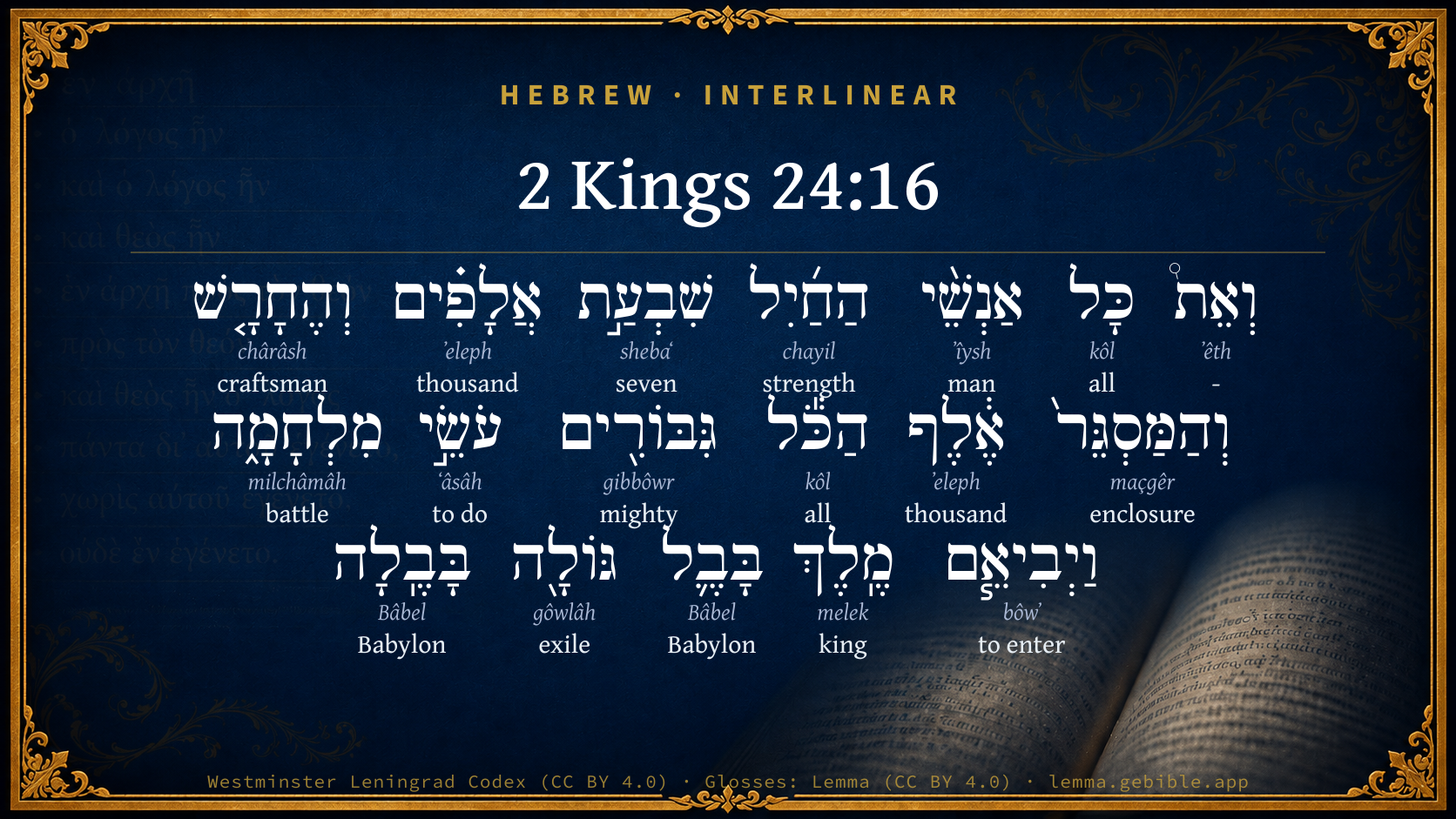
Hebrew (Westminster Leningrad Codex) 2 Kings 24:16 appears in the Hebrew Old Testament. The text above is from the Westminster Leningrad Codex. Each word links to its Strong’s number, a concise gloss, and parsing drawn from the Open Scriptures Hebrew Bible morphology. Click any word for its full Brown-Driver-Briggs (BDB) entry.
Download image
Cite this verse

2 Kings 24:16 (World English Bible). Public Domain. Lemma interlinear Bible study tool, https://lemma.gebible.app/v/2-kings/24/16.

Show BibTeX & RIS
BibTeX
RIS
English Translation
All the men of might, even seven thousand, and the craftsmen and the smiths one thousand, all of them strong and apt for war, even them the king of Babylon brought captive to Babylon.
World English Bible · Public Domain
Download a study sheet

One document with this verse’s original text, its word-by-word gloss line, the meaning frame, cross-references with their text, attributed commentary, and full source and license credits — printable, and it pastes into notes with its structure intact.

This verse Autodidact and up

Study sheet (.html) Plain text (.txt)

A passage Seminary Student

Up to 50 verses in one chapter. A passage sheet keeps up to 6 commentary sources and 12 cross-references per verse, in the order this page ranks them, and says so on the sheet whenever that leaves anything out. Ask for a single verse and you get the Autodidact verse sheet above.

Everything on this page stays free to read, with no account — the sheet is a download of what is already on screen, not access to it.

Want to remove ads? Support Godless Engineer
Compare translations 3

The same verse in 3 English versions, stacked beneath the original-language interlinear above. Click any original word for its lexicon entry.

Each is an independent rendering of the whole verse — the interlinear is not word-aligned to these translations.

Highlighted words mark where these versions differ — a whole-verse word diff, not a word-by-word alignment.

  • World English Bible Public Domain
    All the men of might, even seven thousand, and the craftsmen and the smiths one thousand, all of them strong and apt for war, even them the king of Babylon brought captive to Babylon.
  • King James Version Public Domain
    And all the men of might, even seven thousand, and craftsmen and smiths a thousand, all that were strong and apt for war, even them the king of Babylon brought captive to Babylon.
  • unfoldingWord Literal Text CC BY-SA 4.0
    and all of the men of valor, 7,000, and the craftsman and the smith, 1,000, the whole, the mighty, the makers of war. And the king of Babylon brought them exile to Babylon.

unfoldingWord Literal Text — © unfoldingWord, licensed CC BY-SA 4.0. Word-aligned USFM3 via Door43 (git.door43.org/unfoldingWord/en_ult).

Versions to compare (up to 4)

3 of 4 selected

Show all 18 translations

Every available English version of this verse, each an independent rendering of the whole verse.

  • World English Bible Public Domain
    All the men of might, even seven thousand, and the craftsmen and the smiths one thousand, all of them strong and apt for war, even them the king of Babylon brought captive to Babylon.
  • Berean Standard Bible Public Domain
    The king of Babylon also brought into exile to Babylon all seven thousand men of valor and a thousand craftsmen and metalsmiths—all strong and fit for battle.
  • Majority Standard Bible Public Domain
    The king of Babylon also brought into exile to Babylon all seven thousand men of valor and a thousand craftsmen and metalsmiths—all strong and fit for battle.
  • King James Version Public Domain
    And all the men of might, even seven thousand, and craftsmen and smiths a thousand, all that were strong and apt for war, even them the king of Babylon brought captive to Babylon.
  • American Standard Version (1901) Public Domain
    And all the men of might, even seven thousand, and the craftsmen and the smiths a thousand, all of them strong and apt for war, even them the king of Babylon brought captive to Babylon.
  • Revised Version (1885) Public Domain
    And all the men of might, even seven thousand, and the craftsmen and the smiths a thousand, all of them strong and apt for war, even them the king of Babylon brought captive to Babylon.
  • Geneva Bible (1599) Public Domain
    And al the men of warre, euen seuen thousand, and carpenters, and lockesmithes a thousande: all that were strong and apt for warre, did the King of Babel bring to Babel captiues.
  • Douay-Rheims (1899) Public Domain
    And all the strong men, seven thousand, and the artificers, and the smiths a thousand, all that were valiant men and fit for war: and the king of Babylon led them captives into Babylon.
  • Young's Literal Translation Public Domain
    and all the men of valour seven thousand, and the artificers and the smiths a thousand, the whole `are' mighty men, warriors; and the king of Babylon bringeth them in a captivity to Babylon.
  • Literal Standard Version CC BY-SA 4.0
    and all the men of valor, seven thousand, and the craftsmen and the smiths, one thousand, the whole [are] mighty men, warriors; and the king of Babylon brings them in a captivity to Babylon.
  • Unlocked Literal Bible CC BY-SA 4.0
    All the fighting men, seven thousand in number, and one thousand craftsmen and blacksmiths, all of them fit for fighting—the king of Babylon brought these men into exile at Babylon.
  • unfoldingWord Literal Text CC BY-SA 4.0
    and all of the men of valor, 7,000, and the craftsman and the smith, 1,000, the whole, the mighty, the makers of war. And the king of Babylon brought them exile to Babylon.
  • Darby Bible Public Domain
    and all the men of valour, seven thousand, and the craftsmen and smiths a thousand, all strong men apt for war, and the king of Babylon brought them captive to Babylon.
  • World Messianic Bible Public Domain
    All the men of might, even seven thousand, and the craftsmen and the smiths one thousand, all of them strong and fit for war, even them the king of Babylon brought captive to Babylon.
  • Webster's Bible Public Domain
    And all the men of might, even seven thousand, and artificers and smiths a thousand, all that were strong and apt for war, even them the king of Babylon brought captive to Babylon.
  • Free Bible Version CC BY-SA 4.0
    The king of Babylon also deported to Babylon all seven thousand fighting men and one thousand craftsmen and metal-workers, who were all strong and ready for battle.
  • Bible in Basic English Public Domain
    And all the men of war, seven thousand of them, and a thousand expert workmen and metal-workers, all of them strong and able to take up arms, the king of Babylon took away as prisoners into Babylon.
  • JPS Tanakh (1917) Public Domain
    And all the men of might, even seven thousand, and the craftsmen and the smiths a thousand, all of them strong and apt for war, even them the king of Babylon brought captive to Babylon.

Literal Standard Version (2020), Covenant Press — licensed CC BY-SA 4.0. Text via the HelloAO Bible API (eBible.org). Unlocked Literal Bible (unfoldingWord) — licensed CC BY-SA 4.0. Text via the HelloAO Bible API (eBible.org). unfoldingWord Literal Text — © unfoldingWord, licensed CC BY-SA 4.0. Word-aligned USFM3 via Door43 (git.door43.org/unfoldingWord/en_ult). Free Bible Version, Dr. Jonathan Gallagher — licensed CC BY-SA 4.0. Text via the HelloAO Bible API (eBible.org).

Word by word

More ways to search: Search by grammar → Find every occurrence → Compare this word →

Practice this passage: Drill this verse → Learn its vocabulary →

וְהַמַּסְגֵּר֙
maçgêr
H4525
“and · the · enclosure”
Conjunction + Particle, Definite Article + Noun, Common, Masculine, Singular, Absolute
Part of Speech
Conjunction + Particle + Noun
Type
Common
Gender
Masculine
Number
Singular
State
Absolute
Full BDB Definition

Origin: from H5462

TWOT: 1462c

a shutting up, locksmith, smith, dungeon, enclosure, builder of bulwarks - locksmith, smith - dungeon
  1. וְאֵת֩ ʼêth H853 “and · -” Conjunction + Particle, Direct Object
  2. כָּל kôl H3605 “all of” Noun, Common, Masculine, Singular, Construct
  3. אַנְשֵׁ֨י ʼîysh H376 “men of” Noun, Common, Masculine, Plural, Construct
  4. הַחַ֜יִל chayil H2428 “the · strength” Particle, Definite Article + Noun, Common, Masculine, Singular, Absolute
  5. שִׁבְעַ֣ת shebaʻ H7651 “seven” Adjective, Cardinal number, Masculine, Singular, Construct
  6. אֲלָפִ֗ים ʼeleph H505 “thousand” Adjective, Cardinal number, Both, Plural, Absolute
  7. וְהֶחָרָ֤שׁ chârâsh H2796 “and · the · craftsman” Conjunction + Particle, Definite Article + Noun, Common, Masculine, Singular, Absolute
  8. אֶ֔לֶף ʼeleph H505 “thousand” Adjective, Cardinal number, Both, Singular, Absolute
  9. הַכֹּ֕ל kôl H3605 “the · all” Particle, Definite Article + Noun, Common, Masculine, Singular, Absolute
  10. גִּבּוֹרִ֖ים gibbôwr H1368 “mighty” Adjective, Adjective, Masculine, Plural, Absolute
  11. עֹשֵׂ֣י ʻâsâh H6213 “doing” Verb, Qal, Participle Active, Masculine, Plural, Construct
  12. מִלְחָמָ֑ה milchâmâh H4421 “battle” Noun, Common, Feminine, Singular, Absolute
  13. וַיְבִיאֵ֧ם bôwʼ H935 “and · to enter · them” Conjunction + Verb, Hiphil, Sequential Imperfect, 3rd Person, Masculine, Singular + Suffix, Personal, 3rd Person, Masculine, Plural
  14. מֶֽלֶךְ melek H4428 “king of” Noun, Common, Masculine, Singular, Construct
  15. בָּבֶ֛ל Bâbel H894 “Babylon” Noun, Proper
  16. גּוֹלָ֖ה gôwlâh H1473 “exile” Noun, Common, Feminine, Singular, Absolute
  17. בָּבֶֽלָה Bâbel H894 “Babylon · toward” Noun, Proper + Suffix, Demonstrative

About this verse

These counts appear in no published source. They are computed here, from the morphology-tagged text and Lemma’s own curated glosses. What Lemma adds →

18
words
15
distinct lemmas
Historical
section

Notable vocabulary

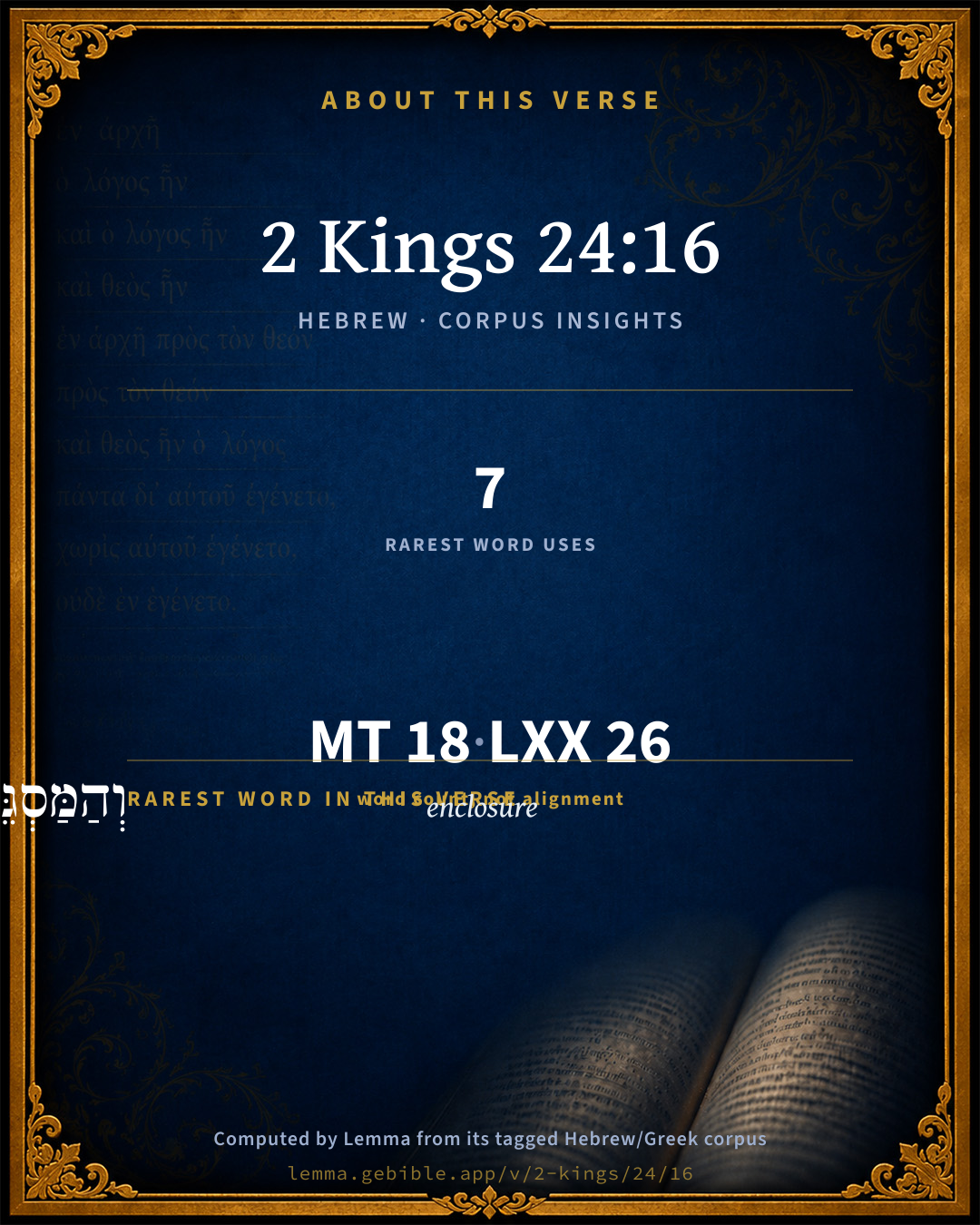
The rarest word here is וְהַמַּסְגֵּר֙ enclosure H4525 — appearing just 7 times in the whole Hebrew Bible.

Shared distinctive vocabulary

וְהַמַּסְגֵּר֙ enclosure H4525 occurs in 7 verses of the Hebrew Bible. Also found in:

Grammatical profile

  • 2 verbs
  • 11 nouns
  • 4 adjectives
  • 1 particle

Verb forms

  • עֹשֵׂ֣י Qal · Participle Active
  • וַיְבִיאֵ֧ם Hiphil · Sequential Imperfect

Repetition

Words recur within this verse — often emphatic in Hebrew:

  • כָּל all H3605 ×2
  • אֲלָפִ֗ים thousand H505 ×2
  • בָּבֶ֛ל Babylon H894 ×2

Hebrew & Septuagint length

In English translation the verse runs 34 words from the Hebrew and 32 from the Septuagint (LXX English) — closely comparable.

A rough comparison of the two English renderings, which tokenize alike — not a word-level alignment.

Word counts can differ between the Hebrew and the Greek without any difference in meaning — e.g. the Hebrew direct-object marker אֵת has no separate Greek word, and Greek often adds the article ὁ.

In the original languages it is 18 Hebrew tokens and 26 Greek tokens — but the two are counted differently (Hebrew bundles its prefixes and suffixes into one token; the Greek is in lemma form), so that isn’t a like-for-like length.

Cross-references

3

Topical passages linked to 2 Kings 24:16 in the Treasury of Scripture Knowledge — connected by theme and wording, ordered by reader-vote popularity; previews shown in the World English Bible.

  • Jeremiah 52:28 This is the people whom Nebuchadrezzar carried away captive: in the seventh year three thousand twenty-three Jews;
  • 2 Kings 24:14 He carried away all Jerusalem, and all the princes, and all the mighty men of valor, even ten thousand captives, and all the craftsmen and the smiths; none remained, save the poorest sort of the people of the land.
  • Jeremiah 29:2 (after that Jeconiah the king, and the queen-mother, and the eunuchs, [and] the princes of Judah and Jerusalem, and the craftsmen, and the smiths, were departed from Jerusalem),

Cross-references courtesy of OpenBible.info (CC BY 4.0).

Hebrew and Greek witnesses Masoretic Hebrew ↔ Greek Septuagint

The same verse in the two great witnesses to the Old Testament, shown verse-for-verse.

These are two independent witnesses, not word-aligned to each other, and the Septuagint is shown in lemma (dictionary) form.

Hebrew 2 Kings 24:16 Masoretic · Westminster Leningrad Codex

וְאֵת֩ כָּל אַנְשֵׁ֨י הַחַ֜יִל שִׁבְעַ֣ת אֲלָפִ֗ים וְהֶחָרָ֤שׁ וְהַמַּסְגֵּר֙ אֶ֔לֶף הַכֹּ֕ל גִּבּוֹרִ֖ים עֹשֵׂ֣י מִלְחָמָ֑ה וַיְבִיאֵ֧ם מֶֽלֶךְ בָּבֶ֛ל גּוֹלָ֖ה בָּבֶֽלָה

All the men of might, even seven thousand, and the craftsmen and the smiths one thousand, all of them strong and apt for war, even them the king of Babylon brought captive to Babylon.

World English Bible · Public Domain

Greek LXX 2 Kings 24:16 Septuagint · lemma form

καί πᾶς ὁ ἀνήρ ὁ δύναμις ἑπτακισχίλιοι καί ὁ τέκτων καί ὁ συνκλείω χίλιοι πᾶς δυνατός ποιέω πόλεμος καί ἄγω αὐτός βασιλεύς βαβυλών μετοικεσία εἰς βαβυλών

And all the men of might, even seven thousand, and one thousand artificers and smiths: all were mighty men fit for war; and the king of Babylon carried them captive to Babylon.

LXX2012 (modern English Septuagint) · Public Domain

Hebrew: Westminster Leningrad Codex (CC BY 4.0). Greek: Septuagint (public domain); English from LXX2012 (modern English Septuagint) (Public Domain). How the Septuagint differs from the Hebrew →

Targum (Aramaic paraphrase)

1

The Targum is the ancient Jewish Aramaic paraphrase of the Hebrew Scriptures — an interpretive translation, not the Hebrew text itself. Onkelos (literal) and Pseudo-Jonathan (expansive) render the Torah, and Jonathan the Prophets. Coverage is partial: where no permissively-licensed English translation exists for a verse, only the Aramaic is shown. This is verse-level text, not a word-by-word alignment to the Hebrew.

  1. Targum Jonathan Prophets (Joshua–Malachi)
    וְיַת כָּל גִבָּרֵי חֵילָא שַׁבְעָא אַלְפִין אוּמָנַיָא וְתַרְעַיָא אַלְפִין כּוּלְהוֹן גִבָּרִין גַבְרֵי עָבְדֵי קְרָבָא וְאַיְתִינוּן מַלְכָּא דְבָבֶל בְּגָלוּתָא לְבָבֶל:

    (no public-domain English translation for this verse)

    Targum Jonathan — Aramaic: “Mikraot Gedolot” (public domain). English: “Sefaria Community Translation” (CC0 1.0 (public-domain dedication)); “London "Chaldee Paraphrase," 1871” (public domain). Text via Sefaria.

Commentary

Notes on 2 Kings 24:16 from classic Christian and Jewish commentators (each source and its license shown beneath its notes). The classic Christian expositions comment on the surrounding passage and are grouped to its opening verse, so a note may address several verses; the Jewish commentaries on the Tanakh (Rashi and others) are per-verse, so they appear only where the commentator wrote on this verse.

Lemma curates 59 commentaries, every one of them public domain or Creative Commons licensed, each selected and text-cleaned for this edition rather than reprinted as found. About our sources →

Trapp's Complete Commentary

John Trapp

2Ki 24:16 And all the men of might, [even] seven thousand, and craftsmen and smiths a thousand, all [that were] strong [and] apt for war, even them the king of Babylon brought captive to Babylon.

Ver. 16. Craftsmen, &c.] Eighteen thousand in all; this was the second captivity.

John Trapp, A Commentary or Exposition upon All the Books of the Old and New Testament (1647–1656) — public domain. Text from a community e-Sword module.

Ellicott's Commentary for English Readers

(16) And all the men of might.—“The mighty men of valour” of 2Ki_24:14. (The words depend on the verb, “he carried away,” in 2Ki_24:14.) As there were 7,000 of these, and 1,000 “craftsmen and smiths,” and the total number of the exiles was 10,000, there were 2,000 belonging to the aristocratic classes. Jer_52:28 gives a total of 3,023. Thenius explains his discrepancy as resulting from a transcriber’s confusion of a large y, i.e. 10, with g, i.e. 3. Josephus has made his total of 10,832 out of the 832 of the second deportation (Jer_52:29) added to the 10,000 here assigned.

All that were strong and apt for war.—Literally, the whole, warriors and doers of battle. This clause refers to both those which precede, and it states that the 8,000 were all men in their prime, and trained in the use of weapons (Thenius). But may not the term “strong” (gibbôrûm, “heroes,” “warriors”) refer to the 7,000 as actual fighting men; and the phrase “makers of war” denote the craftsmen as employed in forging weapons and constructing defences? (The Syriac reads, and all the men that made war.)

Even them the king of Babylon brought.—Literally, and the King of Babylon brought them.

A Bible Commentary for English Readers, edited by Charles John Ellicott (1878–1897) — public domain. Text from a community e-Sword module.

John Gill's Exposition

Zedekiah was twenty years old when he began to reign,.... So that he was but between nine and ten years of age when his father Josiah died; for Jehoahaz reigned three months, Jehoiakim eleven years, and his son three months and ten days:

and he reigned eleven years in Jerusalem: and his mother's name was Hamutal the daughter of Jeremiah of Libnah; by which it appears that he was the brother of Jehoahaz by father and mother's side, Kg2 23:31. This and the two following verses are expressed in the same words as in Jer 52:1, (see Gill on Jer 52:1, Jer 52:2, Jer 52:3), in Ch2 36:10, besides what is here said, is written, that he humbled not himself before Jeremiah the prophet of the Lord, that spoke in his name, but opposed him; and rebelling against the king of Babylon, broke his oath, and hardened his neck and heart against the Lord, and was obstinate, stubborn, and self-willed.

Next: 2 Kings Chapter 25

John Gill's Exposition of the Whole Bible (1746–1763) — public domain (CC PDM 1.0). Text via the HelloAO Bible API.

The Pulpit Commentary

And all the men of mighti.e. "The mighty men of valor" (or, "trained soldiers") of ver. 14even seven thousand, and craftsmen and smiths a thousand, all that were strong and apt for war the craftsmen and smiths would be pressed into the military service inthe event of a siegeeven them the Zing of Babylon brought captive to Babylon; i.e. he brought to Babylon, not only the royal personages, the officials of the court, and the captives who belonged to the upper classes (ver. 15), but also the entire military force which he had deported, and the thousand skilled artificers. All, without exception, were conducted to the capital.

The Pulpit Commentary (1880–1919), ed. H.D.M. Spence-Jones & Joseph S. Exell — public domain. Text from a community e-Sword module.

Rashi

Rabbi Shlomo Yitzchaki (Rashi)

Seven thousand. But above he states, “ten thousand.” The third verse comes to reconcile [the difference], in the Book of Yirmiyohu, ”This is the people whom Nevuchadnetzar exiled in the seventh year, three thousand Jews.” Jews.” We deduce from here that three thousand were of the tribe of Yehudah and seven thousand were of Binyomin and the other tribes. Also in Seder Olam we learned this.

Rashi on the Tanakh — English translations: “The Judaica Press complete Tanach with Rashi, translated by A. J. Rosenberg” (CC BY 4.0); “Pentateuch with Rashi's commentary by M. Rosenbaum and A.M. Silbermann, 1929-1934” (public domain); “The Metsudah Tanach series, Lakewood, N.J” (CC BY 4.0); and “The Book of Joshua, Metsudah Publications, 1997” (CC BY 4.0). Text via Sefaria.

Lesson kit

Teaching starters — assembled from the data on this page, not authored interpretation. Every prompt links to the verse data it draws on. Edit before teaching.

2 Kings, in the Historical, opens this verse with 18 words (15 distinct Hebrew lemmas). Its most distinctive word is maçgêr (“enclosure”). A historical commentator’s framing appears above. Read the whole chapter for the surrounding context.

Discussion questions

  1. What does “enclosure” (maçgêr) contribute to the verse as a whole?
  2. How does 2 Kings 24:14, which shares the word «enclosure», read alongside this verse?
  3. What does the repetition of “all” (2× in this one verse) do in this verse?
  4. These translations render this verse differently. What is at stake in choosing one wording over another?
  5. «עֹשֵׂ֣י» is a Qal Participle Active verb. How does that grammatical form shape the action described?
  6. Compare how Trapp's Complete Commentary and Ellicott's Commentary for English Readers read this verse. Where do they agree or differ?

Things to notice

Reading settings

Reading text

Shown beneath each verse's original-language words.

Old Testament
Old Testament edition

Read the OT as the Masoretic Hebrew (MT) or the Greek Septuagint (LXX).

English shown for the Greek Septuagint (in the Hebrew ↔ Greek comparison).

Comparing translations? Open the Compare panel on any verse page to stack up to four side by side.