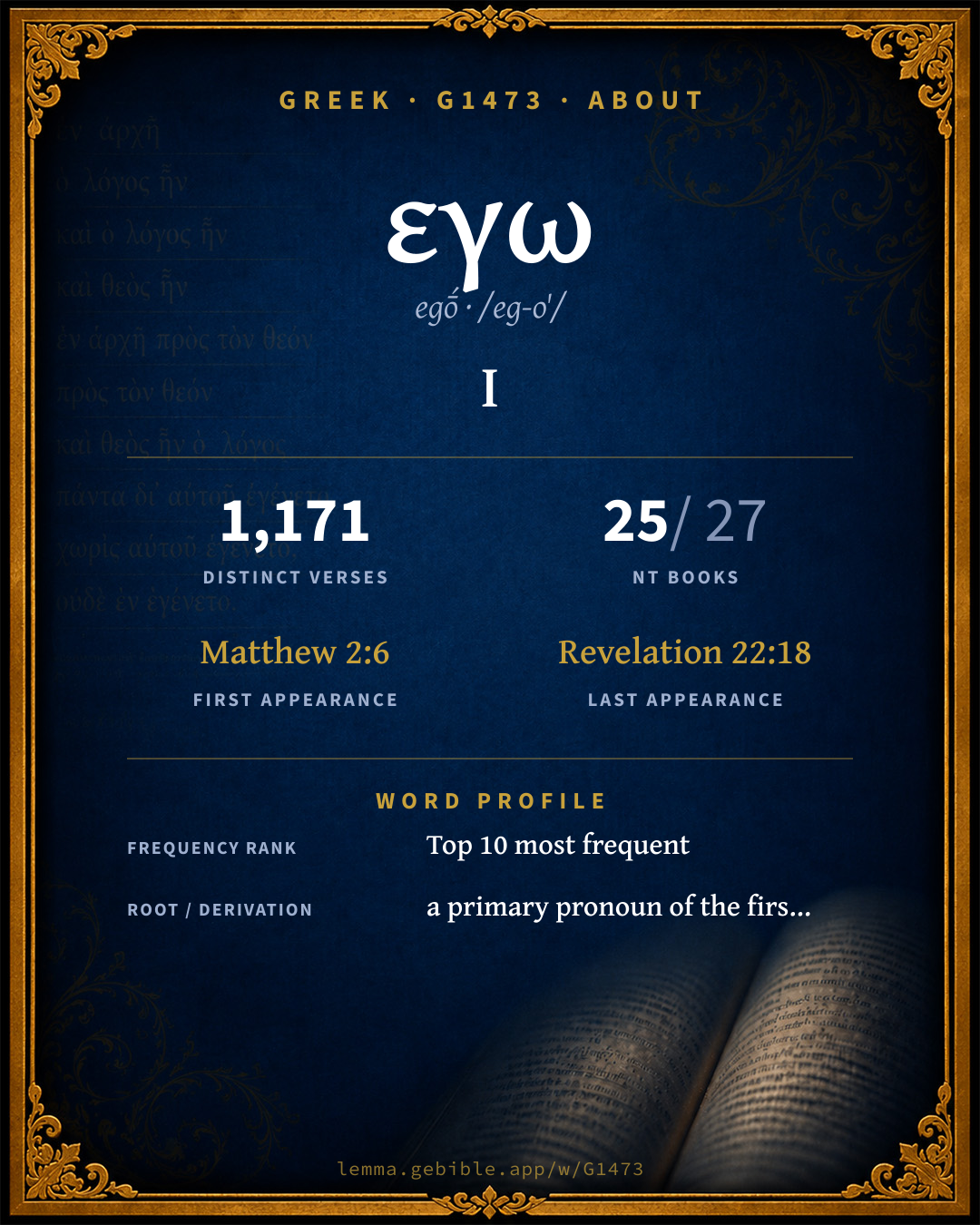
ἐγώ
I
Full lexicon entry — Thayer's Greek Lexicon
From Thayer's Greek Lexicon
Where this word appears
See every Genitive-case word in the Greek New Testament →
Grammar key — what these labels mean
Part of speech
- Personal pronoun
- Stands in for a person already named (“I,” “you,” “he”).
Case
- Genitive
- The case of source, possession, or “of” — answers “whose / from what.”
- Accusative
- The case of the direct object and of extent.
- Nominative
- The case of the subject (and the predicate nominative).
- Dative
- The case of the indirect object, means, or location — “to / for / with / in.”
Person
- 1st person
- The speaker (“I / we”).
Number
- Singular
- One.
- Plural
- More than one.
Grammatical forms
- Personal pronoun, 1st person, Genitive, Singular 679 times (39%)
- Personal pronoun, 1st person, Accusative, Singular 374 times (22%)
- Personal pronoun, 1st person, Nominative, Singular 345 times (20%)
- Personal pronoun, 1st person, Dative, Singular 320 times (19%)
- Personal pronoun, 1st person, Dative, Plural 1 time (0%)
Parsed forms decoded from the imported morphology (Robinson–Tischendorf, public domain), counted across 1,719 parsed occurrences — not distinct verses.
Page 1 of 6 — showing verses 1–200 of 1,171 distinct verses where G1473 appears, across 25 books. Click any verse to open its interlinear word-by-word view. Verse text shown in the World English Bible for context — . Each verse’s Greek form is shown with its reference; the English is not keyword-highlighted, since the data carries no word-level English alignment. Use “Compare translations” on any verse to read it across multiple English versions. This concordance covers the Greek New Testament; Septuagint (Greek Old Testament) occurrences of this word are not indexed here.
Matthew 153 verses
- Matthew 2:6 μου pron 1 gen sg 'You Bethlehem, land of Judah, Are in no way least among the princes of Judah: For out of you shall come forth a governor, Who shall shepherd my people, Israel.'"
- Matthew 2:8 μοι pron 1 dat sg He sent them to Bethlehem, and said, "Go and search diligently for the young child. When you have found him, bring me word, so that I also may come and worship him."
- Matthew 2:15 μου pron 1 gen sg and was there until the death of Herod; that it might be fulfilled which was spoken by the Lord through the prophet, saying, "Out of Egypt I called my son."
- Matthew 3:11 ἐγὼ μου μού pron 1 nom sg pron 1 gen sg pron 1 gen sg I indeed baptize you in water for repentance, but he who comes after me is mightier than I, whose shoes I am not worthy to carry. He will baptize you in the Holy Spirit.
- Matthew 3:14 ἐγὼ με pron 1 nom sg pron 1 acc sg But John would have hindered him, saying, "I need to be baptized by you, and you come to me?"
- Matthew 3:17 μου pron 1 gen sg Behold, a voice out of the heavens said, "This is my beloved Son, with whom I am well pleased."
- Matthew 4:9 μοι pron 1 dat sg He said to him, "I will give you all of these things, if you will fall down and worship me."
- Matthew 4:19 μου pron 1 gen sg He said to them, "Come after me, and I will make you fishers for men."
- Matthew 5:11 ἐμοῦ pron 1 gen sg "Blessed are you when people reproach you, persecute you, and say all kinds of evil against you falsely, for my sake.
- Matthew 5:22 ἐγὼ pron 1 nom sg But I tell you, that everyone who is angry with his brother without a cause shall be in danger of the judgment; and whoever shall say to his brother, 'Raca!' shall be in danger of the council; and whoever shall say, 'You fool!' shall be in danger of the fire of Gehenna.
- Matthew 5:28 ἐγὼ pron 1 nom sg but I tell you that everyone who gazes at a woman to lust after her has committed adultery with her already in his heart.
- Matthew 5:32 ἐγὼ pron 1 nom sg but I tell you that whoever puts away his wife, except for the cause of sexual immorality, makes her an adulteress; and whoever marries her when she is put away commits adultery.
- Matthew 5:34 ἐγὼ pron 1 nom sg but I tell you, don't swear at all: neither by heaven, for it is the throne of God;
- Matthew 5:39 ἐγὼ pron 1 nom sg But I tell you, don't resist him who is evil; but whoever strikes you on your right cheek, turn to him the other also.
- Matthew 5:44 ἐγὼ pron 1 nom sg But I tell you, love your enemies, bless those who curse you, do good to those who hate you, and pray for those who mistreat you and persecute you,
- Matthew 7:21 μοι μου pron 1 dat sg pron 1 gen sg Not everyone who says to me, 'Lord, Lord,' will enter into the Kingdom of Heaven; but he who does the will of my Father who is in heaven.
- Matthew 7:22 μοι pron 1 dat sg Many will tell me in that day, 'Lord, Lord, didn't we prophesy in your name, in your name cast out demons, and in your name do many mighty works?'
- Matthew 7:23 ἐμοῦ pron 1 gen sg Then I will tell them, 'I never knew you. Depart from me, you who work iniquity.'
- Matthew 7:24 μου pron 1 gen sg "Everyone therefore who hears these words of mine, and does them, I will liken him to a wise man, who built his house on a rock.
- Matthew 7:26 μου pron 1 gen sg Everyone who hears these words of mine, and doesn't do them will be like a foolish man, who built his house on the sand.
- Matthew 8:2 με pron 1 acc sg Behold, a leper came to him and worshiped him, saying, "Lord, if you want to, you can make me clean."
- Matthew 8:6 μου pron 1 gen sg and saying, "Lord, my servant lies in the house paralyzed, grievously tormented."
- Matthew 8:7 ἐγὼ pron 1 nom sg Jesus said to him, "I will come and heal him."
- Matthew 8:8 μου μου pron 1 gen sg pron 1 gen sg The centurion answered, "Lord, I'm not worthy for you to come under my roof. Just say the word, and my servant will be healed.
- Matthew 8:9 ἐγὼ μου pron 1 nom sg pron 1 gen sg For I am also a man under authority, having under myself soldiers. I tell this one, 'Go,' and he goes; and tell another, 'Come,' and he comes; and tell my servant, 'Do this,' and he does it."
- Matthew 8:21 μοι μου pron 1 dat sg pron 1 gen sg Another of his disciples said to him, "Lord, allow me first to go and bury my father."
- Matthew 8:22 μοι pron 1 dat sg But Jesus said to him, "Follow me, and leave the dead to bury their own dead."
- Matthew 9:9 μοι pron 1 dat sg As Jesus passed by from there, he saw a man called Matthew sitting at the tax collection office. He said to him, "Follow me." He got up and followed him.
- Matthew 9:18 μου pron 1 gen sg While he told these things to them, behold, a ruler came and worshiped him, saying, "My daughter has just died, but come and lay your hand on her, and she will live."
- Matthew 10:16 ἐγὼ pron 1 nom sg "Behold, I send you out as sheep in the midst of wolves. Therefore be wise as serpents, and harmless as doves.
- Matthew 10:18 ἐμοῦ pron 1 gen sg Yes, and you will be brought before governors and kings for my sake, for a testimony to them and to the Gentiles.
- Matthew 10:22 μου pron 1 gen sg You will be hated by all men for my name's sake, but he who endures to the end will be saved.
- Matthew 10:32 ἐμοὶ μου pron 1 dat sg pron 1 gen sg Everyone therefore who confesses me before men, him I will also confess before my Father who is in heaven.
- Matthew 10:33 με μου pron 1 acc sg pron 1 gen sg But whoever denies me before men, him I will also deny before my Father who is in heaven.
- Matthew 10:37 ἐμὲ μου ἐμὲ μου pron 1 acc sg pron 1 gen sg pron 1 acc sg pron 1 gen sg He who loves father or mother more than me is not worthy of me; and he who loves son or daughter more than me isn't worthy of me.
- Matthew 10:38 μου μου pron 1 gen sg pron 1 gen sg He who doesn't take his cross and follow after me, isn't worthy of me.
- Matthew 10:39 ἐμοῦ pron 1 gen sg He who finds his life will lose it; and he who loses his life for my sake will find it.
- Matthew 10:40 ἐμὲ ἐμὲ με pron 1 acc sg pron 1 acc sg pron 1 acc sg He who receives you receives me, and he who receives me receives him who sent me.
- Matthew 11:6 ἐμοί pron 1 dat sg Blessed is he who finds no occasion for stumbling in me."
- Matthew 11:10 ἐγὼ μου pron 1 nom sg pron 1 gen sg For this is he, of whom it is written, 'Behold, I send my messenger before your face, who will prepare your way before you.'
- Matthew 11:27 μοι μου pron 1 dat sg pron 1 gen sg All things have been delivered to me by my Father. No one knows the Son, except the Father; neither does anyone know the Father, except the Son, and he to whom the Son desires to reveal him.
- Matthew 11:28 με pron 1 acc sg "Come to me, all you who labor and are heavily burdened, and I will give you rest.
- Matthew 11:29 μου ἐμοῦ pron 1 gen sg pron 1 gen sg Take my yoke upon you, and learn from me, for I am gentle and lowly in heart; and you will find rest for your souls.
- Matthew 11:30 μου μου pron 1 gen sg pron 1 gen sg For my yoke is easy, and my burden is light."
- Matthew 12:18 μου μου μου μου pron 1 gen sg pron 1 gen sg pron 1 gen sg pron 1 gen sg "Behold, my servant whom I have chosen; My beloved in whom my soul is well pleased: I will put my Spirit on him. He will proclaim justice to the Gentiles.
- Matthew 12:27 ἐγὼ pron 1 nom sg If I by Beelzebul cast out demons, by whom do your children cast them out? Therefore they will be your judges.
- Matthew 12:28 ἐγὼ pron 1 nom sg But if I by the Spirit of God cast out demons, then the Kingdom of God has come upon you.
- Matthew 12:30 ἐμοῦ ἐμοῦ ἐμοῦ pron 1 gen sg pron 1 gen sg pron 1 gen sg "He who is not with me is against me, and he who doesn't gather with me, scatters.
- Matthew 12:44 μου pron 1 gen sg Then he says, 'I will return into my house from which I came out,' and when he has come back, he finds it empty, swept, and put in order.
- Matthew 12:48 μου μου pron 1 gen sg pron 1 gen sg But he answered him who spoke to him, "Who is my mother? Who are my brothers?"
- Matthew 12:49 μου μου pron 1 gen sg pron 1 gen sg He stretched out his hand towards his disciples, and said, "Behold, my mother and my brothers!
- Matthew 12:50 μου μου pron 1 gen sg pron 1 gen sg For whoever does the will of my Father who is in heaven, he is my brother, and sister, and mother."
- Matthew 13:30 μου pron 1 gen sg Let both grow together until the harvest, and in the harvest time I will tell the reapers, "First, gather up the darnel, and bind them in bundles to burn them; but gather the wheat into my barn."'"
- Matthew 13:35 μου pron 1 gen sg that it might be fulfilled which was spoken through the prophet, saying, "I will open my mouth in parables; I will utter things hidden from the foundation of the world."
- Matthew 14:8 μοι pron 1 dat sg She, being prompted by her mother, said, "Give me here on a platter the head of John the Baptizer."
- Matthew 14:18 μοι pron 1 dat sg He said, "Bring them here to me."
- Matthew 14:27 ἐγώ pron 1 nom sg But immediately Jesus spoke to them, saying "Cheer up! I AM! Don't be afraid."
- Matthew 14:28 με pron 1 acc sg Peter answered him and said, "Lord, if it is you, command me to come to you on the waters."
- Matthew 14:30 με pron 1 acc sg But when he saw that the wind was strong, he was afraid, and beginning to sink, he cried out, saying, "Lord, save me!"
- Matthew 15:5 ἐμοῦ pron 1 gen sg But you say, 'Whoever may tell his father or his mother, "Whatever help you might otherwise have gotten from me is a gift devoted to God,"
- Matthew 15:8 με ἐμοῦ pron 1 acc sg pron 1 gen sg 'These people draw near to me with their mouth, And honor me with their lips; But their heart is far from me.
- Matthew 15:9 με pron 1 acc sg And in vain do they worship me, Teaching as doctrine rules made by men.'"
- Matthew 15:13 μου pron 1 gen sg But he answered, "Every plant which my heavenly Father didn't plant will be uprooted.
- Matthew 15:22 με μου pron 1 acc sg pron 1 gen sg Behold, a Canaanite woman came out from those borders, and cried, saying, "Have mercy on me, Lord, you son of David! My daughter is severely demonized!"
- Matthew 15:25 μοι pron 1 dat sg But she came and worshiped him, saying, "Lord, help me."
- Matthew 15:32 μοι pron 1 dat sg Jesus summoned his disciples and said, "I have compassion on the multitude, because they continue with me now three days and have nothing to eat. I don't want to send them away fasting, or they might faint on the way."
- Matthew 16:15 με pron 1 acc sg He said to them, "But who do you say that I am?"
- Matthew 16:17 μου pron 1 gen sg Jesus answered him, "Blessed are you, Simon Bar Jonah, for flesh and blood has not revealed this to you, but my Father who is in heaven.
- Matthew 16:18 μου pron 1 gen sg I also tell you that you are Peter, and on this rock I will build my assembly, and the gates of Hades will not prevail against it.
- Matthew 16:23 μου ἐμοῦ pron 1 gen sg pron 1 gen sg But he turned, and said to Peter, "Get behind me, Satan! You are a stumbling-block to me, for you are not setting your mind on the things of God, but on the things of men."
- Matthew 16:24 μου μοι pron 1 gen sg pron 1 dat sg Then Jesus said to his disciples, "If anyone desires to come after me, let him deny himself, and take up his cross, and follow me.
- Matthew 16:25 ἐμοῦ pron 1 gen sg For whoever desires to save his life will lose it, and whoever will lose his life for my sake will find it.
- Matthew 17:5 μου pron 1 gen sg While he was still speaking, behold, a bright cloud overshadowed them. Behold, a voice came out of the cloud, saying, "This is my beloved Son, in whom I am well pleased. Listen to him."
- Matthew 17:15 μου pron 1 gen sg "Lord, have mercy on my son, for he is epileptic, and suffers grievously; for he often falls into the fire, and often into the water.
- Matthew 17:17 μοι pron 1 dat sg Jesus answered, "Faithless and perverse generation! How long will I be with you? How long will I bear with you? Bring him here to me."
- Matthew 17:27 ἐμοῦ pron 1 gen sg But, lest we cause them to stumble, go to the sea, and cast a hook, and take up the first fish that comes up. When you have opened its mouth, you will find a stater coin. Take that, and give it to them for me and you."
- Matthew 18:5 μου ἐμὲ pron 1 gen sg pron 1 acc sg Whoever receives one such little child in my name receives me,
- Matthew 18:6 ἐμέ pron 1 acc sg but whoever causes one of these little ones who believe in me to stumble, it would be better for him that a huge millstone should be hung around his neck, and that he should be sunk in the depths of the sea.
- Matthew 18:10 μου pron 1 gen sg See that you don't despise one of these little ones, for I tell you that in heaven their angels always see the face of my Father who is in heaven.
- Matthew 18:19 μου pron 1 gen sg Again, assuredly I tell you, that if two of you will agree on earth concerning anything that they will ask, it will be done for them by my Father who is in heaven.
- Matthew 18:21 ἐμὲ μου pron 1 acc sg pron 1 gen sg Then Peter came and said to him, "Lord, how often shall my brother sin against me, and I forgive him? Until seven times?"
- Matthew 18:26 ἐμοί pron 1 dat sg The servant therefore fell down and kneeled before him, saying, 'Lord, have patience with me, and I will repay you all!'
- Matthew 18:29 ἐμοί pron 1 dat sg "So his fellow servant fell down at his feet and begged him, saying, 'Have patience with me, and I will repay you!'
- Matthew 18:32 με pron 1 acc sg Then his lord called him in, and said to him, 'You wicked servant! I forgave you all that debt, because you begged me.
- Matthew 18:35 μου pron 1 gen sg So my heavenly Father will also do to you, if you don't each forgive your brother from your hearts for his misdeeds."
- Matthew 19:14 ἐμέ pron 1 acc sg But Jesus said, "Allow the little children, and don't forbid them to come to me; for to such belongs the Kingdom of Heaven."
- Matthew 19:17 με pron 1 acc sg He said to him, "Why do you call me good? No one is good but one, that is, God. But if you want to enter into life, keep the commandments."
- Matthew 19:21 μοι pron 1 dat sg Jesus said to him, "If you want to be perfect, go, sell what you have, and give to the poor, and you will have treasure in heaven; and come, follow me."
- Matthew 19:28 μοι pron 1 dat sg Jesus said to them, "Most assuredly I tell you that you who have followed me, in the regeneration when the Son of Man will sit on the throne of his glory, you also will sit on twelve thrones, judging the twelve tribes of Israel.
- Matthew 19:29 ἐμοῦ pron 1 gen sg Everyone who has left houses, or brothers, or sisters, or father, or mother, or wife, or children, or lands, for my name's sake, will receive one hundred times, and will inherit eternal life.
- Matthew 20:13 μοι pron 1 dat sg "But he answered one of them, 'Friend, I am doing you no wrong. Didn't you agree with me for a denarius?
- Matthew 20:15 μοι ἐγὼ pron 1 dat sg pron 1 nom sg Isn't it lawful for me to do what I want to with what I own? Or is your eye evil, because I am good?'
- Matthew 20:21 μου pron 1 gen sg He said to her, "What do you want?" She said to him, "Command that these, my two sons, may sit, one on your right hand, and one on your left hand, in your Kingdom."
- Matthew 20:22 ἐγὼ pron 1 nom sg But Jesus answered, "You don't know what you are asking. Are you able to drink the cup that I am about to drink, and be baptized with the baptism that I am baptized with?" They said to him, "We are able."
- Matthew 20:23 μου μου μου pron 1 gen sg pron 1 gen sg pron 1 gen sg He said to them, "You will indeed drink my cup, and be baptized with the baptism that I am baptized with, but to sit on my right hand and on my left hand is not mine to give; but it is for whom it has been prepared by my Father."
- Matthew 21:2 μοι pron 1 dat sg saying to them, "Go into the village that is opposite you, and immediately you will find a donkey tied, and a colt with her. Untie them, and bring them to me.
- Matthew 21:13 μου pron 1 gen sg He said to them, "It is written, 'My house shall be called a house of prayer,' but you have made it a den of robbers!"
- Matthew 21:24 μοι pron 1 dat sg Jesus answered them, "I also will ask you one question, which if you tell me, I likewise will tell you by what authority I do these things.
- Matthew 21:27 ἐγὼ pron 1 nom sg They answered Jesus, and said, "We don't know." He also said to them, "Neither will I tell you by what authority I do these things.
- Matthew 21:30 ἐγώ pron 1 nom sg He came to the second, and said the same thing. He answered, 'I go, sir,' but he didn't go.
- Matthew 21:37 μου pron 1 gen sg But afterward he sent to them his son, saying, 'They will respect my son.'
- Matthew 22:4 μου μου pron 1 gen sg pron 1 gen sg Again he sent out other servants, saying, 'Tell those who are invited, "Behold, I have made ready my dinner. My oxen and my fatlings are killed, and all things are ready. Come to the marriage feast!"'
- Matthew 22:18 με pron 1 acc sg But Jesus perceived their wickedness, and said, "Why do you test me, you hypocrites?
- Matthew 22:19 μοι pron 1 dat sg Show me the tax money." They brought to him a denarius.
- Matthew 22:32 ἐγώ pron 1 nom sg 'I am the God of Abraham, and the God of Isaac, and the God of Jacob?' God is not the God of the dead, but of the living."
- Matthew 22:44 μου μου pron 1 gen sg pron 1 gen sg 'The Lord said to my Lord, Sit on my right hand, Until I make your enemies a footstool for your feet?'
- Matthew 23:34 ἐγὼ pron 1 nom sg Therefore, behold, I send to you prophets, wise men, and scribes. Some of them you will kill and crucify; and some of them you will scourge in your synagogues, and persecute from city to city;
- Matthew 23:39 με pron 1 acc sg For I tell you, you will not see me from now on, until you say, 'Blessed is he who comes in the name of the Lord!'"
- Matthew 24:5 μου ἐγώ pron 1 gen sg pron 1 nom sg For many will come in my name, saying, 'I am the Christ,' and will lead many astray.
- Matthew 24:9 μου pron 1 gen sg Then they will deliver you up to oppression, and will kill you. You will be hated by all of the nations for my name's sake.
- Matthew 24:35 μου pron 1 gen sg Heaven and earth will pass away, but my words will not pass away.
- Matthew 24:48 μου pron 1 gen sg But if that evil servant should say in his heart, 'My lord is delaying his coming,'
- Matthew 25:20 μοι pron 1 dat sg He who received the five talents came and brought another five talents, saying, 'Lord, you delivered to me five talents. Behold, I have gained another five talents besides them.'
- Matthew 25:22 μοι pron 1 dat sg "He also who got the two talents came and said, 'Lord, you delivered to me two talents. Behold, I have gained another two talents besides them.'
- Matthew 25:27 μου ἐγὼ pron 1 gen sg pron 1 nom sg You ought therefore to have deposited my money with the bankers, and at my coming I should have received back my own with interest.
- Matthew 25:34 μου pron 1 gen sg Then the King will tell those on his right hand, 'Come, blessed of my Father, inherit the Kingdom prepared for you from the foundation of the world;
- Matthew 25:35 μοι με με pron 1 dat sg pron 1 acc sg pron 1 acc sg for I was hungry, and you gave me food to eat; I was thirsty, and you gave me drink; I was a stranger, and you took me in;
- Matthew 25:36 με με με pron 1 acc sg pron 1 acc sg pron 1 acc sg naked, and you clothed me; I was sick, and you visited me; I was in prison, and you came to me.'
- Matthew 25:40 μου ἐμοὶ pron 1 gen sg pron 1 dat sg "The King will answer them, 'Most assuredly I tell you, inasmuch as you did it to one of the least of these my brothers, you did it to me.'
- Matthew 25:41 ἐμοῦ pron 1 gen sg Then he will say also to those on the left hand, 'Depart from me, you cursed, into the eternal fire which is prepared for the devil and his angels;
- Matthew 25:42 μοι με pron 1 dat sg pron 1 acc sg for I was hungry, and you didn't give me food to eat; I was thirsty, and you gave me no drink;
- Matthew 25:43 με με με pron 1 acc sg pron 1 acc sg pron 1 acc sg I was a stranger, and you didn't take me in; naked, and you didn't clothe me; sick, and in prison, and you didn't visit me.'
- Matthew 25:45 ἐμοὶ pron 1 dat sg "Then he will answer them, saying, 'Most assuredly I tell you, inasmuch as you didn't do it to one of the least of these, you didn't do it to me.'
- Matthew 26:10 ἐμέ pron 1 acc sg But Jesus, knowing this, said to them, "Why do you trouble the woman? Because she has done a good work for me.
- Matthew 26:11 ἐμὲ pron 1 acc sg For you always have the poor with you; but you don't always have me.
- Matthew 26:12 μου με pron 1 gen sg pron 1 acc sg For in pouring this ointment on my body, she did it to prepare me for burial.
- Matthew 26:15 μοι ἐγὼ pron 1 dat sg pron 1 nom sg and said, "What are you willing to give me, that I should deliver him to you?" They weighed out for him thirty pieces of silver.
- Matthew 26:18 μου μου pron 1 gen sg pron 1 gen sg He said, "Go into the city to a certain person, and tell him, 'The Teacher says, "My time is at hand. I will keep the Passover at your house with my disciples."'"
- Matthew 26:21 με pron 1 acc sg As they were eating, he said, "Most assuredly I tell you that one of you will betray me."
- Matthew 26:22 ἐγώ pron 1 nom sg They were exceedingly sorrowful, and each began to ask him, "It isn't me, is it, Lord?"
- Matthew 26:23 ἐμοῦ με pron 1 gen sg pron 1 acc sg He answered, "He who dipped his hand with me in the dish, the same will betray me.
- Matthew 26:25 ἐγώ pron 1 nom sg Judas, who betrayed him, answered, "It isn't me, is it, Rabbi?" He said to him, "You said it."
- Matthew 26:26 μου pron 1 gen sg As they were eating, Jesus took bread, gave thanks for it, and broke it. He gave to the disciples, and said, "Take, eat; this is my body."
- Matthew 26:28 μου pron 1 gen sg for this is my blood of the new covenant, which is poured out for many for the remission of sins.
- Matthew 26:29 μου pron 1 gen sg But I tell you that I will not drink of this fruit of the vine from now on, until that day when I drink it anew with you in my Father's Kingdom."
- Matthew 26:31 ἐμοὶ pron 1 dat sg Then Jesus said to them, "All of you will be made to stumble because of me tonight, for it is written, 'I will strike the shepherd, and the sheep of the flock will be scattered.'
- Matthew 26:32 με pron 1 acc sg But after I am raised up, I will go before you into Galilee."
- Matthew 26:33 ἐγὼ pron 1 nom sg But Peter answered him, "Even if all will be made to stumble because of you, I will never be made to stumble."
- Matthew 26:34 με pron 1 acc sg Jesus said to him, "Most assuredly I tell you that tonight, before the rooster crows, you will deny me three times."
- Matthew 26:35 με pron 1 acc sg Peter said to him, "Even if I must die with you, I will not deny you." All of the disciples also said likewise.
- Matthew 26:38 μου ἐμοῦ pron 1 gen sg pron 1 gen sg Then he said to them, "My soul is exceedingly sorrowful, even to death. Stay here, and watch with me."
- Matthew 26:39 ἐμοῦ ἐγὼ pron 1 gen sg pron 1 nom sg He went forward a little, fell on his face, and prayed, saying, "My Father, if it is possible, let this cup pass away from me; nevertheless, not what I desire, but what you desire."
- Matthew 26:40 ἐμοῦ pron 1 gen sg He came to the disciples, and found them sleeping, and said to Peter, "What, couldn't you watch with me for one hour?
- Matthew 26:42 μου pron 1 gen sg Again, a second time he went away, and prayed, saying, "My Father, if this cup can't pass away from me unless I drink it, your desire be done."
- Matthew 26:46 με pron 1 acc sg Arise, let's be going. Behold, he who betrays me is at hand."
- Matthew 26:53 μου μοι pron 1 gen sg pron 1 dat sg Or do you think that I couldn't ask my Father, and he would even now send me more than twelve legions of angels?
- Matthew 26:55 με με pron 1 acc sg pron 1 acc sg In that hour Jesus said to the multitudes, "Have you come out as against a robber with swords and clubs to seize me? I sat daily in the temple teaching, and you didn't arrest me.
- Matthew 26:75 με pron 1 acc sg Peter remembered the word which Jesus had said to him, "Before the rooster crows, you will deny me three times." He went out and wept bitterly.
- Matthew 27:10 μοι pron 1 dat sg And they gave them for the potter's field, As the Lord commanded me."
- Matthew 27:46 μου μου με pron 1 gen sg pron 1 gen sg pron 1 acc sg About the ninth hour Jesus cried with a loud voice, saying, "Eli, Eli, lima sabachthani?" That is, "My God, my God, why have you forsaken me?"
- Matthew 28:10 μου με pron 1 gen sg pron 1 acc sg Then Jesus said to them, "Don't be afraid. Go tell my brothers that they should go into Galilee, and there they will see me."
- Matthew 28:18 μοι pron 1 dat sg Jesus came to them and spoke to them, saying, "All authority has been given to me in heaven and on earth.
- Matthew 28:20 ἐγὼ pron 1 nom sg teaching them to observe all things that I commanded you. Behold, I am with you always, even to the end of the age." Amen.
Mark 85 verses
- Mark 1:2 ἐγὼ μου pron 1 nom sg pron 1 gen sg As it is written in the prophets, "Behold, I send my messenger before your face, Who will prepare your way before you.
- Mark 1:7 μου μου pron 1 gen sg pron 1 gen sg He preached, saying, "After me comes he who is mightier than I, the thong of whose sandals I am not worthy to stoop down and loosen.
- Mark 1:8 ἐγὼ pron 1 nom sg I baptized you in water, but he will baptize you in the Holy Spirit."
- Mark 1:11 μου pron 1 gen sg A voice came out of the sky, "You are my beloved Son, in whom I am well pleased."
- Mark 1:17 μου pron 1 gen sg Jesus said to them, "Come after me, and I will make you into fishers for men."
- Mark 1:40 με pron 1 acc sg There came to him a leper, begging him, kneeling down to him, and saying to him, "If you want to, you can make me clean."
- Mark 2:14 μοι pron 1 dat sg As he passed by, he saw Levi, the son of Alphaeus, sitting at the tax office, and he said to him, "Follow me." And he arose and followed him.
- Mark 3:33 μου μου pron 1 gen sg pron 1 gen sg He answered them, "Who are my mother and my brothers?"
- Mark 3:34 μου μου pron 1 gen sg pron 1 gen sg Looking around at those who sat around him, he said, "Behold, my mother and my brothers!
- Mark 3:35 μου pron 1 gen sg For whoever does the will of God, the same is my brother, and my sister, and mother."
- Mark 5:7 ἐμοὶ με pron 1 dat sg pron 1 acc sg and crying out with a loud voice, he said, "What have I to do with you, Jesus, you Son of the Most High God? I adjure you by God, don't torment me."
- Mark 5:9 μοι pron 1 dat sg He asked him, "What is your name?" He said to him, "My name is Legion, for we are many."
- Mark 5:23 μου pron 1 gen sg and begged him much, saying, "My little daughter is at the point of death. Please come and lay your hands on her, that she may be made healthy, and live."
- Mark 5:30 μου pron 1 gen sg Immediately Jesus, perceiving in himself that the power had gone out from him, turned around in the crowd, and asked, "Who touched my clothes?"
- Mark 5:31 μου pron 1 gen sg His disciples said to him, "You see the multitude pressing against you, and you say, 'Who touched me?'"
- Mark 6:16 ἐγὼ pron 1 nom sg But Herod, when he heard this, said, "This is John, whom I beheaded. He has risen from the dead."
- Mark 6:22 με pron 1 acc sg When the daughter of Herodias herself came in and danced, she pleased Herod and those sitting with him. The king said to the young lady, "Ask me whatever you want, and I will give it to you."
- Mark 6:23 με μου pron 1 acc sg pron 1 gen sg He swore to her, "Whatever you shall ask of me, I will give you, up to half of my kingdom."
- Mark 6:25 μοι pron 1 dat sg She came in immediately with haste to the king, and asked, "I want you to give me right now the head of John the Baptizer on a platter."
- Mark 6:50 ἐγώ pron 1 nom sg for they all saw him, and were troubled. But he immediately spoke with them, and said to them, "Cheer up! It is I! Don't be afraid."
- Mark 7:6 με ἐμοῦ pron 1 acc sg pron 1 gen sg He answered them, "Well did Isaiah prophesy of you hypocrites, as it is written, 'This people honors me with their lips, But their heart is far from me.
- Mark 7:7 με pron 1 acc sg But in vain do they worship me, Teaching as doctrines the commandments of men.'
- Mark 7:11 ἐμοῦ pron 1 gen sg But you say, 'If a man tells his father or his mother, "Whatever profit you might have received from me is Corban, that is to say, given to God;"'
- Mark 7:14 μου pron 1 gen sg He called all the multitude to himself, and said to them, "Hear me, all of you, and understand.
- Mark 8:2 μοι pron 1 dat sg "I have compassion on the multitude, because they have stayed with me now three days, and have nothing to eat.
- Mark 8:27 με pron 1 acc sg Jesus went out, with his disciples, into the villages of Caesarea Philippi. On the way he asked his disciples, "Who do men say that I am?"
- Mark 8:29 με pron 1 acc sg He said to them, "But who do you say that I am?" Peter answered, "You are the Christ."
- Mark 8:33 μου pron 1 gen sg But he, turning around, and seeing his disciples, rebuked Peter, and said, "Get behind me, Satan! For you have in mind not the things of God, but the things of men."
- Mark 8:34 μου μοι pron 1 gen sg pron 1 dat sg He called the multitude to himself with his disciples, and said to them, "Whoever wants to come after me, let him deny himself, and take up his cross, and follow me.
- Mark 8:35 ἐμοῦ pron 1 gen sg For whoever wants to save his life will lose it; and whoever will lose his life for my sake and the Gospel's will save it.
- Mark 8:38 με pron 1 acc sg For whoever will be ashamed of me and of my words in this adulterous and sinful generation, the Son of Man also will be ashamed of him, when he comes in the glory of his Father with the holy angels."
- Mark 9:7 μου pron 1 gen sg A cloud came, overshadowing them, and a voice came out of the cloud, "This is my beloved Son. Listen to him."
- Mark 9:17 μου pron 1 gen sg One of the multitude answered, "Teacher, I brought to you my son, who has a mute spirit;
- Mark 9:19 με pron 1 acc sg He answered him, "Unbelieving generation, how long shall I be with you? How long shall I bear with you? Bring him to me."
- Mark 9:24 μου pron 1 gen sg Immediately the father of the child cried out with tears, "I believe. Help my unbelief!"
- Mark 9:25 ἐγὼ pron 1 nom sg When Jesus saw that a multitude came running together, he rebuked the unclean spirit, saying to him, "You mute and deaf spirit, I command you, come out of him, and never enter him again!"
- Mark 9:37 μου ἐμὲ ἐμὲ ἐμὲ με pron 1 gen sg pron 1 acc sg pron 1 acc sg pron 1 acc sg pron 1 acc sg "Whoever receives one such little child in my name, receives me, and whoever receives me, doesn't receive me, but him who sent me."
- Mark 9:39 μου με pron 1 gen sg pron 1 acc sg But Jesus said, "Don't forbid him, for there is no one who will do a mighty work in my name, and be able quickly to speak evil of me.
- Mark 9:41 μου pron 1 gen sg For whoever will give you a cup of water to drink in my name, because you are Christ's, most assuredly I tell you, he will in no way lose his reward.
- Mark 10:14 με pron 1 acc sg But when Jesus saw it, he was moved with indignation, and said to them, "Allow the little children to come to me! Don't forbid them, for the Kingdom of God belongs to such as these.
- Mark 10:18 με pron 1 acc sg Jesus said to him, "Why do you call me good? No one is good except one-- God.
- Mark 10:20 μου pron 1 gen sg He said to him, "Teacher, I have observed all these things from my youth."
- Mark 10:21 μοι pron 1 dat sg Jesus looking at him loved him, and said to him, "One thing you lack. Go, sell whatever you have, and give to the poor, and you will have treasure in heaven; and come, follow me, taking up the cross."
- Mark 10:29 ἐμοῦ pron 1 gen sg Jesus said, "Most assuredly I tell you, there is no one who has left house, or brothers, or sisters, or father, or mother, or wife, or children, or land, for my sake, and for the Gospel's sake,
- Mark 10:36 με pron 1 acc sg He said to them, "What do you want me to do for you?"
- Mark 10:38 ἐγὼ ἐγὼ pron 1 nom sg pron 1 nom sg But Jesus said to them, "You don't know what you are asking. Are you able to drink the cup that I drink, and to be baptized with the baptism that I am baptized with?"
- Mark 10:39 ἐγὼ ἐγὼ pron 1 nom sg pron 1 nom sg They said to him, "We are able." Jesus said to them, "You shall indeed drink the cup that I drink, and you shall be baptized with the baptism that I am baptized with;
About this entry
At a glance — auto-summarized from this page’s data, not written by a person. Every figure links to its source below. This summary describes the numbers; it doesn’t interpret them.
εγω — transliterated egṓ — is a Greek name carrying the sense “I.” Its earliest occurrence is Matthew 2:6. It appears 1,171 verses across 25 books of the Greek New Testament, among its most common vocabulary. Each statement above links to its evidence; the full detail follows below.
Gloss history
Strong's 1890 vs modern scholarship
About this word
Strong's G1473 catalogs a Greek word from the Greek New Testament.
These counts are not copied from any lexicon or concordance. They are computed here, from the morphology-tagged Greek New Testament. What Lemma adds →
- 1,171
- distinct verses
- The word appears in 1,171 distinct verses.
- 25 / 27
- NT books
- The word appears in 25 of 27 New Testament books.
- #10
- by frequency
- Top 10 most frequent Greek words (rank 10 of 5,347 Greek words by occurrence).
View all 1,171 occurrences in the concordance →
By section of the New Testament
By traditional corpus
Conventional, traditional groupings — biblical authorship is debated, so this is a traditional corpus grouping, not an authorship claim. Some books belong to more than one corpus (Luke is in both the Gospels and the Lukan corpus, and so on), so these shares overlap and need not total 100%. Each figure is a share of the word’s 1,171 distinct verses.
- Gospels 653 verses · 56%
- Johannine 330 verses · 28%
- Pauline corpus 289 verses · 25%
- Lukan (Luke–Acts) 275 verses · 23%
- Revelation 55 verses · 5%
- Hebrews 22 verses · 2%
- General (Catholic) Epistles 20 verses · 2%
How translations render this word
Counts come from each version’s own published word-to-Strong’s tagging or interlinear alignment — an approximate guide to how each version renders this word, not a word-level alignment the data otherwise carries. Because each total is that version’s own tagged count, the per-version totals vary from one another and need not match the appearance or distinct-verse counts above. These counts may also differ from a printed concordance because Lemma counts each distinctly tagged rendering and does not collapse phrase taggings into a single head-word total. This is a fixed set of word-tagged versions (KJV, ASV, BSB, ULT) and does not change with the reading translation you choose elsewhere. Each version’s license is shown beside its name below (and on Sources).
- King James Version: I 356×, I am 2×, Is it i 2×
- American Standard Version: I 337×, In 6×, It 3×
- Berean Standard Bible: Me 709×, My 492×, I 389×
- unfoldingWord Literal Text: Me 811×, My 511×, Us 394×
King James Version Public Domain
Renders G1473 across 370 tagged occurrences — most commonly:
Plus 6 renderings that appear only once — usually multi-word phrases or single function words the recovered tagging swept in, not distinct renderings.
American Standard Version Public Domain
Renders G1473 across 374 tagged occurrences — most commonly:
Plus 19 renderings that appear only once — usually multi-word phrases or single function words the recovered tagging swept in, not distinct renderings.
Berean Standard Bible Public Domain
Renders G1473 across 2,450 tagged occurrences — most commonly:
Plus other, less common renderings. Plus 38 renderings that appear only once — usually multi-word phrases or single function words the recovered tagging swept in, not distinct renderings. Not rendered by a distinct English word in 113 further occurrences.
unfoldingWord Literal Text CC BY-SA 4.0
Renders G1473 across 2,585 tagged occurrences — most commonly:
Plus other, less common renderings. Plus 15 renderings that appear only once — usually multi-word phrases or single function words the recovered tagging swept in, not distinct renderings.
Senses in Thayer's
The 1 sense Thayer's distinguishes for this word, in lexicon order (not ranked by frequency or importance). The full entry — with sub-senses — is in the Lexicon Entry tab.
- I, me, my
Word origin
Origin: a primary pronoun of the first person I (only expressed when emphatic)
Forms in the corpus
The 17 distinct written forms G1473 takes in the Greek New Testament, most frequent first — each parse links to that case’s occurrences in the concordance.
Same root — word family
Other Thayer's entries built from the same root as G1473, grouped by Strong’s listed origin. These share a root / origin per the lexicon — not necessarily a shared meaning. Each links to that word’s own entry.
Derived from this word
- εμος emós G1699 my
- εμου emoû G1700 me
- ημας hēmâs G2248 us
- ημεις hēmeîs G2249 we
- ημιν hēmîn G2254 us
- ημων hēmōn G2257 our
Compare all same-root words → Showing 4 of 7 — not the complete family. They share a root, not necessarily a meaning.
Septuagint usage
The same Greek word εγω appears 10,239 times in the Greek Old Testament (Septuagint), across 5,710 verses in 38 books.
- 10,239
- LXX occurrences
- Tagged occurrences of this Greek word in the Septuagint.
- 5,710
- verses
- Distinct Septuagint verses containing this word.
- 38 / 39
- OT books
- The word appears in 38 of the 39 Old Testament books.
Sample Septuagint occurrences
- Genesis 2:23 ἐγώ
- Exodus 1:9 ἐγώ
- Leviticus 8:31 ἐγώ
- Numbers 3:9 ἐγώ
- Deuteronomy 1:6 ἐγώ
- Joshua 1:2 ἐγώ
- Judges 1:1 ἐγώ
- Ruth 1:8 ἐγώ
- 1 Samuel 1:8 ἐγώ
- 2 Samuel 1:3 ἐγώ
- 1 Kings 1:2 ἐγώ
- 2 Kings 1:2 ἐγώ
Septuagint occurrences (same lexeme)
Every verse where the same Strong’s number (G1473) appears in the Greek Septuagint — showing the first 50 of 5,710. Verse text shown in the World English Bible for context; the Greek form is the matched word — the English is not keyword-highlighted.
- Genesis 2:23 ἐγώ The man said, "This is now bone of my bones, and flesh of my flesh. She will be called Woman, because she was taken out of Man."
- Genesis 3:12 ἐγώ The man said, "The woman whom you gave to be with me, she gave me of the tree, and I ate."
- Genesis 3:13 ἐγώ Yahweh God said to the woman, "What is this you have done?" The woman said, "The serpent deceived me, and I ate."
- Genesis 3:22 ἐγώ Yahweh God said, "Behold, the man has become like one of us, knowing good and evil. Now, lest he put forth his hand, and also take of the tree of life, and eat, and live forever..."
- Genesis 4:9 ἐγώ Yahweh said to Cain, "Where is Abel, your brother?" He said, "I don't know. Am I my brother's keeper?"
- Genesis 4:10 ἐγώ Yahweh said, "What have you done? The voice of your brother's blood cries to me from the ground.
- Genesis 4:13 ἐγώ Cain said to Yahweh, "My punishment is greater than I can bear.
- Genesis 4:14 ἐγώ Behold, you have driven me out this day from the surface of the ground. I will be hidden from your face, and I will be a fugitive and a wanderer in the earth. It will happen that whoever finds me will kill me."
- Genesis 4:23 ἐγώ Lamech said to his wives, "Adah and Zillah, Hear my voice, You wives of Lamech, listen to my speech, For I have slain a man for wounding me, A young man for bruising me.
- Genesis 4:25 ἐγώ Adam knew his wife again. She gave birth to a son, and named him Seth. For, she said, "God has appointed me another child instead of Abel, for Cain killed him."
- Genesis 5:29 ἐγώ and he named him Noah, saying, "This same will comfort us in our work and in the toil of our hands, because of the ground which Yahweh has cursed."
- Genesis 6:3 ἐγώ Yahweh said, "My Spirit will not strive with man forever, because he also is flesh; yet will his days be one hundred twenty years."
- Genesis 6:13 ἐγώ God said to Noah, "The end of all flesh has come before me, for the earth is filled with violence through them. Behold, I will destroy them with the earth.
- Genesis 6:17 ἐγώ I, even, I do bring the flood of waters on this earth, to destroy all flesh having the breath of life from under the sky. Everything that is in the earth will die.
- Genesis 6:18 ἐγώ But I will establish my covenant with you. You shall come into the ark, you, your sons, your wife, and your sons' wives with you.
- Genesis 7:1 ἐγώ Yahweh said to Noah, "Come with all of your household into the ark, for I have seen your righteousness before me in this generation.
- Genesis 7:4 ἐγώ In seven days, I will cause it to rain on the earth for forty days and forty nights. Every living thing that I have made, I will destroy from the surface of the ground."
- Genesis 9:9 ἐγώ "As for me, behold, I establish my covenant with you, and with your offspring after you,
- Genesis 9:11 ἐγώ I will establish my covenant with you; neither will all flesh be cut off any more by the waters of the flood; neither will there any more be a flood to destroy the earth."
- Genesis 9:12 ἐγώ God said, "This is the token of the covenant which I make between me and you and every living creature that is with you, for perpetual generations:
- Genesis 9:13 ἐγώ I set my rainbow in the cloud, and it will be for a sign of a covenant between me and the earth.
- Genesis 9:14 ἐγώ It will happen, when I bring a cloud over the earth, that the rainbow will be seen in the cloud,
- Genesis 9:15 ἐγώ and I will remember my covenant, which is between me and you and every living creature of all flesh, and the waters will no more become a flood to destroy all flesh.
- Genesis 9:16 ἐγώ The rainbow will be in the cloud. I will look at it, that I may remember the everlasting covenant between God and every living creature of all flesh that is on the earth."
- Genesis 9:17 ἐγώ God said to Noah, "This is the token of the covenant which I have established between me and all flesh that is on the earth."
- Genesis 12:11 ἐγώ It happened, when he was come near to enter into Egypt, that he said to Sarai his wife, "See now, I know that you are a beautiful woman to look on.
- Genesis 12:12 ἐγώ It will happen, when the Egyptians will see you, that they will say, 'This is his wife.' They will kill me, but they will save you alive.
- Genesis 12:13 ἐγώ Please say that you are my sister, that it may be well with me for your sake, and that my soul may live because of you."
- Genesis 12:18 ἐγώ Pharaoh called Abram, and said, "What is this that you have done to me? Why didn't you tell me that she was your wife?
- Genesis 12:19 ἐγώ Why did you say, 'She is my sister,' so that I took her to be my wife? Now therefore, see your wife, take her, and go your way."
- Genesis 13:8 ἐγώ Abram said to Lot, "Please, let there be no strife between me and you, and between my herdsmen and your herdsmen; for we are relatives.
- Genesis 13:9 ἐγώ Isn't the whole land before you? Please separate yourself from me. If you go to the left hand, then I will go to the right. Or if you go to the right hand, then I will go to the left."
- Genesis 14:21 ἐγώ The king of Sodom said to Abram, "Give me the people, and take the goods to yourself."
- Genesis 14:22 ἐγώ Abram said to the king of Sodom, "I have lifted up my hand to Yahweh, God Most High, possessor of heaven and earth,
- Genesis 14:23 ἐγώ that I will not take a thread nor a shoe-latchet nor anything that is yours, lest you should say, 'I have made Abram rich.'
- Genesis 14:24 ἐγώ Except only that which the young men have eaten, and the portion of the men who went with me, Aner, Eshcol, and Mamre: let them take their portion."
- Genesis 15:1 ἐγώ After these things the word of Yahweh came to Abram in a vision, saying, "Don't be afraid, Abram. I am your shield, your exceedingly great reward."
- Genesis 15:2 ἐγώ Abram said, "Lord Yahweh, what will you give me, seeing I go childless, and he who will inherit my estate is Eliezer of Damascus?"
- Genesis 15:3 ἐγώ Abram said, "Behold, to me you have given no seed: and, behold, one born in my house is my heir."
- Genesis 15:7 ἐγώ He said to him, "I am Yahweh who brought you out of Ur of the Chaldees, to give you this land to inherit it."
- Genesis 15:9 ἐγώ He said to him, "Take me a heifer three years old, a female goat three years old, a ram three years old, a turtle-dove, and a young pigeon."
- Genesis 15:14 ἐγώ I will also judge that nation, whom they will serve. Afterward they will come out with great substance.
- Genesis 16:2 ἐγώ Sarai said to Abram," See now, Yahweh has restrained me from bearing. Please go in to my handmaid. It may be that I will obtain children by her." Abram listened to the voice of Sarai.
- Genesis 16:5 ἐγώ Sarai said to Abram, "This wrong is your fault. I gave my handmaid into your bosom, and when she saw that she had conceived, I was despised in her eyes. Yahweh judge between me and you."
- Genesis 16:8 ἐγώ He said, "Hagar, Sarai's handmaid, where did you come from? Where are you going?" She said, "I am fleeing from the face of my mistress Sarai."
- Genesis 16:13 ἐγώ She called the name of Yahweh who spoke to her, "You are a God who sees," for she said, "Have I even stayed alive after seeing him?"
- Genesis 17:1 ἐγώ When Abram was ninety-nine years old, Yahweh appeared to Abram, and said to him, "I am God Almighty. Walk before me, and be blameless.
- Genesis 17:2 ἐγώ I will make my covenant between me and you, and will multiply you exceedingly."
- Genesis 17:4 ἐγώ "As for me, behold, my covenant is with you. You will be the father of a multitude of nations.
- Genesis 17:7 ἐγώ I will establish my covenant between me and you and your seed after you throughout their generations for an everlasting covenant, to be a God to you and to your seed after you.
These are occurrences of the same Greek lexeme (G1473) in the Septuagint — not a translation of any one Hebrew word. The store carries no word-level Hebrew↔Greek alignment, so no Hebrew original is asserted here. Counts come from the recovered LXX Strong's tagging — high-frequency vocabulary is well covered, while rare or late forms may be untagged — so they reflect tagged occurrences and may slightly undercount.