Genesis 12:13

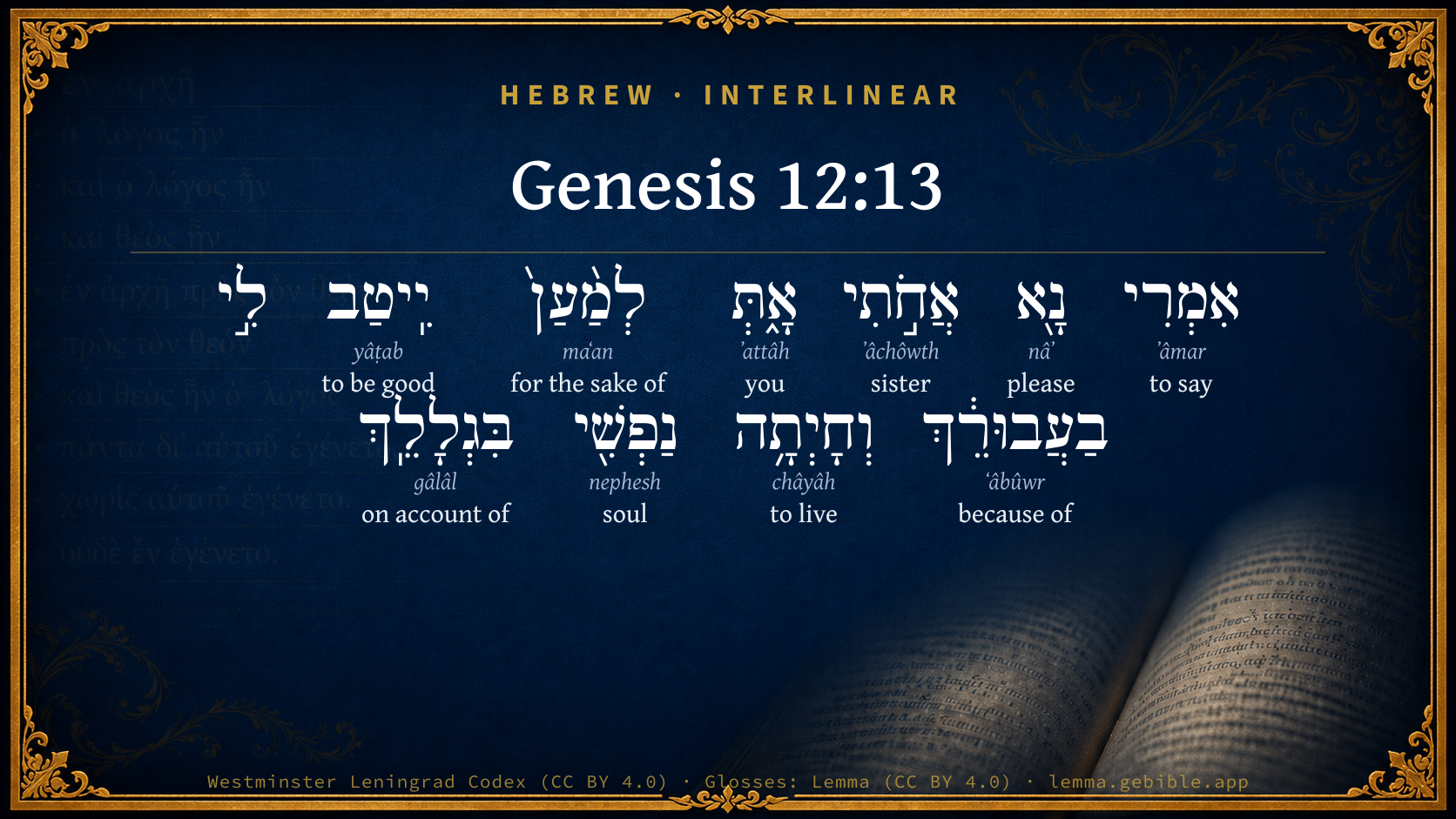
Hebrew (Westminster Leningrad Codex) Genesis 12:13 appears in the Hebrew Old Testament. The text above is from the Westminster Leningrad Codex. Each word links to its Strong’s number, a concise gloss, and parsing drawn from the Open Scriptures Hebrew Bible morphology. Click any word for its full Brown-Driver-Briggs (BDB) entry.
Download image
Cite this verse

Genesis 12:13 (World English Bible). Public Domain. Lemma interlinear Bible study tool, https://lemma.gebible.app/v/genesis/12/13.

Show BibTeX & RIS
BibTeX
RIS
English Translation
Please say that you are my sister, that it may be well with me for your sake, and that my soul may live because of you."
World English Bible · Public Domain
Highlights
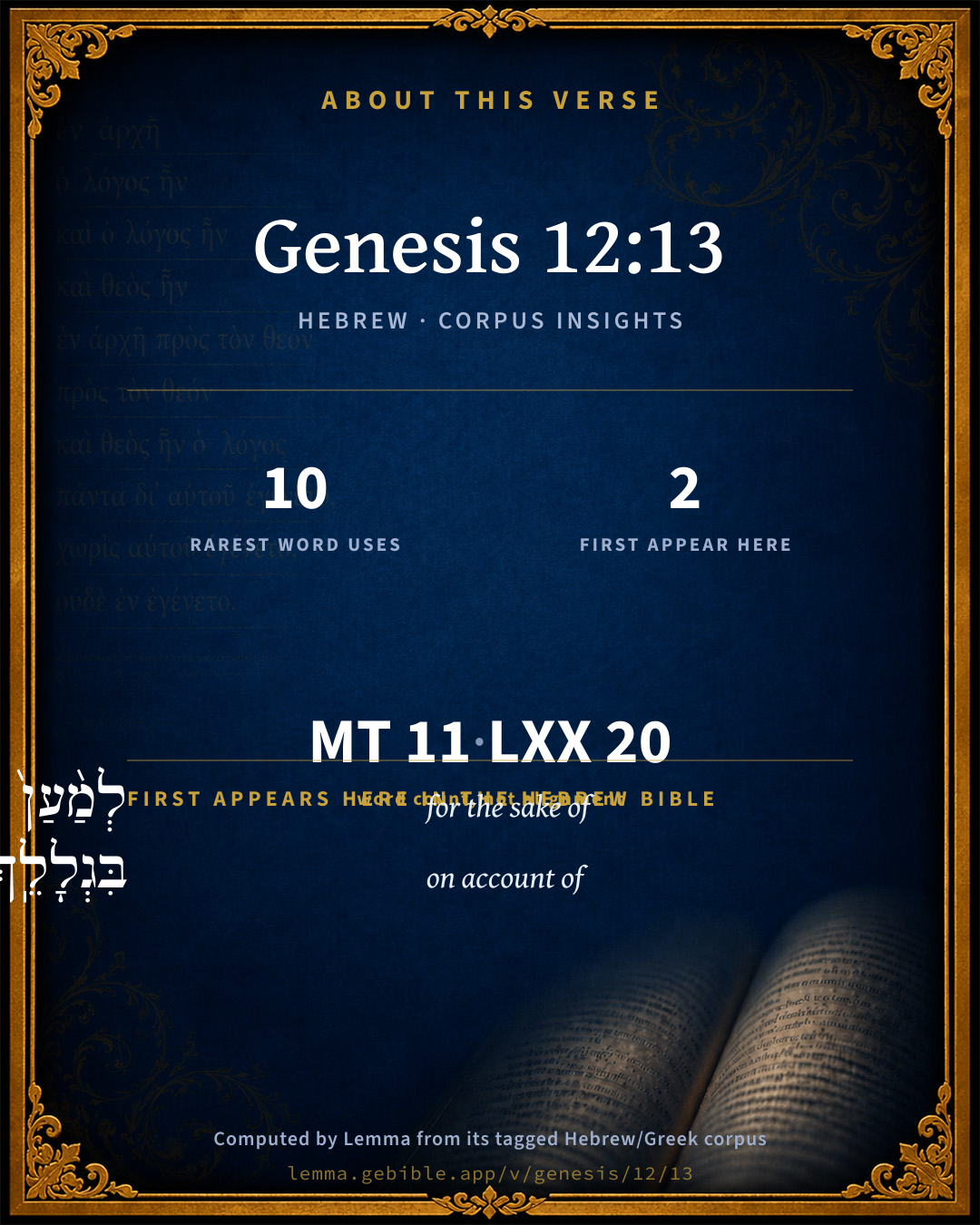
  • 2 first appearances in the Hebrew Bible
Full analysis ↓
Download a study sheet

One document with this verse’s original text, its word-by-word gloss line, the meaning frame, cross-references with their text, attributed commentary, and full source and license credits — printable, and it pastes into notes with its structure intact.

This verse Autodidact and up

Study sheet (.html) Plain text (.txt)

A passage Seminary Student

Up to 50 verses in one chapter. A passage sheet keeps up to 6 commentary sources and 12 cross-references per verse, in the order this page ranks them, and says so on the sheet whenever that leaves anything out. Ask for a single verse and you get the Autodidact verse sheet above.

Everything on this page stays free to read, with no account — the sheet is a download of what is already on screen, not access to it.

Want to remove ads? Support Godless Engineer
Compare translations 3

The same verse in 3 English versions, stacked beneath the original-language interlinear above. Click any original word for its lexicon entry.

Each is an independent rendering of the whole verse — the interlinear is not word-aligned to these translations.

Highlighted words mark where these versions differ — a whole-verse word diff, not a word-by-word alignment.

  • World English Bible Public Domain
    Please say that you are my sister, that it may be well with me for your sake, and that my soul may live because of you."
  • King James Version Public Domain
    Say, I pray thee, thou art my sister: that it may be well with me for thy sake; and my soul shall live because of thee.
  • unfoldingWord Literal Text CC BY-SA 4.0
    Please say you my sister so that it will go well for me for your sake and my life will live because of you.”

unfoldingWord Literal Text — © unfoldingWord, licensed CC BY-SA 4.0. Word-aligned USFM3 via Door43 (git.door43.org/unfoldingWord/en_ult).

Versions to compare (up to 4)

3 of 4 selected

Show all 18 translations

Every available English version of this verse, each an independent rendering of the whole verse.

  • World English Bible Public Domain
    Please say that you are my sister, that it may be well with me for your sake, and that my soul may live because of you."
  • Berean Standard Bible Public Domain
    Please say you are my sister, so that I will be treated well for your sake, and on account of you my life will be spared.”
  • Majority Standard Bible Public Domain
    Please say you are my sister, so that I will be treated well for your sake, and on account of you my life will be spared.”
  • King James Version Public Domain
    Say, I pray thee, thou art my sister: that it may be well with me for thy sake; and my soul shall live because of thee.
  • American Standard Version (1901) Public Domain
    Say, I pray thee, thou art my sister; that it may be well with me for thy sake, and that my soul may live because of thee.
  • Revised Version (1885) Public Domain
    Say, I pray thee, thou art my sister: that it may be well with me for thy sake, and that my soul may live because of thee.
  • Geneva Bible (1599) Public Domain
    Say, I pray thee, that thou art my sister, that I may fare well for thy sake, and that my life may be preserued by thee.
  • Douay-Rheims (1899) Public Domain
    Say, therefore, I pray thee, that thou art my sister: that I may be well used for thee, and that my soul may live for thy sake.
  • Young's Literal Translation Public Domain
    say, I pray thee, thou `art' my sister, so that it is well with me because of thee, and my soul hath lived for thy sake.'
  • Literal Standard Version CC BY-SA 4.0
    please say you [are] my sister, so that it is well with me because of you, and my soul has lived for your sake.”
  • Unlocked Literal Bible CC BY-SA 4.0
    Say that you are my sister, so that it may be well with me because of you, and so that my life will be spared because of you.”
  • unfoldingWord Literal Text CC BY-SA 4.0
    Please say you my sister so that it will go well for me for your sake and my life will live because of you.”
  • Darby Bible Public Domain
    Say, I pray thee, thou art my sister, that it may be well with me on thy account, and my soul may live because of thee.
  • World Messianic Bible Public Domain
    Please say that you are my sister, that it may be well with me for your sake, and that my soul may live because of you.”
  • Webster's Bible Public Domain
    Say, I pray thee, thou art my sister: that it may be well with me for thy sake; and my soul shall live because of thee.
  • Free Bible Version CC BY-SA 4.0
    Tell them you're my sister so I'll be treated well because of you, and my life will be spared for your sake.”
  • Bible in Basic English Public Domain
    Say, then, that you are my sister, and so it will be well with me because of you, and my life will be kept safe on your account.
  • JPS Tanakh (1917) Public Domain
    Say, I pray thee, thou art my sister; that it may be well with me for thy sake, and that my soul may live because of thee.'

Literal Standard Version (2020), Covenant Press — licensed CC BY-SA 4.0. Text via the HelloAO Bible API (eBible.org). Unlocked Literal Bible (unfoldingWord) — licensed CC BY-SA 4.0. Text via the HelloAO Bible API (eBible.org). unfoldingWord Literal Text — © unfoldingWord, licensed CC BY-SA 4.0. Word-aligned USFM3 via Door43 (git.door43.org/unfoldingWord/en_ult). Free Bible Version, Dr. Jonathan Gallagher — licensed CC BY-SA 4.0. Text via the HelloAO Bible API (eBible.org).

Word by word

More ways to search: Search by grammar → Find every occurrence → Compare this word →

Practice this passage: Drill this verse → Learn its vocabulary →

בִּגְלָלֵֽךְ
gâlâl
H1558
“in/at · on account of · your”
Preposition + Noun, Common, Masculine, Singular, Construct + Suffix, Personal, 2nd Person, Feminine, Singular
Part of Speech
Preposition + Noun
Type
Common
Gender
Masculine
Number
Singular
State
Construct
Full BDB Definition

Origin: from H1556

TWOT: 352

on account of, for the sake of
  1. אִמְרִי ʼâmar H559 “say” Verb, Qal, Imperative, 2nd Person, Feminine, Singular
  2. נָ֖א nâʼ H4994 “please” Particle, Exhortation
  3. אֲחֹ֣תִי ʼâchôwth H269 “sister · my” Noun, Common, Feminine, Singular, Construct + Suffix, Personal, 1st Person, Common, Singular
  4. אָ֑תְּ ʼattâh H859 “you” Pronoun, Personal, 2nd Person, Feminine, Singular
  5. לְמַ֨עַן֙ maʻan H4616 “for the sake of” Preposition
  6. יִֽיטַב yâṭab H3190 “to be good” Verb, Qal, Imperfect, 3rd Person, Masculine, Singular
  7. בַעֲבוּרֵ֔ךְ ʻâbûwr H5668 “in/at · because of · your” Preposition + Noun, Common, Masculine, Singular, Construct + Suffix, Personal, 2nd Person, Feminine, Singular
  8. וְחָיְתָ֥ה châyâh H2421 “and · to live” Conjunction + Verb, Qal, Perfect, 3rd Person, Feminine, Singular
  9. נַפְשִׁ֖י nephesh H5315 “soul · my” Noun, Common, Both, Singular, Construct + Suffix, Personal, 1st Person, Common, Singular

About this verse

These counts appear in no published source. They are computed here, from the morphology-tagged text and Lemma’s own curated glosses. What Lemma adds →

11
words
10
distinct lemmas
Pentateuch
section

Notable vocabulary

The rarest word here is בִּגְלָלֵֽךְ on account of H1558 — appearing just 10 times in the whole Hebrew Bible.

First appearance in Scripture

These words make their first canonical appearance in the Hebrew Bible here:

  • לְמַ֨עַן֙ for the sake of H4616
  • בִּגְלָלֵֽךְ on account of H1558

Shared distinctive vocabulary

בִּגְלָלֵֽךְ on account of H1558 occurs in 10 verses of the Hebrew Bible. Also found in:

Grammatical profile

  • 3 verbs
  • 4 nouns
  • 1 pronoun
  • 2 prepositions
  • 1 particle

Verb forms

  • אִמְרִי Qal · Imperative
  • יִֽיטַב Qal · Imperfect
  • וְחָיְתָ֥ה Qal · Perfect

Hebrew & Septuagint length

In English translation the verse runs 26 words from the Hebrew and 25 from the Septuagint (LXX English) — closely comparable.

A rough comparison of the two English renderings, which tokenize alike — not a word-level alignment.

Word counts can differ between the Hebrew and the Greek without any difference in meaning — e.g. the Hebrew direct-object marker אֵת has no separate Greek word, and Greek often adds the article ὁ.

In the original languages it is 11 Hebrew tokens and 20 Greek tokens — but the two are counted differently (Hebrew bundles its prefixes and suffixes into one token; the Greek is in lemma form), so that isn’t a like-for-like length.

Cross-references

10

Topical passages linked to Genesis 12:13 in the Treasury of Scripture Knowledge — connected by theme and wording, ordered by reader-vote popularity; previews shown in the World English Bible.

  • Genesis 26:7 The men of the place asked him about his wife. He said, "She is my sister," for he was afraid to say, "My wife," lest, he thought, the men of the place might kill me for Rebekah, because she was beautiful to look on.
  • Genesis 20:2 Abraham said about Sarah his wife, "She is my sister." Abimelech king of Gerar sent, and took Sarah.
  • Genesis 20:12–13 Moreover she is indeed my sister, the daughter of my father, but not the daughter of my mother; and she became my wife.
  • Genesis 20:5 Didn't he tell me, 'She is my sister?' She, even she herself said, 'He is my brother.' In the integrity of my heart and the innocence of my hands have I done this."
  • Jeremiah 17:5–8 Thus says Yahweh: Cursed is the man who trusts in man, and makes flesh his arm, and whose heart departs from Yahweh.
  • Ezekiel 18:4 Behold, all souls are mine; as the soul of the father, so also the soul of the son is mine: the soul who sins, he shall die.
  • Genesis 11:29 Abram and Nahor took wives. The name of Abram's wife was Sarai, and the name of Nahor's wife, Milcah, the daughter of Haran who was also the father of Iscah.
  • Psalms 146:3–5 Don't put your trust in princes, Each a son of man in whom there is no help.
  • Isaiah 57:11 Of whom have you been afraid and in fear, that you lie, and have not remembered me, nor laid it to your heart? Haven't I held my peace even of long time, and you don't fear me?
  • John 8:44 You are of your Father, the devil, and you want to do the desires of your father. He was a murderer from the beginning, and doesn't stand in the truth, because there is no truth in him. When he speaks a lie, he speaks on his own; for he is a liar, and the father of it.

Cross-references courtesy of OpenBible.info (CC BY 4.0).

Hebrew and Greek witnesses Masoretic Hebrew ↔ Greek Septuagint

The same verse in the two great witnesses to the Old Testament, shown verse-for-verse.

These are two independent witnesses, not word-aligned to each other, and the Septuagint is shown in lemma (dictionary) form.

Hebrew Genesis 12:13 Masoretic · Westminster Leningrad Codex

אִמְרִי נָ֖א אֲחֹ֣תִי אָ֑תְּ לְמַ֨עַן֙ יִֽיטַב לִ֣י בַעֲבוּרֵ֔ךְ וְחָיְתָ֥ה נַפְשִׁ֖י בִּגְלָלֵֽךְ

Please say that you are my sister, that it may be well with me for your sake, and that my soul may live because of you."

World English Bible · Public Domain

Greek LXX Genesis 12:13 Septuagint · lemma form

εἶπον οὖν ὅτι ἀδελφή αὐτός εἰμί ὅπως ἄν εὖ ἐγώ γίγνομαι διά σύ καί ζάω ὁ ψυχή ἐγώ ἕνεκεν σύ

Say, therefore, I am his sister, that it may be well with me on account of you, and my soul shall live because of you.

LXX2012 (modern English Septuagint) · Public Domain

Hebrew: Westminster Leningrad Codex (CC BY 4.0). Greek: Septuagint (public domain); English from LXX2012 (modern English Septuagint) (Public Domain). How the Septuagint differs from the Hebrew →

Targum (Aramaic paraphrase)

2

The Targum is the ancient Jewish Aramaic paraphrase of the Hebrew Scriptures — an interpretive translation, not the Hebrew text itself. Onkelos (literal) and Pseudo-Jonathan (expansive) render the Torah, and Jonathan the Prophets. Coverage is partial: where no permissively-licensed English translation exists for a verse, only the Aramaic is shown. This is verse-level text, not a word-by-word alignment to the Hebrew.

  1. Targum Onkelos Torah (Genesis–Deuteronomy)
    אִמְרִי כְעַן אֲחָתִי אָתְּ בְּדִיל דְּיֵיטַב לִי בְּדִילָךְ וְתִתְקַיֵּם נַפְשִׁי בְּפִתְגָּמָיְכִי

    Say now, thou art my sis­ter, that it may be well with me through thee, and my life may be preserved through thy words.

    Targum Onkelos — Aramaic: “Onkelos Genesis” (public domain); “Onkelos Exodus” (public domain); “Onkelos Leviticus” (public domain); “Onkelos Numbers” (public domain); “Onkelos Deuteronomy” (public domain). English: “Sefaria Community Translation” (CC0 1.0 (public-domain dedication)); “J.W. Etheridge. The Targums of Onkelos and Jonathan Ben Uzziel on the Pentateuch. London: Longmans, Green, 1862” (public domain). Text via Sefaria.

  2. Targum Pseudo-Jonathan Torah (Genesis–Deuteronomy)
    אִמְרִי בְּבָעוּ דַאֲחָתִי אַנְתְּ בְּגִין דְיֵיטִיב לִי בְּגִינָךְ וְתִתְקַיֵים נַפְשִׁי אַמְטוּלְתִּיךְ

    Say, I pray, that thou art my sister, that it may be well with me for thy sake, and that my life may be spared on thy account.

    Targum Pseudo-Jonathan — Aramaic: “Targum Jonathan on Genesis” (public domain); “Targum Jonathan on Exodus” (public domain); “Targum Jonathan on Leviticus” (public domain); “Targum Jonathan on Numbers” (public domain); “Targum Jonathan on Deuteronomy” (public domain). English: “The Targum of Jonathan ben Uzziel, trans. J. W. Etheridge, London, 1862” (public domain). Text via Sefaria.

Commentary

Notes on Genesis 12:13 from classic Christian and Jewish commentators (each source and its license shown beneath its notes). The classic Christian expositions comment on the surrounding passage and are grouped to its opening verse, so a note may address several verses; the Jewish commentaries on the Tanakh (Rashi and others) are per-verse, so they appear only where the commentator wrote on this verse.

Lemma curates 59 commentaries, every one of them public domain or Creative Commons licensed, each selected and text-cleaned for this edition rather than reprinted as found. About our sources →

Trapp's Complete Commentary

John Trapp

Gen 12:13 Say, I pray thee, thou [art] my sister: that it may be well with me for thy sake; and my soul shall live because of thee.

Ver. 13. Say, I pray thee, thou art my sister.] The truth was here not only concealed, but dissembled. As the moon hath her specks, so the best have their blemishes: a sheep may slip into a slough as soon as a swine, and an apple tree may have a fit of barrenness as well as a crab tree.

John Trapp, A Commentary or Exposition upon All the Books of the Old and New Testament (1647–1656) — public domain. Text from a community e-Sword module.

Joseph Benson's Commentary

Gen 12:13. Say thou art my sister — The grace Abram was most eminent for was faith, and yet he thus fell through unbelief and distrust of the divine providence, even after God had appeared to him twice! “Let him that standeth take heed lest he fall.”

Joseph Benson's Commentary on the Old and New Testaments (1811–1818) — public domain. Text from a community e-Sword module.

Tyndale Open Study Notes

Tyndale Open Resources

12:13 tell them you are my sister: This request occurs three times in Genesis (see also 20:2; 26:7). The text explains that this was Abram’s usual strategy (20:13), and his son did likewise. This first occasion was outside the land, the second (ch 20) within, showing that God protected his promise in both regions.

Tyndale Open Study Notes — © Tyndale Open Resources, licensed CC BY-SA 4.0. Text via the HelloAO Bible API.

Geneva Bible (1599)

Geneva Bible translators

By this we may learn not to use unlawful means, nor to put others in danger to save ourselves, read verse 20, albeit it may appear that Abram feared not so much death, as that if he should die without issue, God’s promise should not have taken place: wherein appeared a weak faith.

Hebrew, that my soul may live.

Geneva Bible (1599) marginal notes — public domain. Text via Bolls.life.

Adam Clarke's Commentary

Verse 13. Say, I pray thee, thou art my sister] Abram did not wish his wife to tell a falsehood, but he wished her to suppress a part of the truth. From Ge 20:12, it is evident she was his step-sister, i.e., his sister by his father, but by a different mother. Some suppose Sarai was the daughter of Haran, and consequently the grand-daughter of Terah: this opinion seems to be founded on Ge 11:29, where Iscah is thought to be the same with Sarai, but the supposition has not a sufficiency of probability to support it.

Adam Clarke's Commentary on the Bible (1810–1826) — public domain. Text from a community e-Sword/MySword module.

Ellicott's Commentary for English Readers

(13) My sister.—True literally, as Sarai was Terah’s daughter (Gen_20:12), but absolutely false, as it implied that she was wholly his sister, and therefore not his wife.

A Bible Commentary for English Readers, edited by Charles John Ellicott (1878–1897) — public domain. Text from a community e-Sword module.

The Cambridge Bible for Schools and Colleges

gen. ed. J. J. S. Perowne

13. my sister] i.e. half-sister. Cf. Gen_11:29, Gen_20:12.

my soul] A vivid way of expressing the personal pronoun, cf. Gen_27:4; Gen_27:19; Gen_27:25.

The Cambridge Bible for Schools and Colleges (gen. ed. J. J. S. Perowne; Cambridge University Press, 1878–1918) — public domain. Text from a community e-Sword module.

John Gill's Exposition

Say, I pray thee, that thou art my sister,.... Which though it was not putting a direct lie into her mouth, she being his sister in some sense, as appears from Gen 20:12 yet it was done to conceal truth, and to deceive the Egyptians, and tended to endanger his wife's chastity, as well as showed great timorousness in him, and distrust of the divine care and protection of him; and upon the whole it must be criminal in him, and shows that the best of men are liable to sin, and the strongest believer to fall, and that a saint may fail in the exercise of that grace for which he is most eminent, as Abram was for his faith, and yet fell into unbelief, and through that into other sins; this he said to his wife, and desired her to say on occasion, when she found it necessary:

that it may be well with me for thy sake; his life spared, as follows:

and my soul shall live because of thee; his life be safe and secure for her sake, being reckoned her brother, whereas he feared it would be in the utmost danger should it be known she was his wife.

John Gill's Exposition of the Whole Bible (1746–1763) — public domain (CC PDM 1.0). Text via the HelloAO Bible API.

Haydock's Catholic Bible Commentary

My sister. This was no lie; because she was his niece, being daughter to his brother Aran, and therefore, in the style of the Hebrews, she might truly be called his sister; as Lot is called Abraham’s brother. (Genesis xiv. 14.) See Genesis xx. 12. (Challoner) --- Others say, Sarai was the half-sister of Abraham, by another mother. (Haydock)

George Leo Haydock (1774–1849), Haydock's Catholic Family Bible and Commentary, 1859 edition — public domain. Excludes Psalms (Douay-Rheims chapter numbering differs from Protestant) and Deuterocanonical books (Catholic canon only).

Matthew Poole's English Annotations

Say thou art my sister: so she was, either,

1. More generally, as his niece; for nephews and nieces are in Scripture called brethren and sisters, as Gen 13:8. Or rather,

2. Properly, i.e. by the father’s side, Gen 20:12. So this expression was true, but ambiguous, and intended to deceive the Egyptians, and therefore unwarrantable. And here Abram, the father of the faithful, elsewhere celebrated for the strength of his faith, betrays his infirmity and distrust of God’s providence and promise, and this fact was not without great danger both to himself and Sarai.

Matthew Poole's English Annotations on the Holy Bible (1683–1685) — public domain. Text from a community e-Sword/MySword module.

The Pulpit Commentary

HOMILIES BY F. HASTINGS Ver. 13.

Abraham and carnal policy.

I pray thee, that thou art my sister: that it may be well with me." These words were partially true. (Gen_11:20) Abraham had real ground for saying that Sarah was his sister, but he hid the fact that she was his wife. He asked her to consent to an equivocal statement and to repeat it.

I CONTEMPLATE THE NATURE OF CARNAL POLICY. A truth which is part a lie is ever a dangerous lie. The temptation to this carnal policy came

(1) from his mingling with the worldly Egyptians on equal terms,

(2) from his very prosperous state, and

(3) from his having lately come from a religious observance in which he had had high spiritual revelations.

Possibly he presumed upon his visions and the Divine promises. David fell also shortly after he had attained the kingdom and been delivered from great dangers.

II SEE HOW ALL CARNAL POLICY IS SURE IN THE LONG RUN TO FAIL. Abraham did not foresee all the consequences of his equivocations. He even made the path clear for Pharaoh to ask for Sarah. He had afterwards to know that his name was a byword among the Egyptians.

(1) He lost self-respect;

(2) he had to be rebuked by a Pharaoh, and

(3) to feel that God was dishonored by his act.

Abraham repeated his sin. That God delivered Abraham should teach us that we are not to reject others, who have committed a special sin, as past hope. God does not cast us off for one sinful action. Still Divine forbearance and love should never lead to presumption and to a tampering with carnal policy. H.

The Pulpit Commentary (1880–1919), ed. H.D.M. Spence-Jones & Joseph S. Exell — public domain. Text from a community e-Sword module.

John Wesley's Explanatory Notes

Say thou art my sister - The grace Abram was most eminent for was faith, and yet he thus fell through unbelief and distrust of the divine Providence, even after God had appeared to him twice. Alas, What will become of the willows, when the cedars are thus shaken

John Wesley, Explanatory Notes Upon the Whole Bible (1754–1765) — public domain. Text via the GEBible commentary corpus.

Rashi

Rabbi Shlomo Yitzchaki (Rashi)

למען ייטב לי בעבורך THAT IT MAY BE WELL WITH ME FOR THY SAKE — they may give me presents.

Rashi on the Tanakh — English translations: “The Judaica Press complete Tanach with Rashi, translated by A. J. Rosenberg” (CC BY 4.0); “Pentateuch with Rashi's commentary by M. Rosenbaum and A.M. Silbermann, 1929-1934” (public domain); “The Metsudah Tanach series, Lakewood, N.J” (CC BY 4.0); and “The Book of Joshua, Metsudah Publications, 1997” (CC BY 4.0). Text via Sefaria.

Radak

Rabbi David Kimhi (Radak)

אמרי נא, tell those who ask you.

למען ייטב לי, so that on account of your describing yourself as my sister they will treat me well. The “good treatment” Avram referred to was not financial reward but simply that they would let him live. It is quite inconceivable that Avram wanted to use his wife as a pimp uses a prostitute. Even though we read in verse 15 that Avram, in the event, experienced many financial favours as the man whose consent was sought to have his sister as someone’s wife, this is something he had not counted on at all. In fact, we know how unwilling Avram was to accept people’s favours when he turned down the spoils of war which were not a gift to him but his due as he had fought that war. (Genesis 14,23.) Had he not been in Pharaoh’s country and been afraid to reject these gifts, he would most certainly not have accepted them. Avram was not interested in acquiring more wealth than G’d had seen fit to grant him.

Radak on the Tanakh — English translations: “Sefaria Community Translation” (CC0 1.0 (public-domain dedication)); “Eliyahu Munk, HaChut Hameshulash” (CC BY 4.0); “Rabbi Mike Feuer, Jerusalem Anthology” (CC BY 4.0); and “R. David Kimhi on the first book of Psalms, Translated by R.G. Finch, London, 1919” (public domain). Text via Sefaria.

Lesson kit

Teaching starters — assembled from the data on this page, not authored interpretation. Every prompt links to the verse data it draws on. Edit before teaching.

Genesis, in the Pentateuch, opens this verse with 11 words (10 distinct Hebrew lemmas). Its most distinctive word is gâlâl (“on account of”). A historical commentator’s framing appears above. Read the whole chapter for the surrounding context.

Discussion questions

  1. How does “on account of” (gâlâl) shape what this verse is saying?
  2. 2 words make their first appearance in Scripture here. What does this debut establish?
  3. How does Genesis 30:27, which shares the word «on account of», read alongside this verse?
  4. The translations on this page render this verse differently — a whole-verse word diff, not a word-by-word alignment. What might account for the different wordings?
  5. «אִמְרִי» is a Qal Imperative verb. How does that grammatical form shape the action described?
  6. Compare how Trapp's Complete Commentary and Joseph Benson's Commentary read this verse. Where do they agree or differ?

Things to notice

Reading settings

Reading text

Shown beneath each verse's original-language words.

Old Testament
Old Testament edition

Read the OT as the Masoretic Hebrew (MT) or the Greek Septuagint (LXX).

English shown for the Greek Septuagint (in the Hebrew ↔ Greek comparison).

Comparing translations? Open the Compare panel on any verse page to stack up to four side by side.