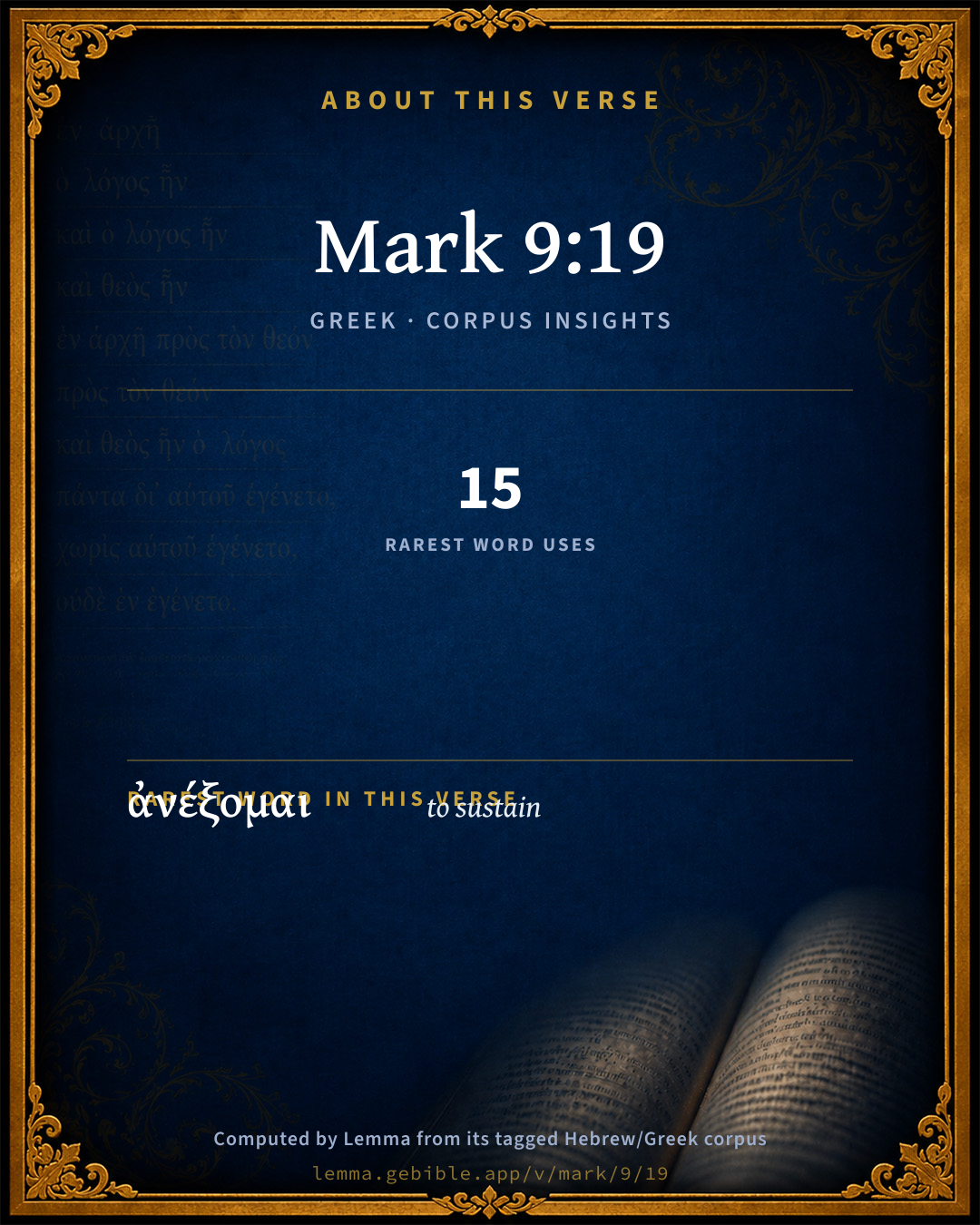
Mark 9:19

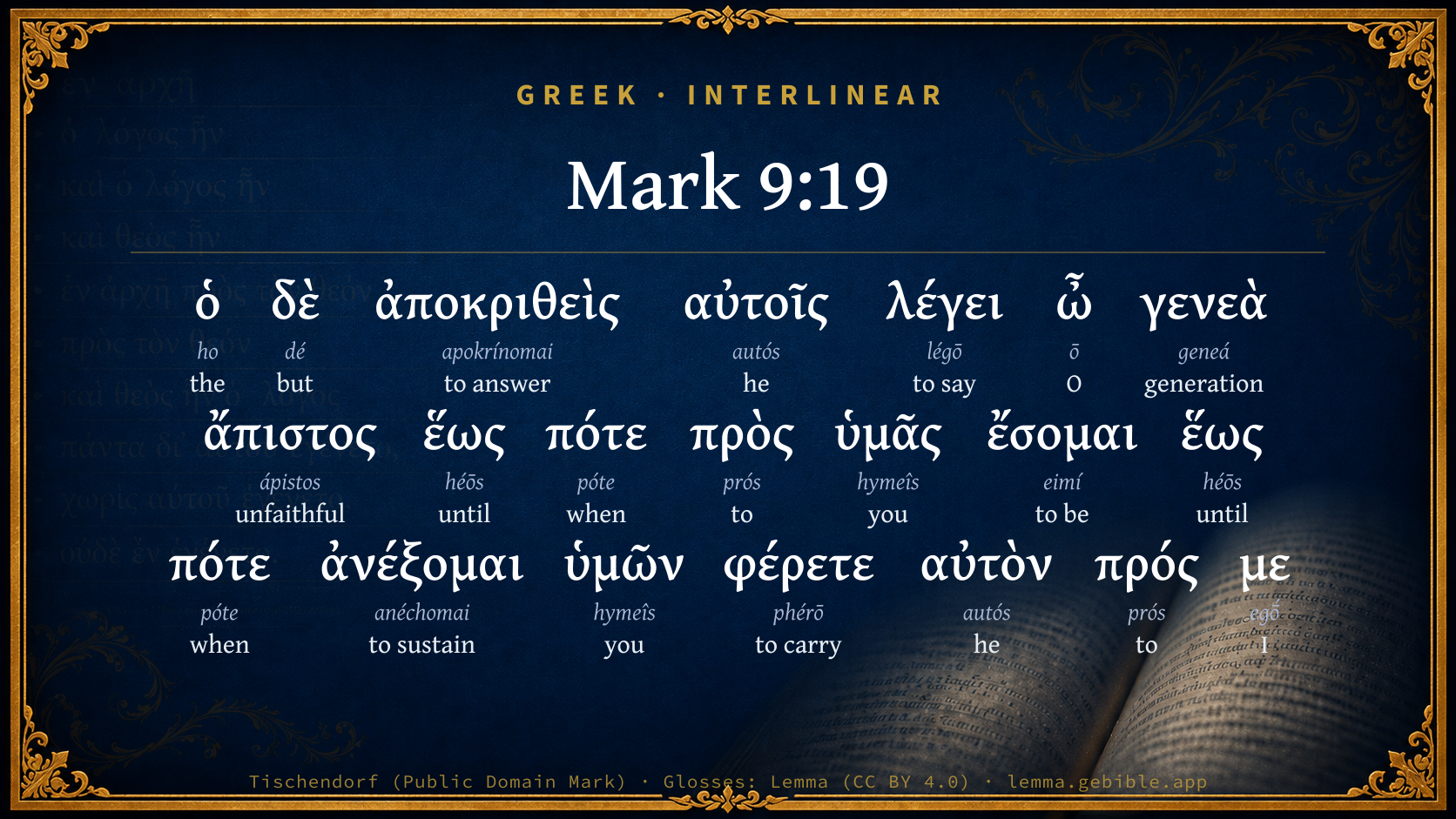
Greek (Tischendorf 8th ed.) Mark 9:19 appears in the Greek New Testament. The text above is from the Tischendorf 8th edition. Each word links to its Strong’s number and a concise gloss. Click any word for its full Thayer’s Greek Lexicon entry.
Download image
Cite this verse

Mark 9:19 (World English Bible). Public Domain. Lemma interlinear Bible study tool, https://lemma.gebible.app/v/mark/9/19.

Show BibTeX & RIS
BibTeX
RIS
English Translation
He answered him, "Unbelieving generation, how long shall I be with you? How long shall I bear with you? Bring him to me."
World English Bible · Public Domain
Download a study sheet

One document with this verse’s original text, its word-by-word gloss line, the meaning frame, cross-references with their text, attributed commentary, and full source and license credits — printable, and it pastes into notes with its structure intact.

This verse Autodidact and up

Study sheet (.html) Plain text (.txt)

A passage Seminary Student

Up to 50 verses in one chapter. A passage sheet keeps up to 6 commentary sources and 12 cross-references per verse, in the order this page ranks them, and says so on the sheet whenever that leaves anything out. Ask for a single verse and you get the Autodidact verse sheet above.

Everything on this page stays free to read, with no account — the sheet is a download of what is already on screen, not access to it.

Want to remove ads? Support Godless Engineer
Compare translations 3

The same verse in 3 English versions, stacked beneath the original-language interlinear above. Click any original word for its lexicon entry.

Each is an independent rendering of the whole verse — the interlinear is not word-aligned to these translations.

Highlighted words mark where these versions differ — a whole-verse word diff, not a word-by-word alignment.

  • World English Bible Public Domain
    He answered him, "Unbelieving generation, how long shall I be with you? How long shall I bear with you? Bring him to me."
  • King James Version Public Domain
    He answereth him, and saith, O faithless generation, how long shall I be with you? how long shall I suffer you? bring him unto me.
  • unfoldingWord Literal Text CC BY-SA 4.0
    But answering them, he says, “O unbelieving generation, until when will I be with you? Until when will I bear with you? Bring him to me.”

unfoldingWord Literal Text — © unfoldingWord, licensed CC BY-SA 4.0. Word-aligned USFM3 via Door43 (git.door43.org/unfoldingWord/en_ult).

Versions to compare (up to 4)

3 of 4 selected

Show all 19 translations

Every available English version of this verse, each an independent rendering of the whole verse.

  • World English Bible Public Domain
    He answered him, "Unbelieving generation, how long shall I be with you? How long shall I bear with you? Bring him to me."
  • Berean Standard Bible Public Domain
    “O unbelieving generation!” Jesus replied. “How long must I remain with you? How long must I put up with you? Bring the boy to Me.”
  • Majority Standard Bible Public Domain
    “O unbelieving generation!” Jesus replied. “How long must I remain with you? How long must I put up with you? Bring the boy to Me.”
  • King James Version Public Domain
    He answereth him, and saith, O faithless generation, how long shall I be with you? how long shall I suffer you? bring him unto me.
  • American Standard Version (1901) Public Domain
    And he answereth them and saith, O faithless generation, how long shall I be with you? how long shall I bear with you? bring him unto me.
  • Revised Version (1885) Public Domain
    And he answereth them and saith, O faithless generation, how long shall I be with you? how long shall I bear with you? bring him unto me.
  • Geneva Bible (1599) Public Domain
    Then he answered him, and said, O faithlesse generation, how long now shall I be with you! how long now shall I suffer you! Bring him vnto me.
  • Douay-Rheims (1899) Public Domain
    And they brought him. And when he had seen him, immediately the spirit troubled him; and being thrown down upon the ground, he rolled about foaming.
  • Young's Literal Translation Public Domain
    And he answering him, said, `O generation unbelieving, till when shall I be with you? till when shall I suffer you? bring him unto me;'
  • Literal Standard Version CC BY-SA 4.0
    And He answering him, said, “O generation unbelieving, until when will I be with you? Until when will I suffer you? Bring him to Me”;
  • Unlocked Literal Bible CC BY-SA 4.0
    He answered them, “Unbelieving generation, how long will I have to stay with you? How long will I bear with you? Bring him to me.”
  • unfoldingWord Literal Text CC BY-SA 4.0
    But answering them, he says, “O unbelieving generation, until when will I be with you? Until when will I bear with you? Bring him to me.”
  • Darby Bible Public Domain
    But he answering them says, O unbelieving generation! how long shall I be with you? how long shall I bear with you? bring him to me.
  • World Messianic Bible Public Domain
    He answered him, “Unbelieving generation, how long shall I be with you? How long shall I bear with you? Bring him to me.”
  • Webster's Bible Public Domain
    He answered him, and saith, O faithless generation, how long shall I be with you, how long shall I suffer you? bring him to me.
  • Free Bible Version CC BY-SA 4.0
    “You unbelieving people!” Jesus responded. “How long must I remain here with you? How long do I have to put up with you? Bring him over here to me!”
  • Bible in Basic English Public Domain
    And he said to them in answer, O generation without faith, how long will I have to be with you? how long will I put up with you? let him come to me.
  • Text-Critical English NT CC BY 4.0
    Jesus answered him, “O faithless generation, how long shall I be with you? How long shall I bear with you? Bring him to me.”
  • Tyndale New Testament (1534) Public Domain
    He answered him and sayd: O generacion with out faith how longe shall I be with you? How longe shall I suffre you? Bringe him vnto me.

Literal Standard Version (2020), Covenant Press — licensed CC BY-SA 4.0. Text via the HelloAO Bible API (eBible.org). Unlocked Literal Bible (unfoldingWord) — licensed CC BY-SA 4.0. Text via the HelloAO Bible API (eBible.org). unfoldingWord Literal Text — © unfoldingWord, licensed CC BY-SA 4.0. Word-aligned USFM3 via Door43 (git.door43.org/unfoldingWord/en_ult). Free Bible Version, Dr. Jonathan Gallagher — licensed CC BY-SA 4.0. Text via the HelloAO Bible API (eBible.org).

Word by word

More ways to search: Search by grammar → Find every occurrence → Compare this word →

Practice this passage: Drill this verse → Learn its vocabulary →

ἀνέξομαι
anéchomai
G430
“to sustain”
Verb, Future, Middle deponent, Indicative, 1st person, Singular
Part of Speech
Verb
Tense
Future
Voice
Middle deponent
Mood
Indicative
Person
1st person
Number
Singular
Full Thayer's Definition

Origin: middle voice from G303 and G2192

TDNT: 1:359,*

1. to hold up 2. to hold one's self erect and firm 3. to sustain, to bear, to endure
  1. ὁ ho G3588 “the” Article, Nominative, Singular, Masculine
  2. δὲ dé G1161 “but” Conjunction
  3. ἀποκριθεὶς apokrínomai G611 “to answer” Verb, Aorist, Passive deponent, Participle, Nominative, Singular, Masculine
  4. αὐτοῖς autós G846 “he” Personal pronoun, Dative, Plural, Masculine
  5. λέγει légō G3004 “to say” Verb, Present, Active, Indicative, 3rd person, Singular
  6. ὦ ō G5599 “O” Interjection
  7. γενεὰ geneá G1074 “generation” Noun, Vocative, Singular, Feminine
  8. ἄπιστος ápistos G571 “unfaithful” Adjective, Vocative, Singular, Feminine
  9. ἕως héōs G2193 “until” Adverb
  10. πότε póte G4219 “when” Particle, Interrogative
  11. πρὸς prós G4314 “to” Preposition
  12. ὑμᾶς hymeîs G5210 “you” Personal pronoun, 2nd person, Accusative, Plural
  13. ἔσομαι eimí G1510 “to be” Verb, Future, Middle deponent, Indicative, 1st person, Singular
  14. ἕως héōs G2193 “until” Adverb
  15. πότε póte G4219 “when” Particle, Interrogative
  16. ὑμῶν hymeîs G5210 “you” Personal pronoun, 2nd person, Genitive, Plural
  17. φέρετε phérō G5342 “to carry” Verb, Present, Active, Imperative, 2nd person, Plural
  18. αὐτὸν autós G846 “he” Personal pronoun, Accusative, Singular, Masculine
  19. πρός prós G4314 “to” Preposition
  20. με egṓ G1473 “I” Personal pronoun, 1st person, Accusative, Singular

About this verse

These counts appear in no published source. They are computed here, from the morphology-tagged text and Lemma’s own curated glosses. What Lemma adds →

21
words
16
distinct lemmas
Gospels
section

Notable vocabulary

The rarest word here is ἀνέξομαι to sustain G430 — appearing just 15 times in the whole Greek New Testament.

Shared distinctive vocabulary

ἀνέξομαι to sustain G430 occurs in 14 verses of the Greek New Testament. Also found in:

Repetition

Words recur within this verse:

  • ἕως until G2193 ×2
  • πότε when G4219 ×2
  • αὐτοῖς he G846 ×2
  • πρὸς to G4314 ×2
  • ὑμᾶς you G5210 ×2

Cross-references

15

Topical passages linked to Mark 9:19 in the Treasury of Scripture Knowledge — connected by theme and wording, ordered by reader-vote popularity; previews shown in the World English Bible.

  • Numbers 14:11 Yahweh said to Moses, How long will this people despise me? and how long will they not believe in me, for all the signs which I have worked among them?
  • Numbers 14:27 How long [shall I bear] with this evil congregation, that murmur against me? I have heard the murmurings of the children of Israel, which they murmur against me.
  • Psalms 106:21–25 They forgot God, their Savior, Who had done great things in Egypt,
  • Matthew 17:17 Jesus answered, "Faithless and perverse generation! How long will I be with you? How long will I bear with you? Bring him here to me."
  • Mark 16:14 Afterward he was revealed to the eleven themselves as they sat at the table, and he rebuked them for their unbelief and hardness of heart, because they didn't believe those who had seen him after he had risen.
  • Luke 9:41 Jesus answered, "Faithless and perverse generation, how long shall I be with you and bear with you? Bring your son here."
  • Luke 24:25 He said to them, "Foolish men, and slow of heart to believe in all that the prophets have spoken!
  • John 20:27 Then he said to Thomas, "Reach here your finger, and see my hands. Reach here your hand, and put it into my side. Don't be unbelieving, but believing."
  • Hebrews 3:10–12 Therefore I was displeased with that generation, And said, 'They always err in their heart, But they didn't know my ways;'
  • Numbers 14:22 because all those men who have seen my glory, and my signs, which I worked in Egypt and in the wilderness, yet have tempted me these ten times, and have not listened to my voice;
  • Numbers 32:13–14 Yahweh's anger was kindled against Israel, and he made them wander back and forth in the wilderness forty years, until all the generation, who had done evil in the sight of Yahweh, was consumed.
  • Deuteronomy 32:20 He said, I will hide my face from them, I will see what their end shall be: For they are a very perverse generation, Children in whom is no faithfulness.
  • Psalms 78:6–8 That the generation to come might know, even the children who should be born; Who should arise and tell their children,
  • Psalms 78:22 Because they didn't believe in God, And didn't trust in his salvation.
  • John 12:27 "Now my soul is troubled. What shall I say? 'Father, save me from this time?' But for this cause I came to this time.

Cross-references courtesy of OpenBible.info (CC BY 4.0).

Where the printed editions differ

1 variant

Places in this verse where the major printed Greek editions disagree on the wording in a way that affects the translation — a comparison of editions, not a manuscript-by-manuscript collation. The editions are the modern critical texts (Nestlé-Aland 28/27, SBL, Westcott-Hort, Tregelles, Tyndale House) and the traditional texts behind the KJV (the Textus Receptus and the Byzantine/Majority text). It is not a claim about which reading is original.

  1. Different wording
    αὐτοῖς

    “to them”

    In NA28NA27TynSBLWHTreg Not in TRByz

    αὐτῷ (autō) 'to him' occurs in traditional manuscripts (TR+Byz) instead of αὐτοῖς (autois) 'to them' in older manuscripts (NA28+NA27+Tyn+SBL+WH+Treg)

Textual data: Translators Amalgamated Greek New Testament (STEPBible TAGNT) · CC BY 4.0.

Commentary

Notes on Mark 9:19 from classic Christian and Jewish commentators (each source and its license shown beneath its notes). The classic Christian expositions comment on the surrounding passage and are grouped to its opening verse, so a note may address several verses; the Jewish commentaries on the Tanakh (Rashi and others) are per-verse, so they appear only where the commentator wrote on this verse.

Lemma curates 59 commentaries, every one of them public domain or Creative Commons licensed, each selected and text-cleaned for this edition rather than reprinted as found. About our sources →

The Biblical Illustrator

Joseph S. Exell

Mar_9:19

O faithless generation.

Christs lament over faithlessness

I. The first thing that seems to be in these words is not anger, indeed, but a very distinct and very pathetic expression of Christs infinite pain, because of mans faithlessness. The element of personal sorrow is most obvious here. It is not only that He is sad for their sakes, that they are so unreceptive, but He feels for Himself, just as we do in our humble measure, the chilling effect of an atmosphere where there is no sympathy. There never was such a lonely soul on this earth as His, just because there never was another so pure and loving. The plain felt soul-chilling after the blessed communion of the mountain. For once the pain He felt broke the bounds of restraint, and shaped for itself this pathetic utterance, How long shall I be with you? I do not know that there is one in which the title of The man of sorrows is to all deeper thinking more pathetically vindicated than in this-the solitude of the uncomprehended and the unaccepted Christ-His pain at His disciples faithlessness. And then do not let us forget that in this short sharp cry of anguish-for it is that-there may be detected by the listening ear not only the tone of personal hurt, but the tone of disappointed and thwarted love. Because of their unbelief He knew that they could not receive what He desired to give them. We find Him more than once in His life hemmed in, hindered of His purpose-simply because there was nobody with a heart open to receive the rich treasure He was ready to pour out Here I would remark, too, before I go to another point, that these two elements-that of personal sorrow and that of disappointed love and baulked purposes-continue still, and are represented as in some measure felt by Him now. It was to disciples that He said, O faithless generation! He did not mean to charge them with the entire absence of all confidence, but He did mean to declare that their poor, feeble faith, such as it was, was not worth naming in comparison with the abounding mass of their unbelief. There was one light spark in them, and there was also a great heap of green wood that had not caught the flame, and only smoked instead of blazing. And so He said to them, O faithless generation! Do not we know that the purer our love, and the more it has purified us, the more sensitive it becomes, even while the less suspicious it becomes? Is not the purest, most unselfish, highest love, that in which the least failure in response is felt most painfully? Though there be no anger, and no change in the love, still there is a pang where there is an inadequate perception, or an unworthy reception, of it. And Scripture seems to countenance the belief that Divine Love, too, may know something, in some mysterious fashion, like that feeling, when it warns us, Grieve not the Holy Spirit of God, whereby ye are sealed unto the day of redemption. So we may venture to say, Grieve not the Christ of God, who redeems us; and remember that we grieve Him most when we will not let Him pour His love upon us, but turn a sullen, unresponsive unbelief towards His pleading grace, as some glacier shuts out the sunshine from the mountainside with its thick-ribbed ice.

II. Another thought, which seems to me to be expressed in this wonderful exclamation of our Lords, is-that their faithlessness bound Christ to earth, and kept Him here. As there is not anger, but only pain, so there is also, I think, not exactly impatience, but a desire to depart, coupled with the feeling that He cannot leave them till they have grown stronger in faith. And that feeling is increased by the experience of their utter helplessness and shameful discomfiture during His brief absence. That had shown that they were not fit to be trusted alone. He had been away for a day up in the mountain there, and though they did not build an altar to any golden calf, like their ancestors, when their leader was absent, still when He comes back He finds things all gone wrong because of the few hours of His absence. They were not ready for Him to leave them; the full-grown tree was not strong enough for the props to be removed. Again, here we get a glimpse into the depth of Christs patient forbearance. We might read these other words of our text, How long shall I suffer you? with such an intonation as to make them almost a threat that the limits of forbearance would soon be reached, and that He was not going to suffer them much longer. But I fail to catch the tone of indignation here. It sounds rather like a pledge that as long as they need forbearance they will get it; but at the same time, a question of How long that is to be? It implies the inexhaustible riches and resources of His patient mercy. There is rebuke in His question, but how tender a rebuke it is! He rebukes without anger. Plainly He names the fault. He shows distinctly His sorrow, and does not hide the strain on His forbearance. That is His way of cure for His servants faithlessness. It was His way on earth. It is His way in heaven. To us, too, comes the loving rebuke of this question, How long shall I suffer you? Thank God that our answer may be cast into the words of His own promise: I say not unto thee, until seven times; but until seventy times seven. Bear with me till thou hast perfected me; and then bear me to Thyself, that I may be with Thee forever, and grieve Thy love no more. So may it be, for with Him is plenteous redemption, and His forbearing mercy endureth forever. (A. Maclaren, D. D,)

The Biblical Illustrator, edited by Joseph S. Exell (c. 1880s–1900s) — public domain. Text from a community e-Sword module.

MacLaren's Expositions of Holy Scripture

Alexander MacLaren

Mark

CHRIST’S LAMENT OVER OUR FAITHLESSNESS

Mar 9:19.

There is a very evident, and, I think, intentional contrast between the two scenes, of the Transfiguration, and of this healing of the maniac boy. And in nothing is the contrast more marked than in the demeanour of these enfeebled and unbelieving Apostles, as contrasted with the rapture of devotion of the other three, and with the lowly submission and faith of Moses and Elias. Perhaps, too, the difference between the calm serenity of the mountain, and the hell-tortured misery of the plain-between the converse with the sainted perfected dead, and the converse with their unworthy successors-made Christ feel more sharply and poignantly than He ordinarily did His disciples’ slowness of apprehension and want of faith. At any rate, it does strike one as remarkable that the only occasion on which there came from His lips anything that sounded like impatience and a momentary flash of indignation was, when in sharpest contrast with ‘This is my beloved Son: hear Him,’ He had to come down from the mountain to meet the devil-possessed boy, the useless agony of the father, the sneering faces of the scribes, and the impotence of the disciples. Looking on all this, He turns to His followers-for it is to the Apostles that the text is spoken, and not to the crowd outside-with this most remarkable exclamation: ‘O faithless generation! how long shall I be with you? how long shall I suffer you?’

Now, I said that these words at first sight looked almost like a momentary flash of indignation, as if for once a spot had come on His pallid cheek-a spot of anger-but I do not think that we shall find it so if we look a little more closely.

The first thing that seems to be in the words is not anger, indeed, but a very distinct and very pathetic expression of Christ’s infinite pain, because of man’s faithlessness. The element of personal sorrow is most obvious here. It is not only that He is sad for their sakes that they are so unreceptive, and He can do so little for them-I shall have something to say about that presently-but that He feels for Himself, just as we do in our poor humble measure, the chilling effect of an atmosphere where there is no sympathy. All that ever the teachers and guides and leaders of the world have in this respect had to bear-all the misery of opening out their hearts in the frosty air of unbelief and rejection-Christ endured. All that men have ever felt of how hard it is to keep on working when not a soul understands them, when not a single creature believes in them, when there is no one that will accept their message, none that will give them credit for pure motives-Jesus Christ had to feel, and that in an altogether singular degree. There never was such a lonely soul on this earth as His, just because there never was one so pure and loving. ‘The little hills rejoice together? as the Psalm says, ‘on every side,’ but the great Alpine peak is alone there, away up amongst the cold and the snows. Thus lived the solitary Christ, the uncomprehended Christ, the unaccepted Christ. Let us see in this exclamation of His how humanly, and yet how divinely, He felt the loneliness to which His love and purity condemned Him.

The plain felt soul-chilling after the blessed communion of the mountain. There was such a difference between Moses and Elias and the voice that said, ‘This is My beloved Son: hear Him,’ and the disbelief and slowness of spiritual apprehension of the people down below there, that no wonder that for once the pain that He generally kept absolutely down and silent, broke the bounds even of His restraint, and shaped for itself this pathetic utterance: ‘How long shall I be with you? how long shall I suffer you?’

Dear friends, here is ‘a little window through which we may see a great matter’ if we will only think of how all that solitude, and all that sorrow of uncomprehended aims, was borne lovingly and patiently, right away on to the very end, for every one of us. I know that there are many of the aspects of Christ’s life in which Christ’s griefs tell more on the popular apprehension; but I do not know that there is one in which the title of ‘The Man of Sorrows’ is to all deeper thinking more pathetically vindicated than in this-the solitude of the uncomprehended and the unaccepted Christ and His pain at His disciples’ faithlessness.

And then do not let us forget that in this short sharp cry of anguish-for it is that-there may be detected by the listening ear not only the tone of personal hurt, but the tone of disappointed and thwarted love. Because of their unbelief He knew that they could not receive what He desired to give them. We find Him more than once in His life, hemmed in, hindered, baulked of His purpose, thwarted, as I may say, in His design, simply because there was no one with a heart open to receive the rich treasure that He was ready to pour out. He had to keep it locked up in His own spirit, else it would have been wasted and spilled upon the ground. ‘He could do no mighty works there because of their unbelief’; and here He is standing in the midst of the men that knew Him best, that understood Him most, that were nearest to Him in sympathy; but even they were not ready for all this wealth of affection, all this infinitude of blessing, with which His heart is charged. They offered no place to put it. They shut up the narrow cranny through which it might have come, and so He has to turn from them, bearing it away unbestowed, like some man who goes out in the morning with his seed-basket full, and finds the whole field where he would fain have sown covered already with springing weeds or encumbered with hard rock, and has to bring back the germs of possible life to bless and fertilise some other soil. ‘He that goeth forth weeping, bearing precious seed, shall doubtless come again with joy’; but He that comes back weeping, bearing the precious seed that He found no field to sow in, knows a deeper sadness, which has in it no prophecy of joy. It is wonderfully pathetic and beautiful, I think, to see how Jesus Christ knew the pains of wounded love that cannot get expressed because there is not heart to receive it.

Here I would remark, too, before I go to another point, that these two elements-that of personal sorrow and that of disappointed love and baulked purposes-continue still, and are represented as in some measure felt by Him now. It was to disciples that He said, ‘O faithless generation!’ He did not mean to charge them with the entire absence of all confidence, but He did mean to declare that their poor, feeble faith, such as it was, was not worth naming in comparison with the abounding mass of their unbelief. There was one spark of light in them, and there was also a great heap of green wood that had not caught the flame and only smoked instead of blazing. And so He said to them, ‘O faithless generation!’

Ay, and if He came down here amongst us now, and went through the professing Christians in this land, to how many of us-regard being had to the feebleness of our confidence and the strength of our unbelief-He would have to say the same thing, ‘O faithless generation!’

The version of that clause in Matthew and Luke adds a significant word,-’faithless and perverse generation.’ The addition carries a grave lesson, as teaching us that the two characteristics are inseparably united; that the want of faith is morally a crime and sin; that unbelief is at once the most tragic manifestation of man’s perverse will, and also in its turn the source of still more obstinate and wide-spreading evil. Blindness to His light and rejection of His love, He treats as the very head and crown of sin. Like intertwining snakes, the loathly heads are separate; but the slimy convolutions are twisted indistinguishably together, and all unbelief has in it the nature of perversity, as all perversity has in it the nature of unbelief. ‘He will convince the world of sin, because they believe not on Me.’

May we venture to say, as we have already hinted, that all this pain is in some mysterious way still inflicted on His loving heart? Can it be that every time we are guilty of unbelieving, unsympathetic rejection of His love, we send a pang of real pain and sorrow into the heart of Christ? It is a strange, solemn thought. There are many difficulties which start up, if we at all accept it. But still it does appear as if we could scarcely believe in His perpetual manhood, or think of His love as being in any real sense a human love, without believing that He sorrows when we sin; and that we can grieve, and wound, and cause to recoil upon itself, as it were, and close up that loving and gracious Spirit that delights in being met with answering love. If we may venture to take our love as in any measure analogous to His-and unless we do, His love is to us a word without meaning-we may believe that it is so. Do not we know that the purer our love, and the more it has purified us, the more sensitive it becomes, even while the less suspicious it becomes? Is not the purest, most unselfish, highest love, that by which the least failure in response is felt most painfully? Though there be no anger, and no change in the love, still there is a pang where there is an inadequate perception, or an unworthy reception, of it. And Scripture seems to countenance the belief that Divine Love, too, may know something, in some mysterious fashion, like that feeling, when it warns us, ‘Grieve not the Holy Spirit of God, whereby ye are sealed unto the day of redemption.’ So we may venture to say, Grieve not the Christ of God, who redeems us; and remember that we grieve Him most when we will not let Him pour His love upon us, but turn a sullen, unresponsive unbelief towards His pleading grace, as some glacier shuts out the sunshine from the mountain-side with its thick-ribbed ice.

Another thought, which seems to me to be expressed in this wonderful exclamation of our Lord’s, is-that this faithlessness bound Christ to earth, and kept Him here. As there is not anger, but only pain, so there is also, I think, not exactly impatience, but a desire to depart, coupled with the feeling that He cannot leave them till they have grown stronger in faith. And that feeling is increased by the experience of their utter helplessness and shameful discomfiture during His brief absence They had shown that they were not fit to be trusted alone. He had been away for a day up in the mountain there, and though they did not build an altar to any golden calf, like their ancestors, when their leader was absent, still when He comes back He finds things all gone wrong because of the few hours of His absence. What would they do if He were to go away from them altogether? They would never be able to stand it at all. It is impossible that He should leave them thus-raw, immature. The plant has not yet grown sufficiently strong to take away the prop round which it climbed. ‘How long must I be with you?’ says the loving Teacher, who is prepared ungrudgingly to give His slow scholars as much time as they need to learn their lesson. He is not impatient, but He desires to finish the task; and yet He is ready to let the scholars’ dulness determine the duration of His stay. Surely that is wondrous and heart-touching love, that Christ should let their slowness measure the time during which He should linger here, and refrain from the glory which He desired. We do not know all the reasons which determined the length of our Lord’s life upon earth, but this was one of them,-that He could not go away until He had left these men strong enough to stand by themselves, and to lay the foundations of the Church. Therefore He yielded to the plea of their very faithlessness and backwardness, and with this wonderful word of condescension and appeal bade them say for how many more days He must abide in the plain, and turn His back on the glories that had gleamed for a moment on the mountain of transfiguration.

In this connection, too, is it not striking to notice how long His short life and ministry appeared to our Lord Himself? There is to me something very pathetic in that question He addressed to one of His Apostles near the end of His pilgrimage: ‘Have I been so long time with you, and yet hast thou not known Me?’ It was not so very long-three years, perhaps, at the outside-and much less, if we take the shortest computation; and yet to Him it had been long. The days had seemed to go tardily. He longed that the ‘fire’ which He came to fling on earth were already ‘kindled,’ and the moments seemed to drop so slowly from the urn of time. But neither the holy longing to consummate His work by the mystery of His passion, to which more than one of His words bear witness, nor the not less holy longing to be glorified with ‘the glory which He had with the Father before the world was,’ which we may reverently venture to suppose in Him, could be satisfied till his slow scholars were wiser, and His feeble followers stronger.

And then again, here we get a glimpse into the depth of Christ’s patient forbearance. We might read these other words of our text, ‘How long shall I suffer you?’ with such an intonation as to make them almost a threat that the limits of forbearance would soon be reached, and that lie was not going to ‘suffer them’ much longer. Some commentators speak of them as expressing ‘holy indignation,’ and I quite believe that there is such a thing, and that on other occasions it was plainly spoken in Christ’s words. But I fail to catch the tone of it here. To me this plaintive question has the very opposite of indignation in its ring. It sounds rather like a pledge that as long as they need forbearance they will get it; but, at the same time, a question of ‘how long’ that is to be. It implies the inexhaustible riches and resources of His patient mercy. And Oh, dear brethren! that endless forbearance is the only refuge and ground of hope we have. His perfect charity ‘is not soon angry; beareth all things,’ and ‘never faileth.’ To it we have all to make the appeal-

‘Though I have most unthankful been

Of all that e’er Thy grace received;

Ten thousand times Thy goodness seen,

Ten thousand times Thy goodness grieved;

Yet, Lord, the chief of sinners spare.’

And, thank God! we do not make our appeal in vain.

There is rebuke in His question, but how tender a rebuke it is! He rebukes without anger. He names the fault plainly. He shows distinctly His sorrow, and does not hide the strain on His forbearance. That is His way of cure for His servants’ faithlessness. It was His way on earth; it is His way in heaven. To us, too, comes the loving rebuke of this question, ‘How long shall I suffer you?’

Thank God that our answer may be cast into the words of His own promise: ‘I say not unto thee, until seven times; but until seventy times seven.’ ‘Bear with me till Thou hast perfected me; and then bear me to Thyself, that I may be with Thee for ever, and grieve Thy love no more.’ So may it be, for ‘with Him is plenteous redemption,’ and His forbearing ‘mercy endureth for ever.’

Alexander MacLaren, Expositions of Holy Scripture (1904–1910) — public domain. Text from a community e-Sword module.

Tyndale Open Study Notes

Tyndale Open Resources

9:19 Jesus said to them: Jesus might have been speaking to the disciples, the father (9:22-24), the crowd, or all present. • How long? Their lack of faith was obstinate and hard-hearted (cp. 3:5; 6:52; 8:17; 10:5).

Tyndale Open Study Notes — © Tyndale Open Resources, licensed CC BY-SA 4.0. Text via the HelloAO Bible API.

Expositor's Greek Testament

ed. W. Robertson Nicoll

Mar 9:19 . The complaint of Jesus, vide on Matthew. Observe the πρὸς ὑμᾶς instead of Matthew’s μεθʼ ὑμῶν . = how long shall I be in relations with you, have to do with you?

The Expositor's Greek Testament, edited by W. Robertson Nicoll (1897–1910) — public domain. Text from a community e-Sword module.

The Cambridge Bible for Schools and Colleges

gen. ed. J. J. S. Perowne

19. O faithless generation] These words, though primarily addressed to the father, apply also to the surrounding multitude, and indeed to the whole Jewish people of which he was a representative, and in a sense to the disciples.

The Cambridge Bible for Schools and Colleges (gen. ed. J. J. S. Perowne; Cambridge University Press, 1878–1918) — public domain. Text from a community e-Sword module.

John Gill's Exposition

He answereth him,.... The father of the child, and who is included in the reproof afterwards given, for his unbelief, and taking part with the Scribes against his disciples; though the Vulgate Latin, Arabic, Persic, and Ethiopic versions, read, "them"; meaning not his disciples, but the Scribes and Pharisees, with the father of the child: and saith,

O faithless generation, how long shall I be with you? how long shall I suffer you? bring him unto me; See Gill on Mat 17:17.

John Gill's Exposition of the Whole Bible (1746–1763) — public domain (CC PDM 1.0). Text via the HelloAO Bible API.

Trapp's Complete Commentary

John Trapp

19 He answereth him, and saith, O faithless generation, how long shall I be with you? how long shall I suffer you? bring him unto me.

Ver. 19. Bring him unto me] Thus man’s perverseness doth not interrupt the course of Christ’s goodness.

John Trapp, A Commentary or Exposition upon All the Books of the Old and New Testament (1647–1656) — public domain. Text from a community e-Sword module.

The Pulpit Commentary

O faithless generation. These words were no doubt intended primarily as a rebuke to the Jews and their scribes; though not without a glance at the weakness of faith of his own disciples. The words are the complaint of one weary of the unbelief of the masses and of the weakness of faith in even his own. Bring him unto me (ferete); literally, Bring ye him to me.

The Pulpit Commentary (1880–1919), ed. H.D.M. Spence-Jones & Joseph S. Exell — public domain. Text from a community e-Sword module.

Cambridge Greek Testament for Schools and Colleges

19. αὐτοῖς ([1930][1931][1932][1933][1934][1935][1936]) rather than αὐτῷ ([1937]3[1938]): [1939][1940] omits.

[1930] Codex Sinaiticus. 4th cent. Discovered by Tischendorf in 1859 at the Monastery of St Katharine on Mount Sinai. Now at St Petersburg. The whole Gospel, ending at Mar 16:8. Photographic facsimile, 1911.

[1931] Codex Alexandrinus. 5th cent. Brought by Cyril Lucar, Patriarch of Constantinople, from Alexandria, and afterwards presented by him to King Charles I. in 1628. In the British Museum. The whole Gospel. Photographic facsimile, 1879.

[1932] Codex Vaticanus. 4th cent., but perhaps a little later than א. In the Vatican Library almost since its foundation by Pope Nicolas V., and one of its greatest treasures. The whole Gospel, ending at Mar 16:8. Photographic facsimile, 1889.

[1933] Codex Bezae. 6th cent. Has a Latin translation (d) side by side with the Greek text, and the two do not quite always agree. Presented by Beza to the University Library of Cambridge in 1581. Remarkable for its frequent divergences from other texts. Contains Mark, except Mar 16:15-20, which has been added by a later hand. Photographic facsimile, 1899.

[1934] Codex Regius. 8th cent. An important witness. At Paris. Contains Mar 1:1 to Mar 10:15; Mar 10:30 to Mar 15:1; Mar 15:20 to Mar 16:20, but the shorter ending is inserted between Mar 16:8 and Mar 16:9, showing that the scribe preferred it to the longer one.

[1935] Codex Sangallensis. 9th or 10th cent. Contains the Gospels nearly complete, with an interlinear Latin translation. The text of Mark is specially good, agreeing often with CL. At St Gall.

[1936] Codex Athous Laurae. 8th cent. Like N and Σ, it is written in silver letters on purple vellum. Contains Mar 9:5 to Mar 16:20, and, as in L, the shorter ending is inserted between Mar 16:8 and Mar 16:9. As in Δ, the text of Mark is specially good.

[1937] Codex Ephraemi. 5th cent. A palimpsest: the original writing has been partially rubbed out, and the works of Ephraem the Syrian have been written over it; but a great deal of the original writing has been recovered; of Mark we have Mar 1:17 to Mar 6:31, Mar 8:5 to Mar 12:29, Mar 13:19 to Mar 16:20. In the National Library at Paris.

[1938] Codex Oxoniensis. 9th cent. Contains Mark, except Mar 3:35 to Mar 6:20.

[1939] Codex Ephraemi. 5th cent. A palimpsest: the original writing has been partially rubbed out, and the works of Ephraem the Syrian have been written over it; but a great deal of the original writing has been recovered; of Mark we have Mar 1:17 to Mar 6:31, Mar 8:5 to Mar 12:29, Mar 13:19 to Mar 16:20. In the National Library at Paris.

[1940] An asterisk denotes that the word is not found elsewhere in N.T., and such words are included in the index, even if there is no note on them in the commentary.

19. Ὦ γενεὰ ἄπιστος, ἕως πότε ἔσομαι. In all three, who agree much more closely in the wording of Christ’s reply than in that of the father’s appeal. Throughout the Synoptics, the chief agreements are in Christ’s Sayings, which tradition preserved more carefully than narrative or the sayings of others. The whole company, esp. the powerless disciples, are included in the “unbelieving generation.” The repeated ἕως πότε is “the Lord’s quousque tandem” (Swete). There is weariness and disappointment in the reproach. Bede compares it to that of a physician whose directions have not been followed. Cf. Joh 14:9; Rev 6:10; and with πρὸς ὑμᾶς the πρὸς ὑμᾶς, Mar 6:3, and πρὸς ὑμᾶς, Mar 14:49.

Cambridge Greek Testament for Schools and Colleges (Cambridge University Press, 1896; 21 vols, various authors incl. Carr, Maclear, Plummer, Farrar, Lumby, Moule, M. R. James, Simcox) — public domain. Text from a community e-Sword module.

Alford’s Greek Testament

Henry Alford

19. γενεά] not addressed to the man, as unbelieving,—nor to the disciples,—but generally, to the race and generation among whom the Lord’s ministry was fulfilled. The additional words καὶ διεστραμμένη (Matt. Luke) are probably from Deu 32:5: see further ib. ver. 20, where ἄπιστος is also expressed by νἱοὶ οἷς οὐκ ἔστι πίστις ἐν αὐτοῖς. The question is not asked in a spirit of longing to be gone from them, but of holy impatience of their hardness of heart and unbelief. In this the father, disciples, Scribes, and multitude are equally involved.

Henry Alford, The Greek Testament (1849–1861) — public domain. Text from a community e-Sword module.

International Critical Commentary

19. Ὁ δὲ ἀποκριθεὶς αὐτοῖς, λέγει—And he answering them, says.

αὐτοῖς, instead of αὐτῷ, him, Tisch. Treg. WH. RV. א ABDL ΔΠ* 1, 28, 33, most mss. Lat. Vet. Vulg. Memph. Syrr.

αὐτοῖς—to them. Jesus’ reply is not addressed to the man, who seems not to have shown any lack of faith, but to the disciples, who have just been mentioned by the father, and to whom the words specially apply, since it was their unbelief that led to the fiasco. Later, the man seems to have lost heart over the failure of the disciples, so that he puts an if you can into his appeal to Jesus (v. 22).

῏Ω γενεὰ ἄπιστος, ἕως πότε πρὸς ὑμᾶς ἔσομαι; ἕως πότε ἀνέξομαι ὑμῶν;—O unbelieving generation, how long shall I be with you? how long shall I suffer you?

γενεὰ—It is possible to translate this race, meaning men of a certain stock or family; but it is more in accordance with almost invariable N.T. usage to translate it generation, men of that time. ἄπιστος—the translation faithless, EV., means generally unfaithful, perfidious, and is therefore ambiguous. It should be translated unbelieving. ἕως πότε—literally, until when.2 πρὸς ὑμᾶς ἔσομαι;—shall I be with you? The question, as appears from the next question, arises from the almost intolerable nature of his intercourse with a generation so spiritually dull and unsympathetic. It is the question of one who feels that his surroundings have become almost unbearable, and who wonders how long they are going to last. ἀνέξομαι ὑμῶν;3—shall I bear with you?

International Critical Commentary — older volumes (1896–1929), various authors — public domain. Text from a community e-Sword module.

Vincent's Word Studies in the New Testament

Marvin R. Vincent

Faithless [απιστος] . Faithless has acquired the sense of treacherous, not keeping faith. But Christ means without faith, and such is Tyndale's translation. Wyc., out of belief. Unbelieving would be better here. The Rev. retains this rendering of the A. V. at 1Co 7:14, 15; Tit 1:15; Rev 21:8, and elsewhere.

Marvin R. Vincent, Word Studies in the New Testament (1887–1900) — public domain. Text from a community e-Sword/MySword module.

Lesson kit

Teaching starters — assembled from the data on this page, not authored interpretation. Every prompt links to the verse data it draws on. Edit before teaching.

Mark, in the Gospels, opens this verse with 21 words (16 distinct Greek lemmas). Its most distinctive word is anéchomai (“to sustain”). A historical commentator’s framing appears above. Read the whole chapter for the surrounding context.

Discussion questions

  1. How does “to sustain” (anéchomai) shape what this verse is saying?
  2. Matthew 17:17 shares the word «to sustain» with this verse. How do the two illuminate each other?
  3. “until” occurs 2× in this one verse. What is the effect of the repetition?
  4. The translations on this page render this verse differently — a whole-verse word diff, not a word-by-word alignment. What might account for the different wordings?
  5. Reading how The Biblical Illustrator and MacLaren's Expositions of Holy Scripture read this verse, where do the two commentators agree and where do they part?

Things to notice

Reading settings

Reading text

Shown beneath each verse's original-language words.

Old Testament
Old Testament edition

Read the OT as the Masoretic Hebrew (MT) or the Greek Septuagint (LXX).

English shown for the Greek Septuagint (in the Hebrew ↔ Greek comparison).

Comparing translations? Open the Compare panel on any verse page to stack up to four side by side.