Genesis 12:19

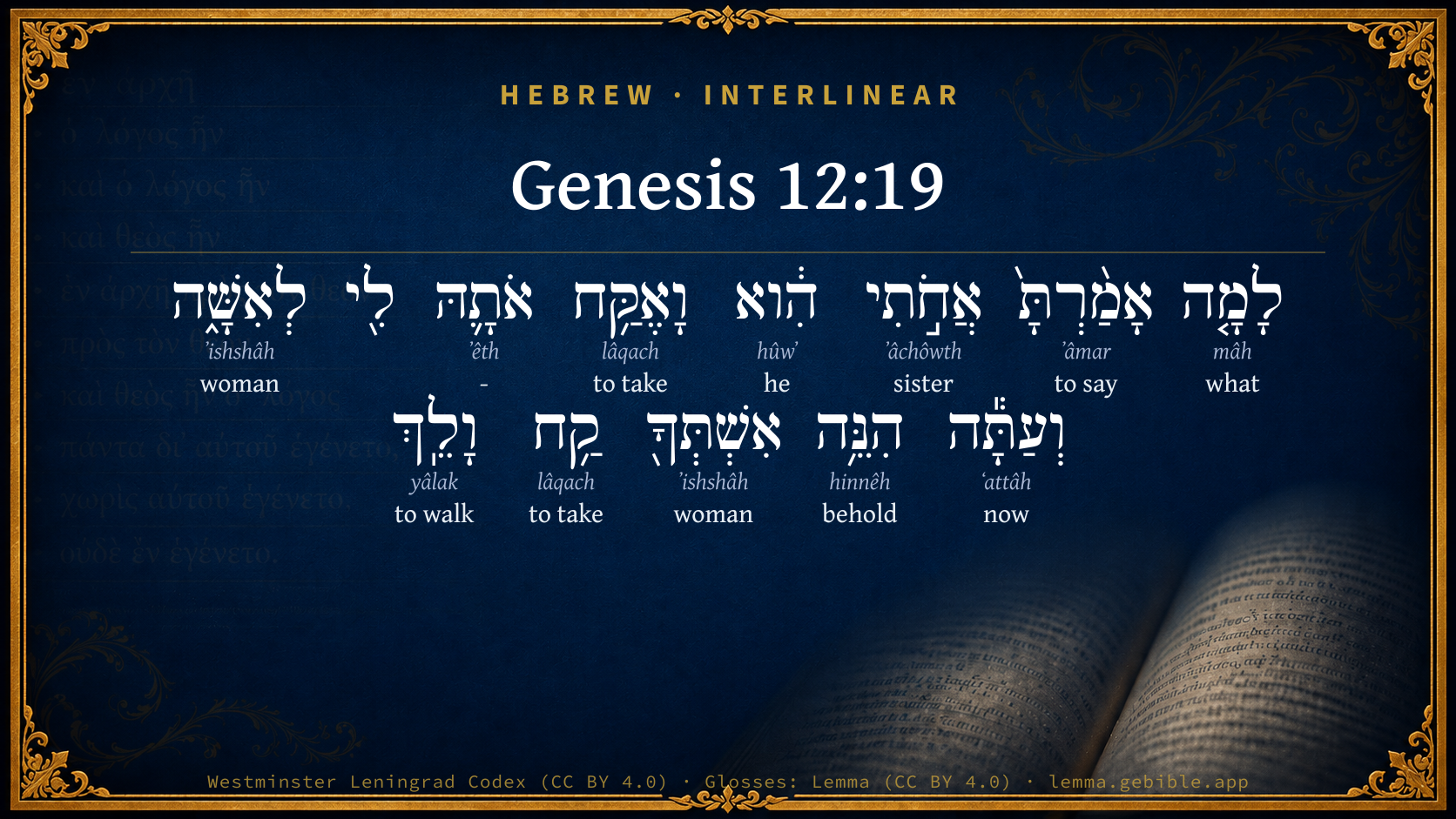
Hebrew (Westminster Leningrad Codex) Genesis 12:19 appears in the Hebrew Old Testament. The text above is from the Westminster Leningrad Codex. Each word links to its Strong’s number, a concise gloss, and parsing drawn from the Open Scriptures Hebrew Bible morphology. Click any word for its full Brown-Driver-Briggs (BDB) entry.
Download image
Cite this verse

Genesis 12:19 (World English Bible). Public Domain. Lemma interlinear Bible study tool, https://lemma.gebible.app/v/genesis/12/19.

Show BibTeX & RIS
BibTeX
RIS
English Translation
Why did you say, 'She is my sister,' so that I took her to be my wife? Now therefore, see your wife, take her, and go your way."
World English Bible · Public Domain
Download a study sheet

One document with this verse’s original text, its word-by-word gloss line, the meaning frame, cross-references with their text, attributed commentary, and full source and license credits — printable, and it pastes into notes with its structure intact.

This verse Autodidact and up

Study sheet (.html) Plain text (.txt)

A passage Seminary Student

Up to 50 verses in one chapter. A passage sheet keeps up to 6 commentary sources and 12 cross-references per verse, in the order this page ranks them, and says so on the sheet whenever that leaves anything out. Ask for a single verse and you get the Autodidact verse sheet above.

Everything on this page stays free to read, with no account — the sheet is a download of what is already on screen, not access to it.

Want to remove ads? Support Godless Engineer
Compare translations 3

The same verse in 3 English versions, stacked beneath the original-language interlinear above. Click any original word for its lexicon entry.

Each is an independent rendering of the whole verse — the interlinear is not word-aligned to these translations.

Highlighted words mark where these versions differ — a whole-verse word diff, not a word-by-word alignment.

  • World English Bible Public Domain
    Why did you say, 'She is my sister,' so that I took her to be my wife? Now therefore, see your wife, take her, and go your way."
  • King James Version Public Domain
    Why saidst thou, She is my sister? so I might have taken her to me to wife: now therefore behold thy wife, take her, and go thy way.
  • unfoldingWord Literal Text CC BY-SA 4.0
    Why did you say, ‘She my sister,’ so that I took her to me as a wife? Now then, behold, your wife. Take and go!”

unfoldingWord Literal Text — © unfoldingWord, licensed CC BY-SA 4.0. Word-aligned USFM3 via Door43 (git.door43.org/unfoldingWord/en_ult).

Versions to compare (up to 4)

3 of 4 selected

Show all 18 translations

Every available English version of this verse, each an independent rendering of the whole verse.

  • World English Bible Public Domain
    Why did you say, 'She is my sister,' so that I took her to be my wife? Now therefore, see your wife, take her, and go your way."
  • Berean Standard Bible Public Domain
    Why did you say, ‘She is my sister,’ so that I took her as my wife? Now then, here is your wife. Take her and go!”
  • Majority Standard Bible Public Domain
    Why did you say, ‘She is my sister,’ so that I took her as my wife? Now then, here is your wife. Take her and go!”
  • King James Version Public Domain
    Why saidst thou, She is my sister? so I might have taken her to me to wife: now therefore behold thy wife, take her, and go thy way.
  • American Standard Version (1901) Public Domain
    why saidst thou, She is my sister, so that I took her to be my wife? now therefore behold thy wife, take her, and go thy way.
  • Revised Version (1885) Public Domain
    Why saidst thou, She is my sister? so that I took her to be my wife: now therefore behold thy wife, take her, and go thy way.
  • Geneva Bible (1599) Public Domain
    Why saidest thou, She is my sister, that I should take her to be my wife? Nowe therefore beholde thy wife, take her and goe thy way.
  • Douay-Rheims (1899) Public Domain
    For what cause didst thou say, she was thy sister, that I might take her to my wife? Now therefore, there is thy wife, take her, and go thy way.
  • Young's Literal Translation Public Domain
    Why hast thou said, She `is' my sister, and I take her to myself for a wife? and now, lo, thy wife, take and go.'
  • Literal Standard Version CC BY-SA 4.0
    Why have you said, She [is] my sister, and I take her to myself for a wife? And now, behold, your wife, take and go.”
  • Unlocked Literal Bible CC BY-SA 4.0
    Why did you say, 'She is my sister,' so that I took her to be my wife? Now therefore, here is your wife. Take her, and go your way.”
  • unfoldingWord Literal Text CC BY-SA 4.0
    Why did you say, ‘She my sister,’ so that I took her to me as a wife? Now then, behold, your wife. Take and go!”
  • Darby Bible Public Domain
    Why didst thou say, She is my sister, so that I took her as my wife. And now, behold, there is thy wife: take [her], and go away.
  • World Messianic Bible Public Domain
    Why did you say, ‘She is my sister,’ so that I took her to be my wife? Now therefore, see your wife, take her, and go your way.”
  • Webster's Bible Public Domain
    Why saidst thou, She is my sister? so I might have taken her to me for a wife: now therefore behold thy wife, take her, and go thy way.
  • Free Bible Version CC BY-SA 4.0
    Why did you say, ‘She's my sister,’ and let me take her to become one of my wives? So here's your wife! Take her and leave!”
  • Bible in Basic English Public Domain
    Why did you say that she was your sister? so that I took her for my wife: now, take your wife and go on your way.
  • JPS Tanakh (1917) Public Domain
    Why saidst thou: She is my sister? so that I took her to be my wife; now therefore behold thy wife, take her, and go thy way.'

Literal Standard Version (2020), Covenant Press — licensed CC BY-SA 4.0. Text via the HelloAO Bible API (eBible.org). Unlocked Literal Bible (unfoldingWord) — licensed CC BY-SA 4.0. Text via the HelloAO Bible API (eBible.org). unfoldingWord Literal Text — © unfoldingWord, licensed CC BY-SA 4.0. Word-aligned USFM3 via Door43 (git.door43.org/unfoldingWord/en_ult). Free Bible Version, Dr. Jonathan Gallagher — licensed CC BY-SA 4.0. Text via the HelloAO Bible API (eBible.org).

Word by word

More ways to search: Search by grammar → Find every occurrence → Compare this word →

Practice this passage: Drill this verse → Learn its vocabulary →

אֲחֹ֣תִי
ʼâchôwth
H269
“sister · my”
Noun, Common, Feminine, Singular, Construct + Suffix, Personal, 1st Person, Common, Singular
Part of Speech
Noun
Type
Common
Gender
Feminine
Number
Singular
State
Construct
Full BDB Definition

Origin: irregular f of H251

TWOT: 62c

sister - sister (same parents) - half-sister (same father) - relative - (metaphorically) of Israel's and Judah's relationship - beloved - bride - (figuratively) of intimate connection - another
  1. לָמָ֤ה mâh H4100 “to/for · what” Preposition + Particle, Interrogative
  2. אָמַ֨רְתָּ֙ ʼâmar H559 “to say” Verb, Qal, Perfect, 2nd Person, Masculine, Singular
  3. הִ֔וא hûwʼ H1931 “he” Pronoun, Personal, 3rd Person, Feminine, Singular
  4. וָאֶקַּ֥ח lâqach H3947 “and · to take” Conjunction + Verb, Qal, Sequential Imperfect, 1st Person, Common, Singular
  5. אֹתָ֛הּ ʼêth H853 “- · her” Particle, Direct Object + Suffix, Personal, 3rd Person, Feminine, Singular
  6. לְאִשָּׁ֑ה ʼishshâh H802 “to/for · woman” Preposition + Noun, Common, Feminine, Singular, Absolute
  7. וְעַתָּ֕ה ʻattâh H6258 “and · now” Conjunction + Adverb
  8. הִנֵּ֥ה hinnêh H2009 “behold” Particle, Demonstrative
  9. אִשְׁתְּךָ֖ ʼishshâh H802 “woman · your” Noun, Common, Feminine, Singular, Construct + Suffix, Personal, 2nd Person, Masculine, Singular
  10. קַ֥ח lâqach H3947 “take” Verb, Qal, Imperative, 2nd Person, Masculine, Singular
  11. וָלֵֽךְ yâlak H3212 “and · walk” Conjunction + Verb, Qal, Imperative, 2nd Person, Masculine, Singular

About this verse

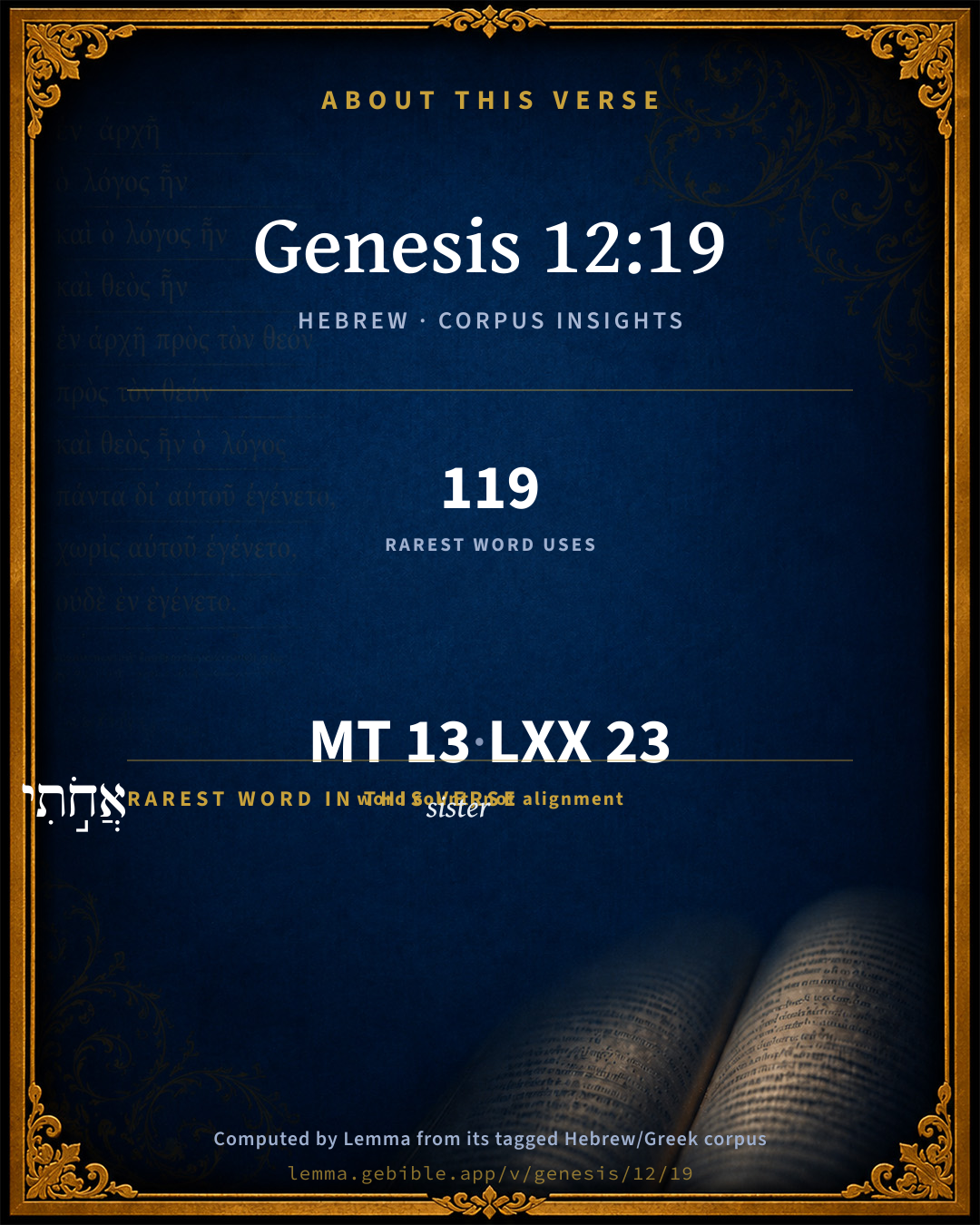
These counts appear in no published source. They are computed here, from the morphology-tagged text and Lemma’s own curated glosses. What Lemma adds →

13
words
10
distinct lemmas
Pentateuch
section

Grammatical profile

  • 4 verbs
  • 3 nouns
  • 1 pronoun
  • 1 preposition
  • 1 adverb
  • 3 particles

Verb forms

  • אָמַ֨רְתָּ֙ Qal · Perfect
  • וָאֶקַּ֥ח Qal · Sequential Imperfect
  • קַ֥ח Qal · Imperative
  • וָלֵֽךְ Qal · Imperative

Repetition

Words recur within this verse — often emphatic in Hebrew:

  • וָאֶקַּ֥ח to take H3947 ×2
  • לְאִשָּׁ֑ה woman H802 ×2

Hebrew & Septuagint length

In English translation the verse runs 28 words from the Hebrew and 31 from the Septuagint (LXX English) — closely comparable.

A rough comparison of the two English renderings, which tokenize alike — not a word-level alignment.

Word counts can differ between the Hebrew and the Greek without any difference in meaning — e.g. the Hebrew direct-object marker אֵת has no separate Greek word, and Greek often adds the article ὁ.

In the original languages it is 13 Hebrew tokens and 23 Greek tokens — but the two are counted differently (Hebrew bundles its prefixes and suffixes into one token; the Greek is in lemma form), so that isn’t a like-for-like length.

Hebrew and Greek witnesses Masoretic Hebrew ↔ Greek Septuagint

The same verse in the two great witnesses to the Old Testament, shown verse-for-verse.

These are two independent witnesses, not word-aligned to each other, and the Septuagint is shown in lemma (dictionary) form.

Hebrew Genesis 12:19 Masoretic · Westminster Leningrad Codex

לָמָ֤ה אָמַ֨רְתָּ֙ אֲחֹ֣תִי הִ֔וא וָאֶקַּ֥ח אֹתָ֛הּ לִ֖י לְאִשָּׁ֑ה וְעַתָּ֕ה הִנֵּ֥ה אִשְׁתְּךָ֖ קַ֥ח וָלֵֽךְ

Why did you say, 'She is my sister,' so that I took her to be my wife? Now therefore, see your wife, take her, and go your way."

World English Bible · Public Domain

Greek LXX Genesis 12:19 Septuagint · lemma form

ἵνα τίς εἶπον ὅτι ἀδελφή ἐγώ εἰμί καί λαμβάνω αὐτός ἐμαυτοῦ εἰς γυνή καί νῦν ἰδού ὁ γυνή σύ ἐναντίον σύ λαμβάνω ἀποτρέχω

Therefore did you say, She is my sister? and I took her for a wife to myself; and now, behold, your wife is before you, take her and go quickly away.

LXX2012 (modern English Septuagint) · Public Domain

Hebrew: Westminster Leningrad Codex (CC BY 4.0). Greek: Septuagint (public domain); English from LXX2012 (modern English Septuagint) (Public Domain). How the Septuagint differs from the Hebrew →

Targum (Aramaic paraphrase)

2

The Targum is the ancient Jewish Aramaic paraphrase of the Hebrew Scriptures — an interpretive translation, not the Hebrew text itself. Onkelos (literal) and Pseudo-Jonathan (expansive) render the Torah, and Jonathan the Prophets. Coverage is partial: where no permissively-licensed English translation exists for a verse, only the Aramaic is shown. This is verse-level text, not a word-by-word alignment to the Hebrew.

  1. Targum Onkelos Torah (Genesis–Deuteronomy)
    לְמָא אֲמַרְתְּ אֲחָתִי הִיא וּדְבָרִית יָתַהּ לִי לְאִתּוּ וּכְעַן הָא אִתְּתָךְ דְּבַר וְאִיזֵל

    Why saidst thou, She is my sister, so that I would have taken her to me to wife? And now, behold thy wife: take, and go.

    Targum Onkelos — Aramaic: “Onkelos Genesis” (public domain); “Onkelos Exodus” (public domain); “Onkelos Leviticus” (public domain); “Onkelos Numbers” (public domain); “Onkelos Deuteronomy” (public domain). English: “Sefaria Community Translation” (CC0 1.0 (public-domain dedication)); “J.W. Etheridge. The Targums of Onkelos and Jonathan Ben Uzziel on the Pentateuch. London: Longmans, Green, 1862” (public domain). Text via Sefaria.

  2. Targum Pseudo-Jonathan Torah (Genesis–Deuteronomy)
    לָמָה אָמַרְתָּ אֲחָתִי הִיא וּדְבָרִית יָתָהּ לִי לְאִנְתּוּ וּמִן יַד אִתְגְרִיאַת בִּי מַכְתָּשָׁא וְלָא קָרֵיבִית לְוָתָהּ וּכְדוֹן הָא אִנְתְּתָךְ דְבַר וְאִיזַל

    Why saidst thou, She is my sister? When I would take her to me to wife, plagues were at once sent against me, and I went not unto her. And now behold thy wife, take (her) and go.

    Targum Pseudo-Jonathan — Aramaic: “Targum Jonathan on Genesis” (public domain); “Targum Jonathan on Exodus” (public domain); “Targum Jonathan on Leviticus” (public domain); “Targum Jonathan on Numbers” (public domain); “Targum Jonathan on Deuteronomy” (public domain). English: “The Targum of Jonathan ben Uzziel, trans. J. W. Etheridge, London, 1862” (public domain). Text via Sefaria.

Commentary

Notes on Genesis 12:19 from classic Christian and Jewish commentators (each source and its license shown beneath its notes). The classic Christian expositions comment on the surrounding passage and are grouped to its opening verse, so a note may address several verses; the Jewish commentaries on the Tanakh (Rashi and others) are per-verse, so they appear only where the commentator wrote on this verse.

Lemma curates 59 commentaries, every one of them public domain or Creative Commons licensed, each selected and text-cleaned for this edition rather than reprinted as found. About our sources →

Trapp's Complete Commentary

John Trapp

Gen 12:19 Why saidst thou, She [is] my sister? so I might have taken her to me to wife: now therefore behold thy wife, take [her], and go thy way.

Ver. 19. Why saidst thou, She is my sister?] He might have answered, Because I was afraid. His fear it was that put him upon this exploit. So it did David when he changed his behaviour, and Peter when he denied his Master, &c. Men should rather die than lie. Nec prodam, nec mentiar , said that good bishop {a} in St Augustine. And that was a brave woman in St Jerome, that being on the rack resolved, and answered the tormentor, Non ideo negare volo ne peream, sed ideo mentiri nolo ne peccem . The chameleon, saith Pliny, is the most fearful of all creatures, and doth therefore turn into all colours, to save itself. So will timorous persons. See Zep 3:13. Let us fortify our hearts against this cowardly passion.

{a} Firmus Episc. Togastensis.

John Trapp, A Commentary or Exposition upon All the Books of the Old and New Testament (1647–1656) — public domain. Text from a community e-Sword module.

Ellicott's Commentary for English Readers

(19) So I might have taken her to me to wife.—The Hebrew is, and I took her to me to wife: that is, I took her with the intention of making her my wife. During the interval before the marriage Pharaoh and his household were visited with such marked troubles that he became alarmed, and possibly Sarai then revealed to him her true relationship to Abram. We find in Est_2:12 that in the case of maidens there was a probation of twelve months duration before the marriage took place, and Sarai was probably saved by some such formality. The conduct of Pharaoh is upright and dignified; nor ought we to disbelieve his assurance that he had acted upon the supposition that Sarai might lawfully be his. The silence of Abram seems to indicate his consciousness that Pharaoh had acted more righteously than himself, and yet his repetition of the offence (Genesis 20) shows that he did not feel much self-reproach at what he had done; nor, possibly, ought we to judge his conduct from the high standpoint of Christian morality. When, however, commentators speak of it as Abram’s fall, they forget that he arranged this matter with Sarai at the very time when he was quitting Haran (Gen_20:13).

A Bible Commentary for English Readers, edited by Charles John Ellicott (1878–1897) — public domain. Text from a community e-Sword module.

The Cambridge Bible for Schools and Colleges

gen. ed. J. J. S. Perowne

19. take her, and go thy way] Pharaoh, justly incensed with Abram, dismisses him with sternness and abruptness.

The Cambridge Bible for Schools and Colleges (gen. ed. J. J. S. Perowne; Cambridge University Press, 1878–1918) — public domain. Text from a community e-Sword module.

John Gill's Exposition

Why saidst thou, she is my sister?.... He could not imagine what could be the reason of it, what could induce him to give out such a story as this; for he knew not the fears that Abram was possessed with, which led him to it, and which might be in a good measure groundless, or else Pharaoh might have guessed at the reason; or this he said as being willing to be satisfied of the true one:

so I might have taken her to me to wife; ignorantly, and without any scruple, supposing her to have been free; and so should have been guilty of taking another man's wife, and of depriving him of her; which with him were crimes he did not choose to commit, though polygamy was not accounted any by him, for no doubt he had a wife or wives when about to take Sarai for one:

now therefore, behold thy wife, take her, and go thy way; Sarai it seems was present at this interview, who was delivered to her husband untouched, as his own property, and is ordered to depart the country, that so neither the king, nor any of his courtiers or subjects, might be under any temptation to do him an injury, by violating the chastity of his wife. The whole of this affair is related by Eupolemus (l), an Heathen historian, in a few words, in great agreement with this account; only he represents Sarai as married to the king of Egypt; he says, that Abram, on account of a famine, went to Egypt, with all his family, and there dwelt, and that the king of the Egyptians married his wife, he saying she was his sister: he goes on to relate more at large, says Alexander Polyhistor that quotes him, that the king could not enjoy her, and that his people and family were infected with a plague, upon which he called his diviners or prophets together, who told him that the woman was not a widow; and when the king of the Egyptians so understood it, that she was the wife of Abram, he restored her to her husband.

(l) Apud Euseb. ut supra. (Praepar. Evangel. l. 9. c. 18. p. 420.)

John Gill's Exposition of the Whole Bible (1746–1763) — public domain (CC PDM 1.0). Text via the HelloAO Bible API.

Matthew Poole's English Annotations

I might have taken her to me to wife; though he had another before; polygamy being then commonly practised.

Matthew Poole's English Annotations on the Holy Bible (1683–1685) — public domain. Text from a community e-Sword/MySword module.

Rashi

Rabbi Shlomo Yitzchaki (Rashi)

קח ולך TAKE HER AND GO AWAY — Not as Abimelech who said to him (Genesis 20:15) “Behold, my land is before thee; dwell wherever it seemeth proper to thee”: but he (Pharaoh) said to him, “Go and do not stay here,” for the Egyptians are greatly addicted to lewd-living, as it is said. (Ezekiel 23:20). “And whose issue is like the issue of horses” (Midrash Tanchuma, Lech Lecha 5). (The passage deals with the immoral practices of the Egyptians).

Rashi on the Tanakh — English translations: “The Judaica Press complete Tanach with Rashi, translated by A. J. Rosenberg” (CC BY 4.0); “Pentateuch with Rashi's commentary by M. Rosenbaum and A.M. Silbermann, 1929-1934” (public domain); “The Metsudah Tanach series, Lakewood, N.J” (CC BY 4.0); and “The Book of Joshua, Metsudah Publications, 1997” (CC BY 4.0). Text via Sefaria.

Ramban (Nachmanides)

Rabbi Moshe ben Nachman (Ramban / Nachmanides)

SO THAT I TOOK HER TO BE MY WIFE. The meaning thereof is that it was Pharaoh’s intention that she be his regal wife, not just his concubine. Pharaoh mentioned this to Abraham so that he should confess to him if she is his sister, as I have explained.

Ramban (Nachmanides) on the Tanakh — English translation: “Commentary on the Torah by Ramban (Nachmanides). Translated and annotated by Charles B. Chavel. New York, Shilo Pub. House, 1971-1976” (CC BY 4.0). Text via Sefaria.

Radak

Rabbi David Kimhi (Radak)

למה...לאשה, I did not take her merely to sleep with her but I took her to be my wife.

הנה אשתך, here she is, as much your wife as before, since I did not touch her.

קח ולך, go and leave immediately before any person in my kingdom tries to rape her. She is too beautiful for most of my subjects to resist the temptation she represents for them. The reason why Avram did not bother to answer Pharaoh as he did Avimelech later (20,11-13) was because Avimelech had not expelled him, so that he deserved an answer.

Radak on the Tanakh — English translations: “Sefaria Community Translation” (CC0 1.0 (public-domain dedication)); “Eliyahu Munk, HaChut Hameshulash” (CC BY 4.0); “Rabbi Mike Feuer, Jerusalem Anthology” (CC BY 4.0); and “R. David Kimhi on the first book of Psalms, Translated by R.G. Finch, London, 1919” (public domain). Text via Sefaria.

Lesson kit

Teaching starters — assembled from the data on this page, not authored interpretation. Every prompt links to the verse data it draws on. Edit before teaching.

Genesis, in the Pentateuch, opens this verse with 13 words (10 distinct Hebrew lemmas). Its most distinctive word is ʼâchôwth (“sister”). A historical commentator’s framing appears above. Read the whole chapter for the surrounding context.

Discussion questions

  1. How does “sister” (ʼâchôwth) shape what this verse is saying?
  2. What does the repetition of “to take” (2× in this one verse) do in this verse?
  3. The translations on this page render this verse differently — a whole-verse word diff, not a word-by-word alignment. What might account for the different wordings?
  4. «אָמַ֨רְתָּ֙» is a Qal Perfect verb. How does that grammatical form shape the action described?
  5. Compare how Trapp's Complete Commentary and Ellicott's Commentary for English Readers read this verse. Where do they agree or differ?

Things to notice

Reading settings

Reading text

Shown beneath each verse's original-language words.

Old Testament
Old Testament edition

Read the OT as the Masoretic Hebrew (MT) or the Greek Septuagint (LXX).

English shown for the Greek Septuagint (in the Hebrew ↔ Greek comparison).

Comparing translations? Open the Compare panel on any verse page to stack up to four side by side.