
Matthew 18:5

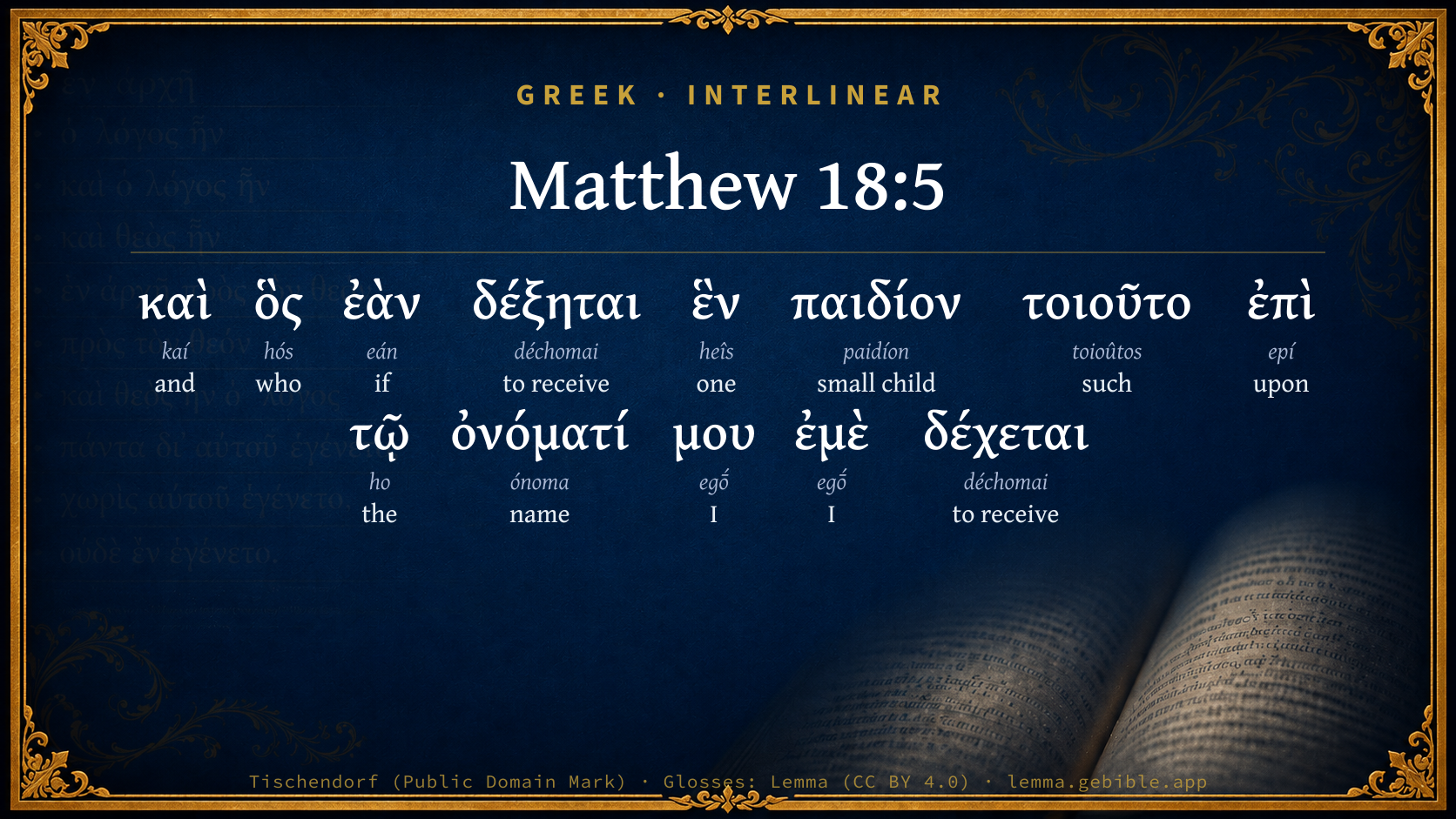
Greek (Tischendorf 8th ed.) Matthew 18:5 appears in the Greek New Testament. The text above is from the Tischendorf 8th edition. Each word links to its Strong’s number and a concise gloss. Click any word for its full Thayer’s Greek Lexicon entry.
Download image
Cite this verse

Matthew 18:5 (World English Bible). Public Domain. Lemma interlinear Bible study tool, https://lemma.gebible.app/v/matthew/18/5.

Show BibTeX & RIS
BibTeX
RIS
English Translation
Whoever receives one such little child in my name receives me,
World English Bible · Public Domain
Download a study sheet

One document with this verse’s original text, its word-by-word gloss line, the meaning frame, cross-references with their text, attributed commentary, and full source and license credits — printable, and it pastes into notes with its structure intact.

This verse Autodidact and up

Study sheet (.html) Plain text (.txt)

A passage Seminary Student

Up to 50 verses in one chapter. A passage sheet keeps up to 6 commentary sources and 12 cross-references per verse, in the order this page ranks them, and says so on the sheet whenever that leaves anything out. Ask for a single verse and you get the Autodidact verse sheet above.

Everything on this page stays free to read, with no account — the sheet is a download of what is already on screen, not access to it.

Want to remove ads? Support Godless Engineer
Compare translations 3

The same verse in 3 English versions, stacked beneath the original-language interlinear above. Click any original word for its lexicon entry.

Each is an independent rendering of the whole verse — the interlinear is not word-aligned to these translations.

Highlighted words mark where these versions differ — a whole-verse word diff, not a word-by-word alignment.

  • World English Bible Public Domain
    Whoever receives one such little child in my name receives me,
  • King James Version Public Domain
    And whoso shall receive one such little child in my name receiveth me.
  • unfoldingWord Literal Text CC BY-SA 4.0
    And whoever receives a little child like this in my name receives me.

unfoldingWord Literal Text — © unfoldingWord, licensed CC BY-SA 4.0. Word-aligned USFM3 via Door43 (git.door43.org/unfoldingWord/en_ult).

Versions to compare (up to 4)

3 of 4 selected

Show all 19 translations

Every available English version of this verse, each an independent rendering of the whole verse.

  • World English Bible Public Domain
    Whoever receives one such little child in my name receives me,
  • Berean Standard Bible Public Domain
    And whoever welcomes a little child like this in My name welcomes Me.
  • Majority Standard Bible Public Domain
    And whoever welcomes a little child like this in My name welcomes Me.
  • King James Version Public Domain
    And whoso shall receive one such little child in my name receiveth me.
  • American Standard Version (1901) Public Domain
    And whoso shall receive one such little child in my name receiveth me:
  • Revised Version (1885) Public Domain
    And whoso shall receive one such little child in my name receiveth me:
  • Geneva Bible (1599) Public Domain
    And whosoeuer shall receiue one such litle childe in my name, receiueth me.
  • Douay-Rheims (1899) Public Domain
    And he that shall receive one such little child in my name, receiveth me.
  • Young's Literal Translation Public Domain
    `And he who may receive one such child in my name, doth receive me,
  • Literal Standard Version CC BY-SA 4.0
    And he who may receive one such child in My Name, receives Me,
  • Unlocked Literal Bible CC BY-SA 4.0
    Whoever welcomes a little child like this in my name receives me.
  • unfoldingWord Literal Text CC BY-SA 4.0
    And whoever receives a little child like this in my name receives me.
  • Darby Bible Public Domain
    and whosoever shall receive one such little child in my name, receives me.
  • World Messianic Bible Public Domain
    Whoever receives one such little child in my name receives me,
  • Webster's Bible Public Domain
    And whoever shall receive one such little child in my name, receiveth me.
  • Free Bible Version CC BY-SA 4.0
    Whoever accepts a little child like this in my name accepts me.
  • Bible in Basic English Public Domain
    And whoever gives honour to one such little child in my name, gives honour to me:
  • Text-Critical English NT CC BY 4.0
    And whoever receives one little child such as this in my name receives me.
  • Tyndale New Testament (1534) Public Domain
    And whosoever receaveth suche a chylde in my name receaveth me.

Literal Standard Version (2020), Covenant Press — licensed CC BY-SA 4.0. Text via the HelloAO Bible API (eBible.org). Unlocked Literal Bible (unfoldingWord) — licensed CC BY-SA 4.0. Text via the HelloAO Bible API (eBible.org). unfoldingWord Literal Text — © unfoldingWord, licensed CC BY-SA 4.0. Word-aligned USFM3 via Door43 (git.door43.org/unfoldingWord/en_ult). Free Bible Version, Dr. Jonathan Gallagher — licensed CC BY-SA 4.0. Text via the HelloAO Bible API (eBible.org).

Word by word

More ways to search: Search by grammar → Find every occurrence → Compare this word →

Practice this passage: Drill this verse → Learn its vocabulary →

παιδίον
paidíon
G3813
“small child”
Noun, Accusative, Singular, Neuter
Part of Speech
Noun
Case
Accusative
Number
Singular
Gender
Neuter
Full Thayer's Definition

Origin: from dimin. of G3816

TDNT: 15:36,8

1. a young child, a little boy, a little girl a. infants b. children, little ones c. an infant 1. of a (male) child just recently born d. of a more advanced child; of a mature child; e. metaph. children (like children) in intellect
  1. καὶ kaí G2532 “and” Conjunction
  2. ὃς hós G3739 “who” Relative pronoun, Nominative, Singular, Masculine
  3. ἐὰν eán G1437 “if” Conditional
  4. δέξηται déchomai G1209 “to receive” Verb, Aorist, Middle deponent, Subjunctive, 3rd person, Singular
  5. ἓν heîs G1520 “one” Adjective, Accusative, Singular, Neuter
  6. τοιοῦτο toioûtos G5108 “such” Demonstrative pronoun, Accusative, Singular, Neuter
  7. ἐπὶ epí G1909 “upon” Preposition
  8. τῷ ho G3588 “the” Article, Dative, Singular, Neuter
  9. ὀνόματί ónoma G3686 “name” Noun, Dative, Singular, Neuter
  10. μου egṓ G1473 “I” Personal pronoun, 1st person, Genitive, Singular
  11. ἐμὲ egṓ G1473 “I” Personal pronoun, 1st person, Accusative, Singular
  12. δέχεται déchomai G1209 “to receive” Verb, Present, Middle or Passive deponent, Indicative, 3rd person, Singular

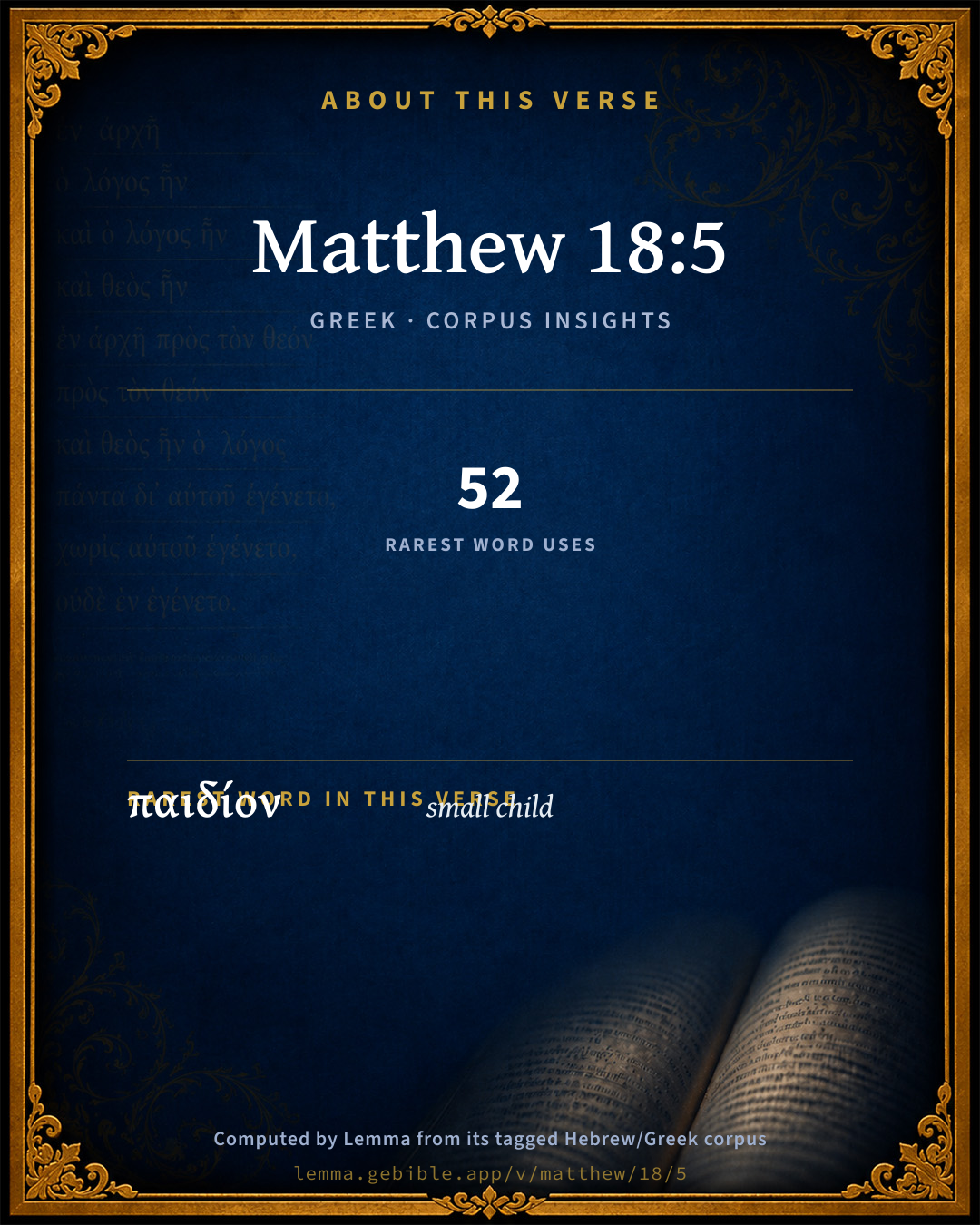
About this verse

These counts appear in no published source. They are computed here, from the morphology-tagged text and Lemma’s own curated glosses. What Lemma adds →

13
words
11
distinct lemmas
Gospels
section

Shared distinctive vocabulary

παιδίον small child G3813 occurs in 49 verses of the Greek New Testament. Also found in:
Repetition

Words recur within this verse:

  • δέξηται to receive G1209 ×2
  • μου I G1473 ×2

Cross-references

9

Topical passages linked to Matthew 18:5 in the Treasury of Scripture Knowledge — connected by theme and wording, ordered by reader-vote popularity; previews shown in the World English Bible.

  • Matthew 25:40 "The King will answer them, 'Most assuredly I tell you, inasmuch as you did it to one of the least of these my brothers, you did it to me.'
  • Mark 9:37 "Whoever receives one such little child in my name, receives me, and whoever receives me, doesn't receive me, but him who sent me."
  • John 13:20 Most assuredly I tell you, he who receives whomever I send, receives me; and he who receives me, receives him who sent me."
  • Galatians 4:14 That which was a temptation to you in my flesh, you didn't despise nor reject; but you received me as an angel of God, even as Christ Jesus.
  • Matthew 10:40–42 He who receives you receives me, and he who receives me receives him who sent me.
  • Matthew 25:45 "Then he will answer them, saying, 'Most assuredly I tell you, inasmuch as you didn't do it to one of the least of these, you didn't do it to me.'
  • Mark 9:41 For whoever will give you a cup of water to drink in my name, because you are Christ's, most assuredly I tell you, he will in no way lose his reward.
  • Luke 9:48 and said to them, "Whoever receives this little child in my name receives me. Whoever receives me receives him who sent me. For whoever is least among you all, this one will be great."
  • Luke 17:1–2 He said to the disciples, "It is impossible that no occasions of stumbling should come, but woe to him through whom they come!

Cross-references courtesy of OpenBible.info (CC BY 4.0).

Commentary

Notes on Matthew 18:5 from classic Christian and Jewish commentators (each source and its license shown beneath its notes). The classic Christian expositions comment on the surrounding passage and are grouped to its opening verse, so a note may address several verses; the Jewish commentaries on the Tanakh (Rashi and others) are per-verse, so they appear only where the commentator wrote on this verse.

Lemma curates 59 commentaries, every one of them public domain or Creative Commons licensed, each selected and text-cleaned for this edition rather than reprinted as found. About our sources →

Joseph Benson's Commentary

Mat 18:5-6. And whoso shall receive one such little child — Whosoever shall entertain or discover an affectionate regard to any one of my humble and meek followers; receiveth me — I shall take the kindness as done to myself. As if he had said, And all who are in this sense little children, are unspeakably dear to me. Therefore help them all you can, as if it were myself in person, and see that ye offend them not: that is, that ye turn them not out of the right way, neither hinder them in it. The original expression, Ος δ’ αν σκανδαλιση, is literally, Whosoever shall cause to stumble one of these little ones that believe in me — Whosoever shall tempt them to sin, or lay obstructions in their way, and render it rough and difficult, and shall thereby impede their progress in it; it were better for him that a millstone were hanged about his neck — Casaubon and Elsner, not to mention others, have shown at large that drowning in the sea was a punishment used among the ancients, and that the persons condemned had sometimes heavy stones tied about their necks, or were rolled up in sheets of lead. It seems to have grown into a proverb for dreadful and inevitable ruin. The term, μυλος ονικος, (as Erasmus, Grotius, Raphelius, and many others observe,) properly signifies a millstone too large to be turned, as some were, by the hand, and requiring the force of asses to move it; as it seems those animals were generally used by the Jews on these occasions.

Joseph Benson's Commentary on the Old and New Testaments (1811–1818) — public domain. Text from a community e-Sword module.

Tyndale Open Study Notes

Tyndale Open Resources

18:5 Jesus moved the discussion toward solidarity within the community; to welcome a humble follower of Jesus is to welcome Jesus himself (see 10:40-42).

Tyndale Open Study Notes — © Tyndale Open Resources, licensed CC BY-SA 4.0. Text via the HelloAO Bible API.

Bengel's Gnomon

Johann Albrecht Bengel

Mat 18:5. Δέξηται, shall receive) sc. humbly, lovingly, to the profit of his soul, as appears from the contrast in the next verse.—τοιοῦτον, such) For little children also are sometimes corrupt.[805]—The same termination occurs in Act 21:25.[806]—ἑν, one) God’s providence is exercised also on individuals; see the next verse. One is frequently mentioned in this chapter. ἐπὶ τῷ ὀνόματί Μου, in My name) Not from natural or political causes.—ὀνόματι, name) see Mat 18:20.—Ἐμὲ, Me) sc. who am in the little ones which believe on Me, as the Father is in Me. In like manner it may be said that, in Justification, when God receives a believer, He receives Christ.

[805] Therefore He marks out one endued with humbleness of heart.—V. g.

[806] τοιοῦτος, τοιαῦτη, τοιοῦτο, Att. also τοιοῦτον, which however is also found in Od. vii. 309, and xiii. 330; and seems to prevail in Herodotus. Liddell and Scott.—(I. B.)

Bengel's Gnomon of the New Testament — English translation (T&T Clark, Edinburgh, 1860) — public domain. Text from a community e-Sword module.

Meyer's Critical & Exegetical Commentary

Heinrich August Wilhelm Meyer

Mat_18:5. Comp. Mar_9:37; Luk_9:47. The question of the disciples has been answered. But His eye having lighted upon this child who happened to be present, Jesus now seizes the opportunity of inculcating upon them the duty of taking an affectionate interest in such little ones,an exhortation, of which the jealous and ambitious spirit evinced by their question in Mat_18:1 must have shown they stood but too much in need.

παιδίον τοιοῦτον] such a little child, i.e. according to the context, not a literal child (Bengel, Paulus, Neander, de Wette, Arnoldi, Bleek, Hilgenfeld), which would give a turn to the discourse utterly foreign to the connection, but a man of such a disposition as this little child representsone who with child-like simplicity is humble and unassuming. So Chrysostom (παιδίον γὰρ ἐνταῦθα τοὺς ἀνθρώπους τοὺς οὕτως ἀφελεῖς φησὶ καὶ ταπεινοὺς καὶ ἀπεῤῥιμμένους παρὰ τοῖς πολλοῖς), Erasmus, Beza, Calvin, Grotius, Wetstein, Kuinoel, Olshausen, Kern, Baumgarten-Crusius, Ewald, Keim. Jesus well knew how much the unassuming, child-like disposition, free from everything like self-assertion, was just that which others, animated by an opposite spirit, were in the habit of overlooking, slighting, and thrusting aside.

ἕν] a single one. So very precious are they!

δέξηται] denotes a loving reception with a view to further care for the soul; the opposite to this is σκανδαλίζειν, Mat_18:6.

ἐπὶ τῷ ὀνόματί μου] on the ground of my name (Mat_24:5)i.e. on account of my name, which, however, is not, with de Wette, to be taken subjectively, and referred to the faith of the one who receives (whosoever confessing my name, on account of his faith in me, etc.), but is to be understood as referring to the παιδίον τοιοῦτον that is to be received (Mar_9:41; Mat_10:42), because my name (Jesus the Messiah) contains the sum of his belief and confession (non ob causas naturales aut politicas, Bengel).

ἐμέ] comp. Mat_10:40, Mat_25:40; Joh_13:20.

Meyer — Critical and Exegetical Commentary on the New Testament — English translation by Peter Christie, edited by Frederick Crombie (T&T Clark, 1880) — public domain. Text from a community e-Sword module.

Expositor's Greek Testament

ed. W. Robertson Nicoll

Mat 18:5-7 .

Mat 18:5 . δέξηται : the discourse passes at this point from being child-like to gracious treatment of a child and what it represents. ἓν παιδίον τοιοῦτο : the real child present in the room passes into an ideal child, representing all that the spirit of ambition in its struggle for place and power is apt to trample under foot. So in effect the majority of commentators; a few, including Bengel, De Wette, Bleek, Weiss, hold that the reference is still to a real child. In favour of this view is Luke’s version: “Whoso receiveth this child ,” etc. (Luk 9:48 ). But the clause ἐπὶ τῷ ὀνόματί μου raises the child into the ideal sphere. The reception required does not mean natural kindness to children (though that also Christ valued), but esteeming them as fellow-disciples in spite of their insignificance. A child may be such a disciple, but it may also represent such disciples, and it is its representative function that is to be emphasised.

The Expositor's Greek Testament, edited by W. Robertson Nicoll (1897–1910) — public domain. Text from a community e-Sword module.

Adam Clarke's Commentary

Verse 5. One such little child] As our Lord in the preceding verses considers a little child an emblem of a genuine disciple, so by the term in this verse he means a disciple only. "Whosoever will receive, i.e. show unto such a child-like, unambitious disciple of mine, any act of kindness for my sake, I will consider it as done to myself."

Adam Clarke's Commentary on the Bible (1810–1826) — public domain. Text from a community e-Sword/MySword module.

Ellicott's Commentary for English Readers

(5) Whoso shall receive one such little child.—The words are memorable as the first utterance of the truth afterwards proclaimed as the law of final judgment in Mat_25:40, and as giving to that law the widest possible range of universality. No child of man is excluded from those whom Christ calls His brethren.

A Bible Commentary for English Readers, edited by Charles John Ellicott (1878–1897) — public domain. Text from a community e-Sword module.

The Cambridge Bible for Schools and Colleges

gen. ed. J. J. S. Perowne

5, 6. Christ’s Little Ones. Mar_9:37

The thought of Jesus passes from the dispute among His disciples to the care of His little ones, the young in faith, who, if they have the weakness, have also the humility of little children.

whoso shall receive] It is a sacrament of lovingkindness when Christ Himself is received in the visible form of His little ones. To receive is to welcome, shew kindness to.

a millstone] Literally, a millstone turned by an ass, and so larger than the ordinary millstone. Cp. Ovid (Fasti vi. 318): “Et quæ pumiceas versat asella molas.”

The manner of death alluded to appears to have been unknown to the Jews. But Plutarch mentions this punishment as being common to Greece and Rome. Cp. Juv. Sat. xiv. 16, 17, where, as in other places, it is named rather than the cross as a swift and terrible penalty for crime.

The Cambridge Bible for Schools and Colleges (gen. ed. J. J. S. Perowne; Cambridge University Press, 1878–1918) — public domain. Text from a community e-Sword module.

John Gill's Exposition

And whoso shall receive one such little child,.... Which is to be understood, not literally but metaphorically; meaning not such an one in age, but one, as the Syriac renders it, , "that is as this child": like unto it for modesty and humility; one, that is as that, free from pride, ambition, and envy. Christ's sense is, that whoever receives his disciples, that are meek and lowly, into their houses, or into their hearts and affections; that receives their ministry and message, embraces the Gospel preached by them with readiness and cheerfulness, with faith and love,

in my name; on his account, because they are his disciples, believe in him, preach his Gospel, and, as being sent by, and representing him,

receiveth me: it is so taken by Christ, as if he was personally present, and personally received, and had all the favours shown to his, done to himself in person; yea, such receive Christ in the ministry of the word, he being the sum and substance of it. This is said to encourage modesty and humility; and intimates, that proud and haughty persons will not be received as the disciples and followers of the meek and lowly Jesus; and to encourage persons to receive such that are modest and humble, since the respect shown to them, is all one as if shown to him.

John Gill's Exposition of the Whole Bible (1746–1763) — public domain (CC PDM 1.0). Text via the HelloAO Bible API.

Trapp's Complete Commentary

John Trapp

5 And whoso shall receive one such little child in my name receiveth me.

Ver. 5. And whoso shall receive one such, &c.] St Luke {Luk 9:48} hath it, "whosoever shall receive this child in my name." Meaneth our Saviour the child, or those that were humble as that child? Both surely. See here how highly Christ regards and rewards humility, even the picture of it in little ones. Now, if the shadow of this grace have such a healing virtue, what then hath the body? If the leaves be so sovereign, what then the fruit?

John Trapp, A Commentary or Exposition upon All the Books of the Old and New Testament (1647–1656) — public domain. Text from a community e-Sword module.

Haydock's Catholic Bible Commentary

He that shall receive. To receive, in the style of the Scriptures, is to honour and favour, to be charitable, and kind to any one. (Witham) --- Who does not admire here the great goodness of God! Jesus, knowing that he was soon to leave the world, and that his disciples would no longer have it in their power to manifest their charity for him by their kind services, substitutes the poor in his place, declaring, that if they receive or honour them, they received Christ himself. (Denis the Carthusian) --- What greater proof can we wish for the merit of good works!!!

George Leo Haydock (1774–1849), Haydock's Catholic Family Bible and Commentary, 1859 edition — public domain. Excludes Psalms (Douay-Rheims chapter numbering differs from Protestant) and Deuterocanonical books (Catholic canon only).

Matthew Poole's English Annotations

Mark hath it thus, Mar 9:37, Whosoever shall receive one of such children in my name, receiveth me: and whosoever receiveth me, receiveth not me, but him that sent me. Then he addeth, Mar 9:42, And whosoever shall offend one of these little ones that believe in me, it is better for him that a millstone were hanged about his neck, and he were cast into the sea. Our Lord having declared that the little ones before mentioned shall be greatest in the kingdom of God, here cometh to show the care which he in his providence will take for them; that their friends shall be his friends, and their enemies his enemies: Whoso receiveth such a little child, that is, a humble Christian. In the next verse it is opened by, one that believeth in me. By receiving I conceive is here to be understood the showing of any favour or kindness to them: Christ declares that he would take it as done to himself. It is much the same with Mat 10:40-42. Mark addeth, He that receiveth me, receiveth him that sent me. The reason is, because he and his Father are one, and the Father takes any kindness done to Christ as if it were done to himself, and the Son takes any kindness or unkindness done to any humble, believing soul, as if it were done to himself: see Mat 25:34-46.

But whoso shall offend one of these little ones, &c. As offending signifieth the laying of a stumbling block before any, so it signifieth any motion or temptation to them to sin against God, whether it be by flattering or frowning arguments, though the latter seemeth rather to be understood here; so, by offending, it signifies the doing them any harm upon Christ’s account, because they own him, and make a profession of his gospel, which, besides that it is a stumblingblock upon which they fall and suffer as to their bodies and outward concerns, is also a stumbling block to their souls, such dangers being strong temptations to Christians, to turn them aside from the right paths of truth and holiness.

It were better for him that a millstone, &c.; mulov onikov, a stone in such a mill as asses were wont to draw, because of the heaviness of it. Some think our Saviour in this phrase alludes to some punishment of notorious malefactors, in use not amongst the Jews, but some other nations, by tying a stone about their necks, and throwing them into the sea: but whether it be such an allusion or no, is of no great moment; the phrase signifieth a certain destruction, both in regard of the weight of the stone and the depth of the sea. He saith, It is better that a millstone, &c., because of the punishment which shall be inflicted on such persons beyond this life.

Matthew Poole's English Annotations on the Holy Bible (1683–1685) — public domain. Text from a community e-Sword/MySword module.

Whedon's Commentary on the Bible

Daniel D. Whedon

5. Whose shall receive one such little child — Not the actual child but the spiritual child, whom grace has made. Receiveth me — In receiving him who is my spiritual image. For our Lord here passes from the symbol to the thing symbolized, from the child by nature to the child by grace.

Daniel D. Whedon (gen. ed.), Commentary on the Old and New Testaments (1874–1909) — public domain. Text from a community e-Sword module.

The Pulpit Commentary

Vers. 5-14. The treatment due to such.

Shall receive (ov eaxhtai). The word is pregnant with meaning. It includes not only the showing of tender affection and the giving of material succour, such as hospitality, shelter, etc., but also the bestowal of help and support in spiritual things, encouragement in holiness, instruction in Divine lore. One such little child. Primarily, Jesus refers to children, pure and confiding as the one he had placed in the midst; but his words are applicable to all who have the childlike spirit and character, the graces which he specially loves and rewards. The expressions here and in the next verse must be understood to belong in some cases to the symbol, and in others to the symbolized. In my Name (epi tw onomati mou); for the sake of my Name; because he belongs to me; not merely from natural affection and pity, but from a higher motive, because the child has in him somewhat of Christ is the child of God, and a member of Christ. Receiveth me. That which is done to his little ones Christ regards as done to himself. (comp. Mat_10:40-42) What a blessing waits on those who teach the young, working laboriously in schools, and training souls for heaven! This "receiving" Christ is a far higher and better thing than being "greatest" in an earthly kingdom.

The Pulpit Commentary (1880–1919), ed. H.D.M. Spence-Jones & Joseph S. Exell — public domain. Text from a community e-Sword module.

John Wesley's Explanatory Notes

And all who are in this sense little children are unspeakably dear to me. Therefore help them all you can, as if it were myself in person, and see that ye offend them not; that is, that ye turn them not out of the right way, neither hinder them in it. Matt. x, 40; Luke x, 16; John xiii, 20.

John Wesley, Explanatory Notes Upon the Whole Bible (1754–1765) — public domain. Text via the GEBible commentary corpus.

Burkitt's Expository Notes on the New Testament

William Burkitt

Our Saviour having declared, that the humblest persons should be always highest in his esteem; he next declares how exceeding dear and precious such christians are to him, who resemble little children in humility of heart, and innocency of life: assuring the world, that whatever kindness and respect is shewn to such for his sake, he reckons shewn to himself; and all the disrespect and unkindness which is offered to them, be accounts as done unto himself: so near is the union, and so dear the relation, betwixt Christ and his members, that whatever good or evil is done unto them, he reckons as done unto himself.

William Burkitt's Expository Notes on the New Testament (1700–1703) — public domain. Text from a community e-Sword module.

The People's New Testament

B. W. Johnson

5. Whoso shall receive one such little child in my name. Receiving in my name is serving with Christian love, and as belonging to Christ. Receiveth me. Observe that the true way to receive Christ is to receive into our heart, for Christ's sake, those who need our sympathies.

B. W. Johnson's The People's New Testament with Notes (1889–1891) — public domain. Electronic text from the Christian Classics Ethereal Library (CCEL) ThML edition.

Cambridge Greek Testament for Schools and Colleges

5, 6. CHRIST’S LITTLE ONES

Mar 9:37-42.

The thought of Jesus passes from the dispute among His disciples to the care of his little ones, the young in faith, who, if they have the weakness, have also the humility of little children.

5. ὃς ἐὰν δέξηται. It is a sacrament of lovingkindness when Christ himself is received in the visible form of His little ones. δέχεσθαι is not only to welcome, show kindness to, but also to receive as a teacher (ἀποδέχεσθαι). The faithful see in the ταπεινότης of little children a symbol of the ταπεινότης of Christ.

Cambridge Greek Testament for Schools and Colleges (Cambridge University Press, 1896; 21 vols, various authors incl. Carr, Maclear, Plummer, Farrar, Lumby, Moule, M. R. James, Simcox) — public domain. Text from a community e-Sword module.

Alford’s Greek Testament

Henry Alford

5.] Having shewn the child as the pattern of humility, the Lord proceeds to shew the honour in which children are held in His heavenly kingdom; and not only actual, but spiritual children—for both are understood in the expression ἓν παιδίον τοιοῦτον.

The receiving in My name is the serving (ἔσται πάντων διάκονος Mar 9:35) with Christian love, and as belonging to Christ (see also ch. 25:40).

Henry Alford, The Greek Testament (1849–1861) — public domain. Text from a community e-Sword module.

International Critical Commentary

5. And whosoever shall receive ore such child in My name receives Me.] Mk. has: “Whosoever shall receive one of such children in My name receives Me.” By “receive in My name” here is apparently meant to recognise in the humble, unassuming disposition of children a feature of the Christlike character; cf. 11:29.They who recognise and welcome this characteristic of childhood receive Christ, i.e. are in communion with Him.

The editor here omits Mk 37b-41. But it is noticeable that in 10:40, 42 he has parallels to the first and last of these sayings.

(M)

International Critical Commentary — older volumes (1896–1929), various authors — public domain. Text from a community e-Sword module.

Vincent's Word Studies in the New Testament

Marvin R. Vincent

In my name [επι τω ονοματι μου] . Lit., upon my name; on the ground of, or on account of; for my sake.

Marvin R. Vincent, Word Studies in the New Testament (1887–1900) — public domain. Text from a community e-Sword/MySword module.

Lesson kit

Teaching starters — assembled from the data on this page, not authored interpretation. Every prompt links to the verse data it draws on. Edit before teaching.

Matthew, in the Gospels, opens this verse with 13 words (11 distinct Greek lemmas). Its most distinctive word is paidíon (“small child”). A historical commentator’s framing appears above. Read the whole chapter for the surrounding context.

Discussion questions

  1. How does “small child” (paidíon) shape what this verse is saying?
  2. Matthew 2:8 shares the word «small child» with this verse. How do the two illuminate each other?
  3. “to receive” occurs 2× in this one verse. What is the effect of the repetition?
  4. The translations on this page render this verse differently — a whole-verse word diff, not a word-by-word alignment. What might account for the different wordings?
  5. Reading how Joseph Benson's Commentary and Tyndale Open Study Notes read this verse, where do the two commentators agree and where do they part?

Things to notice

  • These translations choose different wording for 9 words in this verse.
  • “to receive” occurs 2× in this single verse.
  • 11 distinct Greek lemmas span 13 words in this verse.

Reading settings

Reading text

Shown beneath each verse's original-language words.

Old Testament
Old Testament edition

Read the OT as the Masoretic Hebrew (MT) or the Greek Septuagint (LXX).

English shown for the Greek Septuagint (in the Hebrew ↔ Greek comparison).

Comparing translations? Open the Compare panel on any verse page to stack up to four side by side.