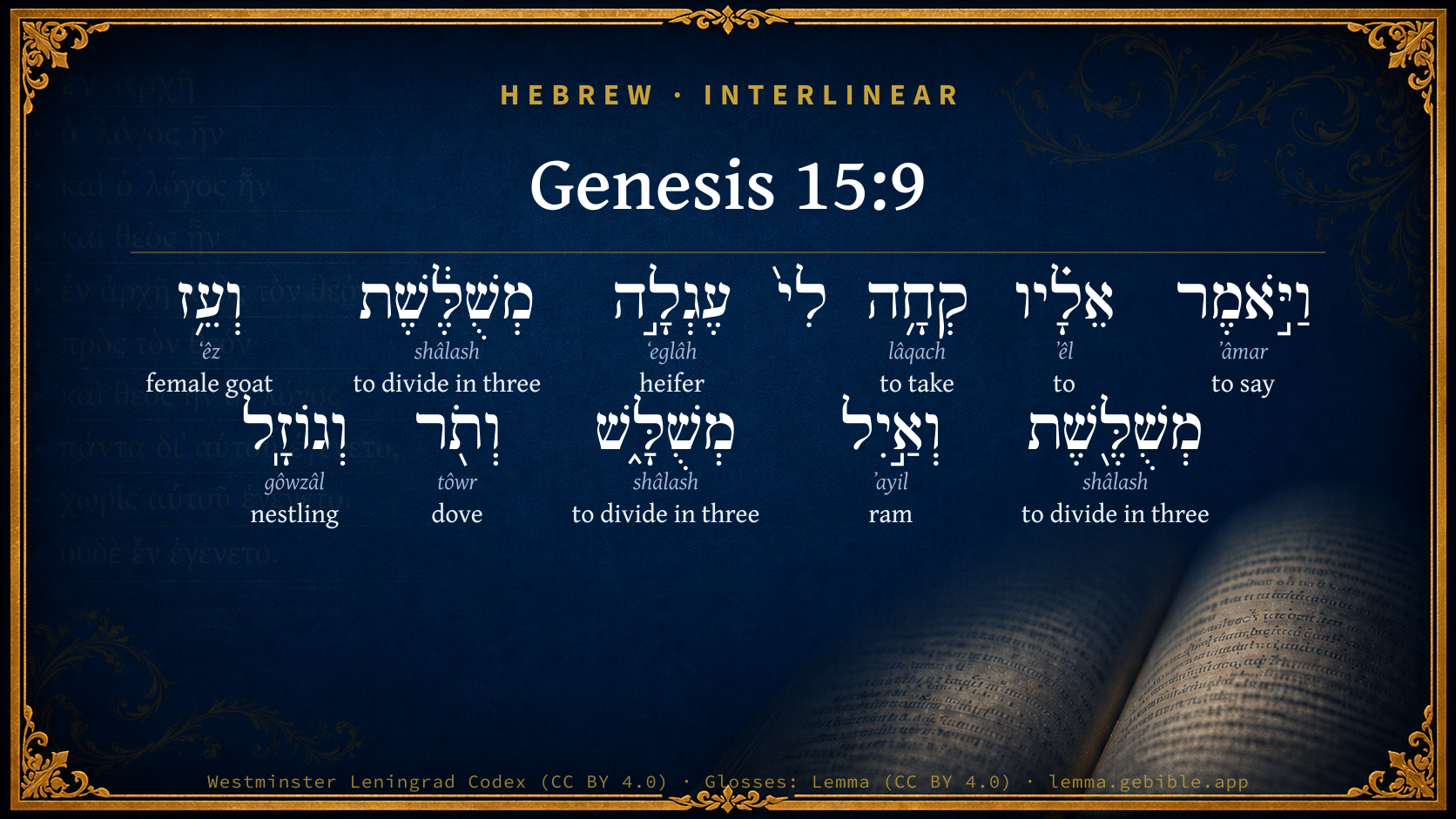
Genesis 15:9

Hebrew (Westminster Leningrad Codex) Genesis 15:9 appears in the Hebrew Old Testament. The text above is from the Westminster Leningrad Codex. Each word links to its Strong’s number, a concise gloss, and parsing drawn from the Open Scriptures Hebrew Bible morphology. Click any word for its full Brown-Driver-Briggs (BDB) entry.
Download image
Cite this verse

Genesis 15:9 (World English Bible). Public Domain. Lemma interlinear Bible study tool, https://lemma.gebible.app/v/genesis/15/9.

Show BibTeX & RIS
BibTeX
RIS
English Translation
He said to him, "Take me a heifer three years old, a female goat three years old, a ram three years old, a turtle-dove, and a young pigeon."
World English Bible · Public Domain
Highlights
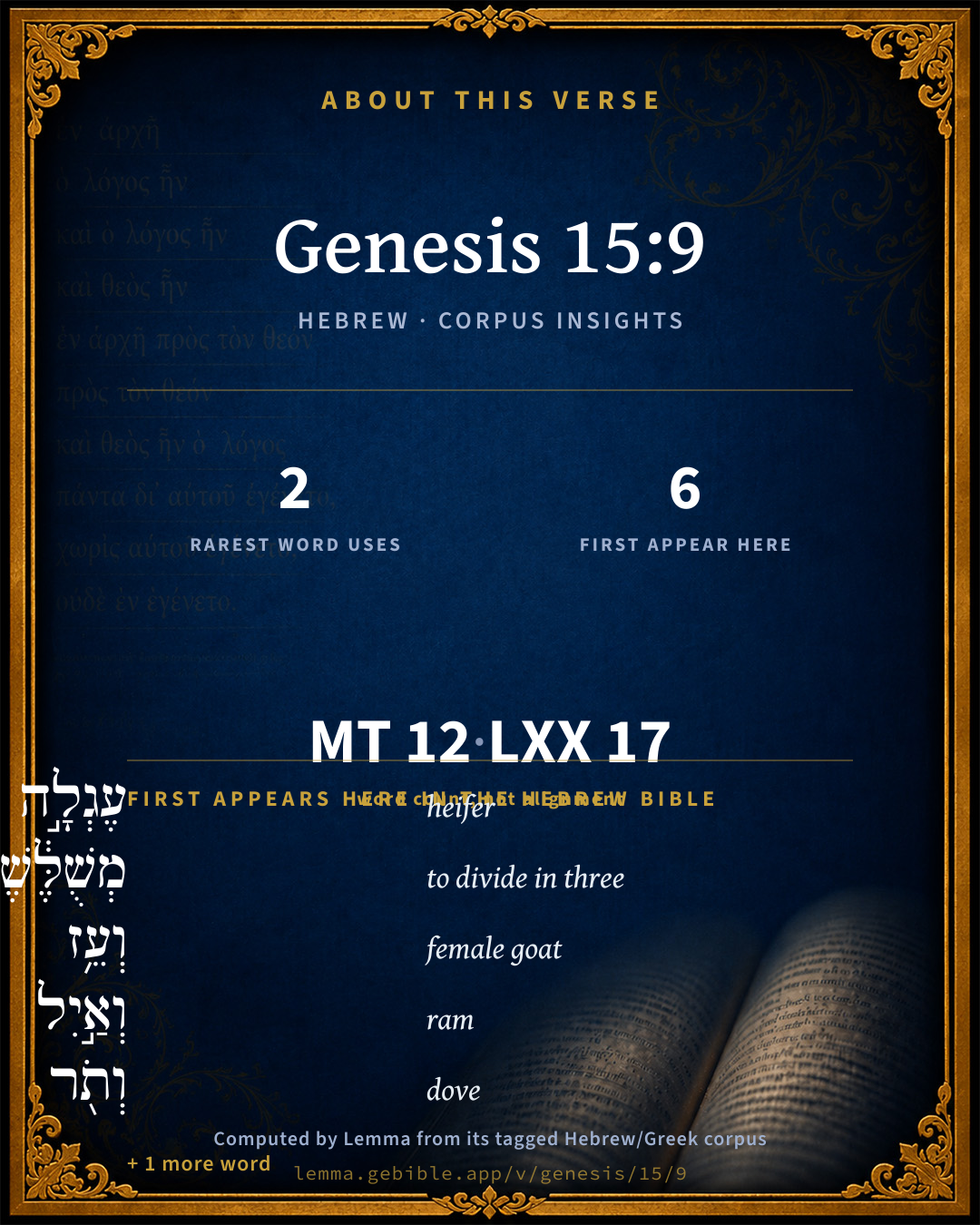
  • 6 first appearances in the Hebrew Bible
Full analysis ↓
Download a study sheet

One document with this verse’s original text, its word-by-word gloss line, the meaning frame, cross-references with their text, attributed commentary, and full source and license credits — printable, and it pastes into notes with its structure intact.

This verse Autodidact and up

Study sheet (.html) Plain text (.txt)

A passage Seminary Student

Up to 50 verses in one chapter. A passage sheet keeps up to 6 commentary sources and 12 cross-references per verse, in the order this page ranks them, and says so on the sheet whenever that leaves anything out. Ask for a single verse and you get the Autodidact verse sheet above.

Everything on this page stays free to read, with no account — the sheet is a download of what is already on screen, not access to it.

Want to remove ads? Support Godless Engineer
Compare translations 3

The same verse in 3 English versions, stacked beneath the original-language interlinear above. Click any original word for its lexicon entry.

Each is an independent rendering of the whole verse — the interlinear is not word-aligned to these translations.

Highlighted words mark where these versions differ — a whole-verse word diff, not a word-by-word alignment.

  • World English Bible Public Domain
    He said to him, "Take me a heifer three years old, a female goat three years old, a ram three years old, a turtle-dove, and a young pigeon."
  • King James Version Public Domain
    And he said unto him, Take me an heifer of three years old, and a she goat of three years old, and a ram of three years old, and a turtledove, and a young pigeon.
  • unfoldingWord Literal Text CC BY-SA 4.0
    Then he said to him, “Bring to me a three-year-old heifer and a three-year-old she-goat and a three-year-old ram and a turtledove and a young pigeon.”

unfoldingWord Literal Text — © unfoldingWord, licensed CC BY-SA 4.0. Word-aligned USFM3 via Door43 (git.door43.org/unfoldingWord/en_ult).

Versions to compare (up to 4)

3 of 4 selected

Show all 18 translations

Every available English version of this verse, each an independent rendering of the whole verse.

  • World English Bible Public Domain
    He said to him, "Take me a heifer three years old, a female goat three years old, a ram three years old, a turtle-dove, and a young pigeon."
  • Berean Standard Bible Public Domain
    And the LORD said to him, “Bring Me a heifer, a goat, and a ram, each three years old, along with a turtledove and a young pigeon.”
  • Majority Standard Bible Public Domain
    And the LORD said to him, “Bring Me a heifer, a goat, and a ram, each three years old, along with a turtledove and a young pigeon.”
  • King James Version Public Domain
    And he said unto him, Take me an heifer of three years old, and a she goat of three years old, and a ram of three years old, and a turtledove, and a young pigeon.
  • American Standard Version (1901) Public Domain
    And he said unto him, Take me a heifer three years old, and a she-goat three years old, and a ram three years old, and a turtle-dove, and a young pigeon.
  • Revised Version (1885) Public Domain
    And he said unto him, Take me an heifer of three years old, and a she-goat of three years old, and a ram of three years old, and a turtledove, and a young pigeon.
  • Geneva Bible (1599) Public Domain
    Then he said vnto him, Take me an heifer of three yeeres olde, and a shee goate of three yeeres olde, and a ramme of three yeeres olde, a turtle doue also and a pigeon.
  • Douay-Rheims (1899) Public Domain
    And the Lord answered, and said: Take me a cow of three years old, and a she goat of three years, and a ram of three years, a turtle also, and a pigeon.
  • Young's Literal Translation Public Domain
    And He saith unto him, `Take for Me a heifer of three years, and a she-goat of three years, and a ram of three years, and a turtle-dove, and a young bird;'
  • Literal Standard Version CC BY-SA 4.0
    And He says to him, “Take for Me a heifer of three years, and a female goat of three years, and a ram of three years, and a turtle-dove, and a young bird”;
  • Unlocked Literal Bible CC BY-SA 4.0
    Then he said to him, “Bring me a heifer three years old, a female goat three years old, a ram three years old, a dove, and a young pigeon.”
  • unfoldingWord Literal Text CC BY-SA 4.0
    Then he said to him, “Bring to me a three-year-old heifer and a three-year-old she-goat and a three-year-old ram and a turtledove and a young pigeon.”
  • Darby Bible Public Domain
    And he said to him, Take me a heifer of three years old, and a she-goat of three years old, and a ram of three years old, and a turtle-dove, and a young pigeon.
  • World Messianic Bible Public Domain
    He said to him, “Bring me a heifer three years old, a female goat three years old, a ram three years old, a turtledove, and a young pigeon.”
  • Webster's Bible Public Domain
    And he said to him, Take me a heifer of three years old, and a she-goat of three years old, and a ram of three years old, and a turtle-dove, and a young pigeon.
  • Free Bible Version CC BY-SA 4.0
    The Lord told him, “Bring me a cow, a goat, and a ram, all of them three years old, together with a dove and a young pigeon.”
  • Bible in Basic English Public Domain
    And he said, Take a young cow of three years old, and a she-goat of three years old, and a sheep of three years old, and a dove and a young pigeon.
  • JPS Tanakh (1917) Public Domain
    And He said unto him: 'Take Me a heifer of three years old, and a she-goat of three years old, and a ram of three years old, and a turtle-dove, and a young pigeon.'

Literal Standard Version (2020), Covenant Press — licensed CC BY-SA 4.0. Text via the HelloAO Bible API (eBible.org). Unlocked Literal Bible (unfoldingWord) — licensed CC BY-SA 4.0. Text via the HelloAO Bible API (eBible.org). unfoldingWord Literal Text — © unfoldingWord, licensed CC BY-SA 4.0. Word-aligned USFM3 via Door43 (git.door43.org/unfoldingWord/en_ult). Free Bible Version, Dr. Jonathan Gallagher — licensed CC BY-SA 4.0. Text via the HelloAO Bible API (eBible.org).

Word by word

More ways to search: Search by grammar → Find every occurrence → Compare this word →

Practice this passage: Drill this verse → Learn its vocabulary →

וְגוֹזָֽל
gôwzâl
H1469
“and · nestling”
Conjunction + Noun, Common, Masculine, Singular, Absolute
Part of Speech
Conjunction + Noun
Type
Common
Gender
Masculine
Number
Singular
State
Absolute
Full BDB Definition

Origin: from H1497

TWOT: 337c

a nestling, young (of birds)
  1. וַיֹּ֣אמֶר ʼâmar H559 “and · to say” Conjunction + Verb, Qal, Sequential Imperfect, 3rd Person, Masculine, Singular
  2. אֵלָ֗יו ʼêl H413 “to · him” Preposition + Suffix, Personal, 3rd Person, Masculine, Singular
  3. קְחָ֥ה lâqach H3947 “take” Verb, Qal, Imperative, 2nd Person, Masculine, Singular + Suffix, h
  4. עֶגְלָ֣ה ʻeglâh H5697 “heifer” Noun, Common, Feminine, Singular, Absolute
  5. מְשֻׁלֶּ֔שֶׁת shâlash H8027 “divided in three” Verb, Pual, Participle Passive, Feminine, Singular, Absolute
  6. וְעֵ֥ז ʻêz H5795 “and · female goat” Conjunction + Noun, Common, Feminine, Singular, Absolute
  7. מְשֻׁלֶּ֖שֶׁת shâlash H8027 “divided in three” Verb, Pual, Participle Passive, Feminine, Singular, Absolute
  8. וְאַ֣יִל ʼayil H352 “and · ram” Conjunction + Noun, Common, Masculine, Singular, Absolute
  9. מְשֻׁלָּ֑שׁ shâlash H8027 “divided in three” Verb, Pual, Participle Passive, Masculine, Singular, Absolute
  10. וְתֹ֖ר tôwr H8449 “and · dove” Conjunction + Noun, Common, Both, Singular, Absolute

About this verse

These counts appear in no published source. They are computed here, from the morphology-tagged text and Lemma’s own curated glosses. What Lemma adds →

12
words
9
distinct lemmas
Pentateuch
section

Notable vocabulary

The rarest word here is וְגוֹזָֽל nestling H1469 — appearing just 2 times in the whole Hebrew Bible.

First appearance in Scripture

These words make their first canonical appearance in the Hebrew Bible here:

  • עֶגְלָ֣ה heifer H5697
  • מְשֻׁלֶּ֔שֶׁת to divide in three H8027
  • וְעֵ֥ז female goat H5795
  • וְאַ֣יִל ram H352
  • וְתֹ֖ר dove H8449
  • וְגוֹזָֽל nestling H1469

Shared distinctive vocabulary

וְגוֹזָֽל nestling H1469 occurs in 2 verses of the Hebrew Bible. Also found in:

Grammatical profile

  • 5 verbs
  • 5 nouns
  • 2 prepositions

Verb forms

  • וַיֹּ֣אמֶר Qal · Sequential Imperfect
  • קְחָ֥ה Qal · Imperative
  • מְשֻׁלֶּ֔שֶׁת Pual · Participle Passive
  • מְשֻׁלֶּ֖שֶׁת Pual · Participle Passive
  • מְשֻׁלָּ֑שׁ Pual · Participle Passive

Repetition

A word recurs within this verse — often emphatic in Hebrew:

  • מְשֻׁלֶּ֔שֶׁת to divide in three H8027 ×3

Hebrew & Septuagint length

In English translation the verse runs 28 words from the Hebrew and 34 from the Septuagint (LXX English) — closely comparable.

A rough comparison of the two English renderings, which tokenize alike — not a word-level alignment.

Word counts can differ between the Hebrew and the Greek without any difference in meaning — e.g. the Hebrew direct-object marker אֵת has no separate Greek word, and Greek often adds the article ὁ.

In the original languages it is 12 Hebrew tokens and 17 Greek tokens — but the two are counted differently (Hebrew bundles its prefixes and suffixes into one token; the Greek is in lemma form), so that isn’t a like-for-like length.

Cross-references

14

Topical passages linked to Genesis 15:9 in the Treasury of Scripture Knowledge — connected by theme and wording, ordered by reader-vote popularity; previews shown in the World English Bible.

  • Leviticus 14:22 and two turtledoves, or two young pigeons, such as he is able to afford; and the one shall be a sin offering, and the other a burnt offering.
  • Leviticus 14:30 He shall offer one of the turtledoves, or of the young pigeons, such as he is able to afford,
  • Luke 2:24 and to offer a sacrifice according to that which is said in the law of the Lord, "A pair of turtledoves, or two young pigeons."
  • Leviticus 1:14 "'If his offering to Yahweh is a burnt offering of birds, then he shall offer his offering of turtledoves, or of young pigeons.
  • Leviticus 3:1 "'If his offering is a sacrifice of peace offerings; if he offers it from the herd, whether male or female, he shall offer it without blemish before Yahweh.
  • Leviticus 3:6 "'If his offering for a sacrifice of peace offerings to Yahweh is from the flock; male or female, he shall offer it without blemish.
  • Leviticus 9:2 and he said to Aaron, "Take a calf from the herd for a sin offering, and a ram for a burnt offering, without blemish, and offer them before Yahweh.
  • Genesis 22:13 Abraham lifted up his eyes, and looked, and saw that behind him was a ram caught in the thicket by his horns. Abraham went and took the ram, and offered him up for a burnt offering instead of his son.
  • Leviticus 1:3 "'If his offering is a burnt offering from the herd, he shall offer a male without blemish. He shall offer it at the door of the Tent of Meeting, that he may be accepted before Yahweh.
  • Leviticus 1:10 "'If his offering is from the flock, from the sheep, or from the goats, for a burnt offering, he shall offer a male without blemish.
  • Leviticus 9:4 and an ox and a ram for peace offerings, to sacrifice before Yahweh; and a meal offering mixed with oil: for today Yahweh appears to you.'"
  • Leviticus 12:8 If she cannot afford a lamb, then she shall take two turtledoves, or two young pigeons; the one for a burnt offering, and the other for a sin offering: and the priest shall make atonement for her, and she shall be clean.'"
  • Psalms 50:5 "Gather my saints together to me, Those who have made a covenant with me by sacrifice."
  • Isaiah 15:5 My heart cries out for Moab; her nobles [flee] to Zoar, to Eglath Shelishiyah: for by the ascent of Luhith with weeping they go up; for in the way of Horonaim they raise up a cry of destruction.

Cross-references courtesy of OpenBible.info (CC BY 4.0).

Hebrew and Greek witnesses Masoretic Hebrew ↔ Greek Septuagint

The same verse in the two great witnesses to the Old Testament, shown verse-for-verse.

These are two independent witnesses, not word-aligned to each other, and the Septuagint is shown in lemma (dictionary) form.

Hebrew Genesis 15:9 Masoretic · Westminster Leningrad Codex

וַיֹּ֣אמֶר אֵלָ֗יו קְחָ֥ה לִי֙ עֶגְלָ֣ה מְשֻׁלֶּ֔שֶׁת וְעֵ֥ז מְשֻׁלֶּ֖שֶׁת וְאַ֣יִל מְשֻׁלָּ֑שׁ וְתֹ֖ר וְגוֹזָֽל

He said to him, "Take me a heifer three years old, a female goat three years old, a ram three years old, a turtle-dove, and a young pigeon."

World English Bible · Public Domain

Greek LXX Genesis 15:9 Septuagint · lemma form

εἶπον δέ αὐτός λαμβάνω ἐγώ δάμαλις τριετίζω καί αἴξ τριετίζω καί κριός τριετίζω καί τρυγών καί περιστερά

And he said to him, Take for me an heifer in her third year, and a she-goat in her third year, and a ram in his third year, and a dove and a pigeon.

LXX2012 (modern English Septuagint) · Public Domain

On this verse, The Pulpit Commentary discusses the Septuagint’s reading. Read the note in Commentary ↓

Hebrew: Westminster Leningrad Codex (CC BY 4.0). Greek: Septuagint (public domain); English from LXX2012 (modern English Septuagint) (Public Domain). How the Septuagint differs from the Hebrew →

Targum (Aramaic paraphrase)

2

The Targum is the ancient Jewish Aramaic paraphrase of the Hebrew Scriptures — an interpretive translation, not the Hebrew text itself. Onkelos (literal) and Pseudo-Jonathan (expansive) render the Torah, and Jonathan the Prophets. Coverage is partial: where no permissively-licensed English translation exists for a verse, only the Aramaic is shown. This is verse-level text, not a word-by-word alignment to the Hebrew.

  1. Targum Onkelos Torah (Genesis–Deuteronomy)
    וַאֲמַר לֵהּ קָרֵב קֳדָמַי עֶגְלִין תְּלָתָא וְעִזִין תְּלָתָא וְדִכְרִין תְּלָת וְשַׁפְנִינָא וּבַר יוֹנָה

    (no public-domain English translation for this verse)

    Targum Onkelos — Aramaic: “Onkelos Genesis” (public domain); “Onkelos Exodus” (public domain); “Onkelos Leviticus” (public domain); “Onkelos Numbers” (public domain); “Onkelos Deuteronomy” (public domain). English: “Sefaria Community Translation” (CC0 1.0 (public-domain dedication)); “J.W. Etheridge. The Targums of Onkelos and Jonathan Ben Uzziel on the Pentateuch. London: Longmans, Green, 1862” (public domain). Text via Sefaria.

  2. Targum Pseudo-Jonathan Torah (Genesis–Deuteronomy)
    וַאֲמַר לֵיהּ סַב לִי תִּקְרוּבְתִּין וּקְרֵיב קֳדָמָי עֶגְלָא בְּרַת תְּלַת שְׁנִין וּבְרַחָא בַּר תְּלַת שְׁנִין וְעִיזָא בְּרַת תְּלַת שְׁנִין וְשַׁפְנִינָא וְתַּסִילָא בַּר יוֹן

    And He said, Bring Me oblations, and offer before Me an heifer of three years, and a goat of three years, a ram of three years, and a dove, and the young of a pigeon.

    Targum Pseudo-Jonathan — Aramaic: “Targum Jonathan on Genesis” (public domain); “Targum Jonathan on Exodus” (public domain); “Targum Jonathan on Leviticus” (public domain); “Targum Jonathan on Numbers” (public domain); “Targum Jonathan on Deuteronomy” (public domain). English: “The Targum of Jonathan ben Uzziel, trans. J. W. Etheridge, London, 1862” (public domain). Text via Sefaria.

Commentary

Notes on Genesis 15:9 from classic Christian and Jewish commentators (each source and its license shown beneath its notes). The classic Christian expositions comment on the surrounding passage and are grouped to its opening verse, so a note may address several verses; the Jewish commentaries on the Tanakh (Rashi and others) are per-verse, so they appear only where the commentator wrote on this verse.

Lemma curates 59 commentaries, every one of them public domain or Creative Commons licensed, each selected and text-cleaned for this edition rather than reprinted as found. About our sources →

Trapp's Complete Commentary

John Trapp

Gen 15:9 And he said unto him, Take me an heifer of three years old, and a she goat of three years old, and a ram of three years old, and a turtledove, and a young pigeon.

Ver. 9. Take me a heifer, &c.] Here God commands him a busy sacrifice, and then casts him into a terrible sleep; the better to prepare him to receive the ensuing oracle, and to teach him that he may not rashly rush upon divine mysteries. Heathens could say, Non loquendum de Deo absque lumine ;{ a} that is, without premeditation and advised consideration.

{a} Pythagoras

John Trapp, A Commentary or Exposition upon All the Books of the Old and New Testament (1647–1656) — public domain. Text from a community e-Sword module.

Joseph Benson's Commentary

Gen 15:9. Take me a heifer — Perhaps Abram expected some sign from heaven, but God gives him a sign upon a sacrifice. Those that would receive the assurances of God’s favour, must attend instituted ordinances, and expect to meet with God in them.

Joseph Benson's Commentary on the Old and New Testaments (1811–1818) — public domain. Text from a community e-Sword module.

Jamieson, Fausset & Brown

Robert Jamieson, A. R. Fausset & David Brown

Take me an heifer, &c.--On occasions of great importance, when two or more parties join in a compact, they either observe precisely the same rites as Abram did, or, where they do not, they invoke the lamp as their witness. According to these ideas, which have been from time immemorial engraven on the minds of Eastern people, the Lord Himself condescended to enter into covenant with Abram. The patriarch did not pass between the sacrifice and the reason was that in this transaction he was bound to nothing. He asked a sign, and God was pleased to give him a sign, by which, according to Eastern ideas, He bound Himself. In like manner God has entered into covenant with us; and in the glory of the only-begotten Son, who passed through between God and us, all who believe have, like Abram, a sign or pledge in the gift of the Spirit, whereby they may know that they shall inherit the heavenly Canaan.

Next: Genesis Chapter 16

Jamieson, Fausset & Brown — Commentary Critical and Explanatory on the Whole Bible (1871) — public domain (CC PDM 1.0). Text via the HelloAO Bible API.

Adam Clarke's Commentary

Verse 9. Take me a heifer] עגלה eglah, a she-calf; a she-goat, עז ez, a goat, male or female, but distinguished here by the feminine adjective; משלשת meshullesheth, a three-yearling; a ram, איל ayil; a turtle-dove, תר tor, from which come turtur and turtle; young pigeon, gozal, a word signifying the young of pigeons and eagles. See De 32:11. It is worthy of remark, that every animal allowed or commanded to be sacrificed under the Mosaic law is to be found in this list. And is it not a proof that God was now giving to Abram an epitome of that law and its sacrifices which he intended more fully to reveal to Moses; the essence of which consisted in its sacrifices, which typified the Lamb of God that takes away the sin of the world?

On the several animals which God ordered Abram to take, Jarchi remarks: "The idolatrous nations are compared in the Scriptures to bulls, rams, and goats; for it is written, Ps 22:12: Many bulls have compassed me about. Da 8:20: The ram which thou hast seen is the king of Persia. The rough goat is the king of Greece. Da 8:21. But the Israelites are compared to doves, c. So 2:14: O my dove, that art in the cleft of the rock. The division of the above carcasses denotes the division and extermination of the idolatrous nations; but the birds not being divided, shows that the Israelites are to abide for ever." See Jarchi on the place.

Adam Clarke's Commentary on the Bible (1810–1826) — public domain. Text from a community e-Sword/MySword module.

John Calvin's Commentaries

9. Take me an heifer of three years old. Some, instead of an heifer of three years old translate the passage, ‘three heifers’ and in each species of animals enumerated, would make the number three. Yet the opinion of those who apply the word three to the age of the heifer, is more general. Moreover, although God would not deny his servant what he had asked; he yet, by no means, granted what would gratify the desire of the flesh. For, what certainty could be added to the promise, by the slaughter of an heifer, or goat, or ram? For the true design of sacrifice, of which we shall see more presently, was hitherto hidden from Abram. Therefore by obeying the command of God, of which, however, no advantage was apparent, he hence proves the obedience of his faith; nor did his wish aim at any other end than this; namely, that the obstacle being removed, he might, as was just, reverently acquiesce in the word of the Lord. Let us, therefore, learn meekly to embrace those helps which God offers for the confirmation of our faith; although they may not accord with our judgment, but rather may seem to be a mockery; until, at length, it shall become plain from the effect, that God was as far as possible from mocking us.

John Calvin's Commentaries (1540-1563) — public domain. Text from the Calvin Translation Society English edition (1840s-50s) via the Christian Classics Ethereal Library (ccel.org). Calvin's coverage is partial (roughly two-thirds of the Bible); uncommented books and verses are honest gaps, never fabricated. The 19th-century editor's footnotes and remarks are omitted so the notes are faithfully Calvin's own voice.

Ellicott's Commentary for English Readers

(9, 10) Take me an heifer . . . —This form of making a covenant was probably that usual in Babylonia, and thus Abram received the assurance of his inheritance by means of a ceremonial with which he was familiar. But in most ancient languages men are said to cut or strike a covenant, because the most solemn formula involved either the cutting of victims in two, or striking them dead, as was the Roman manner. The severing of the bodies was not, as some suppose, to represent the two parties; but, as explained in Jer_34:18-20, it set forth the penalty of perjury, and was usually accompanied by the imprecation upon the covenant-breaker of a destruction as complete as that which had befallen the slaughtered animals. There is no mention in this place of a sacrifice, although the animals are those subsequently set apart for sacrifice by the Levitical law. The heifer, she-goat, and ram at three years old would each have attained its full maturity; but there may be a further symbolic meaning in there being three animals each three years old.

Laid each piece . . . —More exactly, and laid each half over against the other. The birds were not divided; but as there were two, Abram probably placed one on one side and one on the other.

A Bible Commentary for English Readers, edited by Charles John Ellicott (1878–1897) — public domain. Text from a community e-Sword module.

The Cambridge Bible for Schools and Colleges

gen. ed. J. J. S. Perowne

9. Take me an heifer, &c.] The sign to Abram is the sign of the covenant, of which the ceremonial is here described. This ceremonial is evidently of great antiquity. The writer, perhaps, intends to refer the origin of the institution to the time of Abram and to this occasion. The ceremony is as follows: (1) Animals permitted for sacrifice are selected. (2) They are killed, and their carcases divided. (3) The divided portions are placed in two rows over against each other. (4) The contracting parties pass between the rows, invoking, as they do so, an imprecation upon any violator of the covenant, that he should in like manner be cut asunder.

It is this ceremonial which causes the making of a covenant to be expressed by words meaning “to cut,” e.g. Heb. karath b’rîth, Lat. foedus icere, Gr. ὅρκια τέμνειν.

The details of the ceremony probably differed slightly from age to age. The origin of some old customs is lost in obscurity. Why, for instance, are the animals mentioned to be three years old? is it because they are to be full grown? (Cf. 1Sa_1:24, R.V. marg.) Why are the birds not to be divided like the beasts? These are questions of a technical ritual character to which at present we can give no answer.

The most interesting Scriptural illustration of covenant ceremonial is afforded by Jer_34:18, “the covenant which they made before me, when they cut the calf in twain and passed between the parts thereof.”

The Cambridge Bible for Schools and Colleges (gen. ed. J. J. S. Perowne; Cambridge University Press, 1878–1918) — public domain. Text from a community e-Sword module.

John Gill's Exposition

And he took unto him all these,.... The heifer, goat, ram, turtle, and young pigeon, not to himself, but to the Lord, as he was bid, and offered them before him, as the above Targums paraphrase it; or however he took them for his use, and set them before him, and did with them as he directed him:

and divided them in the midst; that is, the three animals, the heifer, goat, and ram; he did not take off their several limbs, and cut them up in small parts, but cut them in halves:

and laid each piece one against another; one half against the other, the left side against the right, shoulder against shoulder, and leg against leg, so that they might seem to join, or might be easily joined together again, or however answer one another; though it is generally thought there was such a distance of the one from the other, as that there might be a passage between them; it being usual in making covenants for the covenanters to pass between the parts of a creature slain, signifying, that should they break the covenant made, they deserved to be cut asunder as that creature was; see Gill on Jer 34:18. So a burning lamp, or lamp of fire, an emblem of the divine Being, is said, Gen 15:17, to pass between those pieces: all this was expressive of the afflictions of the posterity of Abram, of their being distressed in the land of Egypt, cut as it were in twain there, and of their various dispersions in other countries; and yet, like the bones in Ezekiel's vision, were gathered together, and united again: and it may be this may have respect to the division of the people of Israel into two kingdoms, in the times of Rehoboam, and their after reunion, and especially in the latter day, Eze 37:7,

but the birds divided he not; but laid them one against another, as the pieces were laid; so the birds used in sacrifice under the law were not to be divided, Lev 1:17; which may signify, that when the people of the Jews, in the latter day, are converted, and brought together into their own land, when they will better answer the character of turtles and doves than they ever did, will be no more divided and separated from each other.

John Gill's Exposition of the Whole Bible (1746–1763) — public domain (CC PDM 1.0). Text via the HelloAO Bible API.

Haydock's Catholic Bible Commentary

Three years, when these animals have obtained a perfect age.

George Leo Haydock (1774–1849), Haydock's Catholic Family Bible and Commentary, 1859 edition — public domain. Excludes Psalms (Douay-Rheims chapter numbering differs from Protestant) and Deuterocanonical books (Catholic canon only).

Matthew Poole's English Annotations

Take and offer at my command, and for my service,

an heifer of three years old, at which time it is perfect in stature and strength, and therefore fittest for God’s service. This and the other creatures here following, and sacrifices, are the same which afterwards were prescribed in the Levitical law.

Matthew Poole's English Annotations on the Holy Bible (1683–1685) — public domain. Text from a community e-Sword/MySword module.

Whedon's Commentary on the Bible

Daniel D. Whedon

9. Take me — Select for me. Not any of the animals taken at random is a suitable victim for sacrifice, or for symbolic revelations.

Heifer… goat… ram… — Three separate animals representing the three classes of animals suitable for sacrificial offering, and each to be three years old, the age of full maturity and vigour. The fowls suitable for sacrifice were to be represented by a turtle-dove and a young pigeon. These two kinds of fowls were also adopted among the Mosaic offerings. Comp. Lev_1:14; Lev_5:7; Lev_12:8.

Daniel D. Whedon (gen. ed.), Commentary on the Old and New Testaments (1874–1909) — public domain. Text from a community e-Sword module.

The Pulpit Commentary

And he said unto him, Take me (literally, for me, i.e. for my use in sacrifice) a heifer of three years old. So rightly (LXX, Syriac, Samaritan, Arabic, Josephus, Bochart, Rosenm Keil); not three heifers (Onkelos, Jarchi, Kimchi, et alii). And a she goat of three years old, and a ram of three years old. These offerings, afterwards prescribed by the (Exo_29:15; Num_15:27 Num_19:2; Deu_21:3) were three in number, and of three years each, to symbolize him who was, and is, and is to come (Wordsworth); perhaps rather to indicate-the perfection of the victim in respect of maturity (Murphy). Cf. Ganymede"s offering (in "Lucian"s Dialogues") of a three years old ram for a ransom. And a turtle-dove, and a young pigeon also prescribed by the law (Lev_1:14; Luk_2:24)

The Pulpit Commentary (1880–1919), ed. H.D.M. Spence-Jones & Joseph S. Exell — public domain. Text from a community e-Sword module.

John Wesley's Explanatory Notes

Take me an heifer - Perhaps Abram expected some sign from heaven, but God gives him a sign upon a sacrifice. Those that would receive the assurances of God's favour, must attend instituted ordinances, and expect to meet with God in them. Observe,

1. God appointed that each of the beasts used for his service should be three years old, because then they were at their full growth and strength. God must be served with the best we have.

2. We do not read that God gave Abram particular directions how to manage these, knowing that he was well versed in the custom of sacrifices.

3. Abram took as God appointed him, though as yet he knew not how these things should become a sign to him. He divided the beasts in the midst, according to the ceremony used in continuing covenants, Jer. xxxiv, 18, 19, where it is said, they cut the calf in twain, and passed between the parts.

4. Abram, having prepared according to God's appointment, set himself to expect what sign God would give him by these.

John Wesley, Explanatory Notes Upon the Whole Bible (1754–1765) — public domain. Text via the GEBible commentary corpus.

unfoldingWord translationNotes

Door43 World Missions Community

the carcasses

"the dead bodies of the animals and birds"

Abram drove them away

"Abram chased the birds away." He made sure the birds did not eat the dead animals.

translationWords

cow

goat

ewe

Abraham

unfoldingWord translationNotes — © Distant Shores Media and the Door43 World Missions Community, licensed CC BY-SA 4.0. Source: git.door43.org/Door43/en_tn.

Rashi

Rabbi Shlomo Yitzchaki (Rashi)

עגלה משלשת means THREE HEIFERS: symbolical of three sacrifices of bullocks, viz., the bullock offered on the Day of Atonement, the bullock offered when the correct interpretation of a precept was unknown (העלם) to leaders of the nation (see Leviticus 4:13), and the heifer whose neck had to be broken (see Deuteronomy 21:4) (Genesis Rabbah 44:14).

ועז משולשת THREE GOATS — symbolical of the goat the blood of which was sprinkled in the Holy of Holies, of the goats of the additional sacrifices on Festivals, and of the goat brought as a sin-offering by an individual (Genesis Rabbah 44:14).

ואיל משולש AND THREE RAMS—symbolical of the trespass offering brought by a man who knows for certain that he has committed certain offences, the offering brought by a man who is in doubt whether he has committed such offence, and the ewe brought by an individual as a sin-offering.

ותור וגוזל means A TURTLE DOVE AND A YOUNG PIGEON (Genesis Rabbah 44:14).

Rashi on the Tanakh — English translations: “The Judaica Press complete Tanach with Rashi, translated by A. J. Rosenberg” (CC BY 4.0); “Pentateuch with Rashi's commentary by M. Rosenbaum and A.M. Silbermann, 1929-1934” (public domain); “The Metsudah Tanach series, Lakewood, N.J” (CC BY 4.0); and “The Book of Joshua, Metsudah Publications, 1997” (CC BY 4.0). Text via Sefaria.

Ramban (Nachmanides)

Rabbi Moshe ben Nachman (Ramban / Nachmanides)

A HEIFER ‘MESHULESHETH’ AND A SHE-GOAT ‘MESHULESHETH.’ Rabbi Abraham ibn Ezra explained the word meshulesheth as meaning three years old. But Onkelos said “three.” This is indeed correct since a three-year old cow is no longer called eglah (heifer), just as we have learned in a Mishnah: (heifer) it cannot therefore refer to a three-year old, as Ibn Ezra says. “But the Sages say that an eglah (heifer) is two years old; a parah (cow) is three years old.”The allusion here is to the three sacrifices which his seed will bring from them before Him: the Whole-offering, the Sin-offering and the Peace-offering. And as for the Guilt-offering, that is like the Sin-offering, the difference between them being merely in the name.It is possible that the meaning of the word meshulesheth is that he bring the three of them consecutively, each kind remaining separate. A similar use of this word is found in the verse, For they were in ‘meshulashoth’ (three) stories, meaning that there were upper, middle and lower chambers.

Ramban (Nachmanides) on the Tanakh — English translation: “Commentary on the Torah by Ramban (Nachmanides). Translated and annotated by Charles B. Chavel. New York, Shilo Pub. House, 1971-1976” (CC BY 4.0). Text via Sefaria.

Radak

Rabbi David Kimhi (Radak)

'ויאמר אליו קחה לי וגו, the purpose of Avram taking these animals was to offer them to Gd as a sacrifice. G’d would use this sacrifice to illustrate to Avram the future of his descendants, their settlement in the land of Canaan, as well as their exile from that land. By means of these animal sacrifices G’d would conclude a covenant with Avram that was not subject to permanent dissolution, ever. Concluding a covenant is a procedure such as follows in the next verse, ויבתר אותם בתוך. In Jeremiah 34,18 the prophet spells this out more clearly, עגלה אשר כרתו לשנים ויעבר בין בתריו, “(like) the calf which they cut in two so as to pass between the halves”

the Torah mentions three species of animals (mammals) which are basically fit to be offered as sacrificial animals, hinting thereby that as long as these kinds of animals would be offered on the altar to G’d in the prescribed manner, the Jewish people, Avram’s descendants, would not be exiled from their land. The reason why 3 of each species were to be offered by Avram at this time was to apprise him of the fact there would indeed occur three exiles when his descendants would be forcefully uprooted from their land. Their first such exile would be to the land of Egypt, also known as עגלה, calf (Jeremiah 46,20) עגלה יפה פיה מצרים, “Egypt is a handsome heifer.” In Psalms 80,6 the psalmist writes: ותשקמו בדמעות שליש, “You have fed them tears three times,” a prophetic prediction by the author that the exile of the Jewish people in Egypt would not be their only one, but that two more were to follow.

עגלה, this word was an allusion to the first exile of the Israelites. Seeing that Yaakov’s sons had already occupied prominent positions in the land of Canaan, the land could have been described as theirs, if not as their inheritance, as G’d said in Genesis 15,16 “for the measure of the Emorites’ sin will not be full until 4 generations from now.” G’d would not have a legal justification for expelling them from their land until after that period of time. [Most Midrashim understand עגלה as a reference to the Babylonian exile, compare Torah Shleymah on our verse. Ed.]

ועז ואיל, and a she-goat and a ram; these two species are symbolic of the exile to Babylonia and the exile initiated by the Romans. Even though the Jewish people were badly suppressed by the Greeks, this happened while they were and remained on their own land. They are, however included in the parable shown by G’d to Avram. In Daniel’s dream (Daniel 8,8) the Greeks are referred to as a she-goat. Seeing that they were the first oppressors of the Jews during the period of the second Temple, the parable alluded to them in second place. The Romans completed what the Greeks had started and exiled the Jewish people from their homeland. The איל, ram, is an allusion to the Persian-Medes exile Seeing that their dominion was based on Babylon, they are referred to in the parable as the איל, the ram, even though eventually they allowed the exiles to return to their land. Several kings of the Persian-Medes empire had prolonged the Jews’ stay in captivity before allowing them to return home, so that they were also guilty of “exiling” them in the interval. The allusion to the second exile, that in Babylonia is called in the feminine mode i.e. עז, instead of שעיר, to indicate that the Babylonians never allowed the Jews to return, whereas the third exile is represented by the species איל in the masculine mode, the Persians-Medes being the only ones allowing the exiles to return to their homeland. The Persians-Medes possessed the merit of believing in the existence of the Jewish G’d, Cyrus having had a dream as a result of which he allowed the Jews to return to their homeland and build a new Temple. (Chronicles II 36,23) Among other merits he attributed his glory to the G’d in heaven Who had made him such a mighty ruler This compares favourably with the king of Ashur who had attributed his success to his own efforts (Isaiah 10,13) Similarly, Titus, conqueror of Jerusalem in Roman times, blasphemed against the G’d of the Jews. The Persians and Medes therefore are represented by a female animal in the parable G’d shows Avram here, as opposed to the arrogant kings who are represented by the male specimens of their species.

משלשת, three of each, as per Onkelos. Alternately, the meaning could be that these animals were to be three years old (Ibn Ezra)

ותר וגוזל, we are not certain what species of bird is called גוזל by the Torah. Basically, all small birds are known by the collective name of גוזל, as for instances in Deuteronomy 32,11 where the Torah describes the eagle, נשר, as carrying its young on its wings, with the words על גוזליו ירחף. Onkelos explains that what is meant here are young turtle doves. This is one of the few birds that are ritually admissible as sacrifices in Jewish law. It is the kind of bird that, while subject to other predators, does not itself make its livelihood by preying on either birds or beasts. The pigeon, תור, is very similar to it, and both species share the distinction of not mating with another male bird after its first sexual partner has died. The Jewish people, while in exile also considers itself as widowed, separated from its husband, although He is alive and well. It refused to serve other deities (alternate husbands) even though the exile has lasted this long and no immediate redemption is in sight. The female pigeons have this loyalty in common with the Jewish people, not giving up hope that their husbands will return to them. The Jewish people are non-aggressive, though downtrodden by the nations while they are in exile; they have not given up hope that in the fullness of time the messiah, and with him the redemption and return to our own land will finally be realised. (Such fond hopes are expressed by Solomon in his Song of Songs, both in 1,15 and 2,14 in poetical terms. The Jewish people are also compared to the תור in Psalms 74,19 אל תתן לחיות נפש תורך, “do not deliver Your dove to the wild beast.”

Radak on the Tanakh — English translations: “Sefaria Community Translation” (CC0 1.0 (public-domain dedication)); “Eliyahu Munk, HaChut Hameshulash” (CC BY 4.0); “Rabbi Mike Feuer, Jerusalem Anthology” (CC BY 4.0); and “R. David Kimhi on the first book of Psalms, Translated by R.G. Finch, London, 1919” (public domain). Text via Sefaria.

Lesson kit

Teaching starters — assembled from the data on this page, not authored interpretation. Every prompt links to the verse data it draws on. Edit before teaching.

Genesis, in the Pentateuch, opens this verse with 12 words (9 distinct Hebrew lemmas). Its most distinctive word is gôwzâl (“nestling”). A historical commentator’s framing appears above. Read the whole chapter for the surrounding context.

Discussion questions

  1. How does “nestling” (gôwzâl) shape what this verse is saying?
  2. 6 words make their first appearance in Scripture here. What does this debut establish?
  3. How does Deuteronomy 32:11, which shares the word «nestling», read alongside this verse?
  4. What does the repetition of “to divide in three” (3× in this one verse) do in this verse?
  5. These translations render this verse differently; the difference is in the English rendering, not the original. What questions does that raise?
  6. «וַיֹּ֣אמֶר» is a Qal Sequential Imperfect verb. How does that grammatical form shape the action described?
  7. Compare how Trapp's Complete Commentary and Joseph Benson's Commentary read this verse. Where do they agree or differ?

Things to notice

Reading settings

Reading text

Shown beneath each verse's original-language words.

Old Testament
Old Testament edition

Read the OT as the Masoretic Hebrew (MT) or the Greek Septuagint (LXX).

English shown for the Greek Septuagint (in the Hebrew ↔ Greek comparison).

Comparing translations? Open the Compare panel on any verse page to stack up to four side by side.