Mark 6:16

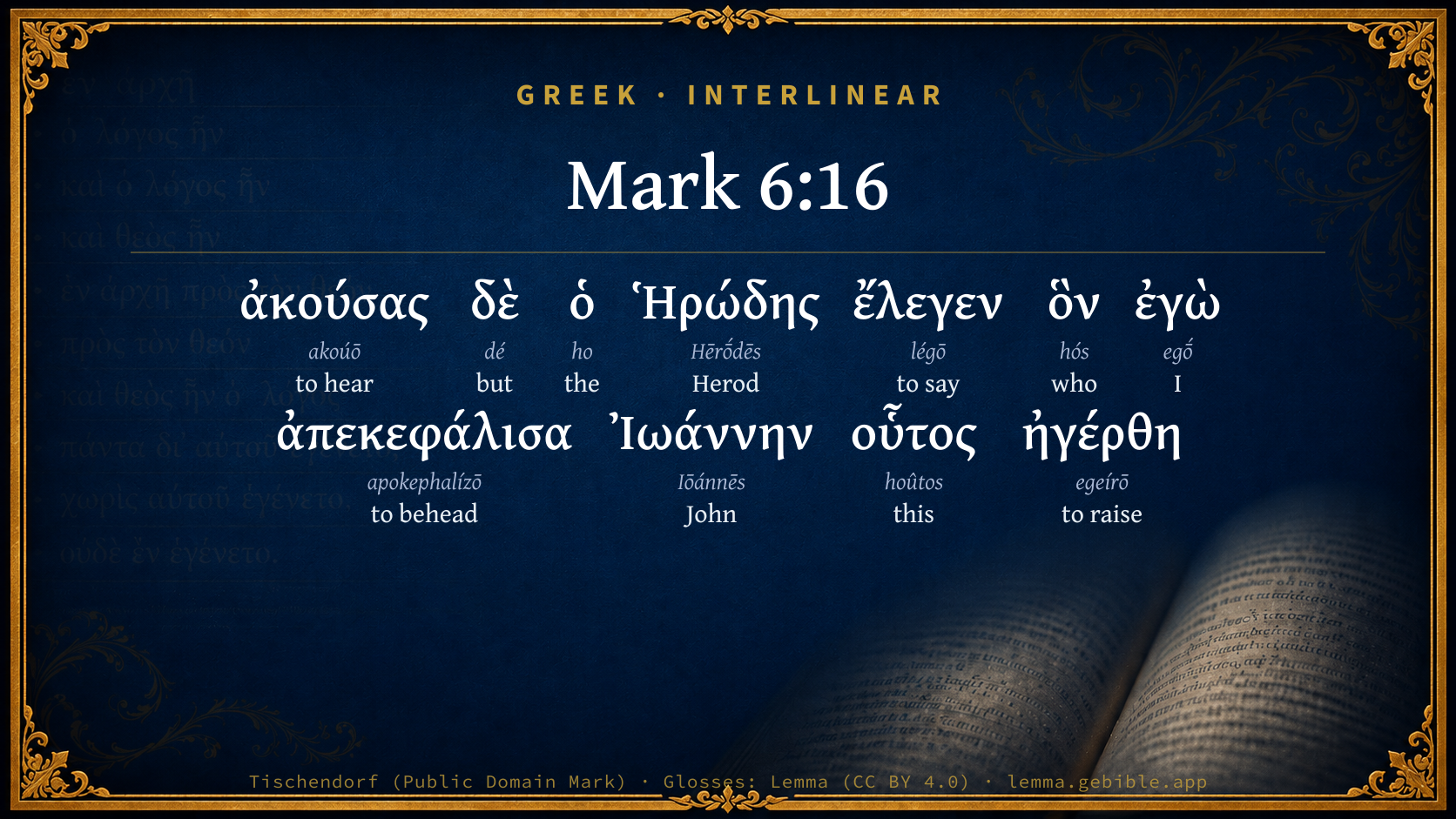
Greek (Tischendorf 8th ed.) Mark 6:16 appears in the Greek New Testament. The text above is from the Tischendorf 8th edition. Each word links to its Strong’s number and a concise gloss. Click any word for its full Thayer’s Greek Lexicon entry.
Download image
Cite this verse

Mark 6:16 (World English Bible). Public Domain. Lemma interlinear Bible study tool, https://lemma.gebible.app/v/mark/6/16.

Show BibTeX & RIS
BibTeX
RIS
English Translation
But Herod, when he heard this, said, "This is John, whom I beheaded. He has risen from the dead."
World English Bible · Public Domain
Download a study sheet

One document with this verse’s original text, its word-by-word gloss line, the meaning frame, cross-references with their text, attributed commentary, and full source and license credits — printable, and it pastes into notes with its structure intact.

This verse Autodidact and up

Study sheet (.html) Plain text (.txt)

A passage Seminary Student

Up to 50 verses in one chapter. A passage sheet keeps up to 6 commentary sources and 12 cross-references per verse, in the order this page ranks them, and says so on the sheet whenever that leaves anything out. Ask for a single verse and you get the Autodidact verse sheet above.

Everything on this page stays free to read, with no account — the sheet is a download of what is already on screen, not access to it.

Want to remove ads? Support Godless Engineer
Compare translations 3

The same verse in 3 English versions, stacked beneath the original-language interlinear above. Click any original word for its lexicon entry.

Each is an independent rendering of the whole verse — the interlinear is not word-aligned to these translations.

Highlighted words mark where these versions differ — a whole-verse word diff, not a word-by-word alignment.

  • World English Bible Public Domain
    But Herod, when he heard this, said, "This is John, whom I beheaded. He has risen from the dead."
  • King James Version Public Domain
    But when Herod heard thereof, he said, It is John, whom I beheaded: he is risen from the dead.
  • unfoldingWord Literal Text CC BY-SA 4.0
    But Herod, having heard this, was saying, “ whom I beheaded, John, this one has been raised.”

unfoldingWord Literal Text — © unfoldingWord, licensed CC BY-SA 4.0. Word-aligned USFM3 via Door43 (git.door43.org/unfoldingWord/en_ult).

Versions to compare (up to 4)

3 of 4 selected

Show all 19 translations

Every available English version of this verse, each an independent rendering of the whole verse.

  • World English Bible Public Domain
    But Herod, when he heard this, said, "This is John, whom I beheaded. He has risen from the dead."
  • Berean Standard Bible Public Domain
    But when Herod heard this, he said, “John, whom I beheaded, has risen from the dead!”
  • Majority Standard Bible Public Domain
    But when Herod heard this, he said, “This is John, whom I beheaded; he has risen from the dead!”
  • King James Version Public Domain
    But when Herod heard thereof, he said, It is John, whom I beheaded: he is risen from the dead.
  • American Standard Version (1901) Public Domain
    But Herod, when he heard `thereof', said, John, whom I beheaded, he is risen.
  • Revised Version (1885) Public Domain
    But Herod, when he heard thereof, said, John, whom I beheaded, he is risen.
  • Geneva Bible (1599) Public Domain
    So when Herod heard it, he said, It is Iohn whom I beheaded: he is risen from the dead.
  • Douay-Rheims (1899) Public Domain
    Which Herod hearing, said: John whom I beheaded, he is risen again from the dead.
  • Young's Literal Translation Public Domain
    And Herod having heard, said -- `He whom I did behead -- John -- this is he; he was raised out of the dead.'
  • Literal Standard Version CC BY-SA 4.0
    And Herod having heard, said, “He whom I beheaded—John—this is he; he was raised out of the dead.”
  • Unlocked Literal Bible CC BY-SA 4.0
    But when Herod heard this he said, “John, whom I beheaded, has been raised.”
  • unfoldingWord Literal Text CC BY-SA 4.0
    But Herod, having heard this, was saying, “ whom I beheaded, John, this one has been raised.”
  • Darby Bible Public Domain
    But Herod when he heard [it] said, John whom *I* beheaded, he it is; *he* is risen [from among the dead].
  • World Messianic Bible Public Domain
    But Herod, when he heard this, said, “This is Yochanan, whom I beheaded. He has risen from the dead.”
  • Webster's Bible Public Domain
    But when Herod heard of him, he said, It is John, whom I beheaded: he hath risen from the dead.
  • Free Bible Version CC BY-SA 4.0
    But when Herod heard about it, he said, “It's John, the one I beheaded! He's come back from the dead!”
  • Bible in Basic English Public Domain
    But Herod, when he had news of it, said, John, whom I put to death, has come back from the dead.
  • Text-Critical English NT CC BY 4.0
    But when Herod heard this, he said, “ This is John, whom I beheaded; he has been raised from the dead.”
  • Tyndale New Testament (1534) Public Domain
    But when Herode hearde of him he sayd: it is Iohn whom I beheded he is rysen from deeth agayne.

Literal Standard Version (2020), Covenant Press — licensed CC BY-SA 4.0. Text via the HelloAO Bible API (eBible.org). Unlocked Literal Bible (unfoldingWord) — licensed CC BY-SA 4.0. Text via the HelloAO Bible API (eBible.org). unfoldingWord Literal Text — © unfoldingWord, licensed CC BY-SA 4.0. Word-aligned USFM3 via Door43 (git.door43.org/unfoldingWord/en_ult). Free Bible Version, Dr. Jonathan Gallagher — licensed CC BY-SA 4.0. Text via the HelloAO Bible API (eBible.org).

Word by word

More ways to search: Search by grammar → Find every occurrence → Compare this word →

Practice this passage: Drill this verse → Learn its vocabulary →

About this verse

These counts appear in no published source. They are computed here, from the morphology-tagged text and Lemma’s own curated glosses. What Lemma adds →

11
words
11
distinct lemmas
Gospels
section

Notable vocabulary

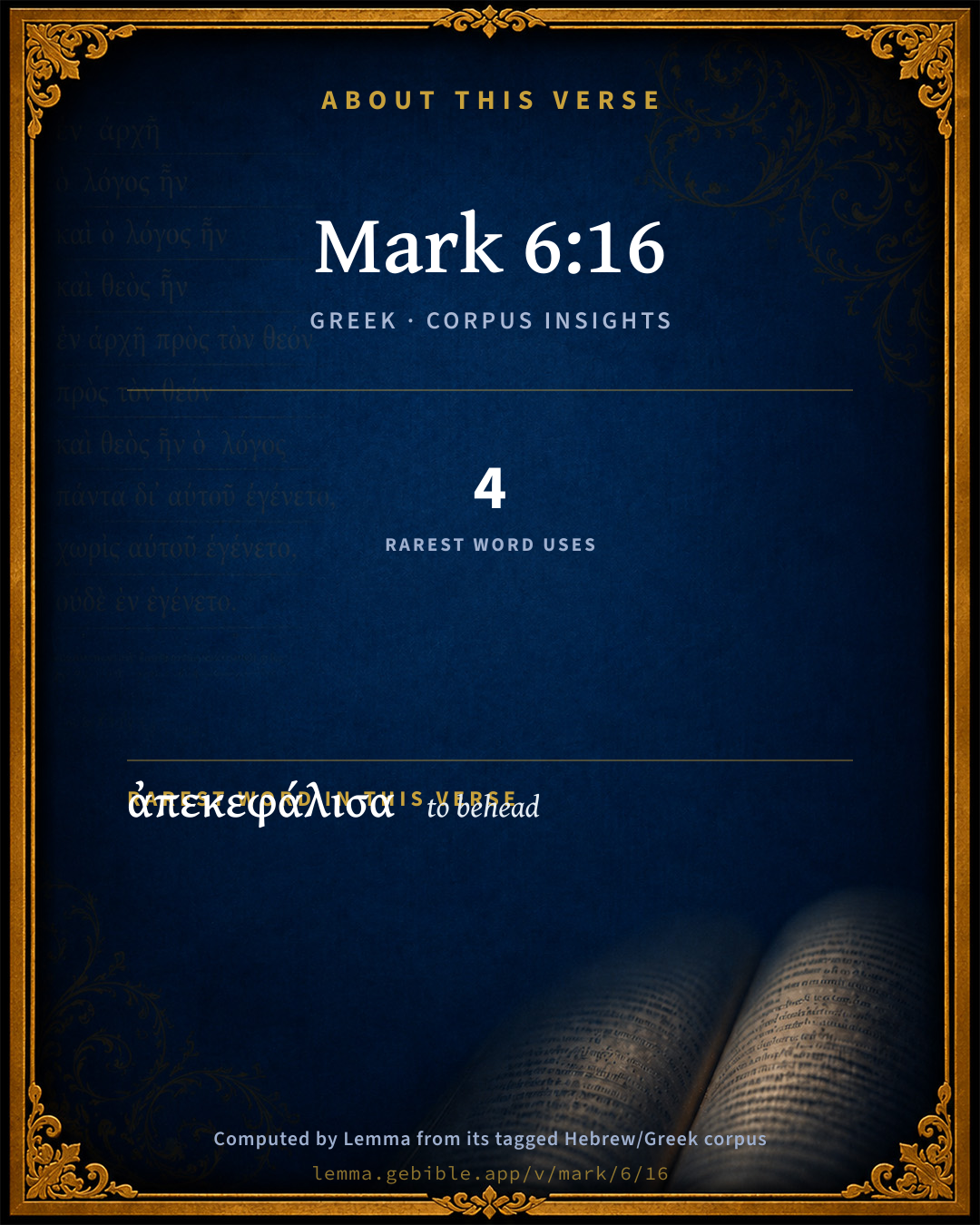
The rarest word here is ἀπεκεφάλισα to behead G607 — appearing just 4 times in the whole Greek New Testament.

Shared distinctive vocabulary

ἀπεκεφάλισα to behead G607 occurs in 4 verses of the Greek New Testament. Also found in:

Cross-references

6

Topical passages linked to Mark 6:16 in the Treasury of Scripture Knowledge — connected by theme and wording, ordered by reader-vote popularity; previews shown in the World English Bible.

  • Genesis 40:10–11 and in the vine were three branches. It was as though it budded, its blossoms shot forth, and the clusters of it brought forth ripe grapes.
  • Psalms 53:5 There they were in great fear, where no fear was, For God has scattered the bones of him who encamps against you. You have put them to shame, Because God has rejected them.
  • Matthew 14:2 and said to his servants, "This is John the Baptizer. He is risen from the dead. That is why these powers work in him."
  • Matthew 27:4 saying, "I have sinned in that I betrayed innocent blood." But they said, "What is that to us? You see to it."
  • Luke 9:9 Herod said, "John I beheaded, but who is this, about whom I hear such things?" He sought to see him.
  • Revelation 11:10–13 Those who dwell on the earth rejoice over them, and they will be glad. They will give gifts to one another, because these two prophets tormented those who dwell on the earth.

Cross-references courtesy of OpenBible.info (CC BY 4.0).

Where the printed editions differ

1 variant

Places in this verse where the major printed Greek editions disagree on the wording in a way that affects the translation — a comparison of editions, not a manuscript-by-manuscript collation. The editions are the modern critical texts (Nestlé-Aland 28/27, SBL, Westcott-Hort, Tregelles, Tyndale House) and the traditional texts behind the KJV (the Textus Receptus and the Byzantine/Majority text). It is not a claim about which reading is original.

  1. Extra text
    νεκρῶν.

    “dead.”

    In TregTRByz Not in NA28NA27TynSBLWH

    νεκρῶν. (nekrōn) 'dead.' is only in traditional manuscripts (Treg+TR+Byz)

Textual data: Translators Amalgamated Greek New Testament (STEPBible TAGNT) · CC BY 4.0.

Commentary

Notes on Mark 6:16 from classic Christian and Jewish commentators (each source and its license shown beneath its notes). The classic Christian expositions comment on the surrounding passage and are grouped to its opening verse, so a note may address several verses; the Jewish commentaries on the Tanakh (Rashi and others) are per-verse, so they appear only where the commentator wrote on this verse.

Lemma curates 59 commentaries, every one of them public domain or Creative Commons licensed, each selected and text-cleaned for this edition rather than reprinted as found. About our sources →

MacLaren's Expositions of Holy Scripture

Alexander MacLaren

Mark

HEROD-A STARTLED CONSCIENCE

Mar 6:16.

The character of this Herod, surnamed Antipas, is a sufficiently common and a sufficiently despicable one. He was the very type of an Eastern despot, exactly like some of those half-independent Rajahs, whose dominions march with ours in India; capricious, crafty, as the epithet which Christ applied to him, ‘That fox!’ shows; cruel, as the story of the murder of John the Baptist proves; sensuous and lustful; and withal weak of fibre and infirm of purpose. He, Herodias, and John the Baptist make a triad singularly like the other triad in the Old Testament, of Ahab, Jezebel, and Elijah. In both cases we have the weak ruler, the beautiful she-devil at his side, inspiring him for all evil, and the stern prophet, the rebuker and the incarnate conscience for them both.

The words that I have read are the terrified exclamation of this weak and wicked man when he was brought in contact with the light and beauty of Jesus Christ. And if we think who it was that frightened him, and ponder the words in which his fear expressed itself, we get, as it seems to me, some lessons worth the drawing.

I. You have here the voice of a startled conscience.

Herod killed John without much sense of doing wrong. He was sorry, no doubt, for he had a kind of respect for the man, and he was reluctant to put him to death. But though there was reluctance, there was no hesitation. His fantastic sense of honour came in the way. In the one scale there was the life of a poor enthusiast who had amused him for a while, but of whom he had got tired. In the other scale there were his word, the pleasure of Herodias, and the applause of the half-drunken boon companions that were sitting with them at the table. So, of course, the prophet was slain, and the pale head brought in to that wild revel, and, except for the malignant gloating of the woman over her gratified revenge, the event, no doubt, very quickly passed from the memories of all concerned.

But then there came stealing into the silken seclusion of the palace, where he was wallowing in his sensuality like a hog in the sty, the tidings of another peasant Teacher that had risen up among the people. Christ’s name had been ringing through the land, and been sounded with blessings in poor men’s huts long before it got within the gates of Herod’s palace. That is the place where religious earnestness makes its mark last of all. But it finally ran thither also; and light gossip went round concerning this new sensation. ‘Who is He? Who is He?’ Each man had his own theory about Him, but a sudden memory started up in the frivolous despot’s soul, and it was with a trembling heart that he said to himself, ‘I know! I know! It is John, whom I beheaded! He is risen from the dead!’ His conscience and his memory and his fears all awoke.

Now, my friends, I pray you to lay that simple lesson to heart. We all of us do evil things with regard to which it is not hard for us to bribe or to silence our memories and our consciences. The hurry and bustle of daily life, the very weakness of our characters, the rush of sensuous delights, may make us blind and deaf to the voice of conscience; and we think that all chance of the evil deed rising again to harm us is past. But some trifle touches the hidden spring by mere accident; as in the old story of the man groping along a wall till his finger happens to fall upon one inch of it, and immediately the concealed door flies open, and there is the skeleton. So with us, some merely fortuitous association may freshen faded memories and wake a dormant conscience. An apparently trivial circumstance, like some hooked pole pushed at random into the sea, may bring up by the locks some pale and drowned memory long plunged in an ocean of oblivion. Here, in Herod’s case, a report reaches him of a new Rabbi who bears but a very faint resemblance to John, and that is enough to bring his crime back in its naked atrocity.

My friends, we all have these hibernating serpents in our consciences, and nobody knows when the needful warmth may come that will wake them and make them lift their forked heads to sting. The whole landscape of my past life lies there behind the mists of apparent forgetfulness, and any light air of suggestion may sweep away the clouds and show it all. What have you laid up in these memories of yours to start into life some day: ‘at the last biting like a serpent and stinging like an adder’? ‘It is John! It is John, whom I beheaded!’

Take this other thought, how, as the story shows us, when once at the bidding of memory conscience begins to work, all illusions as to the nature of my action and as to my share in it are swept away.

When the evil deed was done, Herod scarcely felt as if he did it. There was his plighted troth, there was Herodias’s pressure, there was the excitement of the moment. He seemed forced to do it, and scarcely responsible for doing it. And no doubt, if he ever thought about it afterwards, he shuffled off a large percentage of the responsibility of the guilt upon the shoulders of the others. But when,

‘In the silent sessions of things past,’

the image and remembrance of the deed come up to him, all the helpers and tempters have disappeared, and ‘It is John, whom I beheaded!’ {There is emphasis in the Greek upon the ‘I.’} ‘Yes, it was I. Herodias tempted me; Herodias’ daughter titillated my lust; I fancied that my oath bound me; I could not help doing what would please those who sat at the table-I said all that before I did it. But now, when it is done, they have all disappeared, every one of them to his quarter; and I and the ugly thing are left together alone. It was I that did it, and nobody besides.’

The blackness of the crime, too, presents itself to the startled conscience as it did not in the doing. There are many euphemisms and soft words in which, as in cotton-wool, we wrap our evil deeds and so deceive ourselves as to their hardness and their edge; but when conscience gets hold of them, and they pass out of the realm of fact into the mystical region of remembrance, all the wrappings, and all the apologies, and all the soft phrases drop away; and the ugliest, briefest, plainest word is the one by which my conscience describes my own evil. ‘I beheaded him! I, and none else, was the murderer.’ Oh! dear brethren, do you see to it that what you store up in these caves and treasure-cellars of memory which we all carry with us, are deeds that will bear being brought out again and looked at in the pure white light of conscience, and which you will neither be ashamed nor afraid to lay your hand upon and say: ‘It is mine; I planted and sowed and worked it, and I am ready to reap the fruit.’ ‘If thou be wise thou shalt be wise for thyself, if thou scornest thou alone shalt bear it.’ Take care of the storehouses of memory and of conscience, and mind what kind of things you lay up there.

II. Now, once more, I take these words as setting before us an example of a conscience awakened to the unseen world.

Many commentators tell us that this Herod was a Sadducee; that is to say that theologically and theoretically he had given up the belief in a future state and in spiritual existence. I do not know that that can be sustained, but much more probably he was only a Sadducee in the way in which a great many of us are Sadducees: he never thought about these things, he did not think about them enough to know whether he believed in them or not. He was a practical, if not a theoretical Sadducee; that is to say, this present was his world, and as for the future, it did not come much into his mind. But now, notice that when conscience begins to stir, it at once sends his thoughts into that unseen world beyond.

There is a very close connection, as all history proves, between theoretical disbelief in a future life and in spiritual existence, and superstition. So strong is the bond which unites men with the unseen world, that if they do not link themselves with that world in the legitimate and true fashion, it is almost certain to avenge itself upon them by leading them to all manner of low and abject superstitions. Spiritualism is the disease of a generation that disbelieves in another life. The French Revolution, with its infidelities, was also the age of quacks and impostors such as Cagliostro and the like. The time when Christ lived presented precisely the same phenomena. If Herod was a Sadducee, Herod’s Sadduceeism, like frost upon the window-panes, was such a thin layer shutting out the invisible world, that the least warmth of conscience melted it, and the clear daylight glared in upon him. And I am afraid that there are a great many of us who may be half-inclined to reject the belief in another life, who would find precisely the same thing happening to us.

But be that as it may, it seems to me that whenever a man comes to think very seriously about his conduct as being wrong in the sight of God, there at once starts up before him the thought of a future life and a judgment-bar. And I want to know why and how it is that the vigorous operation of conscience is always accompanied with a ‘fearful looking for of judgment and fiery indignation.’ I think it is worth your while to reflect upon the fact, and to try and ascertain for yourselves the reason of it, that whenever a man’s conscience begins to tell him of his wrong, its message is not only of transgressions but of judgment, and that beyond the grave.

And, moreover, notice here how the startled conscience, when it becomes aware of an unseen world beyond the grave, cannot but think that out of that world there will come evil for it. These words of my text are obviously the words of a frightened man. It was terror that made Herod say: ‘It is John, whom I beheaded. He is risen from the dead!’ Who was it that frightened Herod? It was He who came from the bosom of the Father, with His hands full of blessings and His heart full of love: who came to quiet all fears, and to cleanse all consciences, and to satisfy all men’s souls with His own sweet love and His perfect righteousness. And it was this genial and gracious and divine form, with all its actualities of gentleness and its possibilities of grace, which the evil conscience of the terrified tetrarch converted into a messenger of judgment come from the tomb to rebuke and to smite him for his evils.

That is to say, men may always make that future life and their relation to it what they will. Either the heavens may pour down their dewy influences of benediction and fruitfulness upon them, or may pour down fire and brimstone upon their spirits. Men have the choice which it shall be. The evil conscience drapes the future in darkness, and is right in doing it. The evil conscience forebodes chastisement, judgment, condemnation coming to it from out of the unseen world, and, with limitations, it is right in doing it. You can make Christ Himself the Messenger of condemnation and of death to you. My dear friends, do you choose whether, fronting eternity with an unforgiven burden of sin upon your shoulders and a conscience unsprinkled by the blood of Jesus Christ, you make of it one great fear; or whether you make it what it really is, a lustrous hope, a perfect joy. Is the Messenger that comes out of the unseen to come to you as a Judge of your buried evils started into life, or is He to come to you as the Christ that bears in His hand the price of your redemption, and with His blood ‘sprinkles your conscience from dead works’ and from all its terrors?

III. And now, lastly, I see in this saying an illustration of a conscience which, partially stirred, soon went finally to sleep again.

Strangely enough, if we pursue the story, this very terror and clear-eyed perception of the nature of his action led the frivolous king to nothing more than a curious wish to see this new Teacher. It was not gratified; and thus by degrees he came to hate Him and to wish to kill Him. And then, finally, on the eve of the Crucifixion Jesus was brought into his presence, and Herod was glad that his curiosity was satisfied at last. His conscience lay perfectly still. There was no trace of the old convictions or of the old tremor. He ‘questioned Jesus many things, and Christ answered him nothing,’ because He knew it was of no use to speak to him. So ‘Herod and his men of war mocked Him and set Him at nought’; and sent Him back to Pilate; and he let his last chance of salvation go, and never knew what he had done.

Now, there is a lesson for us all. Do not tamper with partially awakened consciences; do not rest satisfied till they are quieted in the legitimate way. There was a man who trembled when he heard Paul remonstrating with him about ‘righteousness and temperance’-both of which the unjust judge had set at naught-’and judgment to come’ And he ‘sent for him often and communed with him gladly,’ but we never hear that Felix trembled any more. It is possible for you so to lull yourselves into indifference, and, as it were, so to waterproof your consciences that appeals, threatenings, pleadings, mercies, the words of men, the Gospel of God, and the beseechings of Christ Himself may all run off them and leave them dry and hard.

One very potent means of rendering consciences insensible is to neglect their voice. The convictions which you have not followed out, like the ruins of a bastion shattered by shell, protect your remaining fortifications against the impact of God’s truth. I believe that there is no man, woman, or child listening to me at this moment but has had, some time or other in the course of his or her life, convictions which only needed to be followed out, gleams of guidance which only required to be faithfully pursued, to bring him or her into loving fellowship with, and true faith in, Jesus Christ. But some of you have neglected them; some of you have choked them with cares and studies and occupations of different kinds; and you are driving on to this result,-I do not know that it is ever reached in this life, but a man may come indefinitely near it,-that you shall stand, like Herod, face to face with Jesus Christ and feel nothing, and that all His love and grace shall be offered and not excite the faintest stirring in your hearts of a desire to accept it.

Oh! my friend, we have all of us evils enough in these charnel-houses of our memory to make us dread the awakening of conscience, to make us look with fear and apprehension beyond the veil to a judgment-seat. And, blessed be God! we have all of us had, and some of us have now, drawings to which we need but to yield ourselves in order to find that He who comes from the heavens is no ‘John whom we beheaded,’ risen for judgment, but a mightier than he, that Son of God who came ‘not to condemn the world, but that the world through Him might be saved.’

Alexander MacLaren, Expositions of Holy Scripture (1904–1910) — public domain. Text from a community e-Sword module.

Bengel's Gnomon

Johann Albrecht Bengel

Mar 6:16. Ἀκούσας δὲ, but having heard) This is repeated from Mar 6:14.

Bengel's Gnomon of the New Testament — English translation (T&T Clark, Edinburgh, 1860) — public domain. Text from a community e-Sword module.

Expositor's Greek Testament

ed. W. Robertson Nicoll

Mar 6:16 . Ἰωάννην : the accusative incorporated with the relative clause by attraction both in position and in construction; vide Winer, § xxiv. 2, and Viger, p. 33. The king’s statement is very emphatic = the man whom I beheaded, John, he is risen (that is what it all means).

The Expositor's Greek Testament, edited by W. Robertson Nicoll (1897–1910) — public domain. Text from a community e-Sword module.

Geneva Bible (1599)

Geneva Bible translators

Commanded to be beheaded.

Geneva Bible (1599) marginal notes — public domain. Text via Bolls.life.

The Cambridge Bible for Schools and Colleges

gen. ed. J. J. S. Perowne

16. It is John] The words in the original, according to the best MSS., are very striking. John whom I (= I myself; the pronoun “has the emphasis of a guilty conscience”) beheaded—this is he—he is risen. Josephus confirms the account of these forebodings when he tells us that after the utter defeat of Herod Antipas by Aretas, the people regarded it as a righteous retribution for the murder of John (Jos. Ant. xviii. 5. 1, 2).

The Cambridge Bible for Schools and Colleges (gen. ed. J. J. S. Perowne; Cambridge University Press, 1878–1918) — public domain. Text from a community e-Sword module.

John Gill's Exposition

But when Herod heard thereof,.... Either of Christ, or rather of the different opinions about him,

he said, it is John, whom I have beheaded: the thought stuck close to him, and continued with him; he could not get rid of it, nor persuade himself to the contrary; nor could any of his servants get him off of it, but he affirmed it with the greatest assurance imaginable. These different sentiments of the people concerning Jesus, greatly perplexed the mind of Herod, as appears from Luk 9:7, for it was first given out by others, and not by Herod, that John the Baptist was

risen from the dead; which he hearing of, gave him great uneasiness: he thoroughly considered the matter; he called to mind how he had used him, imprisoned him, and put him to death. At first he could not receive it, that since he was beheaded by him, he should be restored to life; but hearing of the miracles that were done by him, his conscience accused him, his fancy worked, and at length he firmly believed it, that he must be risen: and this sentiment, which he himself gave into at last, distressed him above all the rest, because of his concern in his death, fearing he was come to life to take vengeance on him: it might not sit very easy upon his mind, to bear that Elias had appeared the forerunner of the Messiah, the king of the Jews; who himself might be quickly expected, and who, he might fear, would seize upon, and take away that part of the kingdom which he was possessed of: and even to be told, that one of the prophets was risen from the dead, might be shocking to him; imagining that something of considerable moment was to be done, some revolution to be made; that the people would be stirred up by him, to attempt a change of government: but the first of these made the greatest impression on him, and what he could not get off, but fully gave into, as a thing unquestionable. He owns he beheaded John; he was conscious to himself of the sin, and confesses it; he does not lay it to the charge of Herodias and her daughter, though they requested it; the guilt of it lay upon his conscience, and he dreaded this appearance of John, as he fancied. And if he was a Sadducee before, as he has been thought to be, he now changed his mind, and believed a resurrection from the dead. So men may be convinced of sin, and entertain other and better notions of religion, and yet not be converted persons.

John Gill's Exposition of the Whole Bible (1746–1763) — public domain (CC PDM 1.0). Text via the HelloAO Bible API.

Trapp's Complete Commentary

John Trapp

16 But when Herod heard thereof, he said, It is John, whom I beheaded: he is risen from the dead.

Ver. 16. {See Trapp on "Mat 14:2"} {See Trapp on "Mat 14:3"}

John Trapp, A Commentary or Exposition upon All the Books of the Old and New Testament (1647–1656) — public domain. Text from a community e-Sword module.

John Wesley's Explanatory Notes

But Herod hearing thereof - Of their various judgments concerning him, still said, It is John.

John Wesley, Explanatory Notes Upon the Whole Bible (1754–1765) — public domain. Text via the GEBible commentary corpus.

unfoldingWord translationNotes

Door43 World Missions Community

General Information:

In verse 17 the author begins to give background information about Herod and why he beheaded John the Baptist. (See: Background Information)

whom I beheaded

Here Herod uses the word "I" to refer to himself. The word "I" is a metonym for Herod's soldiers. AT: "whom I commanded my soldiers to behead" (See: Metonymy)

has been raised

This can be stated in active form. AT: "has become alive again" (See: Active or Passive)

Herod sent to have John arrested and he had him bound in prison

This can be stated in active form. AT: "Herod sent his soldiers to arrest John and had them bind him in prison" (See: Active or Passive)

sent to have

"ordered to have"

on account of Herodias

"because of Herodias"

his brother Philip's wife

"the wife of his brother Philip." Herod's brother Philip is not the same Philip who was an evangelist in the book of Acts or the Philip who was one of Jesus' twelve disciples. (See: How to Translate Names)

because he had married her

"because Herod had married her"

translationWords

Herod Antipas

John (the Baptist)

raise

prison

Herodias

unfoldingWord translationNotes — © Distant Shores Media and the Door43 World Missions Community, licensed CC BY-SA 4.0. Source: git.door43.org/Door43/en_tn.

Cambridge Greek Testament for Schools and Colleges

16. The text is much confused; but that which is supported throughout by [1194][1195][1196][1197] and in details by other witnesses, is probably original; ὁ Ἡρῴδης ἔλεγεν Ὃν ἐγὼ ἀπεκεφάλισα Ἰ. οὗτος ἠγέρθη.

[1194] Codex Sinaiticus. 4th cent. Discovered by Tischendorf in 1859 at the Monastery of St Katharine on Mount Sinai. Now at St Petersburg. The whole Gospel, ending at Mar 16:8. Photographic facsimile, 1911.

[1195] Codex Vaticanus. 4th cent., but perhaps a little later than א. In the Vatican Library almost since its foundation by Pope Nicolas V., and one of its greatest treasures. The whole Gospel, ending at Mar 16:8. Photographic facsimile, 1889.

[1196] Codex Bezae. 6th cent. Has a Latin translation (d) side by side with the Greek text, and the two do not quite always agree. Presented by Beza to the University Library of Cambridge in 1581. Remarkable for its frequent divergences from other texts. Contains Mark, except Mar 16:15-20, which has been added by a later hand. Photographic facsimile, 1899.

[1197] Codex Regius. 8th cent. An important witness. At Paris. Contains Mar 1:1 to Mar 10:15; Mar 10:30 to Mar 15:1; Mar 15:20 to Mar 16:20, but the shorter ending is inserted between Mar 16:8 and Mar 16:9, showing that the scribe preferred it to the longer one.

16. ἀκούσας. After Antipas had heard all these theories, he decided for the one which touched him most nearly: the pronouns are emphatic. “John whom I beheaded, he is risen”; or perhaps, “John whom I beheaded, is he risen?” Cf. the question in Luk 9:9: ὁ φονεύσας φοβεῖται τὸν φονευμένον• τοιοῦτος γὰρ ὁ κακός (Euthym.). The late verb ἀποκεφαλίζω is used by all three of the beheading of John; elsewhere in Bibl. Grk only Psa 151:7 of David and Goliath. Vulg. has decollo, which is mostly post-class. With Antipas the main thought is that decapitation proved ineffectual (aor.); with the people (Mar 6:14) it was that John is more active than ever (perf.).

Cambridge Greek Testament for Schools and Colleges (Cambridge University Press, 1896; 21 vols, various authors incl. Carr, Maclear, Plummer, Farrar, Lumby, Moule, M. R. James, Simcox) — public domain. Text from a community e-Sword module.

Alford’s Greek Testament

Henry Alford

16.] On this repeated declaration of Herod, with its remarkable attraction of construction, De Wette strangely observes, ‘Mark here combines the text of Luke with that of Matt.’

“ἐγώ has the emphasis given by his guilty conscience.” Meyer.

The principal additional particulars in the following account of John’s imprisonment and execution are,—ver. 19, that it was Herodias who persecuted John (on ἐνεῖχεν see reff. and note Luk 11:53), whereas Herod knew his worth and holiness, and listened to him with pleasure, and even complied in many things with his injunctions:—that the maiden went and asked counsel of her mother before making the request:—and that a σπεκουλάτωρ, one of the body-guard (see note on ver. 27 below), was sent to behead John.

Henry Alford, The Greek Testament (1849–1861) — public domain. Text from a community e-Sword module.

International Critical Commentary

16. ὁ Ἡρώδης ἔλεγεν, Ὃν ἐγὼ ἀπεκεφάλισα—Herod said, John, whom I beheaded.

ἔλεγεν, instead of εἶπεν, Tisch. Treg. WH. RV. א BCL Δ 33, one ms. Lat. Vet. Omit ὅτι before ὅν, Tisch, Treg. WH. RV. א BDL 1, 28, 33, 67, 124, 209, Latt. Syrr.

Herod’s conjecture does stand in contrast with these others, of which he has heard. ὃν ἐγὼ ἀπεκεφάλισα—Herod dwells upon the thought, that this prophet who has now risen from the dead was beheaded by himself. Hence the relative clause, which contains this statement of the beheading, is placed first and ἐγὼ is expressed.

Ἰωάννην, οὗτος ἠγέρθη—John, this one was raised.1

Omit ἐστιν· αὐτὸς, after οὗτος, Tisch. Treg. WH. RV. א* et c BDL Δ 69, 106, 346, mss. Lat. Vet. Vulg. (Memph.). Omit ἐκ νεκρῶν, from the dead, after ἠγέρθη, Tisch. (Treg.) WH. RV. א BL Δ 33, Memph. Hier.

οὗτος ἠγέρθη—this one was raised. The pronoun, which is not necessary to the construction, is introduced in order to continue the solemn emphasis of the whole statement. Luk 9:7-9 says that Herod was perplexed by the report that John had risen from the dead, and said, “John I beheaded, but who is this?” exactly reversing the positions of Herod and of the other parties to this discussion in our account.

IMPRISONMENT AND EXECUTION OF JOHN

International Critical Commentary — older volumes (1896–1929), various authors — public domain. Text from a community e-Sword module.

Vincent's Word Studies in the New Testament

Marvin R. Vincent

He is risen. The he, ou=tov, is emphatic. This one. This very John.

17 - 29. On the Peculiarities of Mark in this narrative, See Introduction.

Marvin R. Vincent, Word Studies in the New Testament (1887–1900) — public domain. Text from a community e-Sword/MySword module.

Lesson kit

Teaching starters — assembled from the data on this page, not authored interpretation. Every prompt links to the verse data it draws on. Edit before teaching.

Mark, in the Gospels, opens this verse with 11 words (11 distinct Greek lemmas). Its most distinctive word is apokephalízō (“to behead”). A historical commentator’s framing appears above. Read the whole chapter for the surrounding context.

Discussion questions

  1. The word apokephalízō carries the sense “to behead.” How does it shape the verse?
  2. Matthew 14:10 shares the word «to behead» with this verse. How do the two illuminate each other?
  3. These translations render this verse differently. What is at stake in choosing one wording over another?
  4. Reading how MacLaren's Expositions of Holy Scripture and Bengel's Gnomon read this verse, where do the two commentators agree and where do they part?

Things to notice

Reading settings

Reading text

Shown beneath each verse's original-language words.

Old Testament
Old Testament edition

Read the OT as the Masoretic Hebrew (MT) or the Greek Septuagint (LXX).

English shown for the Greek Septuagint (in the Hebrew ↔ Greek comparison).

Comparing translations? Open the Compare panel on any verse page to stack up to four side by side.