
Matthew 26:75

Greek (Tischendorf 8th ed.) Matthew 26:75 appears in the Greek New Testament. The text above is from the Tischendorf 8th edition. Each word links to its Strong’s number and a concise gloss. Click any word for its full Thayer’s Greek Lexicon entry.
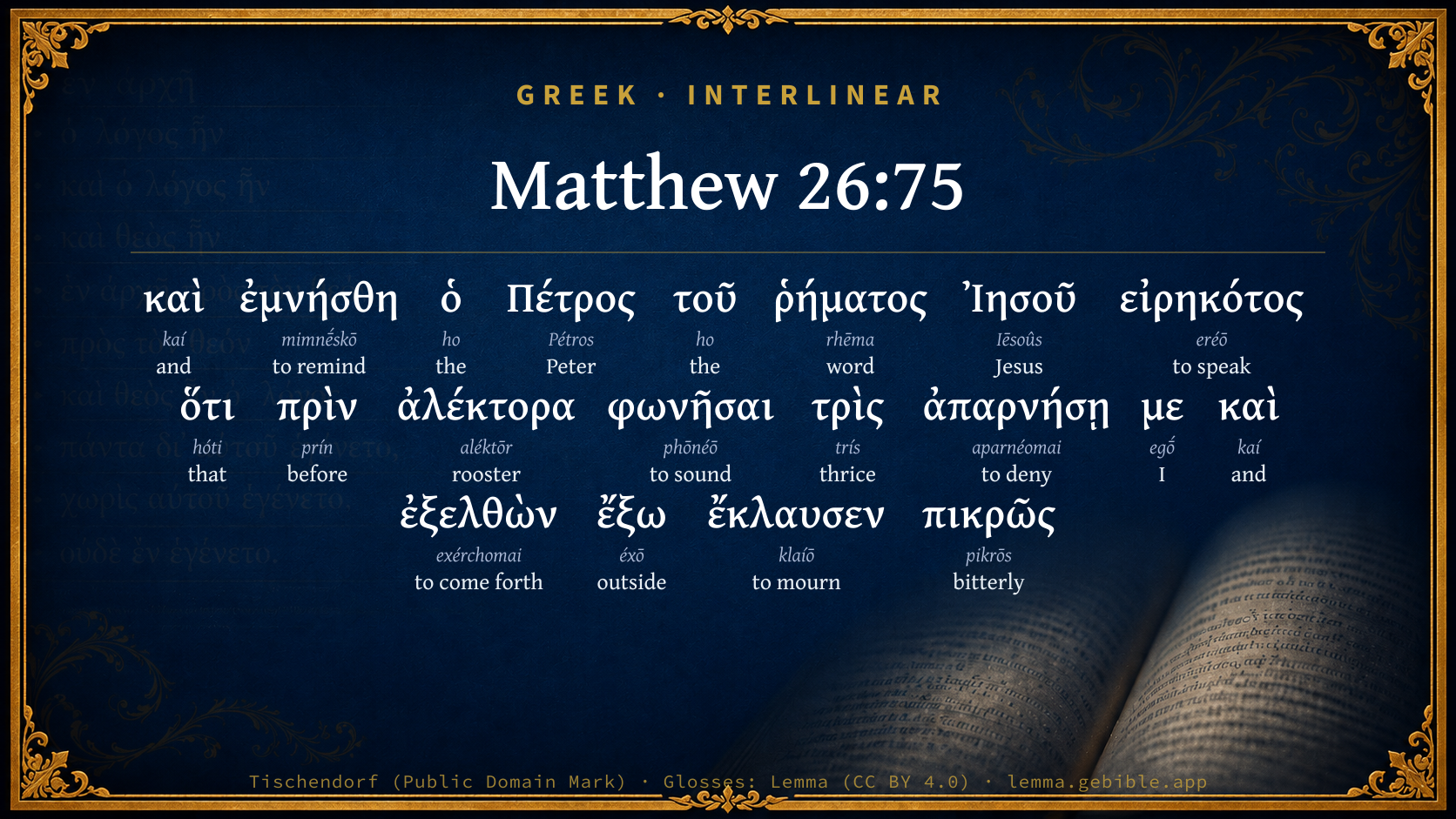
Download image
Cite this verse

Matthew 26:75 (World English Bible). Public Domain. Lemma interlinear Bible study tool, https://lemma.gebible.app/v/matthew/26/75.

Show BibTeX & RIS
BibTeX
RIS
English Translation
Peter remembered the word which Jesus had said to him, "Before the rooster crows, you will deny me three times." He went out and wept bitterly.
World English Bible · Public Domain
Highlights
  • 1 first appearance in the Greek New Testament
Full analysis ↓
Download a study sheet

One document with this verse’s original text, its word-by-word gloss line, the meaning frame, cross-references with their text, attributed commentary, and full source and license credits — printable, and it pastes into notes with its structure intact.

This verse Autodidact and up

Study sheet (.html) Plain text (.txt)

A passage Seminary Student

Up to 50 verses in one chapter. A passage sheet keeps up to 6 commentary sources and 12 cross-references per verse, in the order this page ranks them, and says so on the sheet whenever that leaves anything out. Ask for a single verse and you get the Autodidact verse sheet above.

Everything on this page stays free to read, with no account — the sheet is a download of what is already on screen, not access to it.

Want to remove ads? Support Godless Engineer
Compare translations 3

The same verse in 3 English versions, stacked beneath the original-language interlinear above. Click any original word for its lexicon entry.

Each is an independent rendering of the whole verse — the interlinear is not word-aligned to these translations.

Highlighted words mark where these versions differ — a whole-verse word diff, not a word-by-word alignment.

  • World English Bible Public Domain
    Peter remembered the word which Jesus had said to him, "Before the rooster crows, you will deny me three times." He went out and wept bitterly.
  • King James Version Public Domain
    And Peter remembered the word of Jesus, which said unto him, Before the cock crow, thou shalt deny me thrice. And he went out, and wept bitterly.
  • unfoldingWord Literal Text CC BY-SA 4.0
    And Peter remembered the word of Jesus that he had said: “Before a rooster crows you will deny me three times.” And having gone outside, he wept bitterly.

unfoldingWord Literal Text — © unfoldingWord, licensed CC BY-SA 4.0. Word-aligned USFM3 via Door43 (git.door43.org/unfoldingWord/en_ult).

Versions to compare (up to 4)

3 of 4 selected

Show all 19 translations

Every available English version of this verse, each an independent rendering of the whole verse.

  • World English Bible Public Domain
    Peter remembered the word which Jesus had said to him, "Before the rooster crows, you will deny me three times." He went out and wept bitterly.
  • Berean Standard Bible Public Domain
    Then Peter remembered the word that Jesus had spoken: “Before the rooster crows, you will deny Me three times.” And he went outside and wept bitterly.
  • Majority Standard Bible Public Domain
    Then Peter remembered the word that Jesus had spoken to him: “Before the rooster crows, you will deny Me three times.” And he went outside and wept bitterly.
  • King James Version Public Domain
    And Peter remembered the word of Jesus, which said unto him, Before the cock crow, thou shalt deny me thrice. And he went out, and wept bitterly.
  • American Standard Version (1901) Public Domain
    And Peter remembered the word which Jesus had said, Before the cock crow, thou shalt deny me thrice. And he went out, and wept bitterly.
  • Revised Version (1885) Public Domain
    And Peter remembered the word which Jesus had said, Before the cock crow, thou shalt deny me thrice. And he went out, and wept bitterly.
  • Geneva Bible (1599) Public Domain
    Then Peter remembred the wordes of Iesus, which had sayde vnto him, Before the cocke crowe thou shalt denie me thrise. So he went out, and wept bitterly.
  • Douay-Rheims (1899) Public Domain
    And Peter remembered the word of Jesus which he had said: Before the cock crow, thou wilt deny me thrice. And going forth, he wept bitterly.
  • Young's Literal Translation Public Domain
    and Peter remembered the saying of Jesus, he having said to him -- `Before cock-crowing, thrice thou wilt deny me;' and having gone without, he did weep bitterly.
  • Literal Standard Version CC BY-SA 4.0
    and Peter remembered the saying of Jesus, He having said to him, “Before rooster-crowing, you will deny Me three times”; and having gone outside, he wept bitterly.
  • Unlocked Literal Bible CC BY-SA 4.0
    Peter remembered the words that Jesus had said, “Before the rooster crows you will deny me three times.” Then he went outside and wept bitterly.
  • unfoldingWord Literal Text CC BY-SA 4.0
    And Peter remembered the word of Jesus that he had said: “Before a rooster crows you will deny me three times.” And having gone outside, he wept bitterly.
  • Darby Bible Public Domain
    And Peter remembered the word of Jesus, who had said [to him], Before [the] cock crow thou shalt deny me thrice. And he went forth without, and wept bitterly.
  • World Messianic Bible Public Domain
    Peter remembered the word which Yeshua had said to him, “Before the rooster crows, you will deny me three times.” Then he went out and wept bitterly.
  • Webster's Bible Public Domain
    And Peter remembered the word of Jesus, who said to him, Before the cock shall crow, thou wilt deny me thrice. And he went out, and wept bitterly.
  • Free Bible Version CC BY-SA 4.0
    Then Peter remembered what Jesus had told him: “Before the cock crows, three times you will deny knowing me.” He went outside and wept bitterly.
  • Bible in Basic English Public Domain
    And the word of Jesus came back to Peter, when he said, Before the hour of the cock's cry, you will say three times that you have no knowledge of me. And he went out, weeping bitterly.
  • Text-Critical English NT CC BY 4.0
    Then Peter remembered what Jesus had said to him: “Before a rooster crows, yoʋ will deny me three times.” And he went out and wept bitterly.
  • Tyndale New Testament (1534) Public Domain
    And Peter remembred the wordes of Iesu which sayde vnto him: before the cocke crowe thou shalt deny me thryse: and went out at the dores and wepte bitterly.

Literal Standard Version (2020), Covenant Press — licensed CC BY-SA 4.0. Text via the HelloAO Bible API (eBible.org). Unlocked Literal Bible (unfoldingWord) — licensed CC BY-SA 4.0. Text via the HelloAO Bible API (eBible.org). unfoldingWord Literal Text — © unfoldingWord, licensed CC BY-SA 4.0. Word-aligned USFM3 via Door43 (git.door43.org/unfoldingWord/en_ult). Free Bible Version, Dr. Jonathan Gallagher — licensed CC BY-SA 4.0. Text via the HelloAO Bible API (eBible.org).

Word by word

More ways to search: Search by grammar → Find every occurrence → Compare this word →

Practice this passage: Drill this verse → Learn its vocabulary →

πικρῶς
pikrōs
G4090
“bitterly”
Adverb
Part of Speech
Adverb
Full Thayer's Definition

Origin: from G4089

TDNT: None

1. bitterly 2. metaph. with poignant grief
  1. καὶ kaí G2532 “and” Conjunction
  2. ἐμνήσθη mimnḗskō G3403 “to remind” Verb, Aorist, Passive, Indicative, 3rd person, Singular
  3. ὁ ho G3588 “the” Article, Nominative, Singular, Masculine
  4. Πέτρος Pétros G4074 “Peter” Noun, Nominative, Singular, Masculine
  5. τοῦ ho G3588 “the” Article, Genitive, Singular, Neuter
  6. ῥήματος rhēma G4487 “word” Noun, Genitive, Singular, Neuter
  7. Ἰησοῦ Iēsoûs G2424 “Jesus” Noun, Genitive, Singular, Masculine
  8. εἰρηκότος eréō G2046 “to speak” Verb, Perfect, Active, Participle, Genitive, Singular, Masculine, Attic form
  9. ὅτι hóti G3754 “that” Conjunction
  10. πρὶν prín G4250 “before” Adverb
  11. ἀλέκτορα aléktōr G220 “rooster” Noun, Accusative, Singular, Masculine
  12. φωνῆσαι phōnéō G5455 “to sound” Verb, Aorist, Active, Infinitive
  13. τρὶς trís G5151 “thrice” Adverb
  14. ἀπαρνήσῃ aparnéomai G533 “to deny” Verb, Future, Middle deponent, Indicative, 2nd person, Singular
  15. με egṓ G1473 “I” Personal pronoun, 1st person, Accusative, Singular
  16. καὶ kaí G2532 “and” Conjunction
  17. ἐξελθὼν exérchomai G1831 “to come forth” Verb, Aorist, Active, Participle, Nominative, Singular, Masculine
  18. ἔξω éxō G1854 “outside” Adverb
  19. ἔκλαυσεν klaíō G2799 “to mourn” Verb, Aorist, Active, Indicative, 3rd person, Singular

About this verse

These counts appear in no published source. They are computed here, from the morphology-tagged text and Lemma’s own curated glosses. What Lemma adds →

20
words
18
distinct lemmas
Gospels
section

Notable vocabulary

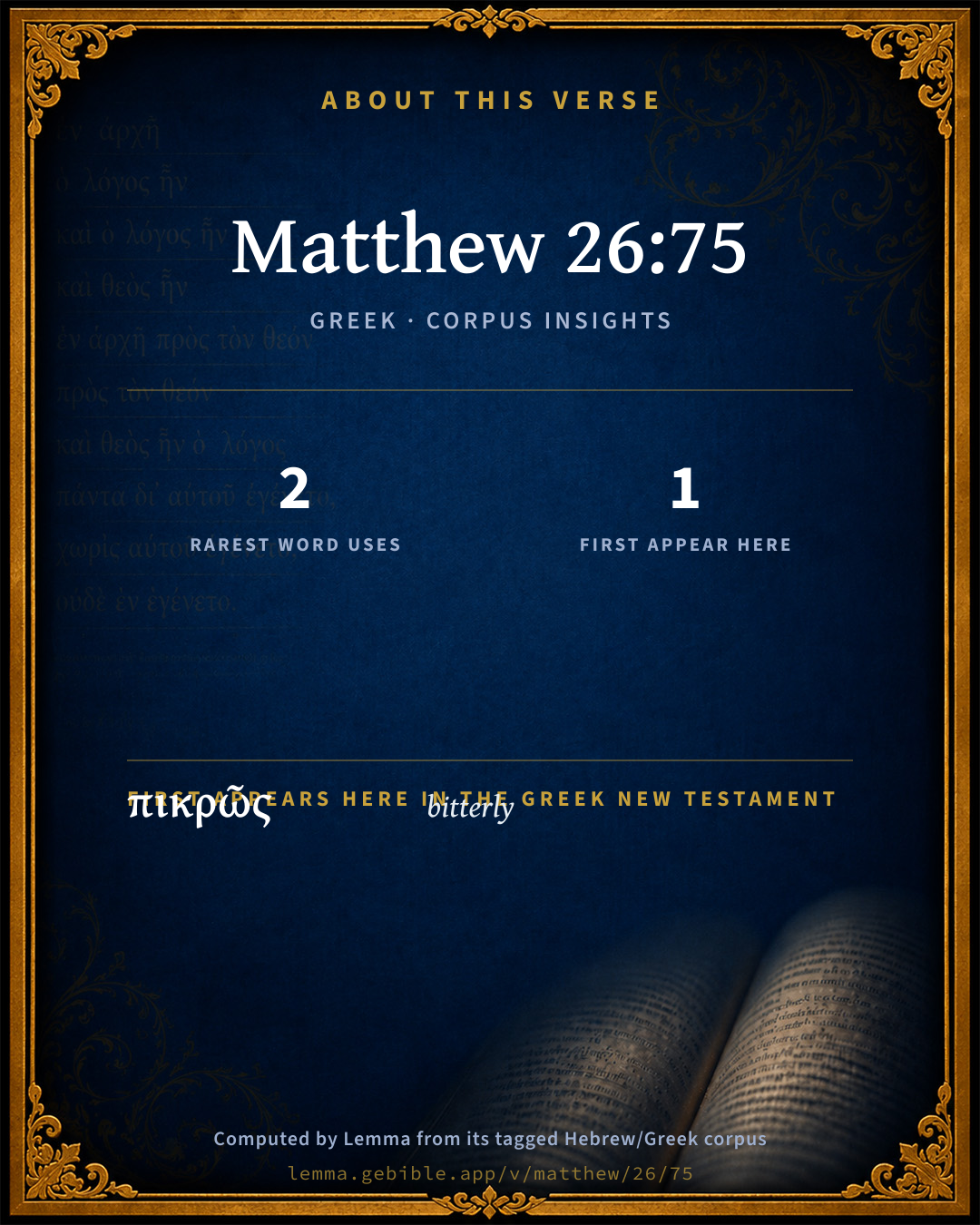
The rarest word here is πικρῶς bitterly G4090 — appearing just 2 times in the whole Greek New Testament.

First appearance in Scripture

This word makes its first canonical appearance in the Greek New Testament here:

  • πικρῶς bitterly G4090

Shared distinctive vocabulary

πικρῶς bitterly G4090 occurs in 2 verses of the Greek New Testament. Also found in:
Repetition

Words recur within this verse:

Cross-references

9

Topical passages linked to Matthew 26:75 in the Treasury of Scripture Knowledge — connected by theme and wording, ordered by reader-vote popularity; previews shown in the World English Bible.

  • Matthew 26:34 Jesus said to him, "Most assuredly I tell you that tonight, before the rooster crows, you will deny me three times."
  • Romans 7:18–20 For I know that in me, that is, in my flesh, dwells no good thing. For desire is present with me, but I don't find it doing that which is good.
  • Luke 22:31–34 The Lord said, "Simon, Simon, behold, Satan asked to have you, that he might sift you as wheat,
  • John 13:38 Jesus answered him, "Will you lay down your life for me? Most assuredly I tell you, the rooster won't crow until you have denied me three times.
  • Luke 22:61–62 The Lord turned, and looked at Peter. Then Peter remembered the Lord's word, how he said to him, "Before the rooster crows you will deny me three times."
  • Matthew 27:3–5 Then Judas, who betrayed him, when he saw that Jesus was condemned, felt remorse, and brought back the thirty pieces of silver to the chief priests and elders,
  • Galatians 6:1 Brothers, even if a man is caught in some fault, you who are spiritual must restore such a one in a spirit of gentleness; looking to yourself so that you also aren't tempted.
  • 1 Corinthians 4:7 For who makes you different? And what do you have that you didn't receive? But if you did receive it, why do you boast as if you had not received it?
  • 1 Peter 1:5 who by the power of God are guarded through faith for a salvation ready to be revealed in the last time.

Cross-references courtesy of OpenBible.info (CC BY 4.0).

Commentary

Notes on Matthew 26:75 from classic Christian and Jewish commentators (each source and its license shown beneath its notes). The classic Christian expositions comment on the surrounding passage and are grouped to its opening verse, so a note may address several verses; the Jewish commentaries on the Tanakh (Rashi and others) are per-verse, so they appear only where the commentator wrote on this verse.

Lemma curates 59 commentaries, every one of them public domain or Creative Commons licensed, each selected and text-cleaned for this edition rather than reprinted as found. About our sources →

Joseph Benson's Commentary

Mat 26:75. And Peter — Immediately upon hearing the cock crow, remembered the words of Jesus — The crowing of the cock reminding him of them. Thus, at the same time that Jesus predicted his fall, by mentioning that it would happen before the cock crew, he provided the means of his recovery, and by this little circumstance the fallen apostle is awakened and brought to repentance. Such weak and contemptible means does God sometimes use to open the eyes of sinners, and bring them to a sense of their danger and their duty! This, however, was not the only means of Peter’s restoration. Luke informs us, that immediately upon Peter’s denying Christ the third time, and the crowing of the cock, the Lord turned and looked upon Peter, and that, upon his so doing, Peter remembered the word of the Lord, how he had said unto him, Before the cock crow thou shalt deny me thrice. “The members of the council,” it appears, “who examined Jesus, sat at the upper end of the hall; in the other, were the servants with Peter at the fire. Wherefore, if Christ was placed on some footstool or bench, that his judges, who were many in number, might hear and see him, he could easily look over the heads of those who stood around him, and observe what was doing at the fire; particularly he could see Peter, who was then denying him with imprecations, and in the vehemency of his passion was speaking loud enough to be heard at the upper end of the room. But he had no sooner denied his Master the third time, than the cock crew, and awakened in him the first conviction of his sin; or at least made him look to his Master, in order, perhaps, to see if he were taking notice of what had happened. But at the same instant Jesus, turning about, fixed his eyes on his cowardly disciple. The look pierced him, and with the crowing of the cock, brought his Master’s prediction afresh into his mind. He was stung with deep remorse, and being unable to contain himself, he covered his face with his garment (see note on Mar 14:72) to conceal the confusion he was in, and going out he wept most bitterly;” experiencing that godly sorrow which worketh repentance unto salvation not to be repented of.

Before we dismiss this melancholy subject of Peter’s fall, it may not be unprofitable to notice, as a warning to ourselves, two particulars therein: First, the gradual progress of sin in him, and the various gradations by which it advanced to this depth of wickedness. From self-confidence, which was the source of the whole mischief, he proceeded, 1st, To disbelieve and disregard Christ’s warnings; and therefore: 2d, Neglected to watch and pray. 3d, When alarmed by the unexpected coming of the band to apprehend Jesus, he gave way to his own spirit, and drew his carnal weapon to defend his heavenly Master. 4th, Immediately upon being convinced of his error in this, he passed from rash courage to unreasonable cowardice, and instantly forsook his Master and fled. 5th, When, recollecting himself, he followed, it was afar off. 6th. Having unthinkingly ventured into the company of Christ’s enemies, when he had the fairest opportunity of confessing his Master, and an evident call to do it, he denied him, first, it seems, equivocating and shuffling, then telling a plain and direct lie, and confirming it by an oath, and, last of all, to gain it still greater credit, cursing and swearing. The aggravations of his sin are, secondly, deserving of our notice: 1st, He was guilty of this base, cowardly, and false conduct in the presence of Christ’s enemies, the high-priest, scribes, and elders, and their servants, who, doubtless, rejoiced at it; and were confirmed in their unbelief, after witnessing the treachery of one of Jesus’s disciples in selling him for money, to hear another of them denying him through fear. 2d, He thus denied his Master, told these lies, and uttered these oaths and curses within his Master’s view, and in his hearing. 3d, The time when Peter behaved in this manner was a peculiar aggravation of his sin. It was within a few hours after his gracious Master had most solemnly and repeatedly warned him of his danger, and he had been a witness of his conflict and bitter sorrow in the garden: it was when his Lord, of whose transfiguration and glory on the mount he had been an astonished and admiring spectator, was beginning to be most unjustly and cruelly treated by the persecutors of God’s truth, and the enemies of all righteousness, for his unspeakable love to Peter himself, and others of the human race, whom he was about to redeem and save. “The time,” says Saurin, “when Peter denied Christ, makes his crime great indeed! The time of the Lord’s looking at him illuminates his looks! At the very time when Jesus was giving the tenderest marks of his love, Peter discovered the blackest ingratitude to him; while Jesus redeemed Peter, Peter denied Jesus! While Jesus yielded to the bloody death of the cross for Peter, Peter refused to confess him! But — Jesus looks at him! My brethren, what do these looks say? how eloquent are those eyes! Never was a discourse so effectual; never did an orator express himself with so much force! It is the man of griefs complaining of a new burden, while he is ready to sink under what he already bears. It is the beneficent Redeemer of mankind pitying a soul ready to be lost! It is the apostle of our profession preaching in chains! In fine, it is the Sovereign of the hearts of men, the Almighty God of love, curbing the efforts of the devil, and taking his conquest away!”

Joseph Benson's Commentary on the Old and New Testaments (1811–1818) — public domain. Text from a community e-Sword module.

Tyndale Open Study Notes

Tyndale Open Resources

26:75 When the crowing of the rooster reminded Peter of Jesus’ prediction (26:34), he was struck with sorrow.

Tyndale Open Study Notes — © Tyndale Open Resources, licensed CC BY-SA 4.0. Text via the HelloAO Bible API.

Bengel's Gnomon

Johann Albrecht Bengel

Mat 26:75. Καὶ, and) then at last. Unbelief, fear, sorrow, bind even the natural faculties, which the joy of faith revives. See Luk 24:7-8.[1168]—εἰρηκότος, which said) A participle of mighty force.—πικρῶς, bitterly) Tears are bitter or sweet, according to the emotion from which they spring. Even if Peter’s weeping was not of long duration, his grief was so undoubtedly: see Mar 16:7. [All his former presumption ceased then and for ever.—B. G. V.] The tears of the godly, even of men, who do not easily weep from any other cause, furnish a great proof of the power, and consequently the truth, of Christianity.

[1168] ἐμνησθη, remembered) Forgetfulness is not unattended with loss and injury. But, nevertheless, if Peter had not ceased to remember the words of Jesus in the very act of his denying Him, his sin would have been even still more heinous.—V. g.

Bengel's Gnomon of the New Testament — English translation (T&T Clark, Edinburgh, 1860) — public domain. Text from a community e-Sword module.

Meyer's Critical & Exegetical Commentary

Heinrich August Wilhelm Meyer

Mat_26:75. Ἐξελθ. ἕξω] namely, from the porch (Mat_26:71) in which the second and third denial had taken place. Finding he could no longer repress the feeling of sorrowful penitence that filled his heart, the apostle must go outside to be all alone with his remorse and shame. The fear of being detected (Chrysostom) had by this time undoubtedly become to him a very secondary consideration; he was now himself again.

εἰρηκότος αὐτῷ] who had said to him (Mat_26:34), in itself a superfluous expression, and yet grande participium, Bengel.

πικρῶς] he wept bitterly. Comp. Isa_22:4, and the passages in Wetstein. How totally different was it with Judas! Lacrymarum physica amaritudo (comp. Hom. Od. iv. 153) aut dulcedo (comp. γλυκύδακρυς, Meleag. 45), congruit cum affectu animi, Bengel.

REMARK.

Seeing that the whole four evangelists concur in representing Peter as having denied Jesus three times, we are bound to regard the threefold repetition of the denial as one of the essential features of the incident (in opposition to Paulus, who, in the discrepancies that occur in the various accounts, finds traces of no less than eight different denials). The information regarding this circumstance can only have been derived from Peter himself; comp. also Joh_21:1 ff. As for the rest, however, it must be acknowledged(1) that John (and Luke too, see on Luk_22:54 ff.) represents the three denials as having taken place in a different locality altogether, namely, in the court of the house in which Annas lived, and not in that of Caiaphas; while to try to account for this by supposing that those two persons occupied one and the same dwelling (Euthymius Zigabenus, Ebrard, Lange, Lichtenstein, Riggenbach, Pressensé, Steinmeyer, Keim), is a harmonistic expedient that is far from according with the clear view of the matter presented in the fourth Gospel; see on Joh_18:16; Joh_18:25. (2) That the Synoptists agree neither with John nor with one another as to certain points of detail connected with the three different scenes in question, and more particularly with reference to the localities in which they are alleged to have taken place, and the persons by whom the apostle was interrogated as to his connection with Jesus; while to say, in attempting to dispose of this, that Abnegatio ad plures plurium interrogationes facta uno paroxysmo, pro una numeratur (Bengel), is to make a mere assertion, against which all the accounts of this incident without exception enter, so to speak, an emphatic protest. (3) It is better, on the whole, to allow the discrepancies to remain just as they stand, and to look upon them as sufficiently accounted for by the diverse forms which the primitive tradition assumed in regard to details. This tradition has for its basis of fact the threefold denial, not merely a denial several times repeated, and, as Strauss alleges, reduced to the number three to agree with the prediction of Jesus. It is to the narrative of John, however, as being that of the only evangelist who was an eye-witness, that we ought to trust for the most correct representation of this matter. Olshausen, however, gives to the synoptic narratives with the one hand so much of the merit in this respect as he takes from the Johannine with the other, and thus lays himself open to the charge of arbitrarily confounding them all.

Meyer — Critical and Exegetical Commentary on the New Testament — English translation by Peter Christie, edited by Frederick Crombie (T&T Clark, 1880) — public domain. Text from a community e-Sword module.

Expositor's Greek Testament

ed. W. Robertson Nicoll

Mat 26:75 . καὶ ἐμνήσθη : The cock crowing caused a sudden revulsion of feeling, and flashed in on Peter’s mind the light of a vivid recollection: the word his Master had spoken. πρὶν , etc., repeated as in Mat 26:34 . ἐξελθὼν , going out, neither in fear of apprehension (Chrys., Euthy.) nor from shame (Orig., Jer.), but that he might give free rein to penitent feeling. ἔκλαυσεν , wept loudly, as distinct from δακρύειν (Joh 11:35 ), to shed tears.

The Expositor's Greek Testament, edited by W. Robertson Nicoll (1897–1910) — public domain. Text from a community e-Sword module.

Adam Clarke's Commentary

Verse 75. Peter remembered the word of Jesus] St. Luke says, Lu 22:61, The Lord turned and looked upon Peter. So it appears he was nigh to our Lord, either at the time when the cock crew, or shortly after. The delicacy of this reproof was great - he must be reproved and alarmed, otherwise he will proceed yet farther in his iniquity; Christ is in bonds, and cannot go and speak to him; if he call aloud, the disciple is discovered, and falls a victim to Jewish malice and Roman jealousy; he therefore does the whole by a look. In the hand of Omnipotence every thing is easy, and he can save by a few, as well as by many.

He went out] He left the place where he had sinned, and the company which had been the occasion of his transgression.

And wept bitterly.] Felt bitter anguish of soul, which evidenced itself by the tears of contrition which flowed plentifully from his eyes. Let him that standeth take heed lest he fall! Where the mighty have been slain, what shall support the feeble? Only the grace of the ALMIGHTY God.

This transaction is recorded by the inspired penmen,

1st. That all may watch unto prayer, and shun the occasions of sin.

2dly. That if a man be unhappily overtaken in a fault, he may not despair, but cast himself immediately with a contrite heart on the infinite tenderness and compassion of God. See the notes on Joh 18:27.

I have touched on the subject of our Lord's anointing but slightly in the preceding notes, because the controversy upon this point is not yet settled; and, except to harmonists, it is a matter of comparatively little importance. Bishop Newcome has written largely on this fact, and I insert an extract from his notes.

Adam Clarke's Commentary on the Bible (1810–1826) — public domain. Text from a community e-Sword/MySword module.

Ellicott's Commentary for English Readers

(75) Peter remembered the word of Jesus.—St. Luke records (Luk_22:61) that it was at this moment, probably as He was passing from the council chamber, mocked and buffeted by the officers, that “the Lord turned and looked upon Peter.” That glance, full, we must believe, of tenderest pity and deepest sadness, as of one who was moved not by anger but by sorrow, recalled him to his better self, and the flood-gates of penitence were opened. From that hour we lose sight of him till the morning of the Resurrection. We may infer from his then appearing in company with John (Joh_20:3), that he turned in his contrition to the friend and companion of his early years, who had probably witnessed his denials, and was not repulsed. The fact that the record of his fall appears in every Gospel, may be noted as indicating that, in after years, he did not shrink from letting men know of his guilt, but sought rather that men might find in him (as St. Paul afterwards in his experience, 1Ti_1:12-16) a proof of the mercy and tender pity of his Lord.

A Bible Commentary for English Readers, edited by Charles John Ellicott (1878–1897) — public domain. Text from a community e-Sword module.

Trapp's Complete Commentary

John Trapp

75 And Peter remembered the word of Jesus, which said unto him, Before the cock crow, thou shalt deny me thrice. And he went out, and wept bitterly.

Ver. 75. And Peter remembered the word of Jesus] Here began his repentance. If we remember not what is preached unto us, all is lost, saith the apostle, 1Co 15:2. If we leak and let slip, saith another, how shall we escape? Μηποτε παραρρυωμεν, Heb 2:1; Heb 2:3. The Spirit shall be the saints’ remembrancer; and as the sea casts up her dead, so shall that come seasonably to mind, that was long before delivered, when God’s good time is come to work upon the dead heart. God will be found of his that seek him not. Surely, mercy and truth shall follow them all the days of their lives, as the sunbeams follow the traveller that turns his back on them. He will bring back his banished, he will reduce his rengades, he will not suffer any of his to be utterly drowned, though haply they have been drenched in the waves of sin, lain some while in them, yea, and have also sunk twice or thrice, as Peter, to the very bottom. Now then how can any either presume of not sinning, or despair for sin, when they read of Peter thus fallen, and now thus remembering, thus rising again by repentance, and received to mercy? The like instances we have not a few, of Origen and other primitive Christians, who, recanting for a season through fear of death, were therefore utterly excluded by Novatus from all hope of mercy; but not so by Christ. "Be not thou a terror unto me, O Lord," saith Jeremiah, and then I care not, though all the world condemn and cast me out. Bilney, Bainham, Benbridge, Abbes, Whittle, Sharp, and many other martyrs, having denied their Lord God, as they called it, for fear of the faggot, could have no rest till they had repented, and publicly revoked their much bewailed recantations. Stephen Gardiner, indeed, like another Ecebolius, cried out that he had denied with Peter, but never repented with Peter, and so both stinkingly and unrepentantly died, saith Mr Fox. It was a saying of the same Mr Fox, that his graces did him most hurt, and his sins most good. A paradox; but by our temptations, we know his meaning. As pain easeth a Christian, death revives him, dissolution unites him, so corruption clarifies him. I dare be bold to say (saith Augustine) that it is good for proud persons to fall into some foul sin, unde sibi displiceant, qui iam sibi placendo ceciderunt. Salubrius enim Petrus sibi displicuit quando flevit, quam sibi placuit quando praesumpsit, that they may be humbled, as Peter was, and so saved. (Aug. Civ. Dei. 14, 13.)

He wept bitterly] That one sweet look from Christ melted him; as God’s kindness did the hard hearted Israelites at the meet of Mizpeh. In this troubled pool Peter washed himself, in this Red Sea the army of his iniquities was drowned. As once his faith was so great that he leapt into a sea of waters to come to Christ, so now his repentance was so great, that he leapt, as it were, into a sea of tears for that he had gone from Christ. There are those who say (and it may very well be) that henceforth he was ever and anon weeping; and that his face was even furrowed with continual tears. {a} He began soon after his sin, Mar 14:72, cum se proripuisset, when he had thrown himself out, as Beza renders επιβαλων. He had no sooner took in poison, but he vomited it up again ere it got to the vitals. He had no sooner handled his serpent, but he turned it into a rod to scourge his soul with remorse. Peccatum tristitiam peperit, et tristitia peccatum contrivit, ut vermis is ligno natus, sed ipsum comminuit.

{a} Semper lachrymis suffusos habuisse oculos adeo ut etiam lachrymae cutem genarum exederint. Chrysost.

John Trapp, A Commentary or Exposition upon All the Books of the Old and New Testament (1647–1656) — public domain. Text from a community e-Sword module.

Albert Barnes' Notes on the Bible

And Peter remembered the word of Jesus ... - Luke has mentioned a beautiful and touching circumstance omitted by the other evangelists, that when the cock crew, “Jesus turned and looked upon Peter,” and that then he remembered his words. They were in the same room - Jesus at the upper end of the hall, elevated for a tribunal and Peter below with the servants, so that Jesus could look down upon Peter standing near the fire. By a tender and compassionate look - a single glance of his eye the injured Saviour brought to remembrance all Peter’s promises, his own predictions, and the great guilt of the disciple; he overwhelmed him with the remembrance of his sin, and pierced his heart through with many sorrows. The consciousness of deep and awful guilt rushed over Peter’s soul; he flew from the palace, he went where he might be alone in the darkness of the night, and “wept bitterly.”

The fall of Peter is one of the most melancholy instances of depravity ever committed in our world. But a little while before so confident; seated at the table of the Lord; distinguished throughout the ministry of Christ with special favors; cautioned against this very thing; yet so soon denying him, forgetting his promises, and profanely calling on God to witness what he knew to be false - that he did not know him! Had it been only once, it would have been awful guilt - guilt deeply piercing the Redeemer’s soul in the day of trial; but it was three times repeated, and at last with profane cursing and swearing. Yet, while we weep over Peter’s fall, and seek not to palliate his crime, we should draw from it important practical uses:

1. The danger of self-confidence. “He that thinketh he standeth should take heed lest he fall” 1Co 10:12. True Christian confidence is that which relies on God for strength, and feels safety only in the belief that he is able and willing to keep from temptation.

2. The highest favors, the most exalted privileges, do not secure us from the danger of falling into sin. Few men were ever so highly favored as Peter; few ever so dreadfully departed from the Saviour, and brought so deep a scandal on religion.

3. When a man begins to sin; his fall from one act to another is easy - perhaps almost certain. At first, Peter’s sin was only simple denial; then it increased to more violent affirmation, and ended with open profaneness. So the downward road of crime is easy. When sin is once indulged, the way is open for a whole deluge of crime, nor is the course easily stayed until the soul is overwhelmed in awful guilt.

4. True repentance is deep, thorough, bitter. Peter wept bitterly. It was sincere sorrow - sorrow proportioned to the nature of the offence he had committed.

5. A look from Jesus - a look of mingled affection, pity, and reproof - produces bitter sorrow for sin. We injure Him by our crimes; and His tender look, when we err, pierces the soul through with many sorrows, opens fountains of tears in the bosom, and leads us to weep with bitterness over our transgressions.

6. When we sin when we fall into temptation - let us retire from the world, seek the place of solitude, and pour out our sorrows before God. He will mark our groans; he will hear our sighs; he will behold our tears; and he will receive us to his arms again.

7. Real Christians may be suffered to go far astray. To show them their weakness, to check self-confidence, and to produce dependence on Jesus Christ, they may be permitted to show how weak, and feeble, and rash they are. Peter was a real believer. Jesus had prayed for him “that his faith should fail not,” Luk 22:32. Jesus was always heard in his prayer, Joh 11:42. He was heard, therefore, then. Peter’s faith did not fail - that is, his belief in Jesus, his real piety, his true attachment to the Saviour. He knew during the whole transaction that Jesus was the Messiah, and that he himself was well acquainted with him; but he was suffered to declare that which he knew was not true, and in this consisted his sin. Yet,

8. Though a Christian may be suffered to go astray - may fall into sin - yet he who should, from this example of Peter, think that he might, lawfully do it, or who should resolve to do it, thinking that he might, like Peter, weep and repent, would give evidence that he knew nothing of the grace of God. He that resolves to sin under the expectation of repenting hereafter “cannot be a Christian.”

It is worthy of further remark, that the fact that the fall of Peter is recorded by “all” the evangelists is high proof of their “honestly.” They were willing to tell the truth as it was; to conceal no fact, even if it made much against themselves, and to make mention of their own faults without attempting to appear to be better than they were. And it is worthy of special observation that Mark has recorded this with all the circumstances of aggravation, perhaps even more so than the others. Yet, by the universal belief of antiquity, the Gospel of Mark was written under Peter’s direction, and every part of it submitted to him for examination. Higher proof of the honesty and candor of the evangelists could not be demanded.

Albert Barnes' Notes on the Bible (1834–1885) — public domain. Text from a community e-Sword/MySword module.

Haydock's Catholic Bible Commentary

And Peter remembered the word of Jesus. St. Augustine understands this rather of an interior illumination of grace: but it is likely our Saviour then might be where he saw Peter, and gave him a glance of his eye. --- And going forth he wept bitterly: even daily all his life-time, say the ancient historians of his life. (Witham) --- St. Clement, pope, in his itinerary, relates how St. Peter was ever after accustomed to watch in prayer, from the first crow of the cock till morning, pouring forth torrents of tears, and bitterly bewailing his heinous crime. (Denis the Carthusian) --- Let us compassionate our blessed Lord under his sufferings, and in opposition to the cruel malice of his enemies, let his followers cry out with the angel in the Apocalypse: Thou are worthy, O Lord, to receive power and divinity, honour and glory, for ever and ever.

George Leo Haydock (1774–1849), Haydock's Catholic Family Bible and Commentary, 1859 edition — public domain. Excludes Psalms (Douay-Rheims chapter numbering differs from Protestant) and Deuterocanonical books (Catholic canon only).

Matthew Poole's English Annotations

Mark saith, Mar 14:72, And the second time the cock crew. And Peter called to mind the word that Jesus said unto him, Before the cock crow twice, thou shalt deny me thrice. And when he thought thereon, he wept. Luke saith, Luk 22:61,62, And the Lord turned, and looked upon Peter. And Peter remembered the word of the Lord, how he had said unto him, Before the cock crow, thou shalt deny me thrice. And Peter went out and wept bitterly. We have in this last verse Peter’s repentance and the occasion and cause of it. A good man may fall, and that foully, but he shall not fall so as to rise no more. David lay longer than Peter under the guilt of his sin, but both of them wept bitterly. He went out of the porch; whither he went is not said; possibly he was afraid to what this detection of him might rise, or else sought a place (as Joseph did) to weep more privately and plentifully than he durst do, or thought convenient to do, in the porch of the high priest. That which gave occasion to this reflection was the crowing of the cock the second time, and his remembrance of the words of Jesus, Mat 26:34. Our memories serve us much in the business of repentance, and therefore that the soul should be without knowledge of the law of God is not good. Peter remembered what Christ had personally said to him. True penitents are still excited to repentance, by remembering the law of God, what Christ hath in his word said to them, and considering their own ways. The crowing of the cock the second time helped him to remember the words of Jesus, for he had said, Before the cock crow twice, &c. But the cause of his repentance is expressed by Luke, The Lord turned, and looked upon Peter. More must be understood by this look of Christ upon him than the mere cast of Christ’s bodily eye: with that look there was a virtue which went from Christ which healed Peter, exciting his habit of grace, and assisting him in the exercise of it; which double influence of grace is necessary to every renewed soul. Christ looked upon Judas, when Judas kissed him; yea, and said to him, Judas, betrayest thou the Son of man with a kiss? Yet Judas went on in his villany without remorse. He looked upon Peter, and he went out and wept bitterly. He looked only upon the face of Judas, but he looked upon the heart of Peter, as well as upon his face.

Matthew Poole's English Annotations on the Holy Bible (1683–1685) — public domain. Text from a community e-Sword/MySword module.

Whedon's Commentary on the Bible

Daniel D. Whedon

75. Wept bitterly — Tears are, indeed, of little use that result not in return to duty. Judas wept perhaps, but turned not. Peter wept, and what was better, he returned to Christ and became a faithful apostle.

Olshausen thinks that Peter’s denial was so inconsistent with his real bravery as to constitute a true “enigma,” explicable only on the hypothesis that he was under a temptation greater than he could bear. On the contrary, we venture to think it was like the man. He had active bravery, but not steady, passive firmness. Give him a sword, his fellow eleven for comrades, and his Lord for captain, and he would have been ready to storm the fortress of Antonia. But bid him put up his sword and stand the foeman’s shafts, and you take the man out of him. He followed his Lord adventurously, and then denied him shamefully; just as he started to walk upon the waves and then sunk before the blast. Such keeping of character is sure proof of the truth of the Gospel history.

Daniel D. Whedon (gen. ed.), Commentary on the Old and New Testaments (1874–1909) — public domain. Text from a community e-Sword module.

The Pulpit Commentary

Peter remembered the word of Jesus. Simultaneously with the crowing of the cock, the Lord turned round, and from the chamber facing the court looked upon Peter, (Luk_22:61) singled him out from all the crowd, showed that amid all his own sufferings and sorrows be had not forgotten his weak apostle. What that look did for Peter we learn by succeeding events; it is for the homilist to expatiate thereon. Christ had prayed for him, and the effect of that prayer was now felt. He went out. From the portico where the denial had taken place; he rushed from that evil company into the night, a broken-hearted man, that no human eye might witness his anguish, that alone with his conscience and God he might wrestle out repentance. Wept bitterly. Tradition asserts that all his life long Peter hereafter never could hear a cock crow without failing on his knees and weeping.

Quick penitence revealing character.

St. Peter had become entangled through making one false step. He had never anticipated what happened. He began with half a lie, which he excused as merely a putting aside of uncomfortable and even perilous questions. but the "beginning or evil is as the letting out of water." Soon the tempter plunged poor Peter over head and neck in evasions lyings, cursings, and swearings. Then came the moment when Jesus was passing from the council chamber, and as he passed he turned, and gave Peter a look, only a look, but we can imagine the wealth of pitying that was in the look. It went right home; it recalled warning words; it revealed, as by a lightning flash, the darkness into which Peter had fallen; and he rushed out of the place, and could not restrain the tears that told of bitterest shame and humiliation. What does this penitence tell concerning Peter?

I HIS SENSITIVENESS. When we see how quickly he responded to Christ"s "look," we begin to understand how he came to respond so readily to the peril which the maid"s question brought him. He was too sensitive; he responded too soon; he was always in danger of speaking and acting before he had time to criticize his own impressions. There are many among us like him. They feel too soon. They respond too quickly. And they respond to evil suggestion and to calamity as readily as to good and success. We call it highly nervous organization.

II HIS AFFECTIONATENESS. We must keep in mind how truly he was attached to his Lord; and how open that attachment made him to all influences exerted on him by Christ. It was his safeguard in that sad time, that he had personal love to Christ. That disposition often brings men round right again after they have gone astray. Fathers and mothers know the anchor hold that a child"s affectionate disposition gives to them.

But there is a gushing and impulsive penitence that is not good. Sometimes there is too easy confession of sin confession before the really humbling sense of sin is felt. Easy penitence is little more than regret; and it is usually very gushing in expression. Easy penitence has little force on the moral nature. Penitence needs to be made deep and searching by the help of serious thinking. R.T.

The Pulpit Commentary (1880–1919), ed. H.D.M. Spence-Jones & Joseph S. Exell — public domain. Text from a community e-Sword module.

The People's New Testament

B. W. Johnson

75. Peter remembered the word of Jesus. It was at this point that the Lord turned and looked at Peter (Luke 22:61). The hall where Jesus was being tried was probably open toward the court, and Jesus may easily have heard all the denials of Peter. Now he turns and looks at Peter, and brings to his mind what he had few hours before foretold. He went out and wept bitterly. The look of Christ broke his heart. As the cock crew, his own confident assertions and the word of the Lord, “Before the cock crow twice (before the second cock crowing) thou shalt thrice deny me,” rushed upon him. He rushed out into the darkness of the night to weep. Judas sinned, betrayed and sold the Lord from covetousness. Afterward he was sorry, but it was the sorrow of this world that worketh death. It was remorse, not repentance, and he went and hanged himself. Peter's repentance was attested (1) by the bitterness of his tears; (2) by his humble submission to his Lord's subsequent rebuke (John 21:15–17); (3) by his subsequent courage in confessing Christ in the face of threatening danger (Acts 4:8–12, 19).

The Order of Events, after the prayer at Gethsemane, for this night were as follows: After the arrest, and its incidents, (1) Jesus was taken first to the house of Annas, ex-high priest (John 18:13). (2) Next, to the palace of Caiaphas, Peter and John following (John 18:15). (3) Here was a preliminary examination before Caiaphas (John 18:19–24). (4) The trial before the council illegal, because held at night—before three o'clock, the cock-crowing (Matt. 26:59–65; Mark 14:55–64). (5) Peter's three denials during the trial (Matt. 26:69–75; Mark 14:66–72). (6) After the Sanhedrim had pronounced him guilty it suspends its session till break of day. (7) During this interval Jesus is exposed to the insults of his enemies (Matt. 26:67, 68; Luke 22:63–65). (8) At the dawn of day the Sanhedrim re-assembles (Matt. 27:1; Mark 15:1; Luke 22:66). (9) After hearing Christ's confession again, he is formally condemned to death for blasphemy (Luke 22:66–71). (10) He is bound and sent to Pilate (Mark 15:1).

On the Illegal Conviction of Christ, Prof. Greenleaf, a distinguished jurist, says: “Throughout the whole course of the trial, the rules of the Jewish law of procedure were grossly violated, and the accused was deprived of rights belonging even to the meanest citizen. He was arrested in the night, bound as a malefactor, beaten before his arraignment, and struck in open court during the trial. He was tried on a feast-day, and before sunrise. He was compelled to criminate himself, and this under an oath of solemn judicial adjuration; and he was sentenced on the same day of conviction. In all these particulars the law was wholly disregarded.”

B. W. Johnson's The People's New Testament with Notes (1889–1891) — public domain. Electronic text from the Christian Classics Ethereal Library (CCEL) ThML edition.

Cambridge Greek Testament for Schools and Colleges

75. ἔκλαυσεν, of loud and bitter wailing, in distinction from δακρύειν, ‘to weep silently.’ The latter verb is found once only in N.T., Joh 11:35, ἐδάκρυσεν ὁ Ἰησοῦς.

Cambridge Greek Testament for Schools and Colleges (Cambridge University Press, 1896; 21 vols, various authors incl. Carr, Maclear, Plummer, Farrar, Lumby, Moule, M. R. James, Simcox) — public domain. Text from a community e-Sword module.

Alford’s Greek Testament

Henry Alford

75.] ἔξω—viz. from the πυλών where the second and third denial had taken place: the motive being, ἵνα μὴ κατηγορηθῇ διὰ τῶν δακρύων, as Chrys.

Henry Alford, The Greek Testament (1849–1861) — public domain. Text from a community e-Sword module.

International Critical Commentary

(M) 75. And Peter remembered the word of Jesus, who said that Before the cock crow, thrice thou shalt deny Me. And he went outside, and wept bitterly.] Mk. has: “And Peter remembered the word, how Jesus said to him that, Before the cock crow twice, thrice thou shalt deny Me. And ἐπιβαλών he was weeping.” If the text of S. Mark which lay before Mt. had δίς in vv. 30 and 72, and ἐκ δευτέρου in v. 72, Mt. has probably omitted all three for the same reasons that have caused so many changes in the Western copies of Mk. See WH., § 323, and p. 330.—τοῦ ῥήματος] so Lk. Mk. has τὸ ̔ῆμα. ἐξελθὼν ἔξω, which occurs also in Lk., seems to be a substitute for, or interpretation of, Mk.’s difficult ἐπιβαλών. See Swete, and especially Moulton, p. 131.—ἔκλαυσεν] aor., as often, for Mk.’s imperfect.—πικρῶς] is added by Mt. (and Lk.) to emphasise the point. See Hastings, DCG. i. p. 444.

International Critical Commentary — older volumes (1896–1929), various authors — public domain. Text from a community e-Sword module.

Lesson kit

Teaching starters — assembled from the data on this page, not authored interpretation. Every prompt links to the verse data it draws on. Edit before teaching.

Matthew, in the Gospels, opens this verse with 20 words (18 distinct Greek lemmas). Its most distinctive word is pikrōs (“bitterly”). A historical commentator’s framing appears above. Read the whole chapter for the surrounding context.

Discussion questions

  1. What does “bitterly” (pikrōs) contribute to the verse as a whole?
  2. The word “bitterly” first appears here in Scripture. What is being introduced at this debut?
  3. Luke 22:62 shares the word «bitterly» with this verse. How do the two illuminate each other?
  4. “and” occurs 2× in this one verse. What is the effect of the repetition?
  5. These translations render this verse differently. What is at stake in choosing one wording over another?
  6. Reading how Joseph Benson's Commentary and Tyndale Open Study Notes read this verse, where do the two commentators agree and where do they part?

Things to notice

  • 1 word makes its first canonical appearance in Scripture here.
  • These translations choose different wording for 17 words in this verse.
  • “and” occurs 2× in this single verse.
  • 18 distinct Greek lemmas span 20 words in this verse.

Reading settings

Reading text

Shown beneath each verse's original-language words.

Old Testament
Old Testament edition

Read the OT as the Masoretic Hebrew (MT) or the Greek Septuagint (LXX).

English shown for the Greek Septuagint (in the Hebrew ↔ Greek comparison).

Comparing translations? Open the Compare panel on any verse page to stack up to four side by side.