Matthew 13:35

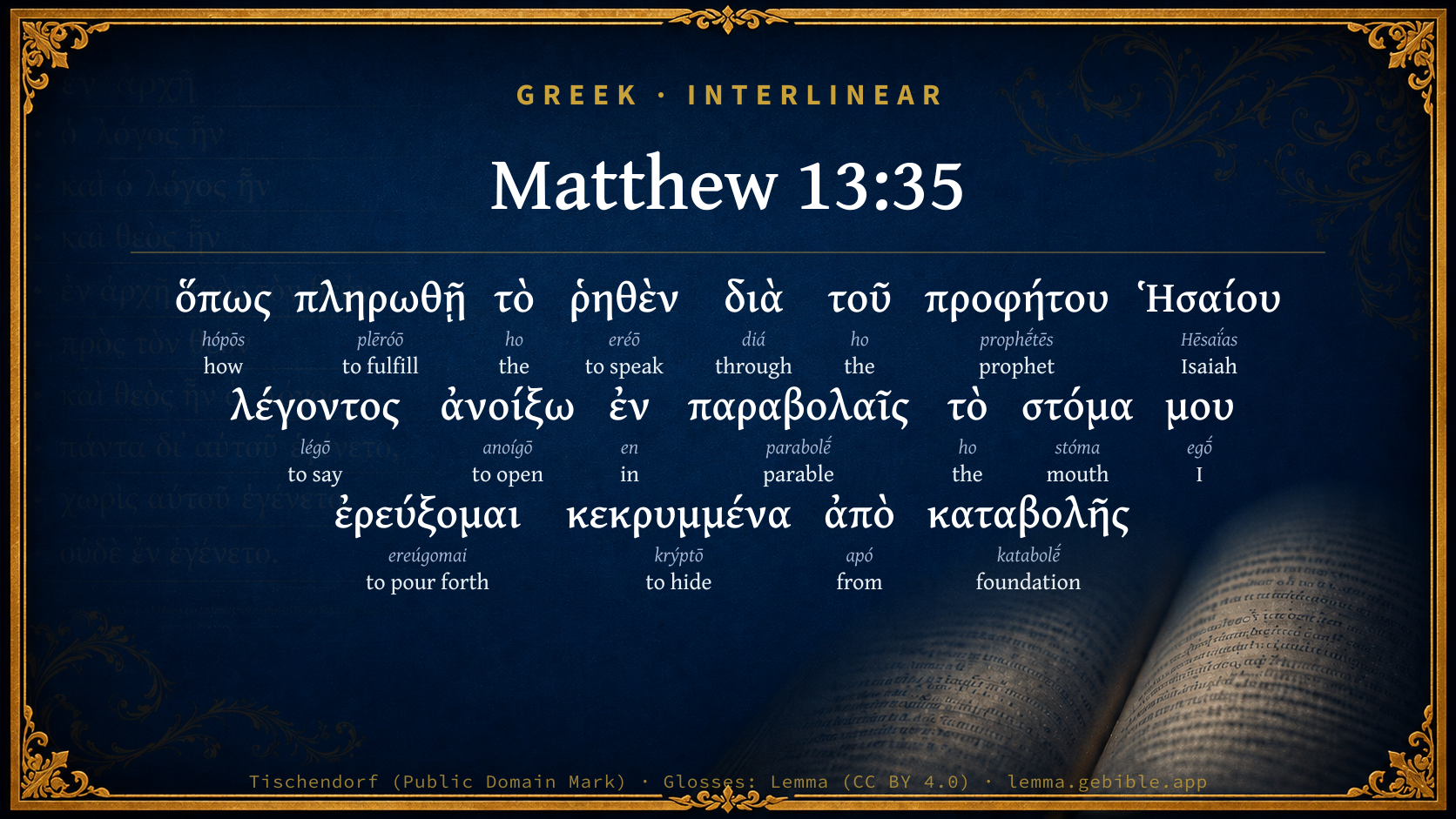
Greek (Tischendorf 8th ed.) Matthew 13:35 appears in the Greek New Testament. The text above is from the Tischendorf 8th edition. Each word links to its Strong’s number and a concise gloss. Click any word for its full Thayer’s Greek Lexicon entry.
Download image
Cite this verse

Matthew 13:35 (World English Bible). Public Domain. Lemma interlinear Bible study tool, https://lemma.gebible.app/v/matthew/13/35.

Show BibTeX & RIS
BibTeX
RIS
English Translation
that it might be fulfilled which was spoken through the prophet, saying, "I will open my mouth in parables; I will utter things hidden from the foundation of the world."
World English Bible · Public Domain
Highlights
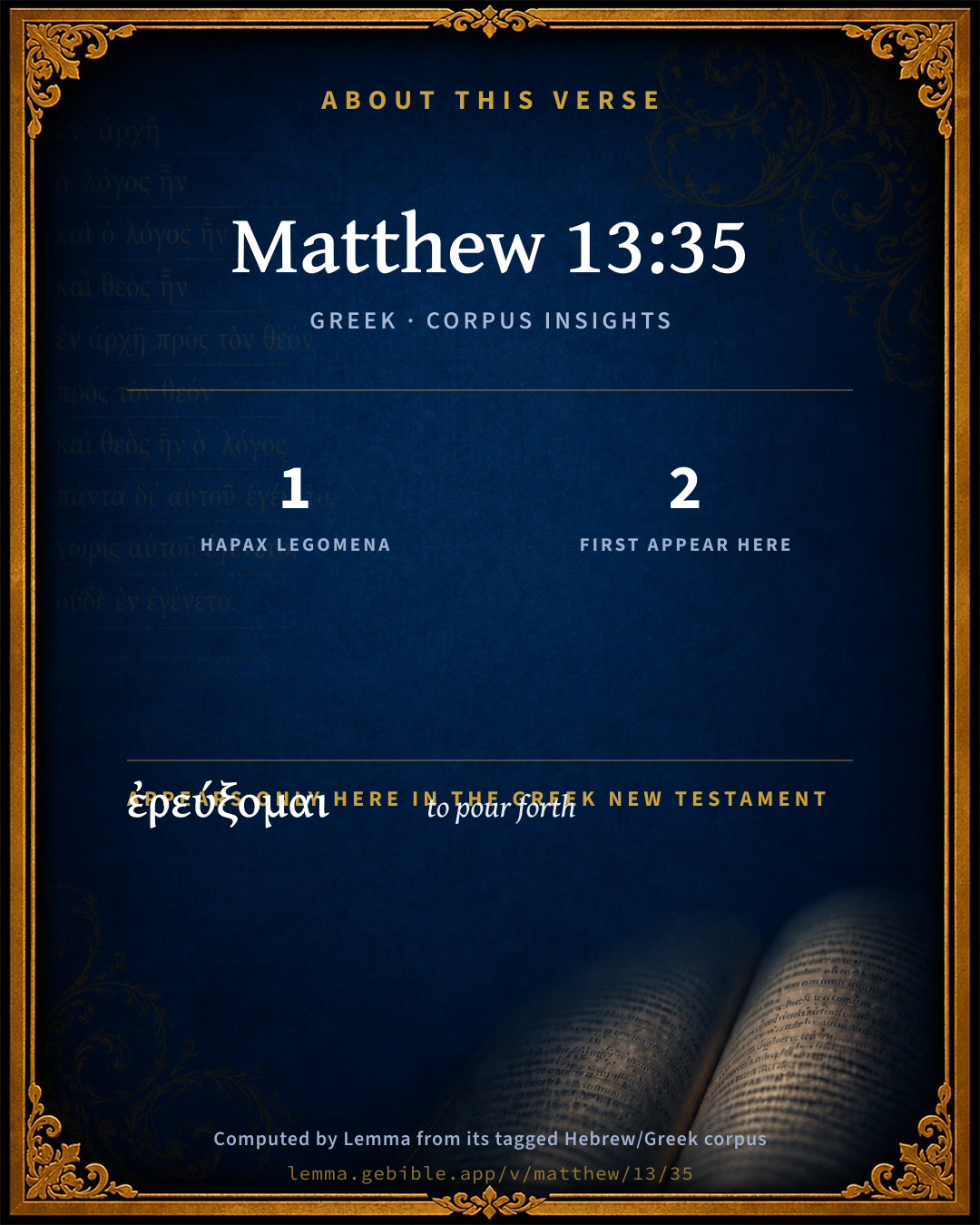
  • 1 hapax legomenon — only here in the Greek New Testament
  • 2 first appearances in the Greek New Testament
Full analysis ↓
Download a study sheet

One document with this verse’s original text, its word-by-word gloss line, the meaning frame, cross-references with their text, attributed commentary, and full source and license credits — printable, and it pastes into notes with its structure intact.

This verse Autodidact and up

Study sheet (.html) Plain text (.txt)

A passage Seminary Student

Up to 50 verses in one chapter. A passage sheet keeps up to 6 commentary sources and 12 cross-references per verse, in the order this page ranks them, and says so on the sheet whenever that leaves anything out. Ask for a single verse and you get the Autodidact verse sheet above.

Everything on this page stays free to read, with no account — the sheet is a download of what is already on screen, not access to it.

Want to remove ads? Support Godless Engineer
Compare translations 3

The same verse in 3 English versions, stacked beneath the original-language interlinear above. Click any original word for its lexicon entry.

Each is an independent rendering of the whole verse — the interlinear is not word-aligned to these translations.

Highlighted words mark where these versions differ — a whole-verse word diff, not a word-by-word alignment.

  • World English Bible Public Domain
    that it might be fulfilled which was spoken through the prophet, saying, "I will open my mouth in parables; I will utter things hidden from the foundation of the world."
  • King James Version Public Domain
    That it might be fulfilled which was spoken by the prophet, saying, I will open my mouth in parables; I will utter things which have been kept secret from the foundation of the world.
  • unfoldingWord Literal Text CC BY-SA 4.0
    so that had been said through the prophet might be fulfilled, saying, “I will open my mouth in parables. I will declare has been hidden from the foundation of the world.”

unfoldingWord Literal Text — © unfoldingWord, licensed CC BY-SA 4.0. Word-aligned USFM3 via Door43 (git.door43.org/unfoldingWord/en_ult).

Versions to compare (up to 4)

3 of 4 selected

Show all 19 translations

Every available English version of this verse, each an independent rendering of the whole verse.

  • World English Bible Public Domain
    that it might be fulfilled which was spoken through the prophet, saying, "I will open my mouth in parables; I will utter things hidden from the foundation of the world."
  • Berean Standard Bible Public Domain
    So was fulfilled what was spoken through the prophet: “I will open My mouth in parables; I will utter things hidden since the foundation of the world.”
  • Majority Standard Bible Public Domain
    So was fulfilled what was spoken through the prophet: “I will open My mouth in parables; I will utter things hidden since the foundation of the world.”
  • King James Version Public Domain
    That it might be fulfilled which was spoken by the prophet, saying, I will open my mouth in parables; I will utter things which have been kept secret from the foundation of the world.
  • American Standard Version (1901) Public Domain
    that it might be fulfilled which was spoken through the prophet, saying, I will open my mouth in parables; I will utter things hidden from the foundation of the world.
  • Revised Version (1885) Public Domain
    that it might be fulfilled which was spoken by the prophet, saying, I will open my mouth in parables; I will utter things hidden from the foundation of the world.
  • Geneva Bible (1599) Public Domain
    That it might be fulfilled, which was spoken by the Prophet, saying, I will open my mouth in parables, and will vtter the thinges which haue beene kept secrete from the foundation of the worlde.
  • Douay-Rheims (1899) Public Domain
    That it might be fulfilled which was spoken by the prophet, saying: I will open my mouth in parables, I will utter things hidden from the foundation of the world.
  • Young's Literal Translation Public Domain
    that it might be fulfilled that was spoken through the prophet, saying, `I will open in similes my mouth, I will utter things having been hidden from the foundation of the world.'
  • Literal Standard Version CC BY-SA 4.0
    that it might be fulfilled that was spoken through the prophet, saying, “I will open in allegories My mouth, || I will utter things having been hidden from the foundation of the world.”
  • Unlocked Literal Bible CC BY-SA 4.0
    This was in order that what had been said through the prophet might come true, when he said, “I will open my mouth in parables. I will say things that were hidden from the foundation of the world.”
  • unfoldingWord Literal Text CC BY-SA 4.0
    so that had been said through the prophet might be fulfilled, saying, “I will open my mouth in parables. I will declare has been hidden from the foundation of the world.”
  • Darby Bible Public Domain
    so that that should be fulfilled which was spoken through the prophet, saying, I will open my mouth in parables; I will utter things hidden from [the] world's foundation.
  • World Messianic Bible Public Domain
    that it might be fulfilled which was spoken through the prophet, saying, “I will open my mouth in parables; I will utter things hidden from the foundation of the world.”
  • Webster's Bible Public Domain
    That it might be fulfilled which was spoken by the prophet, saying, I will open my mouth in parables; I will utter things which have been kept secret from the foundation of the world.
  • Free Bible Version CC BY-SA 4.0
    This fulfilled the prophet's words: “I will speak using stories, and I will explain things hidden from the creation of the world.”
  • Bible in Basic English Public Domain
    That it might come true which was said by the prophet, Opening my mouth, I will give out stories; I will give knowledge of things kept secret from before all time.
  • Text-Critical English NT CC BY 4.0
    This was to fulfill what had been spoken through the prophet: “I will open my mouth in parables; I will declare things hidden from the foundation of the world.”
  • Tyndale New Testament (1534) Public Domain
    to fulfyll that which was spoke by the Prophet sayinge: I wyll open my mouth in similitudes and wyll speake forth thinges which have bene kepte secrete from the begynninge of the worlde.

Literal Standard Version (2020), Covenant Press — licensed CC BY-SA 4.0. Text via the HelloAO Bible API (eBible.org). Unlocked Literal Bible (unfoldingWord) — licensed CC BY-SA 4.0. Text via the HelloAO Bible API (eBible.org). unfoldingWord Literal Text — © unfoldingWord, licensed CC BY-SA 4.0. Word-aligned USFM3 via Door43 (git.door43.org/unfoldingWord/en_ult). Free Bible Version, Dr. Jonathan Gallagher — licensed CC BY-SA 4.0. Text via the HelloAO Bible API (eBible.org).

Word by word

More ways to search: Search by grammar → Find every occurrence → Compare this word →

Practice this passage: Drill this verse → Learn its vocabulary →

ἐρεύξομαι
ereúgomai
G2044
“to pour forth”
Verb, Future, Middle deponent, Indicative, 1st person, Singular
Part of Speech
Verb
Tense
Future
Voice
Middle deponent
Mood
Indicative
Person
1st person
Number
Singular
Full Thayer's Definition

Origin: of uncertain affinity

TDNT: None

1. to spit or spew out 2. to be emptied, discharge itself, used of streams a. to empty, discharge, cast forth, used of rivers and waters 3. to pour forth words, to speak out, utter
  1. ὅπως hópōs G3704 “how” Adverb
  2. πληρωθῇ plēróō G4137 “to fulfill” Verb, Aorist, Passive, Subjunctive, 3rd person, Singular
  3. τὸ ho G3588 “the” Article, Nominative, Singular, Neuter
  4. ῥηθὲν eréō G2046 “to speak” Verb, Aorist, Passive, Participle, Nominative, Singular, Neuter
  5. διὰ diá G1223 “through” Preposition
  6. τοῦ ho G3588 “the” Article, Genitive, Singular, Masculine
  7. προφήτου prophḗtēs G4396 “prophet” Noun, Genitive, Singular, Masculine
  8. Ἡσαίου Hēsaḯas G2268 “Isaiah” Noun, Genitive, Singular, Masculine
  9. λέγοντος légō G3004 “to say” Verb, Present, Active, Participle, Genitive, Singular, Masculine
  10. ἀνοίξω anoígō G455 “to open” Verb, Future, Active, Indicative, 1st person, Singular
  11. ἐν en G1722 “in” Preposition
  12. παραβολαῖς parabolḗ G3850 “parable” Noun, Dative, Plural, Feminine
  13. τὸ ho G3588 “the” Article, Accusative, Singular, Neuter
  14. στόμα stóma G4750 “mouth” Noun, Accusative, Singular, Neuter
  15. μου egṓ G1473 “I” Personal pronoun, 1st person, Genitive, Singular
  16. κεκρυμμένα krýptō G2928 “to hide” Verb, Perfect, Passive, Participle, Accusative, Plural, Neuter
  17. ἀπὸ apó G575 “from” Preposition
  18. καταβολῆς katabolḗ G2602 “foundation” Noun, Genitive, Singular, Feminine

About this verse

These counts appear in no published source. They are computed here, from the morphology-tagged text and Lemma’s own curated glosses. What Lemma adds →

19
words
17
distinct lemmas
Gospels
section

Notable vocabulary

1 hapax legomenon — a word that appears only here in the entire Greek New Testament:

  • ἐρεύξομαι to pour forth G2044

First appearance in Scripture

These words make their first canonical appearance in the Greek New Testament here:

  • ἐρεύξομαι to pour forth G2044
  • καταβολῆς foundation G2602

Shared distinctive vocabulary

καταβολῆς foundation G2602 occurs in 11 verses of the Greek New Testament. Also found in:

Repetition

A word recurs within this verse:

Cross-references

21

Topical passages linked to Matthew 13:35 in the Treasury of Scripture Knowledge — connected by theme and wording, ordered by reader-vote popularity; previews shown in the World English Bible.

  • Psalms 78:2 I will open my mouth in a parable. I will utter dark sayings of old,
  • Ephesians 3:9 and to make all men see what is the administration of the mystery which for ages has been hidden in God, who created all things through Jesus Christ;
  • Romans 16:25–26
  • 1 Peter 1:20–21 who was foreknown indeed before the foundation of the world, but was revealed at the end of times for your sake,
  • 1 Corinthians 2:7 But we speak God's wisdom in a mystery, the wisdom that has been hidden, which God foreordained before the worlds for our glory,
  • John 17:24 Father, I desire that they also whom you have given me be with me where I am, that they may see my glory, which you have given me, for you loved me before the foundation of the world.
  • Amos 3:7 Surely the Lord Yahweh will do nothing, Unless he reveals his secret to his servants the prophets.
  • Matthew 25:34 Then the King will tell those on his right hand, 'Come, blessed of my Father, inherit the Kingdom prepared for you from the foundation of the world;
  • Colossians 1:25–26 of which I was made a servant, according to the stewardship of God which was given me toward you, to fulfill the word of God,
  • Ephesians 3:5 which in other generations was not made known to the children of men, as it has now been revealed to his holy apostles and prophets in the Spirit;
  • Isaiah 42:9 Behold, the former things have happened, and new things do I declare. Before they spring forth I tell you of them.
  • 2 Timothy 1:9–10 who saved us and called us with a holy calling, not according to our works, but according to his own purpose and grace, which was given to us in Christ Jesus before times eternal,
  • Revelation 13:8 All who dwell on the earth will worship him, everyone whose name has not been written from the foundation of the world in the book of life of the Lamb who has been killed.
  • Titus 1:2–3 in hope of eternal life, which God, who can't lie, promised before eternal times;
  • Matthew 13:14 In them the prophecy of Isaiah is fulfilled, which says, 'By hearing you will hear, And will in no way understand; Seeing you will see, And will in no way perceive:
  • Psalms 49:4 I will incline my ear to a proverb. I will open my riddle on the harp.
  • 1 Peter 1:11–12 searching for who or what kind of time the Spirit of Christ, which was in them, pointed to, when he predicted the sufferings of Christ, and the glories that would follow them.
  • Revelation 17:8 The beast that you saw was, and is not; and is about to come up out of the abyss and to go into destruction. Those who dwell on the earth and whose names have not been written in the book of life from the foundation of the world will marvel when they see that the beast was, and is not, and shall be present.
  • Matthew 21:4–5 All this was done, that it might be fulfilled which was spoken through the prophet, saying,
  • Luke 10:14 But it will be more tolerable for Tyre and Sidon in the judgment than for you.
  • Acts 15:18 All his works are known to God from eternity.'

Cross-references courtesy of OpenBible.info (CC BY 4.0).

Commentary

Notes on Matthew 13:35 from classic Christian and Jewish commentators (each source and its license shown beneath its notes). The classic Christian expositions comment on the surrounding passage and are grouped to its opening verse, so a note may address several verses; the Jewish commentaries on the Tanakh (Rashi and others) are per-verse, so they appear only where the commentator wrote on this verse.

Lemma curates 59 commentaries, every one of them public domain or Creative Commons licensed, each selected and text-cleaned for this edition rather than reprinted as found. About our sources →

Bengel's Gnomon

Johann Albrecht Bengel

Mat 13:35. Τὸ ῥηθὲν, which was spoken) viz. Psa 78:2—ἀνοίξω ἐν παραβολαῖς τὸ στόμα μου, φθέγξομαι προβλήματα ἀπʼ ἀρχῆς, I will open my month in parables, I will utter [things which have been] problems from the beginning.—προφήτου, prophet) who was the author of that psalm. The Spirit of Christ was in the prophets; therefore the prophets could, after their manner, predicate of themselves those things which were afterwards most richly fulfilled in Christ.—ἀνοίξω, I will open) which before had not been done.—ἀνοίξω, I will utter) in Hebrew אביעה, I will pour out, which the LXX. elsewhere render ἐρεύγομαι in Psa 19:3, and ἐξερεύγομαι in Psa 119:171; Psa 145:7. Hesychius renders ἐρεύγεται by ἀναβάλλει, throws up, i.e. as a spring does water. He also renders ἐρεύγετο by ἐβρύχετο, roared, ἔβρυεν, was overflowing with; but βρύχειν is said of the noise of the floods, and the roaring of the lion. Therefore the verb ἐρεύγομαι denotes a gushing spring, which resounds by reason of the abundance and impetuosity of its waters; whence the LXX. put ἐρεύγεσθαι also for שאג, to roar.—καταβολῆς, foundation) It does not mean only the foundations, but also the building; see 2Ma 2:29.

Bengel's Gnomon of the New Testament — English translation (T&T Clark, Edinburgh, 1860) — public domain. Text from a community e-Sword module.

Meyer's Critical & Exegetical Commentary

Heinrich August Wilhelm Meyer

Mat_13:35. The circumstance that, on this occasion, Jesus spoke exclusively in parabolic language, was supposed, according to the divine order in history, to be a fulfilling[450] of, and so on.

προφήτου] Asaph, who in 2Ch_29:30 is called הַחֹזֶה (LXX. has ΤΟῦ ΠΡΟΦΉΤΟΥ). The passage referred to is Psa_78:2, the first half being according to the LXX., the second a free rendering of the Hebrew text,

ἘΡΕΎΓΕΣΘΑΙ] to give forth from the mouth, הַבִּיַע, employed by Alexandrian Jews in the sense of pronuntiare, Psa_18:2; Lobeck, ad Phryn. p. 63 f.

κεκρυμμ. ἀπὸ καταβ. κόσμ.] i.e. ΤᾺ ΜΥΣΤΉΡΙΑ Τῆς ΒΑΣΙΛΕΊΑς, Rom_16:25.

[450] The passage, however, is not a prophecy so far as its historical meaning is concerned, but only according to the typical reference which the evangelist discerns in it. In the original Hebrew it is expressly said במשׁל, not in parables, but in a song of proverbs, the contents of which, however, though historical from beginning to end, latentes rerum Messiae figuras continebat (Grotius), and a similar instance of which we meet with afterwards in the discourse of Stephen. Accordingly, the prophet, instructing and warning as he does by means of a typical use of history, is looked upon by the evangelist as the type of Christ speaking in parabolic narratives, and through this medium unfolding the mysteries of the completed theocracy. In Christ he finds realized what the prophet says with reference to himself: ἀνοίξω, etc., and ἑρεύξομαι, etc., the antitypical fulfillment, though it must be granted that in doing so it is undoubtedly the expression ἐν παραβολαῖς on which he makes the whole thing to turn, but that, availing himself of a freedom acknowledged to be legitimate in the use of types, he has employed that expression in a special sense, and one that is foreign to the original Hebrew.

Meyer — Critical and Exegetical Commentary on the New Testament — English translation by Peter Christie, edited by Frederick Crombie (T&T Clark, 1880) — public domain. Text from a community e-Sword module.

Expositor's Greek Testament

ed. W. Robertson Nicoll

Mat 13:35 . rophetic citation from Psa 78:2 , suggested by παραβολαῖς in Sept [83] , second clause, free translation from Hebrew. ἐρεύξομαι in Sept [84] for הּבִּיעַ in Psa 19:2 , etc. (not in Psa 78:2 ), a poetic word in Ionic form, bearing strong, coarse meaning; used in softened sense in Hellenistic Greek. Chief value of this citation: a sign that the parabolic teaching of Jesus, like His healing ministry, was sufficiently outstanding to call for recognition in this way.

[83] Septuagint.

[84] Septuagint.

The Expositor's Greek Testament, edited by W. Robertson Nicoll (1897–1910) — public domain. Text from a community e-Sword module.

Jamieson, Fausset & Brown

Robert Jamieson, A. R. Fausset & David Brown

That it might be fulfilled which was spoken by the prophet, saying-- (Psa 78:2, nearly as in the Septuagint).

I will open my mouth in parables, &c.--Though the Psalm seems to contain only a summary of Israelitish history, the Psalmist himself calls it "a parable," and "dark sayings from of old"--as containing, underneath the history, truths for all time, not fully brought to light till the Gospel day.

Jamieson, Fausset & Brown — Commentary Critical and Explanatory on the Whole Bible (1871) — public domain (CC PDM 1.0). Text via the HelloAO Bible API.

Adam Clarke's Commentary

Verse 35. By the prophet] As the quotation is taken from Ps 78:2, which is attributed to Asaph, he must be the prophet who is meant in the text; and, indeed, he is expressly called a prophet, 1Ch 25:2. Several MSS. have ησαιου, Isaiah; but this is a manifest error. Jerome supposes that Asaph was first in the text, and that some ignorant transcriber, not knowing who this Asaph was, inserted the word Isaiah; and thus, by attempting to remove an imaginary error, made a real one.

Adam Clarke's Commentary on the Bible (1810–1826) — public domain. Text from a community e-Sword/MySword module.

Ellicott's Commentary for English Readers

(35) I will open my mouth in parables.—The quotation illustrates, much in the same way as those in 8:17, 12:17, St. Matthew’s peculiar way of dealing with the prophetic language of the Old Testament. He found the word “parable” at the opening of a Psalm (Psa_78:2). The Psalm itself was in no sense predictive, but simply an historical survey of God’s dealings with Israel from the days of the Exodus to those of David. But the occurrence of the word was enough for him. Here was One whose form of teaching answered to that which the Psalmist had described, who might claim the Psalmist’s words as His own; and excluding, as he did, the idea of chance from all such coincidences, he could use even here the familiar formula, “that it might be fulfilled.”

A remarkable various-reading gives, “by Esaias the prophet.” It is found in the Sinaitic MS., and had been used before the time of Jerome by a heathen writer (Porphyry) as a proof of St. Matthew’s ignorance. Old as it is, however, there is no reason for receiving it as the original reading. The mistake was probably that of a transcriber, misled by the word “prophet,” and writing the name after the precedent of Mat_8:17; Mat_12:17. If the mistake had been St. Matthew’s, it would stand on the same footing as the substitution of Jeremiah for Zechariah in Mat_27:9. The Psalm is assigned by the superscription to the authorship of Asaph.

A Bible Commentary for English Readers, edited by Charles John Ellicott (1878–1897) — public domain. Text from a community e-Sword module.

The Cambridge Bible for Schools and Colleges

gen. ed. J. J. S. Perowne

35. Psa_78:2. The quotation does not agree verbally with the LXX. It is a direct translation of the Hebrew. The psalm which follows these words is a review of the history of Israel from the Exodus to the reign of David. This indicates the somewhat wide sense given to “parables” and “dark sayings.”

The Cambridge Bible for Schools and Colleges (gen. ed. J. J. S. Perowne; Cambridge University Press, 1878–1918) — public domain. Text from a community e-Sword module.

John Gill's Exposition

He answered and said unto them,.... Being very ready to answer their request, and willing to communicate spiritual knowledge to them; thereby showing great condescension, and humility in himself, and great affection to them:

he that soweth the good seed, is the son of man; he that is signified by the man that sowed good seed in his field, is "the son of man"; by whom he means himself, the seed of the woman; and the son of David; who being anointed with the Holy Ghost without measure, went about Judea and Galilee, preaching the everlasting Gospel, to the conversion of sinners, thereby making them good seed; though this may be understood of him, as including his apostles and ministers, whom he makes use of as instruments for the good of souls, by preaching the Gospel.

John Gill's Exposition of the Whole Bible (1746–1763) — public domain (CC PDM 1.0). Text via the HelloAO Bible API.

Trapp's Complete Commentary

John Trapp

35 That it might be fulfilled which was spoken by the prophet, saying, I will open my mouth in parables; I will utter things which have been kept secret from the foundation of the world.

Ver. 35. I will utter things, &c.] I will freely and plentifully discuss with them, {a} as a fountain casteth out her waters constantly and without spare. Charity is no churl: true goodness is communicative, and accounts that it hath not that good thing that it doth not impart: {b} as that Bishop of Lincoln never thought he had that thing which he did not give. It is not pouring out, but want of pouring out, that dries up the streams of grace, as of that oil, 2Ki 4:6; "The liberal soul shall be made fat: and he that watereth shall be watered also himself," Pro 11:25.

{a} Eructabo, vel palam proloquar.

{b} Paulum sepultae distat inertiae Celata virtus. Horat.

John Trapp, A Commentary or Exposition upon All the Books of the Old and New Testament (1647–1656) — public domain. Text from a community e-Sword module.

Haydock's Catholic Bible Commentary

By the prophet. It is taken from Psalm lxxvii. 2. St. Jerome remarks that many copies have, Isaias, the prophet, but supposes that the evangelist wrote, Asaph, the prophet, to whom the title of this psalm seems to attribute it; but it was probably chanted by Asaph, and composed by David, who is simply characterized under the name of prophet, because he prophesied in composing his canticles. (Bible de Vence)

George Leo Haydock (1774–1849), Haydock's Catholic Family Bible and Commentary, 1859 edition — public domain. Excludes Psalms (Douay-Rheims chapter numbering differs from Protestant) and Deuterocanonical books (Catholic canon only).

Whedon's Commentary on the Bible

Daniel D. Whedon

35. Might be fulfilled… by the prophet — Psalms 78. That psalm is ascribed to Asaph, but the sentiment here expressed was fulfilled or exemplified by this mode of our Lord’s teachings. Kept secret — Or unrevealed by God. From the foundation of the world — That is, from the commencement of the creation, or the beginning of sublunary time.

Daniel D. Whedon (gen. ed.), Commentary on the Old and New Testaments (1874–1909) — public domain. Text from a community e-Sword module.

The Pulpit Commentary

That it might be fulfilled (Mat_1:22, note) which was spoken by (through, Revised Version; Mat_1:22, note) the prophet; rather, Isaiah the prophet, according to the margin of Westcott and Hort, on the evidence of the original hand of the Sinaitic and a few cursive manuscripts, the Rushworth Latin Gospels, a manuscript of the Aethiopic Version, the Clementine Homilies, Porphyry as quoted by Jerome, and remarks by Eusebius. Dr. Herr ("Appendix") writes, "It is difficult not to think Hsaiou genuine. There was a strong temptation to omit it; (cf. Mat_27:9 Mar_1:2) and, though its insertion might be accounted for by an impulse to supply the name of the best known prophet, the evidence of the actual operation of such an impulse is much more trifling than might have been anticipated .... The erroneous introduction of Isaiah"s name is limited to two passages, and in each case to a single Latin manuscript." If it be genuine, it is a parallel case to the reading "Jeremiah" instead of "Zechariah" in Mat_27:9, for which no satisfactory explanation has yet been suggested. A simple error of memory (cf. Alford) on the part of one who shows himself so well acquainted with Hebrew customs and modes of thought as our evangelist does, is perhaps the most improbable of all solutions. Possibly, just as there were summaries of legal maxims current in our Lord"s time, (cf. Mat_5:21, note) so there were in Hebrew-Christian circles well known sets of quotations from the Old Testament, which were not expressly divided one from another, (cf. Rom_3:10-18) and which were ferreted to under the name of the author of the best known passage. (Observe that this would distinguish these summaries from liturgical quotations.) Thus Zechariah"s mention of the potter (Zec_11:13) was placed in connexion with Jeremiah"s visit to the potter"s house, and with his warning of the possible rejection of Israel; (Jer_18:1-6; cf. Jer_19:1-11) cf. further Pusey"s remarks on the passage in Zechariah, and Psa_78:2 (or perhaps 1-3), where Israel is bid listen to the lessons derived from their ancestors" behaviour, with the warning in Isa_6:9, 10 (cf. our vers. 34, 35 with ver. 14). We have an example of a similar connexion of passages in Mar_1:2, 3, where Mal_3:1 is closely joined to Isa_40:3. Observe that if St. Mark had copied his source (ex hypothesi) to the end of the quotation from Malachi, and for some reason omitted the next quotation, he might very easily have still retained the name "Isaiah" with which he introduces his double quotation. Had he done so, we should have had another parallel to our present verse and Mat_27:9. The prophet. If "Isaiah" be not genuine, this refers to "Asaph the seer", (2Ch_29:30) who was the recognized author of the psalm. So David is called "a prophet" in Act_2:30. Saying, I will open my mouth (Mat_5:2, note) in parables; I will utter things which have been kept secret from the foundation of the world. From Psa_78:1, Psa_78:2. The first clause of the quotation is verbally the same as the LXX, and fairly represents the meaning of the original (yp l hjtpa). The second clause is different from the LXX, the first verb being a literal translation from the Hebrew, and the rest a paraphrase. I will utter (ereuxomai : hyba): so the LXX in Psa_19:2; and cf. Psa_119:171 Psa_145:7. Things which have been kept secret (kekrummena); but the Hebrew is twdyj, i.e. "enigmatical sayings." From the foundation of the world. Apo katabolhv , for kosmou of the Received Text must be omitted. But the Hebrew ynm (i.e. "from of old") hardly, in the context of the psalm, refers further back than the be ginning of the national history of Israel, when the Israelites came out of Egypt. "Asaph... here recounts to the people their history from that Egyptaeo-Sinaitic age of yore to which Israel"s national indepen dence and specific position in relation to the rest of the world goes back He will set forth the history of the fathers after the manner of a parable and riddle, so that it may become as a parable, i.e. a didactic history, and its events as marks of interrogation and nota benes to the present age" (Delitzsch). What, however, is the exact connexion of thought in the gospel between the passage as it stands, and its context? The first clause evidently corresponds in meaning to ver. 34; Christ fulfils in a fresh sense the expression of the psalmist by speaking in parables (vide infra). But the second clause brings in a different thought, not found, save very indirectly, in ver. 34, namely, that Christ utters things that be fore were always hidden. What does the evangelist mean by this second clause?

(1) Truths never before revealed have now been revealed by Christ"s parables, especially by those two which have just been related. For in these it has been affirmed that outsiders, i.e. those belonging to other nations than the Jewish nation, shall seek the protection of the kingdom of heaven, and also that the whole world, including, therefore, these Gentile nations, shall become permeated with its principles. It may well be thought that the clause refers to the announcement of these great truths.

(2) This interpretation, however, if taken alone, is not enough. For the evangelist is not speaking of Christ revealing truths to men generally. On the contrary, he says that Christ does not reveal them to the multi tudes, but to his disciples (cf. ver. 10, sqq.) a contrast which the emphatic language of ver. 34 (toiv ocloiv autoiv) would probably suggest, even though it is not expressly mentioned. It is, therefore, likely that it was this latter fact to which the evangelist specially wished to refer by his quotation of the second clause. Hence, to make his meaning clearer, he has modified its language. As he quotes it, not merely "enigmatical sayings," but "things hidden" (and that from the foundation of the world) are uttered by Christ; but these are now no longer "hidden" to those to whom he speaks them. This complete meaning of the clause revelation to his disciples of truths before hidden corresponds to the idea of musthrion in ver. 11 (where see note) and in St. Paul, (cf. especially Rom_16:25) and is merely another side of St. Mark"s phrase, "Privately to his own disciples he expounded all things" (cf. supra, vers. 16, 17). It is also possible that kekrummena , which is not merely negative, so as to mean "unrevealed," but implies a positive concealment, includes a reference to the thought of ekruqav in Mat_11:25, that God purposely hid these truths from those who were morally unfit to receive them. These, indeed, belonged in general to the times before Christ came, but also "the multitudes" came under this category. If it be asked What is the relation of the quotation in its context here to the verse in its original context? the easiest answer is that it is only superficial, that the "accidental" employment by the psalmist of the word "parable" was the only reason why the evangelist made the quotation. Yet it may not be quite so; for there was a real similarity between the psalmist teaching his contemporaries by history and Christ teaching his contemporaries by truths couched in narrative form. May we not go even further, and say that in both cases the message was, generally speaking, refused, though in both a remnant of those who heard it were saved? (cf. also Isa_6:9-13; vide supra)

The Pulpit Commentary (1880–1919), ed. H.D.M. Spence-Jones & Joseph S. Exell — public domain. Text from a community e-Sword module.

John Wesley's Explanatory Notes

Psalm lxxviii, 2.

John Wesley, Explanatory Notes Upon the Whole Bible (1754–1765) — public domain. Text via the GEBible commentary corpus.

Cambridge Greek Testament for Schools and Colleges

35. The insertion of Ἡσαίου before τοῦ προφήτου, a mistaken gloss, has very slender authority, א being the only uncial that contains the reading.

35. ὅπως πληρωθῇ, For the meaning of this formula cp. note, ch. Mat 1:22.

διὰ τοῦ προφήτου, Asaph, the author of Psalms 78 from which this quotation is taken. He is called ‘Asaph the seer,’ 2Ch 29:30.

The quotation does not agree verbally with the LXX. where the last clause is φθέγξομαι προβλήματα ἀπʼ ἀρχῆς. It is a direct translation of the Hebrew. The psalm which follows these words is a review of the history of Israel from the Exodus to the reign of David. This indicates the somewhat wide sense given to ‘parables’ and ‘dark sayings.’ Here the mashal, παραβολή, or ‘comparison,’ implies the teachings of history. Though possibly the term may apply only to the antithetical form of Hebrew poetry. See Dean Perowne ad loc.

ἐρεύγεσθαι. Ionic form for Attic ἐρυγγάνω, cp. τυγχάνω for τεύχω, λανθάνω for λήθω, Cp. ἐρεύγετο οἰνοβαρείων, Od. IX. 374. (κύματα) ἐρεύγεται ἠπειρόνδε, Od. 13:438. The word is similarly used in Pindar and Theocritus, and in the LXX. of lions roaring, Hos 11:11; Amo 3:4; Amo 3:8; of water bursting forth, Lev 11:10, and in Psa 18:2 figuratively ἡμέρα τῇ ἡμέρᾳ ἐρεύγεται ῥῆμα. Here only in the softened sense of ‘speaking;’ such softening of coarse and strong meanings is characteristic of Alexandrine Greek, cp. σκύλλειν.

καταβολή, foundation, beginning. So used by Pindar and Polyb. ἐκ καταβολῆς κατηγορεῖν, Polyb. XXVI. 1, 9. καταβολὴν ἐποιεῖτο καὶ θεμέλιον ὑπεβάλλετο πολυχρονίου τυραννίδος, XIII. 6, 2. Cp. μὴ πάλιν θεμέλιον καταβαλλόμενοι μετανοίας ἀπὸ νεκρῶν ἔργων. Heb 6:1.

Cambridge Greek Testament for Schools and Colleges (Cambridge University Press, 1896; 21 vols, various authors incl. Carr, Maclear, Plummer, Farrar, Lumby, Moule, M. R. James, Simcox) — public domain. Text from a community e-Sword module.

Alford’s Greek Testament

Henry Alford

35.] Conclusion of the parables spoken to the multitudes. Mar 4:33, Mar 4:34.

35. ὅπως πλ.] in order that &c., not ‘so that thus,’ or ‘and in this way’ (?) as Webst. and Wilk.,—here, or any where else. See note on ch. 1:22. The prophet, according to the superscription of Psa_78, is Asaph, so called 2Ch 29:30, LXX. The former clause of the citation is identical with the LXX; the latter = φθέγξομαι προβλήματα ἀπʼ ἀρχῆς, LXX. When we find De Wette, &c. maintaining that the Psalm contains no parable, and that consequently these words can only be cited out of their context, we must remember that such a view is wholly inconsistent with any deep insight into the meaning of the Scripture record: for the whole Psalm consists of a recounting of events which St. Paul assures us τύποι ἡμῶν ἐγενήθησαν … τυπικῶς συνέβαινον ἐκείνοις, ἐγράφη δὲ πρὸς νουθεσίαν ἡμῶν. 1Co 10:6, 1Co 10:11.

Henry Alford, The Greek Testament (1849–1861) — public domain. Text from a community e-Sword module.

International Critical Commentary

35. He now adds one of the series of quotations from which he has elsewhere borrowed.

(O) 35. That it might be fulfilled which was spoken through the prophet, saying, I will open My mouth in parables; I will utter things hidden from the foundation of the world.]—ὅπως πληρωθῇ] see Introduction, p. lxi, and on 1:22. The quotation is from Psa 77:2. The LXX. there has: ἀνοίξω ἐν παραβολαῖς τὸ στόμα μου, φθέγξομαι προβλήματα ἀπʼ ἀρχῆς. The first clause of the Gospel quotation betrays reminiscence of the LXX., the second clause appears to be an independent translation from the Hebrew. For ἐρεύγεσθαι, cf. Psa 18:3; and for κεκρυμμένα, cf. 2 Mac 12:41. καταβολὴ κόσμου does not occur in the LXX., but here, 25:34, Luk 11:50, Joh 17:24, Eph 1:4, three times in Heb., 1 P. 1:20, and Rev 13:8 and 17:8. Cf. also Ass. Mos 1:14 “ab initio orbis terrarum” =πρὸ καταβολῆς κόσμου, with Charles’ note, p. 58. But see critical note on p. 154.

35. Add Ἠσαίου, א* curss. and MSS. known to Eus. and Jer. Omit אb B C D S1 S2. The word is certainly not genuine.—καταβολῆς κόσμου] אb B 1 22 k omit κόσμου. S1 S2 have “from of old” ܕܡܢ ܩܕܝܡ, assimilating to the Syriac and to the Hebrew of the Psalm, which has מני קדם. It seems probable that Mt. wrote καταβολῆς, that S1 and S2 assimilated to the Hebrew, and that the mass of authorities have added κόσμου to assimilate to the general usage of the N.T.

International Critical Commentary — older volumes (1896–1929), various authors — public domain. Text from a community e-Sword module.

Vincent's Word Studies in the New Testament

Marvin R. Vincent

I will utter [ερευξομαι] . The verb, in which the sound corresponds to the sense [ερευξομαι] , means originally to belch, to disgorge. Homer uses it of the sea surging against the shore (" Iliad, "17 265). Pindar of the eruption of Aetna (" Pyth.," 1 40). There seems to lie in the word a sense of full, impassioned utterance, as of a prophet.

From the foundation [απο καταβολης] . "It is assumed by the Psalmist (Psa 78:2) that there was a hidden meaning in God 's ancient dealings with his people. A typical, archetypical, and prefigurative element ran through the whole. The history of the dealings is one long Old Testament parable. Things long kept secret, and that were hidden indeed in the depths of the divine mind from before the foundation of the world, were involved in these dealings. And hence the evangelist wisely sees, in the parabolic teaching of our Lord, a real culmination of the older parabolic teaching of the Psalmist. The culmination was divinely intended, and hence the expression that it might be fulfilled" (Morison on Matthew).

Marvin R. Vincent, Word Studies in the New Testament (1887–1900) — public domain. Text from a community e-Sword/MySword module.

Lesson kit

Teaching starters — assembled from the data on this page, not authored interpretation. Every prompt links to the verse data it draws on. Edit before teaching.

Matthew, in the Gospels, opens this verse with 19 words (17 distinct Greek lemmas). Its most distinctive word is ereúgomai (“to pour forth”). A historical commentator’s framing appears above. Read the whole chapter for the surrounding context.

Discussion questions

  1. The word ereúgomai carries the sense “to pour forth.” How does it shape the verse?
  2. This verse holds 1 word here found nowhere else in the Greek New Testament. What might the rare word draw attention to?
  3. 2 words here appear for the first time in Scripture. What is being introduced at this debut?
  4. Matthew 25:34 shares the word «foundation» with this verse. How do the two illuminate each other?
  5. “the” occurs 3× in this one verse. What is the effect of the repetition?
  6. These translations render this verse differently. What is at stake in choosing one wording over another?
  7. Reading how Bengel's Gnomon and Meyer's Critical & Exegetical Commentary read this verse, where do the two commentators agree and where do they part?

Things to notice

  • 1 word in this verse appears nowhere else in the Greek New Testament.
  • 2 words make their first canonical appearance in Scripture here.
  • These translations choose different wording for 14 words in this verse.
  • “the” occurs 3× in this single verse.
  • 17 distinct Greek lemmas span 19 words in this verse.

Reading settings

Reading text

Shown beneath each verse's original-language words.

Old Testament
Old Testament edition

Read the OT as the Masoretic Hebrew (MT) or the Greek Septuagint (LXX).

English shown for the Greek Septuagint (in the Hebrew ↔ Greek comparison).

Comparing translations? Open the Compare panel on any verse page to stack up to four side by side.