Matthew 26:34

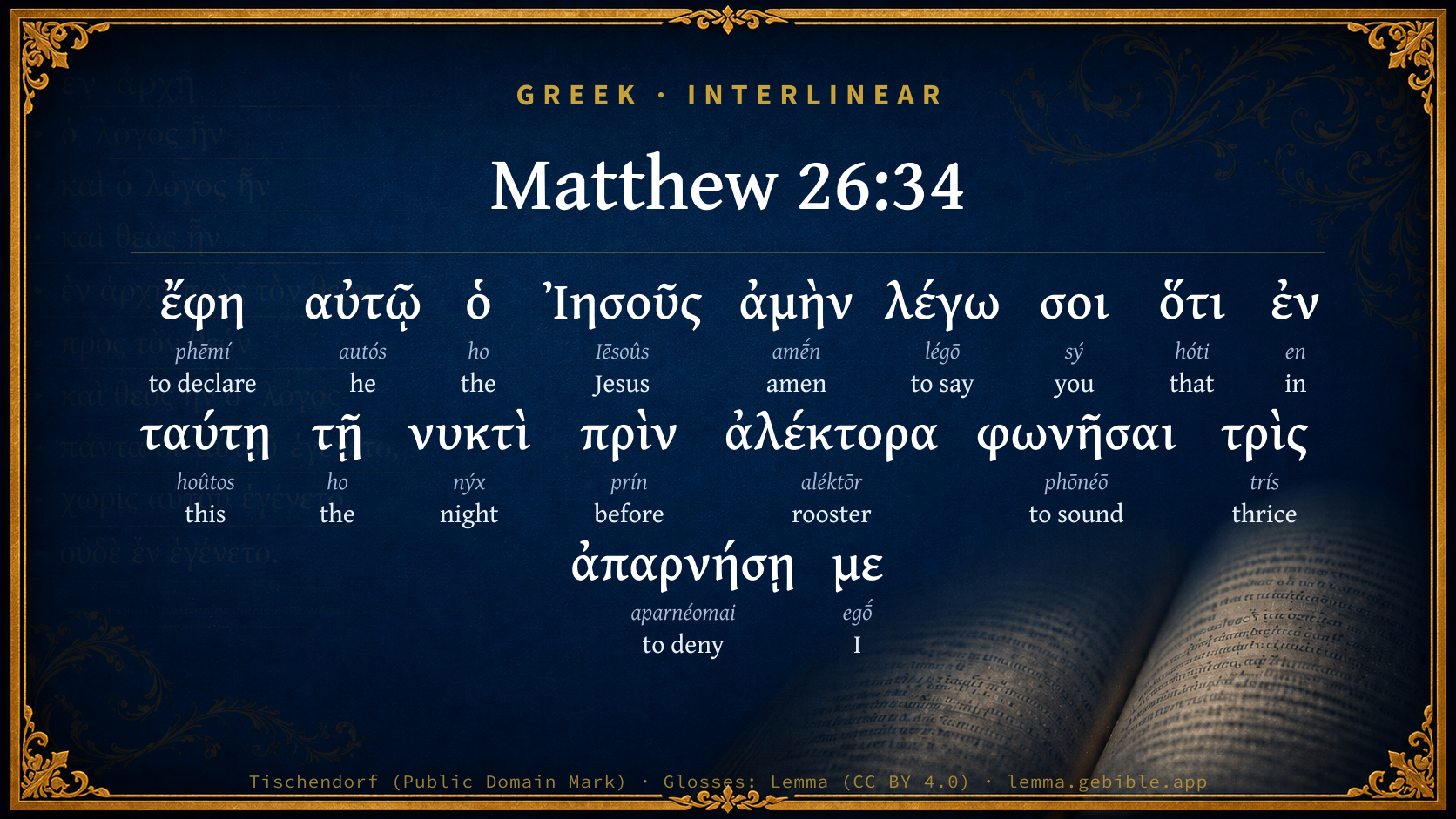
Greek (Tischendorf 8th ed.) Matthew 26:34 appears in the Greek New Testament. The text above is from the Tischendorf 8th edition. Each word links to its Strong’s number and a concise gloss. Click any word for its full Thayer’s Greek Lexicon entry.
Download image
Cite this verse

Matthew 26:34 (World English Bible). Public Domain. Lemma interlinear Bible study tool, https://lemma.gebible.app/v/matthew/26/34.

Show BibTeX & RIS
BibTeX
RIS
English Translation
Jesus said to him, "Most assuredly I tell you that tonight, before the rooster crows, you will deny me three times."
World English Bible · Public Domain
Highlights
  • 2 first appearances in the Greek New Testament
Full analysis ↓
Download a study sheet

One document with this verse’s original text, its word-by-word gloss line, the meaning frame, cross-references with their text, attributed commentary, and full source and license credits — printable, and it pastes into notes with its structure intact.

This verse Autodidact and up

Study sheet (.html) Plain text (.txt)

A passage Seminary Student

Up to 50 verses in one chapter. A passage sheet keeps up to 6 commentary sources and 12 cross-references per verse, in the order this page ranks them, and says so on the sheet whenever that leaves anything out. Ask for a single verse and you get the Autodidact verse sheet above.

Everything on this page stays free to read, with no account — the sheet is a download of what is already on screen, not access to it.

Want to remove ads? Support Godless Engineer
Compare translations 3

The same verse in 3 English versions, stacked beneath the original-language interlinear above. Click any original word for its lexicon entry.

Each is an independent rendering of the whole verse — the interlinear is not word-aligned to these translations.

Highlighted words mark where these versions differ — a whole-verse word diff, not a word-by-word alignment.

  • World English Bible Public Domain
    Jesus said to him, "Most assuredly I tell you that tonight, before the rooster crows, you will deny me three times."
  • King James Version Public Domain
    Jesus said unto him, Verily I say unto thee, That this night, before the cock crow, thou shalt deny me thrice.
  • unfoldingWord Literal Text CC BY-SA 4.0
    Jesus said to him, “Truly I say to you that in this night, before a rooster crows, you will deny me three times.”

unfoldingWord Literal Text — © unfoldingWord, licensed CC BY-SA 4.0. Word-aligned USFM3 via Door43 (git.door43.org/unfoldingWord/en_ult).

Versions to compare (up to 4)

3 of 4 selected

Show all 19 translations

Every available English version of this verse, each an independent rendering of the whole verse.

  • World English Bible Public Domain
    Jesus said to him, "Most assuredly I tell you that tonight, before the rooster crows, you will deny me three times."
  • Berean Standard Bible Public Domain
    “Truly I tell you,” Jesus declared, “this very night, before the rooster crows, you will deny Me three times.”
  • Majority Standard Bible Public Domain
    “Truly I tell you,” Jesus declared, “this very night, before the rooster crows, you will deny Me three times.”
  • King James Version Public Domain
    Jesus said unto him, Verily I say unto thee, That this night, before the cock crow, thou shalt deny me thrice.
  • American Standard Version (1901) Public Domain
    Jesus said unto him, Verily I say unto thee, that this night, before the cock crow, thou shalt deny me thrice.
  • Revised Version (1885) Public Domain
    Jesus said unto him, Verily I say unto thee, that this night, before the cock crow, thou shalt deny me thrice.
  • Geneva Bible (1599) Public Domain
    Iesus sayde vnto him, Verely I say vnto thee, that this night, before the cocke crow, thou shalt denie me thrise.
  • Douay-Rheims (1899) Public Domain
    Jesus said to him: Amen I say to thee, that in this night before the cock crow, thou wilt deny me thrice.
  • Young's Literal Translation Public Domain
    Jesus said to him, `Verily I say to thee, that, this night, before cock-crowing, thrice thou wilt deny me.'
  • Literal Standard Version CC BY-SA 4.0
    Jesus said to him, “Truly I say to you that this night, before rooster-crowing, three times you will deny Me.”
  • Unlocked Literal Bible CC BY-SA 4.0
    Jesus said to him, “Truly I say to you, this very night, before the rooster crows, you will deny me three times.”
  • unfoldingWord Literal Text CC BY-SA 4.0
    Jesus said to him, “Truly I say to you that in this night, before a rooster crows, you will deny me three times.”
  • Darby Bible Public Domain
    Jesus said to him, Verily I say to thee, that during this night, before [the] cock shall crow, thou shalt deny me thrice.
  • World Messianic Bible Public Domain
    Yeshua said to him, “Most certainly I tell you that tonight, before the rooster crows, you will deny me three times.”
  • Webster's Bible Public Domain
    Jesus said to him, Verily I say to thee, that this night, before the cock shall crow, thou wilt deny me thrice.
  • Free Bible Version CC BY-SA 4.0
    “I'm telling you the truth,” Jesus told him, “This very night, before the cock crows, you'll deny me three times.”
  • Bible in Basic English Public Domain
    Jesus said to him, Truly I say to you that this night, before the hour of the cock's cry, you will say three times that you have no knowledge of me.
  • Text-Critical English NT CC BY 4.0
    Jesus said to him, “Truly I say to yoʋ that on this night, before a rooster crows, yoʋ will deny me three times.”
  • Tyndale New Testament (1534) Public Domain
    Iesus sayde vnto him. Verely I saye vnto the that this same night before the cocke crowe thou shalt denye me thryse.

Literal Standard Version (2020), Covenant Press — licensed CC BY-SA 4.0. Text via the HelloAO Bible API (eBible.org). Unlocked Literal Bible (unfoldingWord) — licensed CC BY-SA 4.0. Text via the HelloAO Bible API (eBible.org). unfoldingWord Literal Text — © unfoldingWord, licensed CC BY-SA 4.0. Word-aligned USFM3 via Door43 (git.door43.org/unfoldingWord/en_ult). Free Bible Version, Dr. Jonathan Gallagher — licensed CC BY-SA 4.0. Text via the HelloAO Bible API (eBible.org).

Word by word

More ways to search: Search by grammar → Find every occurrence → Compare this word →

Practice this passage: Drill this verse → Learn its vocabulary →

ἀπαρνήσῃ
aparnéomai
G533
“to deny”
Verb, Future, Middle deponent, Indicative, 2nd person, Singular
Part of Speech
Verb
Tense
Future
Voice
Middle deponent
Mood
Indicative
Person
2nd person
Number
Singular
Full Thayer's Definition

Origin: from G575 and G720

TDNT: 1:471,*

1. to deny a. to affirm that one has no acquaintance or connection with someone b. to forget one's self, lose sight of one's self and one's own interests
  1. ἔφη phēmí G5346 “to declare” Verb, Imperfect, Active, Indicative, 3rd person, Singular
  2. αὐτῷ autós G846 “he” Personal pronoun, Dative, Singular, Masculine
  3. ὁ ho G3588 “the” Article, Nominative, Singular, Masculine
  4. Ἰησοῦς Iēsoûs G2424 “Jesus” Noun, Nominative, Singular, Masculine
  5. ἀμὴν amḗn G281 “amen” Hebrew transliteration
  6. λέγω légō G3004 “to say” Verb, Present, Active, Indicative, 1st person, Singular
  7. σοι sý G4771 “you” Personal pronoun, 2nd person, Dative, Singular
  8. ὅτι hóti G3754 “that” Conjunction
  9. ἐν en G1722 “in” Preposition
  10. ταύτῃ hoûtos G3778 “this” Demonstrative pronoun, Dative, Singular, Feminine
  11. τῇ ho G3588 “the” Article, Dative, Singular, Feminine
  12. νυκτὶ nýx G3571 “night” Noun, Dative, Singular, Feminine
  13. πρὶν prín G4250 “before” Adverb
  14. ἀλέκτορα aléktōr G220 “rooster” Noun, Accusative, Singular, Masculine
  15. φωνῆσαι phōnéō G5455 “to sound” Verb, Aorist, Active, Infinitive
  16. τρὶς trís G5151 “thrice” Adverb
  17. με egṓ G1473 “I” Personal pronoun, 1st person, Accusative, Singular

About this verse

These counts appear in no published source. They are computed here, from the morphology-tagged text and Lemma’s own curated glosses. What Lemma adds →

18
words
17
distinct lemmas
Gospels
section

Notable vocabulary

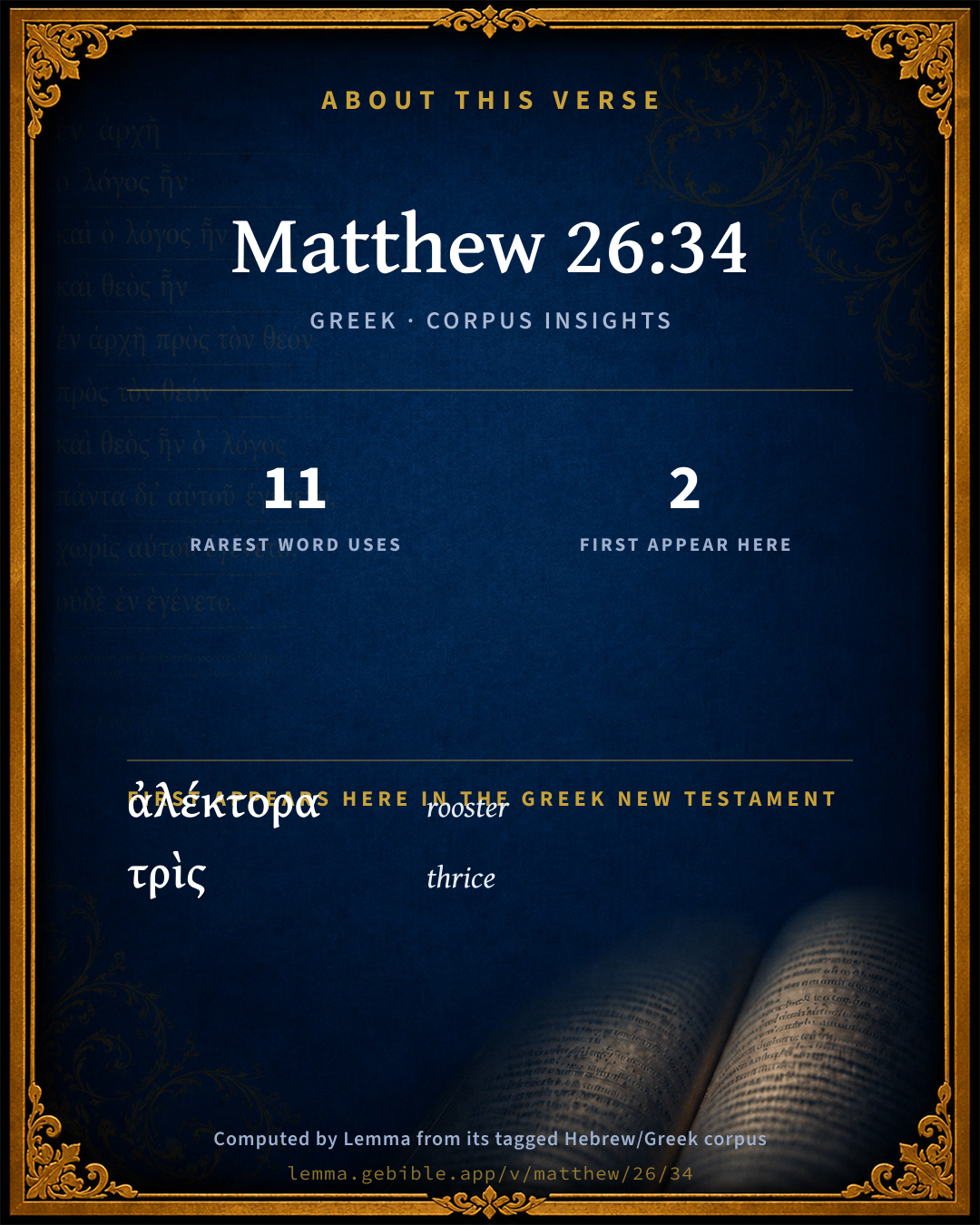
The rarest word here is ἀπαρνήσῃ to deny G533 — appearing just 11 times in the whole Greek New Testament.

First appearance in Scripture

These words make their first canonical appearance in the Greek New Testament here:

  • ἀλέκτορα rooster G220
  • τρὶς thrice G5151

Shared distinctive vocabulary

ἀπαρνήσῃ to deny G533 occurs in 11 verses of the Greek New Testament. Also found in:

Repetition

A word recurs within this verse:

Cross-references

4

Topical passages linked to Matthew 26:34 in the Treasury of Scripture Knowledge — connected by theme and wording, ordered by reader-vote popularity; previews shown in the World English Bible.

  • John 13:38 Jesus answered him, "Will you lay down your life for me? Most assuredly I tell you, the rooster won't crow until you have denied me three times.
  • Luke 22:34 He said, "I tell you, Peter, the rooster will by no means crow today until you deny that you know me three times."
  • Matthew 26:75 Peter remembered the word which Jesus had said to him, "Before the rooster crows, you will deny me three times." He went out and wept bitterly.
  • Mark 14:30–31 Jesus said to him, "Most assuredly I tell you, that you today, even this night, before the rooster crows twice, you will deny me three times."

Cross-references courtesy of OpenBible.info (CC BY 4.0).

Commentary

Notes on Matthew 26:34 from classic Christian and Jewish commentators (each source and its license shown beneath its notes). The classic Christian expositions comment on the surrounding passage and are grouped to its opening verse, so a note may address several verses; the Jewish commentaries on the Tanakh (Rashi and others) are per-verse, so they appear only where the commentator wrote on this verse.

Lemma curates 59 commentaries, every one of them public domain or Creative Commons licensed, each selected and text-cleaned for this edition rather than reprinted as found. About our sources →

Bengel's Gnomon

Johann Albrecht Bengel

Mat 26:34. Ἐν ταύτῃ τῇ νυκτὶ in this very night) It was already night; and it was more wonderful that this should happen by night than by day.—πρὶν, before that) A considerable portion of the night remains after cock-crow. Peter’s never, therefore, is utterly refuted.—ἀλέκτορα, the cock) The bird here intended is that strictly so called, cf. Mar 13:35; see 3Ma 5:23. There were some of them in Jerusalem, though, as Lightfoot says, they were few in number, at least with the Jews. They could not, however, prevent the Romans from having them; and so much the more wonderful, therefore, was our Lord’s prediction.—φωνῆσαι, crow) St Mark adds δὶς, twice. The sense in St Matthew is, Before the cock crow once thou shalt deny Me, and thou shalt deny Me thrice.—τρὶς, thrice) The Saviour knows us much better than we know ourselves.—ἀπαρνήσῃ, thou shalt deny) The sin of the mouth shall be added to the offence of the heart.[1143]

[1143] The sin of the mouth is hurtful to faith.—V. g.

Bengel's Gnomon of the New Testament — English translation (T&T Clark, Edinburgh, 1860) — public domain. Text from a community e-Sword module.

Meyer's Critical & Exegetical Commentary

Heinrich August Wilhelm Meyer

Mat_26:34 f. Πρὶν ἀλέκτορα φωνῆσαι] before a cock crows, therefore before the day begins to dawn. Cock-crowing occurs in the third of the four night watches (see on Mat_14:24), which watch lasted from midnight till about three oclock, and is called ἀλεκτοροφωνία in Mar_13:35. For the opposite of the πρὶν ἀλ. φων., see Plat. Symp. p. 223 C: πρὸς ἡμέραν ἤδη ἀλεκτρυόνων ᾀδόντων; Lucian, Ocyp. 670: ἐπεὶ δʼ ἀλέκτωρ ἡμέραν ἐσάλπισεν; Horace, Sat. i. 1. 10. For a later modification of the expression in conformity with the repeated denials, see Mar_14:30. On the question as to whether or not ἀλέκτωρ can be considered good Greek, consult Lobeck, ad Phryn. p. 228 f. This prediction as to the time was subsequently confirmed by the actual crowing of a cock, Mat_26:74.

ἀπαρνήσῃ με] thou wilt deny me, deny that I am thy Lord and Master. Comp. Celsus in Origen, ii. 45: οὔτε συναπέθανον οὔτε ὑπεραπέθανον αὐτοῦ, οὐδὲ κολάσεων καταφρονεῖν ἐπείσθησαν, ἀλλὰ καὶ ἠρνήσαντο εἶναι μαθηταί. For σὺν σοὶ ἀποθ. comp. Joh_11:16.

ἀπαρνήσομαι] The future after οὐ μή (see Hartung, Partikell. p. 157; Winer, p. 471 f. [E. T. 635]) is rather more expressive of a confident assertion than the subjunctive, the reading of A E G, etc.

ὁμοίως καὶ πάντες, κ.τ.λ.] Considering the sincere but as yet untried love of each, this is not an improbable statement, though it is found only in Matthew and Mark.

Meyer — Critical and Exegetical Commentary on the New Testament — English translation by Peter Christie, edited by Frederick Crombie (T&T Clark, 1880) — public domain. Text from a community e-Sword module.

Expositor's Greek Testament

ed. W. Robertson Nicoll

Mat 26:34 . ἐν . τ . τ . ν ., repetition of statement in Mat 26:31 , with added emphasis ( ἀμὴν , etc.), and = never? This night I tell you. πρὶν ἀλέκτορα φωνῆσαι : more exact specification of the time to make the statement more impressive = before the dawn. ἀλέκτωρ , poetic form for ἀλεκτρυών . This fowl not mentioned in O. T.; probably introduced into Palestine after the exile, possibly from Babylon (Benzinger, pp. 38, 94). Not allowed to be kept in Jerusalem according to Lightfoot, but this is contradicted by others (Schöttgen, Wünsche). In any case the prohibition would not apply to the Romans. Though no hens had been in Jerusalem, Jesus might have spoken the words to mark the time of night. τρὶς , thrice, suggestive of denial in aggravated form ; on which, not on the precise number of times, as an instance of miraculous prediction, stress should be laid.

The Expositor's Greek Testament, edited by W. Robertson Nicoll (1897–1910) — public domain. Text from a community e-Sword module.

Adam Clarke's Commentary

Verse 34. Jesus said] Our Lord's answer to Peter is very emphatic and impressive. Verily - I speak a solemn weighty truth, thou wilt not only be stumbled, fall off, and forsake thy Master, but thou wilt even deny that thou hast, or ever had, any knowledge of or connection with me; and this thou wilt do, not by little and little, through a long process of time, till the apostasy, daily gathering strength, shall be complete; but thou wilt do it this very night, and that not once only, but thrice; and this thou wilt do also in the earlier part of the night, before even a cock shall crow. Was not this warning enough to him not to trust in his own strength, but to depend on God?

Adam Clarke's Commentary on the Bible (1810–1826) — public domain. Text from a community e-Sword/MySword module.

Ellicott's Commentary for English Readers

(34) Thou shalt deny me thrice.—The agreement of all the four Evangelists places the fact of the prediction beyond the shadow of a doubt, and the prevision which it implies is obviously more than a general insight into the instability of the disciple’s character, and involves a power essentially superhuman. We must not forget what the disciple could not fail to remember, that to the sin thus foretold was attached the penalty, that he who was guilty of it should be “denied before the angels of God” (Luk_12:9). That was the law of retribution, but as with all such laws, the penalty might be averted by repentance.

A Bible Commentary for English Readers, edited by Charles John Ellicott (1878–1897) — public domain. Text from a community e-Sword module.

The Cambridge Bible for Schools and Colleges

gen. ed. J. J. S. Perowne

34. before the cock crow, thou shalt deny me thrice] “This day, even in this night, before the cock crow twice, thou shalt deny me thrice” (Mark). A curious difficulty has been raised here from the fact that it was unlawful for Jews to keep fowls in the Holy City. Such rules, however, could not be applied to the Romans.

The Cambridge Bible for Schools and Colleges (gen. ed. J. J. S. Perowne; Cambridge University Press, 1878–1918) — public domain. Text from a community e-Sword module.

John Gill's Exposition

Peter saith unto him,.... Mark says, "he spake the more vehemently", Mar 14:31; his spirits were raised to a greater pitch of resentment, and he expressed himself in stronger terms, and in more peremptory and self-confident language,

though I should die with thee, yet will I not deny thee: he seems to have understood Christ, that he should suffer death, and that he would be in great danger himself, and therefore rather than lose his life would deny his master; wherefore he most confidently affirms, that should this be the case, should he be called to suffer death for his sake, or along with him, he would most cheerfully embrace it, rather than be guilty of so dreadful a crime, which he could not look upon but with the utmost detestation and abhorrence, as to deny his dear Lord and Saviour:

likewise also said all the disciples; that they would never be offended because of him, and would die with him rather than deny him. This they said, being also self-confident and ignorant of their own weakness, and drawn into these expressions through Peter's example; and that partly to show their equal abhorrence of so horrible an iniquity, as denying Jesus; and partly to remove all suspicion from them, lest they should be thought to have less love and zeal for Christ than Peter had.

John Gill's Exposition of the Whole Bible (1746–1763) — public domain (CC PDM 1.0). Text via the HelloAO Bible API.

Trapp's Complete Commentary

John Trapp

34 Jesus said unto him, Verily I say unto thee, That this night, before the cock crow, thou shalt deny me thrice.

Ver. 34. Before the cock crow, &c.] Christ mentioneth the cock, quia tam strenuum pugnatorem decebat tale praeconium, saith one. The presumption of proud flesh never but miscarries; when humble self-suspicion holds out, and hath favour. The story of Pendleton and Saunders is better known than that it needs here to be related. (Acts and Mon.)

John Trapp, A Commentary or Exposition upon All the Books of the Old and New Testament (1647–1656) — public domain. Text from a community e-Sword module.

Haydock's Catholic Bible Commentary

Before the cock crow.[7] St. Mark is more particular; before the cock crow twice, thou shalt deny me thrice. The sense seems to be, before the time that the cock crow the second time, towards the morning. (Witham)

Christ’s prayer and agony in the garden. He is seized, and carried before Annas and Caiphas.

===============================

[BIBLIOGRAPHY]

The time towards the morning, called Gallicinium.

George Leo Haydock (1774–1849), Haydock's Catholic Family Bible and Commentary, 1859 edition — public domain. Excludes Psalms (Douay-Rheims chapter numbering differs from Protestant) and Deuterocanonical books (Catholic canon only).

The Pulpit Commentary

Peter"s boast elicits a crushing reply from his Lord, foretelling the special sin of which he would be guilty, and the very time of the night when it should be committed. This night, before the cock crow. The word "cock" is without the article, so the meaning may be "before a cock crow;" i.e. probably before midnight. Cocks were unclean birds, and not kept by strict Jews, and their voice was not much heard in Jerusalem; though it is quite different now, where barn door fowls swarm round every house. One of the night watches, that about 3 a.m., was known as "cockcrow". (see Mar_13:35) Some think this is what is meant here. Thou shalt deny me thrice. What Peter denied was that he knew anything of Christ, or had ever been his follower. (see vers. 69-75 Luk_22:34)

Self-knowledge and Divine knowledge.

Jesus knew Peter better than he knew himself. Any observant man would have told wherein lay peril for such a repulsive, hastily outspoken, warmhearted man. Our Lord divinely "knew what was in man," and foresaw the coming danger. We are all keen enough at estimating the character of others, but we cannot do it with any certainty, because we can only make our experience of ourselves our standard of judgment. And oftentimes those who are most ready to judge others are the least efficient in appraising themselves, and so their standard is incomplete and unworthy. Divine knowledge is perfect. So the truehearted can say, "Search me, O God, and know my heart; try me, and know my ways.

I SELF-KNOWLEDGE CAN NEVER BE GOT AT IMPULSIVELY. Impulse can only express a passing mood or feeling; and that may have its explanation in temporary circumstances and excitements. A man acting or speaking on impulse may act or speak in strict harmony with his real self. He may; but it is equally true that he may act or speak otherwise than he would if he could quietly resolve. Impulse is good, but it is perilous. Distinguish from the power of quick judgment and decision. Impulses tell the hour; they seldom tell the real man.

II SELF-KNOWLEDGE CALLS FOR CAREFUL THOUGHT. We find great differences in characters. Some are easy to read, they belong to recognized classes. Some are very difficult to read; we must watch them a long time; their individuality is more marked than their classification. And men find similar variety in themselves. Some may read themselves easily. St. Peter might, if he had tried. Some never feel quite sure that they know themselves.

III SELF-KNOWLEDGE IS ALWAYS SUBJECT TO DIVINE CORRECTIONS. The apostle thought he knew himself when he made his stout assertion. But he came into Divine correction. This is often given us by the discipline of disappointment and failure; and often by the providence which offers us work for which we could not have thought that we were fitted.

IV DIVINE CORRECTIONS SHOULD LEAD TO A RE-READING OF OURSELVES IS THE NEW LIGHT. If we fail to do this, we shall have to go on with St. Peter, and learn to know ourselves through a bitter experience. R.T.

The Pulpit Commentary (1880–1919), ed. H.D.M. Spence-Jones & Joseph S. Exell — public domain. Text from a community e-Sword module.

John Wesley's Explanatory Notes

Before cock crowing thou wilt deny me thrice - That is, before three in the morning, the usual time of cock crowing: although one cock was heard to crow once, after Peter's first denial of his Lord.

John Wesley, Explanatory Notes Upon the Whole Bible (1754–1765) — public domain. Text via the GEBible commentary corpus.

The People's New Testament

B. W. Johnson

34, 35. Thou shalt deny me thrice. The first cock crow was about twelve at night. The second about three o'clock. Before this the three-fold denial would occur. Peter and the disciples were sincere, but knew not their own weakness.

B. W. Johnson's The People's New Testament with Notes (1889–1891) — public domain. Electronic text from the Christian Classics Ethereal Library (CCEL) ThML edition.

Cambridge Greek Testament for Schools and Colleges

34. πρὶν ἀλέκτορα κ.τ.λ. ‘This day, even in this night, before the cock crow twice, thou shalt deny me thrice’ (Mark). A curious difficulty has been raised here from the fact that it was unlawful for Jews to keep fowls in the Holy City. Such rules, however, could not be applied to the Romans.

Cambridge Greek Testament for Schools and Colleges (Cambridge University Press, 1896; 21 vols, various authors incl. Carr, Maclear, Plummer, Farrar, Lumby, Moule, M. R. James, Simcox) — public domain. Text from a community e-Sword module.

Alford’s Greek Testament

Henry Alford

34.] The very words in their order are, I doubt not, reported by St. Mark—ἀμὴν λ. σοι ὅτι σήμερον ταύτῃ τῇ νυκτὶ πρὶν ἢ δὶς ἀλέκτορα φωνῆσαι τ. με ἀπ. The contrast to Peter’s boast, and the climax, is in these words the strongest; and the inference also comes out most clearly, that they likewise were not now said for the first time. The first cock-crowing is at midnight; but inasmuch as few hear it,—when the word is used generally, we mean the second crowing, early in the morning, before dawn. If this view be taken, the ἀλέκτ. φων. and δὶς ἀλ. φ. amount to the same—only the latter is the more precise expression. It is most likely that Peter understood this expression as only a mark of time, and therefore received it, as when it was spoken before, as merely an expression of distrust on the Lord’s part; it was this solemn and circumstantial repetition of it which afterwards struck upon his mind when the sign itself was literally fulfilled.

A question has been raised whether cocks were usually kept or even allowed in Jerusalem. No such bird is mentioned in the O.T., and the Mischna states that the inhabitants of Jerusalem, and the priests every where, kept no fowls, because they scratched up unclean worms. But the Talmud is here not consistent with itself: and Lightfoot brings forward a story which proves it. And there might be many kept by the resident Romans, over whom the Jews had no power.

We must not overlook the spiritual parabolic import of this warning. Peter stands here as a representative of all disciples who deny or forget Christ—and the watchful bird that cries in the night is that warning voice which ‘speaketh once, yea twice,’ to call them to repentance: see Rom 13:11, Rom 13:12.

Henry Alford, The Greek Testament (1849–1861) — public domain. Text from a community e-Sword module.

International Critical Commentary

(M) 34. Jesus said to him, Verily I say to you, That on this night, before the cock crow, thrice thou shalt deny Me.] Mk. has: “And Jesus saith to him, Verily I say to thee, That to-day, on this night, before that the cock crow twice, thrice thou shalt deny Me.” Mt. omits Mk.’s redundant σήμερον; cf. Introduction, p. xxv. —πρίν] for Mk.’s πρὶν ἤ, cf. Blass, p. 229. Mk.’s δίς is of doubtful authority; see Swete.

International Critical Commentary — older volumes (1896–1929), various authors — public domain. Text from a community e-Sword module.

Vincent's Word Studies in the New Testament

Marvin R. Vincent

Before the cock crow. A little more graphic if the article is omitted, as in the Greek. Before a single cock shall be heard, early in the night, thou shalt deny me. Dr. Thomson (" Land and Book ") says that the barn - door fowls "swarm round every door, share in the food of their possessors, are at home among the children in every room, roost overhead at night, and with their ceaseless crowing are the town - clock and the morning - bell to call up sleepers at early dawn."

Marvin R. Vincent, Word Studies in the New Testament (1887–1900) — public domain. Text from a community e-Sword/MySword module.

Lesson kit

Teaching starters — assembled from the data on this page, not authored interpretation. Every prompt links to the verse data it draws on. Edit before teaching.

Matthew, in the Gospels, opens this verse with 18 words (17 distinct Greek lemmas). Its most distinctive word is aparnéomai (“to deny”). A historical commentator’s framing appears above. Read the whole chapter for the surrounding context.

Discussion questions

  1. How does “to deny” (aparnéomai) shape what this verse is saying?
  2. 2 words make their first appearance in Scripture here. What does this debut establish?
  3. How does Matthew 16:24, which shares the word «to deny», read alongside this verse?
  4. What does the repetition of “the” (2× in this one verse) do in this verse?
  5. The translations on this page render this verse differently — a whole-verse word diff, not a word-by-word alignment. What might account for the different wordings?
  6. Compare how Bengel's Gnomon and Meyer's Critical & Exegetical Commentary read this verse. Where do they agree or differ?

Things to notice

  • 2 words make their first canonical appearance in Scripture here.
  • These translations choose different wording for 17 words in this verse.
  • “the” occurs 2× in this single verse.
  • 17 distinct Greek lemmas span 18 words in this verse.

Reading settings

Reading text

Shown beneath each verse's original-language words.

Old Testament
Old Testament edition

Read the OT as the Masoretic Hebrew (MT) or the Greek Septuagint (LXX).

English shown for the Greek Septuagint (in the Hebrew ↔ Greek comparison).

Comparing translations? Open the Compare panel on any verse page to stack up to four side by side.