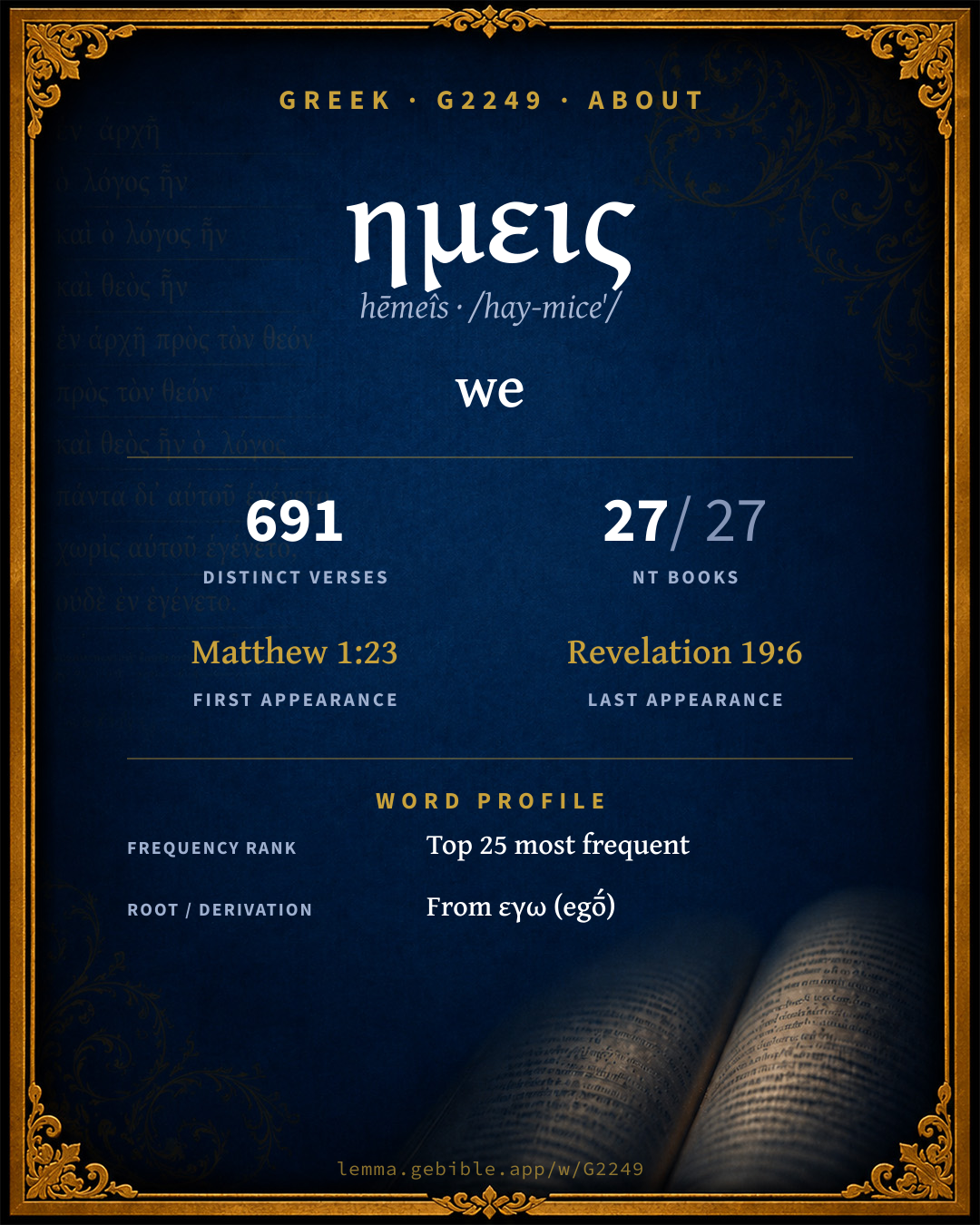
ἡμεῖς
we
Full lexicon entry — Thayer's Greek Lexicon
From Thayer's Greek Lexicon
Where this word appears
See every Genitive-case word in the Greek New Testament →
Grammar key — what these labels mean
Part of speech
- Personal pronoun
- Stands in for a person already named (“I,” “you,” “he”).
Case
- Genitive
- The case of source, possession, or “of” — answers “whose / from what.”
- Dative
- The case of the indirect object, means, or location — “to / for / with / in.”
- Accusative
- The case of the direct object and of extent.
- Nominative
- The case of the subject (and the predicate nominative).
Person
- 1st person
- The speaker (“I / we”).
Number
- Plural
- More than one.
Grammatical forms
- Personal pronoun, 1st person, Genitive, Plural 401 times (47%)
- Personal pronoun, 1st person, Dative, Plural 168 times (19%)
- Personal pronoun, 1st person, Accusative, Plural 167 times (19%)
- Personal pronoun, 1st person, Nominative, Plural 126 times (15%)
Parsed forms decoded from the imported morphology (Robinson–Tischendorf, public domain), counted across 862 parsed occurrences — not distinct verses.
Page 1 of 4 — showing verses 1–200 of 691 distinct verses where G2249 appears, across 27 books. Click any verse to open its interlinear word-by-word view. Verse text shown in the World English Bible for context — . Each verse’s Greek form is shown with its reference; the English is not keyword-highlighted, since the data carries no word-level English alignment. Use “Compare translations” on any verse to read it across multiple English versions. This concordance covers the Greek New Testament; Septuagint (Greek Old Testament) occurrences of this word are not indexed here.
Matthew 39 verses
- Matthew 1:23 ἡμῶν pron 1 gen pl "Behold, the virgin shall be with child, And shall bring forth a son. They shall call his name Immanuel;" Which is, being interpreted, "God with us."
- Matthew 3:15 ἡμῖν pron 1 dat pl But Jesus, answering, said to him, "Allow it now, for this is the fitting way for us to fulfill all righteousness." Then he allowed him.
- Matthew 6:9 ἡμῶν pron 1 gen pl Pray like this: 'Our Father in heaven, may your name be kept holy.
- Matthew 6:11 ἡμῶν ἡμῖν pron 1 gen pl pron 1 dat pl Give us today our daily bread.
- Matthew 6:12 ἡμῖν ἡμῶν ἡμεῖς ἡμῶν pron 1 dat pl pron 1 gen pl pron 1 nom pl pron 1 gen pl Forgive us our debts, as we also forgive our debtors.
- Matthew 6:13 ἡμᾶς ἡμᾶς pron 1 acc pl pron 1 acc pl Bring us not into temptation, but deliver us from the evil one. For yours is the Kingdom, the power, and the glory forever. Amen.'
- Matthew 8:17 ἡμῶν pron 1 gen pl that it might be fulfilled which was spoken through Isaiah the prophet, saying: "He took our infirmities, and bore our diseases."
- Matthew 8:29 ἡμῖν ἡμᾶς pron 1 dat pl pron 1 acc pl Behold, they cried out, saying, "What do we have to do with you, Jesus, Son of God? Have you come here to torment us before the time?"
- Matthew 8:31 ἡμᾶς ἡμᾶς pron 1 acc pl pron 1 acc pl The demons begged him, saying, "If you cast us out, permit us to go away into the herd of pigs."
- Matthew 9:14 ἡμεῖς pron 1 nom pl Then John's disciples came to him, saying, "Why do we and the Pharisees fast often, but your disciples don't fast?"
- Matthew 9:27 ἡμᾶς pron 1 acc pl As Jesus passed by from there, two blind men followed him, calling out and saying, "Have mercy on us, son of David!"
- Matthew 13:36 ἡμῖν pron 1 dat pl Then Jesus sent the multitudes away, and went into the house. His disciples came to him, saying, "Explain to us the parable of the darnel of the field."
- Matthew 13:56 ἡμᾶς pron 1 acc pl Aren't all of his sisters with us? Where then did this man get all of these things?"
- Matthew 15:15 ἡμῖν pron 1 dat pl Peter answered him, "Explain the parable to us."
- Matthew 15:23 ἡμῶν pron 1 gen pl But he answered her not a word. His disciples came and begged him, saying, "Send her away; for she cries after us."
- Matthew 15:33 ἡμῖν pron 1 dat pl The disciples said to him, "Where should we get so many loaves in a deserted place as to satisfy so great a multitude?"
- Matthew 17:4 ἡμᾶς pron 1 acc pl Peter answered, and said to Jesus, "Lord, it is good for us to be here. If you want, let's make three tents here: one for you, one for Moses, and one for Elijah."
- Matthew 17:19 ἡμεῖς pron 1 nom pl Then the disciples came to Jesus privately, and said, "Why weren't we able to cast it out?"
- Matthew 19:27 ἡμεῖς ἡμῖν pron 1 nom pl pron 1 dat pl Then Peter answered, "Behold, we have left everything, and followed you. What then will we have?"
- Matthew 20:7 ἡμᾶς pron 1 acc pl "They said to him, 'Because no one has hired us.' "He said to them, 'You also go into the vineyard, and you will receive whatever is right.'
- Matthew 20:12 ἡμῖν pron 1 dat pl saying, 'These last have spent one hour, and you have made them equal to us, who have borne the burden of the day and the scorching heat!'
- Matthew 20:30 ἡμᾶς pron 1 acc pl Behold, two blind men sitting by the road, when they heard that Jesus was passing by, cried out, "Lord, have mercy on us, you son of David!"
- Matthew 20:31 ἡμᾶς pron 1 acc pl The multitude rebuked them, telling them that they should be quiet, but they cried out even more, "Lord, have mercy on us, you son of David!"
- Matthew 20:33 ἡμῶν pron 1 gen pl They told him, "Lord, that our eyes may be opened."
- Matthew 21:26 ἡμῖν pron 1 dat pl But if we say, 'From men,' we fear the multitude, for all hold John as a prophet."
- Matthew 21:42 ἡμῶν pron 1 gen pl Jesus said to them, "Did you never read in the Scriptures, 'The stone which the builders rejected, The same was made the head of the corner. This was from the Lord. It is marvelous in our eyes?'
- Matthew 22:17 ἡμῖν pron 1 dat pl Tell us therefore, what do you think? Is it lawful to pay taxes to Caesar, or not?"
- Matthew 22:25 ἡμῖν pron 1 dat pl Now there were with us seven brothers. The first married and died, and having no seed left his wife to his brother.
- Matthew 23:30 ἡμῶν pron 1 gen pl and say, 'If we had lived in the days of our fathers, we wouldn't have been partakers with them in the blood of the prophets.'
- Matthew 24:3 ἡμῖν pron 1 dat pl As he sat on the Mount of Olives, the disciples came to him privately, saying, "Tell us, when will these things be? What is the sign of your coming, and of the end of the age?"
- Matthew 25:8 ἡμῖν ἡμῶν pron 1 dat pl pron 1 gen pl The foolish said to the wise, 'Give us some of your oil, for our lamps are going out.'
- Matthew 25:9 ἡμῖν pron 1 dat pl But the wise answered, saying, 'What if there isn't enough for us and you? You go rather to those who sell, and buy for yourselves.'
- Matthew 25:11 ἡμῖν pron 1 dat pl Afterward the other virgins also came, saying, 'Lord, Lord, open to us.'
- Matthew 26:63 ἡμῖν pron 1 dat pl But Jesus held his peace. The high priest answered him, "I adjure you by the living God, that you tell us whether you are the Christ, the Son of God."
- Matthew 26:68 ἡμῖν pron 1 dat pl saying, "Prophesy to us, you Christ! Who hit you?"
- Matthew 27:4 ἡμᾶς pron 1 acc pl saying, "I have sinned in that I betrayed innocent blood." But they said, "What is that to us? You see to it."
- Matthew 27:25 ἡμᾶς ἡμῶν pron 1 acc pl pron 1 gen pl All the people answered, "May his blood be on us, and on our children!"
- Matthew 28:13 ἡμῶν pron 1 gen pl saying, "Say that his disciples came by night, and stole him away while we slept.
- Matthew 28:14 ἡμεῖς pron 1 nom pl If this comes to the governor's ears, we will persuade him and make you free of worry."
Mark 20 verses
- Mark 1:24 ἡμῖν ἡμᾶς pron 1 dat pl pron 1 acc pl saying, "Ha! What do we have to do with you, Jesus, you Nazarene? Have you come to destroy us? I know you who you are: the Holy One of God!"
- Mark 5:12 ἡμᾶς pron 1 acc pl All the demons begged him, saying, "Send us into the pigs, that we may enter into them."
- Mark 6:3 ἡμᾶς pron 1 acc pl Isn't this the carpenter, the son of Mary, and brother of James, Joses, Judas, and Simon? Aren't his sisters here with us?" They were offended at him.
- Mark 9:5 ἡμᾶς pron 1 acc pl Peter answered Jesus, "Rabbi, it is good for us to be here. Let's make three tents: one for you, one for Moses, and one for Elijah."
- Mark 9:22 ἡμῖν ἡμᾶς pron 1 dat pl pron 1 acc pl Often it has cast him both into the fire and into the water, to destroy him. But if you can do anything, have compassion on us, and help us."
- Mark 9:28 ἡμεῖς pron 1 nom pl When he had come into the house, his disciples asked him privately, "Why couldn't we cast it out?"
- Mark 9:38 ἡμῖν ἡμῖν pron 1 dat pl pron 1 dat pl John said to him, "Teacher, we saw someone who doesn't follow us casting out demons in your name; and we forbade him, because he doesn't follow us."
- Mark 9:40 ἡμῶν ἡμῶν pron 1 gen pl pron 1 gen pl For whoever is not against us is on our side.
- Mark 10:28 ἡμεῖς pron 1 nom pl Peter began to tell him, "Behold, we have left all, and have followed you."
- Mark 10:35 ἡμῖν pron 1 dat pl James and John, the sons of Zebedee, came near to him, saying, "Teacher, we want you to do for us whatever we will ask."
- Mark 10:37 ἡμῖν pron 1 dat pl They said to him, "Grant to us that we may sit, one at your right hand, and one at your left hand, in your glory."
- Mark 11:10 ἡμῶν pron 1 gen pl Blessed is the kingdom of our father David that is coming in the name of the Lord! Hosanna in the highest!"
- Mark 12:7 ἡμῶν pron 1 gen pl But those farmers said among themselves, 'This is the heir. Come, let's kill him, and the inheritance will be ours.'
- Mark 12:11 ἡμῶν pron 1 gen pl This was from the Lord, It is marvelous in our eyes'?"
- Mark 12:19 ἡμῖν pron 1 dat pl "Teacher, Moses wrote to us, 'If a man's brother dies, and leaves a wife behind him, and leaves no children, that his brother should take his wife, and raise up offspring for his brother.'
- Mark 12:29 ἡμῶν pron 1 gen pl Jesus answered, "The greatest is, 'Hear, Israel, the Lord our God, the Lord is one:
- Mark 13:4 ἡμῖν pron 1 dat pl "Tell us, when will these things be? What is the sign that these things are all about to be fulfilled?"
- Mark 14:15 ἡμῖν pron 1 dat pl He will himself show you a large upper room furnished and ready. Make ready for us there."
- Mark 14:58 ἡμεῖς pron 1 nom pl "We heard him say, 'I will destroy this temple that is made with hands, and in three days I will build another made without hands.'"
- Mark 16:3 ἡμῖν pron 1 dat pl They were saying among themselves, "Who will roll away the stone from the door of the tomb for us?"
Luke 54 verses
- Luke 1:1 ἡμῖν pron 1 dat pl Since many have undertaken to set in order a narrative concerning those matters which have been fulfilled among us,
- Luke 1:2 ἡμῖν pron 1 dat pl even as those who from the beginning were eyewitnesses and ministers of the word delivered them to us,
- Luke 1:55 ἡμῶν pron 1 gen pl As he spoke to our fathers, To Abraham and his seed forever."
- Luke 1:69 ἡμῖν pron 1 dat pl And has raised up a horn of salvation for us in the house of his servant David
- Luke 1:71 ἡμῶν ἡμᾶς pron 1 gen pl pron 1 acc pl Salvation from our enemies, and from the hand of all who hate us;
- Luke 1:72 ἡμῶν pron 1 gen pl To show mercy towards our fathers, To remember his holy covenant,
- Luke 1:73 ἡμῶν ἡμῖν pron 1 gen pl pron 1 dat pl The oath which he spoke to Abraham, our father,
- Luke 1:75 ἡμῶν pron 1 gen pl In holiness and righteousness before him all the days of our life.
- Luke 1:78 ἡμῶν ἡμᾶς pron 1 gen pl pron 1 acc pl Because of the tender mercy of our God, Whereby the dawn from on high will visit us,
- Luke 1:79 ἡμῶν pron 1 gen pl To shine on those who sit in darkness and the shadow of death; To guide our feet into the way of peace."
- Luke 2:15 ἡμῖν pron 1 dat pl It happened, when the angels went away from them into the sky, that the shepherds said one to another, "Let's go to Bethlehem, now, and see this thing that has happened, which the Lord has made known to us."
- Luke 2:48 ἡμῖν pron 1 dat pl When they saw him, they were astonished, and his mother said to him, "Son, why have you treated us this way? Behold, your father and I were anxiously looking for you."
- Luke 3:14 ἡμεῖς pron 1 nom pl Soldiers also asked him, saying, "What about us? What must we do?" He said to them, "Extort from no one by violence, neither accuse anyone wrongfully. Be content with your wages."
- Luke 4:34 ἡμῖν ἡμᾶς pron 1 dat pl pron 1 acc pl saying, "Ah! what have we to do with you, Jesus of Nazareth? Have you come to destroy us? I know you who you are: the Holy One of God!"
- Luke 7:5 ἡμῶν ἡμῖν pron 1 gen pl pron 1 dat pl for he loves our nation, and he built our synagogue for us."
- Luke 7:16 ἡμῖν pron 1 dat pl Fear took hold of all, and they glorified God, saying, "A great prophet has arisen among us!" and, "God has visited his people!"
- Luke 7:20 ἡμᾶς pron 1 acc pl When the men had come to him, they said, "John the Baptizer has sent us to you, saying, 'Are you he who comes, or should we look for another?'"
- Luke 9:13 ἡμῖν ἡμεῖς pron 1 dat pl pron 1 nom pl But he said to them, "You give them something to eat." They said, "We have no more than five loaves and two fish, unless we should go and buy food for all these people."
- Luke 9:33 ἡμᾶς pron 1 acc pl It happened, as they were parting from him, that Peter said to Jesus, "Master, it is good for us to be here. Let's make three tents: one for you, and one for Moses, and one for Elijah," not knowing what he said.
- Luke 9:49 ἡμῶν pron 1 gen pl John answered, "Master, we saw someone casting out demons in your name, and we forbade him, because he doesn't follow with us."
- Luke 10:11 ἡμῖν pron 1 dat pl 'Even the dust from your city that clings to us, we wipe off against you. Nevertheless know this, that the Kingdom of God has come near to you.'
- Luke 10:17 ἡμῖν pron 1 dat pl The seventy returned with joy, saying, "Lord, even the demons are subject to us in your name!"
- Luke 10:19 ἡμᾶς pron 1 acc pl Behold, I give you authority to tread on serpents and scorpions, and over all the power of the enemy. Nothing will in any way hurt you.
- Luke 11:1 ἡμᾶς pron 1 acc pl It happened, that when he finished praying in a certain place, one of his disciples said to him, "Lord, teach us to pray, just as John also taught his disciples."
- Luke 11:3 ἡμῶν ἡμῖν pron 1 gen pl pron 1 dat pl Give us day by day our daily bread.
- Luke 11:4 ἡμῖν ἡμῶν ἡμῖν ἡμᾶς pron 1 dat pl pron 1 gen pl pron 1 dat pl pron 1 acc pl Forgive us our sins, For we ourselves also forgive everyone who is indebted to us. Bring us not into temptation, But deliver us from the evil one.'"
- Luke 11:45 ἡμᾶς pron 1 acc pl One of the lawyers answered him, "Teacher, in saying this you insult us also."
- Luke 12:41 ἡμᾶς pron 1 acc pl Peter said to him, "Lord, are you telling this parable to us, or to everybody?"
- Luke 13:25 ἡμῖν pron 1 dat pl When once the master of the house has risen up, and has shut the door, and you begin to stand outside, and to knock at the door, saying, 'Lord, Lord, open to us!' then he will answer and tell you, 'I don't know you or where you come from.'
- Luke 13:26 ἡμῶν pron 1 gen pl Then you will begin to say, 'We ate and drink in your presence, and you taught in our streets.'
- Luke 16:26 ἡμῶν ἡμᾶς pron 1 gen pl pron 1 acc pl Besides all this, between us and you there is a great gulf fixed, that those who want to pass from here to you are not able, and that none may cross over from there to us.'
- Luke 17:5 ἡμῖν pron 1 dat pl The apostles said to the Lord, "Increase our faith."
- Luke 17:13 ἡμᾶς pron 1 acc pl They lifted up their voices, saying, "Jesus, Master, have mercy on us!"
- Luke 18:28 ἡμεῖς pron 1 nom pl Peter said, "Look, we have left everything, and followed you."
- Luke 19:14 ἡμᾶς pron 1 acc pl But his citizens hated him, and sent an envoy after him, saying, 'We don't want this man to reign over us.'
- Luke 20:2 ἡμῖν pron 1 dat pl They asked him, "Tell us: by what authority do you do these things? Or who is giving you this authority?"
- Luke 20:6 ἡμᾶς pron 1 acc pl But if we say, 'From men,' all the people will stone us, for they are persuaded that John was a prophet."
- Luke 20:14 ἡμῶν pron 1 gen pl "But when the farmers saw him, they reasoned among themselves, saying, 'This is the heir. Come, let's kill him, that the inheritance may be ours.'
- Luke 20:22 ἡμᾶς pron 1 acc pl Is it lawful for us to pay taxes to Caesar, or not?"
- Luke 20:28 ἡμῖν pron 1 dat pl They asked him, "Teacher, Moses wrote to us that if a man's brother dies having a wife, and he is childless, his brother should take the wife, and raise up children for his brother.
- Luke 22:8 ἡμῖν pron 1 dat pl He sent Peter and John, saying, "Go and prepare the Passover for us, that we may eat."
- Luke 22:66 ἡμῖν pron 1 dat pl As soon as it was day, the assembly of the elders of the people was gathered together, both chief priests and scribes, and they led him away into their council, saying,
- Luke 23:2 ἡμῶν pron 1 gen pl They began to accuse him, saying, "We found this man perverting the nation, forbidding paying taxes to Caesar, and saying that he himself is Christ, a king."
- Luke 23:15 ἡμᾶς pron 1 acc pl Neither has Herod, for I sent you to him, and see, nothing worthy of death has been done by him.
- Luke 23:18 ἡμῖν pron 1 dat pl But they all cried out together, saying, "Away with this man! Release to us Barabbas!" --
- Luke 23:30 ἡμᾶς ἡμᾶς pron 1 acc pl pron 1 acc pl Then they will begin to tell the mountains, 'Fall on us!' and tell the hills, 'Cover us.'
- Luke 23:39 ἡμᾶς pron 1 acc pl One of the criminals who was hanged insulted him, saying, "If you are the Christ, save yourself and us!"
- Luke 23:41 ἡμεῖς pron 1 nom pl And we indeed justly, for we receive the due reward for our deeds, but this man has done nothing wrong."
- Luke 24:20 ἡμῶν pron 1 gen pl and how the chief priests and our rulers delivered him up to be condemned to death, and crucified him.
- Luke 24:21 ἡμεῖς pron 1 nom pl But we were hoping that it was he who would redeem Israel. Yes, and besides all this, it is now the third day since these things happened.
- Luke 24:22 ἡμῶν ἡμᾶς pron 1 gen pl pron 1 acc pl Also, certain women of our company amazed us, having arrived early at the tomb;
- Luke 24:24 ἡμῖν pron 1 dat pl Some of us went to the tomb, and found it just like the women had said, but they didn't see him."
- Luke 24:29 ἡμῶν pron 1 gen pl They urged him, saying, "Stay with us, for it is almost evening, and the day is almost over." He went in to stay with them.
- Luke 24:32 ἡμῶν ἡμῖν ἡμῖν ἡμῖν pron 1 gen pl pron 1 dat pl pron 1 dat pl pron 1 dat pl They said one to another, "Weren't our hearts burning within us, while he spoke to us along the way, and while he opened the Scriptures to us?"
John 44 verses
- John 1:14 ἡμῖν pron 1 dat pl The Word became flesh, and lived among us. We saw his glory, such glory as of the one and only Son of the Father, full of grace and truth.
- John 1:16 ἡμεῖς pron 1 nom pl From his fullness we all received grace upon grace.
- John 1:22 ἡμᾶς pron 1 acc pl They said therefore to him, "Who are you? Give us an answer to take back to those who sent us. What do you say about yourself?"
- John 2:18 ἡμῖν pron 1 dat pl The Jews therefore answered him, "What sign do you show us, seeing that you do these things?"
- John 3:11 ἡμῶν pron 1 gen pl Most assuredly I tell you, we speak that which we know, and testify of that which we have seen, and you don't receive our witness.
- John 4:12 ἡμῶν ἡμῖν pron 1 gen pl pron 1 dat pl Are you greater than our father, Jacob, who gave us the well, and drank of it himself, as did his children, and his cattle?"
- John 4:20 ἡμῶν pron 1 gen pl Our fathers worshiped in this mountain, and you Jews say that in Jerusalem is the place where people ought to worship."
- John 4:22 ἡμεῖς pron 1 nom pl You worship that which you don't know. We worship that which we know; for salvation is from the Jews.
- John 4:25 ἡμῖν pron 1 dat pl The woman said to him, "I know that Messiah comes," (he who is called Christ). "When he has come, he will declare to us all things."
- John 6:31 ἡμῶν pron 1 gen pl Our fathers ate the manna in the wilderness. As it is written, 'He gave them bread out of heaven to eat.'"
- John 6:34 ἡμῖν pron 1 dat pl They said therefore to him, "Lord, always give us this bread."
- John 6:42 ἡμεῖς pron 1 nom pl They said, "Isn't this Jesus, the son of Joseph, whose father and mother we know? How then does he say, 'I have come down out of heaven?'"
- John 6:52 ἡμῖν pron 1 dat pl The Jews therefore contended with one another, saying, "How can this man give us his flesh to eat?"
- John 6:69 ἡμεῖς pron 1 nom pl We have come to believe and know that you are the Christ, the Son of the living God."
- John 7:51 ἡμῶν pron 1 gen pl "Does our law judge a man, unless it first hears from him personally and knows what he does?"
- John 8:39 ἡμῶν pron 1 gen pl They answered him, "Our father is Abraham." Jesus said to them, "If you were Abraham's children, you would do the works of Abraham.
- John 8:41 ἡμεῖς pron 1 nom pl You do the works of your father." They said to him, "We were not born of sexual immorality. We have one Father, God."
- John 8:48 ἡμεῖς pron 1 nom pl Then the Jews answered him, "Don't we say well that you are a Samaritan, and have a demon?"
- John 8:53 ἡμῶν pron 1 gen pl Are you greater than our father, Abraham, who died? The prophets died. Who do you make yourself out to be?"
- John 8:54 ἡμῶν pron 1 gen pl Jesus answered, "If I glorify myself, my glory is nothing. It is my Father who glorifies me, of whom you say that he is our God.
- John 9:4 ἡμᾶς ἡμᾶς pron 1 acc pl pron 1 acc pl I must work the works of him who sent me, while it is day. The night is coming, when no one can work.
- John 9:20 ἡμῶν pron 1 gen pl His parents answered them, "We know that this is our son, and that he was born blind;
- John 9:21 ἡμεῖς pron 1 nom pl but how he now sees, we don't know; or who opened his eyes, we don't know. He is of age. Ask him. He will speak for himself."
- John 9:24 ἡμεῖς pron 1 nom pl So they called the man who was blind a second time, and said to him, "Give glory to God. We know that this man is a sinner."
- John 9:28 ἡμεῖς pron 1 nom pl They insulted him and said, "You are his disciple, but we are disciples of Moses.
- John 9:29 ἡμεῖς pron 1 nom pl We know that God has spoken to Moses. But as for this man, we don't know where he comes from."
- John 9:34 ἡμᾶς pron 1 acc pl They answered him, "You were altogether born in sins, and do you teach us?" They threw him out.
- John 9:40 ἡμεῖς pron 1 nom pl Those of the Pharisees who were with him heard these things, and said to him, "Are we also blind?"
- John 10:24 ἡμῶν ἡμῖν pron 1 gen pl pron 1 dat pl The Jews therefore came around him and said to him, "How long will you hold us in suspense? If you are the Christ, tell us plainly."
- John 11:11 ἡμῶν pron 1 gen pl He said these things, and after that, he said to them, "Our friend, Lazarus, has fallen asleep, but I am going so that I may awake him out of sleep."
- John 11:16 ἡμεῖς pron 1 nom pl Thomas therefore, who is called Didymus, said to his fellow disciples, "Let's go also, that we may die with him."
- John 11:48 ἡμῶν pron 1 gen pl If we leave him alone like this, everyone will believe in him, and the Romans will come and take away both our place and our nation."
- John 12:34 ἡμεῖς pron 1 nom pl The multitude answered him, "We have heard out of the law that the Christ remains forever. How do you say, 'The Son of Man must be lifted up?' Who is this Son of Man?"
- John 12:38 ἡμῶν pron 1 gen pl that the word of Isaiah the prophet might be fulfilled, which he spoke, "Lord, who has believed our report? To whom has the arm of the Lord been revealed?"
- John 14:8 ἡμῖν ἡμῖν pron 1 dat pl pron 1 dat pl Philip said to him, "Lord, show us the Father, and that will be enough for us."
- John 14:9 ἡμῖν pron 1 dat pl Jesus said to him, "Have I been with you such a long time, and do you not know me, Philip? He who has seen me has seen the Father. How do you say, 'Show us the Father?'
- John 14:22 ἡμῖν pron 1 dat pl Judas (not Iscariot) said to him, "Lord, what has happened that you are about to reveal yourself to us, and not to the world?"
- John 16:17 ἡμῖν pron 1 dat pl Some of his disciples therefore said to one another, "What is this that he says to us, 'A little while, and you won't see me, and again a little while, and you will see me;' and, 'Because I go to the Father?'"
- John 17:11 ἡμεῖς pron 1 nom pl I am no more in the world, but these are in the world, and I am coming to you. Holy Father, keep them through your name which you have given me, that they may be one, even as we are.
- John 17:21 ἡμῖν pron 1 dat pl that they may all be one; even as you, Father, are in me, and I in you, that they also may be one in us; that the world may believe that you sent me.
- John 17:22 ἡμεῖς pron 1 nom pl The glory which you have given me, I have given to them; that they may be one, even as we are one;
- John 18:31 ἡμῖν pron 1 dat pl Pilate therefore said to them, "Take him yourselves, and judge him according to your law." Therefore the Jews said to him, "It is not lawful for us to put anyone to death,"
- John 19:7 ἡμεῖς pron 1 nom pl The Jews answered him, "We have a law, and by our law he ought to die, because he made himself the Son of God."
- John 21:3 ἡμεῖς pron 1 nom pl Simon Peter said to them, "I'm going fishing." They told him, "We are also coming with you." They immediately went out, and entered into the boat. That night, they caught nothing.
Acts 109 verses
- Acts 1:17 ἡμῖν pron 1 dat pl For he was numbered with us, and received his portion in this ministry.
- Acts 1:21 ἡμῖν ἡμᾶς pron 1 dat pl pron 1 acc pl Of the men therefore who have accompanied us all the time that the Lord Jesus went in and out among us,
- Acts 1:22 ἡμῶν ἡμῖν pron 1 gen pl pron 1 dat pl beginning from the baptism of John, to the day that he was received up from us, of these one must become a witness with us of his resurrection."
- Acts 2:8 ἡμεῖς ἡμῶν pron 1 nom pl pron 1 gen pl How do we hear, everyone in our own native language?
- Acts 2:29 ἡμῖν pron 1 dat pl "Brothers, I may tell you freely of the patriarch David, that he both died and was buried, and his tomb is with us to this day.
- Acts 2:32 ἡμεῖς pron 1 nom pl This Jesus God raised up, to which we all are witnesses.
- Acts 2:39 ἡμῶν pron 1 gen pl For to you is the promise, and to your children, and to all who are far off, even as many as the Lord our God will call to himself."
- Acts 3:4 ἡμᾶς pron 1 acc pl Peter, fastening his eyes on him, with John, said, "Look at us."
- Acts 3:12 ἡμῖν pron 1 dat pl When Peter saw it, he responded to the people, "You men of Israel, why do you marvel at this man? Why do you fasten your eyes on us, as though by our own power or godliness we had made him walk?
- Acts 3:13 ἡμῶν pron 1 gen pl The God of Abraham, Isaac, and Jacob, the God of our fathers, has glorified his Servant Jesus, whom you delivered up, and denied in the presence of Pilate, when he had determined to release him.
- Acts 3:15 ἡμεῖς pron 1 nom pl and killed the Prince of life, whom God raised from the dead, to which we are witnesses.
- Acts 3:22 ἡμῶν pron 1 gen pl For Moses indeed said to the fathers, 'The Lord God will raise up a prophet for you from among your brothers, like me. You shall listen to him in all things whatever he says to you.
- Acts 3:25 ἡμῶν pron 1 gen pl You are the children of the prophets, and of the covenant which God made with our fathers, saying to Abraham, 'In your seed will all the families of the earth be blessed.'
- Acts 4:9 ἡμεῖς pron 1 nom pl if we are examined today concerning a good deed done to a crippled man, by what means this man has been healed,
- Acts 4:12 ἡμᾶς pron 1 acc pl There is salvation in none other, for neither is there any other name under heaven, that is given among men, by which we must be saved!"
- Acts 4:20 ἡμεῖς pron 1 nom pl for we can't help telling the things which we saw and heard."
- Acts 4:25 ἡμῶν pron 1 gen pl who by the mouth of your servant, David, said, 'Why do the nations rage, And the peoples plot a vain thing?
- Acts 5:28 ἡμᾶς pron 1 acc pl saying, "Didn't we strictly charge you not to teach in this name? Behold, you have filled Jerusalem with your teaching, and intend to bring this man's blood on us."
- Acts 5:30 ἡμῶν pron 1 gen pl The God of our fathers raised up Jesus, whom you killed, hanging him on a tree.
- Acts 5:32 ἡμεῖς pron 1 nom pl We are His witnesses of these things; and so also is the Holy Spirit, whom God has given to those who obey him."
- Acts 6:2 ἡμᾶς pron 1 acc pl The twelve summoned the multitude of the disciples and said, "It is not appropriate for us to forsake the word of God and serve tables.
- Acts 6:4 ἡμεῖς pron 1 nom pl But we will continue steadfastly in prayer and in the ministry of the word."
- Acts 6:14 ἡμῖν pron 1 dat pl For we have heard him say that this Jesus of Nazareth will destroy this place, and will change the customs which Moses delivered to us."
- Acts 7:2 ἡμῶν pron 1 gen pl He said, "Brothers and fathers, listen. The God of glory appeared to our father Abraham, when he was in Mesopotamia, before he lived in Haran,
- Acts 7:11 ἡμῶν pron 1 gen pl Now a famine came over all the land of Egypt and Canaan, and great affliction. Our fathers found no food.
- Acts 7:12 ἡμῶν pron 1 gen pl But when Jacob heard that there was grain in Egypt, he sent out our fathers the first time.
- Acts 7:15 ἡμῶν pron 1 gen pl Jacob went down into Egypt, and he died, himself and our fathers,
- Acts 7:19 ἡμῶν pron 1 gen pl The same took advantage of our race, and mistreated our fathers, and forced them to throw out their babies, so that they wouldn't stay alive.
- Acts 7:27 ἡμῶν pron 1 gen pl But he who did his neighbor wrong pushed him away, saying, 'Who made you a ruler and a judge over us?
- Acts 7:38 ἡμῶν ἡμῖν pron 1 gen pl pron 1 dat pl This is he who was in the assembly in the wilderness with the angel that spoke to him on Mount Sinai, and with our fathers, who received living oracles to give to us,
- Acts 7:39 ἡμῶν pron 1 gen pl to whom our fathers wouldn't be obedient, but rejected him, and turned back in their hearts to Egypt,
- Acts 7:40 ἡμῖν ἡμῶν ἡμᾶς pron 1 dat pl pron 1 gen pl pron 1 acc pl saying to Aaron, 'Make us gods that will go before us, for as for this Moses, who led us out of the land of Egypt, we don't know what has become of him.'
- Acts 7:44 ἡμῶν pron 1 gen pl "Our fathers had the tent of the testimony in the wilderness, even as he who spoke to Moses commanded him to make it according to the pattern that he had seen;
- Acts 7:45 ἡμῶν ἡμῶν pron 1 gen pl pron 1 gen pl which also our fathers, in their turn, brought in with Joshua when they entered into the possession of the nations, whom God drove out before the face of our fathers, to the days of David,
- Acts 9:38 ἡμῶν pron 1 gen pl As Lydda was near Joppa, the disciples, hearing that Peter was there, sent two men to him, imploring him not to delay in coming to them.
- Acts 10:33 ἡμεῖς pron 1 nom pl Therefore I sent to you at once, and it was good of you to come. Now therefore we are all here present in the sight of God to hear all things that have been commanded you by God."
- Acts 10:39 ἡμεῖς pron 1 nom pl We are witnesses of everything he did both in the country of the Jews, and in Jerusalem; whom they also killed, hanging him on a tree.
- Acts 10:41 ἡμῖν pron 1 dat pl not to all the people, but to witnesses who were chosen before by God, to us, who ate and drank with him after he rose from the dead.
- Acts 10:42 ἡμῖν pron 1 dat pl He charged us to preach to the people and to testify that this is he who is appointed by God as the Judge of the living and the dead.
- Acts 10:47 ἡμεῖς pron 1 nom pl "Can any man forbid the water, that these who have received the Holy Spirit as well as we should not be baptized?"
- Acts 11:13 ἡμῖν pron 1 dat pl He told us how he had seen the angel standing in his house, and saying to him, 'Send to Joppa, and get Simon, whose surname is Peter,
- Acts 11:15 ἡμᾶς pron 1 acc pl As I began to speak, the Holy Spirit fell on them, even as on us at the beginning.
- Acts 11:17 ἡμῖν pron 1 dat pl If then God gave to them the same gift as us, when we believed in the Lord Jesus Christ, who was I, that I could withstand God?"
About this entry
At a glance — auto-summarized from this page’s data, not written by a person. Every figure links to its source below. This summary describes the numbers; it doesn’t interpret them.
ημεις (hēmeîs) is a Greek word most often rendered “we.” It first appears in Matthew 1:23. The Greek New Testament uses it across 691 verses — among the most common. Sharing its root, it stands alongside εγω, εμος and εμου. For the data behind this summary, explore the sense tree and the renderings breakdown below.
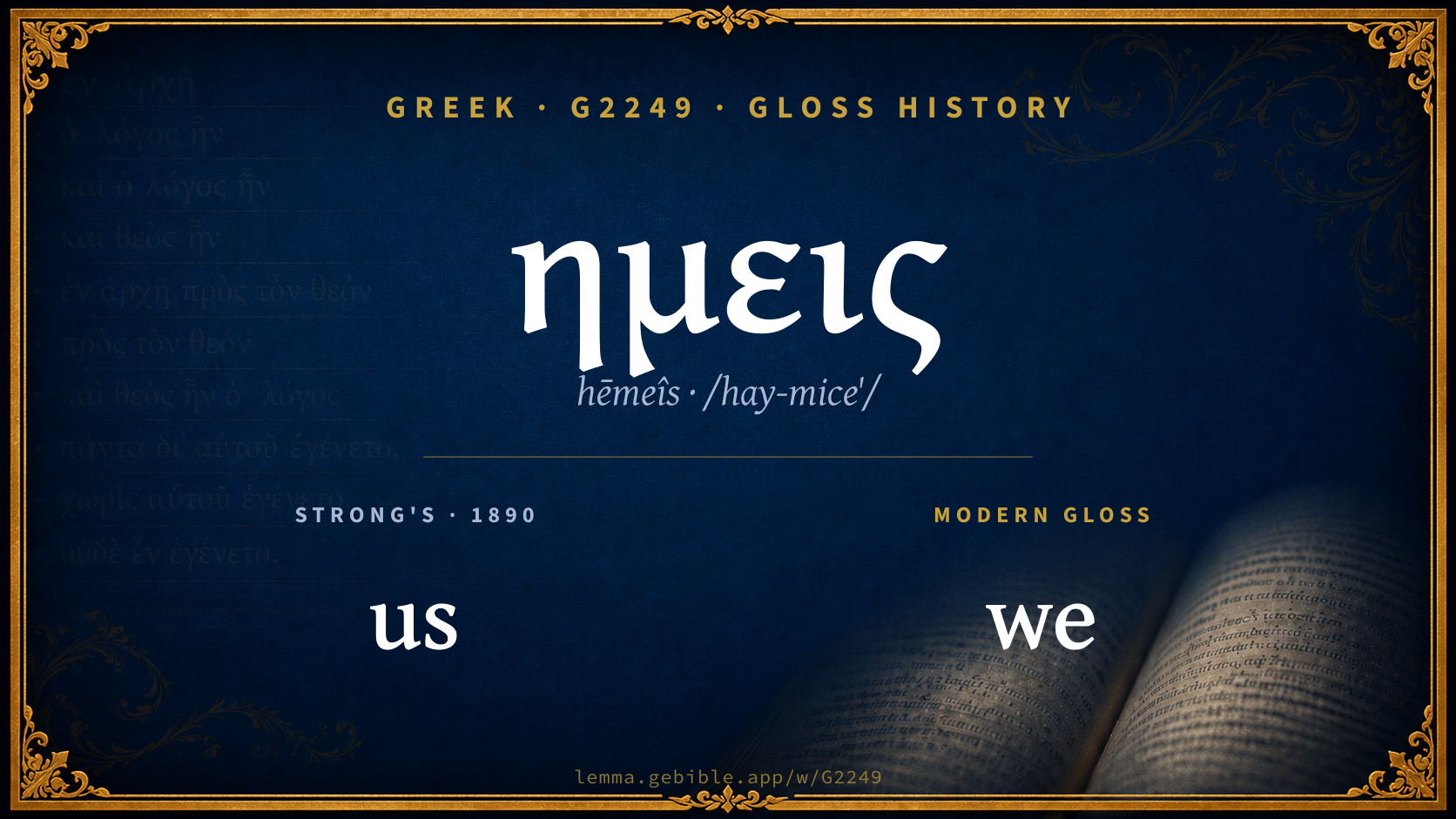
Gloss history
Strong's 1890 vs modern scholarship
About this word
Strong's G2249 catalogs a Greek word from the Greek New Testament.
These counts are not copied from any lexicon or concordance. They are computed here, from the morphology-tagged Greek New Testament. What Lemma adds →
- 691
- distinct verses
- The word appears in 691 distinct verses.
- 27 / 27
- NT books
- The word appears in 27 of 27 New Testament books.
- #23
- by frequency
- Top 25 most frequent Greek words (rank 23 of 5,347 Greek words by occurrence).
View all 691 occurrences in the concordance →
Most concentrated in
- Acts 109 verses 16%
- 2 Corinthians 81 verses 12%
- Luke 54 verses 8%
By section of the New Testament
By traditional corpus
Conventional, traditional groupings — biblical authorship is debated, so this is a traditional corpus grouping, not an authorship claim. Some books belong to more than one corpus (Luke is in both the Gospels and the Lukan corpus, and so on), so these shares overlap and need not total 100%. Each figure is a share of the word’s 691 distinct verses.
- Pauline corpus 318 verses · 46%
- Lukan (Luke–Acts) 163 verses · 24%
- Gospels 157 verses · 23%
- Johannine 99 verses · 14%
- General (Catholic) Epistles 68 verses · 10%
- Hebrews 25 verses · 4%
- Revelation 14 verses · 2%
How translations render this word
Counts come from each version’s own published word-to-Strong’s tagging or interlinear alignment — an approximate guide to how each version renders this word, not a word-level alignment the data otherwise carries. Because each total is that version’s own tagged count, the per-version totals vary from one another and need not match the appearance or distinct-verse counts above. These counts may also differ from a printed concordance because Lemma counts each distinctly tagged rendering and does not collapse phrase taggings into a single head-word total. This is a fixed set of word-tagged versions (KJV, ASV, BSB, ULT) and does not change with the reading translation you choose elsewhere. Each version’s license is shown beside its name below (and on Sources).
- King James Version: We 118×, Shall we 2×, Us 2×
- American Standard Version: We 117×, Us 3×
King James Version Public Domain
Renders G2249 across 126 tagged occurrences — most commonly:
Plus 4 renderings that appear only once — usually multi-word phrases or single function words the recovered tagging swept in, not distinct renderings.
American Standard Version Public Domain
Renders G2249 across 129 tagged occurrences — most commonly:
Plus 9 renderings that appear only once — usually multi-word phrases or single function words the recovered tagging swept in, not distinct renderings.
Senses in Thayer's
The 1 sense Thayer's distinguishes for this word, in lexicon order (not ranked by frequency or importance). The full entry — with sub-senses — is in the Lexicon Entry tab.
- us, we etc.
Word origin
Derived from εγω (egṓ) (G1473) — I.
Nomitive plural of G1473 ; we (only used when emphatic): - us we (ourselves).
— Strong’s Exhaustive Concordance (1890), public domain.
Forms in the corpus
The 5 distinct written forms G2249 takes in the Greek New Testament, most frequent first — each parse links to that case’s occurrences in the concordance.
| Form | Parsing | Example | Uses |
|---|---|---|---|
| ἡμῶν hēmō̂n | Personal pronoun, 1st person, Genitive, Plural | Matthew 1:23 | 401 |
| ἡμῖν hēmîn | Personal pronoun, 1st person, Dative, Plural | Matthew 3:15 | 168 |
| ἡμᾶς hēmâs | Personal pronoun, 1st person, Accusative, Plural | Matthew 6:13 | 167 |
| ἡμεῖς hēmeîs | Personal pronoun, 1st person, Nominative, Plural | Matthew 6:12 | 122 |
| Ἡμεῖς Hēmeîs | Personal pronoun, 1st person, Nominative, Plural | Acts 20:13 | 4 |
Same root — word family
Other Thayer's entries built from the same root as G2249, grouped by Strong’s listed origin. These share a root / origin per the lexicon — not necessarily a shared meaning. Each links to that word’s own entry.
Derives from
Shares the same root
Compare all same-root words → Showing 4 of 7 — not the complete family. 1 of the same-root words is a proper name (a person or place). They share a root, not necessarily a meaning.