
Matthew 10:39

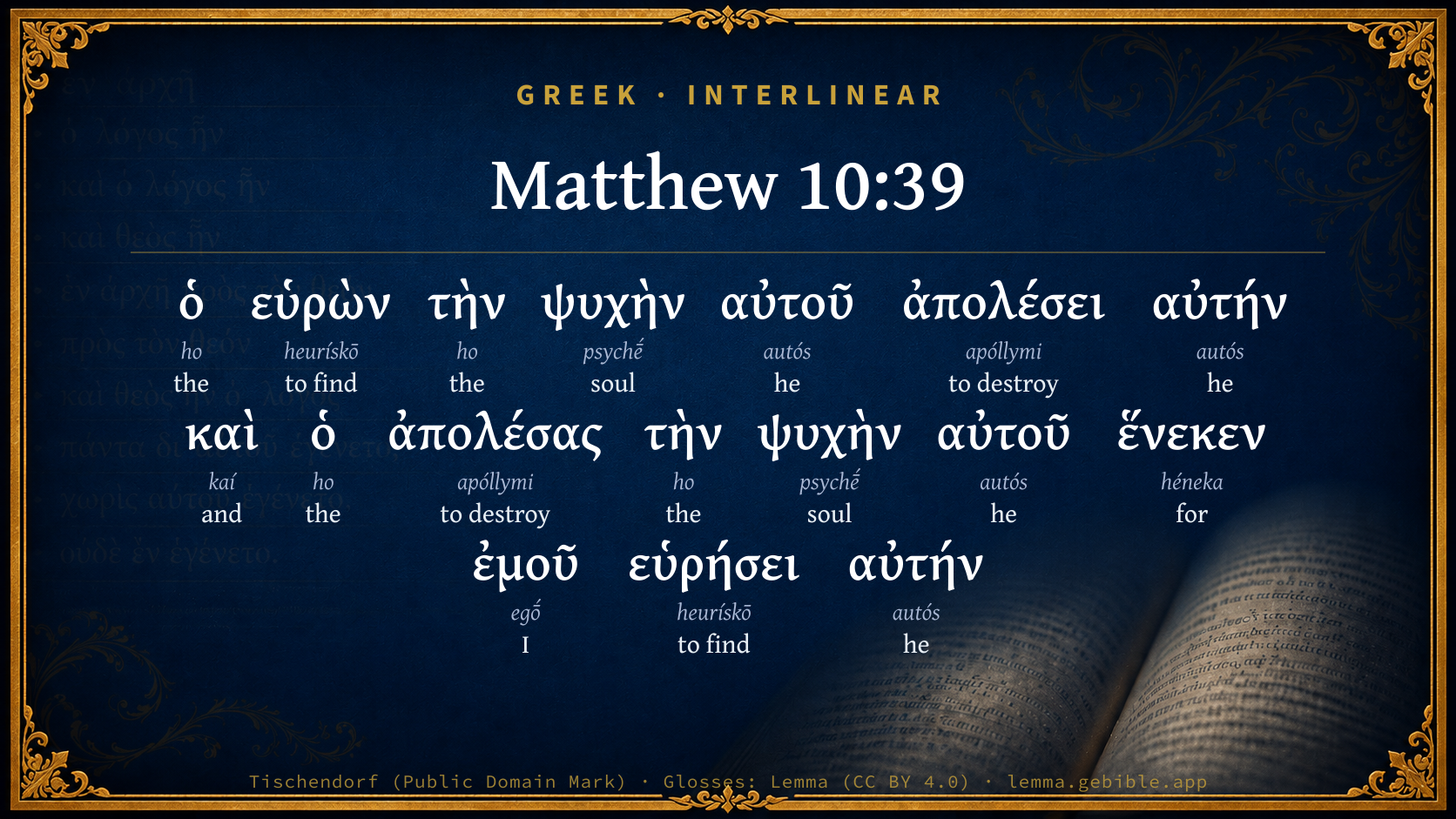
Greek (Tischendorf 8th ed.) Matthew 10:39 appears in the Greek New Testament. The text above is from the Tischendorf 8th edition. Each word links to its Strong’s number and a concise gloss. Click any word for its full Thayer’s Greek Lexicon entry.
Download image
Cite this verse

Matthew 10:39 (World English Bible). Public Domain. Lemma interlinear Bible study tool, https://lemma.gebible.app/v/matthew/10/39.

Show BibTeX & RIS
BibTeX
RIS
English Translation
He who finds his life will lose it; and he who loses his life for my sake will find it.
World English Bible · Public Domain
Download a study sheet

One document with this verse’s original text, its word-by-word gloss line, the meaning frame, cross-references with their text, attributed commentary, and full source and license credits — printable, and it pastes into notes with its structure intact.

This verse Autodidact and up

Study sheet (.html) Plain text (.txt)

A passage Seminary Student

Up to 50 verses in one chapter. A passage sheet keeps up to 6 commentary sources and 12 cross-references per verse, in the order this page ranks them, and says so on the sheet whenever that leaves anything out. Ask for a single verse and you get the Autodidact verse sheet above.

Everything on this page stays free to read, with no account — the sheet is a download of what is already on screen, not access to it.

Want to remove ads? Support Godless Engineer
Compare translations 3

The same verse in 3 English versions, stacked beneath the original-language interlinear above. Click any original word for its lexicon entry.

Each is an independent rendering of the whole verse — the interlinear is not word-aligned to these translations.

Highlighted words mark where these versions differ — a whole-verse word diff, not a word-by-word alignment.

  • World English Bible Public Domain
    He who finds his life will lose it; and he who loses his life for my sake will find it.
  • King James Version Public Domain
    He that findeth his life shall lose it: and he that loseth his life for my sake shall find it.
  • unfoldingWord Literal Text CC BY-SA 4.0
    The one having found his life will lose it, and the one having lost his life for my sake will find it.

unfoldingWord Literal Text — © unfoldingWord, licensed CC BY-SA 4.0. Word-aligned USFM3 via Door43 (git.door43.org/unfoldingWord/en_ult).

Versions to compare (up to 4)

3 of 4 selected

Show all 19 translations

Every available English version of this verse, each an independent rendering of the whole verse.

  • World English Bible Public Domain
    He who finds his life will lose it; and he who loses his life for my sake will find it.
  • Berean Standard Bible Public Domain
    Whoever finds his life will lose it, and whoever loses his life for My sake will find it.
  • Majority Standard Bible Public Domain
    Whoever finds his life will lose it, and whoever loses his life for My sake will find it.
  • King James Version Public Domain
    He that findeth his life shall lose it: and he that loseth his life for my sake shall find it.
  • American Standard Version (1901) Public Domain
    He that findeth his life shall lose it; and he that loseth his life for my sake shall find it.
  • Revised Version (1885) Public Domain
    He that findeth his life shall lose it; and he that loseth his life for my sake shall find it.
  • Geneva Bible (1599) Public Domain
    He that will finde his life, shall lose it: and he that loseth his life for my sake, shall finde it.
  • Douay-Rheims (1899) Public Domain
    He that findeth his life, shall lose it: and he that shall lose his life for me, shall find it.
  • Young's Literal Translation Public Domain
    `He who found his life shall lose it, and he who lost his life for my sake shall find it.
  • Literal Standard Version CC BY-SA 4.0
    He who found his life will lose it, and he who lost his life for My sake will find it.
  • Unlocked Literal Bible CC BY-SA 4.0
    He who finds his life will lose it. But he who loses his life for my sake will find it.
  • unfoldingWord Literal Text CC BY-SA 4.0
    The one having found his life will lose it, and the one having lost his life for my sake will find it.
  • Darby Bible Public Domain
    He that finds his life shall lose it, and he who has lost his life for my sake shall find it.
  • World Messianic Bible Public Domain
    He who seeks his life will lose it; and he who loses his life for my sake will find it.
  • Webster's Bible Public Domain
    He that findeth his life shall lose it: and he that loseth his life for my sake, shall find it.
  • Free Bible Version CC BY-SA 4.0
    If you try to save your life, you will lose it, but if you lose your life because of me you will save it.
  • Bible in Basic English Public Domain
    He who has the desire to keep his life will have it taken from him, and he who gives up his life because of me will have it given back to him.
  • Text-Critical English NT CC BY 4.0
    Whoever finds his life will lose it, but whoever loses his life for my sake will find it.
  • Tyndale New Testament (1534) Public Domain
    He that fyndeth hys lyfe shall lose it: and he that losith hys lyfe for my sake shall fynde it.

Literal Standard Version (2020), Covenant Press — licensed CC BY-SA 4.0. Text via the HelloAO Bible API (eBible.org). Unlocked Literal Bible (unfoldingWord) — licensed CC BY-SA 4.0. Text via the HelloAO Bible API (eBible.org). unfoldingWord Literal Text — © unfoldingWord, licensed CC BY-SA 4.0. Word-aligned USFM3 via Door43 (git.door43.org/unfoldingWord/en_ult). Free Bible Version, Dr. Jonathan Gallagher — licensed CC BY-SA 4.0. Text via the HelloAO Bible API (eBible.org).

Word by word

More ways to search: Search by grammar → Find every occurrence → Compare this word →

Practice this passage: Drill this verse → Learn its vocabulary →

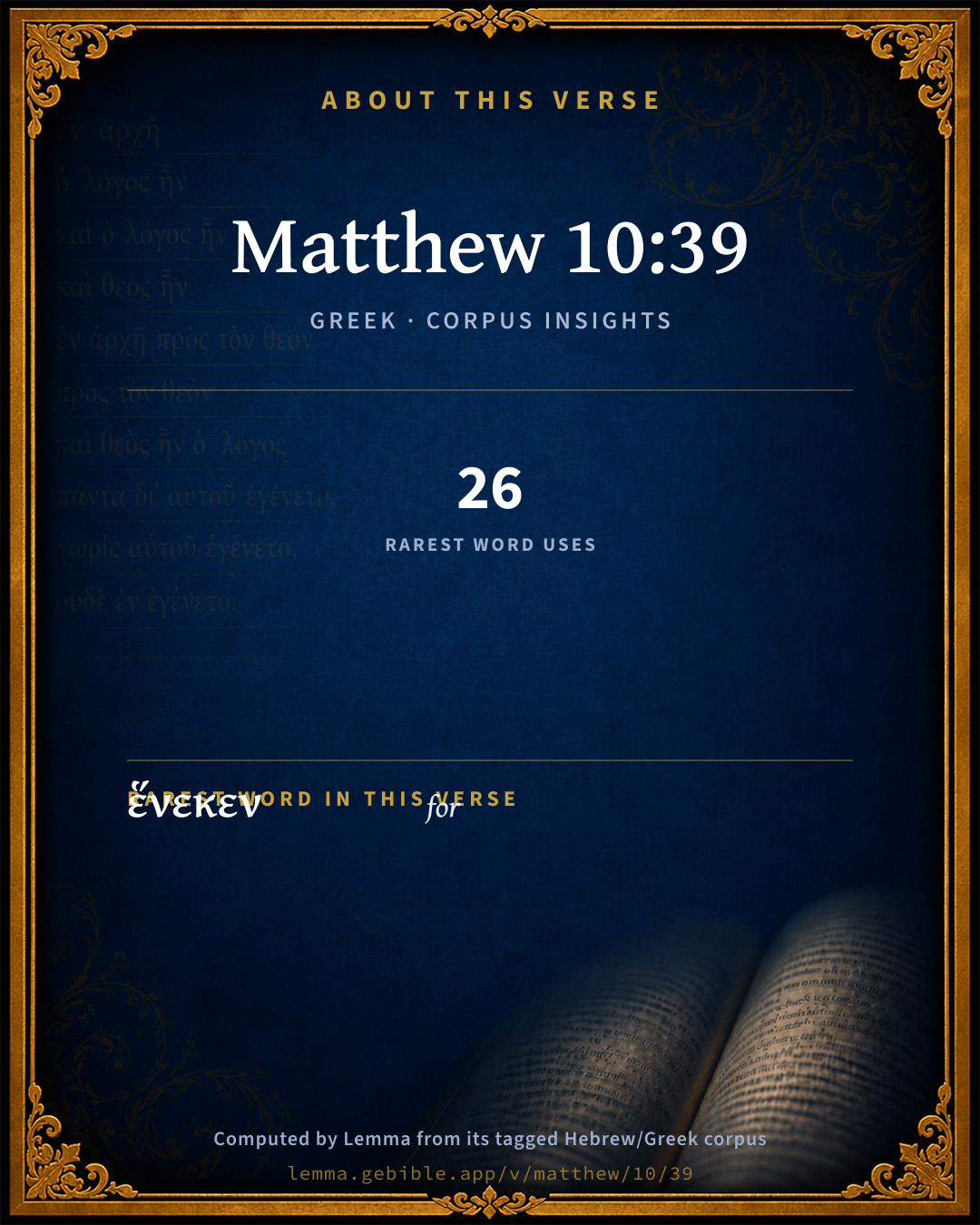
ἕνεκεν
héneka
G1752
“for”
Preposition
Part of Speech
Preposition
Full Thayer's Definition

Origin: of uncertain affinity

TDNT: None

1. on account of, for the sake of, for 2. for this cause, therefore
  1. ὁ ho G3588 “the” Article, Nominative, Singular, Masculine
  2. εὑρὼν heurískō G2147 “to find” Verb, Aorist, Active, Participle, Nominative, Singular, Masculine
  3. τὴν ho G3588 “the” Article, Accusative, Singular, Feminine
  4. ψυχὴν psychḗ G5590 “soul” Noun, Accusative, Singular, Feminine
  5. αὐτοῦ autós G846 “he” Personal pronoun, Genitive, Singular, Masculine
  6. ἀπολέσει apóllymi G622 “to destroy” Verb, Future, Active, Indicative, 3rd person, Singular
  7. αὐτήν autós G846 “he” Personal pronoun, Accusative, Singular, Feminine
  8. καὶ kaí G2532 “and” Conjunction
  9. ὁ ho G3588 “the” Article, Nominative, Singular, Masculine
  10. ἀπολέσας apóllymi G622 “to destroy” Verb, Aorist, Active, Participle, Nominative, Singular, Masculine
  11. τὴν ho G3588 “the” Article, Accusative, Singular, Feminine
  12. ψυχὴν psychḗ G5590 “soul” Noun, Accusative, Singular, Feminine
  13. αὐτοῦ autós G846 “he” Personal pronoun, Genitive, Singular, Masculine
  14. ἐμοῦ egṓ G1473 “I” Personal pronoun, 1st person, Genitive, Singular
  15. εὑρήσει heurískō G2147 “to find” Verb, Future, Active, Indicative, 3rd person, Singular
  16. αὐτήν autós G846 “he” Personal pronoun, Accusative, Singular, Feminine

About this verse

These counts appear in no published source. They are computed here, from the morphology-tagged text and Lemma’s own curated glosses. What Lemma adds →

17
words
8
distinct lemmas
Gospels
section

Shared distinctive vocabulary

ἕνεκεν for G1752 occurs in 23 verses of the Greek New Testament. Also found in:
Repetition

Words recur within this verse:

  • εὑρὼν to find G2147 ×2
  • ψυχὴν soul G5590 ×2
  • ἀπολέσει to destroy G622 ×2
  • ὁ the G3588 ×4
  • αὐτοῦ he G846 ×4

Cross-references

8

Topical passages linked to Matthew 10:39 in the Treasury of Scripture Knowledge — connected by theme and wording, ordered by reader-vote popularity; previews shown in the World English Bible.

  • John 12:25 He who loves his life will lose it. He who hates his life in this world will keep it to eternal life.
  • Mark 8:35–36 For whoever wants to save his life will lose it; and whoever will lose his life for my sake and the Gospel's will save it.
  • Luke 17:33 Whoever seeks to save his life loses it, but whoever loses his life preserves it.
  • Matthew 16:25–26 For whoever desires to save his life will lose it, and whoever will lose his life for my sake will find it.
  • Luke 9:24 For whoever desires to save his life will lose it, but whoever will lose his life for my sake, the same will save it.
  • Revelation 2:10 Don't be afraid of the things which you are about to suffer. Behold, the devil is about to throw some of you into prison, that you may be tested; and you will have oppression for ten days. Be faithful to death, and I will give you the crown of life.
  • Philippians 1:20–21 according to my earnest expectation and hope, that I will in no way be disappointed, but with all boldness, as always, now also Christ will be magnified in my body, whether by life, or by death.
  • 2 Timothy 4:6–8 For I am already being offered, and the time of my departure has come.

Cross-references courtesy of OpenBible.info (CC BY 4.0).

Commentary

Notes on Matthew 10:39 from classic Christian and Jewish commentators (each source and its license shown beneath its notes). The classic Christian expositions comment on the surrounding passage and are grouped to its opening verse, so a note may address several verses; the Jewish commentaries on the Tanakh (Rashi and others) are per-verse, so they appear only where the commentator wrote on this verse.

Lemma curates 59 commentaries, every one of them public domain or Creative Commons licensed, each selected and text-cleaned for this edition rather than reprinted as found. About our sources →

The Biblical Illustrator

Joseph S. Exell

Mat_10:39

He that findeth his life.

The love of life

I. The nature and end of this love of life. This attachment not engendered since the fall-a degraded exhibition of some early beauty. Adam loved life; but the life he loved was a fragment of immortality. He loved it as an unbroken walk with the Eternal; we commonly cling to life as a removal from His presence. Adam loved an immortality begun; we an immortality put off. But a Divine purification of our nature and the old lineaments shall start forth from the canvass. This love of life of Divine implantation; it survives all pleasure in life; and is not accounted for by dread of the future. The Almighty appointed that it should act as a powerful engine in the furtherance of His several dispensations. Take it away, and society is shaken in every part. Evidence that man is far even from original righteousness in the eagerness with which he clings to absence from his Maker. The love of life a perpetual source of honour to God by the opportunity afforded for the display of His grace.

II. When the principle takes a right direction, and when a wrong direction. We have shown that the principle which in fallen man is the love of life, was in unfallen man the love of immortality; hence as it is our own aim to return to the privileges of the unfallen state, we give the principle its right direction when we draw it off from the mortal, and fasten it upon the immortal. To find by losing is the principle rightly applied; for this is the mortal surrendered to the immortal. To lose by finding is the principle wrongly applied; for this is the immortal basely exchanged for the mortal. We call upon you to love life, but you must understand what life is; not mere existence. (H. Melvill.)

Nothing to lose

He that would loss nothing, must learn to have nothing. (Farindon.)

Finding by losing

A remarkable instance of the literal fulfilment of this promise, even with regard to this life, is furnished by a circumstance lately mentioned to us by one who knew the subject of it well. A devoted Christian woman had been in the habit of carrying on extensive religious work in a large and important town, especially in the infirmary of the workhouse, which she was constantly in the habit of visiting. When no longer young, in fact she must have been nearly fifty, Miss G-became seriously ill, and her medical advisers pronounced it their opinion that she could not recover. She requested to be told how long, according to their calculation, she could possibly live, and the reply was, At the longest about a year, but you must take perfect rest, and give up all work and exertion. No, replied Miss G-; if I am to live so short a time, I must work all the more heartily for my Master. She did so, continuing her classes, visits, etc., but it did not shorten her life. At the present time, fifteen years after, Miss G-still lives, and still works actively, though between sixty and seventy years of age.

Losing life for others

Ernest entered heartily into the sport of marble-playing when that season came round; and, as he played for keeps, it was not long before complaints began to be made against him. He was a good player and did win a good many marbles; and nobody likes to lose at play, be it money or marbles. Ernest resented the hard talk about his playing, and one day when he met his pastor he told him how unjust and unkind the boys were. The pastor listened kindly; he was one of the men who have the good sense and the good taste to love boys. When Ernest paused he said: Well, Ernest, you do win a good many marbles, dont you? Why, yes, sir; of course I do. I wonder, now, if you ever ask the Lord Jesus about this marble playing? Yes, sir; I do, answered Ernest, heartily. And what do you ask Him? I ask Him to let me hit. Ernest, do you ever ask Him to let another boy hit? No, sir; of course I dont. Why not? … Why, I want to get all the marbles I can. It seems as if the other boys might like to win sometimes, said Mr. Burch, thoughtfully. Ernest, are you trying to show God to the boys? Yes, Mr. Burch; I am, very earnestly. Do you ever talk to them about God? Yes, sir, I do; Id like to have the boys know Him. Well, do they seem to want to love Him much? No, Mr. Burch; I think the boys dont care much about God. Well, Ernest, I dont know that I wonder much at it. The God that they see is your God. He lets you have all that you want, but does not tell you to ask Him to give them anything! You are not showing them the God who laid down His life. What do you mean by that, Mr. Burch? Giving up the thing that we want is the very heart of Christs religion. Christ laid down His life for us, and we are to lay clown our lives for others. If we lose our life-that is, our will, our way, our pleasure, our advantage-for Christs sake, we shall find the real life, which He only can give. Try it, Ernest; lose your life among the boys, and see if they wont think better of your God.

The Biblical Illustrator, edited by Joseph S. Exell (c. 1880s–1900s) — public domain. Text from a community e-Sword module.

Joseph Benson's Commentary

Mat 10:39-42. He that findeth his life shall lose it — He that saves his life by denying me shall lose it eternally; and he that loses his life by confessing me shall save it eternally. Or, as Macknight expresses it, “He that makes shipwreck of faith and a good conscience to save his life, shall lose that which is really his life — his everlasting happiness; whereas, he that maintaineth integrity at the expense of life, and all its enjoyments, shall find what is infinitely better — a blessed immortality.” It is justly observed by Campbell, that there is a kind of a paronomasia in the sentence, whereby the same word is used in different senses, in such a manner as to convey the sentiment with greater energy to the attentive. “He who, by making a sacrifice of his duty, preserves temporal life, shall lose eternal life; and contrariwise.” The trope has a beauty in the original which we cannot give it in a version: the word ψυχη being equivocal, and signifying both life and soul, and consequently being much better fitted for exhibiting, with entire perspicuity, the two meanings, than the English word life. The Syro- Chaldaic, which was the language then spoken in Palestine, had, in this respect, the same advantage with the Greek. He that receiveth you receiveth me — And as you shall be thus rewarded, so, in proportion, shall they who entertain you for my sake. He that receiveth a prophet in the name of a prophet — That is, because he is such, shall receive a prophet’s reward — Shall have a reward like that conferred on a prophet. It is evident, that by a prophet here is meant, not merely one that foretels future events, but a minister of God in general. And the word δεχομαι, rendered receive, plainly signifies here to entertain in an hospitable way, as it does also Heb 11:31; Jas 2:25, &c. Nor can the gradation, in the following words, be understood without such an interpretation, for Jesus descends here from a prophet to a righteous man, and from a righteous man to a disciple, termed a little one, that is, any believer, however poor, mean, and contemptible in the world. It must be observed, that what renders the good works here mentioned valuable in the sight of God, and procures them a recompense from him, is their being done out of regard for him and his blessed Son. By the rewards here promised, Le Clerc understands the happiness of heaven, paraphrasing the worsts thus: “He that showeth kindness to a prophet, on account of his mission and doctrine, or to a righteous man, on account of his righteousness, especially if by so doing he exposes himself to persecution, shall be as highly rewarded as that righteous man or prophet shall be; nay, he who doth any good office whatever to the meanest of my disciples, though it should be but the small service of handing a cup of cold water to them, shall not go unrewarded,” that is, if he shall give it to him in the name of a disciple, or with a real affection to him, on account of his relation to me. This seems to be the true interpretation of the passage. Thus also Dr. Hammond, “How great soever your persecutions are, and how dangerous soever it be to profess to be a follower of Christ, yet shall no man have reason to fear the entertaining of you; for the same protection which awaits you, and the same reward that attends you, shall await them that receive you. It shall be as if they had entertained, not only angels, but Christ and God himself. He that doth support, and enable a prophet to do His work that sent him, shall receive the same reward that he should if himself had been sent to prophesy.” This, “as it is a great incitement to others to express their kindness to Christ’s ministers and faithful servants, so is it also to his ministers to apply themselves to his service with a ready mind, and with the utmost diligence in the execution of their pastoral office.” — Whitby.

Joseph Benson's Commentary on the Old and New Testaments (1811–1818) — public domain. Text from a community e-Sword module.

The Pulpit Commentary

Besides Mat_16:25 and parallel passages (vide supra), cf. also Luk_17:33 and even Joh_12:25. Observe that in our chapter vers. 37, 38 are equivalent to Luk_14:26, Luk_14:27; vers. 38, 39 to Luk_9:23, Luk_9:24; ver. 39 to Luk_17:33. A comparison of the various passages leads to the inference that the original occasion of vers. 37, 38 was that of Luk_14:26, Luk_14:27, and the original occasion of ver. 39 was that of Mat_16:25. Thus our passage is a compendium, and Mat_16:25 is either a modification by our Lord of an earlier thought, or, more probably, another "setting" of the utterance in place of something that corresponded to it. Luk_17:33, on the other hand, may be a modification by our Lord, or an insertion made in the process of the composition of the Gospel. He that findeth; found (Revised Version margin); o eurwn : but unnecessarily, the statement is timeless, and the inherent thought of completion is contained also in our present tense. Findeth; after expenditure of trouble, and so Mat_16:25 with parallel passages, "wish to save," and Luk_17:33, "seek to gain.

Observe also the idea of acquiring for personal use common both to euriskein and peripoieisyai (Luke). The phrase, "find the soul," occurs only here (twice) and Mat_16:25; cf. Heb_10:39. His life. (Mat_6:25, note) As the full develop-merit of personality in true independence and energy is the aim and the promise for hereafter, so its shrinking and weakening by sin ends in loss of moral independence and mental worth. Shall lose it: and he that loseth his life for my sake shall find it. He shall acquire that personality of Iris with all its inherent germs of power fully developed. (cf. Luk_21:19 Heb_10:39; cf. also the apocryphal legion , Swzou su kai h quch sou , Resch, "Agrapha," p. 145) In Talm. Bab., "Tamid," 32 a, Alexander the Great asks "the elders of the south ten questions, among them," What shall a man do that he may live?" They answer, "Let him put himself to death." "What shall a man do that he may die?" "Let him make himself alive." But though there is so much verbal similarity, it may be doubted whether Rashi is not right in explaining the passage as a merely worldly wise warning against provoking the envy of others by pride and ostentation.

The Pulpit Commentary (1880–1919), ed. H.D.M. Spence-Jones & Joseph S. Exell — public domain. Text from a community e-Sword module.

MacLaren's Expositions of Holy Scripture

Alexander MacLaren

Matthew

A LIFE LOST AND FOUND 1

Mat 10:39.

My heart impels me to break this morning my usual rule of avoiding personal references in the pulpit. Death has been busy in our own congregation this last week, and yesterday we laid in the grave all that was mortal of a man to whom Manchester owes more than it knows. Mr. Crossley has been for thirty years my close and dear friend. He was long a member of this church and congregation. I need not speak of his utter unselfishness, of his lifelong consecration, of his lavish generosity, of his unstinted work for God and man; but thinking of him and of it, I have felt as if the words of my text were the secret of his life, and as if he now understood the fulness of the promise they contain: ‘He that loseth his life for My sake shall find it.’ Now, looking at these words in the light of the example so tenderly beloved by some of us, so sharply criticised by many, but now so fully recognised as saintly by all, I ask you to consider-

I. The stringent requirement for the Christian life that is here made.

Now we shall very much impoverish the meaning and narrow the sweep of these great and penetrating words, if we understand by ‘losing one’s life’ only the actual surrender of physical existence. It is not only the martyr on whose bleeding brows the crown of life is gently placed; it is not only the temples that have been torn by the crown of thorns, that are soothed by that unfading wreath; but there is a daily dying, which is continually required from all Christian people, and is, perhaps, as hard as, or harder than, the brief and bloody passage of martyrdom by which some enter into rest. For the true losing of life is the slaying of self, and that has to be done day by day, and not once for all, in some supreme act of surrender at the end, or in some initial act of submission and yielding at the beginning, of the Christian life. We ourselves have to take the knife into our own hands and strike, and that not once, but ever, right on through our whole career. For, by natural disposition, we are all inclined to make our own selves to be our own centres, our own aims, the objects of our trust, our own law; and if we do so, we are dead whilst we live, and the death that brings life is when, day by day, we ‘crucify the old man with his affections and lusts.’ Crucifixion was no sudden death; it was an exquisitely painful one, which made every nerve quiver and the whole frame thrill with anguish; and that slow agony, in all its terribleness and protractedness, is the image that is set before us as the true ideal of every life that would not be a living death. The world is to be crucified to me, and I to the world.

We have our centre in ourselves, and we need the centre to be shifted, or we live in sin. If I might venture upon so violent an image, the comets that career about the heavens need to be caught and tamed, and bound to peaceful revolution round some central sun, or else they are ‘wandering stars to whom is reserved the blackness of darkness for ever.’ So, brethren, the slaying of self by a painful, protracted process, is the requirement of Christ.

But do not let us confine ourselves to generalities. What is meant? This is meant-the absolute submission of the will to commandments and providences, the making of that obstinate part of our nature meek and obedient and plastic as the clay in the potter’s hands. The tanner takes a stiff hide, and soaks it in bitter waters, and dresses it with sharp tools, and lubricates it with unguents, and his work is not done till all the stiffness is out of it and it is flexible. And we do not lose our lives in the lofty, noble sense, until we can say-and verify the speech by our actions-’Not my will but Thine be done.’ They who thus submit, they who thus welcome into their hearts, and enthrone upon the sovereign seat in their wills, Christ and His will-these are they who have lost their lives. When we can say, ‘I live, yet not I, but Christ liveth in me,’ then, and only then, have we in the deepest sense of the words ‘lost our lives.’

The phrase means the suppression, and sometimes the excision, of appetites, passions, desires, inclinations. It means the hallowing of all aims; it means the devotion and the consecration of all activities. It means the surrender and the stewardship of all possessions. And only then, when we have done these things, shall we have come to practical obedience to the initial requirement that Christ makes from us all-to lose our lives for His sake.

I need not diverge here to point to that life from which my thoughts have taken their start in this sermon. Surely if there was any one characteristic in it more distinct and lovely than another, it was that self was dead and that Christ lived. There may be sometimes a call for the actual-which is the lesser-surrender of the bodily life, in obedience to the call of duty. There have been Christian men who have wrought themselves to death in the Master’s service. Perhaps he of whom I have been speaking was one of these. It may be that, if he had done like so many of our wealthy men-had flung himself into business and then collapsed into repose-he would have been here to-day. Perhaps it would have been better if there had been a less entire throwing of himself into arduous and clamant duties. I am not going to enter on the ethics of that question. I do not think there are many of this generation of Christians who are likely to work themselves to death in Christ’s cause; and perhaps, after all, the old saying is a true one, ‘Better to wear out than to rust out.’ But only this I will say: we honour the martyrs of Science, of Commerce, of Empire, why should not we honour the martyrs of Faith? And why should they be branded as imprudent enthusiasts, if they make the same sacrifice which, when an explorer or a soldier makes, his memory is honoured as heroic, and his cold brows are crowned with laurels? Surely it is as wise to die for Christ as for England. But be that as it may; the requirement, the stringent requirement, of my text is not addressed to any spiritual aristocracy, but is laid upon the consciences of all professing Christians.

II. Observe the grounds of this requirement.

Did you ever think-or has the fact become so familiar to you that it ceases to attract notice?-did you ever think what an extraordinary position it is for the son of a carpenter in Nazareth to plant Himself before the human race and say, ‘You will be wise if you die for My sake, and you will be doing nothing more than your plain duty’? What business has He to assume such a position as that? What warrants that autocratic and all-demanding tone from His lips? ‘Who art Thou’-we may fancy people saying-’that Thou shouldst put out a masterful hand and claim to take as Thine the life of my heart?’ Ah! brethren, there is but one answer: ‘Who loved me, and gave Himself for me.’ The foolish, loving, impulsive apostle that blurted out, before his time had come, ‘I will lay down my life for Thy sake,’ was only premature; he was not mistaken. There needed that His Lord should lay down His life for Peter’s sake; and then He had a right to turn to the apostle and say, ‘Thou shalt follow Me afterwards,’ and ‘lay down thy life for My sake.’ The ground of Christ’s unique claim is Christ’s solitary sacrifice. He who has died for men, and He only, has the right to require the unconditional, the absolute surrender of themselves, not only in the sacrifice of a life that is submitted, but, if circumstances demand, in the sacrifice of a death. The ground of the requirement is laid, first in the fact of our Lord’s divine nature, and second, in the fact that He who asks my life has first of all given His.

But that same phrase, ‘for My sake,’ suggests-

III. The all-sufficient motive which makes such a loss of life possible.

I suppose that there is nothing else that will wholly dethrone self but the enthroning of Jesus Christ. That dominion is too deeply rooted to be abolished by any enthusiasms, however noble they may be, except the one that kindles its undying torch at the flame of Christ’s own love. God forbid that I should deny that wonderful and lovely instances of self-oblivion may be found in hearts untouched by the supreme love of Christ! But whilst I recognise all the beauty of such, I, for my part, humbly venture to believe and assert that, for the entire deliverance of a man from self-regard, the one sufficient motive power is the reception into his opening heart of the love of Jesus Christ.

Ah! brethren, you and I know how hard it is to escape from the tyrannous dominion of self, and how the evil spirits that have taken possession of us mock at all lesser charms than the name which ‘devils fear and fly’; ‘the Name that is above every name.’ We have tried other motives. We have sought to reprove our selfishness by other considerations. Human love-which itself is sometimes only the love of self, seeking satisfaction from another-human love does conquer it, but yet conquers it partially. The demons turn round upon all other would-be exorcists, and say, ‘Jesus we know . . . but who are ye?’ It is only when the Ark is carried into the Temple that Dagon falls prone before it. If you would drive self out of your hearts-and if you do not it will slay you-if you would drive self out, let Christ’s love and sacrifice come in. And then, what no brooms and brushes, no spades nor wheelbarrows, will ever do-namely, cleanse out the filth that lodges there-the turning of the river in will do, and float it all away. The one possibility for complete, conclusive deliverance from the dominion and tyranny of Self is to be found in the words ‘For My sake.’ Ah! brethren, I suppose there are none of us so poor in earthly love, possessed or remembered, but that we know the omnipotence of these words when whispered by beloved lips, ‘For My sake’; and Jesus Christ is saying them to us all.

IV. Lastly, notice the recompense of the stringent requirement.

‘Shall find it,’ and that finding, like the losing, has a twofold reference and accomplishment: here and now, yonder and then.

Here and now, no man possesses himself till he has given himself to Jesus Christ. Only then, when we put the reins into His hands, can we coerce and guide the fiery steeds of passion and of impulse, And so Scripture, in more than one place, uses a remarkable expression, when it speaks of those that believe to the ‘acquiring of their souls.’ You are not your own masters until you are Christ’s servants; and when you fancy yourselves to be most entirely your own masters, you have promised yourselves liberty and have become the slave of corruption. So if you would own yourselves, give yourselves away. And such an one ‘shall find’ his life, here and now, in that all earthly things will be sweeter and better. The altar sanctifies the gift. When some pebble is plunged into a sunlit stream, the water brings out the veined colourings of the stone that looked all dull and dim when it was lying upon the bank. Fling your whole being, your wealth, your activities, and everything, into that stream, and they will flash in splendour else unknown. Did not my friend, of whom I have been speaking, enjoy his wealth far more, when he poured it out like water upon good causes, than if he had spent it in luxury and self-indulgence? And shall we not find that everything is sweeter, nobler, better, fuller of capacity to delight, if we give it all to our Master? The stringent requirement of Christ is the perfection of prudence. ‘Who pleasure follows pleasure slays,’ and who slays pleasure finds a deeper and a holier delight. The keenest epicureanism could devise no better means for sucking the last drop of sweetness out of the clustering grapes of the gladnesses of earth than to obey this stringent requirement, and so realise the blessed promise, ‘Whoso loseth his life for My sake shall find it.’ The selfish man is a roundabout fool. The self-devoted man, the Christ-enthroning man, is the wise man.

And there will be the further finding hereafter, about which we cannot speak. Only remember, how in a passage parallel with this of my text, spoken when almost within sight of Calvary, our Lord laid down not only the principle of His own life but the principle for all His servants, when He said, ‘Except a corn of wheat fall into the ground and die, it abideth alone: but if it die, it bringeth forth much fruit.’ The solitary grain dropped into the furrow brings forth a waving harvest. We may not, we need not, particularise, but the life that is found at last is as the fruit an hundredfold of the life that men called ‘lost’ and God called ‘sown.’

‘Blessed are the dead which die in the Lord; they rest from their labours, and their works do follow them.’

1 Preached after the funeral of Mr. F. W. Crossley.

Alexander MacLaren, Expositions of Holy Scripture (1904–1910) — public domain. Text from a community e-Sword module.

Bengel's Gnomon

Johann Albrecht Bengel

Mat 10:39. Ψυχὴν, soul) i.e., man with respect to his natural life, himself; cf. Luk 9:24-25.—ἕνεκεν Ἐμοῦ, for My sake) Many lose their soul for the sake of the world.

Bengel's Gnomon of the New Testament — English translation (T&T Clark, Edinburgh, 1860) — public domain. Text from a community e-Sword module.

Meyer's Critical & Exegetical Commentary

Heinrich August Wilhelm Meyer

Mat_10:39. Ψυχήν and αὐτήν have no other meaning than that of soul (Mat_2:20, Mat_6:25, Mat_9:28); but the point lies in the reference of the finding and losing not being the same in the first as in the second half of the verse. Whoever will have found his soul (by a saving of his life in this world through denying me in those times when life is endangered), will lose it (namely, through the ἀπώλεια, Mat_7:13, the eternal death at the second coming; comp. Luk_9:24 f.); and whoever will have lost his soul (through the loss of his life in this world in persecution, through an act of self-sacrifice), will find it (at the resurrection to the eternal ζωή); σωθήσεται, Mat_10:22. For ἀπόλλ. ψυχήν, comp. Eur. Hec. 21; Anth. Pal. vii. 272. 2. The finding in the first half, accordingly, denotes the saving of the ψυχή, when to all appearance hopelessly endangered from temporal death; while, in the second, it denotes the saving of the ψυχή after it has actually succumbed to death. The former is a finding that issues in eternal death; the latter, one that conducts to eternal life.

Meyer — Critical and Exegetical Commentary on the New Testament — English translation by Peter Christie, edited by Frederick Crombie (T&T Clark, 1880) — public domain. Text from a community e-Sword module.

Expositor's Greek Testament

ed. W. Robertson Nicoll

Mat 10:39 . εὑρὼν … ἀπολέσει , ἀπολέσας … εὑρήσει : crucifixion, death ignominious, as a criminal horrible; but horrible though it be it means salvation. This paradox is one of Christ’s great, deep, yet ever true words. It turns on a double sense of the term ψυχή as denoting now the lower now the higher life. Every wise man understands and acts on the maxim, “dying to live”.

The Expositor's Greek Testament, edited by W. Robertson Nicoll (1897–1910) — public domain. Text from a community e-Sword module.

International Critical Commentary

39. He that found his life shall lose it; and he that lost his life for My sake shall find it). This saying occurs in four forms: (1) Mar 8:35 = Mat 16:25 = Luk 9:24 ὃς γὰρ ἐὰν (Lk. ἂν) θέλῃ τὴν ψυχὴν αὐτοῦ (Mk. ἐαυτοῦ ψυχὴν) σῶσαι ἀπολέσει αὐτήν, ὃς δʼ ἂν ἀπολέσῃ (Mk. ἀπολέσει) τὴν ψυχὴν αὐτοῦ ἕνεκεν ἐμοῦ (Mk. καὶ τοῦ εὐαγγελίου) οὗτος (Om. Mt. Mk.) σῶσει αὐτήν (Mt. εὑρήσει, assimilating to 10:39). (2) Mat 10:38 ὁ εὑρὼν τὴν ψυχὴν αὐτοῦ ἀπολέσει αὐτήν, καὶ ὁ ἀπολέσας τὴν ψυχὴν αὐτοῦ ἕνεκεν ἐμοῦ εὐρήσει αὑτήν. (3) Luk 17:33, in a different context, ὃς ἐὰν ζητήσῃ τὴν ψυχὴν αὐτοῦ περιποιήσασθαι ἀπολέσει αὐτήν, ὃς δʼ ἂν ἀπολέσῃ ζωογονήσει αὐτήν. This and No. 1 look like independent translations of a Semitic original. They are not based on a common Greek source. (4) Joh 12:25 ὁ φιλῶν τὴν ψυχὴν αὐτοῦ ἀπολλύει αὐτήν· καὶ ὁ μισῶν τὴν ψυχὴν αὐτοῦ ἐν τῷ κόσμῳ τούτῳ εἰς ζωὴν αἰώνιον φυλάξει αὐτήν.

In Mar_8 = Mat_16 =Luk_9, and in Mat_10, this saying is connected with the saying about bearing the cross.

Here in Mt. it clearly has reference to death in persecution. “He who shrinks from death, and wishes to preserve his life of the body, will indeed do so, but will lose the higher life of the soul into which he would have passed through martyrdom. He who is content to suffer death because of his faithfulness to My teaching, will forfeit the life of the body, but will make discovery on the other side of death of the higher life of the soul.”

International Critical Commentary — older volumes (1896–1929), various authors — public domain. Text from a community e-Sword module.

Geneva Bible (1599)

Geneva Bible translators

They are said to find their life, which deliver it out of danger: and this is spoken after the opinion of the people which think them clean lost that die, because they think not of the life to come.

Geneva Bible (1599) marginal notes — public domain. Text via Bolls.life.

Jamieson, Fausset & Brown

Robert Jamieson, A. R. Fausset & David Brown

He that findeth his life shall lose it: and he that loseth his life for my sake shall find it--another of those pregnant sayings which our Lord so often reiterates (Mat 16:25; Luk 17:33; Joh 12:25). The pith of such paradoxical maxims depends on the double sense attached to the word "life"--a lower and a higher, the natural and the spiritual, the temporal and eternal. An entire sacrifice of the lower, with all its relationships and interests--or, a willingness to make it which is the same thing--is indispensable to the preservation of the higher life; and he who cannot bring himself to surrender the one for the sake of the other shall eventually lose both.

Jamieson, Fausset & Brown — Commentary Critical and Explanatory on the Whole Bible (1871) — public domain (CC PDM 1.0). Text via the HelloAO Bible API.

Adam Clarke's Commentary

Verse 39. He that findeth his life, c.] i.e. He who, for the sake of his temporal interest, abandons his spiritual concerns, shall lose his soul and he who, in order to avoid martyrdom, abjures the pure religion of Christ, shall lose his soul, and perhaps his life too. He that findeth his life shall lose it, was literally fulfilled in Archbishop Cranmer. He confessed Christ against the devil, and his eldest son, the pope. He was ordered to be burnt; to save his life he recanted, and was, notwithstanding, burnt. Whatever a man sacrifices to God is never lost, for he finds it again in God.

There is a fine piece on this subject in Juvenal, Sat. viii. l. 80, which deserves to be recorded here.

----------- ambiguae si quando citabere testis

Incertaeque rei, Phalaris liect imperet ut sis

Falsus, et admoto dictet perjuria tauro,

Summum crede nefas ANIMAM praeferre PUDORI

Et propter VITAM VIVENDI perdere causas.

---------- If ever call'd

To give thy witness in a doubtful case,

Though Phalaris himself should bid thee lie,

On pain of torture in his flaming bull,

Disdain to barter innocence for life;

To which life owes its lustre and its worth.

Wakefield.

Adam Clarke's Commentary on the Bible (1810–1826) — public domain. Text from a community e-Sword/MySword module.

Ellicott's Commentary for English Readers

(39) He that findeth his life.—The word is the same as that translated “soul” (i.e., that by which man lives in the lower or the higher sense of life) in Mat_10:28. The point of the maxim lies in the contrast between the two senses. To gain the lower now is to lose the higher hereafter, and conversely, to lose the lower for the sake of Christ (i.e., to die a martyr’s death in confessing Him) is to gain the higher.

A Bible Commentary for English Readers, edited by Charles John Ellicott (1878–1897) — public domain. Text from a community e-Sword module.

The Cambridge Bible for Schools and Colleges

gen. ed. J. J. S. Perowne

39. He that findeth his life shall lose it] The Greek word for life (ψυχή) embraces every form of life from mere vegetative existence to the highest spiritual life of the soul. Sometimes this variety of meaning is found within the limits of a single sentence—“He that findeth the life of external comfort and pleasure, shall lose the eternal life of spiritual joy.”

The Cambridge Bible for Schools and Colleges (gen. ed. J. J. S. Perowne; Cambridge University Press, 1878–1918) — public domain. Text from a community e-Sword module.

John Gill's Exposition

He that receiveth you, receiveth me,.... This is said to comfort the disciples, lest they should conclude from this account of the sorrows, afflictions, and persecutions they were to meet with, that there would be none that would receive them and their message; Christ therefore suggests, that there would be some that would embrace the Gospel preached by them, and receive them kindly into their houses, and entertain them in a very hospitable manner: and, for the encouragement of such persons, who would risk their own goods and lives by so doing, he lets them know, that receiving of his disciples, was interpreted by him, a receiving of himself; and what they did to them, would be taken as kindly, as if done to him personally; and, in like manner, would it be understood and accepted by his Father:

and he that receiveth me, receiveth him that sent me. To which agrees, what the Jews say (p) of the angel, in Exo 23:22 "If thou shalt indeed obey his voice, and do all that I shall speak": who observe, that it is not written, "that he shall speak", but "that I shall speak"; intimating, that , "if ye receive him, it is all one as if you received me": and the whole of this accords with a common saying among (q) them, , "that a man's messenger is as himself". The Jew (r), therefore, has no reason to reproach Christ and his followers as he does, as if it was the sense of these words of Christ, and which the Christians give of them, that Christ and his twelve apostles were but one person.

(p) Shemot Rabba Parash. 32. fol. 135. 3. (q) T. Bab. Baracot, fol. 34. 2. Kiddushin, fol. 41. 2. 42. 1. & 43. 1. Bava Metzia, fol. 96. 1. (r) R. Isaac Chizzuk Emuna, par 2. sect. 14. p. 404.

John Gill's Exposition of the Whole Bible (1746–1763) — public domain (CC PDM 1.0). Text via the HelloAO Bible API.

Trapp's Complete Commentary

John Trapp

39 He that findeth his life shall lose it: and he that loseth his life for my sake shall find it.

Ver. 39. He that findeth his llfe shall lose it] This is a strange expression, a riddle to the world, a seeming contradiction, {a} such as natural reason can never reconcile. But if the paradoxes of the Stoics might be proven, much more may those of the gospel. He that findeth his life, that is, redeemeth it with the forfeiture of his faith, with the shipwreck of his conscience, makes a loser’s bargain, makes more haste than good speed; while in running from death as far as he can he runs to it as fast as he can. Christ will kill him with death, Rev 2:23; and sentence him, as an apostate, unto double damnation.

He that loseth his life for my sake, &c.] For else all is lost, since it is not poena penalty, but causa reason that makes a martyr. Christ and the thieves were in the same condemnation: Samson and the Philistines in the same destruction, by the downfall of the house: Similis poena, dissimilis causa, saith Augustine. Martyrdom is a crown, as old age, if it be found in the way of righteousness. One martyr cried out, Blessed be God that ever I was born to this happy hour. To another, when it was said, Take heed; it is a hard matter to burn. Indeed, said he, it is for him that hath his soul linked to his body, as a thief’s foot in a pair of fetters. Can I die but once for Christ? said a third.

Shall find it] For the line of his lost life shall be hidden in the endless maze of God’s surest mercies. The passion days of the martyrs were therefore anciently called, Natalitia salutis, the birthdays of salvation, the daybreak of eternal brightness. Those poor seduced souls that lost their lives in the Holy Wars, as they called them, and were persuaded that thereby they made amends to Christ for his death, were much to be pitied.

{a} παραδαξον αλλ’ ου παραλογον.

John Trapp, A Commentary or Exposition upon All the Books of the Old and New Testament (1647–1656) — public domain. Text from a community e-Sword module.

Albert Barnes' Notes on the Bible

He that findeth his life ... - The word “life” in this passage is used evidently in two senses. The meaning may be expressed thus: He that is anxious to save his “temporal” life, or his comfort and security here, shall lose “eternal” life, or shall fail of heaven. He that is willing to risk or lose his comfort and “life” here for my sake, shall find “life” everlasting, or shall be saved. The manner of speaking is similar to that where he said, “Let the dead bury their dead.” See notes at Mat 8:22.

Albert Barnes' Notes on the Bible (1834–1885) — public domain. Text from a community e-Sword/MySword module.

Haydock's Catholic Bible Commentary

He that findeth, &c. Behold the great losses that befall such as love their souls above measure; and on the contrary, the advantages that follow from hating them as they ought. (St. John Chrysostom, hom. xxxvi.) --- That is, he that findeth in this life pleasures and comforts, and places his affections upon them, will certainly soon lose them. For Isaias says, (Chap. xl, ver. 6,) All flesh is grass, and all the glory thereof as the flower of the field. The grass is withered, and the flower is fallen. So man’s glory seems to flourish and appears great, but falls away and dies before it has come to its full bloom; for what duration is there in the flesh? and what stability in the pleasures of this world? To-day you may behold a young man, strong, beautiful, healthy, admired, and flourishing in virtue; and to-morrow you will find him quite changed, oppressed with either sin, labour, want, or sickness. (St. Ambrose) --- But if he continues moderately happy as to temporal concerns till death, and places his affections on them, he hath found life here, but shall lose it in the next world. But he that shall, for the sake of Christ, deprive himself of the pleasures of this life, shall receive the reward of a hundred fold in the next. (Haydock)

George Leo Haydock (1774–1849), Haydock's Catholic Family Bible and Commentary, 1859 edition — public domain. Excludes Psalms (Douay-Rheims chapter numbering differs from Protestant) and Deuterocanonical books (Catholic canon only).

Matthew Poole's English Annotations

Joh 12:25, giveth us a commentary upon these words thus, He that loveth his life shall lose it; and he that hateth his life in this world shall keep it unto life eternal. He in this text is said to find his life, who thinks that he hath found, that is, saved it, who is so much in love with his life that, rather than he will lose it, he will lose God’s favour, deny the Lord that brought him, deny the most fundamental truths of the gospel. The man that doth thus (saith Christ) shall lose it; possibly he shall not obtain the end he aims at here, but if he doth he shall lose eternal life. When, on the contrary, he that is valiant for the truth shall sometimes be preserved, notwithstanding his enemies’ rage; but if this happens not, yet he shall have life eternal, his mortality shall be swallowed up in life.

Matthew Poole's English Annotations on the Holy Bible (1683–1685) — public domain. Text from a community e-Sword/MySword module.

Whedon's Commentary on the Bible

Daniel D. Whedon

39. He that findeth his life — Findeth his life by avoiding the cross mentioned in the last verse. Our Lord uses the word findeth here in the sense of saveth, in order to form an antithesis with the word loseth.

But the greatest difficulty in the interpretation of this verse is in the word life. The Greek word ψυχη, psyche, signifies either life or soul, inasmuch as it is the presence of the soul in the body which constitutes it a living body. It is the same word as is rendered soul in Mat_10:28. In our view it should have been rendered soul throughout the discourse. The force of the antithesis, then, in the present verse would be this: He that, by avoiding the cross, findeth or saveth his soul, (as the vivifier of his body,) shall lose it in the future world. He attains a present, earthly, and corporeal retention of his soul, by the future loss of his soul in the world to come. He that loseth his life — Loseth his soul from his body by a martyr’s death. Shall find it — In the world of heavenly blessedness.

Daniel D. Whedon (gen. ed.), Commentary on the Old and New Testaments (1874–1909) — public domain. Text from a community e-Sword module.

John Wesley's Explanatory Notes

He that findeth his life shall lose it - He that saves his life by denying me, shall lose it eternally; and he that loseth his life by confessing me, shall save it eternally. And as you shall be thus rewarded, so in proportion shall they who entertain you for my sake. Matt. xvi, 25; John xii, 25.

John Wesley, Explanatory Notes Upon the Whole Bible (1754–1765) — public domain. Text via the GEBible commentary corpus.

The People's New Testament

B. W. Johnson

39. He that findeth his life shall lose it. Whoever counts his life of so much value that he will preserve it by sacrificing his Christian integrity, or will renounce his religion to save his life, will find in the end that he has lost his soul forever for the sake of a few fleeting years; while he who gives up all things, even life itself, will find an abundant reward in the life eternal. All self-seeking is self-losing. The Divine law is always to give in order to receive.

B. W. Johnson's The People's New Testament with Notes (1889–1891) — public domain. Electronic text from the Christian Classics Ethereal Library (CCEL) ThML edition.

Cambridge Greek Testament for Schools and Colleges

39. ὁ εὑρὼν τὴν ψυχὴν κ.τ.λ. ψυχὴ embraces every form of life from mere vegetative existence to the highest spiritual life of the soul. Sometimes this variety of meaning is found within the limits of a single sentence—‘He that findeth the life of external comfort and pleasure, shall lose the eternal life of spiritual joy; and conversely, he who loseth his earthly life for my sake shall find the truer and more blessed life in heaven.’ Even in a lower sense this is true: ὁπόσοι μὲν μαστεύουσιν ζῆν ἐκ παντὸς τρόπου ἐν τοῖς πολεμικοῖς οὗτοι κακῶς τε καὶ αἰσχρῶς ὡς ἑπὶ τὸ πολὑ ἀποθνήσκουσιν. Xen. Cyr. Exped. III. i. 43.

Cambridge Greek Testament for Schools and Colleges (Cambridge University Press, 1896; 21 vols, various authors incl. Carr, Maclear, Plummer, Farrar, Lumby, Moule, M. R. James, Simcox) — public domain. Text from a community e-Sword module.

Alford’s Greek Testament

Henry Alford

39.] ψυχὴν … αὐτήν refer to the same thing, but in somewhat different senses. The first ψυχή is the life of this world, which we here all count so dear to us; the second, implied in αὐτήν, the real life of man in a blessed eternity.

εὑρών = φιλῶν, Joh 12:25 = σῶσαι θέλων, Mar 8:34. The past participles are used proleptically, with reference to that day when the loss and gain shall become apparent. But εὑρών and ἀπολέσας are again somewhat different in position: the first implying earnest desire to save, but not so the second any will or voluntary act to destroy. This is brought out by the ἕνεκεν ἐμοῦ, which gives the ruling providential arrangement whereby the ἀπολέσας is brought about. But besides the primary meaning of this saying as regards the laying down of life literally for Christ’s sake, we cannot fail to recognize in it a far deeper sense, in which he who loses his life shall find it. In Luk 9:23, the taking up of the cross is to be καθʼ ἡμέραν; in ch. 16:24 ║ Mark ἀπαρνησάσθω ἑαυτόν is joined with it. Thus we have the crucifying of the life of this world,—the death to sin spoken of Rom 6:4-11, and life unto God. And this life unto God is the real, true ψυχὴ αὐτοῦ, which the self-denier shall find, and preserve unto life eternal. See Joh 12:25 and note.

Henry Alford, The Greek Testament (1849–1861) — public domain. Text from a community e-Sword module.

Vincent's Word Studies in the New Testament

Marvin R. Vincent

Findeth [ευρων] . The word is really a past participle, found. Our Lord looked back in thought to each man's past, and forward to its appropriate consummation in the future. Similarly, he who lost [απολεσας] . Plato seems to have foreshadowed this wonderful thought. "O my friend ! I want you to see that the noble and the good may possibly be something different from saving and being saved, and that he who is truly a man ought not to care about living a certain time : he knows, as women say, that we must all die, and therefore he is not fond of life; he leaves all that with God, and considers in what way he can best spend his appointed term" (" Gorgias, " 512). Still more to the point, Euripides :

"Who knows if life be not death, and death life ?"

Marvin R. Vincent, Word Studies in the New Testament (1887–1900) — public domain. Text from a community e-Sword/MySword module.

Lesson kit

Teaching starters — assembled from the data on this page, not authored interpretation. Every prompt links to the verse data it draws on. Edit before teaching.

Matthew, in the Gospels, opens this verse with 17 words (8 distinct Greek lemmas). Its most distinctive word is héneka (“for”). A historical commentator’s framing appears above. Read the whole chapter for the surrounding context.

Discussion questions

  1. What does “for” (héneka) contribute to the verse as a whole?
  2. How does Matthew 5:10, which shares the word «for», read alongside this verse?
  3. What does the repetition of “to find” (2× in this one verse) do in this verse?
  4. These translations render this verse differently; the difference is in the English rendering, not the original. What questions does that raise?
  5. Compare how The Biblical Illustrator and Joseph Benson's Commentary read this verse. Where do they agree or differ?

Things to notice

  • These translations choose different wording for 11 words in this verse.
  • “to find” occurs 2× in this single verse.
  • 8 distinct Greek lemmas span 17 words in this verse.

Reading settings

Reading text

Shown beneath each verse's original-language words.

Old Testament
Old Testament edition

Read the OT as the Masoretic Hebrew (MT) or the Greek Septuagint (LXX).

English shown for the Greek Septuagint (in the Hebrew ↔ Greek comparison).

Comparing translations? Open the Compare panel on any verse page to stack up to four side by side.