
Matthew 10:40

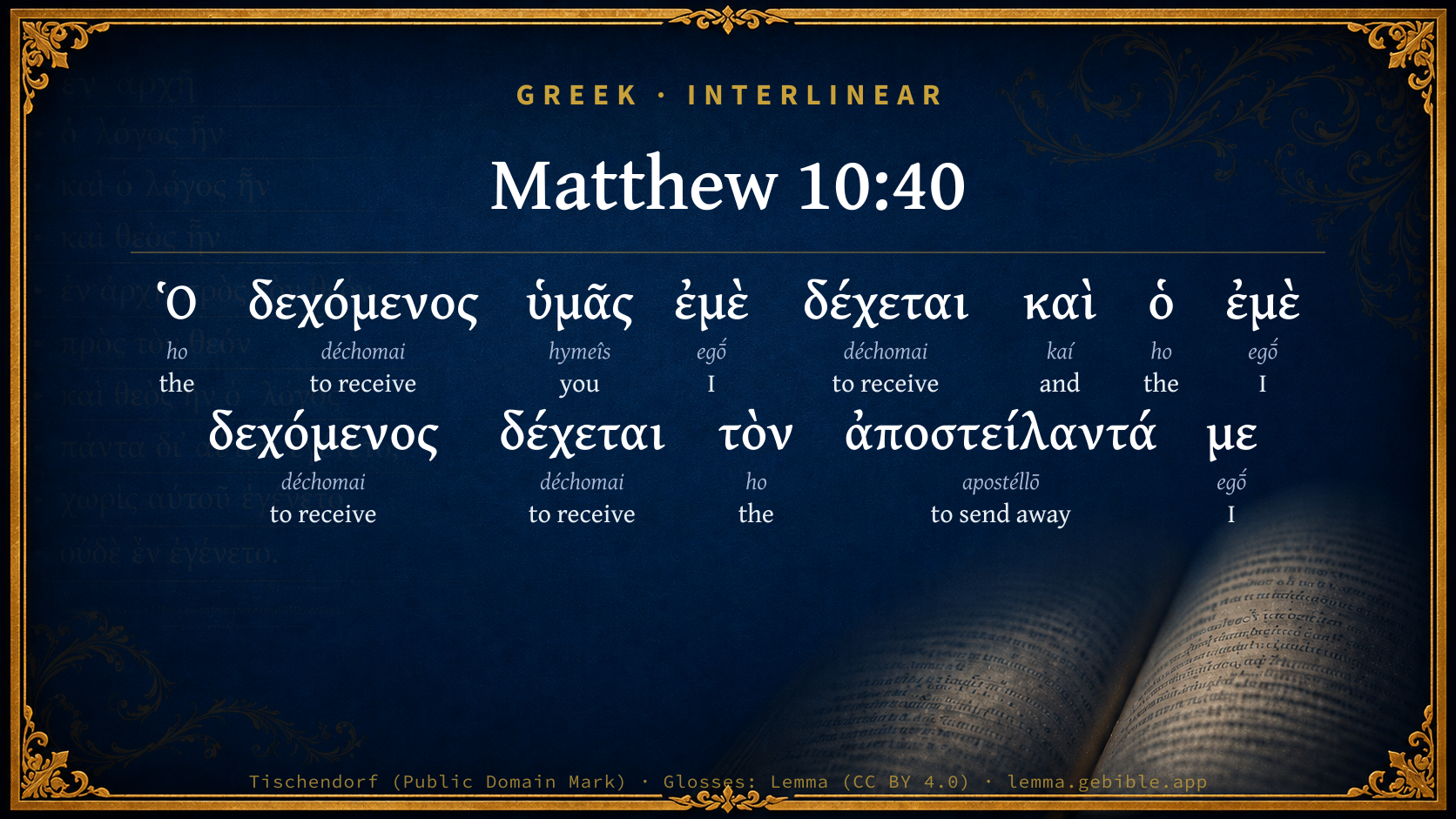
Greek (Tischendorf 8th ed.) Matthew 10:40 appears in the Greek New Testament. The text above is from the Tischendorf 8th edition. Each word links to its Strong’s number and a concise gloss. Click any word for its full Thayer’s Greek Lexicon entry.
Download image
Cite this verse

Matthew 10:40 (World English Bible). Public Domain. Lemma interlinear Bible study tool, https://lemma.gebible.app/v/matthew/10/40.

Show BibTeX & RIS
BibTeX
RIS
English Translation
He who receives you receives me, and he who receives me receives him who sent me.
World English Bible · Public Domain
Download a study sheet

One document with this verse’s original text, its word-by-word gloss line, the meaning frame, cross-references with their text, attributed commentary, and full source and license credits — printable, and it pastes into notes with its structure intact.

This verse Autodidact and up

Study sheet (.html) Plain text (.txt)

A passage Seminary Student

Up to 50 verses in one chapter. A passage sheet keeps up to 6 commentary sources and 12 cross-references per verse, in the order this page ranks them, and says so on the sheet whenever that leaves anything out. Ask for a single verse and you get the Autodidact verse sheet above.

Everything on this page stays free to read, with no account — the sheet is a download of what is already on screen, not access to it.

Want to remove ads? Support Godless Engineer
Compare translations 3

The same verse in 3 English versions, stacked beneath the original-language interlinear above. Click any original word for its lexicon entry.

Each is an independent rendering of the whole verse — the interlinear is not word-aligned to these translations.

Highlighted words mark where these versions differ — a whole-verse word diff, not a word-by-word alignment.

  • World English Bible Public Domain
    He who receives you receives me, and he who receives me receives him who sent me.
  • King James Version Public Domain
    He that receiveth you receiveth me, and he that receiveth me receiveth him that sent me.
  • unfoldingWord Literal Text CC BY-SA 4.0
    The one receiving you receives me, and the one receiving me receives the one having sent me.

unfoldingWord Literal Text — © unfoldingWord, licensed CC BY-SA 4.0. Word-aligned USFM3 via Door43 (git.door43.org/unfoldingWord/en_ult).

Versions to compare (up to 4)

3 of 4 selected

Show all 19 translations

Every available English version of this verse, each an independent rendering of the whole verse.

  • World English Bible Public Domain
    He who receives you receives me, and he who receives me receives him who sent me.
  • Berean Standard Bible Public Domain
    He who receives you receives Me, and he who receives Me receives the One who sent Me.
  • Majority Standard Bible Public Domain
    He who receives you receives Me, and he who receives Me receives the One who sent Me.
  • King James Version Public Domain
    He that receiveth you receiveth me, and he that receiveth me receiveth him that sent me.
  • American Standard Version (1901) Public Domain
    He that receiveth you receiveth me, and he that receiveth me receiveth him that sent me.
  • Revised Version (1885) Public Domain
    He that receiveth you receiveth me, and he that receiveth me receiveth him that sent me.
  • Geneva Bible (1599) Public Domain
    He that receiueth you, receiueth me: and hee that receiueth mee, receiueth him that hath sent me.
  • Douay-Rheims (1899) Public Domain
    He that receiveth you, receiveth me: and he that receiveth me, receiveth him that sent me.
  • Young's Literal Translation Public Domain
    `He who is receiving you doth receive me, and he who is receiving me doth receive Him who sent me,
  • Literal Standard Version CC BY-SA 4.0
    He who is receiving you receives Me, and he who is receiving Me receives Him who sent Me;
  • Unlocked Literal Bible CC BY-SA 4.0
    He who welcomes you welcomes me, and he who welcomes me also welcomes him who sent me.
  • unfoldingWord Literal Text CC BY-SA 4.0
    The one receiving you receives me, and the one receiving me receives the one having sent me.
  • Darby Bible Public Domain
    He that receives you receives me, and he that receives me receives him that sent me.
  • World Messianic Bible Public Domain
    “He who receives you receives me, and he who receives me receives him who sent me.
  • Webster's Bible Public Domain
    He that receiveth you, receiveth me, and he that receiveth me, receiveth him that sent me.
  • Free Bible Version CC BY-SA 4.0
    Those who welcome you welcome me, and those who welcome me welcome the one that sent me.
  • Bible in Basic English Public Domain
    He who gives honour to you gives honour to me; and he who gives honour to me gives honour to him who sent me.
  • Text-Critical English NT CC BY 4.0
    “Whoever receives you receives me, and whoever receives me receives him who sent me.
  • Tyndale New Testament (1534) Public Domain
    He that receavith you receavith me: and he that receavith me receavith him that sent me.

Literal Standard Version (2020), Covenant Press — licensed CC BY-SA 4.0. Text via the HelloAO Bible API (eBible.org). Unlocked Literal Bible (unfoldingWord) — licensed CC BY-SA 4.0. Text via the HelloAO Bible API (eBible.org). unfoldingWord Literal Text — © unfoldingWord, licensed CC BY-SA 4.0. Word-aligned USFM3 via Door43 (git.door43.org/unfoldingWord/en_ult). Free Bible Version, Dr. Jonathan Gallagher — licensed CC BY-SA 4.0. Text via the HelloAO Bible API (eBible.org).

Word by word

More ways to search: Search by grammar → Find every occurrence → Compare this word →

Practice this passage: Drill this verse → Learn its vocabulary →

δεχόμενος
déchomai
G1209
“to receive”
Verb, Present, Middle or Passive deponent, Participle, Nominative, Singular, Masculine
Part of Speech
Verb
Tense
Present
Voice
Middle or Passive deponent
Mood
Participle
Case
Nominative
Number
Singular
Gender
Masculine
Full Thayer's Definition

Origin: middle voice of a primary verb

TDNT: 02:50,1

1. to take with the hand a. to take hold of, take up 2. to take up, receive a. used of a place receiving one b. to receive or grant access to, a visitor, not to refuse intercourse or friendship 1. to receive hospitality 2. to receive into one's family to bring up or educate c. of the thing offered in speaking, teaching, instructing 1. to receive favourably, give ear to, embrace, make one's own, approve, not to reject d. to receive. i.e. to take upon one's self, sustain, bear, endure 3. to receive, get a. to learn
  1. Ὁ ho G3588 “the” Article, Nominative, Singular, Masculine
  2. ὑμᾶς hymeîs G5210 “you” Personal pronoun, 2nd person, Accusative, Plural
  3. ἐμὲ egṓ G1473 “I” Personal pronoun, 1st person, Accusative, Singular
  4. δέχεται déchomai G1209 “to receive” Verb, Present, Middle or Passive deponent, Indicative, 3rd person, Singular
  5. καὶ kaí G2532 “and” Conjunction
  6. ὁ ho G3588 “the” Article, Nominative, Singular, Masculine
  7. ἐμὲ egṓ G1473 “I” Personal pronoun, 1st person, Accusative, Singular
  8. δεχόμενος déchomai G1209 “to receive” Verb, Present, Middle or Passive deponent, Participle, Nominative, Singular, Masculine
  9. δέχεται déchomai G1209 “to receive” Verb, Present, Middle or Passive deponent, Indicative, 3rd person, Singular
  10. τὸν ho G3588 “the” Article, Accusative, Singular, Masculine
  11. ἀποστείλαντά apostéllō G649 “to send away” Verb, Aorist, Active, Participle, Accusative, Singular, Masculine
  12. με egṓ G1473 “I” Personal pronoun, 1st person, Accusative, Singular

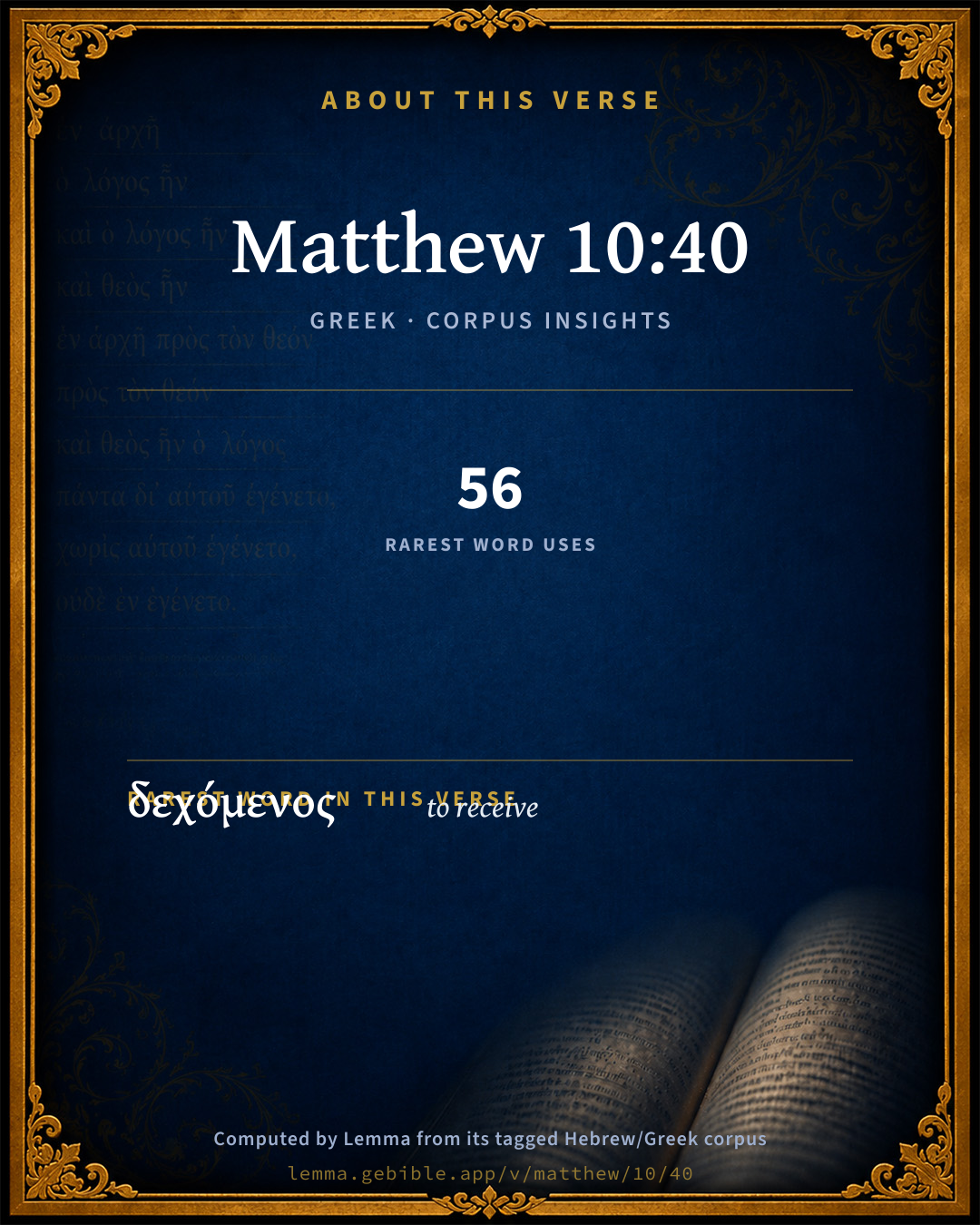
About this verse

These counts appear in no published source. They are computed here, from the morphology-tagged text and Lemma’s own curated glosses. What Lemma adds →

13
words
6
distinct lemmas
Gospels
section

Shared distinctive vocabulary

δεχόμενος to receive G1209 occurs in 45 verses of the Greek New Testament. Also found in:
Repetition

Words recur within this verse:

  • δεχόμενος to receive G1209 ×4
  • Ὁ the G3588 ×3
  • ἐμὲ I G1473 ×3

Cross-references

16

Topical passages linked to Matthew 10:40 in the Treasury of Scripture Knowledge — connected by theme and wording, ordered by reader-vote popularity; previews shown in the World English Bible.

  • John 13:20 Most assuredly I tell you, he who receives whomever I send, receives me; and he who receives me, receives him who sent me."
  • Luke 9:48 and said to them, "Whoever receives this little child in my name receives me. Whoever receives me receives him who sent me. For whoever is least among you all, this one will be great."
  • Luke 10:16 Whoever listens to you listens to me, and whoever rejects you rejects me. Whoever rejects me rejects him who sent me."
  • Matthew 18:5 Whoever receives one such little child in my name receives me,
  • Matthew 25:40 "The King will answer them, 'Most assuredly I tell you, inasmuch as you did it to one of the least of these my brothers, you did it to me.'
  • Mark 9:37 "Whoever receives one such little child in my name, receives me, and whoever receives me, doesn't receive me, but him who sent me."
  • John 20:21 Jesus therefore said to them again, "Peace be to you. As the Father has sent me, even so I send you."
  • Galatians 4:14 That which was a temptation to you in my flesh, you didn't despise nor reject; but you received me as an angel of God, even as Christ Jesus.
  • 2 John 1:9 Whoever transgresses and doesn't remain in the teaching of Christ, doesn't have God. He who remains in the teaching, the same has both the Father and the Son.
  • Matthew 25:45 "Then he will answer them, saying, 'Most assuredly I tell you, inasmuch as you didn't do it to one of the least of these, you didn't do it to me.'
  • John 5:23 that all may honor the Son, even as they honor the Father. He who doesn't honor the Son doesn't honor the Father who sent him.
  • 1 Thessalonians 4:8 Therefore he who rejects doesn't reject man, but God, who has also given his Holy Spirit to you.
  • John 12:44–49 Jesus cried out and said, "Whoever believes in me, believes not in me, but in him who sent me.
  • Philippians 2:10–11 that at the name of Jesus every knee should bow, of those in heaven, those on earth, and those under the earth,
  • 1 John 2:22–23 Who is the liar but he who denies that Jesus is the Christ? This is the Antichrist, he who denies the Father and the Son.
  • 2 Corinthians 5:20 We are therefore ambassadors on behalf of Christ, as though God were entreating by us. We beg you on behalf of Christ, be reconciled to God.

Cross-references courtesy of OpenBible.info (CC BY 4.0).

Commentary

Notes on Matthew 10:40 from classic Christian and Jewish commentators (each source and its license shown beneath its notes). The classic Christian expositions comment on the surrounding passage and are grouped to its opening verse, so a note may address several verses; the Jewish commentaries on the Tanakh (Rashi and others) are per-verse, so they appear only where the commentator wrote on this verse.

Lemma curates 59 commentaries, every one of them public domain or Creative Commons licensed, each selected and text-cleaned for this edition rather than reprinted as found. About our sources →

Albert Barnes' Notes on the Bible

He that receiveth you ... - In all these three illustrations Christ meant to teach substantially the same thing - that he that would entertain kindly or treat with hospitality himself, his disciples, a prophet, or a righteous man, would show that he approved their character, and should not fail of proper reward. To receive in the “name” of a prophet is to receive “as” a prophet; to do proper honour to his character, and to evince attachment to the cause in which he was engaged.

Mat 10:42

These little ones - By “these little ones” are clearly meant his disciples.

They are called “little ones” to denote their want of wealth, rank, learning, and whatever the world calls “great.” They were “little” in the estimation of the world and in their own estimation. They were “learners,” not yet “teachers;” and they made no pretensions to what attracts the admiration of mankind.

A cup of cold” water “only - Few would refuse a cup of cold water to any man, if thirsty and weary, and yet not all people would give it to such a one “because he was a Christian,” or to express attachment to the Lord Jesus. In bestowing it on a man “because he was a Christian,” he would show love to the Saviour himself; in the other case he would give it from mere sympathy or kindness, evincing no regard for the Christian, the Christian’s Master, or his cause. In one case he would show that he loved the cause of religion; in the other case, he would not.

Remarks On Matthew 10

1. From the narrative in this chapter, in connection with that in Luke, we are permitted to see the Saviour’s habits in regard to prayer. An important event was before him; an event on which, humanly speaking, depended the whole success of his religion - the choice of those who should be his messengers to mankind. He felt its importance; and even the Son of God sought the place of prayer, and during the nightwatches asked the direction of his Father. His example shows that we, in great and trying circumstances, should seek particularly the direction of God.

2. We see the benevolence of the gospel, Mat 10:7-8. The apostles were to confer the highest favors on mankind without reward. Like air, and sunbeams, and water - gifts of God - they are without price. The poor are welcome; the rich, unaided by their wealth, are welcome also; the wide world may freely come and partake the rich blessings or the gospel of peace.

3. Ministers of the gospel, and all the followers of Jesus, should depend on the providence of God for support and the supply of their wants, Mat 10:9-10. He sent his apostles into a cold, unfriendly world, and he took care of them. So none that trust Him shall lack. The righteous shall not be forsaken. The God who has in His hand all the pearls of the ocean, the gold in the heart of the earth, and the cattle on a thousand hills, and that feeds the raven when it cries, will hear the cries of His children and supply their needs.

4. We see the duty of treating kindly the messengers of salvation, Mat 10:11-13. Christ expected that in every city and town they would find some who would welcome them. He promised the reward of a prophet to those who should receive a prophet, and assured those of his favor who had nothing better to bestow than even a cup of cold water. The ministers of religion are sent to benefit the world. It is but right that in that world they should be kindly received, and that their wants should be supplied.

5. The guilt of rejecting the gospel, Mat 10:14-15. It is not a small matter to reject an offer of heaven. A palace, a throne, a rich earthly inheritance, might be rejected, and, compared with rejecting the gospel, it would be a trifle. But life eternal is not like thrones, and gold, and palaces. This lost, all is lost. The gospel rejected, all is gone. Nor hope nor happiness awaits him that hath spurned this offer. God requires everyone to believe the gospel; and woe, woe, a greater woe than befell guilty Sodom and Gomorrah, to him who rejects it.

6. Judgment will certainly overtake the guilty, Mat 10:15. It fell upon Sodom, and it will fall on all transgressors. None shall escape. Damnation may slumber long over the wicked, and they may long mock the God of truth, but in due time their feet will slide, and the whole creation shall not be able to save them from woe. How dangerous, how awful is the condition of an impenitent sinner!

7. We are to take proper care of our lives, Mat 10:23. The apostles were to flee from danger, when they could do it without denying their Lord. So are we. He that throws away his life when it might have been, and ought to have been preserved, is a self-murderer. He that exposes himself when duty does not require it, and whose life pays the forfeit, goes before God “rushing unbidden into his Maker’s presence,” nor can he be held guiltless.

8. We are to persevere “in our duty” through all trials, Mat 10:23. Neither the world, nor pain, nor poverty, nor persecution. nor death is to appal us. He that endures to the end shall be saved. We have but one thing to do - to do the will of God, to “be Christians everywhere,” and to leave the event with him.

9. God exercises a particular providence, Mat 10:29-30. He watches the falling sparrow, numbers the hairs of the head, and for the same reason he presides over all other things. The Lord reigneth, says the Psalmist, let the earth rejoice, Psa 97:1.

10. The duty of making a profession of religion, Mat 10:32-33. It must be done in a proper way, or Christ will disown us in the day of judgment. It is impossible to neglect it, and have evidence of piety. If ashamed of him, he will be ashamed of us.

11. Religion is easy, and easily tested, Mat 10:40-42. What more easy than to give a cup of water to a stranger, and what more easy than to know from what motive we do it! Yet how many are there who, while they would do the thing, would yet “lose eternal life” rather than do it with a view of honoring Christ or showing attachment to him! How dreadful is the opposition of the human heart to religion! How amazing that man will not do the slightest act to secure an interest in the kingdom of God!

Albert Barnes' Notes on the Bible (1834–1885) — public domain. Text from a community e-Sword/MySword module.

Whedon's Commentary on the Bible

Daniel D. Whedon

The Result, Mat_10:40-42.

All that receive the apostles, and God and Christ, in them, shall share with the apostles in their reward.

40. He that receiveth you — The phrase that receiveth you, imports undoubtedly receiving in faith their mission. It implies the heartfelt acceptance of Christianity, and the reception of the saving grace of the Gospel. Receiveth me — As his accepted and sufficient Saviour.

41. He that receiveth a prophet — That is, with a faithful acceptance of his message. In the name of a prophet — With a full recognition of his character and mission, and in spite of the persecutions of a faithless world. Shall receive a prophet’s reward — Sharing both the prophet’s faith and the prophet’s danger, he shall share the prophet’s reward.

42. One of these little ones — A tender appellation for his apostles. They were sheep in the midst of wolves, they were harmless like doves, they were tender like little ones. A cup of cold water only in the name of a disciple — In the glowing climate of Palestine, the pursued and persecuted apostle might find a cup of cold water the preservation of his life. And whosoever, in recognition of his discipleship, that is, because he was a disciple of Jesus, and from love to his Master, shall furnish him this precious boon, shall in no wise lose his reward. His faith has worked by love, and has been justified by works.

Here, therefore, is no shadow of a denial of the doctrine of justification by faith; but an assertion that works in faith are graciously rewarded of God. And in such faith the slightest work, the simplest cup of cold water, is a noble investment for a great reward.

It is said that in India the Hindoos go often a great distance for water, boil it to render it healthful, and then, in honour of some idol, stand by the roadside until night offering drink to travellers. Such an act of faith in Christ performed for his apostles cannot fail of its reward.

This commissioning of the apostles opens the SIXTH PERIOD of our Lord’s history upon earth. It is the period of his expanding ministry. See Historical Synopsis. His apostles go forth; the Baptist retreats from the world; the fame of Jesus fills the palace of Herod; and the faith of his disciples is so established that at the next period he commits to them the keys of his kingdom and prepares for his departure. Mat_16:13-21.

Neither Matthew nor either of the other evangelists gives a detailed account of the mission of the apostles. While our Saviour was upon earth, and preaching, it seems as if the evangelist held all other ministries of little account. Mark tells us (Mar_6:12-13) that “they went out and preached that men should repent. And they cast out many devils, and anointed with oil many that were sick, and healed them.” And in Mar_6:30 : “The apostles gathered themselves unto Jesus, and told him all things, both what they had done, and what they had taught.” And this was followed by their crossing over Lake Gennesaret, and the feeding of the five thousand. We are informed in the first verse of the next chapter, that when Jesus had finished this discourse, he departed thence to teach and to preach in their cities.

Daniel D. Whedon (gen. ed.), Commentary on the Old and New Testaments (1874–1909) — public domain. Text from a community e-Sword module.

Bengel's Gnomon

Johann Albrecht Bengel

Mat 10:40. Ὑμᾶς, you) A descending gradation: sc. you (apostles), a prophet, a righteous man, a little one.—Ἐμὲ, Me) It is not only of the same avail as if he received Me, but he actually does receive Me.

Bengel's Gnomon of the New Testament — English translation (T&T Clark, Edinburgh, 1860) — public domain. Text from a community e-Sword module.

Meyer's Critical & Exegetical Commentary

Heinrich August Wilhelm Meyer

Mat_10:40-42. Before concluding, the reassuring statement is added that: In all such troubles you are to have the less hesitation in claiming to be entertained and supported by believers; the holier the deeds and the greater (in the Messianic kingdom) the reward of those will prove to be who so receive and maintain you. Euth. Zigabenus appropriately observes: ταῦτα εἶπεν ἀνοίγων τοῖς μαθηταῖς τὰς οἰκίας τῶν πιστευόντων. Comp. with Mat_10:40, Joh_13:20; and with Mat_10:41 f., comp. Mar_9:37; Mar_9:41.

Meyer — Critical and Exegetical Commentary on the New Testament — English translation by Peter Christie, edited by Frederick Crombie (T&T Clark, 1880) — public domain. Text from a community e-Sword module.

Expositor's Greek Testament

ed. W. Robertson Nicoll

Mat 10:40-42 . The following sentences might have been spoken in connection with the early Galilean mission, and are accordingly regarded by Weiss as the conclusion of the instructions then given. Luke gives their gist (Mat 10:16 ) at the close of the instructions to the seventy. After uttering many awful, stern sayings, Jesus takes care to make the last cheering. He promises great rewards to those who receive the missionaries, thereby “opening the houses of the whole world to them,” Chrysos.

Mat 10:40 . ἐμὲ δέχεται : first the principle is laid down that to receive the messenger is to receive the Master who sent him (Mat 25:40 ), as to receive the Master is to receive God.

The Expositor's Greek Testament, edited by W. Robertson Nicoll (1897–1910) — public domain. Text from a community e-Sword module.

Geneva Bible (1599)

Geneva Bible translators

God is both author and revenger of his holy ministry.

Geneva Bible (1599) marginal notes — public domain. Text via Bolls.life.

Jamieson, Fausset & Brown

Robert Jamieson, A. R. Fausset & David Brown

He that receiveth you--entertaineth you,

receiveth me; and he that receiveth me, receiveth him that sent me--As the treatment which an ambassador receives is understood and regarded as expressing the light in which he that sends him is viewed, so, says our Lord here, "Your authority is Mine, as Mine is My Father's."

Jamieson, Fausset & Brown — Commentary Critical and Explanatory on the Whole Bible (1871) — public domain (CC PDM 1.0). Text via the HelloAO Bible API.

Adam Clarke's Commentary

Verse 40. He that receiveth you] Treats you kindly, receiveth me; I will consider the kindness as shown to myself; for he who receiveth me, as the true Messiah, receiveth that God by whose counsels and through whose love I am come.

Adam Clarke's Commentary on the Bible (1810–1826) — public domain. Text from a community e-Sword/MySword module.

Ellicott's Commentary for English Readers

(40) The discourse which had so clearly told of suffering ends with words of promise and the assurance of victory. As Christ was sent by the Father (Joh_20:21; comp. Heb_3:1), so were they His apostles and representatives; and He would count all honour and affection shown to them as shown also to Himself, and through Him to His Father.

A Bible Commentary for English Readers, edited by Charles John Ellicott (1878–1897) — public domain. Text from a community e-Sword module.

The Cambridge Bible for Schools and Colleges

gen. ed. J. J. S. Perowne

40–42. The Reception of the Apostles and Ministers of Jesus Christ

40. receiveth] In the sense of receiving as a teacher, and of welcoming as a guest, see Mat_10:14. Whoever welcomes the Apostles and listens to them, listens to the voice of Jesus Christ and of God the Father Himself, and They “will make their abode with him,” Joh_14:23.

The Cambridge Bible for Schools and Colleges (gen. ed. J. J. S. Perowne; Cambridge University Press, 1878–1918) — public domain. Text from a community e-Sword module.

John Gill's Exposition

He that receiveth a prophet in the name of a prophet,.... By "a prophet" is meant, not one that foretells things to come, but a preacher of the Gospel; for as prophesying sometimes signifies preaching, so a prophet designs a minister of the word: and to "receive" him, is not only to embrace his doctrine, but to entertain him in a kind, and generous manner; and he that does this, "in the name of a prophet", not as coming in the name of another prophet, but upon this account, and for this consideration, because he himself is a prophet; so the phrase, "in the name", or on the account of anything, is often used in the Misnic writings (s): he that regards such a person, and shows him respect, by an hospitable entertainment of him; not because he may be related to him after the flesh; or because he may be a man of good behaviour, of a singular disposition and temper, of much learning and eloquence, of great natural parts and abilities; but because he is a faithful minister of the Gospel; he

shall receive a prophet's reward: either a reward from the prophet himself, who shall interpret the Scriptures to him, preach the Gospel to him, lead him more fully into the truths of it, and guide him to the true, and more clear and distinct sense of the sacred writings; which is an ample reward for his kind entertainment of him: or else, that reward which God has appointed, prepared, and promised, to them who receive his prophets; and which indeed is no other, than what the prophets themselves shall receive, even the reward of the inheritance, the kingdom prepared from the foundation of the world, a reward of grace, and not of debt; since both, in their way, serve the Lord Christ.

And he that receiveth a righteous man, in the name of a righteous man. He that is kind and liberal to any good man, whether he is a minister of the Gospel or not, who appears to have the work of grace upon his soul, and is justified by the righteousness of Christ, and expects eternal life on that account; if he shows respect to him, purely because he has the image of Christ stamped on him, and the righteousness of Christ imputed to him, and not on any natural, worldly, or civil accounts,

he shall receive a righteous man's reward; either from the good man himself, who will not fail to pray for his benefactor, to wish him well, and give him all the assistance he can in his Christian course; to exhort, comfort, instruct him as much, and as far as his Christian experience will furnish him with; or else the same reward of grace the righteous man himself shall have, namely, eternal life, as God's gift, through Jesus Christ our Lord.

(s) Misn. Zebachim, c. 1. sect. 1. 2, 3, 4. & 4. 6. &. 6. 7. & 7. 1, 2, 3, 4.

John Gill's Exposition of the Whole Bible (1746–1763) — public domain (CC PDM 1.0). Text via the HelloAO Bible API.

Trapp's Complete Commentary

John Trapp

40 He that receiveth you receiveth me, and he that receiveth me receiveth him that sent me.

Ver. 40. He that receiveth you, receiveth me] And who would not be glad to entertain the Lord Christ? Elizabeth held it a great matter that the another of her Lord should come to her, Luk 1:43. Behold, Christ comes to us in his servants, in his ministers especially. Receive them, therefore, as so many angels, yea, as Christ himself, Gal 4:14, accounting their very feet (how much more their faces!) beautiful. We know with what great respect Cornelius entertained Peter. Non tanus sum, ut vos alloquar, said Tertullian to certain martyrs. He tells us also that it was a custom of some in those times, reptare ad vincula martyrum, to creep to the martyr’s bonds in way of honour to them, which perhaps was more than was meet.

Receiveth him that sent me] The heathens held it a great honour to entertain their gods; and the poets tell us of much evil that befell those that refused to do so. "That which we have heard and seen," saith St John, "declare we unto you, that ye also may have fellowship with us," 1Jn 1:3. But what so great matter is that might some say. You and your fellows are but men of low condition. True, saith the apostle, but as lowly as we are, our "fellowship is with the Father, and with his Son Jesus Christ," who will also come in and sup with such as receive his servants. And may they not be glad of such guests?

John Trapp, A Commentary or Exposition upon All the Books of the Old and New Testament (1647–1656) — public domain. Text from a community e-Sword module.

Matthew Poole's English Annotations

He that receiveth you receiveth me, &c.; we have the same Luk 10:16, only there it is, he that heareth you heareth me; and there is added, and he that despiseth you despiseth me; and he that despiseth me despiseth him that sent me. In Joh 13:20, it is, Verily, verily, I say unto you, He that receiveth whomsoever I send receiveth me; and he that receiveth me receiveth him that sent me. As great princes account what favour is shown to their ambassadors, who represent their persons, shown unto themselves, and whatsoever indignities or affronts are done unto them as done to themselves, so doth Christ.

Receiving is a general term, and capable of a large interpretation. That hearing is one branch of it, Luke tells us. The scope of the context, and the words that follow, do manifest that a giving entertainment to them in their houses is another thing here meant. There is another more inward, receiving of their doctrine by faith and love, to which undoubtedly there will be a great reward. But whether it be here intended, I doubt. Our Saviour was sending the twelve out, he had commanded them to take with them no gold, silver, nor brass, no scrip, &c.; but when they came into any city, to inquire who there were in that city who were worthy men, favourers to the gospel, and ready to entertain strangers, and to go to their house or houses, saluting them, and to abide there till they left the place. He furnisheth them here as it were with a ticket, or bill of exchange. He gives them an assurance, that whatsoever kindness should be done to them, he would account it as done to himself. And further hath assured both them, and all the world, that if any should come to them to reveal the will of God, (for that the term prophet signifieth), if they give him an entertainment upon that account they should be rewarded. What is here meant by the term, a prophet’s reward, is variously guessed, whether it be,

1. The reward which God hath appointed for such as entertain his prophets; or;

2. Such a reward as such a prophet shall himself receive; or;

3. The reward which the prophet; will give him or them, viz. prayers and instruction.

That which appears to me most probable is, that no more is meant than a liberal reward, for such shall be the reward of those who turn many to righteousness, Dan 12:3. Those words, in the name of a prophet, are both exclusive of those from the benefit of this promise who receive and entertain the ministers of the gospel upon any other account than this, that they are the Lord’s prophets; and also encouraging to those who may discern they have been mistaken in their acts of charity of this nature; if they have been sincere in their designs and actions, they shall not lose their reward, though the pretended prophet so entertained prove but an impostor.

And whosoever shall give to drink unto one of these little ones a cup of cold water only in the name of a disciple, he shall in no wise lose his reward. Christ will not only reward those who show love to his prophets, but those who show kindness to his members, whom the world counts contemptible, and calleth little ones; nor shall those only be rewarded who give them great entertainments, and make them great presents, but (if it be proportionable to what they are able to do) though it be a kindness of the most minute consideration, but a cup of cold water, they shall be rewarded. God rewards the love we show to him, and the good actions that flow from it. Here are three persons mentioned, for whose entertainment and reception God hath provided in this promise; a prophet, a righteous man, a little one: and a threefold reward promised; the reward of a prophet, the reward of a righteous man, and his reward. How to distinguish the righteous man and the little one I cannot tell, unless we understand by the righteous man one more perfect, more eminent in holiness; and by the little one, one that is sincere, though we cannot judge him so grown in grace and the knowledge of Christ. I should understand no more by the threefold rewards, than God’s more particular value for his ministers, and for such as are more perfect in holiness; while in the mean time he will not break the bruised reed, nor quench the smoking flax; and that every one shall be rewarded according to his works; which shall not be measured by the quantity of the gift, but by the obedience, and affection, and ability of the giver, Luk 21:2,3; Heb 6:10.

Matthew Poole's English Annotations on the Holy Bible (1683–1685) — public domain. Text from a community e-Sword/MySword module.

The Pulpit Commentary

Vers. 40-42. Final encouragement. The evangelist takes the main idea of these verses from our Lord"s words to the seventy, (Luk_10:16) but moulds it in the form of his later saying, Mat_18:5. (cf. especially the parallel passage, Luk_9:48, also Mar_9:37) He further adds (ver. 42) other words also spoken later. (Mar_9:41; cf. ver. 42 there with our Mat_18:6) In these verses the discourse returns to the immediate occasion, the mission of the disciples. Christ shows his personal interest in their work; his messengers" cause is his. He says, "I reckon treatment of you as treatment of me; ay, and he that sent me reckons it as treatment of himself" (ver. 40). This principle as to the treatment of representatives holds good throughout. Not every one can be a prophet, but those who help him shall share his reward. Not every one shall acquire the technical name of "righteous," but those who help such a man shall share his reward (ver. 41); even the smallest kindnesses shall not be unrewarded (ver. 42).

He that receiveth you receiveth me. "A man"s messenger is as himself" (Mishna, "Berach.," 5:5). Yet, as Bengel says, "Non mode tantundem est, ac si me reciperet. sed severn me recipit. " Ford quotes from Tertullian ("De Orat.," "A brother that hath entered into thine house, dismiss not without prayer. "Thou hast seen," saith he, "thy brother; thou hast seen thy Lord. The same legion is found twice in Clem. Alex. (cf. Resch, "Agrapha," p. 296). (For an extension of the thought to bishops, cf. Ign., "Ephesians,"

Receiving Christ.

Jesus concludes his charge to the twelve on the eve of their mission with words that have more reference to others, with a promise of blessing to those who shall give a good reception to the apostles. Earlier he said that if any rejected the messengers of Christ they were to shake off the very dust of their feet as a testimony against the inhospitable people; and now he concludes his address by cheering words on the other side, generously recognizing a friendly reception of his disciples. Local and temporal as was the immediate occasion of our Lord"s remarks, they are evidently of lasting application.

I THE BROTHERHOOD OF CHRIST LEADS HIM TO REGARD KINDNESS TO HIS DISCIPLES EXACTLY AS THOUGH IT WERE OFFERED TO HIMSELF. He is not the Oriental monarch treating his subjects as a race of slaves. He is completely one with his people. Whatever hurts them hurts him; whatever cheers them pleases him. There is a Christian solidarity. The benefit or injury of one member affects the whole body. (1Co_12:26) But if other members of the body are thus affected, much more will the Head, which is in direct communication with the whole, be affected.

1. This is meant as a great encouragement for the servants of Christ. They are not deserted by Christ; he is in all their work, and he feels keenly every kindness or unkindness offered to them.

2. This suggests how we may all have the unspeakable privilege of receiving Christ. Not only a prophet or an apostle, but a little child, may bring Christ to our home. Receiving the least of Christ"s disciples for his sake, we receive him.

II THE CONDITION OF RECEIVING CHRIST IS RECEIVING HIS DISCIPLES IN HIS NAME.

1. Receiving Christs disciples. He does not speak here of indiscriminate hospitality, nor of the neighbourly love which he elsewhere commends. Here is a specially Christian action. Much is made in the New Testament of brotherly love love to fellow-Christians. It is a great privilege to be able to help one of Christ"s own little ones.

2. Receiving them in Christs Name. Thrice does our Lord refer to the conditions of "the name name of a prophet," "the name of a righteous man," "the name of a disciple." This points to a set purpose in the hospitality. The prophet is received as a prophet because we wish to honour prophets; the righteous man as a righteous man because we desire to help the righteous; the Christian disciple as a disciple, for Christ"s sake. This is more than mere kindness; it is a distinct recognition of the claim of Christ. We are encouraged to show kindness for Christ"s sake, that we may please him receiving the envoy for the sake of the King.

III THEY WHO THUS RECEIVE CHRIST"S DISCIPLES ARE DOUBLY REWARDED.

1. In receiving, Christ. They are treated just as though they had shown hospitality to the Lord Jesus Christ himself. But the reward of such hospitality is in the very coming of Christ. When he entered the house of Zacchaeus salvation came there. To have Christ within us is to have a better blessing than could be got out of all the wealth of the Indies or all the joy of a Christless paradise.

2. In receiving God. This thought is nearly akin to the teaching of the Fourth Gospel. (see Joh_14:9, Joh_14:10) We do not merely receive Christ as a brother-man. Beneath the veil of the humanity of Jesus the very glory of God enters the soul. Thus he who receives a child lop Christ"s sake is blessed by having God in his heart, and then his heart becomes a heaven. W.F.A.

The Pulpit Commentary (1880–1919), ed. H.D.M. Spence-Jones & Joseph S. Exell — public domain. Text from a community e-Sword module.

John Wesley's Explanatory Notes

Matt. xviii, 5; Luke x, 16; John xiii, 20.

John Wesley, Explanatory Notes Upon the Whole Bible (1754–1765) — public domain. Text via the GEBible commentary corpus.

Kretzmann's Popular Commentary

Paul E. Kretzmann

A cheering saying:

v. 40. He that receiveth you receiveth Me; and he that receiveth Me receiveth Him that sent Me.

v. 41. He that receiveth a prophet in the name of a prophet shall receive a prophet’s reward; and he that receiveth a righteous man in the name of a righteous man shall receive a righteous man’s reward.

v. 42. And whosoever shall give to drink unto one of these little ones a cup of cold water only, in the name of a disciple, verily, I say unto you, he shall in no wise lose his reward.

The apostles, the messengers of Christ, are His representatives. The treatment accorded them is, in them, given to Christ, and thus to God Himself, for the Master and God are one. But He makes the statement more general. He who receives, shows any kindness to, a prophet, one commissioned by God to teach the truth of eternal life, always keeping that fact in mind, will receive the reward of the prophet from God. The same holds true of him that shows a similar favor to any Christian brother, to any of the righteous. He also shall have a reward of mercy. And were it, under circumstances, only so much as a drink of cold water, as a welcome boon to a thirsty traveler, to refresh a brother, a fellow-disciple, or another sufferer, Christ affirms with great emphasis that such a person will not be without his reward. Christ speaks with great emotion, it is a question which affects Him very deeply, since the men whom He is sending out are His own messengers, who shall be consecrated wholly to Him. Any attention which may aid them in doing the great work of proclaiming the Gospel more cheerfully not only meets with His approval, but will, in the end, at least on the great day of reckoning, find such acknowledgment as will fully repay the kindness, and with thousand-fold interest.

Summary.Christ commissions twelve of His disciples as apostles by transmitting to them miraculous powers, by giving them instructions as to dress, equipment, content of preaching, manner of entry, reception, and rejection of the Gospel, and demanding perfect consecration to Him.

Paul E. Kretzmann, Popular Commentary of the Bible (1921–1924) — public domain. Text from a community e-Sword module.

Burkitt's Expository Notes on the New Testament

William Burkitt

Here in the close of the chapter, our blessed Saviour encourages his apostles to faithfulness in their office, by assuring them that he should reckon and esteem all the kindness shown to them as done unto himself: and to encourage the world to be kind to his disciples and ministers, he assures them that even a cup of cold water should meet with a liberal reward. How cold is their charity who deny a cup of cold water to the ministers and disciples of Christ!

Learn, 1. That there is some special and eminent reward due to the faithful prophets of God above other men.

2. That he that shall entertain a prophet and do any good office for him, under that name, that is, for his office sake, shall be partaker of that reward.

3. That the least office of love and respect, of kindness and charity, which we show to any of the ministers or members of Jesus Christ for his sake, Christ accounts it as done unto himself, and it shall be rewarded by himself.

William Burkitt's Expository Notes on the New Testament (1700–1703) — public domain. Text from a community e-Sword module.

The People's New Testament

B. W. Johnson

40. He that receiveth you, receiveth me. They would go forth in Christ's name, as his servants and ambassadors. They carried his message, and to receive it and them was virtually receiving him.

B. W. Johnson's The People's New Testament with Notes (1889–1891) — public domain. Electronic text from the Christian Classics Ethereal Library (CCEL) ThML edition.

unfoldingWord translationNotes

Door43 World Missions Community

Connecting Statement:

Jesus continues to instruct his disciples about the reasons why they should not be afraid of the persecution that they might experience.

He who

The word "He" refers to anyone in general. AT: "Whoever" or "Anyone who" or "The one who" (See: When Masculine Words Include Women)

welcomes

This means to receive someone as a guest.

you

This is plural and refers to the twelve apostles to whom Jesus is speaking. (See: Forms of You)

He who welcomes you welcomes me

Jesus means that when someone welcomes you, it is like welcoming him. AT: "When someone welcomes you, it is like he is welcoming me" or "If someone welcomes you, it is as if he were welcoming me"

he who welcomes me also welcomes him who sent me

This means that when someone welcomes Jesus, it is like welcoming God. AT: "When someone welcomes me, it is like he is welcoming God the Father who sent me" or "If someone welcomes me, it is as if he were welcoming God the Father who sent me"

because he is a prophet

Here "he" does not refer to the person who is welcoming. It refers to the person being welcomed.

a prophet's reward

This refers to the reward that God gives the prophet, not to the reward that a prophet gives to another person.

he is a righteous man

Here "he" does not refer to the person who is welcoming. It refers to the person being welcomed.

a righteous man's reward

This refers to the reward God gives to a righteous person, not a reward that a righteous person gives to another person.

translationWords

send

prophet

reward

righteous

unfoldingWord translationNotes — © Distant Shores Media and the Door43 World Missions Community, licensed CC BY-SA 4.0. Source: git.door43.org/Door43/en_tn.

Cambridge Greek Testament for Schools and Colleges

40–42. THE RECEPTION OF THE APOSTLES AND MINISTERS OF JESUS CHRIST

In respect of poetical form, note first the ascending climax ὑμᾶς … ἐμὲ … τὸν πέμψαντα ἐμέ. And then the descending climax, προφήτην … δίκαιον … ἕνα τῶν μικρῶν. The privilege rises to the highest point conceivable; the reward is not only for welcome to a prophet but for the slightest service to the lowliest child of God (see Bp. Jebb, Sacr. Lit., on the whole passage). For a similar rise and fall in a poetical passage see ch. Mat 20:25-28.

40. ὁ δεχόμενος. In the sense of receiving as a teacher, and of welcoming as a guest, see Mat 10:14. Whoever welcomes the Apostles and listens to them, listens to the voice of Jesus Christ and of God the Father Himself, and They ‘will make their abode with him,’ Joh 14:23.

Cambridge Greek Testament for Schools and Colleges (Cambridge University Press, 1896; 21 vols, various authors incl. Carr, Maclear, Plummer, Farrar, Lumby, Moule, M. R. James, Simcox) — public domain. Text from a community e-Sword module.

Alford’s Greek Testament

Henry Alford

40.] Here in the conclusion of the discourse, the Lord recurs again to His Apostles whom He was sending out. From ver. 32 has been connected with πᾶς ὅστις, and therefore general.

δέχεται, see ver. 14; but it has here the wider sense of not only receiving to house and board,—but receiving in heart and life the message of which the Apostles were the bearers. On the sense of the verse, see Joh 20:21, and on τὸν ἀποστείλαντά με, ἐγὼ ἀποστέλλω ὑμᾶς, ver. 16, and Heb 3:1. There is a difference between the representation of Christ by His messengers, which at most is only official, and even then broken by personal imperfection and infirmity (see Gal 2:11; Gal 4:13, Gal 4:14),—and the perfect unbroken representation of the Eternal Father by His Blessed Son, Joh 14:9: Heb 1:3.

Henry Alford, The Greek Testament (1849–1861) — public domain. Text from a community e-Sword module.

International Critical Commentary

(L) 40. He who receiveth you receiveth Me, and he who receiveth Me receiveth Him that sent Me.] Cf. Mar 9:37.

International Critical Commentary — older volumes (1896–1929), various authors — public domain. Text from a community e-Sword module.

Lesson kit

Teaching starters — assembled from the data on this page, not authored interpretation. Every prompt links to the verse data it draws on. Edit before teaching.

Matthew, in the Gospels, opens this verse with 13 words (6 distinct Greek lemmas). Its most distinctive word is déchomai (“to receive”). A historical commentator’s framing appears above. Read the whole chapter for the surrounding context.

Discussion questions

  1. The word déchomai carries the sense “to receive.” How does it shape the verse?
  2. How does Matthew 10:14, which shares the word «to receive», read alongside this verse?
  3. What does the repetition of “to receive” (4× in this one verse) do in this verse?
  4. These translations render this verse differently; the difference is in the English rendering, not the original. What questions does that raise?
  5. Compare how Albert Barnes' Notes on the Bible and Whedon's Commentary on the Bible read this verse. Where do they agree or differ?

Things to notice

  • These translations choose different wording for 7 words in this verse.
  • “to receive” occurs 4× in this single verse.
  • 6 distinct Greek lemmas span 13 words in this verse.

Reading settings

Reading text

Shown beneath each verse's original-language words.

Old Testament
Old Testament edition

Read the OT as the Masoretic Hebrew (MT) or the Greek Septuagint (LXX).

English shown for the Greek Septuagint (in the Hebrew ↔ Greek comparison).

Comparing translations? Open the Compare panel on any verse page to stack up to four side by side.