

Matthew 12:44
Greek (Tischendorf 8th ed.) Matthew 12:44 appears in the Greek New Testament. The text above is from the Tischendorf 8th edition. Each word links to its Strong’s number and a concise gloss. Click any word for its full Thayer’s Greek Lexicon entry.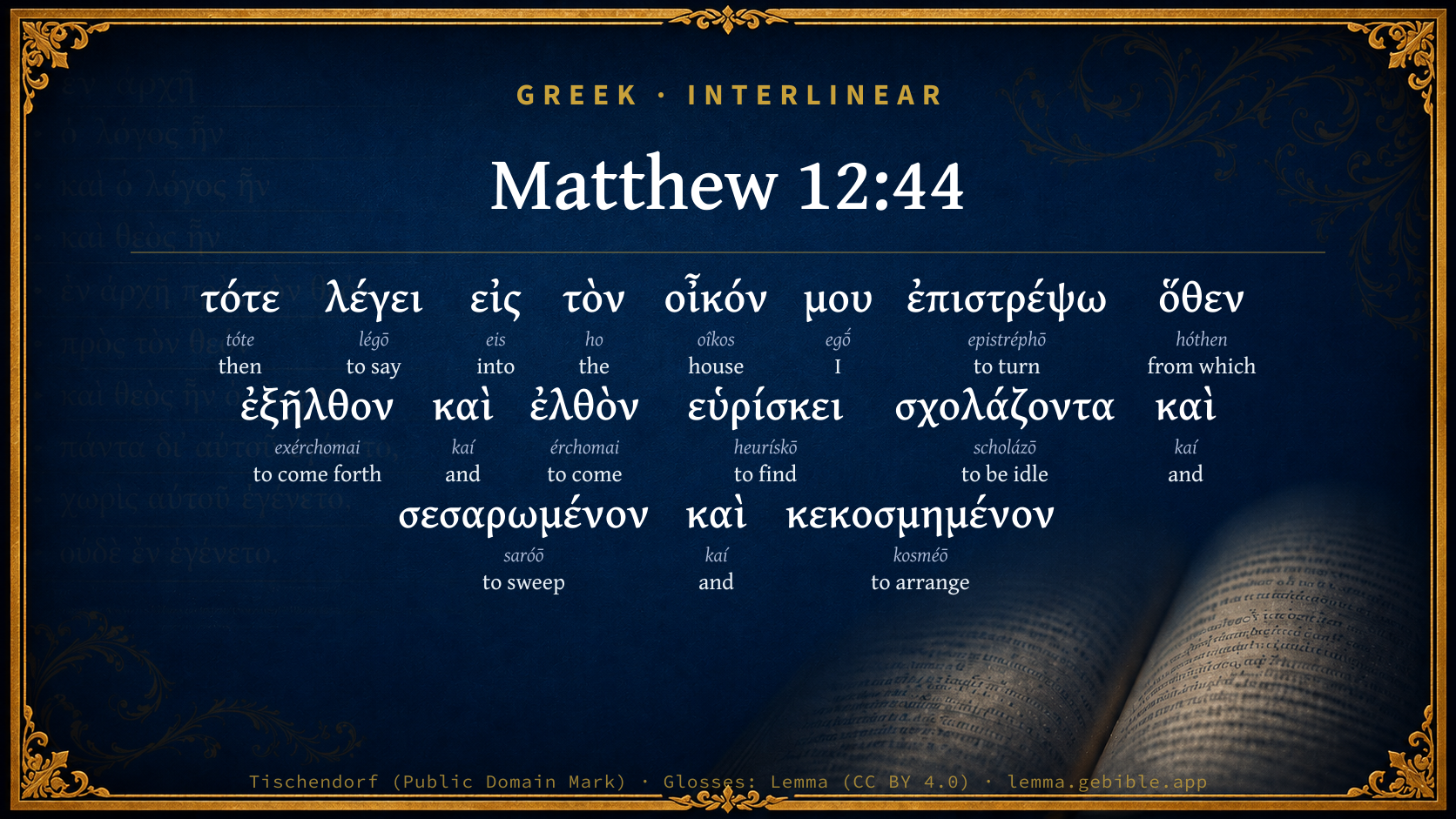
Then he says, 'I will return into my house from which I came out,' and when he has come back, he finds it empty, swept, and put in order.
Download a study sheet
One document with this verse’s original text, its word-by-word gloss line, the meaning frame, cross-references with their text, attributed commentary, and full source and license credits — printable, and it pastes into notes with its structure intact.
This verse Autodidact and up
A passage Seminary Student
Up to 50 verses in one chapter. A passage sheet keeps up to 6 commentary sources and 12 cross-references per verse, in the order this page ranks them, and says so on the sheet whenever that leaves anything out. Ask for a single verse and you get the Autodidact verse sheet above.
Everything on this page stays free to read, with no account — the sheet is a download of what is already on screen, not access to it.
Compare translations 3
The same verse in 3 English versions, stacked beneath the original-language interlinear above. Click any original word for its lexicon entry.
Each is an independent rendering of the whole verse — the interlinear is not word-aligned to these translations.
Highlighted words mark where these versions differ — a whole-verse word diff, not a word-by-word alignment.
-
World English Bible Public Domain
Then he says, 'I will return into my house from which I came out,' and when he has come back, he finds it empty, swept, and put in order.
-
King James Version Public Domain
Then he saith, I will return into my house from whence I came out; and when he is come, he findeth it empty, swept, and garnished.
-
unfoldingWord Literal Text CC BY-SA 4.0
Then it says, ‘I will return to my house from which I came out.’ And having come, it finds being empty, having been swept out and put in order.
unfoldingWord Literal Text — © unfoldingWord, licensed CC BY-SA 4.0. Word-aligned USFM3 via Door43 (git.door43.org/unfoldingWord/en_ult).
Show all 19 translations
Every available English version of this verse, each an independent rendering of the whole verse.
-
World English Bible Public Domain
Then he says, 'I will return into my house from which I came out,' and when he has come back, he finds it empty, swept, and put in order.
-
Berean Standard Bible Public Domain
Then it says, ‘I will return to the house I left.’ On its return, it finds the house vacant, swept clean, and put in order.
-
Majority Standard Bible Public Domain
Then it says, ‘I will return to the house I left.’ On its return, it finds the house vacant, swept clean, and put in order.
-
King James Version Public Domain
Then he saith, I will return into my house from whence I came out; and when he is come, he findeth it empty, swept, and garnished.
-
American Standard Version (1901) Public Domain
Then he saith, I will return into my house whence I came out; and when he is come, he findeth it empty, swept, and garnished.
-
Revised Version (1885) Public Domain
Then he saith, I will return into my house whence I came out; and when he is come, he findeth it empty, swept, and garnished.
-
Geneva Bible (1599) Public Domain
Then he saith, I wil returne into mine house from whence I came: and when he is come, he findeth it emptie, swept and garnished.
-
Douay-Rheims (1899) Public Domain
Then he saith: I will return into my house from whence I came out. And coming he findeth it empty, swept, and garnished.
-
Young's Literal Translation Public Domain
then it saith, I will turn back to my house whence I came forth; and having come, it findeth `it' unoccupied, swept, and adorned:
-
Literal Standard Version CC BY-SA 4.0
then it says, I will return to my house from where I came forth; and having come, it finds [it] unoccupied, swept, and adorned:
-
Unlocked Literal Bible CC BY-SA 4.0
Then it says, 'I will return to my house from which I came.' Having returned, it finds that house swept out and put in order.
-
unfoldingWord Literal Text CC BY-SA 4.0
Then it says, ‘I will return to my house from which I came out.’ And having come, it finds being empty, having been swept out and put in order.
-
Darby Bible Public Domain
Then he says, I will return to my house whence I came out; and having come, he finds [it] unoccupied, swept, and adorned.
-
World Messianic Bible Public Domain
Then he says, ‘I will return into my house from which I came;’ and when he has come back, he finds it empty, swept, and put in order.
-
Webster's Bible Public Domain
Then he saith, I will return into my house from whence I came out; and when he is come, he findeth it empty, swept, and garnished.
-
Free Bible Version CC BY-SA 4.0
So it says, ‘I'll go back to the place I left,’ and when it returns it finds the place empty, all clean and tidy.
-
Bible in Basic English Public Domain
Then he says, I will go back into my house from which I came out; and when he comes, he sees that there is no one in it, but that it has been made fair and clean.
-
Text-Critical English NT CC BY 4.0
Then it says, ‘I will return to the house I left.’ When it arrives, it finds the house unoccupied, swept, and put in order.
-
Tyndale New Testament (1534) Public Domain
Then he sayeth: I will retourne ageyne into my housse from whence I came oute. And when he is come he fyndeth the housse empty and swepte and garnisshed.
Literal Standard Version (2020), Covenant Press — licensed CC BY-SA 4.0. Text via the HelloAO Bible API (eBible.org). Unlocked Literal Bible (unfoldingWord) — licensed CC BY-SA 4.0. Text via the HelloAO Bible API (eBible.org). unfoldingWord Literal Text — © unfoldingWord, licensed CC BY-SA 4.0. Word-aligned USFM3 via Door43 (git.door43.org/unfoldingWord/en_ult). Free Bible Version, Dr. Jonathan Gallagher — licensed CC BY-SA 4.0. Text via the HelloAO Bible API (eBible.org).
Word by word
More ways to search: Search by grammar → Find every occurrence → Compare this word →
Practice this passage: Drill this verse → Learn its vocabulary →
- Appears 2× in the Greek New Testament
- First appears here
- Part of Speech
- Verb
- Tense
- Present
- Voice
- Active
- Mood
- Participle
- Case
- Accusative
- Number
- Singular
- Gender
- Masculine
Full Thayer's Definition
- τότε tóte G5119 “then” Adverb
- λέγει légō G3004 “to say” Verb, Present, Active, Indicative, 3rd person, Singular
- εἰς eis G1519 “into” Preposition
- τὸν ho G3588 “the” Article, Accusative, Singular, Masculine
- οἶκόν oîkos G3624 “house” Noun, Accusative, Singular, Masculine
- μου egṓ G1473 “I” Personal pronoun, 1st person, Genitive, Singular
- ἐπιστρέψω epistréphō G1994 “to turn” Verb, Future, Active, Indicative, 1st person, Singular
- ὅθεν hóthen G3606 “from which” Adverb
- ἐξῆλθον exérchomai G1831 “to come forth” Verb, Aorist, Active, Indicative, 1st person, Singular
- καὶ kaí G2532 “and” Conjunction
- ἐλθὸν érchomai G2064 “to come” Verb, Aorist, Active, Participle, Nominative, Singular, Neuter
- εὑρίσκει heurískō G2147 “to find” Verb, Present, Active, Indicative, 3rd person, Singular
- σχολάζοντα scholázō G4980 “to be idle” Verb, Present, Active, Participle, Accusative, Singular, Masculine
- καὶ kaí G2532 “and” Conjunction
- σεσαρωμένον saróō G4563 “to sweep” Verb, Perfect, Passive, Participle, Accusative, Singular, Masculine
- καὶ kaí G2532 “and” Conjunction
- κεκοσμημένον kosméō G2885 “to arrange” Verb, Perfect, Passive, Participle, Accusative, Singular, Masculine
About this verse
These counts appear in no published source. They are computed here, from the morphology-tagged text and Lemma’s own curated glosses. What Lemma adds →
- 17
- words
- 15
- distinct lemmas
- Gospels
- section
Notable vocabulary
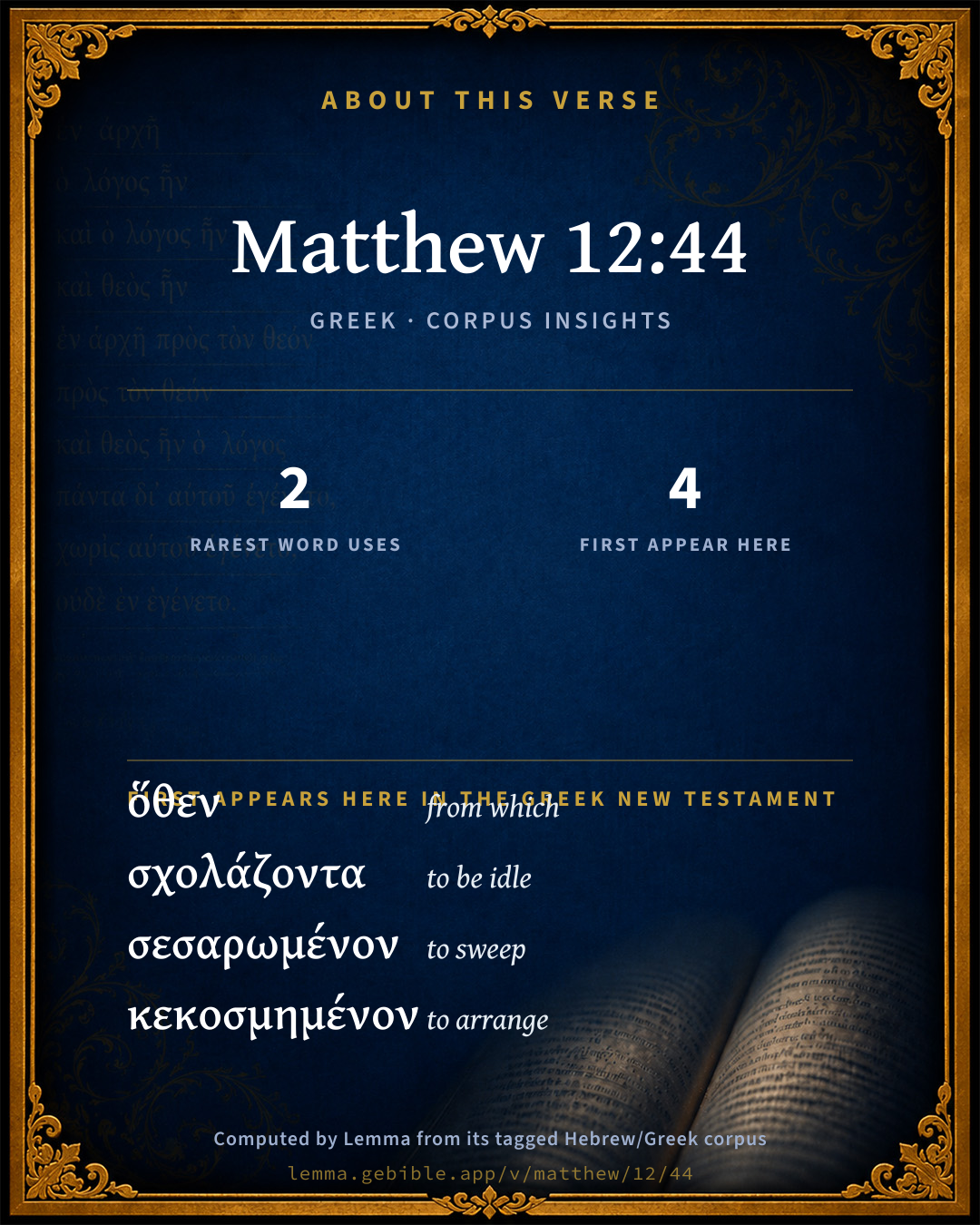
The rarest word here is σχολάζοντα to be idle G4980 — appearing just 2 times in the whole Greek New Testament.
First appearance in Scripture
These words make their first canonical appearance in the Greek New Testament here:
Shared distinctive vocabulary
σχολάζοντα to be idle G4980 occurs in 2 verses of the Greek New Testament. Also found in:
Repetition
A word recurs within this verse:
- καὶ and G2532 ×3
Cross-references
20Topical passages linked to Matthew 12:44 in the Treasury of Scripture Knowledge — connected by theme and wording, ordered by reader-vote popularity; previews shown in the World English Bible.
- 1 John 4:4 You are of God, little children, and have overcome them; because greater is he who is in you than he who is in the world.
- Psalms 81:11–12 But my people didn't listen to my voice. Israel desired none of me.
- 1 Corinthians 11:19 For there also must be factions among you, that those who are approved may be revealed among you.
- 1 John 2:19 They went out from us, but they didn't belong to us; for if they had belonged to us, they would have continued with us. But they left, that they might be revealed that none of them belong to us.
- Jude 1:4–5 For there are certain men who crept in secretly, even those who were long ago written about for this condemnation: ungodly men, turning the grace of our God into lasciviousness, and denying our only Master, God, and Lord, Jesus Christ.
- Revelation 13:8–9 All who dwell on the earth will worship him, everyone whose name has not been written from the foundation of the world in the book of life of the Lamb who has been killed.
- Hosea 7:6 For they have made ready their heart like an oven, While they lie in wait. Their baker sleeps all the night. In the morning it burns as a flaming fire.
- Matthew 12:29 Or how can one enter into the house of the strong man, and plunder his goods, unless he first bind the strong man? Then he will plunder his house.
- Matthew 13:20–22 What was sown on the rocky places, this is he who hears the word, and immediately with joy receives it;
- Luke 11:21–22 "When the strong man, fully armed, guards his own dwelling, his goods are safe.
- John 12:6 Now he said this, not because he cared for the poor, but because he was a thief, and having the money box, used to steal what was put into it.
- John 13:2 After supper, the devil having already put into the heart of Judas Iscariot, Simon's son, to betray him,
- John 13:27 After the piece of bread, then Satan entered into him. Then Jesus said to him, "What you do, do quickly."
- Acts 5:1–3 But a certain man named Ananias, with Sapphira, his wife, sold a possession,
- Ephesians 2:2 in which you once walked according to the course of this world, according to the prince of the powers of the air, the spirit who now works in the children of disobedience;
- 2 Thessalonians 2:9–12 even he whose coming is according to the working of Satan with all power and signs and lying wonders,
- 1 Timothy 6:9–10 But those who are determined to be rich fall into a temptation and a snare and many foolish and harmful lusts, such as drown men in ruin and destruction.
- Acts 8:18–23 Now when Simon saw that the Holy Spirit was given through the laying on of the apostles' hands, he offered them money,
- 1 Timothy 6:4–5 he is conceited, knowing nothing, but obsessed with arguments, disputes, and word battles, from which come envy, strife, reviling, evil suspicions,
- Revelation 13:3–4 One of his heads looked like it had been wounded fatally. His fatal wound was healed, and the whole earth marveled at the beast.
Cross-references courtesy of OpenBible.info (CC BY 4.0).
Lesson kit
Teaching starters — assembled from the data on this page, not authored interpretation. Every prompt links to the verse data it draws on. Edit before teaching.
Matthew, in the Gospels, opens this verse with 17 words (15 distinct Greek lemmas). Its most distinctive word is scholázō (“to be idle”). A historical commentator’s framing appears above. Read the whole chapter for the surrounding context.
Discussion questions
- What does “to be idle” (scholázō) contribute to the verse as a whole?
- 4 words make their first appearance in Scripture here. What does this debut establish?
- How does 1 Corinthians 7:5, which shares the word «to be idle», read alongside this verse?
- What does the repetition of “and” (3× in this one verse) do in this verse?
- These translations render this verse differently; the difference is in the English rendering, not the original. What questions does that raise?
- Compare how Bengel's Gnomon and Expositor's Greek Testament read this verse. Where do they agree or differ?
Things to notice
- 4 words make their first canonical appearance in Scripture here.
- These translations choose different wording for 15 words in this verse.
- “and” occurs 3× in this single verse.
- 15 distinct Greek lemmas span 17 words in this verse.
Commentary
Notes on Matthew 12:44 from classic Christian and Jewish commentators (each source and its license shown beneath its notes). The classic Christian expositions comment on the surrounding passage and are grouped to its opening verse, so a note may address several verses; the Jewish commentaries on the Tanakh (Rashi and others) are per-verse, so they appear only where the commentator wrote on this verse.
Lemma curates 59 commentaries, every one of them public domain or Creative Commons licensed, each selected and text-cleaned for this edition rather than reprinted as found. About our sources →
Bengel's Gnomon
Johann Albrecht Bengel
Bengel's Gnomon of the New Testament — English translation (T&T Clark, Edinburgh, 1860) — public domain. Text from a community e-Sword module.
Expositor's Greek Testament
ed. W. Robertson Nicoll
The Expositor's Greek Testament, edited by W. Robertson Nicoll (1897–1910) — public domain. Text from a community e-Sword module.
Adam Clarke's Commentary
Adam Clarke's Commentary on the Bible (1810–1826) — public domain. Text from a community e-Sword/MySword module.
Ellicott's Commentary for English Readers
A Bible Commentary for English Readers, edited by Charles John Ellicott (1878–1897) — public domain. Text from a community e-Sword module.
The Cambridge Bible for Schools and Colleges
gen. ed. J. J. S. Perowne
The Cambridge Bible for Schools and Colleges (gen. ed. J. J. S. Perowne; Cambridge University Press, 1878–1918) — public domain. Text from a community e-Sword module.
John Gill's Exposition
John Gill's Exposition of the Whole Bible (1746–1763) — public domain (CC PDM 1.0). Text via the HelloAO Bible API.
Trapp's Complete Commentary
John Trapp
John Trapp, A Commentary or Exposition upon All the Books of the Old and New Testament (1647–1656) — public domain. Text from a community e-Sword module.
Whedon's Commentary on the Bible
Daniel D. Whedon
Daniel D. Whedon (gen. ed.), Commentary on the Old and New Testaments (1874–1909) — public domain. Text from a community e-Sword module.
The Pulpit Commentary
The Pulpit Commentary (1880–1919), ed. H.D.M. Spence-Jones & Joseph S. Exell — public domain. Text from a community e-Sword module.
John Wesley's Explanatory Notes
John Wesley, Explanatory Notes Upon the Whole Bible (1754–1765) — public domain. Text via the GEBible commentary corpus.
Cambridge Greek Testament for Schools and Colleges
Cambridge Greek Testament for Schools and Colleges (Cambridge University Press, 1896; 21 vols, various authors incl. Carr, Maclear, Plummer, Farrar, Lumby, Moule, M. R. James, Simcox) — public domain. Text from a community e-Sword module.
International Critical Commentary
International Critical Commentary — older volumes (1896–1929), various authors — public domain. Text from a community e-Sword module.