Matthew 26:38

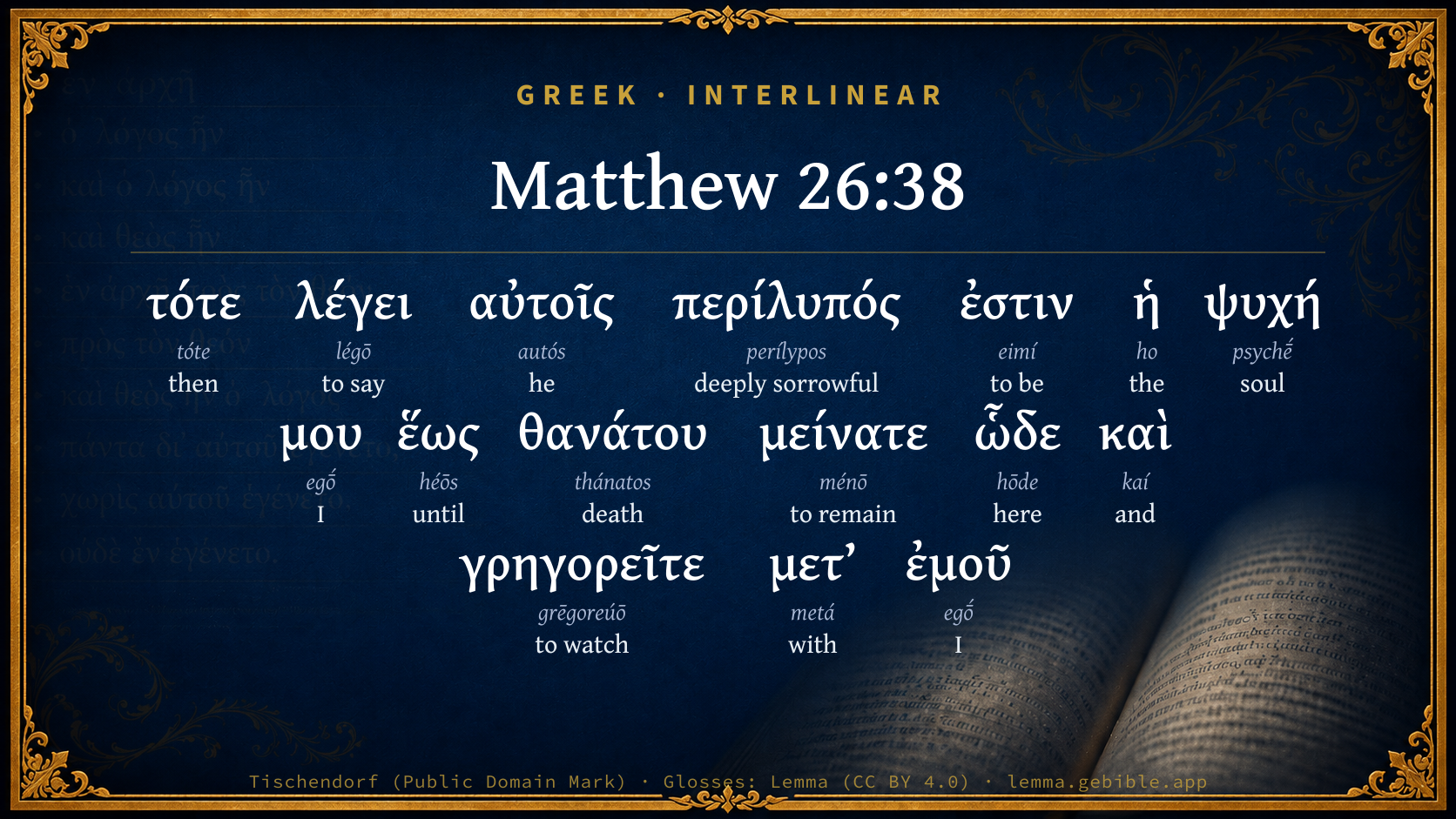
Greek (Tischendorf 8th ed.) Matthew 26:38 appears in the Greek New Testament. The text above is from the Tischendorf 8th edition. Each word links to its Strong’s number and a concise gloss. Click any word for its full Thayer’s Greek Lexicon entry.
Download image
Cite this verse

Matthew 26:38 (World English Bible). Public Domain. Lemma interlinear Bible study tool, https://lemma.gebible.app/v/matthew/26/38.

Show BibTeX & RIS
BibTeX
RIS
English Translation
Then he said to them, "My soul is exceedingly sorrowful, even to death. Stay here, and watch with me."
World English Bible · Public Domain
Highlights
  • 1 first appearance in the Greek New Testament
Full analysis ↓
Download a study sheet

One document with this verse’s original text, its word-by-word gloss line, the meaning frame, cross-references with their text, attributed commentary, and full source and license credits — printable, and it pastes into notes with its structure intact.

This verse Autodidact and up

Study sheet (.html) Plain text (.txt)

A passage Seminary Student

Up to 50 verses in one chapter. A passage sheet keeps up to 6 commentary sources and 12 cross-references per verse, in the order this page ranks them, and says so on the sheet whenever that leaves anything out. Ask for a single verse and you get the Autodidact verse sheet above.

Everything on this page stays free to read, with no account — the sheet is a download of what is already on screen, not access to it.

Want to remove ads? Support Godless Engineer
Compare translations 3

The same verse in 3 English versions, stacked beneath the original-language interlinear above. Click any original word for its lexicon entry.

Each is an independent rendering of the whole verse — the interlinear is not word-aligned to these translations.

Highlighted words mark where these versions differ — a whole-verse word diff, not a word-by-word alignment.

  • World English Bible Public Domain
    Then he said to them, "My soul is exceedingly sorrowful, even to death. Stay here, and watch with me."
  • King James Version Public Domain
    Then saith he unto them, My soul is exceeding sorrowful, even unto death: tarry ye here, and watch with me.
  • unfoldingWord Literal Text CC BY-SA 4.0
    Then he says to them, “My soul is very grieved—unto death. Remain here and be alert with me.”

unfoldingWord Literal Text — © unfoldingWord, licensed CC BY-SA 4.0. Word-aligned USFM3 via Door43 (git.door43.org/unfoldingWord/en_ult).

Versions to compare (up to 4)

3 of 4 selected

Show all 19 translations

Every available English version of this verse, each an independent rendering of the whole verse.

  • World English Bible Public Domain
    Then he said to them, "My soul is exceedingly sorrowful, even to death. Stay here, and watch with me."
  • Berean Standard Bible Public Domain
    Then He said to them, “My soul is consumed with sorrow to the point of death. Stay here and keep watch with Me.”
  • Majority Standard Bible Public Domain
    Then Jesus said to them, “My soul is consumed with sorrow to the point of death. Stay here and keep watch with Me.”
  • King James Version Public Domain
    Then saith he unto them, My soul is exceeding sorrowful, even unto death: tarry ye here, and watch with me.
  • American Standard Version (1901) Public Domain
    Then saith he unto them, My soul is exceeding sorrowful, even unto death: abide ye here, and watch with me.
  • Revised Version (1885) Public Domain
    Then saith he unto them, My soul is exceeding sorrowful, even unto death: abide ye here, and watch with me.
  • Geneva Bible (1599) Public Domain
    Then sayde Iesus vnto them, My soule is very heauie, euen vnto the death: tarie yee here, and watch with me.
  • Douay-Rheims (1899) Public Domain
    Then he saith to them: My soul is sorrowful even unto death: stay you here, and watch with me.
  • Young's Literal Translation Public Domain
    then saith he to them, `Exceedingly sorrowful is my soul -- unto death; abide ye here, and watch with me.'
  • Literal Standard Version CC BY-SA 4.0
    then He says to them, “Exceedingly sorrowful is My soul—to death; abide here, and watch with Me.”
  • Unlocked Literal Bible CC BY-SA 4.0
    Then he said to them, “My soul is deeply sorrowful, even to death. Remain here and watch with me.”
  • unfoldingWord Literal Text CC BY-SA 4.0
    Then he says to them, “My soul is very grieved—unto death. Remain here and be alert with me.”
  • Darby Bible Public Domain
    Then he says to them, My soul is very sorrowful even unto death; remain here and watch with me.
  • World Messianic Bible Public Domain
    Then Yeshua said to them, “My soul is exceedingly sorrowful, even to death. Stay here and watch with me.”
  • Webster's Bible Public Domain
    Then saith he to them, My soul is exceeding sorrowful, even to death: tarry ye here, and watch with me.
  • Free Bible Version CC BY-SA 4.0
    Then he said to them, “I am so overwhelmed with sadness that it's killing me. Wait here and keep watch with me.”
  • Bible in Basic English Public Domain
    Then says he to them, My soul is very sad, even to death: keep watch with me here.
  • Text-Critical English NT CC BY 4.0
    Then Jesus said to them, “My soul is very sorrowful, even to the point of death; stay here and keep watch with me.”
  • Tyndale New Testament (1534) Public Domain
    Then sayd Iesus vnto them: my soule is hevy even vnto the deeth. Tary ye here and watche with me.

Literal Standard Version (2020), Covenant Press — licensed CC BY-SA 4.0. Text via the HelloAO Bible API (eBible.org). Unlocked Literal Bible (unfoldingWord) — licensed CC BY-SA 4.0. Text via the HelloAO Bible API (eBible.org). unfoldingWord Literal Text — © unfoldingWord, licensed CC BY-SA 4.0. Word-aligned USFM3 via Door43 (git.door43.org/unfoldingWord/en_ult). Free Bible Version, Dr. Jonathan Gallagher — licensed CC BY-SA 4.0. Text via the HelloAO Bible API (eBible.org).

Word by word

More ways to search: Search by grammar → Find every occurrence → Compare this word →

Practice this passage: Drill this verse → Learn its vocabulary →

περίλυπός
perílypos
G4036
“deeply sorrowful”
Adjective, Nominative, Singular, Feminine
Part of Speech
Adjective
Case
Nominative
Number
Singular
Gender
Feminine
Full Thayer's Definition

Origin: from G4012 and G3077

TDNT: 09:23,5

1. very sad, exceedingly sorrowful 2. overcome with sorrow so much as to cause one's death
  1. τότε tóte G5119 “then” Adverb
  2. λέγει légō G3004 “to say” Verb, Present, Active, Indicative, 3rd person, Singular
  3. αὐτοῖς autós G846 “he” Personal pronoun, Dative, Plural, Masculine
  4. ἐστιν eimí G1510 “to be” Verb, Present, Active, Indicative, 3rd person, Singular
  5. ἡ ho G3588 “the” Article, Nominative, Singular, Feminine
  6. ψυχή psychḗ G5590 “soul” Noun, Nominative, Singular, Feminine
  7. μου egṓ G1473 “I” Personal pronoun, 1st person, Genitive, Singular
  8. ἕως héōs G2193 “until” Adverb
  9. θανάτου thánatos G2288 “death” Noun, Genitive, Singular, Masculine
  10. μείνατε ménō G3306 “to remain” Verb, Aorist, Active, Imperative, 2nd person, Plural
  11. ὧδε hōde G5602 “here” Adverb
  12. καὶ kaí G2532 “and” Conjunction
  13. γρηγορεῖτε grēgoreúō G1127 “to watch” Verb, Present, Active, Imperative, 2nd person, Plural
  14. μετ’ metá G3326 “with” Preposition
  15. ἐμοῦ egṓ G1473 “I” Personal pronoun, 1st person, Genitive, Singular

About this verse

These counts appear in no published source. They are computed here, from the morphology-tagged text and Lemma’s own curated glosses. What Lemma adds →

16
words
15
distinct lemmas
Gospels
section

Notable vocabulary

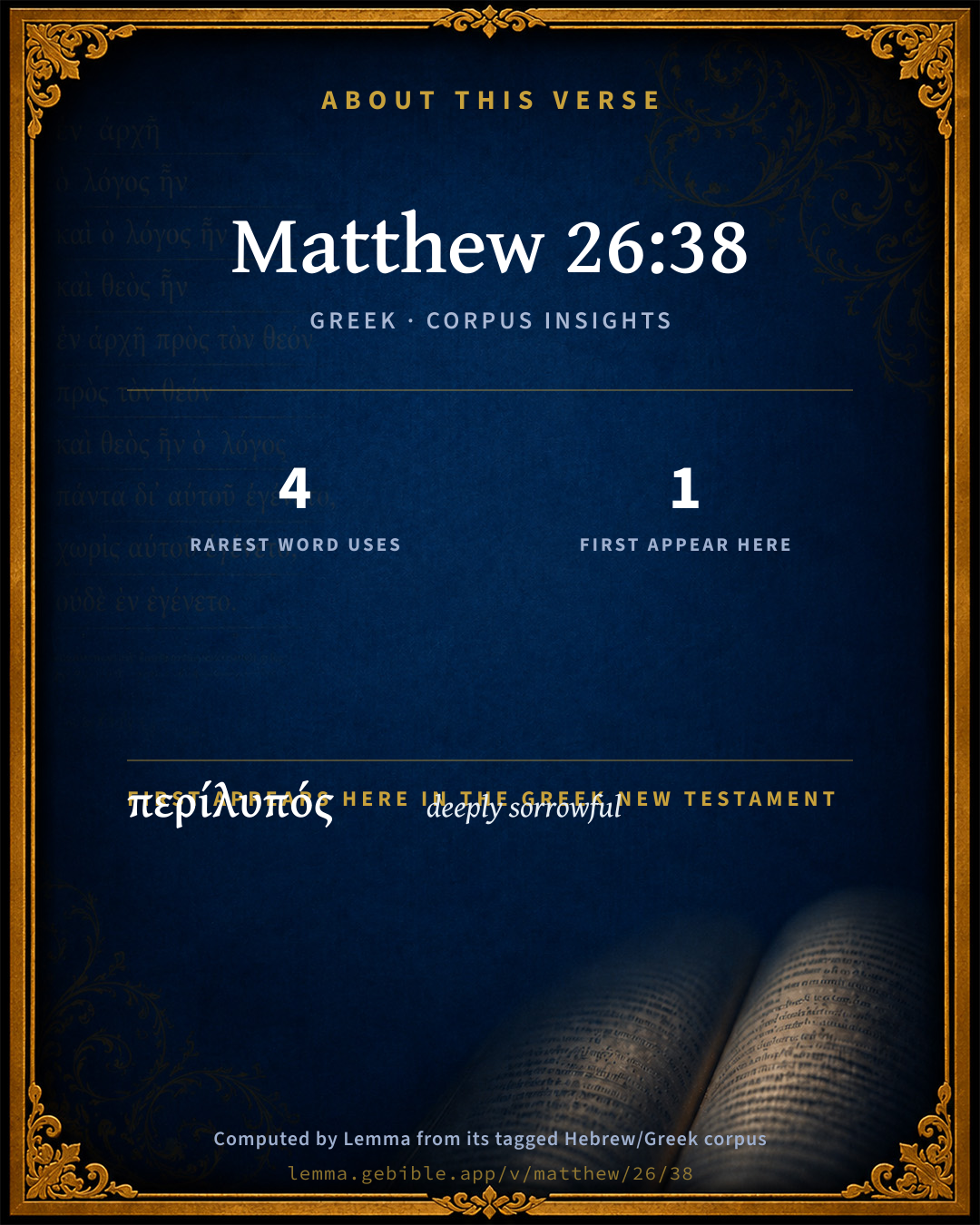
The rarest word here is περίλυπός deeply sorrowful G4036 — appearing just 4 times in the whole Greek New Testament.

First appearance in Scripture

This word makes its first canonical appearance in the Greek New Testament here:

  • περίλυπός deeply sorrowful G4036

Shared distinctive vocabulary

περίλυπός deeply sorrowful G4036 occurs in 4 verses of the Greek New Testament. Also found in:

Repetition

A word recurs within this verse:

Cross-references

15

Topical passages linked to Matthew 26:38 in the Treasury of Scripture Knowledge — connected by theme and wording, ordered by reader-vote popularity; previews shown in the World English Bible.

  • John 12:27 "Now my soul is troubled. What shall I say? 'Father, save me from this time?' But for this cause I came to this time.
  • 1 Peter 3:18 Because Christ also suffered for sins once, the righteous for the unrighteous, that he might bring you to God; being put to death in the flesh, but made alive in the spirit;
  • 1 Peter 2:24 who his own self bore our sins in his body on the tree, that we, having died to sins, might live to righteousness; by whose stripes you were healed.
  • Isaiah 53:10 Yet it pleased Yahweh to bruise him; he has put him to grief: when you shall make his soul an offering for sin, he shall see [his] seed, he shall prolong his days, and the pleasure of Yahweh shall prosper in his hand.
  • Matthew 26:40–41 He came to the disciples, and found them sleeping, and said to Peter, "What, couldn't you watch with me for one hour?
  • Galatians 3:13 Christ redeemed us from the curse of the law, having become a curse for us. For it is written, "Cursed is everyone who hangs on a tree,"
  • 1 Peter 4:7 But the end of all things is near. Therefore be of sound mind, self-controlled, and sober in prayer.
  • Job 6:2–4 "Oh that my anguish were weighed, And all my calamity laid in the balances!
  • Psalms 88:14–16 Yahweh, why do you reject my soul? Why do you hide your face from me?
  • Isaiah 53:3 He was despised, and rejected by men; a man of suffering, and acquainted with disease: and as one from whom men hide their face he was despised; and we didn't respect him.
  • Matthew 25:13 Watch therefore, for you don't know the day nor the hour in which the Son of Man is coming.
  • Romans 8:32 He who didn't spare his own Son, but delivered him up for us all, how would he not also with him freely give us all things?
  • 2 Corinthians 5:21 For him who knew no sin he made to be sin on our behalf; so that in him we might become the righteousness of God.
  • Psalms 88:1–7 Yahweh, the God of my salvation, I have cried day and night before you.
  • Psalms 116:3 The cords of death surrounded me, The pains of Sheol got a hold of me. I found trouble and sorrow.

Cross-references courtesy of OpenBible.info (CC BY 4.0).

Where the printed editions differ

1 variant

Places in this verse where the major printed Greek editions disagree on the wording in a way that affects the translation — a comparison of editions, not a manuscript-by-manuscript collation. The editions are the modern critical texts (Nestlé-Aland 28/27, SBL, Westcott-Hort, Tregelles, Tyndale House) and the traditional texts behind the KJV (the Textus Receptus and the Byzantine/Majority text). It is not a claim about which reading is original.

  1. Extra text
    Ἰησοῦς·

    “Jesus:”

    In Byz Not in NA28NA27TynSBLWHTregTR

    Ἰησοῦς· (Iēsous) 'Jesus:' is only in a few manuscripts (Byz)

Textual data: Translators Amalgamated Greek New Testament (STEPBible TAGNT) · CC BY 4.0.

Commentary

Notes on Matthew 26:38 from classic Christian and Jewish commentators (each source and its license shown beneath its notes). The classic Christian expositions comment on the surrounding passage and are grouped to its opening verse, so a note may address several verses; the Jewish commentaries on the Tanakh (Rashi and others) are per-verse, so they appear only where the commentator wrote on this verse.

Lemma curates 59 commentaries, every one of them public domain or Creative Commons licensed, each selected and text-cleaned for this edition rather than reprinted as found. About our sources →

Tyndale Open Study Notes

Tyndale Open Resources

26:38 crushed with grief: See John 12:27; cp. Pss 42:5-6, 11; 43:5.

Tyndale Open Study Notes — © Tyndale Open Resources, licensed CC BY-SA 4.0. Text via the HelloAO Bible API.

Bengel's Gnomon

Johann Albrecht Bengel

Mat 26:38.[1146] Ἕως θανάτου, even unto death) Such sorrow as might have led an ordinary mortal to commit suicide.—μείνατε ὧδε, tarry ye here) You must not go with Me.—μετʼ Ἐμοῦ, with Me) In great trials solitude is pleasing, yet so that friends be near at hand. Jesus commands His disciples to watch with Him, though He knew that they would not afford Him any assistance.

[1146] ἡ ψυκή μου, my soul) How great must have been the emotions and thoughts in the most holy soul of the Saviour in reference to the work committed to Him by the Father, as also in reference to His passion and His glory, especially during the last months, days, and hours before His death, throughout the very precious alternations which befell Him; for instance when, as He said, “He must be about His Father’s business;” when He received baptism; when He overcame the Tempter; when He put forth His zeal for His Father’s House; when He rejoiced in the “revelation made to infants of things hidden from the wise and prudent;” when He was transfigured on the Mount; when He set His face stedfastly toward Jerusalem; when He solemnly entered the city; when He said, “Now is My soul troubled,” etc.; when He washed the feet of the disciples; when He spake the words, “Now is the Son of Man glorified;” when He celebrated the last supper before His Passion with His disciples. And also in this very place, where He testifies that His “soul is sorrowful even unto death.” Add the several divine sentences which He uttered on the Cross.—Harm., p. 526, 527.

Bengel's Gnomon of the New Testament — English translation (T&T Clark, Edinburgh, 1860) — public domain. Text from a community e-Sword module.

Expositor's Greek Testament

ed. W. Robertson Nicoll

Mat 26:38 . τοτὲ λέγει αὐτ .: He confides to the three His state of mind without reserve, as if He wished it to be known. Cf. the use made in the epistle to the Hebrews of this frank manifestation of weakness as showing that Christ could not have usurped the priestly office, but rather simply submitted to be made a priest (chap. Mat 5:7-8 ). περίλυπος , overwhelmed with distress, “über and über traurig” (Weiss). ἕως θανάτου , mortally = death by anticipation, showing that it was the Passion with all its horrors vividly realised that was causing the distress. Hilary, true to his docetic tendency represents Christ as distressed on account of the three, fearing they might altogether lose their faith in God. ὧδε : the three stationed nearer the scene of agony to keep watch there.

The Expositor's Greek Testament, edited by W. Robertson Nicoll (1897–1910) — public domain. Text from a community e-Sword module.

Geneva Bible (1599)

Geneva Bible translators

Christ a true man, going about to suffer the punishment which was due unto us, for forsaking of God is forsaken of his own: he hath a terrible conflict with the horror and fear of the curse of God: out of which he escaping as a conqueror, causeth us not to be afraid anymore of death.

Geneva Bible (1599) marginal notes — public domain. Text via Bolls.life.

Adam Clarke's Commentary

Verse 38. Then saith he] Then saith - Jesus: - I have added the word Jesus, ὁ Ιησους, on the authority of a multitude of eminent MSS. See them in Griesbach.

My soul is exceeding sorrowful, (or, is surrounded with exceeding sorrow,) even unto death.] This latter word explains the two former: My soul is so dissolved in sorrow, my spirit is filled with such agony and anguish, that, if speedy succour be not given to my body, death must be the speedy consequence.

Now, the grand expiatory sacrifice begins to be offered: in this garden Jesus enters fully into the sacerdotal office; and now, on the altar of his immaculate divinity, begins to offer his own body - his own life - a lamb without spot, for the sin of the world. St. Luke observes, Lu 22:43-44, that there appeared unto him an angel from heaven strengthening him; and that, being in an agony, his sweat was like great drops of blood falling to the ground. How exquisite must this anguish have been, when it forced the very blood through the coats of the veins, and enlarged the pores in such a preternatural manner as to cause them to empty it out in large successive drops! In my opinion, the principal part of the redemption price was paid in this unprecedented and indescribable agony.

Bloody sweats are mentioned by many authors; but none was ever such as this - where a person in perfect health, (having never had any predisposing sickness to induce a debility of the system,) and in the full vigour of life, about thirty-three years of age, suddenly, through mental pressure, without any fear of death, sweat great drops of blood; and these continued, during his wrestling with God to fall to the ground.

To say that all this was occasioned by the fear he had of the ignominious death which he was about to die confutes itself - for this would not only rob him of his divinity, for which purpose it is brought, but it deprives him of all excellency, and even of manhood itself. The prospect of death could not cause him to suffer thus, when he knew that in less than three days he was to be restored to life, and be brought into an eternity of blessedness. His agony and distress can receive no consistent explication but on this ground - He SUFFERED, the JUST for the UNJUST, that he might BRING us to GOD. O glorious truth! O infinitely meritorious suffering! And O! above all, the eternal love, that caused him to undergo such sufferings for the sake of SINNERS!

Adam Clarke's Commentary on the Bible (1810–1826) — public domain. Text from a community e-Sword/MySword module.

Ellicott's Commentary for English Readers

(38) Then cometh Jesus . . .—In the interval between Mat_26:35-36, we have probably to place the discourses in John 15 (the reference to the vine, probably suggested by one which was putting forth its leaves in the early spring), John 16, and the great prayer of intercession in John 17. As St. John alone has recorded them, it is probable that he alone entered into their meaning, while others either did not hear them, or listened to them as above their reach, and asked their child-like questions (Joh_16:18-19; Joh_16:29-30). St. Luke records what we may look on as the germ of the great intercession, in our Lord’s words to Peter, “I have prayed for thee, that thy faith fail not” (Luk_22:32).

A place called Gethsemane.—The word means “oil-press,” and was obviously connected with the culture of the trees from which the Mount took its name. St. John’s description implies that it was but a little way beyond the brook Kidron (Joh_18:1), on the lower western slope of the mount. There was, a garden (or rather, orchard) there which was the wonted resort of our Lord and the disciples when they sought retirement. The olive-trees now growing in the place shown as Gethsemane, venerable as their age is, can hardly have been those that then grew there, as Josephus expressly records that Titus ordered all the trees in the neighbourhood of Jerusalem to be cut down, and the Tenth Legion was actually encamped on the Mount of Olives (Jos. Wars, v. 2, § 3). They probably represent the devotion of pilgrims of the fourth or some later century, who replanted the hallowed site.

Sit ye here, while I go and pray yonder.—Partly in compassion to the weakness and weariness of the disciples, partly from the sense of the need of solitude in the highest acts of communing with His Father, the Son of Man withdraws for a little while from converse with those whom, up to this time, He had been strengthening. He had been (as in John 17) praying for them; He now needs to pray for Himself.

(38) Exceeding sorrowful, even unto death.—The infinite sadness of that hour leads the Master to crave for sympathy from the three who were, most of all, His brothers. If they may not see, or fully hear, the throes of that agony, as though the pangs of death had already fallen on Him, it will be something to know that they are at least watching with Him, sharers in that awful vigil.

A Bible Commentary for English Readers, edited by Charles John Ellicott (1878–1897) — public domain. Text from a community e-Sword module.

The Cambridge Bible for Schools and Colleges

gen. ed. J. J. S. Perowne

38. My soul] This is important as the one passage in which Jesus ascribes to Himself a human soul.

watch with me] The Son of man in this dark hour asks for human sympathy.

with me] Only in Matthew.

The Cambridge Bible for Schools and Colleges (gen. ed. J. J. S. Perowne; Cambridge University Press, 1878–1918) — public domain. Text from a community e-Sword module.

John Gill's Exposition

And he went a little further,.... Luke says, Luk 22:41, "about a stone's cast", about fifty or sixty feet from the place where they were,

and fell on his face, and prayed; partly to show his great reverence of God, the sword of whose justice was awaked against him, the terrors of whose law were set in array before him, and whose wrath was pouring down upon him; and partly to signify how much his soul was depressed, how low he was brought, and in what distress and anguish of spirit he was, that he was not able to lift up his head, and look up. This was a prayer gesture used when a person was in the utmost perplexity. The account the Jews give of it, is this (g),

, "when they fall upon their faces", they do not stretch out their hands and their feet, but incline on their sides.

This was not to be done by any person, or at any time; the rules are these (h):

"no man is accounted fit , "to fall upon his face", but he that knows in himself that he is righteous, as Joshua; but he inclines his face a little, and does not bow it down to the floor; and it is lawful for a man to pray in one place, and to "fall upon his face" in another: it is a custom that reaches throughout all Israel, that there is no falling upon the face on a sabbath day, nor on feast days, nor on the beginning of the year, nor on the beginning of the month, nor on the feast of dedication, nor on the days of "purim", nor at the time of the meat offering of the eves of the sabbath days, and good days, nor at the evening prayer for every day; and there are private persons that fall upon their faces at the evening prayer, and on the day of atonement only: they fall upon their faces because it is a time of supplication, request, and fasting.

Saying, O my father; or, as in Mark, "Abba, Father", Mar 14:36; "Abba" being the Syriac word he used, and signifies, "my father"; and the other word is added for explanation's sake, and to denote the vehemency of his mind, and fervour of spirit in prayer. Christ prayed in the same manner he taught his disciples to pray, saying, "our Father"; and as all his children pray under the influence of the spirit of adoption, whereby they cry "Abba, Father". God is the Father of Christ, not as man, for as such he was without father, being the seed of the woman, and made of a woman, without man; nor by creation, as he is the Father of spirits, of angels, and the souls of men, of Adam, and all mankind; nor by adoption, as he is the Father of all the chosen, redeemed, and regenerated ones; but by nature, he being the only begotten of the Father, in a manner inconceivable and inexpressible by us. Christ now addresses him in prayer in his human nature, as standing in this relation to him as the Son of God, both to express his reverence of him, and what freedom and boldness he might use with him; what confidence he might put in him; and what expectation he might have of being heard and regarded by him; and what submission and resignation of will was due from himself unto him,

If it be possible, let this cup pass from me; meaning not only the hour, as it is called in Mark, the present season and time of distress, and horror; but all his future sufferings and death, which were at hand; together with the bearing the sins of his people, the enduring the curse of the law, and the wrath of God, all which were ingredients in, and made up this dreadful bitter cup, this cup of fury, cursing, and trembling; called a cup, either in allusion to the nauseous potions given by physicians to their patients; or rather to the cup of poison given to malefactors the sooner to dispatch them; or to that of wine mingled with myrrh and frankincense to intoxicate them, that they might not feel their pain; see Gill on Mar 15:23, or to the cup appointed by the master of the family to everyone in the house; these sorrows, sufferings, and death of Christ being what were allotted and appointed by his heavenly Father: and when he prays that this cup might pass from him, his meaning is, that he might be freed from the present horrors of his mind, be excused the sufferings of death, and be delivered from the curse of the law, and wrath of God; which request was made without sin, though it betrayed the weakness of the human nature under its insupportable load, and its reluctance to sufferings and death, which is natural; and yet does not represent him herein as inferior to martyrs, who have desired death, and triumphed in the midst of exquisite torments: for their case and his were widely different; they had the presence of God with them, Christ was under the hidings of his Father's face; they had the love of God shed abroad in them, he had the wrath of God poured out upon him; and his prayer bespeaks him to be in a condition which neither they, nor any mortal creature were ever in. Moreover, the human nature of Christ was now, as it were, swallowed up in sorrow, and intent upon nothing but sufferings and death; had nothing in view but the wrath of God, and the curse of the law; so that everything else was, for the present, out of sight; as the purposes of God, his counsel and covenant, his own engagements and office, and the salvation of his people; hence it is no wonder to hear such a request made; and yet it is with this condition, "if it be possible". In Mark it is said, "all things are possible unto thee", Mar 14:36; intimating, that the taking away, or causing the cup to pass from him, was: all things are possible to God, which are consistent with the perfections of his nature, and the counsel of his will: and all such things, though possible in themselves, yet are not under such and such circumstances so; the removal of the cup from Christ was possible in itself, but not as things were circumstanced, and as matters then stood; and therefore it is hypothetically put, "if it be possible", as it was not; and that by reason of the decrees and purposes of God, which had fixed it, and are immutable; and on account of the covenant of grace, of which this was a considerable branch and article, and in which Christ had agreed unto it, and is unalterable; and also on the score of the prophecies of the Old Testament, in which it had been often spoken of; and therefore without it, how should the Scriptures be fulfilled that thus it must be? they would not have been the Scriptures of truth. Besides, Christ had foretold it himself once and again, and therefore consistent with the truth of his own predictions, it could not be dispensed with: add to all this, that the salvation of his people required his drinking it; that could not be brought about no other way in agreement with the veracity, faithfulness, justice, and holiness of God. This condition qualities and restrains the above petition; nor is it to be considered but in connection with what follows:

nevertheless, not as I will, but as thou wilt; which shows that the request was far from being sinful, or contrary to piety to God, or love to men, or to true fortitude of mind; the pure natural will of Christ, or the will of Christ's human nature, being left to act in a mere natural way, shows a reluctancy to sorrows, sufferings, and death; this same will acting on rational principles, and in a rational way, puts it upon the possibility the thing, and the agreement of the divine will to it. That there are two wills in Christ, human and divine, is certain; his human will, though in some instances, as in this, may have been different from the divine will, yet not contrary to it; and his divine will is always the same with his Father's. This, as mediator, he engaged to do, and came down from heaven for that purpose, took delight in doing it, and has completely finished it,

(g) Gloss. in T. Bab. Beracot, fol. 34. 2. (h) Maimon. Hilch. Tephilla, c. 5. sect. 14, 15.

John Gill's Exposition of the Whole Bible (1746–1763) — public domain (CC PDM 1.0). Text via the HelloAO Bible API.

Trapp's Complete Commentary

John Trapp

38 Then saith he unto them, My soul is exceeding sorrowful, even unto death: tarry ye here, and watch with me.

Ver. 38. My soul is exceeding sorrowful] He had a true human soul then, neither was his deity to him for a soul, as some heretics fancied; for then our bodies only had been redeemed by him, and not our souls (το γαρ απροσληπτον αθεραπευτον, as that Father hath it), if he had not in soul also suffered, and so descended into hell. The sufferings of his body were but the body of his sufferings; the soul of his sufferings were the sufferings of his soul, whch was now undequaque tristis, beset with sorrows, and heavy as a heart could hold, περιλυπος. The "sorrows of death compassed him, the cords of hell surrounded him," Psa 18:4-5, the pain whereof he certainly suffered, non specie et loco sed αναλογον τι και ανεκλαλητον, something answerable to hell, and altogether unspeakable. Hence the Greek Litany, "By thine unknown sufferings (δι’ αγνωστων σου παθηματων), good Lord, deliver us." Faninus, an Italian martyr, being asked by one why he was so merry at his death, since Christ himself was so sorrowful? Christ, said he, sustained in his soul all the sorrows and conflicts with hell and death due to us; by whose sufferings we are delivered from sorrow and fear of them all.

Tarry ye here, and watch with me] Yet not for my sake so much as for your own, that ye enter not into temptation, Luk 22:40.

John Trapp, A Commentary or Exposition upon All the Books of the Old and New Testament (1647–1656) — public domain. Text from a community e-Sword module.

Haydock's Catholic Bible Commentary

My soul is sorrowful. The cause of our Lord’s grief was not the fear of suffering; since he took upon himself human nature, to suffer and to die for us; but the cause of his grief was the unhappy state of Judas, the scandal his disciples would take at this passion, the reprobation of the Jewish nation, and the destruction of the miserable Jerusalem. Our Lord also suffered himself to be thus dejected, to convince the world of the truth and reality of his human nature. (St. Jerome)

George Leo Haydock (1774–1849), Haydock's Catholic Family Bible and Commentary, 1859 edition — public domain. Excludes Psalms (Douay-Rheims chapter numbering differs from Protestant) and Deuterocanonical books (Catholic canon only).

Whedon's Commentary on the Bible

Daniel D. Whedon

38. My soul is exceeding sorrowful — Jesus then had a purely human soul. The doctrine of the Monophysites, that he had only a human body, of which God was the only soul, is not true. That human soul, Luke informs us, in his childhood increased in wisdom and in favour with God and man. Hence our Lord was complete man. His mind, as human, was subject to limitations. Beyond its human circle were innumerable things it did not know; though, doubtless, his mind was so divinely illuminated as not to be liable to positive involuntary falsity or mistake.

Exceeding sorrowful — Our Saviour here speaks not of fear, that is, of the approaching cross, but of sorrow. A supernatural woe overwhelms and all but sinks him before the cross arrives. “He trod the winepress of the wrath of God.”

Sorrowful even unto death — Not sorrowful in anticipation of death; but a sorrow, not his own, pressed so heavily and so damply upon him, that it would drown and quench the spark of life but for the divine aid impregnating and strengthening his human person. What sorrow was this? Doubtless the prophet Isaiah (Isa_53:4) furnishes the true answer: “Surely he hath borne our griefs and carried our sorrows.” We do not here find any warrant for the supposition that God, the Father Almighty, poured the thunderbolts of personal anger on his suffering Son. But as Christ suffered as a substitute for a sinful world, so he did voluntarily, by his own sad consent, encounter all the woe that could be inflicted by hell and earth, (the natural executioners of absolute justice under the government of God,) and thus with his infinite dignity do honour to the law of eternal justice.

And in view of this, having done homage to justice in his own person, he is entitled to bestow paradise and confer righteousness on all who obediently accept him as their substitute and Redeemer.

Tarry… watch — They were to watch, yet at a reverent distance. The Saviour, as if powers other than human were haunting his soul, yearns to be in reach of human sympathy.

Daniel D. Whedon (gen. ed.), Commentary on the Old and New Testaments (1874–1909) — public domain. Text from a community e-Sword module.

The Pulpit Commentary

My soul is exceeding sorrowful, even unto death. (Jon_4:9) Christ speaks here of the mental agony which he is enduring; he bides not from the faithful three that which weighs upon his heart, so excessive a strain that human nature must fail to endure it. We cannot gauge the anguish; we may suggest some of the causes of this sorrow. It was not merely the thought of bodily pain, though that would be long and excessive; there were other elements which made his sorrow like to no other sorrow. He thought of all the circumstances that led to his Passion; all that would accompany it; all that would succeed it the malice and perversity of the Jews, the grievous wickedness that brought about his death, the treachery of Judas, the desertion of his friends, the denial of Peter, his unjust condemnation at the hands of the rulers of the chosen nation, the pusillanimity of Pilate, the guilt of the actors in the tragedy, the wilful iniquity of those whom he came to redeem, the ruin which they brought on themselves, their city and nation such considerations formed one ingredient in the bitter cup which he had to drain. And then the thought of death was unspeakably terrible to the all-holy Son of God. We men become accustomed to the thought of death. It accompanies us through all our life; it looms before us always. But man was created immortal, (RAPC Wis 2:23) his nature shrinks from the dissolution of soul and body; and to the sinless, unfallen Man this experience was wholly unknown and awful. Here was the incarnate God, the God-Man, submitting himself to the punishment of sin, tasting death for every man, bearing in his own Person the inexpressible bitterness of this penal humiliation. Added to all this was the incalculable fact that "the Lord had laid on him the iniquity of us all." The burden of the sins of all mankind he bore on his sacred shoulders. "Him who knew no sin God made to be sin on our behalf". (2Co_5:21) What this mysterious imputation, so to speak, involved, we cannot tell; but to a being perfectly pure and holy it must have been anguish unspeakable. Tarry ye here. As ver. 36, "Sit ye here." And watch with me. In his dark hour his human soul yearned for the comfort of a friendly presence; even though these chosen three might not witness the extremity of his agony, their proximity and sympathy and prayers were a support. But he bade them watch for their own sake also. Their great trial was close at hand; they were about to be tempted to deny and forsake him; they could resist only by prayer and watchfulness (ver. 41).

The Man of sorrows.

Although this name is found in Messianic prophecy, (Isa_53:3) it would be wrong to suppose that there was no gladness in the life of Christ. He spoke of his joy, (Joh_15:11) and he delighted to do the will of Psa_40:8). So pure a life spent in doing good to men must have had a gladness which no earthly pleasure could bestow. Yet Jesus had sorrows which no man can measure. It is easier to understand the glory of the Transfiguration than the agony of the garden.

I THE GREATNESS OF THE SORROWS. Many bitter ingredients entered into the cup of anguish which it was the Father"s will that Jesus should drink.

1. The horror of death. Jesus was young and in health; it was natural for him to shrink from a premature and violent death.

2. The dread of shame. Jesus was of the most refined and sensitive nature; in his Passion he was to face insult and ignominy.

3. Apparent failure. He came to set up his kingdom, to redeem Israel, to save the world; and his mission was rejected. Instead of the throne, he was to have the cross. All his efforts seemed to be ending in darkness. This was the earthly aspect of them. During his humiliation he must have felt it.

4. The faithlessness of friends. One had betrayed him; another was about to deny him; nearly all would flee in selfish cowardice.

5. Spiritual depression. At last Jesus seemed to be deserted by God.

II THE SOURCE OF THE SORROWS. We must look deeper than these immediate occasions of the grief of Christ. The fundamental source is beneath and behind all of them.

1. The world"s sin. They all result from sin. The world"s sin rose up against God"s Holy One, and smote him with all its fury. It was the dark cloud of this mass of sin that hid from him the vision of God. Jesus was bearing the load of sin, and it was breaking his heart.

2. The goodness of Christ. Bad men do not feel the world"s sin very acutely.

(1) The holiness of Jesus was horrified at its black and hideous enormity.

(2) The love of Christ was grieved at its shocking cruelty towards himself, and at its own fatal and suicidal influence in the world. He saw it as the cause of misery and ruin and death.

III THE ENDURANCE OF THE SORROWS. HOW did Jesus meet them?

1. With natural shrinking. He was no fanatical lover of martyrdom. He proved his humanity by feeling acutely and desiring to escape. Therefore he can sympathize with sufferers.

2. With prayer. The Gethsemane of agony is Christ"s most sacred oratory. He teaches us to bring our griefs to God. His example shows that prayer is the soul"s consolation in trouble.

3. With trustful submissions. He desired God"s will to be done, whatever that might be. He prayed for deliverance, but he never complained, much less did he rebel. Here he is the example for us whose greatest sorrows never approach the tragic terror of his.

IV THE FRUIT OF THE SORROWS.

1. Christ"s victory. He triumphed by submission. In obedience to God, he attained to the desire of his heart. Through his Passion and crucifixion he won the "Name which is above every name." His sorrows led to his glory. By the via dolorosa he reached his throne.

2. The world"s salvation. No selfish motive of personal gain inspired our Lord"s endurance. His very reward was to see the world saved. His suffering was all for others; if the world may rejoice in hope, this is owing to the fact that Jesus suffered in the darkness of a dreadful death. W.F.A.

The Pulpit Commentary (1880–1919), ed. H.D.M. Spence-Jones & Joseph S. Exell — public domain. Text from a community e-Sword module.

The People's New Testament

B. W. Johnson

38. My soul is exceedingly sorrowful, even unto death. The weight of woe was literally crushing out the Savior's life. Tarry ye here, and watch. He had wished his chosen disciples to be near him in his woe; and yet, as it advanced, he felt that he must retire even from them, and be alone with himself and his Father.

B. W. Johnson's The People's New Testament with Notes (1889–1891) — public domain. Electronic text from the Christian Classics Ethereal Library (CCEL) ThML edition.

Cambridge Greek Testament for Schools and Colleges

38. ἡ ψυχή μου. Comp. Joh 12:27, the only other passage in which Jesus ascribes to Himself a human ψυχὴ in this particular sense—the seat of the feelings and emotions.

γρηγορεῖτε μετʼ ἐμοῦ. The Son of man in this dark hour asks for human sympathy.

μετʼ ἐμοῦ. Only in Matthew.

Cambridge Greek Testament for Schools and Colleges (Cambridge University Press, 1896; 21 vols, various authors incl. Carr, Maclear, Plummer, Farrar, Lumby, Moule, M. R. James, Simcox) — public domain. Text from a community e-Sword module.

Alford’s Greek Testament

Henry Alford

38.] Our Lord’s whole inmost life must have been one of continued trouble of spirit—He was a man of sorrows, and acquainted with grief—but there was an extremity of anguish now, reaching even to the utmost limit of endurance, so that it seemed that more would be death itself. The expression is said to be proverbial (see ref. Jonah): but we must remember that though with us men, who see from below, proverbs are merely bold guesses at truth,—with Him, who sees from above, they are the truth itself, in its very purest form. So that although when used by a man, a proverbial expression is not to be pressed to literal exactitude,—when used by our Lord, it is, just because it is a proverb, to be searched into and dwelt on all the more. The expression ἡ ψυχή μου, in this sense, spoken by our Lord, is only found besides in Joh 12:27. It is the human soul, the seat of the affections and passions, which is troubled with the anguish of the body; and it is distinguished from the πνεῦμα, the higher spiritual being. Our Lord’s soul was crushed down even to death by the weight of that anguish which lay upon Him—and that literally—so that He (as regards his humanity) would have died, had not strength (bodily strength, upholding his human frame) been ministered from on high by an angel (see note on Luk 22:43).

γρηγορεῖτε μετʼ ἐμοῦ] not προσεύχεσθε μετʼ ἐμοῦ, for in that work the Mediator must be alone; but (see above) watch with Me—just (if we may compare our weakness with His) as we derive comfort in the midst of a terrible storm, from knowing that some are awake and with us, even though their presence is no real safeguard.

Henry Alford, The Greek Testament (1849–1861) — public domain. Text from a community e-Sword module.

International Critical Commentary

(M) 38. Then He saith to them, My soul is very grieved unto death; stay here and watch with Me.] Mk. has the same, without “with Me,” and with καί for τότε, on which see 2:7.—ἕως θανάτου] Cf. Jon 4:9, Ecclus 51:8. For ψυχή of the human soul of Christ, cf. Joh 12:27. Lk. omits the whole clause. See on Luk 22:42.

International Critical Commentary — older volumes (1896–1929), various authors — public domain. Text from a community e-Sword module.

Lesson kit

Teaching starters — assembled from the data on this page, not authored interpretation. Every prompt links to the verse data it draws on. Edit before teaching.

Matthew, in the Gospels, opens this verse with 16 words (15 distinct Greek lemmas). Its most distinctive word is perílypos (“deeply sorrowful”). A historical commentator’s framing appears above. Read the whole chapter for the surrounding context.

Discussion questions

  1. The word perílypos carries the sense “deeply sorrowful.” How does it shape the verse?
  2. This is the first place “deeply sorrowful” appears in Scripture (first appears here). What does its debut here establish?
  3. How does Mark 6:26, which shares the word «deeply sorrowful», read alongside this verse?
  4. What does the repetition of “I” (2× in this one verse) do in this verse?
  5. These translations render this verse differently; the difference is in the English rendering, not the original. What questions does that raise?
  6. Compare how Tyndale Open Study Notes and Bengel's Gnomon read this verse. Where do they agree or differ?

Things to notice

  • 1 word makes its first canonical appearance in Scripture here.
  • These translations choose different wording for 13 words in this verse.
  • “I” occurs 2× in this single verse.
  • 15 distinct Greek lemmas span 16 words in this verse.

Reading settings

Reading text

Shown beneath each verse's original-language words.

Old Testament
Old Testament edition

Read the OT as the Masoretic Hebrew (MT) or the Greek Septuagint (LXX).

English shown for the Greek Septuagint (in the Hebrew ↔ Greek comparison).

Comparing translations? Open the Compare panel on any verse page to stack up to four side by side.