

Mark 7:6
Greek (Tischendorf 8th ed.) Mark 7:6 appears in the Greek New Testament. The text above is from the Tischendorf 8th edition. Each word links to its Strong’s number and a concise gloss. Click any word for its full Thayer’s Greek Lexicon entry.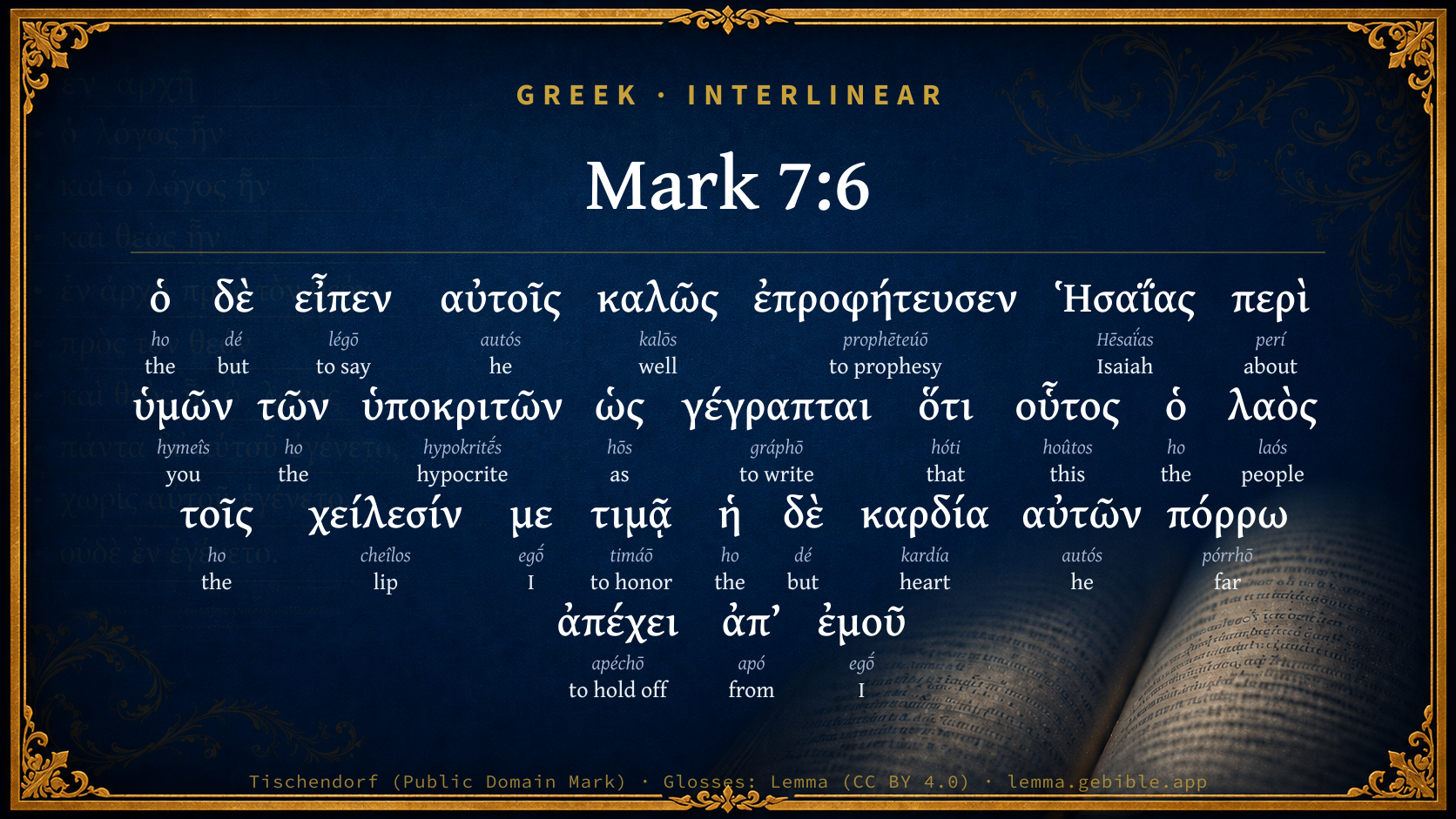
He answered them, "Well did Isaiah prophesy of you hypocrites, as it is written, 'This people honors me with their lips, But their heart is far from me.
Download a study sheet
One document with this verse’s original text, its word-by-word gloss line, the meaning frame, cross-references with their text, attributed commentary, and full source and license credits — printable, and it pastes into notes with its structure intact.
This verse Autodidact and up
A passage Seminary Student
Up to 50 verses in one chapter. A passage sheet keeps up to 6 commentary sources and 12 cross-references per verse, in the order this page ranks them, and says so on the sheet whenever that leaves anything out. Ask for a single verse and you get the Autodidact verse sheet above.
Everything on this page stays free to read, with no account — the sheet is a download of what is already on screen, not access to it.
Compare translations 3
The same verse in 3 English versions, stacked beneath the original-language interlinear above. Click any original word for its lexicon entry.
Each is an independent rendering of the whole verse — the interlinear is not word-aligned to these translations.
Highlighted words mark where these versions differ — a whole-verse word diff, not a word-by-word alignment.
-
World English Bible Public Domain
He answered them, "Well did Isaiah prophesy of you hypocrites, as it is written, 'This people honors me with their lips, But their heart is far from me.
-
King James Version Public Domain
He answered and said unto them, Well hath Esaias prophesied of you hypocrites, as it is written, This people honoureth me with their lips, but their heart is far from me.
-
unfoldingWord Literal Text CC BY-SA 4.0
But he, answering, said to them, “Isaiah prophesied well about you hypocrites. As it is written, ‘This people honors me with their lips, but their heart is far away from me.
unfoldingWord Literal Text — © unfoldingWord, licensed CC BY-SA 4.0. Word-aligned USFM3 via Door43 (git.door43.org/unfoldingWord/en_ult).
Show all 19 translations
Every available English version of this verse, each an independent rendering of the whole verse.
-
World English Bible Public Domain
He answered them, "Well did Isaiah prophesy of you hypocrites, as it is written, 'This people honors me with their lips, But their heart is far from me.
-
Berean Standard Bible Public Domain
Jesus answered them, “Isaiah prophesied correctly about you hypocrites, as it is written: ‘These people honor Me with their lips, but their hearts are far from Me.
-
Majority Standard Bible Public Domain
Jesus answered them, “Isaiah prophesied correctly about you hypocrites, as it is written: ‘These people honor Me with their lips, but their hearts are far from Me.
-
King James Version Public Domain
He answered and said unto them, Well hath Esaias prophesied of you hypocrites, as it is written, This people honoureth me with their lips, but their heart is far from me.
-
American Standard Version (1901) Public Domain
And he said unto them, Well did Isaiah prophesy of you hypocrites, as it is written, This people honoreth me with their lips, But their heart is far from me.
-
Revised Version (1885) Public Domain
And he said unto them, Well did Isaiah prophesy of you hypocrites, as it is written, This people honoureth me with their lips, But their heart is far from me.
-
Geneva Bible (1599) Public Domain
Then hee answered and sayd vnto them, Surely Esay hath prophecied well of you, hypocrites, as it is written, This people honoureth mee with lippes, but their heart is farre away from me.
-
Douay-Rheims (1899) Public Domain
But he answering, said to them: Well did Isaias prophesy of you hypocrites, as it is written: This people honoureth me with their lips, but their heart is far from me.
-
Young's Literal Translation Public Domain
and he answering said to them -- `Well did Isaiah prophesy concerning you, hypocrites, as it hath been written, This people with the lips doth honor Me, and their heart is far from Me;
-
Literal Standard Version CC BY-SA 4.0
And He answering said to them, “Well did Isaiah prophesy concerning you, hypocrites, as it has been written: This people honors Me with the lips, and their heart is far from Me;
-
Unlocked Literal Bible CC BY-SA 4.0
But he said to them, “Isaiah prophesied well about you hypocrites. He wrote, 'This people honors me with their lips, but their heart is far from me.
-
unfoldingWord Literal Text CC BY-SA 4.0
But he, answering, said to them, “Isaiah prophesied well about you hypocrites. As it is written, ‘This people honors me with their lips, but their heart is far away from me.
-
Darby Bible Public Domain
But he answering said to them, Well did Esaias prophesy concerning you hypocrites, as it is written, This people honour me with their lips, but their heart is far away from me.
-
World Messianic Bible Public Domain
He answered them, “Well did Isaiah prophesy of you hypocrites, as it is written, ‘This people honors me with their lips, but their heart is far from me.
-
Webster's Bible Public Domain
He answered and said to them, Well hath Isaiah prophesied concerning you hypocrites, as it is written, This people honoreth me with their lips, but their heart is far from me.
-
Free Bible Version CC BY-SA 4.0
Jesus replied, “Isaiah was right about you hypocrites when he said, ‘These people claim they honor me, but in their thinking they are far from me.
-
Bible in Basic English Public Domain
And he said, Well did Isaiah say of you, you false ones: These people give me honour with their lips, but their heart is far from me.
-
Text-Critical English NT CC BY 4.0
He answered them, “Isaiah prophesied rightly about you hypocrites, as it is written, ‘This people honors me with their lips, but their heart is far from me.
-
Tyndale New Testament (1534) Public Domain
He answered and sayde vnto them: well prophesied Esaias of you ypocrites as it is writte: This people honoreth me with their lyppes but their hert is farre from me:
Literal Standard Version (2020), Covenant Press — licensed CC BY-SA 4.0. Text via the HelloAO Bible API (eBible.org). Unlocked Literal Bible (unfoldingWord) — licensed CC BY-SA 4.0. Text via the HelloAO Bible API (eBible.org). unfoldingWord Literal Text — © unfoldingWord, licensed CC BY-SA 4.0. Word-aligned USFM3 via Door43 (git.door43.org/unfoldingWord/en_ult). Free Bible Version, Dr. Jonathan Gallagher — licensed CC BY-SA 4.0. Text via the HelloAO Bible API (eBible.org).
Word by word
More ways to search: Search by grammar → Find every occurrence → Compare this word →
Practice this passage: Drill this verse → Learn its vocabulary →
- Appears 3× in the Greek New Testament
- First appears at Matthew 15:8
- Part of Speech
- Adverb
Full Thayer's Definition
- ὁ ho G3588 “the” Article, Nominative, Singular, Masculine
- δὲ dé G1161 “but” Conjunction
- εἶπεν légō G3004 “to say” Verb, Aorist, Active, Indicative, 3rd person, Singular
- αὐτοῖς autós G846 “he” Personal pronoun, Dative, Plural, Masculine
- καλῶς kalōs G2573 “well” Adverb
- ἐπροφήτευσεν prophēteúō G4395 “to prophesy” Verb, Aorist, Active, Indicative, 3rd person, Singular
- Ἡσαΐας Hēsaḯas G2268 “Isaiah” Noun, Nominative, Singular, Masculine
- περὶ perí G4012 “about” Preposition
- ὑμῶν hymeîs G5210 “you” Personal pronoun, 2nd person, Genitive, Plural
- τῶν ho G3588 “the” Article, Genitive, Plural, Masculine
- ὑποκριτῶν hypokritḗs G5273 “hypocrite” Noun, Genitive, Plural, Masculine
- ὡς hōs G5613 “as” Adverb
- γέγραπται gráphō G1125 “to write” Verb, Perfect, Passive, Indicative, 3rd person, Singular
- ὅτι hóti G3754 “that” Conjunction
- οὗτος hoûtos G3778 “this” Demonstrative pronoun, Nominative, Singular, Masculine
- ὁ ho G3588 “the” Article, Nominative, Singular, Masculine
- λαὸς laós G2992 “people” Noun, Nominative, Singular, Masculine
- τοῖς ho G3588 “the” Article, Dative, Plural, Neuter
- χείλεσίν cheîlos G5491 “lip” Noun, Dative, Plural, Neuter
- με egṓ G1473 “I” Personal pronoun, 1st person, Accusative, Singular
- τιμᾷ timáō G5091 “to honor” Verb, Present, Active, Indicative, 3rd person, Singular
- ἡ ho G3588 “the” Article, Nominative, Singular, Feminine
- δὲ dé G1161 “but” Conjunction
- καρδία kardía G2588 “heart” Noun, Nominative, Singular, Feminine
- αὐτῶν autós G846 “he” Personal pronoun, Genitive, Plural, Masculine
- πόρρω pórrhō G4206 “far” Adverb
- ἀπέχει apéchō G568 “to hold off” Verb, Present, Active, Indicative, 3rd person, Singular
- ἀπ’ apó G575 “from” Preposition
- ἐμοῦ egṓ G1473 “I” Personal pronoun, 1st person, Genitive, Singular
About this verse
These counts appear in no published source. They are computed here, from the morphology-tagged text and Lemma’s own curated glosses. What Lemma adds →
- 29
- words
- 22
- distinct lemmas
- Gospels
- section
Cross-references
14Topical passages linked to Mark 7:6 in the Treasury of Scripture Knowledge — connected by theme and wording, ordered by reader-vote popularity; previews shown in the World English Bible.
- Isaiah 29:13 The Lord said, Because this people draw near [to me], and with their mouth and with their lips to honor me, but have removed their heart far from me, and their fear of me is a commandment of men which has been taught [them];
- Titus 1:16 They profess that they know God, but by their works they deny him, being abominable, disobedient, and unfit for any good work.
- Matthew 15:7–9 You hypocrites! Well did Isaiah prophesy of you, saying,
- Ezekiel 33:31 They come to you as the people comes, and they sit before you as my people, and they hear your words, but don't do them; for with their mouth they show much love, but their heart goes after their gain.
- 2 Timothy 3:5 holding a form of godliness, but having denied the power thereof. Turn away from these, also.
- Matthew 23:13–15 "Woe to you, scribes and Pharisees, hypocrites! For you devour widows' houses, and as a pretense you make long prayers. Therefore you will receive greater condemnation.
- James 2:14–17 What good is it, my brothers, if a man says he has faith, but has no works? Can faith save him?
- John 5:42 But I know you, that you don't have God's love in yourselves.
- Luke 11:39–44 The Lord said to him, "Now you Pharisees cleanse the outside of the cup and of the platter, but your inward part is full of extortion and wickedness.
- John 15:24 If I hadn't done among them the works which no one else did, they wouldn't have had sin. But now have they seen and also hated both me and my Father.
- John 8:54–55 Jesus answered, "If I glorify myself, my glory is nothing. It is my Father who glorifies me, of whom you say that he is our God.
- Hosea 8:2–3 They cry to me, 'My God, we Israel acknowledge you!'
- Acts 28:25 When they didn't agree among themselves, they departed after Paul had spoken one word, "The Holy Spirit spoke rightly through Isaiah, the prophet, to our fathers,
- John 8:41–42 You do the works of your father." They said to him, "We were not born of sexual immorality. We have one Father, God."
Cross-references courtesy of OpenBible.info (CC BY 4.0).
Lesson kit
Teaching starters — assembled from the data on this page, not authored interpretation. Every prompt links to the verse data it draws on. Edit before teaching.
Mark, in the Gospels, opens this verse with 29 words (22 distinct Greek lemmas). Its most distinctive word is pórrhō (“far”). A historical commentator’s framing appears above. Read the whole chapter for the surrounding context.
Discussion questions
- What does “far” (pórrhō) contribute to the verse as a whole?
- Matthew 15:8 shares the word «far» with this verse. How do the two illuminate each other?
- “the” occurs 5× in this one verse. What is the effect of the repetition?
- These translations render this verse differently. What is at stake in choosing one wording over another?
- Reading how Tyndale Open Study Notes and Bengel's Gnomon read this verse, where do the two commentators agree and where do they part?
Things to notice
- These translations choose different wording for 12 words in this verse.
- “the” occurs 5× in this single verse.
- 22 distinct Greek lemmas span 29 words in this verse.
Commentary
Notes on Mark 7:6 from classic Christian and Jewish commentators (each source and its license shown beneath its notes). The classic Christian expositions comment on the surrounding passage and are grouped to its opening verse, so a note may address several verses; the Jewish commentaries on the Tanakh (Rashi and others) are per-verse, so they appear only where the commentator wrote on this verse.
Lemma curates 59 commentaries, every one of them public domain or Creative Commons licensed, each selected and text-cleaned for this edition rather than reprinted as found. About our sources →
Tyndale Open Study Notes
Tyndale Open Resources
Tyndale Open Study Notes — © Tyndale Open Resources, licensed CC BY-SA 4.0. Text via the HelloAO Bible API.
Bengel's Gnomon
Johann Albrecht Bengel
Bengel's Gnomon of the New Testament — English translation (T&T Clark, Edinburgh, 1860) — public domain. Text from a community e-Sword module.
Expositor's Greek Testament
ed. W. Robertson Nicoll
The Expositor's Greek Testament, edited by W. Robertson Nicoll (1897–1910) — public domain. Text from a community e-Sword module.
Geneva Bible (1599)
Geneva Bible translators
Geneva Bible (1599) marginal notes — public domain. Text via Bolls.life.
Adam Clarke's Commentary
Adam Clarke's Commentary on the Bible (1810–1826) — public domain. Text from a community e-Sword/MySword module.
Ellicott's Commentary for English Readers
A Bible Commentary for English Readers, edited by Charles John Ellicott (1878–1897) — public domain. Text from a community e-Sword module.
The Cambridge Bible for Schools and Colleges
gen. ed. J. J. S. Perowne
The Cambridge Bible for Schools and Colleges (gen. ed. J. J. S. Perowne; Cambridge University Press, 1878–1918) — public domain. Text from a community e-Sword module.
John Gill's Exposition
John Gill's Exposition of the Whole Bible (1746–1763) — public domain (CC PDM 1.0). Text via the HelloAO Bible API.
Trapp's Complete Commentary
John Trapp
John Trapp, A Commentary or Exposition upon All the Books of the Old and New Testament (1647–1656) — public domain. Text from a community e-Sword module.
Whedon's Commentary on the Bible
Daniel D. Whedon
Daniel D. Whedon (gen. ed.), Commentary on the Old and New Testaments (1874–1909) — public domain. Text from a community e-Sword module.
The Pulpit Commentary
The Pulpit Commentary (1880–1919), ed. H.D.M. Spence-Jones & Joseph S. Exell — public domain. Text from a community e-Sword module.
John Wesley's Explanatory Notes
John Wesley, Explanatory Notes Upon the Whole Bible (1754–1765) — public domain. Text via the GEBible commentary corpus.
Kretzmann's Popular Commentary
Paul E. Kretzmann
Paul E. Kretzmann, Popular Commentary of the Bible (1921–1924) — public domain. Text from a community e-Sword module.
unfoldingWord translationNotes
Door43 World Missions Community
unfoldingWord translationNotes — © Distant Shores Media and the Door43 World Missions Community, licensed CC BY-SA 4.0. Source: git.door43.org/Door43/en_tn.
Cambridge Greek Testament for Schools and Colleges
Cambridge Greek Testament for Schools and Colleges (Cambridge University Press, 1896; 21 vols, various authors incl. Carr, Maclear, Plummer, Farrar, Lumby, Moule, M. R. James, Simcox) — public domain. Text from a community e-Sword module.
International Critical Commentary
International Critical Commentary — older volumes (1896–1929), various authors — public domain. Text from a community e-Sword module.
Vincent's Word Studies in the New Testament
Marvin R. Vincent
Marvin R. Vincent, Word Studies in the New Testament (1887–1900) — public domain. Text from a community e-Sword/MySword module.