Mark 9:7

Greek (Tischendorf 8th ed.) Mark 9:7 appears in the Greek New Testament. The text above is from the Tischendorf 8th edition. Each word links to its Strong’s number and a concise gloss. Click any word for its full Thayer’s Greek Lexicon entry.
Download image
Cite this verse

Mark 9:7 (World English Bible). Public Domain. Lemma interlinear Bible study tool, https://lemma.gebible.app/v/mark/9/7.

Show BibTeX & RIS
BibTeX
RIS
English Translation
A cloud came, overshadowing them, and a voice came out of the cloud, "This is my beloved Son. Listen to him."
World English Bible · Public Domain
Download a study sheet

One document with this verse’s original text, its word-by-word gloss line, the meaning frame, cross-references with their text, attributed commentary, and full source and license credits — printable, and it pastes into notes with its structure intact.

This verse Autodidact and up

Study sheet (.html) Plain text (.txt)

A passage Seminary Student

Up to 50 verses in one chapter. A passage sheet keeps up to 6 commentary sources and 12 cross-references per verse, in the order this page ranks them, and says so on the sheet whenever that leaves anything out. Ask for a single verse and you get the Autodidact verse sheet above.

Everything on this page stays free to read, with no account — the sheet is a download of what is already on screen, not access to it.

Want to remove ads? Support Godless Engineer
Compare translations 3

The same verse in 3 English versions, stacked beneath the original-language interlinear above. Click any original word for its lexicon entry.

Each is an independent rendering of the whole verse — the interlinear is not word-aligned to these translations.

Highlighted words mark where these versions differ — a whole-verse word diff, not a word-by-word alignment.

  • World English Bible Public Domain
    A cloud came, overshadowing them, and a voice came out of the cloud, "This is my beloved Son. Listen to him."
  • King James Version Public Domain
    And there was a cloud that overshadowed them: and a voice came out of the cloud, saying, This is my beloved Son: hear him.
  • unfoldingWord Literal Text CC BY-SA 4.0
    And a cloud appeared, overshadowing them, and there was a voice from the cloud, “This is my beloved Son. Listen to him.”

unfoldingWord Literal Text — © unfoldingWord, licensed CC BY-SA 4.0. Word-aligned USFM3 via Door43 (git.door43.org/unfoldingWord/en_ult).

Versions to compare (up to 4)

3 of 4 selected

Show all 19 translations

Every available English version of this verse, each an independent rendering of the whole verse.

  • World English Bible Public Domain
    A cloud came, overshadowing them, and a voice came out of the cloud, "This is my beloved Son. Listen to him."
  • Berean Standard Bible Public Domain
    Then a cloud appeared and enveloped them, and a voice came from the cloud: “This is My beloved Son. Listen to Him!”
  • Majority Standard Bible Public Domain
    Then a cloud appeared and enveloped them, and a voice came from the cloud: “This is My beloved Son. Listen to Him!”
  • King James Version Public Domain
    And there was a cloud that overshadowed them: and a voice came out of the cloud, saying, This is my beloved Son: hear him.
  • American Standard Version (1901) Public Domain
    And there came a cloud overshadowing them: and there came a voice out of the cloud, This is my beloved Son: hear ye him.
  • Revised Version (1885) Public Domain
    And there came a cloud overshadowing them: and there came a voice out of the cloud, This is my beloved Son: hear ye him.
  • Geneva Bible (1599) Public Domain
    And there was a cloude that shadowed them, and a voyce came out of the cloude, saying, This is my beloued Sonne: heare him.
  • Douay-Rheims (1899) Public Domain
    And immediately looking about, they saw no man any more, but Jesus only with them.
  • Young's Literal Translation Public Domain
    And there came a cloud overshadowing them, and there came a voice out of the cloud, saying, `This is My Son -- the Beloved, hear ye him;'
  • Literal Standard Version CC BY-SA 4.0
    And there came a cloud overshadowing them, and there came a voice out of the cloud, saying, “This is My Son, the Beloved, hear Him”;
  • Unlocked Literal Bible CC BY-SA 4.0
    A cloud came and overshadowed them. Then a voice came out of the cloud, “This is my beloved Son. Listen to him.”
  • unfoldingWord Literal Text CC BY-SA 4.0
    And a cloud appeared, overshadowing them, and there was a voice from the cloud, “This is my beloved Son. Listen to him.”
  • Darby Bible Public Domain
    And there came a cloud overshadowing them, and there came a voice out of the cloud, *This* is my beloved Son: hear him.
  • World Messianic Bible Public Domain
    A cloud came, overshadowing them, and a voice came out of the cloud, “This is my beloved Son. Listen to him.”
  • Webster's Bible Public Domain
    And there was a cloud that overshadowed them: and a voice came out of the cloud, saying, This is my beloved Son: hear him.
  • Free Bible Version CC BY-SA 4.0
    Then a cloud covered them, and a voice came from the cloud, saying, “This is my Son, the one I love. Listen to him.”
  • Bible in Basic English Public Domain
    And a cloud came over them; and a voice came out of the cloud, saying, This is my dearly loved Son, give ear to him.
  • Text-Critical English NT CC BY 4.0
    Then a cloud came and overshadowed them, and a voice came from the cloud: “This is my beloved Son; listen to him!”
  • Tyndale New Testament (1534) Public Domain
    And ther was a cloude that shaddowed the. And a voyce came out of the cloude sayinge: This is my dere sonne here him.

Literal Standard Version (2020), Covenant Press — licensed CC BY-SA 4.0. Text via the HelloAO Bible API (eBible.org). Unlocked Literal Bible (unfoldingWord) — licensed CC BY-SA 4.0. Text via the HelloAO Bible API (eBible.org). unfoldingWord Literal Text — © unfoldingWord, licensed CC BY-SA 4.0. Word-aligned USFM3 via Door43 (git.door43.org/unfoldingWord/en_ult). Free Bible Version, Dr. Jonathan Gallagher — licensed CC BY-SA 4.0. Text via the HelloAO Bible API (eBible.org).

Word by word

More ways to search: Search by grammar → Find every occurrence → Compare this word →

Practice this passage: Drill this verse → Learn its vocabulary →

ἐπισκιάζουσα
episkiázō
G1982
“to overshadow”
Verb, Present, Active, Participle, Nominative, Singular, Feminine
Part of Speech
Verb
Tense
Present
Voice
Active
Mood
Participle
Case
Nominative
Number
Singular
Gender
Feminine
Full Thayer's Definition

Origin: from G1909 and a derivative of G4639

TDNT: 13:39,1

1. to throw a shadow upon, to envelop in a shadow, to overshadow
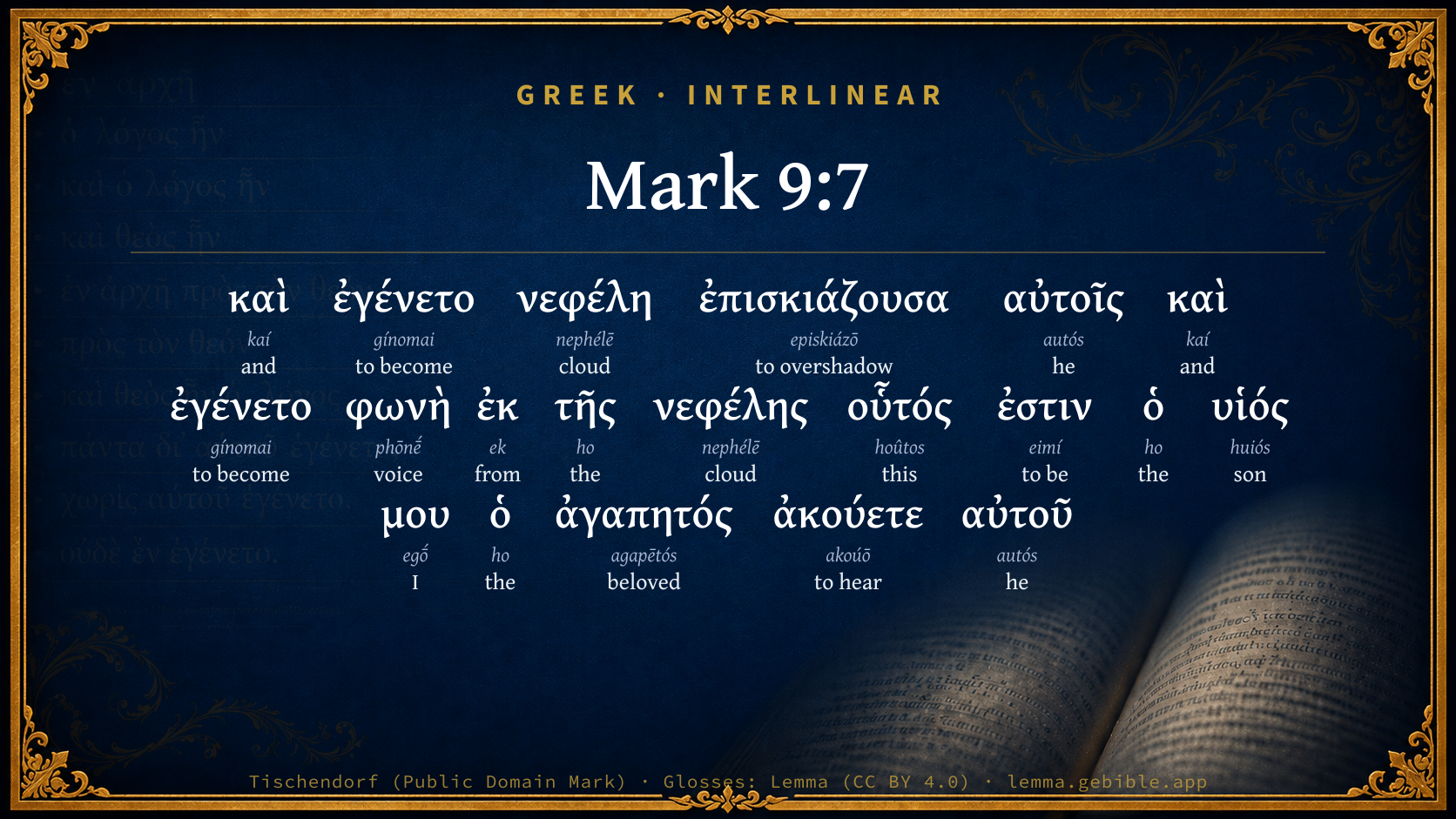
  1. καὶ kaí G2532 “and” Conjunction
  2. ἐγένετο gínomai G1096 “to become” Verb, Aorist, Middle deponent, Indicative, 3rd person, Singular
  3. νεφέλη nephélē G3507 “cloud” Noun, Nominative, Singular, Feminine
  4. αὐτοῖς autós G846 “he” Personal pronoun, Dative, Plural, Masculine
  5. καὶ kaí G2532 “and” Conjunction
  6. ἐγένετο gínomai G1096 “to become” Verb, Aorist, Middle deponent, Indicative, 3rd person, Singular
  7. φωνὴ phōnḗ G5456 “voice” Noun, Nominative, Singular, Feminine
  8. ἐκ ek G1537 “from” Preposition
  9. τῆς ho G3588 “the” Article, Genitive, Singular, Feminine
  10. νεφέλης nephélē G3507 “cloud” Noun, Genitive, Singular, Feminine
  11. οὗτός hoûtos G3778 “this” Demonstrative pronoun, Nominative, Singular, Masculine
  12. ἐστιν eimí G1510 “to be” Verb, Present, Active, Indicative, 3rd person, Singular
  13. ὁ ho G3588 “the” Article, Nominative, Singular, Masculine
  14. υἱός huiós G5207 “son” Noun, Nominative, Singular, Masculine
  15. μου egṓ G1473 “I” Personal pronoun, 1st person, Genitive, Singular
  16. ὁ ho G3588 “the” Article, Nominative, Singular, Masculine
  17. ἀγαπητός agapētós G27 “beloved” Adjective, Nominative, Singular, Masculine
  18. ἀκούετε akoúō G191 “to hear” Verb, Present, Active, Imperative, 2nd person, Plural
  19. αὐτοῦ autós G846 “he” Personal pronoun, Genitive, Singular, Masculine

About this verse

These counts appear in no published source. They are computed here, from the morphology-tagged text and Lemma’s own curated glosses. What Lemma adds →

20
words
14
distinct lemmas
Gospels
section

Notable vocabulary

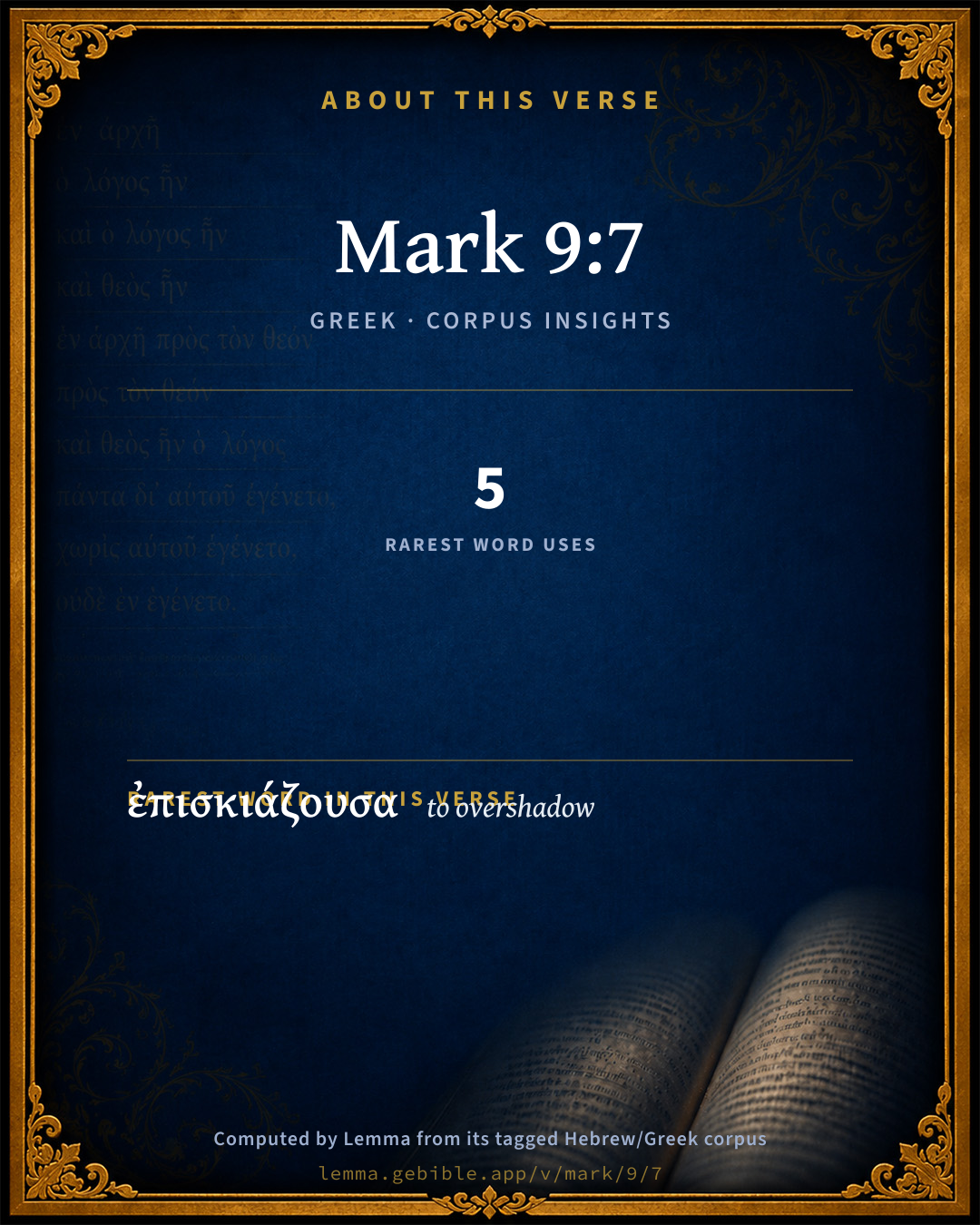
The rarest word here is ἐπισκιάζουσα to overshadow G1982 — appearing just 5 times in the whole Greek New Testament.

Shared distinctive vocabulary

ἐπισκιάζουσα to overshadow G1982 occurs in 5 verses of the Greek New Testament. Also found in:

Repetition

Words recur within this verse:

  • ἐγένετο to become G1096 ×2
  • νεφέλη cloud G3507 ×2
  • τῆς the G3588 ×3
  • καὶ and G2532 ×2
  • αὐτοῖς he G846 ×2

Cross-references

37

Topical passages linked to Mark 9:7 in the Treasury of Scripture Knowledge — connected by theme and wording, ordered by reader-vote popularity; previews shown in the World English Bible.

  • 2 Peter 1:17 For he received from God the Father honor and glory, when the voice came to him from the Majestic Glory, "This is my beloved Son, in whom I am well pleased."
  • Matthew 3:17 Behold, a voice out of the heavens said, "This is my beloved Son, with whom I am well pleased."
  • Luke 9:34–36 While he said these things, a cloud came and overshadowed them, and they were afraid as they entered into the cloud.
  • Mark 1:11 A voice came out of the sky, "You are my beloved Son, in whom I am well pleased."
  • Hebrews 2:1 Therefore we ought to pay greater attention to the things that were heard, lest perhaps we drift away.
  • Exodus 23:21–22 Pay attention to him, and listen to his voice. Don't provoke him, for he will not pardon your disobedience, for my name is in him.
  • Matthew 17:5–7 While he was still speaking, behold, a bright cloud overshadowed them. Behold, a voice came out of the cloud, saying, "This is my beloved Son, in whom I am well pleased. Listen to him."
  • John 5:22–25 For the Father judges no one, but he has given all judgment to the Son,
  • Deuteronomy 18:15–19 Yahweh your God will raise up to you a prophet from the midst of you, of your brothers, like me; to him you shall listen;
  • Psalms 2:7 I will tell of the decree. Yahweh said to me, "You are my son. Today I have become your father.
  • John 1:34 I have seen, and have testified that this is the Son of God."
  • 1 John 5:11–12 The testimony is this, that God gave to us eternal life, and this life is in his Son.
  • Revelation 1:7 Behold, he is coming with the clouds, and every eye will see him, including those who pierced him. All the tribes of the earth will mourn over him. Even so, Amen.
  • 1 Kings 8:10–12 It came to pass, when the priests were come out of the holy place, that the cloud filled the house of Yahweh,
  • Psalms 97:2 Clouds and darkness are around him. Righteousness and justice are the foundation of his throne.
  • John 3:16–18 For God so loved the world, that he gave his one and only Son, that whoever believes in him should not perish, but have eternal life.
  • John 6:69 We have come to believe and know that you are the Christ, the Son of the living God."
  • John 20:31 but these are written, that you may believe that Jesus is the Christ, the Son of God, and that believing you may have life in his name.
  • Acts 3:22–23 For Moses indeed said to the fathers, 'The Lord God will raise up a prophet for you from among your brothers, like me. You shall listen to him in all things whatever he says to you.
  • Hebrews 12:25–26 See that you don't refuse him who speaks. For if they didn't escape when they refused him who warned on the Earth, how much more will we not escape who turn away from him who warns from heaven,
  • Exodus 24:16 The glory of Yahweh settled on Mount Sinai, and the cloud covered it six days. The seventh day he called to Moses out of the midst of the cloud.
  • Exodus 40:34 Then the cloud covered the tent of meeting, and the glory of Yahweh filled the tent.
  • Daniel 7:13 I saw in the night-visions, and, behold, there came with the clouds of the sky one like a son of man, and he came even to the ancient of days, and they brought him near before him.
  • Matthew 26:63–64 But Jesus held his peace. The high priest answered him, "I adjure you by the living God, that you tell us whether you are the Christ, the Son of God."
  • Matthew 27:43 He trusts in God. Let God deliver him now, if he wants him; for he said, 'I am the Son of God.'"
  • Matthew 27:54 Now the centurion, and those who were with him watching Jesus, when they saw the earthquake, and the things that were done, feared exceedingly, saying, "Truly this was the Son of God."
  • John 1:49 Nathanael answered him, "Rabbi, you are the Son of God! You are King of Israel!"
  • John 5:18 For this cause therefore the Jews sought all the more to kill him, because he not only broke the Sabbath, but also called God his own Father, making himself equal with God.
  • John 5:37 The Father himself, who sent me, has testified about me. You have neither heard his voice at any time, nor seen his form.
  • John 9:35 Jesus heard that they had thrown him out, and finding him, he said, "Do you believe in the Son of God?"
  • John 19:7 The Jews answered him, "We have a law, and by our law he ought to die, because he made himself the Son of God."
  • Acts 1:9 When he had said these things, as they were looking, he was taken up, and a cloud received him out of their sight.
  • Acts 7:37 This is that Moses, who said to the children of Israel, 'The Lord our God will raise up a prophet for you from among your brothers, like me.'
  • Acts 8:36 As they went on the way, they came to some water, and the eunuch said, "Behold, here is water. What is keeping me from being baptized?"
  • Romans 1:4 who was declared to be the Son of God with power, according to the Spirit of holiness, by the resurrection from the dead, Jesus Christ our Lord,
  • 1 John 4:9–10 By this was God's love revealed in us, that God has sent his one and only Son into the world that we might live through him.
  • 1 John 5:20 We know that the Son of God has come, and has given us an understanding, that we know him who is true, and we are in him who is true, in his Son Jesus Christ. This is the true God, and eternal life.

Cross-references courtesy of OpenBible.info (CC BY 4.0).

Commentary

Notes on Mark 9:7 from classic Christian and Jewish commentators (each source and its license shown beneath its notes). The classic Christian expositions comment on the surrounding passage and are grouped to its opening verse, so a note may address several verses; the Jewish commentaries on the Tanakh (Rashi and others) are per-verse, so they appear only where the commentator wrote on this verse.

Lemma curates 59 commentaries, every one of them public domain or Creative Commons licensed, each selected and text-cleaned for this edition rather than reprinted as found. About our sources →

The Biblical Illustrator

Joseph S. Exell

Mar_9:7

This is My Beloved Son: hear Him.

Hearing Christ

I. We should hear the Lord Jesus with resolution. I will go. Nothing shall prevent me; no employments, no pleasures; no solicitations, no difficulties. The Son of God calls me, and I must go. Thus we ought all to feel.

II. We must hear Him with submission. Not the pride of the world only, but our own pride, is to be resisted. We have no right to say how much or what part of His message we will receive, or when or where we will follow Him.

III. We must hear Him with attention, with serious and concentrated heed.

IV. We must hear Him not so much from the principle of fear, as of deep and earnest affection. He came to speak to us because He loved us.

V. We must hear Him with singleness of mind, placing no other instruction on a footing with His, far less yielding them the precedence. (F. W. P. Greenwood, D. D.)

The ministry of Jesus

I. Christ is Gods Messenger to man. He came forth and proceeded from the Father. Grace and truth came by Jesus Christ. He had

(1) a Divine commission;

(2) a Divine message;

(3) Divine credentials, divinely authenticated. He spake with authority. He revealed mysteries.

II. Mans duty to Gods Messenger. Hear Him-

1. Because His ministry is the supercessor of the ministries of Moses and Elias.

2. Because this ministry contains matters of universal importance.

3. Because the rejection of this ministry leaves no moral instructor available. Christ is the truth of God, through whom the Fathers latest will is made known to man. Hear Christs words, catch Christs spirit, obey Christs law, and you shall inherit Christs promises. (J. F. Porter.)

Hear Him

I. Christs authority is divine.

II. Christs authority is undivided.

III. Men are to be heard only so far as they repeat Christs words. (J. Parker, D. D.)

The Biblical Illustrator, edited by Joseph S. Exell (c. 1880s–1900s) — public domain. Text from a community e-Sword module.

MacLaren's Expositions of Holy Scripture

Alexander MacLaren

Mark

THE TRANSFIGURATION

‘THIS IS MY BELOVED SON: HEAR HIM’

Mar 9:7.

With regard to the first part of these words spoken at the Transfiguration, they open far too large and wonderful a subject for me to do more than just touch with the tip of my finger, as it were, in passing, because the utterance of the divine words, ‘This is My beloved Son,’ in all the depth of their meaning and loftiness, is laid as the foundation of the two words that come after, which, for us, are the all-important things here. And so I would rather dwell upon them than upon the mysteries of the first part, but a sentence must be spared. If we accept this story before us as the divine attestation of the mystery of the person and nature of Jesus Christ, we must take the words to mean-as these disciples, no doubt, took them to mean-something pointing to a unique and solitary revelation which He bore to the Divine Majesty. We have to see in them the confirmation of the great truth that the manhood of Jesus Christ was the supernatural creation of a direct divine power. ‘Conceived of the Holy Ghost, born of the Virgin Mary’; therefore, ‘that Holy Thing which shall be born of thee shall be called the Son of God.’ And we have to go, as I take it, farther back than the earthly birth, and to say, ‘No man hath seen God at any time-the only begotten Son which is in the bosom of the Father.’ He was the Son here by human birth, and was in the bosom of the Father all through that human life. ‘He hath declared Him,’ and so not only is there here the testimony to the miraculous incarnation, and to the true and proper Divinity and Deity of Jesus Christ, but there is also the witness to the perfectness of His character in the great word, ‘This is My beloved Son,’ which points us to an unbroken communion of love between Him and the Father, which tells us that in the depths of that divine nature there has been a constant play of mutual love, which reveals to us that in His humanity there never was anything that came as the faintest film of separation between His will and the will of the Father, between His heart and the heart of God.

But this revelation of the mysterious personality of the divine Son, the perfect harmony between Him and God, is here given as the ground of the command that follows: ‘Hear Him.’ God’s voice bids you listen to Christ’s voice-God’s voice bids you listen to Christ’s voice as His voice. Listen to Him when He speaks to you about God-do not trust your own fancy, do not trust your own fear, do not trust the dictates of your conscience, do not consult man, do not listen to others, do not speculate about the mysteries of the earth and the heavens, but go to Him, and listen to the only begotten Son in the bosom of the Father. He declares unto us God; in Him alone we have certain knowledge of a loving Father in heaven. Hear Him when He tells us of God’s tenderness and patience and love. Hear Him above all when He says to us, ‘As Moses lifted up the serpent in the wilderness, even so must the Son of Man be lifted up.’ Hear Him when He says, ‘The Son of Man came to give His life a ransom for many.’ Hear Him when He speaks of Himself as Judge of you and me and all the world, and when He says, ‘The Son of Man shall come in His glory, and before Him shall be gathered all nations.’ Hear Him then. Hear Him when He calls you to Himself. Hear Him when He says to you, ‘Come unto Me all ye that labour and are heavy laden.’ Hear Him when He says, ‘If any man come unto Me he shall never thirst.’ Hear Him when He says, ‘Cast your burden upon Me, and I will sustain you.’ Hear Him when He commands. Hear Him when He says, ‘If ye love Me keep My commandments,’ and when He says, ‘Abide in Me and I in you,’ hear Him then. ‘In all time of our tribulation, in all time of our well-being, in the hour of death, and in the day of judgment,’ let us listen to Him.

Dear friends there is no rest anywhere else; there is no peace, no pleasure, no satisfaction-except close at His side. ‘Speak Lord! for Thy servant heareth.’ ‘To whom shall we go but unto Thee? Thou hast the words of eternal life.’ Look how these disciples, grovelling there on their faces, were raised by the gentle hand laid upon their shoulder, and the blessed voice that brought them back to consciousness, and how, as they looked about them with dazed eyes, all was gone. The vision, the cloud, Moses and Elias-the lustre and radiance and the dread voice were past, and everything was as it used to be. Christ stood alone there like some solitary figure relieved against a clear daffodil sky upon some extended plain, and there was nothing else to meet the eye but He. Christ is there, and in Him is all.

That is a summing up of all Divine revelation. ‘God, who at sundry times and in divers manners spake in time past unto the fathers by the prophets, hath, in these last days, spoken unto us by His Son.’ Moses dies, Elijah fades, clouds and symbols and voices and all mortal things vanish, but Jesus Christ stands before us, the manifest God, for ever and ever, the sole illumination of the world, It is also a summing up of all earthly history. All other people go. The beach of time is strewed with wrecked reputations and forgotten glories. And I am not ashamed to say that I believe that, as the ages grow, and the world gets further away in time from the Cross upon Calvary, more and more everything else will sink beneath the horizon, and Christ alone be left to fill the past as He fills the present and the future.

We may make that scene the picture of our lives. Distractions and temptations that lie all round us are ever seeking to drag us away. There is no peace anywhere but in having Christ only-my only pattern, my only hope, my only salvation, my only guide, my only aim, my only friend. The solitary Christ is the sufficient Christ, and that for ever. Take Him for your only friend, and you need none other. Then at death there may be a brief spasm of darkness, a momentary fear, perchance, but then the touch of a Brother’s hand will be upon us as we lie there prone in the dust, and we shall lift up our eyes, and lo! life’s illusions are gone, and life’s noises are fallen dumb, and we ‘see no man any more, save Jesus only,’ with ourselves.

Alexander MacLaren, Expositions of Holy Scripture (1904–1910) — public domain. Text from a community e-Sword module.

Tyndale Open Study Notes

Tyndale Open Resources

9:7 a cloud: Cp. Exod 40:34-35. • The voice from the cloud issued a stern rebuke of Peter’s suggestion: This is my dearly loved Son—not an equal of Moses and Elijah. God’s voice also confirmed Peter’s earlier confession (Mark 8:29), and it indirectly rebuked Peter for rejecting Jesus’ prediction of his suffering (8:32) by telling him and the other disciples to listen to him.

Tyndale Open Study Notes — © Tyndale Open Resources, licensed CC BY-SA 4.0. Text via the HelloAO Bible API.

Expositor's Greek Testament

ed. W. Robertson Nicoll

Mar 9:7 . καὶ ἐγένετο , before νεφέλη , and again before φωνὴ , in each place instead of Mt.’s ἰδοὺ ; in both cases pointing to something remarkable: an overshadowing cloud, and a mysterious voice from the cloud.

The Expositor's Greek Testament, edited by W. Robertson Nicoll (1897–1910) — public domain. Text from a community e-Sword module.

Ellicott's Commentary for English Readers

(7) This is my beloved Son.—It will be noted that St. Mark omits the words “in whom I am well pleased.”

A Bible Commentary for English Readers, edited by Charles John Ellicott (1878–1897) — public domain. Text from a community e-Sword module.

The Cambridge Bible for Schools and Colleges

gen. ed. J. J. S. Perowne

7. a cloud] not dark and murky, but bright (Mat_17:5), overshadowed the lawgiver and the prophet, and perhaps also the Lord. “Light in its utmost intensity performs the effects of darkness, hides as effectually as the darkness would do.” Comp. 1Ti_6:16, and the words of Milton, “dark with excess of light,” and of Wordsworth, “a glorious privacy of light.” Trench’s Studies, pp. 205, 206.

a voice came out of the cloud] The same Voice which had been heard once before at the Baptism (Mat_3:17), and which was to be heard again when He stood on the threshold of His Passion (Joh_12:28), attesting His Divinity and Sonship at the beginning, at the middle, and at the close of His ministry. Looking back afterwards on the scene now vouchsafed to him and to the “sons of thunder,” St Peter speaks of himself and them as “eyewitnesses of His majesty” (2Pe_1:16), i. e. literally, as men who had been admitted and initiated into secret and holy mysteries, and says that the Voice “came from the excellent glory” (2Pe_1:17), from Him, that is, Who dwelt in the cloud, which was the symbol and the vehicle of the Divine Presence. St John also clearly alludes to the scene in Joh_1:14 and 1Jn_1:1.

This is my beloved Son] “In the words themselves of this majestic installation there is a remarkable honouring of the Old Testament, and of it in all its parts, which can scarcely be regarded as accidental; for the three several clauses of that salutation are drawn severally from the Psalms (Psa_2:7), the Prophets (Isa_42:1), and the Law (Deu_18:15); and together they proclaim Him, concerning whom they are spoken, to be the King, the Priest, and the Prophet of the New Covenant.” Trench, Studies, p. 207.

The Cambridge Bible for Schools and Colleges (gen. ed. J. J. S. Perowne; Cambridge University Press, 1878–1918) — public domain. Text from a community e-Sword module.

John Gill's Exposition

And there was a cloud that overshadowed them,.... Jesus, Moses, and Elias, and also the disciples; who, according to Luke, entered into it, and so were covered by it.

And a voice came out the cloud, saying, this is my beloved Son, hear him. This was the voice of God the Father, bearing a testimony to the sonship of Christ; and was directed, not to Moses and Elias, but to the disciples, enjoining them to hear and obey him, who was the end of the law and prophets; was the great prophet Moses had spoken of, and was to be hearkened to, and whom all the prophets had testified of, and in whom they all centred; See Gill on Mat 17:5.

John Gill's Exposition of the Whole Bible (1746–1763) — public domain (CC PDM 1.0). Text via the HelloAO Bible API.

Trapp's Complete Commentary

John Trapp

7 And there was a cloud that overshadowed them: and a voice came out of the cloud, saying, This is my beloved Son: hear him.

Ver. 7. {See Trapp on "Mat 17:5"}

John Trapp, A Commentary or Exposition upon All the Books of the Old and New Testament (1647–1656) — public domain. Text from a community e-Sword module.

The Pulpit Commentary

There came a cloud overshadowing them. The cloud enfolded them all, so that they could not be seen, it was so ample and dense, and yet so bright and shining. St. Matthew (Mat_17:5) says it was "out of a cloud." The cloud was a symbol of the grandeur and unapproachable glory of God. The disciples were admitted within this cloud that they might have a foretaste of future glory, and that they might be witnesses of what took place under the cloud, and especially that they might be able to give evidence throughout all ages of the voice which they heard come out of the cloud from "the excellent glory" (the expression is equivalent to the Hebrew "Shechinah," and St. Peter says, (2Pe_1:18) it came from heaven), This is my beloved Son: hear ye him. But at the same time that this cloud was the symbol, it was also the veil of Deity, of the glory of Deity. "He maketh the clouds his chariot," says the psalmist. (Psa_104:3) Moreover, the cloud abated and subdued the splendor of Christ"s appearance, which otherwise the mortal eyes of the disciples could not have borne. It will be observed that St. Mark omits the words, found in St. Matthew," (Mat_17:5) in whom I am well pleased." So does St. Luke. But it is remarkable that they are found in St. Peter; (2Pe_1:17) from whence we might have expected to find them here. In St. Luke (Luk_9:35) the most approved readings give, "This is my Son, my chosen (eklelegmenov)." The words, "my beloved Son," are impressed upon us in order that epithets so sweet and endearing might kindle our love and devotion. "Hear ye him not Moses, who has now departed, but Christ himself, the new Author of a new Law. "Hear ye him" was not said when our Lord was baptized, because he was then only just proclaimed to the world. But now these words signify the abolition of the old dispensation, and the establishment of the new covenant in Christ.

The Pulpit Commentary (1880–1919), ed. H.D.M. Spence-Jones & Joseph S. Exell — public domain. Text from a community e-Sword module.

John Wesley's Explanatory Notes

There came a (bright, luminous) cloud, overshadowing them - This seems to have been such a cloud of glory as accompanied Israel in the wilderness, which, as the Jewish writers observe, departed at the death of Moses. But it now appeared again, in honour of our Lord, as the great Prophet of the Church, who was prefigured by Moses. Hear ye him - Even preferably to Moses and Elijah.

John Wesley, Explanatory Notes Upon the Whole Bible (1754–1765) — public domain. Text via the GEBible commentary corpus.

unfoldingWord translationNotes

Door43 World Missions Community

came and overshadowed

"appeared and covered"

Then a voice came out of the cloud

Here "a voice came out" is a metonym for someone speaking. It can also be stated clearly who spoke. AT: "Then someone spoke from the cloud" or "Then God spoke from the cloud" (See: Metonymy and Assumed Knowledge and Implicit Information)

This is my beloved Son. Listen to him

God the Father expresses his love for his "beloved Son," the Son of God.

beloved Son

This is an important title for Jesus, the Son of God. (See: Translating Son and Father)

when they looked

Here "they" refers to Peter, James, and John.

translationWords

beloved

Son of God

Jesus

unfoldingWord translationNotes — © Distant Shores Media and the Door43 World Missions Community, licensed CC BY-SA 4.0. Source: git.door43.org/Door43/en_tn.

Bengel's Gnomon

Johann Albrecht Bengel

[7. Αὐτοῦ ἀκούετε) Hear ye Him: viz. Jesus. For Moses and Elias had by this time disappeared.—V. g.]

Bengel's Gnomon of the New Testament — English translation (T&T Clark, Edinburgh, 1860) — public domain. Text from a community e-Sword module.

Cambridge Greek Testament for Schools and Colleges

7. [1871][1872][1873] etc. omit λέγουσα, from Mt. and Lk.

[1871] Codex Sinaiticus. 4th cent. Discovered by Tischendorf in 1859 at the Monastery of St Katharine on Mount Sinai. Now at St Petersburg. The whole Gospel, ending at Mar 16:8. Photographic facsimile, 1911.

[1872] Codex Vaticanus. 4th cent., but perhaps a little later than א. In the Vatican Library almost since its foundation by Pope Nicolas V., and one of its greatest treasures. The whole Gospel, ending at Mar 16:8. Photographic facsimile, 1889.

[1873] Codex Ephraemi. 5th cent. A palimpsest: the original writing has been partially rubbed out, and the works of Ephraem the Syrian have been written over it; but a great deal of the original writing has been recovered; of Mark we have Mar 1:17 to Mar 6:31, Mar 8:5 to Mar 12:29, Mar 13:19 to Mar 16:20. In the National Library at Paris.

7. νεφέλη ἐπισκιάζουσα αὐτοῖς. Mt. says that it was “luminous” (φωτινή), which is somewhat out of harmony with “overshadow”; but the etymology of ἐπισκιάζω need not be pressed. Cf. ἐπέφωσκεν of evening coming on (Luk 23:54). The cloud hung over them and rested above them. Syr-Sin. has “Him” for “them.” The luminous cloud represents the Shechinah, symbolizing the Divine Presence, and it is in marked contrast to the petty shelter suggested by Peter. Similarity of sound may have suggested a connexion between Shechinah and ἐπισκιάζω. Cf. the cloud at the Ascension (Act 1:9), and at the Second Advent (Luk 21:27).

Οὗτός ἐστιν. We have four reports of this Voice, those of the Synoptists and that of 2 Pet., and no two of them agree in wording. These differences are less important than the difference between this Voice and the one at the Baptism, viz. the ἀκούετε αὐτοῦ. At the Baptism (Mar 1:11) the words are addressed to Christ, here to the Apostles. The Law and the Prophets are consummated in Christ, and henceforth the disciples are to listen to Him. Thus the charge of the Heavenly Father agrees with the last recorded words of the earthly Mother, “Whatsoever He saith unto you, do it” (Joh 2:5). This Voice assured the disciples that, although the Jews might reject Him and the Romans put Him to death (Mar 8:31), yet He was accepted and beloved by God. The servants who prepared the way have passed; the Son abides (Joh 8:35). On the proposal to make ὁ ἀγαπητός a separate title of the Messiah, ὁ υἱός μου, ὁ ἀγαπητός, see Hastings’ D.B. II. 501.

Cambridge Greek Testament for Schools and Colleges (Cambridge University Press, 1896; 21 vols, various authors incl. Carr, Maclear, Plummer, Farrar, Lumby, Moule, M. R. James, Simcox) — public domain. Text from a community e-Sword module.

Vincent's Word Studies in the New Testament

Marvin R. Vincent

Sore afraid. Wyc., aghast by dread.

Beloved son. Wyc., most dearworthy.

Marvin R. Vincent, Word Studies in the New Testament (1887–1900) — public domain. Text from a community e-Sword/MySword module.

Lesson kit

Teaching starters — assembled from the data on this page, not authored interpretation. Every prompt links to the verse data it draws on. Edit before teaching.

Mark, in the Gospels, opens this verse with 20 words (14 distinct Greek lemmas). Its most distinctive word is episkiázō (“to overshadow”). A historical commentator’s framing appears above. Read the whole chapter for the surrounding context.

Discussion questions

  1. What does “to overshadow” (episkiázō) contribute to the verse as a whole?
  2. How does Matthew 17:5, which shares the word «to overshadow», read alongside this verse?
  3. What does the repetition of “to become” (2× in this one verse) do in this verse?
  4. These translations render this verse differently. What is at stake in choosing one wording over another?
  5. Compare how The Biblical Illustrator and MacLaren's Expositions of Holy Scripture read this verse. Where do they agree or differ?

Things to notice

  • These translations choose different wording for 9 words in this verse.
  • “to become” occurs 2× in this single verse.
  • 14 distinct Greek lemmas span 20 words in this verse.

Reading settings

Reading text

Shown beneath each verse's original-language words.

Old Testament
Old Testament edition

Read the OT as the Masoretic Hebrew (MT) or the Greek Septuagint (LXX).

English shown for the Greek Septuagint (in the Hebrew ↔ Greek comparison).

Comparing translations? Open the Compare panel on any verse page to stack up to four side by side.