Matthew 26:22

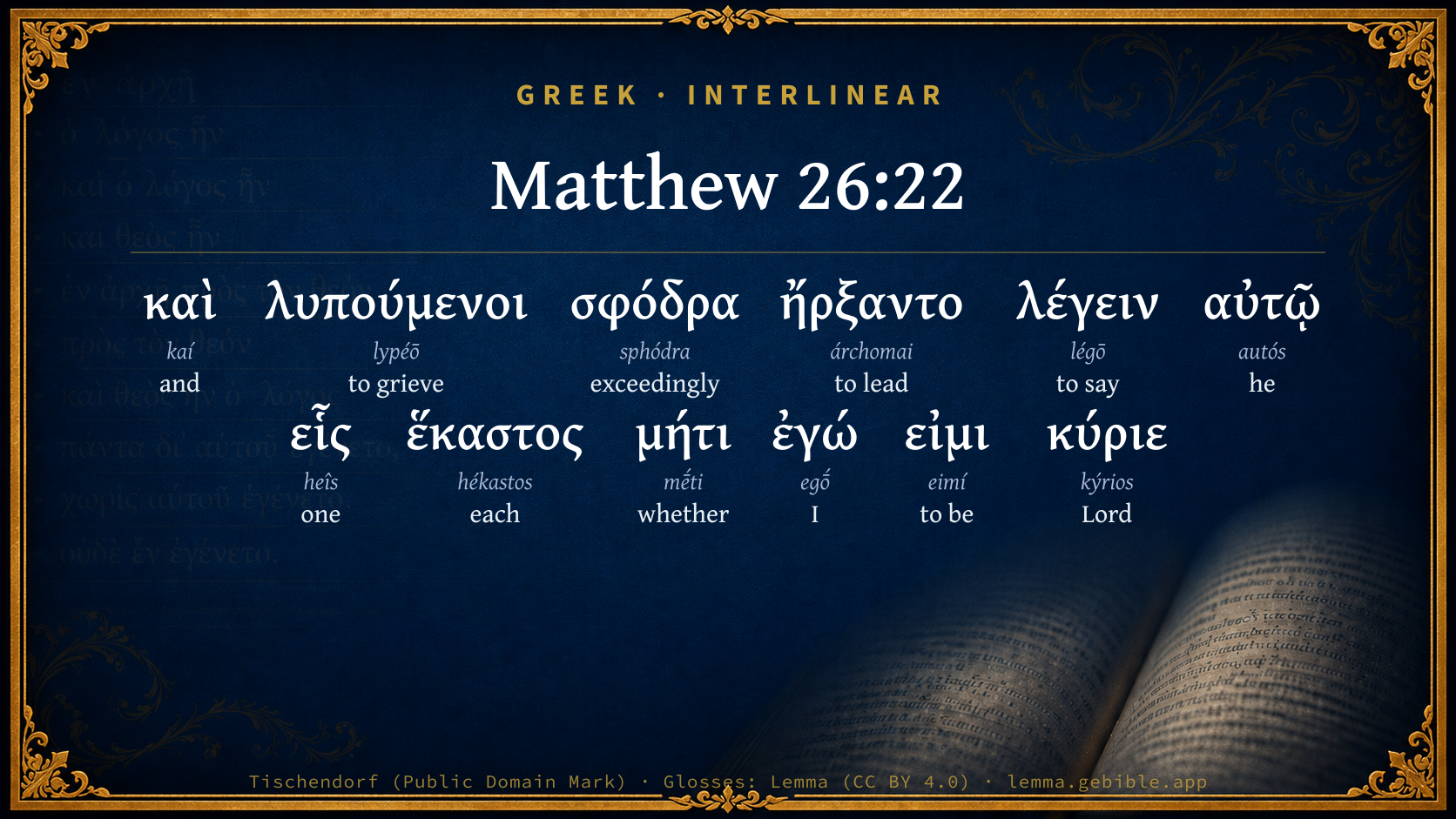
Greek (Tischendorf 8th ed.) Matthew 26:22 appears in the Greek New Testament. The text above is from the Tischendorf 8th edition. Each word links to its Strong’s number and a concise gloss. Click any word for its full Thayer’s Greek Lexicon entry.
Download image
Cite this verse

Matthew 26:22 (World English Bible). Public Domain. Lemma interlinear Bible study tool, https://lemma.gebible.app/v/matthew/26/22.

Show BibTeX & RIS
BibTeX
RIS
English Translation
They were exceedingly sorrowful, and each began to ask him, "It isn't me, is it, Lord?"
World English Bible · Public Domain
Download a study sheet

One document with this verse’s original text, its word-by-word gloss line, the meaning frame, cross-references with their text, attributed commentary, and full source and license credits — printable, and it pastes into notes with its structure intact.

This verse Autodidact and up

Study sheet (.html) Plain text (.txt)

A passage Seminary Student

Up to 50 verses in one chapter. A passage sheet keeps up to 6 commentary sources and 12 cross-references per verse, in the order this page ranks them, and says so on the sheet whenever that leaves anything out. Ask for a single verse and you get the Autodidact verse sheet above.

Everything on this page stays free to read, with no account — the sheet is a download of what is already on screen, not access to it.

Want to remove ads? Support Godless Engineer
Compare translations 3

The same verse in 3 English versions, stacked beneath the original-language interlinear above. Click any original word for its lexicon entry.

Each is an independent rendering of the whole verse — the interlinear is not word-aligned to these translations.

Highlighted words mark where these versions differ — a whole-verse word diff, not a word-by-word alignment.

  • World English Bible Public Domain
    They were exceedingly sorrowful, and each began to ask him, "It isn't me, is it, Lord?"
  • King James Version Public Domain
    And they were exceeding sorrowful, and began every one of them to say unto him, Lord, is it I?
  • unfoldingWord Literal Text CC BY-SA 4.0
    And being very grieved, each one began to say to him, “Surely not I, Lord?”

unfoldingWord Literal Text — © unfoldingWord, licensed CC BY-SA 4.0. Word-aligned USFM3 via Door43 (git.door43.org/unfoldingWord/en_ult).

Versions to compare (up to 4)

3 of 4 selected

Show all 19 translations

Every available English version of this verse, each an independent rendering of the whole verse.

  • World English Bible Public Domain
    They were exceedingly sorrowful, and each began to ask him, "It isn't me, is it, Lord?"
  • Berean Standard Bible Public Domain
    They were deeply grieved and began to ask Him one after another, “Surely not I, Lord?”
  • Majority Standard Bible Public Domain
    They were deeply grieved and began to ask Him one after another, “Surely not I, Lord?”
  • King James Version Public Domain
    And they were exceeding sorrowful, and began every one of them to say unto him, Lord, is it I?
  • American Standard Version (1901) Public Domain
    And they were exceeding sorrowful, and began to say unto him every one, Is it I, Lord?
  • Revised Version (1885) Public Domain
    And they were exceeding sorrowful, and began to say unto him every one, Is it I, Lord?
  • Geneva Bible (1599) Public Domain
    And they were exceeding sorowfull, and began euery one of them to say vnto him, Is it I, Master?
  • Douay-Rheims (1899) Public Domain
    And they being very much troubled, began every one to say: Is it I, Lord?
  • Young's Literal Translation Public Domain
    And being grieved exceedingly, they began to say to him, each of them, `Is it I, Sir?'
  • Literal Standard Version CC BY-SA 4.0
    And being grieved exceedingly, they began to say to Him, each of them, “Is it I, Lord?”
  • Unlocked Literal Bible CC BY-SA 4.0
    They were very sorrowful, and each one began to ask him, “Surely not I, Lord?”
  • unfoldingWord Literal Text CC BY-SA 4.0
    And being very grieved, each one began to say to him, “Surely not I, Lord?”
  • Darby Bible Public Domain
    And being exceedingly grieved they began to say to him, each of them, Is it *I*, Lord?
  • World Messianic Bible Public Domain
    They were exceedingly sorrowful, and each began to ask him, “It isn’t me, is it, Lord?”
  • Webster's Bible Public Domain
    And they were exceeding sorrowful, and began every one of them to say to him, Lord, is it I?
  • Free Bible Version CC BY-SA 4.0
    They were extremely upset. One after the other they asked him, “Lord, it's not me, is it?”
  • Bible in Basic English Public Domain
    And they were very said, and said to him, one by one, Is it I, Lord?
  • Text-Critical English NT CC BY 4.0
    Greatly distressed, they began to say to him one after another, “Surely not I, Lord?”
  • Tyndale New Testament (1534) Public Domain
    And they were excedinge sorowfull and beganne every one of the to saye vnto him: is it I master?

Literal Standard Version (2020), Covenant Press — licensed CC BY-SA 4.0. Text via the HelloAO Bible API (eBible.org). Unlocked Literal Bible (unfoldingWord) — licensed CC BY-SA 4.0. Text via the HelloAO Bible API (eBible.org). unfoldingWord Literal Text — © unfoldingWord, licensed CC BY-SA 4.0. Word-aligned USFM3 via Door43 (git.door43.org/unfoldingWord/en_ult). Free Bible Version, Dr. Jonathan Gallagher — licensed CC BY-SA 4.0. Text via the HelloAO Bible API (eBible.org).

Word by word

More ways to search: Search by grammar → Find every occurrence → Compare this word →

Practice this passage: Drill this verse → Learn its vocabulary →

About this verse

These counts appear in no published source. They are computed here, from the morphology-tagged text and Lemma’s own curated glosses. What Lemma adds →

12
words
12
distinct lemmas
Gospels
section

Notable vocabulary

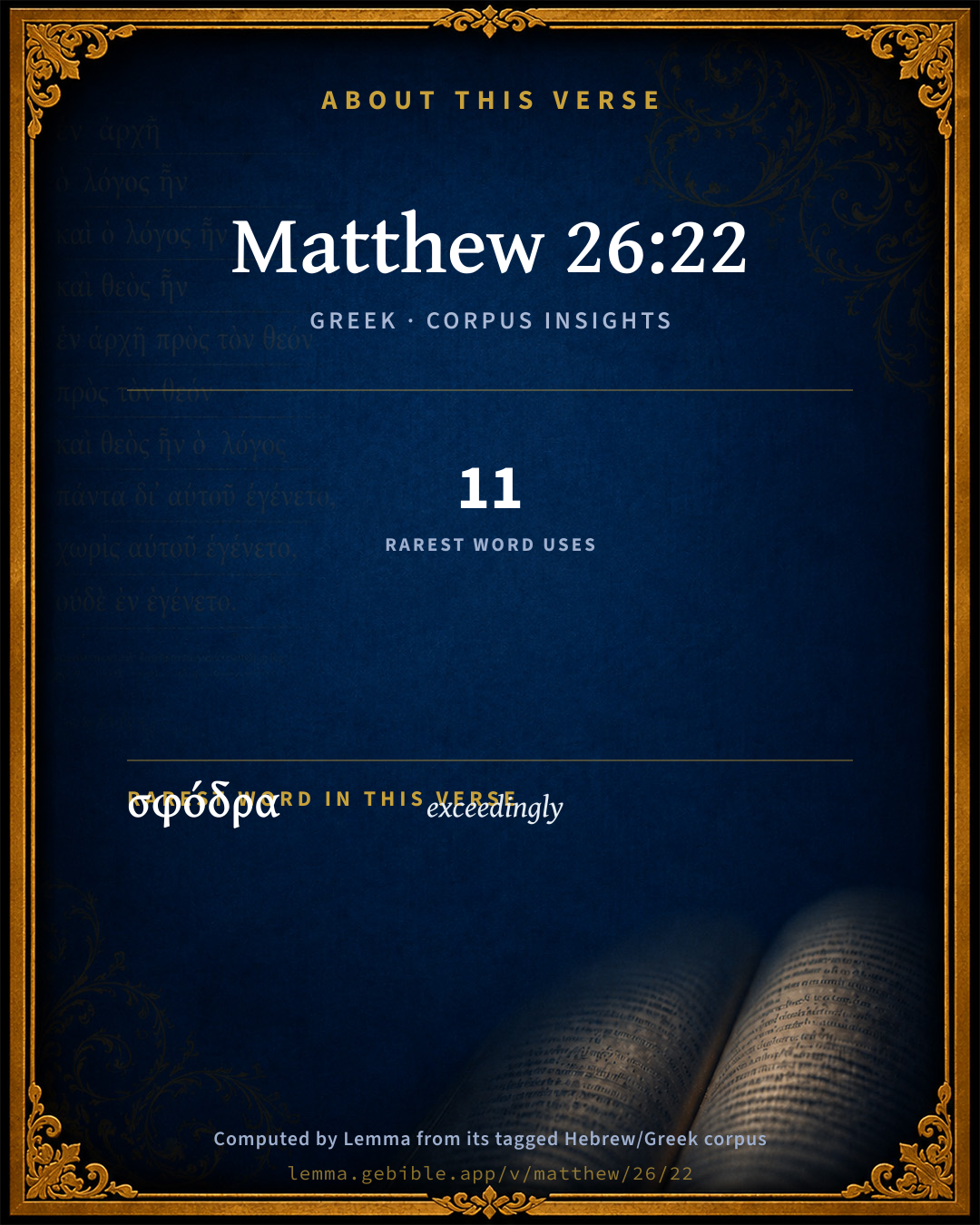
The rarest word here is σφόδρα exceedingly G4970 — appearing just 11 times in the whole Greek New Testament.

Shared distinctive vocabulary

σφόδρα exceedingly G4970 occurs in 11 verses of the Greek New Testament. Also found in:

Cross-references

4

Topical passages linked to Matthew 26:22 in the Treasury of Scripture Knowledge — connected by theme and wording, ordered by reader-vote popularity; previews shown in the World English Bible.

  • Luke 22:23 They began to question among themselves, which of them it was who would do this thing.
  • John 13:22–25 The disciples looked at one another, perplexed about whom he spoke.
  • Mark 14:19–20 They began to be sorrowful, and to ask him one by one, "Surely not I?" And another said, "Surely not I?"
  • John 21:17 He said to him the third time, "Simon, son of Jonah, do you have affection for me?" Peter was grieved because he asked him the third time, "Do you have affection for me?" He said to him, "Lord, you know everything. You know that I have affection for you." Jesus said to him, "Feed my sheep.

Cross-references courtesy of OpenBible.info (CC BY 4.0).

Commentary

Notes on Matthew 26:22 from classic Christian and Jewish commentators (each source and its license shown beneath its notes). The classic Christian expositions comment on the surrounding passage and are grouped to its opening verse, so a note may address several verses; the Jewish commentaries on the Tanakh (Rashi and others) are per-verse, so they appear only where the commentator wrote on this verse.

Lemma curates 59 commentaries, every one of them public domain or Creative Commons licensed, each selected and text-cleaned for this edition rather than reprinted as found. About our sources →

Meyer's Critical & Exegetical Commentary

Heinrich August Wilhelm Meyer

Mat_26:22. Ἤρξαντο] portrays the unfolding of one scene after another in the incident. Jesus did not answer till this question had been addressed to Him by all of them in turn.

μήτι ἐγώ εἰμι] surely it is not I? presupposes a reply in the negative. Cum scelus exhorreant, cupiunt ab ejus suspicione purgari; bona tamen conscientia freti, libere testari volunt, quam procul remoti sint a tanto scelere, Calvin. The account in Joh_13:22 ff. does not exclude, but supplements that before us, particularly because it also mentions that Judas had retired before the supper was instituted.

Meyer — Critical and Exegetical Commentary on the New Testament — English translation by Peter Christie, edited by Frederick Crombie (T&T Clark, 1880) — public domain. Text from a community e-Sword module.

Expositor's Greek Testament

ed. W. Robertson Nicoll

Mat 26:22 . λυπούμενοι seems a weak word, and the addition of the evangelist’s pet word σφόδρα does not make it strong. None of the accounts realistically express the effect which must have been produced. ἤρξαντο helps to bring out the situation: they began to inquire after some moments of mute astonishment. μήτι ἐγώ , etc., can it be I? expecting or hoping for a negative answer; yet not too sure: probably many of them were conscious of fear; even Peter might be, quite compatibly with his boldness a little later.

The Expositor's Greek Testament, edited by W. Robertson Nicoll (1897–1910) — public domain. Text from a community e-Sword module.

Adam Clarke's Commentary

Verse 22. They were exceeding sorrowful] That is, the eleven who were innocent; and the hypocritical traitor, Judas, endeavoured to put on the appearance of sorrow. Strange! Did he not know that Christ knew the secrets of his soul! Or had his love of money so far blinded him, as to render him incapable of discerning even this, with which he had been before so well acquainted?

Adam Clarke's Commentary on the Bible (1810–1826) — public domain. Text from a community e-Sword/MySword module.

Ellicott's Commentary for English Readers

(22) They were exceeding sorrowful.—St. John (Joh_13:22) describes their perplexed and questioning glances at each other, the whisper of Peter to John, the answer of our Lord to the beloved disciple, announcing the sign by which the traitor was to be indicated. All this passed apparently as a by-play, unheard or unheeded by the other disciples. It was followed by the hands of the Master and the Traitor meeting in the dish (probably that which contained the conserve of fruit above referred to); and dipping a piece of the unleavened bread in the syrup, the One gave it to the other. The signal was, of course, understood by Peter and John, but probably not by the others.

A Bible Commentary for English Readers, edited by Charles John Ellicott (1878–1897) — public domain. Text from a community e-Sword module.

The Cambridge Bible for Schools and Colleges

gen. ed. J. J. S. Perowne

22. they were exceeding sorrowful] St John (Joh_13:22) has the graphic words “then the disciples looked on one another, doubting of whom he spake.” It is this moment of intense and painful emotion which Leonardo da Vinci has interpreted by his immortal picture, so true to the spirit of this scene, so unlike the external reality of it.

The Cambridge Bible for Schools and Colleges (gen. ed. J. J. S. Perowne; Cambridge University Press, 1878–1918) — public domain. Text from a community e-Sword module.

John Gill's Exposition

And he answered and said,.... In order to make them easy, and point out the betrayer to them,

he that dippeth his hand with me in the dish, the same shall betray me. This seems to refer to the dipping of the unleavened bread, or bitter herbs, both, into the sauce called "Charoseth", which the Jews (z) say,

"was made of figs, nuts, almonds, and other fruits; to which they added apples; all which they bruised in a mortar, and mixed with vinegar; and put spices into it, calamus and cinnamon, in the form of small long threads, in remembrance of the straw; and it was necessary it should be: thick, in memory of the clay.''

The account Maimonides (a) gives of it is,

"the "Charoseth" is a precept from the words of the Scribes, in remembrance of the clay in which they served in Egypt; and how did they make it? They took dates, or berries, or raisins, and the like, and stamped them, and put vinegar into them, and seasoned them with spices, as clay in straw, and brought it upon the table, in the night of the passover.''

And in this he says, the master of the family dipped both the herbs, and the unleavened bread (b), and that both separately and conjunctly; for he says (c), that

"he rolled up the unleavened bread and bitter herbs together, and dipped them in the Charoseth.''

And this was twice done in eating the passover; for so it is observed (d) among the many things, which distinguished this night from others: "in all other nights we dip but once, but in this night twice". By this action, Christ gave his disciples a signal, whereby they might know the betrayer: for this is not the general description of one, that sat at the table, and ate of his bread with him, and so fulfilled the prediction, in Psa 41:9, though this is too true; but then, this was saying no more than he had before done, when he said, "one of you shall betray me"; though the phrase is so (e) used; for instance,

"if a man goes and sits at table with them, , and "dips with them", though he does not eat the quantity of an olive, they bless for him.''

But this refers to a particular action then performed by Judas, just at the time Christ spoke these words; and who might sit near him, and dip into the same dish he did; for since there were thirteen of them, there might be more dishes than one; and two or three might have a dish to themselves, and Judas dip in the same dish with Christ.

(z) Bartenora in Misn. Pesach. c. 10. sect. 3. Vid. Maimon. & Yom Tob, in ib. & Piske Tos. Pesach. art. 322. (a) Hilch. Chametz Umetzah, c. 7. sect. 11. (b) Ib. c. 8. sect. 2. 8. (c) Ib. sect. 6. & T. Bab. Pesach. fol. 115. 1. (d) Misn. Pesach. c. 10. sect. 4, Maimon. Chametz Umetzah, c 8. sect. 2. Haggadah Shel Pesach, p. 5. (e) Bereshit Rabba, sect. 91. fol. 78. 4.

John Gill's Exposition of the Whole Bible (1746–1763) — public domain (CC PDM 1.0). Text via the HelloAO Bible API.

Trapp's Complete Commentary

John Trapp

22 And they were exceeding sorrowful, and began every one of them to say unto him, Lord, is it I?

Ver. 22. And they were exceeding sorrowful] Not joyful (as some would have been) to find out other men’s faults, and to exagitate them. Not only those that make, but that love lies, yea, or unseasonable truths in this kind, are shut out of heaven among dogs and devils, Rev 22:15.

Lord, is it I?] He puts them all to a search, before the sacrament. Let "a man therefore examine himself," &c., 1Co 11:28; who knows the error of his life? saith David, Psa 19:12. In our hearts are volumes of corruptions, in our lives infinite erratas. Socrates would say, when he saw one drunk, or otherwise disordered, Num ego talis? Am I such a one? So would Mr Bradford, when he looked into the lewd lives of any others.

John Trapp, A Commentary or Exposition upon All the Books of the Old and New Testament (1647–1656) — public domain. Text from a community e-Sword module.

Haydock's Catholic Bible Commentary

And they being very much troubled. There were three motives for this great sorrow in the disciples: 1st, because they saw their innocent and dear Master was soon to be taken from them, and delivered up to a most cruel and ignominious death; 2d, because each of them was afraid lest, through human frailty, he might fall into so great a crime; for they all were convinced, that what he said must necessarily come to pass: and lastly, that there could be found one among them so wretchedly perverse, as to deliver Jesus into the hands of his enemies. Hence afraid of themselves, and not daring to affix a suspicion on any individual, they began every one to say: Is it I, Lord, on whom so atrocious a crime is to fall? ... It is extremely probable that Christ made this prediction three times: 1st, at the commencement of supper; (Matthew xxvi. 21.) 2d, after washing the feet; (John xiii. 18.) 3d, after the institution of the blessed Eucharist. (Luke xxii. 21.) Thus Pope Benedict XIV. Sandinus, &c.

George Leo Haydock (1774–1849), Haydock's Catholic Family Bible and Commentary, 1859 edition — public domain. Excludes Psalms (Douay-Rheims chapter numbering differs from Protestant) and Deuterocanonical books (Catholic canon only).

Whedon's Commentary on the Bible

Daniel D. Whedon

22. Lord, is it I? — It is an interesting point that each one thought at the moment, not of his neighbour, but of himself. Perhaps, had they not been disturbed by the announcement, and a sorrow at the fact that the predicted death of their Lord was approaching in the terrible form of treachery, they might have guessed the man. To their credit they did not. Judas had already made the secret bargain, and knew by consciousness of guilt that he was the man; while the other apostles are struck with consternation to hear that a traitor is among them.

Daniel D. Whedon (gen. ed.), Commentary on the Old and New Testaments (1874–1909) — public domain. Text from a community e-Sword module.

The Pulpit Commentary

Exceeding sorrowful. Such an announcement filled them with amazement and grief; they scarcely dared suspect one another, but began to doubt their own constancy, though at the time conscious of their integrity. Is it I? Mhti egw eimi ; Numquid ego sum? It is not I, is it? where the negative answer is expected. It is remarkable that the real character of Judas had never been discovered by the fellow disciples who for three years had mixed with him in closest companionship. Either he was a consummate hypocrite, or the other apostles were too simple-minded, good, and charitable to think evil of any one. Thus his peculations passed unnoticed, and the greed and. avarice which wrecked his spiritual life were entirely unsuspected.

The betrayal of Christ.

This is one of the saddest scenes in the life of the Man of sorrows. Leonardo DiVinci has commemorated it pictorially, although his famous fresco is fast fading from the walls of the refectory of the monastery at Milan. Familiar copies of this wonderful picture must have impressed the scene upon all our memories. It is alive with heart searching lessons for all time.

I IT IS POSSIBLE FOR A DISCIPLE OF CHRIST TO BETRAY HIS MASTER. We might have thought that the spell of Christ"s presence would have effectually prevented such a fall. That there should be a Judas in the college of the apostles is a startling fact.

1. Jesus does not hold any by force. This is not a case for considering the scope of omnipotence. Here we trench on the awful region of the human will. God does not override that mysterious power. If he did, he would destroy the man himself; he would crush the personality in which alone true service can be rendered to God.

2. It is possible to know much of Christ, and yet to escape from his influence. Judas appears to have been a man of great intelligence. He had heard the wonderful teachings of One who "spake as never man spake," yet they had made no final impression on his character. We are not saved by our knowledge of Christ. We may be disciples without being Christians; scholars in the school of Jesus, and yet not saints in his household.

II NO CHRISTIAN CAN BE SURE THAT HE WILL NEVER BETRAY HIS MASTER. It is pathetic to see these humble men each putting the anxious question, "Is it I, Lord?" But the very utterance of the question suggests the wisdom of those who breathed it. We do not know ourselves. There are volcanic depths which may reveal themselves in sudden explosions, fires that slumber far beneath the green fields and the flowery gardens. The rose and the lily bloom on the surface; but who shall say what will happen when the eruption takes place? No one has fathomed the depth of the hidden possibilities of evil in his own heart; and no one can tell what force of temptations he will be called upon to face. For aught we know, any one of us might become a Judas.

III THE ONLY SECURITY AGAINST BETRAYING CHRIST IS TO BE FOUND IN A HUMBLE TRUST IN HIS GRACE. The disciples acted wisely in uttering their anxious question This was the best way to get a negative answer. "Let him that thinketh he standeth take heed, lest he fall." The very fear of falling will be a help against falling, by inducing a spirit of watchfulness.

1. We need to be on our guard against unfaithfulness The danger comes when it is least expected. He who is anxious lest he shall betray his Master will be the first to detect the temptation that points the way of treason.

2. Christ can keep his people faithful. We are not left to be the victims of chance, nor are we entirely committed to the charge of our own wayward wills. Christ will not keep any from falling by force, apart from the concurrence of their own will. But he can and he does preserve those who seek his grace and trust his aid. He is able to keep such from falling (Jud_1:24). W.F.A.

Asking the Lord what we should ask ourselves.

Phillips Brooks sees in the questioning of our Lord by his disciples a state of mind and feeling of which he can approve. "Each man"s anxiety seems to be turned, not towards his brother, but towards himself, and you hear them asking, one after another, "Lord, is it I?" Peter, Bartholomew, John, James, Thomas, each speaks for himself, and the quick questions come pouring in out of their simple hearts, "Lord, is it I?" Certainly there is something that is strange in this. These men were genuine. There could not be any affectation in their question. A real, live fear came over them at Jesus" prophecy. And it was a good sign, no doubt, that the first thought of each of them was about the possibility of his own sins." This, however, is what lies on the surface; closer study of character reveals something that is not so commendable. The turning of these disciples to question their Lord concerning themselves illustrates the constant disposition of men to shift their responsibilities, and especially the responsibility of searching into and duly appraising themselves. No doubt, self-examination is difficult work, unpleasant, humbling work; but if a man is to be a man, he will have to do it. Over the Greek temple they wrote, "Know thyself." It is man"s hardest, it is man"s noblest, work.

I REFERENCE TO CHRIST OF WHAT WE CANNOT DECIDE OURSELVES IS GOOD. It would have been all right if these disciples had done a little self-examination first, and then, bewildered and uncertain, had sought their Lord"s help. Instead of that, impulsively, inconsiderately, exciting one another, hardly knowing what they said, they all said the same thing at once.

II CHRIST WILL BE SURE TO THROW SUCH QUESTIONERS AS THESE BACK ON THEMSELVES. There was no answer for each one. There was a general answer for all. "He that dippeth his hand with me in the dish." But they all did that. That told nothing save to a very keen observer, who might notice that Judas"s hand went into the dish at the same moment as the hand of Jesus. Jesus, in effect, bade them ask themselves the question which they were so impulsively asking him.

III DISCIPLES MIGHT HAVE ANSWERED THEIR QUESTIONS THEMSELVES. Suppose they had begun to examine their own motives, what would the eleven have found? and what would Judas have found? The eleven might have gained satisfaction; for treachery was no natural fruitage of the relations in which they were standing with their Master. R.T.

The Pulpit Commentary (1880–1919), ed. H.D.M. Spence-Jones & Joseph S. Exell — public domain. Text from a community e-Sword module.

Burkitt's Expository Notes on the New Testament

William Burkitt

Observe here, 1. The disciples’ sorrow, and next, the effect of that sorrow. Their sorrow was (as well it might) exceeding great. Well might innocent disciples be overwhelmed with sorrow, to hear that their Master should die; that he should die by treason; that the traitor should be one of themselves.

2. But though their sorrow was great, yet was the effect of their sorrow very good; it wrought in them a holy suspicion of themselves, and caused every one to search himself, and say, Master, is it I?

Thence learn, That it is possible for such secret wickedness to lurk in our hearts as we never suspected, which time and temptation may draw forth in such a manner as we could not believe: and therefore it is both wise and holy to suspect ourselves, and to be often saying, Lord, is it I? There is no better preservative from sin, than to be jealous over ourselves with a godly jealousy.

Observe farther, that though the disciples’ fear and sorrow made them jealous and suspicious, yet was it of themselves, not of one another, nay, not of Judas himself: every one said, Master, is it I? Not, Master, is it Judas?

Learn hence, That true sincerity and Christian charity will make us more suspicious of ourselves than of any other person whatsoever; it always hopes the best of others, and fears the worst concerning ourselves.

William Burkitt's Expository Notes on the New Testament (1700–1703) — public domain. Text from a community e-Sword module.

The People's New Testament

B. W. Johnson

22. Lord, is it I? Not one of them ventures to question the truth of the Lord's prophecy; and each asks the personal question, “Is it I?” No one accuses, even by implication, his neighbor.

B. W. Johnson's The People's New Testament with Notes (1889–1891) — public domain. Electronic text from the Christian Classics Ethereal Library (CCEL) ThML edition.

Cambridge Greek Testament for Schools and Colleges

22. λυπούμενοι σφόδρα. St John (Joh 13:22) has the graphic words Ἔβλεπον οὖν εἰς ἀλλήλους οἱ μαθηταὶ ἀπορούμενοι περὶ τίνος λέγει. It is this moment of intense and painful emotion which Leonardo da Vinci has interpreted by his immortal picture, so true to the spirit of this scene, so unlike the external reality of it.

Cambridge Greek Testament for Schools and Colleges (Cambridge University Press, 1896; 21 vols, various authors incl. Carr, Maclear, Plummer, Farrar, Lumby, Moule, M. R. James, Simcox) — public domain. Text from a community e-Sword module.

Alford’s Greek Testament

Henry Alford

22.] In the accounts of Luke and John, this enquiry is made πρὸς ἑαυτούς or εἰς ἀλλήλους. The real enquiry from the Lord was made by John himself, owing to a sign from Peter. This part of John’s narrative stands in the highest position for accuracy of detail, and the facts related in it are evidently the ground of the other accounts.

Henry Alford, The Greek Testament (1849–1861) — public domain. Text from a community e-Sword module.

International Critical Commentary

(M) 22. And being very grieved, they began to say to Him each one, Is it I, Lord ?] Mk. has: “They began to be grieved, and to say to Him one by one, Is it I ?”—καί] Mt. avoids Mk.’s asyndeton.—σφόδρα] is characteristic of Mt., see on 2:10.—εἷς ἔκαστος] see Blass, p. 179, for Mk.’s harsher εἷς κατὰ εἷς which occurs in Joh 8:9.

International Critical Commentary — older volumes (1896–1929), various authors — public domain. Text from a community e-Sword module.

Vincent's Word Studies in the New Testament

Marvin R. Vincent

Began to say [ηρξαντο] . Denoting the commencement of a series of questions; one after the other (every one) saying, Is it I?

Is it I? [μητι εγω ειμι] . The form of the negative expects a negative answer. "Surely I am not the one."

Marvin R. Vincent, Word Studies in the New Testament (1887–1900) — public domain. Text from a community e-Sword/MySword module.

Lesson kit

Teaching starters — assembled from the data on this page, not authored interpretation. Every prompt links to the verse data it draws on. Edit before teaching.

Matthew, in the Gospels, opens this verse with 12 words (12 distinct Greek lemmas). Its most distinctive word is sphódra (“exceedingly”). A historical commentator’s framing appears above. Read the whole chapter for the surrounding context.

Discussion questions

  1. What does “exceedingly” (sphódra) contribute to the verse as a whole?
  2. Matthew 2:10 shares the word «exceedingly» with this verse. How do the two illuminate each other?
  3. These translations render this verse differently; the difference is in the English rendering, not the original. What questions does that raise?
  4. Reading how Meyer's Critical & Exegetical Commentary and Expositor's Greek Testament read this verse, where do the two commentators agree and where do they part?

Things to notice

Reading settings

Reading text

Shown beneath each verse's original-language words.

Old Testament
Old Testament edition

Read the OT as the Masoretic Hebrew (MT) or the Greek Septuagint (LXX).

English shown for the Greek Septuagint (in the Hebrew ↔ Greek comparison).

Comparing translations? Open the Compare panel on any verse page to stack up to four side by side.