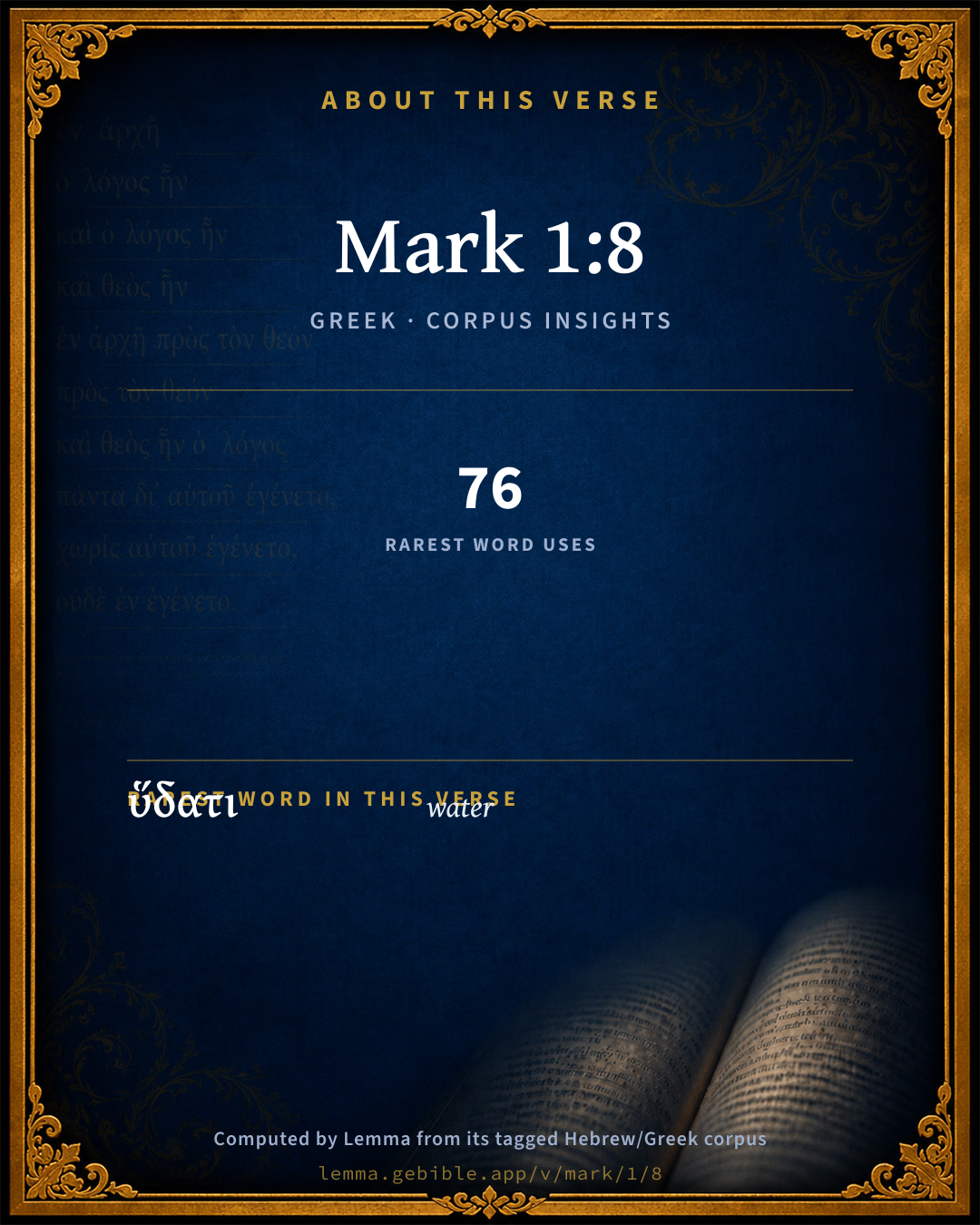
Mark 1:8

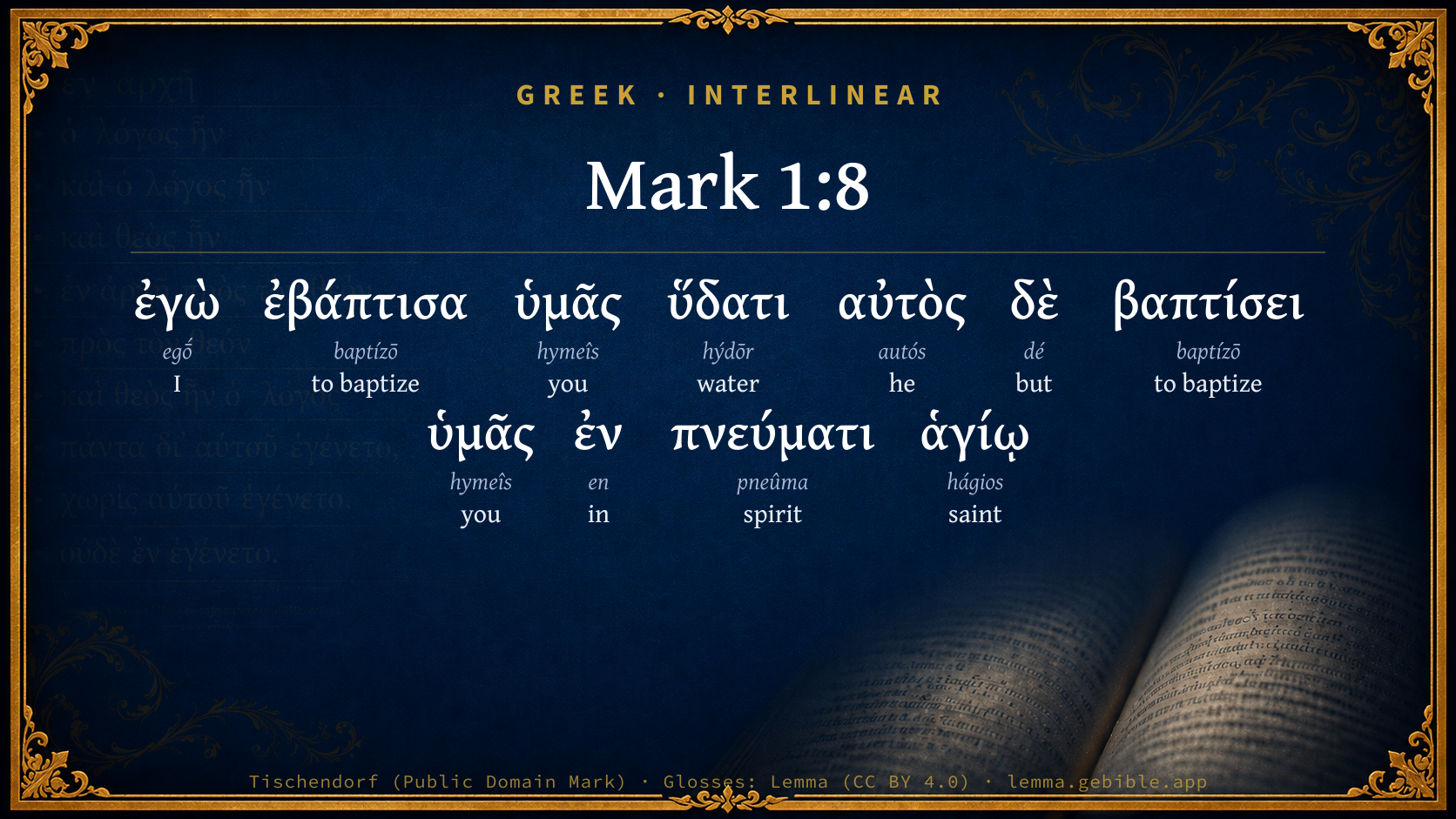
Greek (Tischendorf 8th ed.) Mark 1:8 appears in the Greek New Testament. The text above is from the Tischendorf 8th edition. Each word links to its Strong’s number and a concise gloss. Click any word for its full Thayer’s Greek Lexicon entry.
Download image
Cite this verse

Mark 1:8 (World English Bible). Public Domain. Lemma interlinear Bible study tool, https://lemma.gebible.app/v/mark/1/8.

Show BibTeX & RIS
BibTeX
RIS
English Translation
I baptized you in water, but he will baptize you in the Holy Spirit."
World English Bible · Public Domain
Download a study sheet

One document with this verse’s original text, its word-by-word gloss line, the meaning frame, cross-references with their text, attributed commentary, and full source and license credits — printable, and it pastes into notes with its structure intact.

This verse Autodidact and up

Study sheet (.html) Plain text (.txt)

A passage Seminary Student

Up to 50 verses in one chapter. A passage sheet keeps up to 6 commentary sources and 12 cross-references per verse, in the order this page ranks them, and says so on the sheet whenever that leaves anything out. Ask for a single verse and you get the Autodidact verse sheet above.

Everything on this page stays free to read, with no account — the sheet is a download of what is already on screen, not access to it.

Want to remove ads? Support Godless Engineer
Compare translations 3

The same verse in 3 English versions, stacked beneath the original-language interlinear above. Click any original word for its lexicon entry.

Each is an independent rendering of the whole verse — the interlinear is not word-aligned to these translations.

Highlighted words mark where these versions differ — a whole-verse word diff, not a word-by-word alignment.

  • World English Bible Public Domain
    I baptized you in water, but he will baptize you in the Holy Spirit."
  • King James Version Public Domain
    I indeed have baptized you with water: but he shall baptize you with the Holy Ghost.
  • unfoldingWord Literal Text CC BY-SA 4.0
    I baptized you with water, but he will baptize you with the Holy Spirit.”

unfoldingWord Literal Text — © unfoldingWord, licensed CC BY-SA 4.0. Word-aligned USFM3 via Door43 (git.door43.org/unfoldingWord/en_ult).

Versions to compare (up to 4)

3 of 4 selected

Show all 19 translations

Every available English version of this verse, each an independent rendering of the whole verse.

  • World English Bible Public Domain
    I baptized you in water, but he will baptize you in the Holy Spirit."
  • Berean Standard Bible Public Domain
    I baptize you with water, but He will baptize you with the Holy Spirit.”
  • Majority Standard Bible Public Domain
    I indeed baptize you with water, but He will baptize you with the Holy Spirit.”
  • King James Version Public Domain
    I indeed have baptized you with water: but he shall baptize you with the Holy Ghost.
  • American Standard Version (1901) Public Domain
    I baptized you in water; But he shall baptize you in the Holy Spirit.
  • Revised Version (1885) Public Domain
    I baptized you with water; but he shall baptize you with the Holy Ghost.
  • Geneva Bible (1599) Public Domain
    Trueth it is, I haue baptized you with water: but he will baptize you with the holy Ghost.
  • Douay-Rheims (1899) Public Domain
    I have baptized you with water; but he shall baptize you with the Holy Ghost.
  • Young's Literal Translation Public Domain
    I indeed did baptize you with water, but he shall baptize you with the Holy Spirit.'
  • Literal Standard Version CC BY-SA 4.0
    I indeed immersed you in water, but He will immerse you in the Holy Spirit.”
  • Unlocked Literal Bible CC BY-SA 4.0
    I baptized you with water, but he will baptize you with the Holy Spirit.”
  • unfoldingWord Literal Text CC BY-SA 4.0
    I baptized you with water, but he will baptize you with the Holy Spirit.”
  • Darby Bible Public Domain
    *I* indeed have baptised you with water, but *he* shall baptise you with [the] Holy Spirit.
  • World Messianic Bible Public Domain
    I immersed you in water, but he will immerse you in the Holy Spirit.”
  • Webster's Bible Public Domain
    I indeed have baptized you with water: but he will baptize you with the Holy Spirit.
  • Free Bible Version CC BY-SA 4.0
    I baptized you in water but he will baptize you in the Holy Spirit.”
  • Bible in Basic English Public Domain
    I have given you baptism with water, but he will give you baptism with the Holy Spirit.
  • Text-Critical English NT CC BY 4.0
    I have baptized you with water, but he will baptize you with the Holy Spirit.”
  • Tyndale New Testament (1534) Public Domain
    I have baptised you with water: but he shall baptise you with the holy goost.

Literal Standard Version (2020), Covenant Press — licensed CC BY-SA 4.0. Text via the HelloAO Bible API (eBible.org). Unlocked Literal Bible (unfoldingWord) — licensed CC BY-SA 4.0. Text via the HelloAO Bible API (eBible.org). unfoldingWord Literal Text — © unfoldingWord, licensed CC BY-SA 4.0. Word-aligned USFM3 via Door43 (git.door43.org/unfoldingWord/en_ult). Free Bible Version, Dr. Jonathan Gallagher — licensed CC BY-SA 4.0. Text via the HelloAO Bible API (eBible.org).

Word by word

More ways to search: Search by grammar → Find every occurrence → Compare this word →

Practice this passage: Drill this verse → Learn its vocabulary →

ὕδατι
hýdōr
G5204
“water”
Noun, Dative, Singular, Neuter
Part of Speech
Noun
Case
Dative
Number
Singular
Gender
Neuter
Full Thayer's Definition

Origin: genitive case, hudatos hoo'-dat-os, etc., from the base of G5205

TDNT: 13:14,1

1. water a. of water in rivers, in fountains, in pools b. of the water of the deluge c. of water in any of the earth's repositories d. of water as the primary element, out of and through which the world that was before the deluge, arose and was compacted e. of the waves of the sea f. fig. used of many peoples
  1. ἐγὼ egṓ G1473 “I” Personal pronoun, 1st person, Nominative, Singular
  2. ἐβάπτισα baptízō G907 “to baptize” Verb, Aorist, Active, Indicative, 1st person, Singular
  3. ὑμᾶς hymeîs G5210 “you” Personal pronoun, 2nd person, Accusative, Plural
  4. αὐτὸς autós G846 “he” Personal pronoun, Nominative, Singular, Masculine
  5. δὲ dé G1161 “but” Conjunction
  6. βαπτίσει baptízō G907 “to baptize” Verb, Future, Active, Indicative, 3rd person, Singular
  7. ὑμᾶς hymeîs G5210 “you” Personal pronoun, 2nd person, Accusative, Plural
  8. ἐν en G1722 “in” Preposition
  9. πνεύματι pneûma G4151 “spirit” Noun, Dative, Singular, Neuter
  10. ἁγίῳ hágios G40 “saint” Adjective, Dative, Singular, Neuter

About this verse

These counts appear in no published source. They are computed here, from the morphology-tagged text and Lemma’s own curated glosses. What Lemma adds →

11
words
9
distinct lemmas
Gospels
section

Repetition

Words recur within this verse:

  • ἐβάπτισα to baptize G907 ×2
  • ὑμᾶς you G5210 ×2

Cross-references

14

Topical passages linked to Mark 1:8 in the Treasury of Scripture Knowledge — connected by theme and wording, ordered by reader-vote popularity; previews shown in the World English Bible.

  • Acts 1:5 For John indeed baptized in water, but you will be baptized in the Holy Spirit not many days from now."
  • 1 Corinthians 12:13 For in one Spirit we were all baptized into one body, whether Jews or Greeks, whether bond or free; and were all given to drink into one Spirit.
  • Acts 19:4–6 Paul said, "John indeed baptized with the baptism of repentance, saying to the people that they should believe in the one who would come after him, that is, in Jesus."
  • Joel 2:28 "It will happen afterward, that I will pour out my Spirit on all flesh; And your sons and your daughters will prophesy. Your old men will dream dreams. Your young men will see visions.
  • Acts 2:4 They were all filled with the Holy Spirit, and began to speak with other languages, as the Spirit gave them the ability to speak.
  • Acts 10:45 They of the circumcision who believed were amazed, as many as came with Peter, because the gift of the Holy Spirit was also poured out on the Gentiles.
  • Acts 11:15–16 As I began to speak, the Holy Spirit fell on them, even as on us at the beginning.
  • Ezekiel 36:25–27 I will sprinkle clean water on you, and you shall be clean: from all your filthiness, and from all your idols, will I cleanse you.
  • Proverbs 1:23 Turn at my reproof. Behold, I will pour out my spirit on you. I will make known my words to you.
  • Isaiah 32:15 until the Spirit be poured on us from on high, and the wilderness become a fruitful field, and the fruitful field be esteemed as a forest.
  • Isaiah 44:3 For I will pour water on him who is thirsty, and streams on the dry ground; I will pour my Spirit on your seed, and my blessing on your offspring:
  • Matthew 3:11 I indeed baptize you in water for repentance, but he who comes after me is mightier than I, whose shoes I am not worthy to carry. He will baptize you in the Holy Spirit.
  • Acts 2:17 'It will be in the last days, says God, That I will pour out my Spirit on all flesh. Your sons and your daughters will prophesy. Your young men will see visions. Your old men will dream dreams.
  • Titus 3:5–6 not by works of righteousness, which we did ourselves, but according to his mercy, he saved us, through the washing of regeneration and renewing by the Holy Spirit,

Cross-references courtesy of OpenBible.info (CC BY 4.0).

Commentary

Notes on Mark 1:8 from classic Christian and Jewish commentators (each source and its license shown beneath its notes). The classic Christian expositions comment on the surrounding passage and are grouped to its opening verse, so a note may address several verses; the Jewish commentaries on the Tanakh (Rashi and others) are per-verse, so they appear only where the commentator wrote on this verse.

Lemma curates 59 commentaries, every one of them public domain or Creative Commons licensed, each selected and text-cleaned for this edition rather than reprinted as found. About our sources →

Tyndale Open Study Notes

Tyndale Open Resources

1:8 John’s baptism prepared people for God’s Kingdom by calling them to repentance. The baptism of Jesus brought the gift of the Holy Spirit, through whom sinful people become God’s children (Rom 8:15-16; 1 Cor 12:13; Gal 4:6).

Tyndale Open Study Notes — © Tyndale Open Resources, licensed CC BY-SA 4.0. Text via the HelloAO Bible API.

Expositor's Greek Testament

ed. W. Robertson Nicoll

Mar 1:8 . πνεύματι ἁγίῳ : καὶ πυρί omitted, whereby the view presented of Messiah’s function becomes less judicial, more Christian. Mt.’s account here is truer to John’s conception of the Messiah. Mk.’s was probably influenced by the destination of his Gospel for Gentile readers.

The Expositor's Greek Testament, edited by W. Robertson Nicoll (1897–1910) — public domain. Text from a community e-Sword module.

International Critical Commentary

8. ἐγὼ ἐβάπτισα ὕδατι—I baptized you with water.

Omit μὲν after ἐγὼ Tisch. Treg. WH. RV. א BL 33, 69, 124, Lat. Vet. mss. Vulg. Memph. Pesh. etc. Omit ἐν before ὕδατι Tisch. Treg. marg. WH. א BH Δ 16, 33, 56, 58, 258, Vulg. etc.

Without the prep. the element ὕδατι becomes the instrument with which the act is performed. See Win. 31. 7. d.

ἐν Πνεύματι Ἁγίῳ—in Holy Spirit. We are not to look for Christian terms, nor Christian uses of terms, in John’s teaching. The line that divides them in this matter of the Holy Spirit is fine, but distinguishable. In the Jewish conception, personality is ascribed to the Holy Spirit only figuratively. In the Christian use, on the other hand, the impersonal sense is the figurative one, e.g. where it speaks of a pouring out of the Holy Spirit (Tit 3:5, Act 2:17, Act 2:18). But the Spirit of God, or of Yahweh, or the Spirit of holiness, figures more or less largely in the O.T. as the animating power in the universe, as the inspiration of the prophet, the soldier, the king, and even the workman. And the possession of this Spirit by all men is prophesied as one of the marks of Israel’s golden age. See Job 26:13, Job 33:4, Psa 104:30, Isa 42:1, Isa 61:1, Mic 3:8, Jud 1:3:10, Jud 1:6:34, Isa 11:2, Joe 2:28, Isa 59:21, Exo 31:3. John’s reference to the Holy Spirit, the רוּחַ קֹדֶשׁ, would not therefore be strange to his Jewish hearers. The absence of the art. indicates that the Spirit is regarded here as an element, a pervading presence, like the air, in the ocean of which we are submerged. The epithet holy would not in itself suggest moral quality, as it denoted what is invested with awe or reverence, and only secondarily and rarely, moral purity. But in the connection, since the Spirit is regarded here as the purifying element, it is evidently holiness in the moral sense that is predicated of it. The contrast between the work of the Baptist, and that of the Messiah, amounts to this, that the mightier one who is to follow John will do the real work of which the Baptist is able to perform only the sign. Water cleanses only the body, and represents figuratively the inward cleansing of the man. But the Holy Spirit is the element in which man is cleansed inwardly and really, and it is this real baptism which the coming one was to perform. So far as it is given us in the Gospels, John’s annunciation of the Messiah includes only the spiritual side of his anticipated work, and thus corresponds with the historical fact. But John’s later doubt could have arisen probably only from the failure of Jesus to carry out the kingly part of the Jewish Messianic expectation. See Mat 11:2-19. And it would be quite improbable that John would be so far separated from his time as to expect a purely spiritual Messiah.

In this paragraph, the signs of Mk.’s use of the Logia are not wanting. In the first place, O.T. citations are not common in Mk., but are quite characteristic of the Logia. And especially, the first part of the double quotation is, in Mar 1:2, Mar 1:3, Luk 7:27, taken unquestionably from that source. The somewhat clumsy junction of the two passages is due apparently to bringing together what was separated in the original source. And Mat 3:12, Luk 3:17 show signs of being connected with what precedes in the original source. Mk. omits this, but gives what precedes with the identity of language that shows a common source for all three. For the verbal resemblance, implying the interdependence of the Synoptics, cf. Mar 1:3, Mat 3:3, Luk 3:4, especially the change of τοῦ Θεοῦ ἡμῶν, LXX, to αὐτοῦ in them all (Mar 1:4, Luk 3:3, Mar 1:5, Mar 1:6, Mat 3:4, Mat 3:5, Mat 3:6, Mar 1:7, Mar 1:8, Mat 3:11, Luk 3:16).

THE BAPTISM OF JESUS

International Critical Commentary — older volumes (1896–1929), various authors — public domain. Text from a community e-Sword module.

Geneva Bible (1599)

Geneva Bible translators

He showeth that all the force of baptism proceedeth from Christ, who baptizeth within.

Geneva Bible (1599) marginal notes — public domain. Text via Bolls.life.

Adam Clarke's Commentary

Verse 8. I indeed have baptized you with water] As if he had said: This baptism is not to be rested in; it is only an emblem of that which you must receive from him who is mightier than I. It is he only who can communicate the Holy Spirit; and water baptism is nothing, but as it points out, and leads to, the baptism of the Holy Ghost. The subject of these two verses is not found in Matthew nor John; but is mentioned with some varying circumstances by Luke, Lu 3:16.

Adam Clarke's Commentary on the Bible (1810–1826) — public domain. Text from a community e-Sword/MySword module.

Ellicott's Commentary for English Readers

(8) I indeed have baptized you with water.—See Note on Mat_3:11. St. Mark omits the “fire” which St. Matthew joins with the Holy Ghost, possibly as less intelligible to his Gentile readers.

A Bible Commentary for English Readers, edited by Charles John Ellicott (1878–1897) — public domain. Text from a community e-Sword module.

John Gill's Exposition

I indeed have baptized you with water,.... This was spoken to the baptized persons, partly to take off their dependence upon him and his baptism; and partly to direct their views to Christ, from whom the gifts and graces of the Spirit are alone to be had:

but he shall baptize you with the Holy Ghost; See Gill on Mat 3:11. One copy adds, "and with fire", as there: a Jewish writer says, the holy blessed God baptizeth with fire, and the wise shall understand (p).

(p) R. Menachem in Lev. viii. apud Ainsworth on Gen. xvii. 12.

John Gill's Exposition of the Whole Bible (1746–1763) — public domain (CC PDM 1.0). Text via the HelloAO Bible API.

Trapp's Complete Commentary

John Trapp

8 I indeed have baptized you with water: but he shall baptize you with the Holy Ghost.

Ver. 8. With the Holy Ghost] By whom your iniquity is taken away, Isa 6:6-7. {See Trapp on "Mat 3:11"}

John Trapp, A Commentary or Exposition upon All the Books of the Old and New Testament (1647–1656) — public domain. Text from a community e-Sword module.

The Pulpit Commentary

I baptized you with water; but he shall baptize you with or in the Holy Ghost. It is as though he said, "Christ will pour his Holy Spirit so abundantly upon you, that he will cleanse you from all your sins, and fill you with holiness and love and all his other excellent graces. " Christ did this visibly on the day of Pentecost. And this he does invisibly in the. sacrament of Holy Baptism, and in the rite of Confirmation, which is the completion of the sacrament of Baptism. John baptized with water only, but Christ with water and the Holy Spirit. John baptized the body only, Christ baptizes the soul. By how much, therefore, the Holy Spirit transcends the water, and the soul excels the body, by so much is Christ"s baptism more excellent than that of John, which was only preparatory and rudimentary. If it be asked why it was needful that our Lord should be baptized with John"s baptism, the best answer is that given by Christ himself, "Suffer it to be so now; for thus it becometh us to fulfill all righteousness;" it becometh us me in receiving this baptism, and you in imparting it. Christ was sent to do the whole will of God; and as in his circumcision, so in his baptism, "he was made to be sin for us, who knew no sin.

John"s baptism and Christ"s.

I THE GRAND RELIGIOUS NEED OF MAN IS PURIFICATION. The existence of so many ceremonial religions is a presumption in favor of this. They all speak of offenses in man which require expiation. But the knowledge of the true character of sin is revealed by the Law. (Rom_3:19) Sin itself, of course, exists anterior to the knowledge of the Law of Moses, because of the "law of God written upon the heart." In Psalm 14 the universal depravity of the Jews of the age in which the psalmist wrote is very absolutely, declared; and St. Paul, in Rom_3:10, etc., quotes it freely, in proof that Jews as well as Gentiles are under the power of sin. "As his argument is at this point addressed particularly to the Jew, he reasons, not from the sense of sin or the voice of conscience, but from the Scriptures, whose authority the Jew acknowledged. The Jew would, of course, admit the inference as to the state of the Gentile world" (Perowne). The first aim, therefore, of every real religion must be the removal of sin, because:

1. The sense of guilt estranges man from God. Under this feeling of alienation the heart hardens, and the tendency is to cast off the authority of all Divine sanctions.

2. Indwelling sin corrupts and perverts the moral mature. The vision of God is obscured, and as he is the Fountain of moral obligation and perception, moral distinctions become uncertain and confused. Right and truth are not desired for their own sakes; there is no genuine enthusiasm for them. On the contrary, the heart is already biased and bribed on behalf of evil. "Evil, be thou my good," expresses the final stage to which the corruption of the heart may attain; and:

3. Sinful habit and inherited tendency enfeeble the will. This moral weakness may coexist with the clearest perceptions of right and wrong. (Rom_7:14-19)

II RELIGIOUS MINISTRIES ARE TO BE TESTED BY THEIR POWER TO EFFECT THIS,

1. It is the general pretension which they make in common. There may be supernatural evidences, etc., to recommend them, but the practical ground upon which they base their claim to reception is really that, in some way or other, they can settle the question of sin between man and God. To judge them upon this point is not, therefore, to do them an injustice.

2. The standard is common and within human experience. In the measure in which they wean man from sin and reconcile him to the Divine Being, they prove their ability to make good their pretension. A religion whose followers have low moral ideas, or are not in the habit of practising what they profess, must be discredited as a moral power.

3. There are various respects in which this purifying power may show itself:

(1) Spiritual rest. This arises from a sense of forgiveness and of reconciliation with God. In other words, when the consciousness of guilt is removed and the sanctions of righteousness have been honored, the soul is satisfied and loses its fear and dislike to God, trusting, and in time loving, him.

(2) Moral inspiration. If sin has truly been overcomes and the relations of the soul with God are satisfactory, there will be hopefulness and vigor in the discharge of duty, resignation and patience in suffering, and a disposition to do good.

(3) Change of character and conduct. He who did evil and delighted in it will then find his joy in righteousness and holiness. There will he manifest "the fruits of the Spirit," and there will be "no fellowship with the unfruitful works of darkness.

III How THE SUPERIORITY OF THE CHRISTIAN RELIGION IN THIS RESPECT IS TO BE EXPLAINED.

1. Because it was spiritual and not ceremonial. John anticipated the explanation in his prophecy concerning Christ. He was not, like himself, to baptize with water, but with the Holy Spirit. Now, John"s baptism was most significant, perhaps the most significant of the rites of the ceremonial law. Enforced by his moral earnestness, it also exercised a powerful spiritual effect. But it did not produce that which he preached, viz. repentance, in any inward and enduring manner. It was only indirectly spiritual. Duty was powerfully suggested by the symbol, and, where spiritual influence was at work, in many instances a morn! change was produced. But there was, so to speak, no command over that spiritual influence, no ensuring its operation upon the heart. What was needed was something that would go directly to the heart, and renew the moral nature.

2. It is only in the communication of greater spiritual power than existed before that this can take place. A strong moral nature like John"s was felt whilst it appealed to men, but, when its immediate influence was withdrawn, the impulses and emotions to which it gave rise died down again. Christ, on the other hand, furnished moral power in the communication of truth under vital and vivid representations. From the fullness of his own spiritual life also there was a constant overflowing of grace and strength. He spake as never man spake; his authority was felt; his example inspired. It was the meaning and spirit of everything he revealed. The conscience was strengthened, and the moral nature filled with new light and life. Lord, to whom shall we go? thou hast the words of eternal life. And we have believed and know that thou art the Holy One of God". (Joh_6:68)

3. Because it was the communication of Divine life and power. He "baptized with the Holy Ghost." An awful and mysterious expression? The Spirit of God was set free by the atoning work of the Saviour to operate upon the heart and conscience of man. By purifying the outward man John sought to impress men with the sense of their spiritual impurity, and their need of forgiveness and inward cleansing. But only Christ could give purity of heart. He gave life; he inspired. The inward man was renewed, "created after God, in righteousness and true holiness." "I can do all things through Christ which strengtheneth me. M.

The Pulpit Commentary (1880–1919), ed. H.D.M. Spence-Jones & Joseph S. Exell — public domain. Text from a community e-Sword module.

Burkitt's Expository Notes on the New Testament

William Burkitt

John showed the dignity of Christ’s person above his own, in the former verse; in this he declares the excellency of Christ’s office, and the meanness of his own; I wash the body with water, but Christ cleanses the soul by the operation of his Holy Spirit.

Thence learn, That though the ministers of Christ do by Christ’s command dispense the outward ordinance of baptism, yet it is Christ himself, that by the inward work of his Spirit doth make it effectual to such as receive it. I baptize with water; but he with the Holy Ghost.

William Burkitt's Expository Notes on the New Testament (1700–1703) — public domain. Text from a community e-Sword module.

Cambridge Greek Testament for Schools and Colleges

8. Many texts ([68][69][70] etc.) insert ἐν before ὕδατι and before πνεύματι ἁγίῳ. The evidence for the latter insertion is stronger than that for the former, but in neither should it be made. R.V. retains ἐν in both places.

[68] Codex Alexandrinus. 5th cent. Brought by Cyril Lucar, Patriarch of Constantinople, from Alexandria, and afterwards presented by him to King Charles I. in 1628. In the British Museum. The whole Gospel. Photographic facsimile, 1879.

[69] Codex Bezae. 6th cent. Has a Latin translation (d) side by side with the Greek text, and the two do not quite always agree. Presented by Beza to the University Library of Cambridge in 1581. Remarkable for its frequent divergences from other texts. Contains Mark, except Mar 16:15-20, which has been added by a later hand. Photographic facsimile, 1899.

[70] Codex Guelpherbytanus. 6th cent. Contains Mar 1:2-11; Mar 3:5-17; Mar 14:13-24; Mar 14:48-61; Mar 15:12-37.

8. ἐγὼ ἐβάπτισα. He is addressing his baptized converts. Mt. and Lk. have βαπτίζω. They have μέν after ἐγώ, and some texts insert it here. The classical μὲν … δὲ … is comparatively rare in N.T.; only three or four times in Mk, and in some books (2 Thess., 1 Tim., Tit., 2 Peter , 1, 2, 3 Jn, Rev.) not at all. Jn has ἐν before ὕδατι, Mt. and Lk. before πνεύματι, Mk in neither place; see crit. note. Here we have dat. of the instrument; with water, with (the) Holy Spirit. There is no art and the Spirit is hardly personal; John would not think of a Person. In Mk the Baptist utters no warning about a judgment that is near at hand; there is no axe or fan or fire, and the mission of the Forerunner is almost immediately lost in that of the Messiah. But the effect of his teaching is seen long after his death; even at Ephesus, where St Paul found men ready to accept the Gospel, having previously known only the baptism of John (Act 19:2), and in the zeal of Apollos (Act 18:22-28).

Cambridge Greek Testament for Schools and Colleges (Cambridge University Press, 1896; 21 vols, various authors incl. Carr, Maclear, Plummer, Farrar, Lumby, Moule, M. R. James, Simcox) — public domain. Text from a community e-Sword module.

Alford’s Greek Testament

Henry Alford

8.] Matt. and Luke add καὶ πυρί.

Henry Alford, The Greek Testament (1849–1861) — public domain. Text from a community e-Sword module.

Lesson kit

Teaching starters — assembled from the data on this page, not authored interpretation. Every prompt links to the verse data it draws on. Edit before teaching.

Mark, in the Gospels, opens this verse with 11 words (9 distinct Greek lemmas). Its most distinctive word is hýdōr (“water”). A historical commentator’s framing appears above. Read the whole chapter for the surrounding context.

Discussion questions

  1. How does “water” (hýdōr) shape what this verse is saying?
  2. Acts 1:5 shares this passage’s theme. How do the two illuminate each other?
  3. “to baptize” occurs 2× in this one verse. What is the effect of the repetition?
  4. The translations on this page render this verse differently — a whole-verse word diff, not a word-by-word alignment. What might account for the different wordings?
  5. Reading how Tyndale Open Study Notes and Expositor's Greek Testament read this verse, where do the two commentators agree and where do they part?

Things to notice

  • These translations choose different wording for 6 words in this verse.
  • “to baptize” occurs 2× in this single verse.
  • 9 distinct Greek lemmas span 11 words in this verse.

Reading settings

Reading text

Shown beneath each verse's original-language words.

Old Testament
Old Testament edition

Read the OT as the Masoretic Hebrew (MT) or the Greek Septuagint (LXX).

English shown for the Greek Septuagint (in the Hebrew ↔ Greek comparison).

Comparing translations? Open the Compare panel on any verse page to stack up to four side by side.