
Matthew 17:15

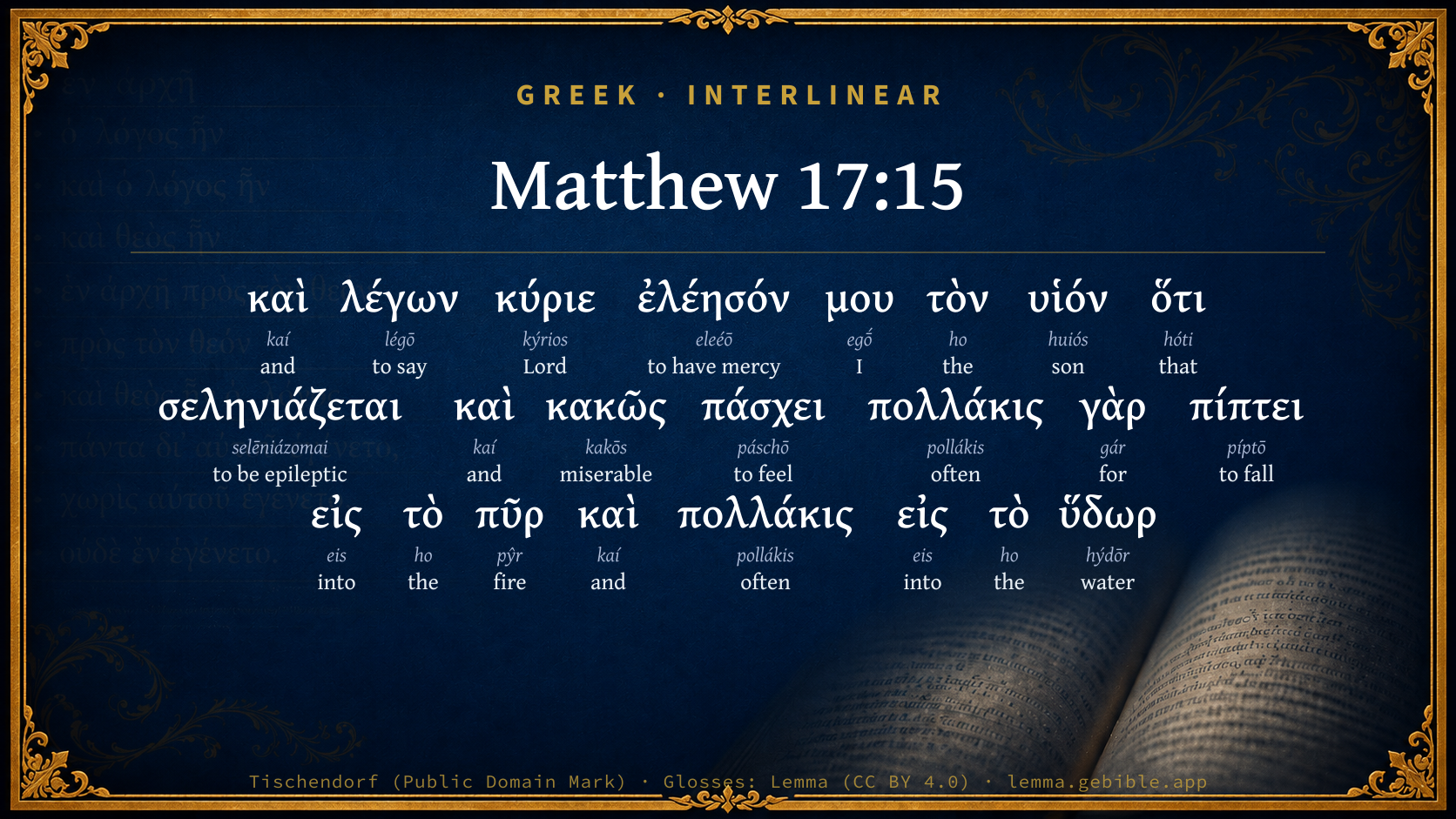
Greek (Tischendorf 8th ed.) Matthew 17:15 appears in the Greek New Testament. The text above is from the Tischendorf 8th edition. Each word links to its Strong’s number and a concise gloss. Click any word for its full Thayer’s Greek Lexicon entry.
Download image
Cite this verse

Matthew 17:15 (World English Bible). Public Domain. Lemma interlinear Bible study tool, https://lemma.gebible.app/v/matthew/17/15.

Show BibTeX & RIS
BibTeX
RIS
English Translation
"Lord, have mercy on my son, for he is epileptic, and suffers grievously; for he often falls into the fire, and often into the water.
World English Bible · Public Domain
Highlights
  • 1 first appearance in the Greek New Testament
Full analysis ↓
Download a study sheet

One document with this verse’s original text, its word-by-word gloss line, the meaning frame, cross-references with their text, attributed commentary, and full source and license credits — printable, and it pastes into notes with its structure intact.

This verse Autodidact and up

Study sheet (.html) Plain text (.txt)

A passage Seminary Student

Up to 50 verses in one chapter. A passage sheet keeps up to 6 commentary sources and 12 cross-references per verse, in the order this page ranks them, and says so on the sheet whenever that leaves anything out. Ask for a single verse and you get the Autodidact verse sheet above.

Everything on this page stays free to read, with no account — the sheet is a download of what is already on screen, not access to it.

Want to remove ads? Support Godless Engineer
Compare translations 3

The same verse in 3 English versions, stacked beneath the original-language interlinear above. Click any original word for its lexicon entry.

Each is an independent rendering of the whole verse — the interlinear is not word-aligned to these translations.

Highlighted words mark where these versions differ — a whole-verse word diff, not a word-by-word alignment.

  • World English Bible Public Domain
    "Lord, have mercy on my son, for he is epileptic, and suffers grievously; for he often falls into the fire, and often into the water.
  • King James Version Public Domain
    Lord, have mercy on my son: for he is lunatick, and sore vexed: for ofttimes he falleth into the fire, and oft into the water.
  • unfoldingWord Literal Text CC BY-SA 4.0
    and saying, “Lord, have mercy on my son, because he is epileptic and has sickness, for he often falls into the fire and often into the water.

unfoldingWord Literal Text — © unfoldingWord, licensed CC BY-SA 4.0. Word-aligned USFM3 via Door43 (git.door43.org/unfoldingWord/en_ult).

Versions to compare (up to 4)

3 of 4 selected

Show all 19 translations

Every available English version of this verse, each an independent rendering of the whole verse.

  • World English Bible Public Domain
    "Lord, have mercy on my son, for he is epileptic, and suffers grievously; for he often falls into the fire, and often into the water.
  • Berean Standard Bible Public Domain
    “Lord, have mercy on my son,” he said. “He has seizures and is suffering terribly. He often falls into the fire or into the water.
  • Majority Standard Bible Public Domain
    “Lord, have mercy on my son,” he said. “He has seizures and is suffering terribly. He often falls into the fire or into the water.
  • King James Version Public Domain
    Lord, have mercy on my son: for he is lunatick, and sore vexed: for ofttimes he falleth into the fire, and oft into the water.
  • American Standard Version (1901) Public Domain
    Lord, have mercy on my son: for he is epileptic, and suffereth grievously; for oft-times he falleth into the fire, and off-times into the water.
  • Revised Version (1885) Public Domain
    Lord, have mercy on my son: for he is epileptic, and suffereth grievously: for oft-times he falleth into the fire, and oft-times into the water.
  • Geneva Bible (1599) Public Domain
    And saide, Master, haue pitie on my sonne: for he is lunatike, and is sore vexed: for oft times he falleth into the fire, and oft times into the water.
  • Douay-Rheims (1899) Public Domain
    And I brought him to thy disciples, and they could not cure him.
  • Young's Literal Translation Public Domain
    and saying, `Sir, deal kindly with my son, for he is lunatic, and doth suffer miserably, for often he doth fall into the fire, and often into the water,
  • Literal Standard Version CC BY-SA 4.0
    and saying, “Lord, deal kindly with my son, for he is [a] lunatic, and suffers miserably, for he often falls into the fire, and often into the water,
  • Unlocked Literal Bible CC BY-SA 4.0
    “Lord, have mercy on my son, for he is epileptic and suffers severely. For he often falls into the fire or the water.
  • unfoldingWord Literal Text CC BY-SA 4.0
    and saying, “Lord, have mercy on my son, because he is epileptic and has sickness, for he often falls into the fire and often into the water.
  • Darby Bible Public Domain
    Lord, have mercy on my son, for he is lunatic, and suffers sorely; for often he falls into the fire and often into the water.
  • World Messianic Bible Public Domain
    “Lord, have mercy on my son, for he is epileptic and suffers grievously; for he often falls into the fire, and often into the water.
  • Webster's Bible Public Domain
    Lord, have mercy on my son; for he is lunatic, and grievously distressed; for often he falleth into the fire, and often into the water.
  • Free Bible Version CC BY-SA 4.0
    “Lord, please have mercy on my son,” he said. “He loses his mind and suffers such terrible fits that he often falls in the fire or into water.
  • Bible in Basic English Public Domain
    Lord have mercy on my son: for he is off his head, and is in great pain; and frequently he goes falling into the fire, and frequently into the water.
  • Text-Critical English NT CC BY 4.0
    and saying, “Lord, have mercy on my son, for he is an epileptic and suffers terribly. For often he falls into the fire, and often into the water.
  • Tyndale New Testament (1534) Public Domain
    Master have mercy on my sonne for he is franticke: and is sore vexed. And oft tymes he falleth into the fyre and oft into the water.

Literal Standard Version (2020), Covenant Press — licensed CC BY-SA 4.0. Text via the HelloAO Bible API (eBible.org). Unlocked Literal Bible (unfoldingWord) — licensed CC BY-SA 4.0. Text via the HelloAO Bible API (eBible.org). unfoldingWord Literal Text — © unfoldingWord, licensed CC BY-SA 4.0. Word-aligned USFM3 via Door43 (git.door43.org/unfoldingWord/en_ult). Free Bible Version, Dr. Jonathan Gallagher — licensed CC BY-SA 4.0. Text via the HelloAO Bible API (eBible.org).

Word by word

More ways to search: Search by grammar → Find every occurrence → Compare this word →

Practice this passage: Drill this verse → Learn its vocabulary →

σεληνιάζεται
selēniázomai
G4583
“to be epileptic”
Verb, Present, Middle or Passive deponent, Indicative, 3rd person, Singular
Part of Speech
Verb
Tense
Present
Voice
Middle or Passive deponent
Mood
Indicative
Person
3rd person
Number
Singular
Full Thayer's Definition

Origin: middle voice or passive from a presumed derivative of G4582

TDNT: None

1. to be moon-struck or lunatic 2. to be epileptic a. epilepsy being supposed to return and increase with the increase of the moon. This meaning is doubtful as the Greeks knew nothing of epilepsy.
  1. καὶ kaí G2532 “and” Conjunction
  2. λέγων légō G3004 “to say” Verb, Present, Active, Participle, Nominative, Singular, Masculine
  3. κύριε kýrios G2962 “Lord” Noun, Vocative, Singular, Masculine
  4. ἐλέησόν eleéō G1653 “to have mercy” Verb, Aorist, Active, Imperative, 2nd person, Singular
  5. μου egṓ G1473 “I” Personal pronoun, 1st person, Genitive, Singular
  6. τὸν ho G3588 “the” Article, Accusative, Singular, Masculine
  7. υἱόν huiós G5207 “son” Noun, Accusative, Singular, Masculine
  8. ὅτι hóti G3754 “that” Conjunction
  9. καὶ kaí G2532 “and” Conjunction
  10. κακῶς kakōs G2560 “miserable” Adverb
  11. πάσχει páschō G3958 “to feel” Verb, Present, Active, Indicative, 3rd person, Singular
  12. πολλάκις pollákis G4178 “often” Adverb
  13. γὰρ gár G1063 “for” Conjunction
  14. πίπτει píptō G4098 “to fall” Verb, Present, Active, Indicative, 3rd person, Singular
  15. εἰς eis G1519 “into” Preposition
  16. τὸ ho G3588 “the” Article, Accusative, Singular, Neuter
  17. πῦρ pŷr G4442 “fire” Noun, Accusative, Singular, Neuter
  18. καὶ kaí G2532 “and” Conjunction
  19. πολλάκις pollákis G4178 “often” Adverb
  20. εἰς eis G1519 “into” Preposition
  21. τὸ ho G3588 “the” Article, Accusative, Singular, Neuter
  22. ὕδωρ hýdōr G5204 “water” Noun, Accusative, Singular, Neuter

About this verse

These counts appear in no published source. They are computed here, from the morphology-tagged text and Lemma’s own curated glosses. What Lemma adds →

23
words
17
distinct lemmas
Gospels
section

Notable vocabulary

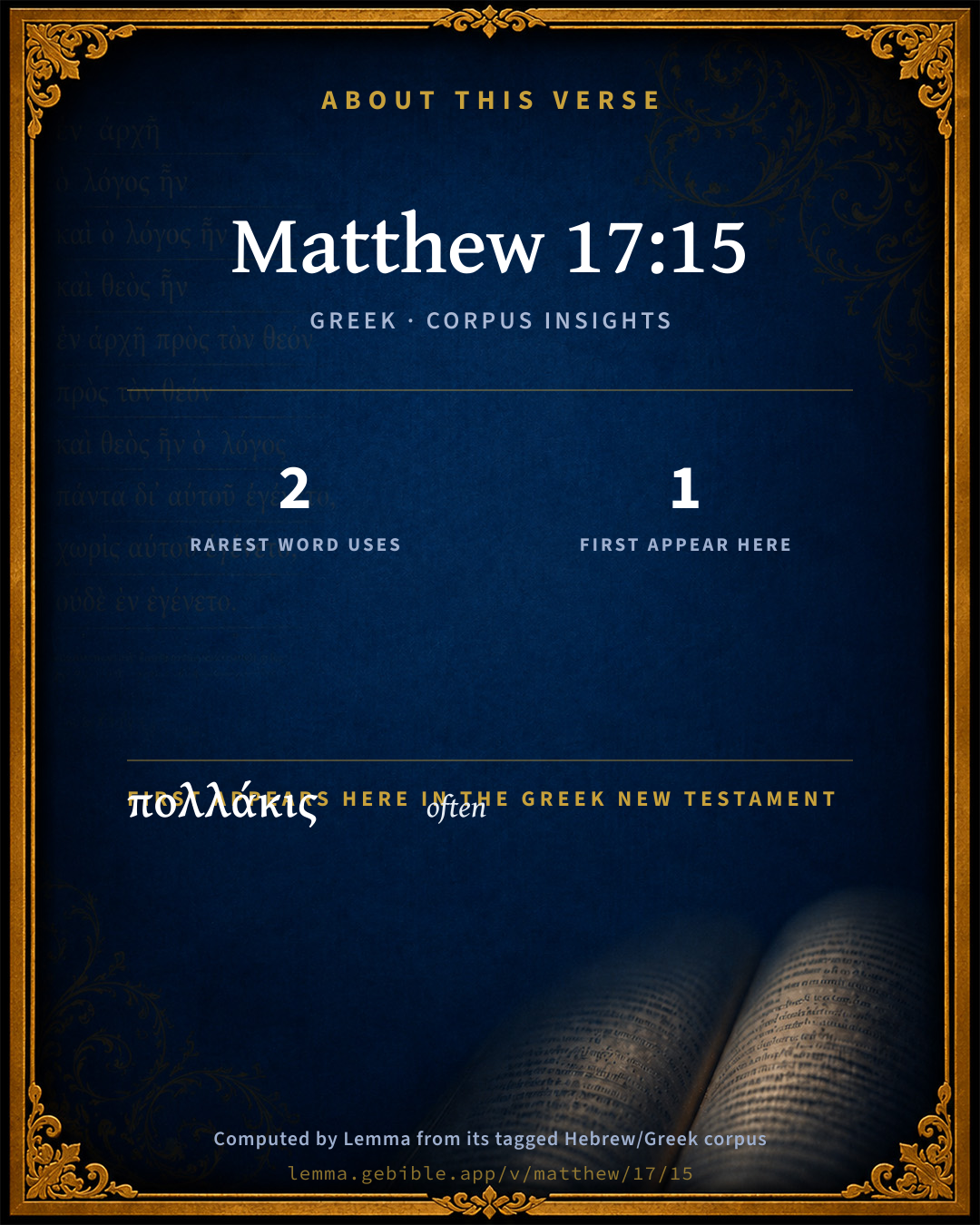
The rarest word here is σεληνιάζεται to be epileptic G4583 — appearing just 2 times in the whole Greek New Testament.

First appearance in Scripture

This word makes its first canonical appearance in the Greek New Testament here:

  • πολλάκις often G4178

Shared distinctive vocabulary

σεληνιάζεται to be epileptic G4583 occurs in 2 verses of the Greek New Testament. Also found in:
Repetition

Words recur within this verse:

  • πολλάκις often G4178 ×2
  • εἰς into G1519 ×2
  • καὶ and G2532 ×3
  • τὸν the G3588 ×3

Cross-references

11

Topical passages linked to Matthew 17:15 in the Treasury of Scripture Knowledge — connected by theme and wording, ordered by reader-vote popularity; previews shown in the World English Bible.

  • Matthew 4:24 The report about him went out into all Syria. They brought to him all who were sick, afflicted with various diseases and torments, possessed with demons, epileptics, and paralytics; and he healed them.
  • Job 1:10–19 Haven't you made a hedge around him, and around his house, and around all that he has, on every side? You have blessed the work of his hands, and his substance is increased in the land.
  • Job 2:7 So Satan went forth from the presence of Yahweh, and struck Job with painful sores from the sole of his foot to his head.
  • Matthew 8:31–32 The demons begged him, saying, "If you cast us out, permit us to go away into the herd of pigs."
  • Matthew 15:22 Behold, a Canaanite woman came out from those borders, and cried, saying, "Have mercy on me, Lord, you son of David! My daughter is severely demonized!"
  • Mark 5:4–5 because he had been often bound with fetters and chains, and the chains had been torn apart by him, and the fetters broken in pieces. Nobody had the strength to tame him.
  • Mark 5:22–23 Behold, one of the rulers of the synagogue, Jairus by name, came; and seeing him, he fell at his feet,
  • Mark 9:17–18 One of the multitude answered, "Teacher, I brought to you my son, who has a mute spirit;
  • Mark 9:20–22 They brought him to him, and when he saw him, immediately the spirit convulsed him, and he fell on the ground, wallowing and foaming at the mouth.
  • Luke 9:38–42 Behold, a man from the crowd called out, saying, "Teacher, I beg you to look at my son, for he is my only child.
  • John 4:46–47 Jesus came therefore again to Cana of Galilee, where he made the water into wine. There was a certain nobleman whose son was sick at Capernaum.

Cross-references courtesy of OpenBible.info (CC BY 4.0).

Where the printed editions differ

1 variant

Places in this verse where the major printed Greek editions disagree on the wording in a way that affects the translation — a comparison of editions, not a manuscript-by-manuscript collation. The editions are the modern critical texts (Nestlé-Aland 28/27, SBL, Westcott-Hort, Tregelles, Tyndale House) and the traditional texts behind the KJV (the Textus Receptus and the Byzantine/Majority text). It is not a claim about which reading is original.

  1. Different wording
    πάσχει·

    “suffers;”

    In NA28NA27SBLTRByz Not in TynWHTreg

    ἔχει (echei) 'has' occurs in a few manuscripts (Tyn+WH+Treg) instead of πάσχει· (paschei) 'suffers;' in older manuscripts (NA28+NA27+SBL+TR+Byz)

Textual data: Translators Amalgamated Greek New Testament (STEPBible TAGNT) · CC BY 4.0.

Commentary

Notes on Matthew 17:15 from classic Christian and Jewish commentators (each source and its license shown beneath its notes). The classic Christian expositions comment on the surrounding passage and are grouped to its opening verse, so a note may address several verses; the Jewish commentaries on the Tanakh (Rashi and others) are per-verse, so they appear only where the commentator wrote on this verse.

Lemma curates 59 commentaries, every one of them public domain or Creative Commons licensed, each selected and text-cleaned for this edition rather than reprinted as found. About our sources →

Bengel's Gnomon

Johann Albrecht Bengel

Mat 17:15. Ἐλέησόν μου τὸν υἱὸν, have mercy on my son) The lunatic might have said, in the words of David (see Psa 25:16 [Psa 25:16]), both in the Hebrew original and S. V.:[789] “Have mercy upon me, for I am an only son.” And this his father repeats.—τὸ πῦρ—τὸ ὕδωρ, THE fire—THE water) The article implies that the nature of these elements universally[790] is intended: because the lunatic is more liable to fall into the paroxysm when near fire or water: but in Mar 9:22 (see Gnomon) fires and waters are mentioned, and that indefinitely, without the article.

[789] Ps. 24:16, LXX. ἐπίβλεψον ἐπʼ ἐμὲ καὶ ἐλέησόν με, ὅτι μονογενής εἰμι ἐγώ.—ED.

[790] Middleton remarks on this, “Bengel (in Gnom.) has here a note which I do not understand: he says, ‘Articulus UNIVERSE innuit naturam horum elementorum, quod lunaticus apud ignem et aquam proclivior sit in paroxysmum.’ ” Though it savours of presumption to attempt any explanation of that which Middleton did not understand, I would venture to suggest, that Bengel means to say, that the article shows that the element of fire is intended, in the abstract, and consequently every presence of it (universè), in the concrete.—(I. B.)

In Mar 9:22, fire and water are not used in the general sense as here (Oft-times he falleth into a paroxysm, wherever fire is and wherever water is,”—this is the effect which these elements produce on him): but of particular fires and waters. Though the sing. τὸ πῦρ is used there, it stands for the plural, as the accompanying ὕδατα show: also the article τὸ gives the same force, as there is no plur. of πῦρ else τὰ πῦρα would be found. However, BCD abcd reject the τὸ there; but A supports it.—ED.

Bengel's Gnomon of the New Testament — English translation (T&T Clark, Edinburgh, 1860) — public domain. Text from a community e-Sword module.

Meyer's Critical & Exegetical Commentary

Heinrich August Wilhelm Meyer

Mat_17:15. The lunatic, whose malady was regarded as the result of demoniacal possession (Mat_17:18; Mar_5:16; Luk_5:39), was evidently suffering from epilepsy, and, according to Mark, deprived of the power of speech as well.

κακῶς πάσχειν] to be ill (opposite of εὖ πάσχ.), is likewise very common among classical writers. Hom. Od. xvi. 275; Plat. Menex. p. 244 B; Xen. Anab. iii. 3. 7; Herod, iii. 146.

Meyer — Critical and Exegetical Commentary on the New Testament — English translation by Peter Christie, edited by Frederick Crombie (T&T Clark, 1880) — public domain. Text from a community e-Sword module.

Expositor's Greek Testament

ed. W. Robertson Nicoll

Mat 17:15 . σεληνιάζεται , he is moonstruck; the symptoms as described are those of epilepsy, which were supposed to become aggravated with the phases of the moon ( cf. Mat 4:24 ). κακῶς πάσχει ( ἔχει W. H [105] text), good Greek. Raphel ( Annot. ) gives examples from Polyb. = suffers badly.

[105] Westcott and Hort.

The Expositor's Greek Testament, edited by W. Robertson Nicoll (1897–1910) — public domain. Text from a community e-Sword module.

Geneva Bible (1599)

Geneva Bible translators

They that at certain times of the moon are troubled with the falling sickness, or any other kind of disease: but in this place, we must so take it, that besides the natural disease, he had a devilish frenzy.

Geneva Bible (1599) marginal notes — public domain. Text via Bolls.life.

Adam Clarke's Commentary

Verse 15. My son - is lunatic] σεληνιαζεται. One who was most affected with this disorder at the change and full of the moon. See Clarke on Mt 4:24. But this lunacy was occasioned by a demon, see Mt 17:18, and Mr 9:17; Lu 9:38. In this case, the devil intended to hide himself under the appearance of a natural disorder, that no supernatural means might be resorted to for his expulsion. See a remarkable account on Lu 9:39.

Falleth ofttimes into the fire, and oft into the water.] The paroxysms of his disorder frequently recurred; and among his numerous falls, some were into the fire and some into the water: so that, on this account, his life was in continual danger. Those who are under the influence of the devil are often driven to extremes in every thing. Such are often driven into the fire of presumption, or the waters of despair. Satan takes advantage of our natural temper, state of health, and outward circumstances, to plague and ruin our souls.

Adam Clarke's Commentary on the Bible (1810–1826) — public domain. Text from a community e-Sword/MySword module.

Ellicott's Commentary for English Readers

(15) Lunatick.—See Note on Mat_4:24. The other Gospels add some further touches. The boy had a “dumb spirit.” When the spirit seized him it “tore him,” and he foamed at the mouth, and gnashed with his teeth. Slowly, and as with difficulty, the paroxysm passed off, and the sufferer was wasting away under the violence of the attacks. The phenomena described are, it need hardly be said, those of epilepsy complicated with insanity, a combination common in all countries, and likely to be aggravated where the “seizure,” which the very word epilepsy implies, was the work of a supernatural power. A prolonged melancholy, an indescribable look of sadness, a sudden falling, and loss of consciousness, with or without convulsions, or passing into a tetanic stiffness, a periodical recurrence coinciding often with the new or full moon (hence probably the description of the boy as “lunatick”), grinding the teeth, foaming at the mouth, are all noted by medical writers as symptoms of the disease. The names by which it was known in the earlier stages of medical science were all indicative of the awe with which men looked on it. It was the “divine,” the “sacred” disease, as being a direct supernatural infliction. The Latin synonym, morbus comitialis, came from the fact that if a seizure of this kind occurred during the comitia, or assemblies of the Roman Republic, it was looked upon as of such evil omen that the meeting was at once broken up, and all business adjourned. Whether there was in this case something more than disease, viz., a distinct possession by a supernatural force, is a question which belongs to the general subject of the “demoniacs” of the Gospel records. (See Note on 8:28.) Here, at any rate, our Lord’s words (Mat_17:21) assume, even more emphatically than elsewhere, the reality of the possession. (See Mar_9:25.)

A Bible Commentary for English Readers, edited by Charles John Ellicott (1878–1897) — public domain. Text from a community e-Sword module.

The Cambridge Bible for Schools and Colleges

gen. ed. J. J. S. Perowne

15. for he is lunatick] This is the only special instance of cure in the case of a lunatic. They are mentioned as a class, ch. Mat_4:24. The word literally means “affected by changes of the moon.” There appears to be some truth in the notion that there is an access of mania at the time of lunar changes. See Belcher, Our Lord’s Miracles of Healing, p. 131.

St Mark describes the child as foaming, gnashing with his teeth, and pining away. St Luke mentions that he “crieth out.” All these were epileptic symptoms; “the child was a possessed epileptic lunatic.”

The Cambridge Bible for Schools and Colleges (gen. ed. J. J. S. Perowne; Cambridge University Press, 1878–1918) — public domain. Text from a community e-Sword module.

John Gill's Exposition

Lord, have mercy on my son,.... He addressed him with great marks of honour and respect, not only by gesture, but by words; he craves mercy, pity, and compassion; for the case he had to present, was a miserable one; and his earnestness and importunity he hoped might be excused, since it was for a child of his own. Luke adds "for he is mine only child"; and therefore his affection for him must be thought to be very strong, and he greatly concerned for its grievous affliction, and earnestly desirous of its health and life.

For he is lunatic: not a mad man, but troubled with the epileptic disease; upon which, as on madness or lunacy, the changes and full of the moon have an influence: hence the next clause,

and sore vexed, is rendered in the Arabic version, "and sore vexed at the beginning of full moons"; at which times, he had very grievous and frequent fits of his disorder:

for ofttimes he falleth into the fire, and oft into the water: which shows it to be the "epilepsy", or "falling sickness", he was afflicted with; which, whenever it seized him, whether by the fireside, or by the side of a river or brook, or any place of water, or in any other dangerous situation, he fell into it, not being able to help himself, or avoid any danger to which he was exposed. A larger account of this child's disorder, and of the circumstances of his cure, are related by Mar 9:17 where this case will be more fully considered. See Gill on Mar 9:17. See Gill on Mar 9:18.

John Gill's Exposition of the Whole Bible (1746–1763) — public domain (CC PDM 1.0). Text via the HelloAO Bible API.

Trapp's Complete Commentary

John Trapp

15 Lord, have mercy on my son: for he is lunatick, and sore vexed: for ofttimes he falleth into the fire, and oft into the water.

Ver. 15. For he is lunatic] Or, he hath the falling sickness, as the symptoms show. A common disease, but (besides that) the devil was in it. {a} The old manslayer makes advantage of our natural diseases (which are therefore the bath of the devil, and the bed of diseases) to exercise his cruelty upon the poor creature by Divine permission; seeking by the infirmities of the body to bring sin upon the soul.

For ofttimes he falls into the fire, &c.] The devil pushing him in, as it were, to destroy him, but could not. He is limited, and cannot do as he would, else he would soon end us. If God chastise us with his own bare hand, or by men like ourselves, whip us, as it were, privately and at home, let us thank him, and think ourselves far better dealt with than if he should deliver us up to the public officer, to his tormentor, to be scourged with scorpions at his pleasure. The wicked he often casts into the fire of lust and water of drunkenness, and they complain not: like a sleepy man (fire burning in his bed straw), he cries not out, when others haply lament his case that see afar off, but cannot help him. It hath "set him on fire round about, yet he knew it not: and it burned him, yet he laid it not to heart," Isa 42:25. See Pro 23:34-35.

And oft into the water] Urbanus Regius, in a sermon of his at Wittenberg, made mention of a certain maid possessed by the devil; and when she should have been prayed for in the congregation, the devil made as if he had been departed out of her. But before the next public meeting, Satan returned, and drove the maid into a deep water, where she presently perished.

{a} Lunaticus speculum miseriae humanae, et malitiae Satanae. Pareus.

John Trapp, A Commentary or Exposition upon All the Books of the Old and New Testament (1647–1656) — public domain. Text from a community e-Sword module.

Albert Barnes' Notes on the Bible

Lord, have mercy - The word “Lord” here means “Sir,” a title of civility, not implying divinity.

My son - This was an only son (Luke). He was possessed with a devil. This calamity was attended with the following symptoms: he was lunatic (see the notes at Mat 4:24); he was sore vexed; that is, he suffered greatly, or was greatly afflicted; he fell often suddenly, in the manner of persons having epileptic fits; he was dumb - that is, he was mute except when the seizure was coming upon him, for Luke says that when the spirit took him he cried suddenly out; he foamed and gnashed with his teeth, and wasted away, or became poor and emaciated. Luke Luk 9:39 adds of the evil spirit, “it teareth him that he foameth again, and, bruising him, hardly departeth from him;” that is, scarcely departed from him, or he had only short intervals of reason, for so the passage in Luke, “bruising him, hardly departeth from him,” should be translated.

Albert Barnes' Notes on the Bible (1834–1885) — public domain. Text from a community e-Sword/MySword module.

Haydock's Catholic Bible Commentary

I brought him to thy disciples. By these words the man here mentioned privately accuses the apostles, though the impossibility of the cure is not always to be attributed to the weakness of God’s servants, but sometimes to the want of faith in the afflicted. (St. Jerome) --- Stand astonished at the folly of this man! how he accuses the apostles before Jesus! But Christ frees them from this inculpation, imputing the fault entirely to the man himself. For it is evident, from many circumstances, that he was weak in faith. Our Saviour does not inveigh against this man alone, not to wound his feelings too sensibly, but against the whole people of the Jews. We may infer, that many of the bystanders entertained false notions of his disciples, from these words of deserved reproach: O! unbelieving and incredulous generation, how long shall I be with you? In which words, he shews us how much he wished for his passion, and his departure hence. (St. John Chrysostom) --- We must not imagine that our Saviour, who was meekness and mildness itself, uttered on this occasion words of anger and intemperance. Not unlike a feeling and tender physician, observing his patient totally disregarding his prescriptions, he says, How long shall I visit you; how long shall I order one thing, and you do the contrary? Thus Jesus is not angry with the man, but with the vices of the man; and in him he upbraids the Jews, in general, for their incredulity and perversity. (St. Jerome) --- The general sentiment is, that these reproaches are limited to the people; some extend them to the apostles. See below, ver. 19. (Bible de Vence)

George Leo Haydock (1774–1849), Haydock's Catholic Family Bible and Commentary, 1859 edition — public domain. Excludes Psalms (Douay-Rheims chapter numbering differs from Protestant) and Deuterocanonical books (Catholic canon only).

Whedon's Commentary on the Bible

Daniel D. Whedon

15. Lunatic — Insane, and deprived by the evil spirit of his reasoning faculties. Mark gives a vivid description of the power of the demon and the sufferings of the victim. The terrible convulsions to which he had been subjected had rent and torn him “from a child.”

Daniel D. Whedon (gen. ed.), Commentary on the Old and New Testaments (1874–1909) — public domain. Text from a community e-Sword module.

The Pulpit Commentary

This verse in the Vulgate is contained in ver. 14. Have mercy on my son. According to St. Luke, the father makes his plea more touching by adding that he was his only son an appeal to which the Saviour"s tender heart was always open, as when he stopped the bier at Nain, and said to the childless widow, "Weep not." He is lunatic (selhniaxetai). The Revised Version most unnecessarily renders the verb, he is epileptic. Doubtless the case in many respects simulated epilepsy, and might have been so described; but it seems inexpedient to conceal the actual word used, which gave the popular and probably correct view of one phase of the complaint. Surely a real fact well known to medical science underlies the term lunacy, in the catalogue of the diseased persons who were brought to Christ to be healed, (Mat_4:24) we find a class called lunatics, distinct from the paralytic and possessed. It is by no means an exploded fallacy that the moon has some mysterious influence on certain constitutions, and produces an aggravation of symptoms in accordance with some of its changes. It was from observation of this phenomenon that this form of insanity was termed seleniasmus or lunacy. In the present instance the disease was complicated and of no ordinary nature. The other synoptists state that the child was possessed by a demon. This was the fact which differentiated the malady from any merely organic sickness. It was in truth epilepsy accompanied by or occasioned by demoniacal possession. St. Matthew does not mention the possession in his introductory account, but he afterwards (ver. 18) speaks of the demon departing. Sore vexed (kakwv pascei); is in evil case; suffers grievously.

He was affected with terrible paroxysms, which are detailed more at length by Mark and Luke. Matthew narrates some of the effects of the mania upon the victim. Ofttimes he falleth into the fire. The fits, coming on suddenly and without warning, brought the sufferer into imminent dangers, perhaps produced suicidal tendencies, which urged him to destroy himself.

The Pulpit Commentary (1880–1919), ed. H.D.M. Spence-Jones & Joseph S. Exell — public domain. Text from a community e-Sword module.

John Wesley's Explanatory Notes

He is lunatic - This word might with great propriety he used, though the case was mostly preternatural; as the evil spirit would undoubtedly take advantage of the influence which the changes of the moon have on the brain and nerves.

John Wesley, Explanatory Notes Upon the Whole Bible (1754–1765) — public domain. Text via the GEBible commentary corpus.

The People's New Testament

B. W. Johnson

15. My son; for he is a lunatic. Epileptic, in the Revision. The symptoms are those of epilepsy, in this case caused by demoniac possession. The son was a child (Luke 9:38). He was dumb as well as epileptic (Mark).

B. W. Johnson's The People's New Testament with Notes (1889–1891) — public domain. Electronic text from the Christian Classics Ethereal Library (CCEL) ThML edition.

Cambridge Greek Testament for Schools and Colleges

15. σεληνιάζεται. This is the only special instance of cure in the case of a lunatic. They are mentioned as a class, ch. Mat 4:24. The word literally means ‘affected by changes of the moon.’ On the thought underlying the word, that there is an access of mania at the time of lunar changes, see Belcher, Our Lord’s Miracles of Healing, p. 131.

St Mark describes the child as foaming, gnashing with his teeth, and pining away. St Luke mentions that he ‘crieth out.’ All these were epileptic symptoms; ‘the child was a possessed epileptic lunatic.’

Cambridge Greek Testament for Schools and Colleges (Cambridge University Press, 1896; 21 vols, various authors incl. Carr, Maclear, Plummer, Farrar, Lumby, Moule, M. R. James, Simcox) — public domain. Text from a community e-Sword module.

Alford’s Greek Testament

Henry Alford

15.] He was an only son, Luk 9:38. The dæmon had deprived him of speech, Mar 9:17.

Henry Alford, The Greek Testament (1849–1861) — public domain. Text from a community e-Sword module.

International Critical Commentary

15. Lord, have pity on my son: because he is moonstruck, and in evil plight: for often he falls into the fire, and often into the water.] Mk. has: “Teacher, I brought my son to Thee, having a dumb devil; and wheresoever it takes him, it throws him down: and he foams, and gnashes his teeth, and wastes away.” And in v. 22 “And often it cast him into the fire, and into waters, to destroy him.” The symptoms seem to be those of some form of epileptic seizure, described in Mk. under terms of demoniac possession. Mt. omits the references to demoniac possession, except in vv. 18, 20.—κύριε] for Mk.’s διδάσκαλε. A similar change in 8:25.—σελμνιάζεται] only again in 4:24.

(M)

International Critical Commentary — older volumes (1896–1929), various authors — public domain. Text from a community e-Sword module.

Vincent's Word Studies in the New Testament

Marvin R. Vincent

Is lunatic [σεληνιαζεται] . Rev., epileptic. The A. V. preserves the etymology of the word (selhnh, the moon), but lunatic conveys to us the idea of demented; while the Rev. epileptic gives the true character of the disease, yet does not tell us the fact contained in the Greek word, that epilepsy was supposed to be affected by the changes of the moon. See on Mt 4:24.

Marvin R. Vincent, Word Studies in the New Testament (1887–1900) — public domain. Text from a community e-Sword/MySword module.

Lesson kit

Teaching starters — assembled from the data on this page, not authored interpretation. Every prompt links to the verse data it draws on. Edit before teaching.

Matthew, in the Gospels, opens this verse with 23 words (17 distinct Greek lemmas). Its most distinctive word is selēniázomai (“to be epileptic”). A historical commentator’s framing appears above. Read the whole chapter for the surrounding context.

Discussion questions

  1. The word selēniázomai carries the sense “to be epileptic.” How does it shape the verse?
  2. The word “often” first appears here in Scripture. What is being introduced at this debut?
  3. Matthew 4:24 shares the word «to be epileptic» with this verse. How do the two illuminate each other?
  4. “often” occurs 2× in this one verse. What is the effect of the repetition?
  5. These translations render this verse differently. What is at stake in choosing one wording over another?
  6. Reading how Bengel's Gnomon and Meyer's Critical & Exegetical Commentary read this verse, where do the two commentators agree and where do they part?

Things to notice

  • 1 word makes its first canonical appearance in Scripture here.
  • These translations choose different wording for 15 words in this verse.
  • “often” occurs 2× in this single verse.
  • 17 distinct Greek lemmas span 23 words in this verse.

Reading settings

Reading text

Shown beneath each verse's original-language words.

Old Testament
Old Testament edition

Read the OT as the Masoretic Hebrew (MT) or the Greek Septuagint (LXX).

English shown for the Greek Septuagint (in the Hebrew ↔ Greek comparison).

Comparing translations? Open the Compare panel on any verse page to stack up to four side by side.