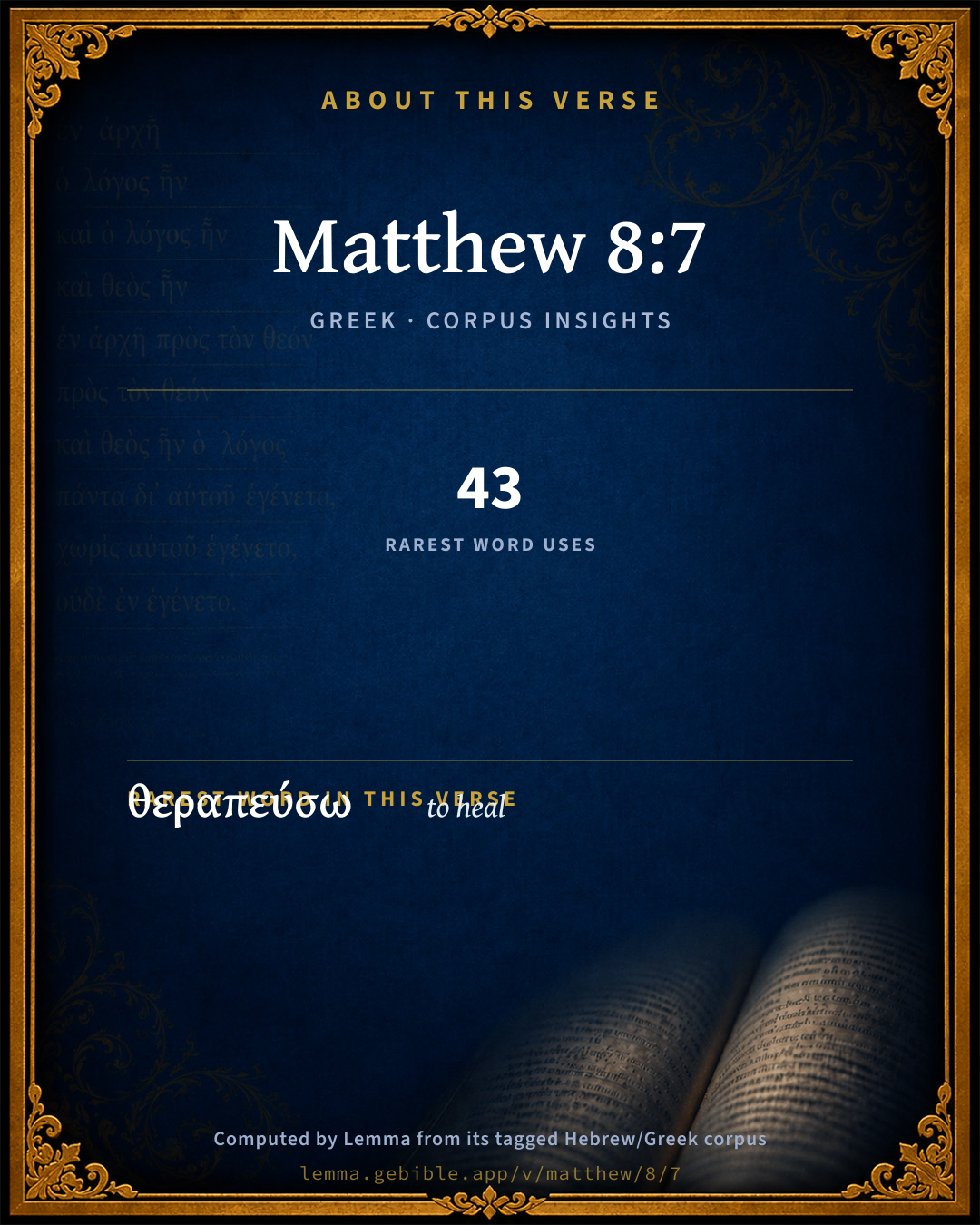
Matthew 8:7

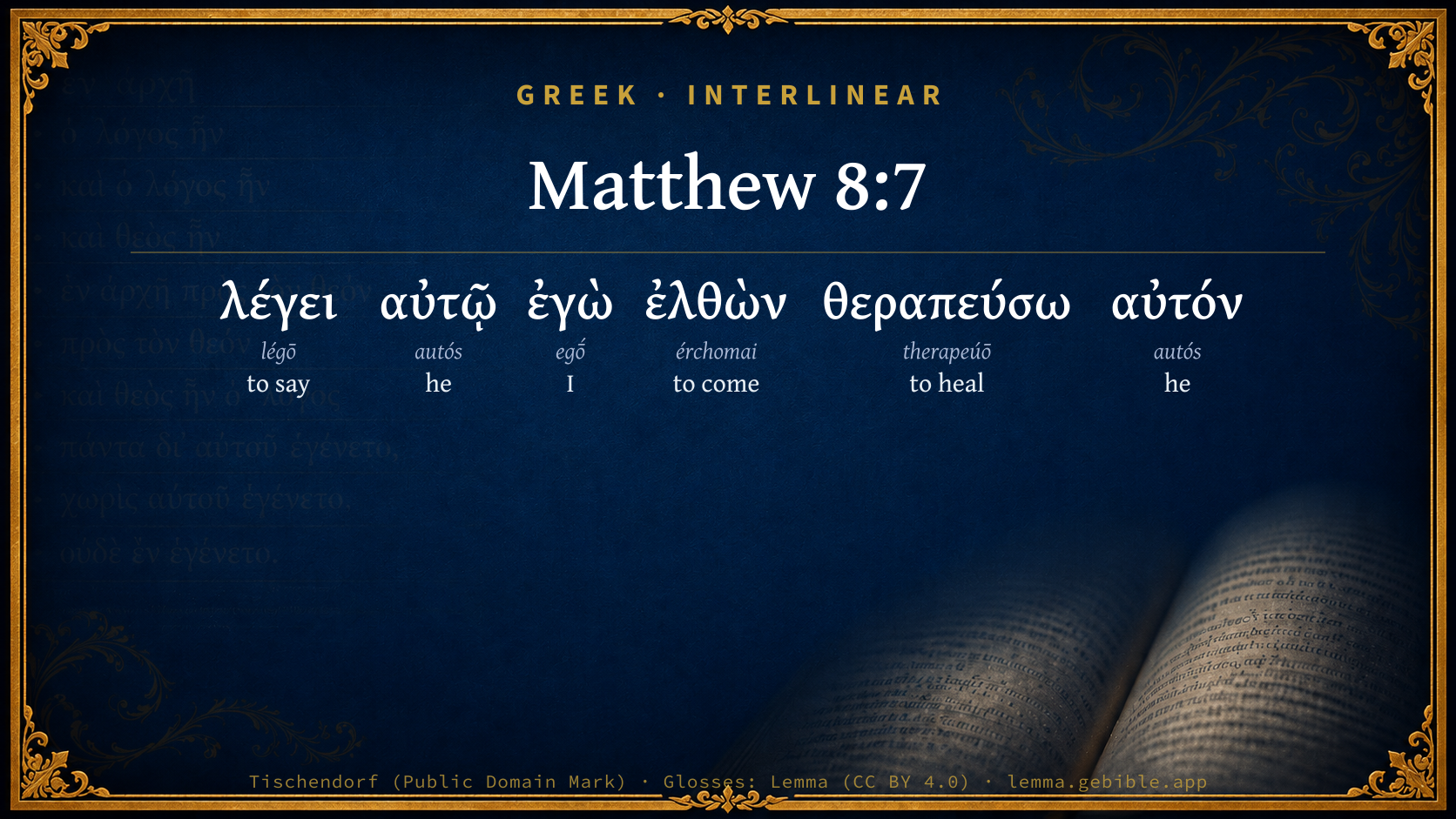
Greek (Tischendorf 8th ed.) Matthew 8:7 appears in the Greek New Testament. The text above is from the Tischendorf 8th edition. Each word links to its Strong’s number and a concise gloss. Click any word for its full Thayer’s Greek Lexicon entry.
Download image
Cite this verse

Matthew 8:7 (World English Bible). Public Domain. Lemma interlinear Bible study tool, https://lemma.gebible.app/v/matthew/8/7.

Show BibTeX & RIS
BibTeX
RIS
English Translation
Jesus said to him, "I will come and heal him."
World English Bible · Public Domain
Download a study sheet

One document with this verse’s original text, its word-by-word gloss line, the meaning frame, cross-references with their text, attributed commentary, and full source and license credits — printable, and it pastes into notes with its structure intact.

This verse Autodidact and up

Study sheet (.html) Plain text (.txt)

A passage Seminary Student

Up to 50 verses in one chapter. A passage sheet keeps up to 6 commentary sources and 12 cross-references per verse, in the order this page ranks them, and says so on the sheet whenever that leaves anything out. Ask for a single verse and you get the Autodidact verse sheet above.

Everything on this page stays free to read, with no account — the sheet is a download of what is already on screen, not access to it.

Want to remove ads? Support Godless Engineer
Compare translations 3

The same verse in 3 English versions, stacked beneath the original-language interlinear above. Click any original word for its lexicon entry.

Each is an independent rendering of the whole verse — the interlinear is not word-aligned to these translations.

Highlighted words mark where these versions differ — a whole-verse word diff, not a word-by-word alignment.

  • World English Bible Public Domain
    Jesus said to him, "I will come and heal him."
  • King James Version Public Domain
    And Jesus saith unto him, I will come and heal him.
  • unfoldingWord Literal Text CC BY-SA 4.0
    And he says to him, “I, I have come, will heal him.”

unfoldingWord Literal Text — © unfoldingWord, licensed CC BY-SA 4.0. Word-aligned USFM3 via Door43 (git.door43.org/unfoldingWord/en_ult).

Versions to compare (up to 4)

3 of 4 selected

Show all 19 translations

Every available English version of this verse, each an independent rendering of the whole verse.

  • World English Bible Public Domain
    Jesus said to him, "I will come and heal him."
  • Berean Standard Bible Public Domain
    “I will go and heal him,” Jesus replied.
  • Majority Standard Bible Public Domain
    “I will go and heal him,” Jesus replied.
  • King James Version Public Domain
    And Jesus saith unto him, I will come and heal him.
  • American Standard Version (1901) Public Domain
    And he saith unto him, I will come and heal him.
  • Revised Version (1885) Public Domain
    And he saith unto him, I will come and heal him.
  • Geneva Bible (1599) Public Domain
    And Iesus saide vnto him, I will come and heale him.
  • Douay-Rheims (1899) Public Domain
    And Jesus saith to him: I will come and heal him.
  • Young's Literal Translation Public Domain
    and Jesus saith to him, `I, having come, will heal him.'
  • Literal Standard Version CC BY-SA 4.0
    and Jesus says to him, “I, having come, will heal him.”
  • Unlocked Literal Bible CC BY-SA 4.0
    Jesus said to him, “I will come and heal him.”
  • unfoldingWord Literal Text CC BY-SA 4.0
    And he says to him, “I, I have come, will heal him.”
  • Darby Bible Public Domain
    And Jesus says to him, *I* will come and heal him.
  • World Messianic Bible Public Domain
    Yeshua said to him, “I will come and heal him.”
  • Webster's Bible Public Domain
    And Jesus saith to him, I will come and heal him.
  • Free Bible Version CC BY-SA 4.0
    “I will come and heal him,” Jesus replied.
  • Bible in Basic English Public Domain
    And he said to him, I will come and make him well.
  • Text-Critical English NT CC BY 4.0
    Jesus said to him, “I will come and heal him.”
  • Tyndale New Testament (1534) Public Domain
    And Iesus sayd vnto hym: I will come and heale him.

Literal Standard Version (2020), Covenant Press — licensed CC BY-SA 4.0. Text via the HelloAO Bible API (eBible.org). Unlocked Literal Bible (unfoldingWord) — licensed CC BY-SA 4.0. Text via the HelloAO Bible API (eBible.org). unfoldingWord Literal Text — © unfoldingWord, licensed CC BY-SA 4.0. Word-aligned USFM3 via Door43 (git.door43.org/unfoldingWord/en_ult). Free Bible Version, Dr. Jonathan Gallagher — licensed CC BY-SA 4.0. Text via the HelloAO Bible API (eBible.org).

Word by word

More ways to search: Search by grammar → Find every occurrence → Compare this word →

Practice this passage: Drill this verse → Learn its vocabulary →

About this verse

These counts appear in no published source. They are computed here, from the morphology-tagged text and Lemma’s own curated glosses. What Lemma adds →

6
words
5
distinct lemmas
Gospels
section

Shared distinctive vocabulary

θεραπεύσω to heal G2323 occurs in 42 verses of the Greek New Testament. Also found in:

Repetition

A word recurs within this verse:

  • αὐτῷ he G846 ×2

Cross-references

3

Topical passages linked to Matthew 8:7 in the Treasury of Scripture Knowledge — connected by theme and wording, ordered by reader-vote popularity; previews shown in the World English Bible.

  • Luke 7:6 Jesus went with them. When he was now not far from the house, the centurion sent friends to him, saying to him, "Lord, don't trouble yourself, for I am not worthy for you to come under my roof.
  • Matthew 9:18–19 While he told these things to them, behold, a ruler came and worshiped him, saying, "My daughter has just died, but come and lay your hand on her, and she will live."
  • Mark 5:23–24 and begged him much, saying, "My little daughter is at the point of death. Please come and lay your hands on her, that she may be made healthy, and live."

Cross-references courtesy of OpenBible.info (CC BY 4.0).

Commentary

Notes on Matthew 8:7 from classic Christian and Jewish commentators (each source and its license shown beneath its notes). The classic Christian expositions comment on the surrounding passage and are grouped to its opening verse, so a note may address several verses; the Jewish commentaries on the Tanakh (Rashi and others) are per-verse, so they appear only where the commentator wrote on this verse.

Lemma curates 59 commentaries, every one of them public domain or Creative Commons licensed, each selected and text-cleaned for this edition rather than reprinted as found. About our sources →

Tyndale Open Study Notes

Tyndale Open Resources

8:7 I will come (cp. Acts 10:9-35; Gal 2:11-14): Some have rendered this as a question: Shall I [a Jew] come [into the house of a Gentile, risking defilement] and heal him?

Tyndale Open Study Notes — © Tyndale Open Resources, licensed CC BY-SA 4.0. Text via the HelloAO Bible API.

Bengel's Gnomon

Johann Albrecht Bengel

Mat 8:7. Ἐλθὼν, coming) In His Divine wisdom, our Lord puts forth those addresses by which He elicits the profession of the faithful, and thus as it were anticipates them: which is the reason why men of those times received a swifter, greater, and more frequent effect from heavenly words than they do now. He declares Himself ready to come to the centurion’s servant. He does not promise that He will do so to the nobleman’s son. By each method He arouses faith, and shows that He is no respecter of persons.

Bengel's Gnomon of the New Testament — English translation (T&T Clark, Edinburgh, 1860) — public domain. Text from a community e-Sword module.

Meyer's Critical & Exegetical Commentary

Heinrich August Wilhelm Meyer

Mat_8:7. And Jesus (perceiving, from his mode of address and whole demeanour, the centurions faith in His divine miraculous power) answered him: I (emphatically) will come, and so on. Fritzsche puts it interrogatively. But (καί, by way of coupling an objection, Porson, ad Eur. Phoen. 1373) said Jesus to him, Am I to come and heal him (θεραπ. conj. aor.)? This is refining more than is necessary, and not in keeping with the simple character of the passage. Bengel well says, Divina sapientia Jesus, eos sermones proponit, quibus elicit confessionem fidelium eosque antevertit.

Meyer — Critical and Exegetical Commentary on the New Testament — English translation by Peter Christie, edited by Frederick Crombie (T&T Clark, 1880) — public domain. Text from a community e-Sword module.

Expositor's Greek Testament

ed. W. Robertson Nicoll

Mat 8:7 . his is generally taken as an offer on Christ’s part to go to the house. Fritzsche finds in it a question, arranging the words (T. R.) thus: καὶ , λέγει α . ὁ Ἰ ., Ἐγὼ ἐλθὼν θεραπεύσω αὐτόν ; and rendering: “And,” saith Jesus to him, “shall I go and heal him?” = is that what you wish? The following verse then contains the centurion’s reply. This is, to say the least, ingenious.

The Expositor's Greek Testament, edited by W. Robertson Nicoll (1897–1910) — public domain. Text from a community e-Sword module.

Adam Clarke's Commentary

Verse 7. I will come and heal him.] εγω ελοθων θεραπευσω αυτον, I am coming, and will heal him. This saying is worthy of observation. Jesus did not positively say, I will came and heal him; this could not have been strictly true, because our Lord healed him without going to the house: and the issue shows that the words ought to be taken in the most literal sense: thus understood, they contained a promise which it seems none of them distinctly comprehended. Foreseeing the exercise of the centurion's faith, he promises that while he is coming, ere he arrives at the house, he will heal him, and this was literally done, Mt 8:13. There is much beauty in this passage.

Adam Clarke's Commentary on the Bible (1810–1826) — public domain. Text from a community e-Sword/MySword module.

Ellicott's Commentary for English Readers

(7) I will come and heal him.—In St. Luke’s report the words are omitted, but they are implied in our Lord’s act in going with the elders of the synagogue. While He went, some one, it would seem, ran on in front to tell the centurion that his prayer was heard. Then, in his humility, he sends off some of his friends with the message, which St. Matthew records as if it had come from his own lips.

A Bible Commentary for English Readers, edited by Charles John Ellicott (1878–1897) — public domain. Text from a community e-Sword module.

John Gill's Exposition

And Jesus saith unto him, I will come and heal him. This answer of Christ's, which is short and full, not only shows the readiness of Christ to do good, how soon and easily he complied with the centurion's request, it being a prayer of faith, and so effectual, and was heard as soon as delivered; but also contains an absolute promise that he would heal him. He does not say that he would come and see him, and what his case was, and do what he could for him, as ordinary physicians do; but he would come and heal him at once: and indeed it is a proposal of more than what was asked of him; his presence was not asked, and yet he offered it; though Luke says, that he besought him by the messengers to "come and heal his servant"; and so this is an answer to both parts of the request; the whole is granted. Christ cannot deny anything to faith, his presence or assistance.

And Jesus saith unto him, I will come and heal him. This answer of Christ's, which is short and full, not only shows the readiness of Christ to do good, how soon and easily he complied with the centurion's request, it being a prayer of faith, and so effectual, and was heard as soon as delivered; but also contains an absolute promise that he would heal him. He does not say that he would come and see him, and what his case was, and do what he could for him, as ordinary physicians do; but he would come and heal him at once: and indeed it is a proposal of more than what was asked of him; his presence was not asked, and yet he offered it; though Luke says, that he besought him by the messengers to "come and heal his servant"; and so this is an answer to both parts of the request; the whole is granted. Christ cannot deny anything to faith, his presence or assistance.

Matthew 8:8

mat 8:8

mat 8:8

mat 8:8The centurion answered, and said,.... This, according to Luk 7:6 was said by his friends in his name, when he understood that Christ had agreed to come to his house, with the elders of the Jews, he first sent to him; and after he was actually set out with them, and was in the way to his house; who, conscious of his own unworthiness, deputes some persons to him, to address him in this manner,

Lord, I am not worthy that thou shouldst come under my roof. This is not said as rejecting and despising the presence and company of Christ; but is expressive of his great modesty and humility, and of his consciousness of his own vileness, and unworthiness of having so great a person in his house: it was too great a favour for him to enjoy. And if such a man was unworthy, having been an idolater, and lived a profane course of life, that Christ should come into his house, and be, though but for a short time, under his roof; how much more unworthy are poor sinful creatures (and sensible sinners see themselves to be so unworthy), that Christ should come into their hearts, and dwell there by faith, as he does, in all true believers, however vile and sinful they have been?

But speak the word only, and my servant shall be healed. As the former expression declares his modesty and humility, and the mean apprehensions he had of himself; so this signifies his great faith in Christ, and the persuasion he had of his divine power: he does not say pray, and my servant shall be healed, as looking upon him barely as a man of God, a prophet, one that had great interest in God, and at the throne of grace; but speak, command, order it to be done, and it shall be done, which is ascribing omnipotence to him; such power as was put forth in creation, by the all commanding word of God; "he spake, and it was done, he commanded, and it stood fast", Psa 33:9 yea, he signifies that if he would but speak a word, the least word whatever; or, as Luke has it, "say in a word"; let but a word come out of thy mouth, and it will be done.

John Gill's Exposition of the Whole Bible (1746–1763) — public domain (CC PDM 1.0). Text via the HelloAO Bible API.

Trapp's Complete Commentary

John Trapp

7 And Jesus saith unto him, I will come and heal him.

Ver. 7. I will come and heal him] Stupenda dignatio; a wonderful condescending that the Lord of lords should vouchsafe to visit a poor servant and restore him to health. {a} It was a great favour that Queen Elizabeth did Sir Christopher Hatton, Lord Chancellor (who died nevertheless of grief of mind), that, when she had broken his heart with a harsh word, she was pleased to visit and comfort him, though it were all too late. What was it then for the Lord Christ in the shape of a servant to come down to the sick servant’s pallet! Hunniades, when he felt himself in danger of death, desired to receive the sacrament before his departure; and would in any case (sick as he was) be carried to the church to receive the same, saying that it was not fit that the Lord should come to the house of his servant, but the servant rather to go to the house of his Lord and Master.

{a} Ut coeli Dominus nequaquam dedignaretur centurionis servulum visitare, Ambros.

John Trapp, A Commentary or Exposition upon All the Books of the Old and New Testament (1647–1656) — public domain. Text from a community e-Sword module.

Haydock's Catholic Bible Commentary

On this occasion our Saviour does what he never did before: every where indeed he meets the will of his supplicants, but here he runs before his request, saying: "I will come;" and this he does to teach us to imitate the virtue of the centurion.

George Leo Haydock (1774–1849), Haydock's Catholic Family Bible and Commentary, 1859 edition — public domain. Excludes Psalms (Douay-Rheims chapter numbering differs from Protestant) and Deuterocanonical books (Catholic canon only).

The Pulpit Commentary

Matthew only. And Jesus (Revised Version, be) saith unto him, I Will come and heal him. The emphasis is not on the coming, but on the person who comes (egw elywn). Observe Christ"s perfect self-consciousness. Heal (yerapeusw); contrast ver. 8.

The Pulpit Commentary (1880–1919), ed. H.D.M. Spence-Jones & Joseph S. Exell — public domain. Text from a community e-Sword module.

Kretzmann's Popular Commentary

Paul E. Kretzmann

The offer of Jesus and the centurion’s answer:

v. 7. And Jesus saith unto him, I will come and heal him.

v. 8. The centurion answered and said, Lord, I am not worthy that Thou shouldest come under my roof; but speak the word only, and my servant shall be healed.

Christ’s sympathy is aroused, though an actual prayer for help has not been made, a mere statement of need and trouble being sufficient. He expressly declares His willingness to come and help: Coming I shall heal him. Christ’s sovereignty decides sickness and health, death and life. An astonishing answer: I am not worthy, I am not fit; not merely on account of his being a Gentile, but because his humility forbade his receiving the Lord on terms of equality. See Mat 3:11. Deprecatingly he speaks of his roof, a mere hut when the Lord is coming. A bare word will suffice. He both acknowledges the necessity of Christ’s mercy and his own total unworthiness. A sublime faith: My body-servant will be healed, a conviction born of absolute trust in His almighty and merciful power. On the other hand, unbelief, presumption, ignorance will hinder any kind of communion between God and man.

Paul E. Kretzmann, Popular Commentary of the Bible (1921–1924) — public domain. Text from a community e-Sword module.

The People's New Testament

B. W. Johnson

7. He saith to him. Luke tells us that he started at once, but was interrupted by what follows.

B. W. Johnson's The People's New Testament with Notes (1889–1891) — public domain. Electronic text from the Christian Classics Ethereal Library (CCEL) ThML edition.

International Critical Commentary

7. And he saith to him, Shall I come and heal him?] The centurion was probably a Gentile. He had not ventured to bring his servant to a Jewish healer. Only in the case of Jairus’ daughter does Christ go to the patient. Elsewhere the sick are brought to Him. It matters little whether we translate the last clause as a question or as a simple statement, “I will come,” etc. In either case the main point is that Christ should be willing to enter the house of a foreigner.

(X)

International Critical Commentary — older volumes (1896–1929), various authors — public domain. Text from a community e-Sword module.

Vincent's Word Studies in the New Testament

Marvin R. Vincent

Heal [θεραπευσω] . So A. V. and Rev. The word, however, originally means to attend, and to treat medically. The centurion uses another and stronger word, shall be healed [ιαθησεται] . Luke, who as a physician is precise in the use of medical terms, uses both words in one verse (ix. 11). Jesus healed [ιατο] all who had need of treatment [θεραπειας] . Still, Luke himself does not always observe the distinction. See on Luk 5:15.

Marvin R. Vincent, Word Studies in the New Testament (1887–1900) — public domain. Text from a community e-Sword/MySword module.

Lesson kit

Teaching starters — assembled from the data on this page, not authored interpretation. Every prompt links to the verse data it draws on. Edit before teaching.

Matthew, in the Gospels, opens this verse with 6 words (5 distinct Greek lemmas). Its most distinctive word is therapeúō (“to heal”). A historical commentator’s framing appears above. Read the whole chapter for the surrounding context.

Discussion questions

  1. The word therapeúō carries the sense “to heal.” How does it shape the verse?
  2. How does Matthew 4:23, which shares the word «to heal», read alongside this verse?
  3. What does the repetition of “he” (2× in this one verse) do in this verse?
  4. These translations render this verse differently; the difference is in the English rendering, not the original. What questions does that raise?
  5. Compare how Tyndale Open Study Notes and Bengel's Gnomon read this verse. Where do they agree or differ?

Things to notice

  • These translations choose different wording for 4 words in this verse.
  • “he” occurs 2× in this single verse.
  • 5 distinct Greek lemmas span 6 words in this verse.

Reading settings

Reading text

Shown beneath each verse's original-language words.

Old Testament
Old Testament edition

Read the OT as the Masoretic Hebrew (MT) or the Greek Septuagint (LXX).

English shown for the Greek Septuagint (in the Hebrew ↔ Greek comparison).

Comparing translations? Open the Compare panel on any verse page to stack up to four side by side.