

Matthew 22:44
Greek (Tischendorf 8th ed.) Matthew 22:44 appears in the Greek New Testament. The text above is from the Tischendorf 8th edition. Each word links to its Strong’s number and a concise gloss. Click any word for its full Thayer’s Greek Lexicon entry.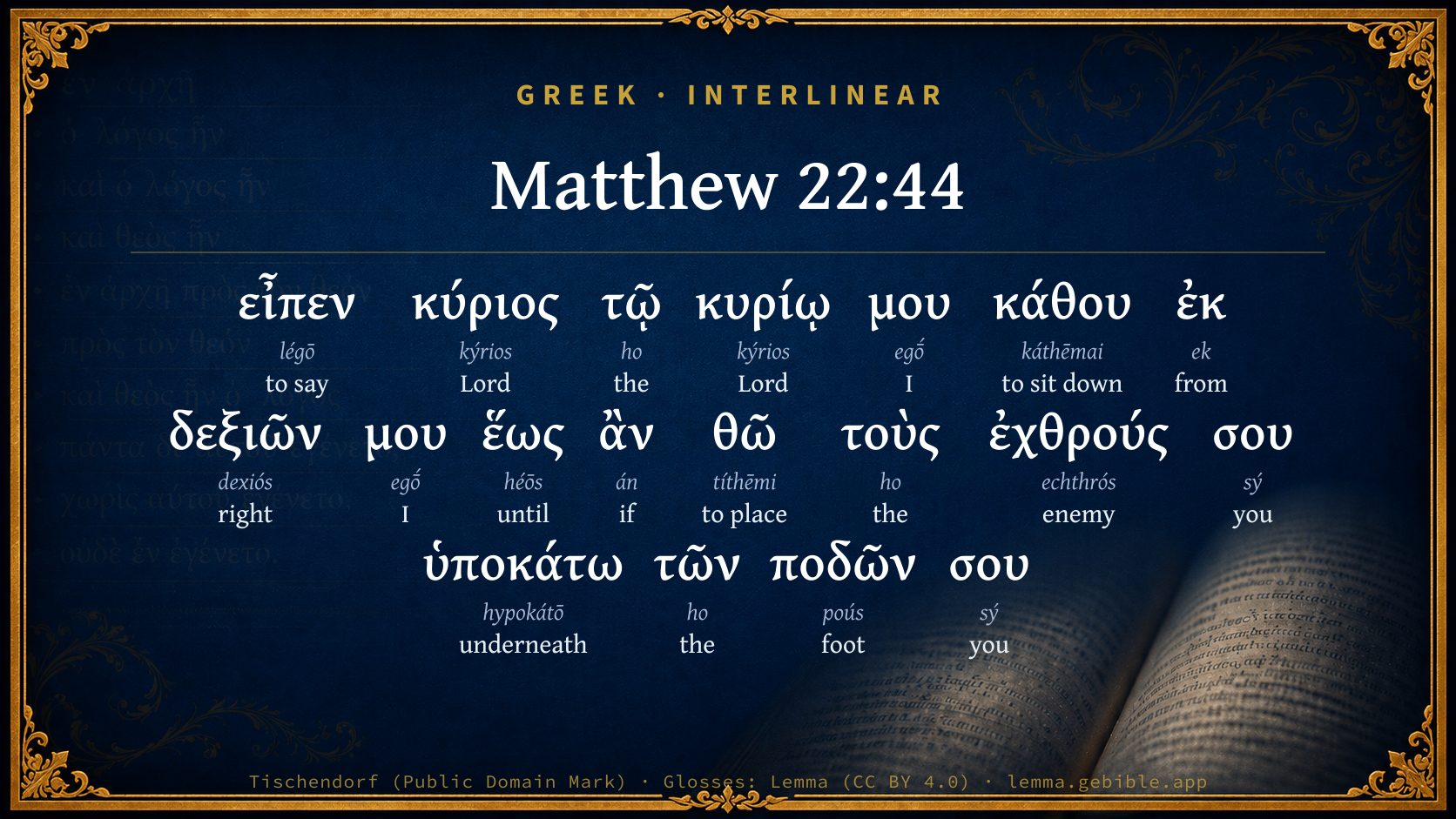
'The Lord said to my Lord, Sit on my right hand, Until I make your enemies a footstool for your feet?'
Download a study sheet
One document with this verse’s original text, its word-by-word gloss line, the meaning frame, cross-references with their text, attributed commentary, and full source and license credits — printable, and it pastes into notes with its structure intact.
This verse Autodidact and up
A passage Seminary Student
Up to 50 verses in one chapter. A passage sheet keeps up to 6 commentary sources and 12 cross-references per verse, in the order this page ranks them, and says so on the sheet whenever that leaves anything out. Ask for a single verse and you get the Autodidact verse sheet above.
Everything on this page stays free to read, with no account — the sheet is a download of what is already on screen, not access to it.
Compare translations 3
The same verse in 3 English versions, stacked beneath the original-language interlinear above. Click any original word for its lexicon entry.
Each is an independent rendering of the whole verse — the interlinear is not word-aligned to these translations.
Highlighted words mark where these versions differ — a whole-verse word diff, not a word-by-word alignment.
-
World English Bible Public Domain
'The Lord said to my Lord, Sit on my right hand, Until I make your enemies a footstool for your feet?'
-
King James Version Public Domain
The LORD said unto my Lord, Sit thou on my right hand, till I make thine enemies thy footstool?
-
unfoldingWord Literal Text CC BY-SA 4.0
‘The Lord said to my Lord, “Sit at my right hand, until I put your enemies under your feet”’?
unfoldingWord Literal Text — © unfoldingWord, licensed CC BY-SA 4.0. Word-aligned USFM3 via Door43 (git.door43.org/unfoldingWord/en_ult).
Show all 19 translations
Every available English version of this verse, each an independent rendering of the whole verse.
-
World English Bible Public Domain
'The Lord said to my Lord, Sit on my right hand, Until I make your enemies a footstool for your feet?'
-
Berean Standard Bible Public Domain
‘The Lord said to my Lord, “Sit at My right hand until I put Your enemies under Your feet.”’
-
Majority Standard Bible Public Domain
‘The Lord said to my Lord, “Sit at My right hand until I make Your enemies a footstool for Your feet.”’
-
King James Version Public Domain
The LORD said unto my Lord, Sit thou on my right hand, till I make thine enemies thy footstool?
-
American Standard Version (1901) Public Domain
The Lord said unto my Lord, Sit thou on my right hand, Till I put thine enemies underneath thy feet?
-
Revised Version (1885) Public Domain
The Lord said unto my Lord, Sit thou on my right hand, Till I put thine enemies underneath thy feet?
-
Geneva Bible (1599) Public Domain
The Lord sayd to my Lord, Sit at my right hand, till I make thine enemies thy footestoole?
-
Douay-Rheims (1899) Public Domain
The Lord said to my Lord, Sit on my right hand, until I make thy enemies thy footstool?
-
Young's Literal Translation Public Domain
The Lord said to my lord, Sit at my right hand, till I may make thine enemies thy footstool?
-
Literal Standard Version CC BY-SA 4.0
The LORD said to my Lord, || Sit at My right hand, || Until I may make Your enemies Your footstool?
-
Unlocked Literal Bible CC BY-SA 4.0
'The Lord said to my Lord, “Sit at my right hand, until I make your enemies your footstool”'?
-
unfoldingWord Literal Text CC BY-SA 4.0
‘The Lord said to my Lord, “Sit at my right hand, until I put your enemies under your feet”’?
-
Darby Bible Public Domain
The Lord said to my Lord, Sit on my right hand until I put thine enemies under thy feet?
-
World Messianic Bible Public Domain
‘The Lord said to my Lord, sit on my right hand, until I make your enemies a footstool for your feet’?
-
Webster's Bible Public Domain
The LORD said to my Lord, Sit thou on my right hand, till I make thy enemies thy footstool?
-
Free Bible Version CC BY-SA 4.0
‘The Lord said to my Lord, Sit down at my right hand until I defeat all your enemies.’
-
Bible in Basic English Public Domain
The Lord said to my Lord, Be seated at my right hand, till I put under your feet all those who are against you?
-
Text-Critical English NT CC BY 4.0
‘The Lord said to my Lord, “Sit at my right hand until I make yoʋr enemies a footstool for yoʋr feet” ’?
-
Tyndale New Testament (1534) Public Domain
The Lorde sayde to my Lorde syt on my right honde: tyll I make thyne enemyes thy fote stole.
Literal Standard Version (2020), Covenant Press — licensed CC BY-SA 4.0. Text via the HelloAO Bible API (eBible.org). Unlocked Literal Bible (unfoldingWord) — licensed CC BY-SA 4.0. Text via the HelloAO Bible API (eBible.org). unfoldingWord Literal Text — © unfoldingWord, licensed CC BY-SA 4.0. Word-aligned USFM3 via Door43 (git.door43.org/unfoldingWord/en_ult). Free Bible Version, Dr. Jonathan Gallagher — licensed CC BY-SA 4.0. Text via the HelloAO Bible API (eBible.org).
Word by word
More ways to search: Search by grammar → Find every occurrence → Compare this word →
Practice this passage: Drill this verse → Learn its vocabulary →
- Appears 10× in the Greek New Testament
- First appears here
- Part of Speech
- Adverb
Full Thayer's Definition
- εἶπεν légō G3004 “to say” Verb, Aorist, Active, Indicative, 3rd person, Singular
- κύριος kýrios G2962 “Lord” Noun, Nominative, Singular, Masculine
- τῷ ho G3588 “the” Article, Dative, Singular, Masculine
- κυρίῳ kýrios G2962 “Lord” Noun, Dative, Singular, Masculine
- μου egṓ G1473 “I” Personal pronoun, 1st person, Genitive, Singular
- κάθου káthēmai G2521 “to sit down” Verb, Present, Middle or Passive deponent, Imperative, 2nd person, Singular
- ἐκ ek G1537 “from” Preposition
- δεξιῶν dexiós G1188 “right” Adjective, Genitive, Plural, Masculine
- μου egṓ G1473 “I” Personal pronoun, 1st person, Genitive, Singular
- ἕως héōs G2193 “until” Adverb
- ἂν án G302 “if” Particle
- θῶ títhēmi G5087 “to place” Verb, Aorist, Active, Subjunctive, 1st person, Singular
- τοὺς ho G3588 “the” Article, Accusative, Plural, Masculine
- ἐχθρούς echthrós G2190 “enemy” Adjective, Accusative, Plural, Masculine
- σου sý G4771 “you” Personal pronoun, 2nd person, Genitive, Singular
- ὑποκάτω hypokátō G5270 “underneath” Adverb
- τῶν ho G3588 “the” Article, Genitive, Plural, Masculine
- ποδῶν poús G4228 “foot” Noun, Genitive, Plural, Masculine
- σου sý G4771 “you” Personal pronoun, 2nd person, Genitive, Singular
About this verse
These counts appear in no published source. They are computed here, from the morphology-tagged text and Lemma’s own curated glosses. What Lemma adds →
- 19
- words
- 14
- distinct lemmas
- Gospels
- section
Notable vocabulary
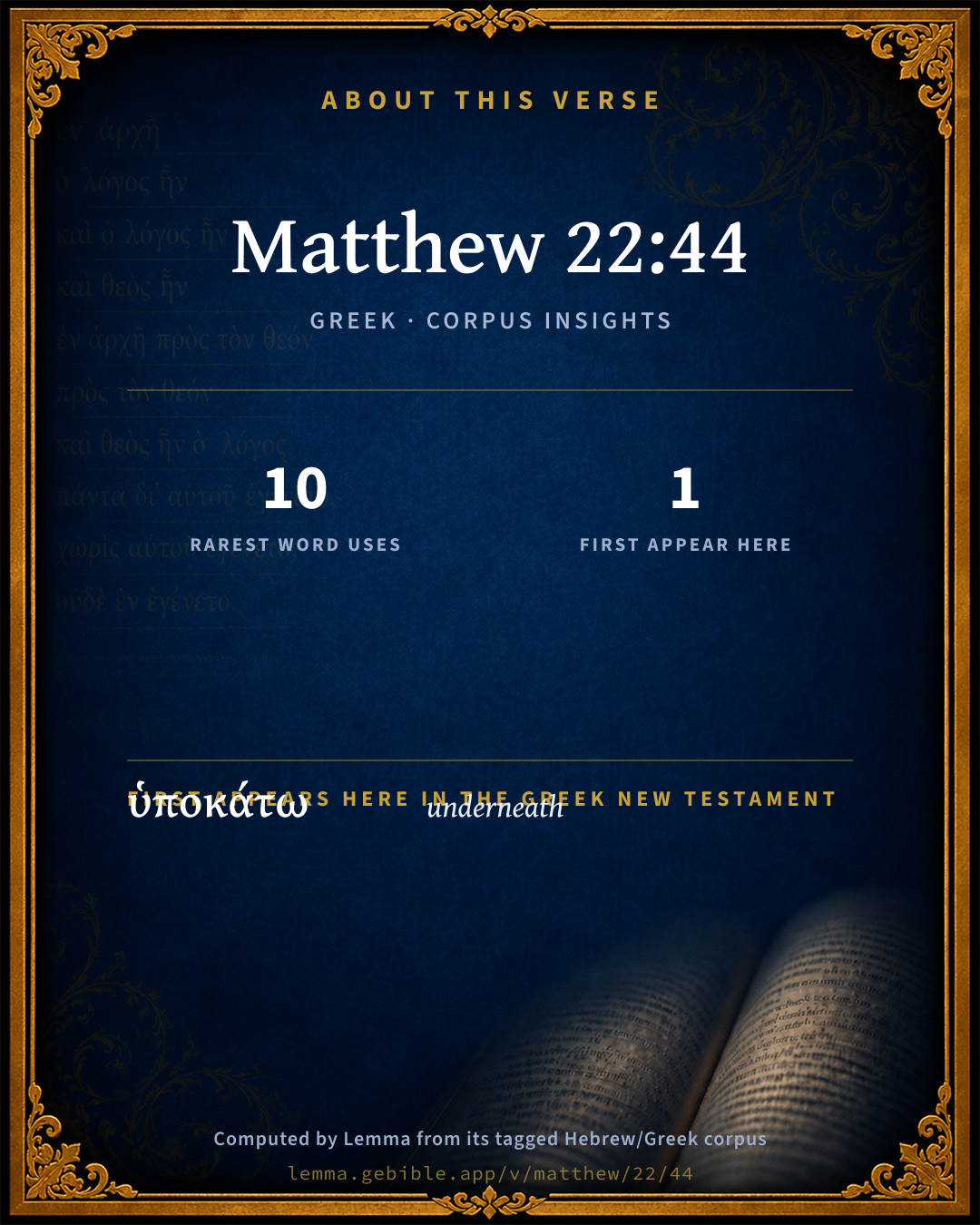
The rarest word here is ὑποκάτω underneath G5270 — appearing just 10 times in the whole Greek New Testament.
First appearance in Scripture
This word makes its first canonical appearance in the Greek New Testament here:
- ὑποκάτω underneath G5270
Shared distinctive vocabulary
ὑποκάτω underneath G5270 occurs in 10 verses of the Greek New Testament. Also found in:
Cross-references
17Topical passages linked to Matthew 22:44 in the Treasury of Scripture Knowledge — connected by theme and wording, ordered by reader-vote popularity; previews shown in the World English Bible.
- Psalms 110:1 Yahweh says to my Lord, "Sit at my right hand, Until I make your enemies your footstool for your feet."
- Hebrews 1:13 But of which of the angels has he said at any time, "Sit at my right hand, Until I make your enemies the footstool of your feet?"
- Acts 2:34–35 For David didn't ascend into the heavens, but he says himself, 'The Lord said to my Lord, "Sit by my right hand,
- 1 Corinthians 15:25 For he must reign until he has put all his enemies under his feet.
- Hebrews 1:3 His Son is the radiance of his glory, the very image of his substance, and upholding all things by the word of his power, when he had by himself made purification for our sins, sat down on the right hand of the Majesty on high;
- Hebrews 10:12–13 but he, when he had offered one sacrifice for sins for ever, sat down on the right hand of God;
- Hebrews 12:2 looking to Jesus, the author and perfecter of faith, who for the joy that was set before him endured the cross, despising shame, and has sat down at the right hand of the throne of God.
- Genesis 3:15 I will put enmity between you and the woman, and between your offspring and her offspring. He will bruise your head, and you will bruise his heel."
- Revelation 19:19–20:3 I saw the beast, and the kings of the earth, and their armies, gathered together to make war against him who sat on the horse, and against his army.
- Isaiah 63:1–6 Who is this who comes from Edom, with dyed garments from Bozrah? this who is glorious in his clothing, marching in the greatness of his strength? I who speak in righteousness, mighty to save.
- Revelation 20:11–15 I saw a great white throne, and him who sat on it, from whose face the earth and the heaven fled away. There was found no place for them.
- Philippians 3:8 Yes most assuredly, and I count all things to be loss for the excellency of the knowledge of Christ Jesus, my Lord, for whom I suffered the loss of all things, and count them nothing but refuse, that I may gain Christ
- Psalms 21:9 You will make them as a fiery furnace in the time of your anger. Yahweh will swallow them up in his wrath. The fire shall devour them.
- Luke 19:27 But bring those enemies of mine who didn't want me to reign over them here, and kill them before me.'"
- John 20:28 Thomas answered him, "My Lord and my God!"
- 1 Corinthians 1:2 to the assembly of God which is at Corinth; those who are sanctified in Christ Jesus, called to be saints, with all who call on the name of our Lord Jesus Christ in every place, both theirs and ours:
- Psalms 2:8–9 Ask of me, and I will give the nations for your inheritance, The uttermost parts of the earth for your possession.
Cross-references courtesy of OpenBible.info (CC BY 4.0).
Lesson kit
Teaching starters — assembled from the data on this page, not authored interpretation. Every prompt links to the verse data it draws on. Edit before teaching.
Matthew, in the Gospels, opens this verse with 19 words (14 distinct Greek lemmas). Its most distinctive word is hypokátō (“underneath”). A historical commentator’s framing appears above. Read the whole chapter for the surrounding context.
Discussion questions
- What does “underneath” (hypokátō) contribute to the verse as a whole?
- The word “underneath” first appears here in Scripture. What is being introduced at this debut?
- Mark 6:11 shares the word «underneath» with this verse. How do the two illuminate each other?
- “Lord” occurs 2× in this one verse. What is the effect of the repetition?
- These translations render this verse differently; the difference is in the English rendering, not the original. What questions does that raise?
- Reading how Tyndale Open Study Notes and Bengel's Gnomon read this verse, where do the two commentators agree and where do they part?
Things to notice
- 1 word makes its first canonical appearance in Scripture here.
- These translations choose different wording for 7 words in this verse.
- “Lord” occurs 2× in this single verse.
- 14 distinct Greek lemmas span 19 words in this verse.
Commentary
Notes on Matthew 22:44 from classic Christian and Jewish commentators (each source and its license shown beneath its notes). The classic Christian expositions comment on the surrounding passage and are grouped to its opening verse, so a note may address several verses; the Jewish commentaries on the Tanakh (Rashi and others) are per-verse, so they appear only where the commentator wrote on this verse.
Lemma curates 59 commentaries, every one of them public domain or Creative Commons licensed, each selected and text-cleaned for this edition rather than reprinted as found. About our sources →
Tyndale Open Study Notes
Tyndale Open Resources
Tyndale Open Study Notes — © Tyndale Open Resources, licensed CC BY-SA 4.0. Text via the HelloAO Bible API.
Bengel's Gnomon
Johann Albrecht Bengel
Bengel's Gnomon of the New Testament — English translation (T&T Clark, Edinburgh, 1860) — public domain. Text from a community e-Sword module.
Adam Clarke's Commentary
Adam Clarke's Commentary on the Bible (1810–1826) — public domain. Text from a community e-Sword/MySword module.
The Cambridge Bible for Schools and Colleges
gen. ed. J. J. S. Perowne
The Cambridge Bible for Schools and Colleges (gen. ed. J. J. S. Perowne; Cambridge University Press, 1878–1918) — public domain. Text from a community e-Sword module.
Trapp's Complete Commentary
John Trapp
John Trapp, A Commentary or Exposition upon All the Books of the Old and New Testament (1647–1656) — public domain. Text from a community e-Sword module.
Whedon's Commentary on the Bible
Daniel D. Whedon
Daniel D. Whedon (gen. ed.), Commentary on the Old and New Testaments (1874–1909) — public domain. Text from a community e-Sword module.
The Pulpit Commentary
The Pulpit Commentary (1880–1919), ed. H.D.M. Spence-Jones & Joseph S. Exell — public domain. Text from a community e-Sword module.
John Wesley's Explanatory Notes
John Wesley, Explanatory Notes Upon the Whole Bible (1754–1765) — public domain. Text via the GEBible commentary corpus.
The People's New Testament
B. W. Johnson
B. W. Johnson's The People's New Testament with Notes (1889–1891) — public domain. Electronic text from the Christian Classics Ethereal Library (CCEL) ThML edition.
Cambridge Greek Testament for Schools and Colleges
Cambridge Greek Testament for Schools and Colleges (Cambridge University Press, 1896; 21 vols, various authors incl. Carr, Maclear, Plummer, Farrar, Lumby, Moule, M. R. James, Simcox) — public domain. Text from a community e-Sword module.
International Critical Commentary
International Critical Commentary — older volumes (1896–1929), various authors — public domain. Text from a community e-Sword module.