

Mark 8:2
Greek (Tischendorf 8th ed.) Mark 8:2 appears in the Greek New Testament. The text above is from the Tischendorf 8th edition. Each word links to its Strong’s number and a concise gloss. Click any word for its full Thayer’s Greek Lexicon entry.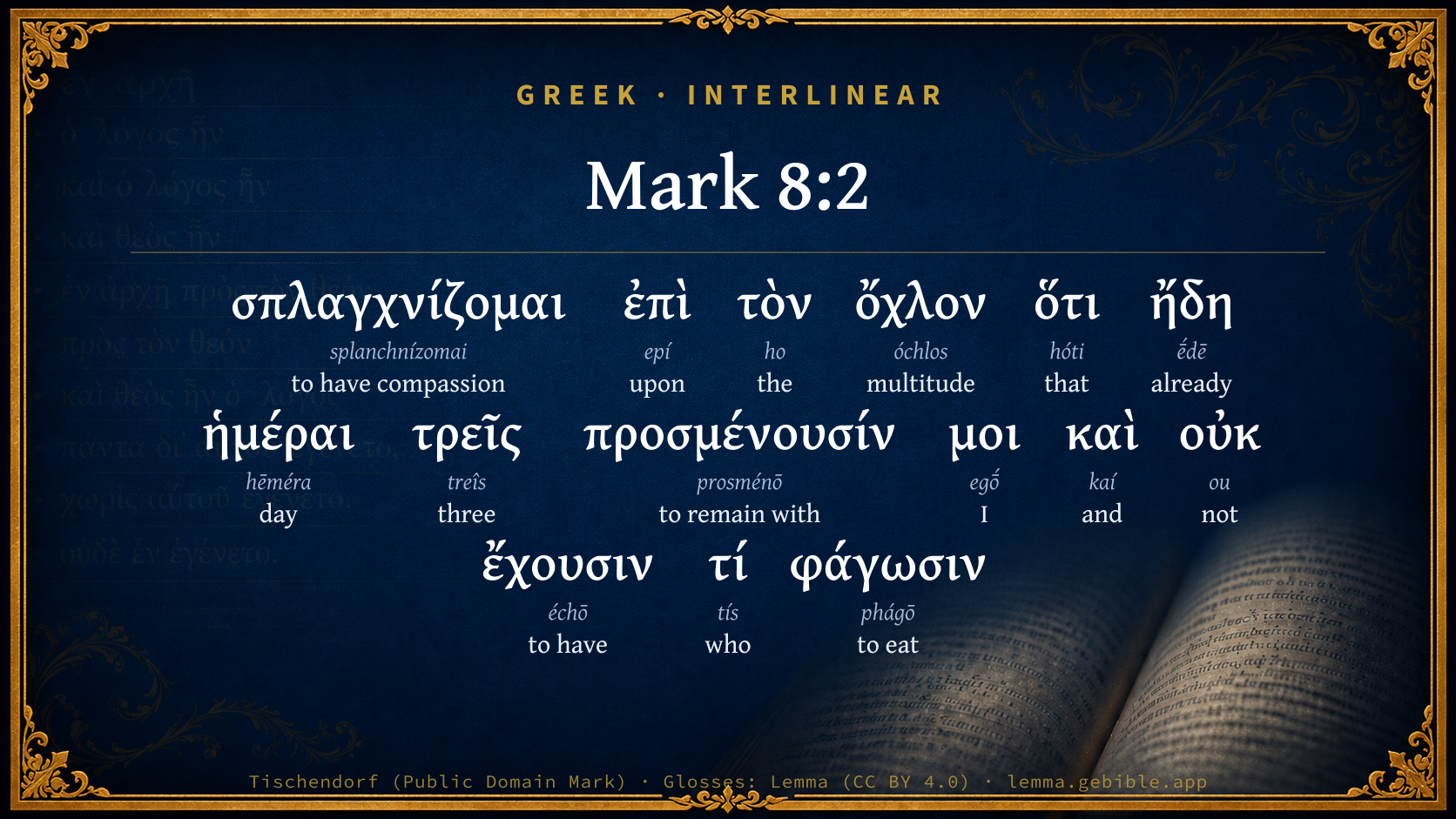
"I have compassion on the multitude, because they have stayed with me now three days, and have nothing to eat.
Download a study sheet
One document with this verse’s original text, its word-by-word gloss line, the meaning frame, cross-references with their text, attributed commentary, and full source and license credits — printable, and it pastes into notes with its structure intact.
This verse Autodidact and up
A passage Seminary Student
Up to 50 verses in one chapter. A passage sheet keeps up to 6 commentary sources and 12 cross-references per verse, in the order this page ranks them, and says so on the sheet whenever that leaves anything out. Ask for a single verse and you get the Autodidact verse sheet above.
Everything on this page stays free to read, with no account — the sheet is a download of what is already on screen, not access to it.
Compare translations 3
The same verse in 3 English versions, stacked beneath the original-language interlinear above. Click any original word for its lexicon entry.
Each is an independent rendering of the whole verse — the interlinear is not word-aligned to these translations.
Highlighted words mark where these versions differ — a whole-verse word diff, not a word-by-word alignment.
-
World English Bible Public Domain
"I have compassion on the multitude, because they have stayed with me now three days, and have nothing to eat.
-
King James Version Public Domain
I have compassion on the multitude, because they have now been with me three days, and have nothing to eat:
-
unfoldingWord Literal Text CC BY-SA 4.0
“I have compassion on the crowd because they are remaining with me already three days and do not have anything they might eat.
unfoldingWord Literal Text — © unfoldingWord, licensed CC BY-SA 4.0. Word-aligned USFM3 via Door43 (git.door43.org/unfoldingWord/en_ult).
Show all 19 translations
Every available English version of this verse, each an independent rendering of the whole verse.
-
World English Bible Public Domain
"I have compassion on the multitude, because they have stayed with me now three days, and have nothing to eat.
-
Berean Standard Bible Public Domain
“I have compassion for this crowd, because they have already been with Me three days and have nothing to eat.
-
Majority Standard Bible Public Domain
“I have compassion for this crowd, because they have already been with Me three days and have nothing to eat.
-
King James Version Public Domain
I have compassion on the multitude, because they have now been with me three days, and have nothing to eat:
-
American Standard Version (1901) Public Domain
I have compassion on the multitude, because they continue with me now three days, and have nothing to eat:
-
Revised Version (1885) Public Domain
I have compassion on the multitude, because they continue with me now three days, and have nothing to eat:
-
Geneva Bible (1599) Public Domain
I haue compassion on the multitude, because they haue nowe continued with mee three dayes, and haue nothing to eate.
-
Douay-Rheims (1899) Public Domain
I have compassion on the multitude, for behold they have now been with me three days, and have nothing to eat.
-
Young's Literal Translation Public Domain
`I have compassion upon the multitude, because now three days they do continue with me, and they have not what they may eat;
-
Literal Standard Version CC BY-SA 4.0
“I have compassion on the multitude, because now three days they continue with Me, and they have not what they may eat;
-
Unlocked Literal Bible CC BY-SA 4.0
“I have compassion on the crowd, because they continue to be with me already for three days and have nothing to eat.
-
unfoldingWord Literal Text CC BY-SA 4.0
“I have compassion on the crowd because they are remaining with me already three days and do not have anything they might eat.
-
Darby Bible Public Domain
I have compassion on the crowd, because they have stayed with me already three days and they have not anything they can eat,
-
World Messianic Bible Public Domain
“I have compassion on the multitude, because they have stayed with me now three days and have nothing to eat.
-
Webster's Bible Public Domain
I have compassion on the multitude, because they have now been with me three days, and have nothing to eat:
-
Free Bible Version CC BY-SA 4.0
“I feel for the crowd because they have already stayed with me for three days and they have nothing to eat.
-
Bible in Basic English Public Domain
I have pity for these people because they have been with me now three days, and have no food;
-
Text-Critical English NT CC BY 4.0
“I have compassion on the crowd because they have stayed with me now for three days and have nothing to eat.
-
Tyndale New Testament (1534) Public Domain
I have compassion on this people because they have nowe bene with me.iii. dayes and have nothinge to eate:
Literal Standard Version (2020), Covenant Press — licensed CC BY-SA 4.0. Text via the HelloAO Bible API (eBible.org). Unlocked Literal Bible (unfoldingWord) — licensed CC BY-SA 4.0. Text via the HelloAO Bible API (eBible.org). unfoldingWord Literal Text — © unfoldingWord, licensed CC BY-SA 4.0. Word-aligned USFM3 via Door43 (git.door43.org/unfoldingWord/en_ult). Free Bible Version, Dr. Jonathan Gallagher — licensed CC BY-SA 4.0. Text via the HelloAO Bible API (eBible.org).
Word by word
More ways to search: Search by grammar → Find every occurrence → Compare this word →
Practice this passage: Drill this verse → Learn its vocabulary →
- Appears 7× in the Greek New Testament
- First appears at Matthew 15:32
- Part of Speech
- Verb
- Tense
- Present
- Voice
- Active
- Mood
- Indicative
- Person
- 3rd person
- Number
- Plural
Full Thayer's Definition
- σπλαγχνίζομαι splanchnízomai G4697 “to have compassion” Verb, Present, Middle or Passive deponent, Indicative, 1st person, Singular
- ἐπὶ epí G1909 “upon” Preposition
- τὸν ho G3588 “the” Article, Accusative, Singular, Masculine
- ὄχλον óchlos G3793 “multitude” Noun, Accusative, Singular, Masculine
- ὅτι hóti G3754 “that” Conjunction
- ἤδη ḗdē G2235 “already” Adverb
- ἡμέραι hēméra G2250 “day” Noun, Nominative, Plural, Feminine
- τρεῖς treîs G5140 “three” Adjective, Nominative, Plural, Feminine
- προσμένουσίν prosménō G4357 “to remain with” Verb, Present, Active, Indicative, 3rd person, Plural
- μοι egṓ G1473 “I” Personal pronoun, 1st person, Dative, Singular
- καὶ kaí G2532 “and” Conjunction
- οὐκ ou G3756 “not” Particle, Negative
- ἔχουσιν échō G2192 “to have” Verb, Present, Active, Indicative, 3rd person, Plural
- τί tís G5101 “who” Interrogative pronoun, Accusative, Singular, Neuter
- φάγωσιν phágō G5315 “to eat” Verb, Aorist, Active, Subjunctive, 3rd person, Plural
About this verse
These counts appear in no published source. They are computed here, from the morphology-tagged text and Lemma’s own curated glosses. What Lemma adds →
- 15
- words
- 15
- distinct lemmas
- Gospels
- section
Cross-references
20Topical passages linked to Mark 8:2 in the Treasury of Scripture Knowledge — connected by theme and wording, ordered by reader-vote popularity; previews shown in the World English Bible.
- Matthew 9:36 But when he saw the multitudes, he was moved with compassion for them, because they were harassed and scattered, like sheep without a shepherd.
- Micah 7:19 He will again have compassion on us. He will tread our iniquities under foot; And you will cast all their sins into the depths of the sea.
- Psalms 103:13 Like a father has compassion on his children, So Yahweh has compassion on those who fear him.
- Psalms 145:15 The eyes of all wait for you. You give them their food in due season.
- Matthew 14:14 Jesus went out, and he saw a great multitude. He had compassion on them, and healed their sick.
- Matthew 20:34 Jesus, being moved with compassion, touched their eyes; and immediately their eyes received their sight, and they followed him.
- Mark 5:19 He didn't allow him, but said to him, "Go to your house, to your friends, and tell them what great things the Lord has done for you, and how he had mercy on you."
- Mark 6:34 Jesus came out, saw a great multitude, and he had compassion on them, because they were like sheep without a shepherd, and he began to teach them many things.
- Luke 7:13 When the Lord saw her, he had compassion on her, and said to her, "Don't cry."
- Hebrews 4:15 For we don't have a high priest who can't be touched with the feeling of our infirmities, but one who has been in all points tempted like we are, yet without sin.
- Hebrews 5:2 The high priest can deal gently with those who are ignorant and going astray, because he himself is also surrounded with weakness.
- Psalms 145:8 Yahweh is gracious, merciful, Slow to anger, and of great loving kindness.
- Matthew 4:2–4 When he had fasted forty days and forty nights, he was hungry afterward.
- Matthew 6:32–33 For the Gentiles seek after all these things, for your heavenly Father knows that you need all these things.
- Mark 1:41 Being moved with compassion, he stretched out his hand, and touched him, and said to him, "I want to. Be made clean."
- Mark 9:22 Often it has cast him both into the fire and into the water, to destroy him. But if you can do anything, have compassion on us, and help us."
- Luke 15:20 "He arose, and came to his father. But while he was still far off, his father saw him, and was moved with compassion, and ran, and fell on his neck, and kissed him.
- John 4:6–8 Jacob's well was there. Jesus therefore, being tired from his journey, sat down by the well. It was about the sixth hour.
- John 4:30–34 They went out of the city, and were coming to him.
- Hebrews 2:17 Therefore he was obligated in all things to be made like his brothers, that he might become a merciful and faithful high priest in things pertaining to God, to make atonement for the sins of the people.
Cross-references courtesy of OpenBible.info (CC BY 4.0).
Lesson kit
Teaching starters — assembled from the data on this page, not authored interpretation. Every prompt links to the verse data it draws on. Edit before teaching.
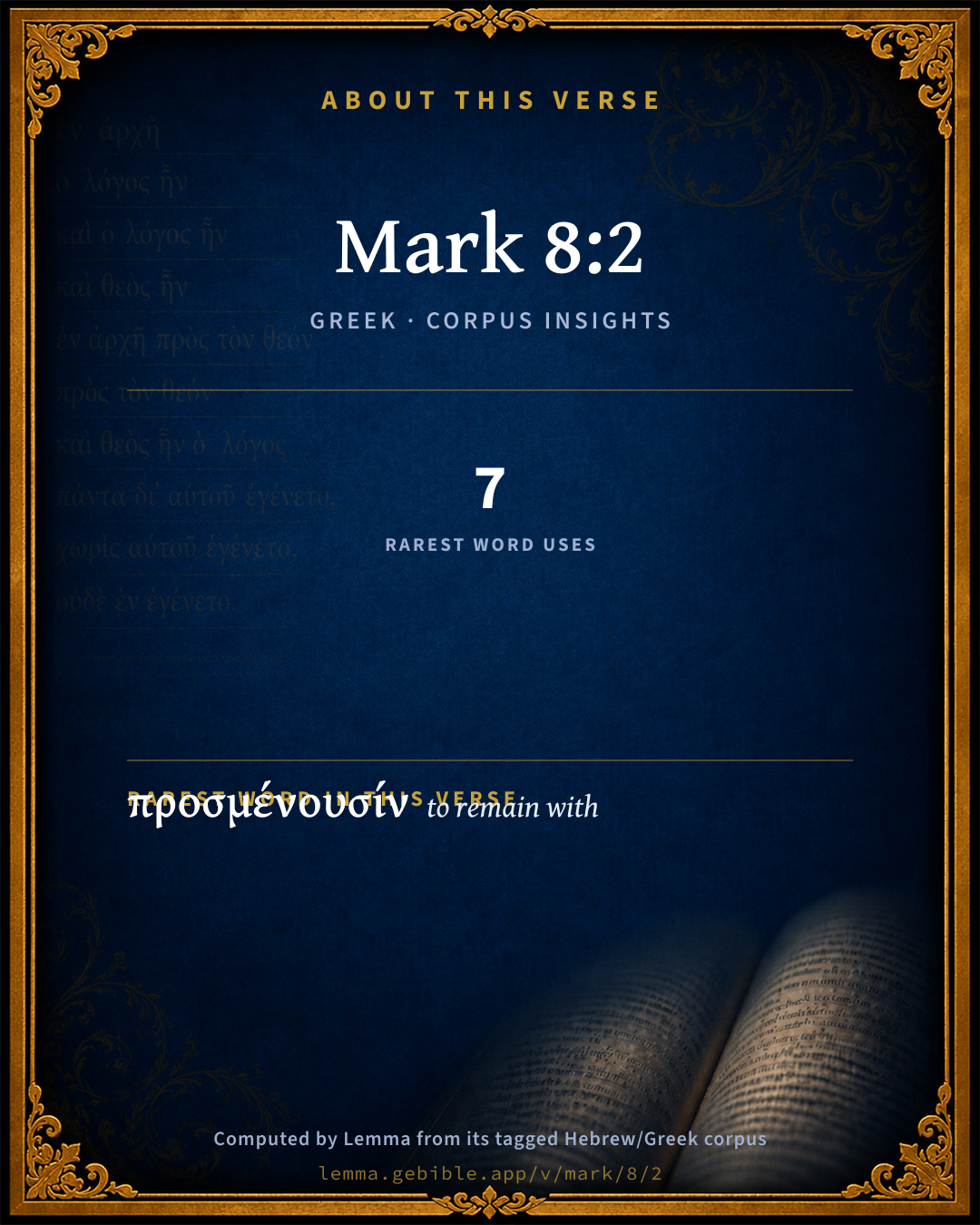
Mark, in the Gospels, opens this verse with 15 words (15 distinct Greek lemmas). Its most distinctive word is prosménō (“to remain with”). A historical commentator’s framing appears above. Read the whole chapter for the surrounding context.
Discussion questions
- What does “to remain with” (prosménō) contribute to the verse as a whole?
- How does Matthew 15:32, which shares the word «to remain with», read alongside this verse?
- These translations render this verse differently. What is at stake in choosing one wording over another?
- Compare how Bengel's Gnomon and Expositor's Greek Testament read this verse. Where do they agree or differ?
Things to notice
- These translations choose different wording for 11 words in this verse.
- 15 distinct Greek lemmas span 15 words in this verse.
Commentary
Notes on Mark 8:2 from classic Christian and Jewish commentators (each source and its license shown beneath its notes). The classic Christian expositions comment on the surrounding passage and are grouped to its opening verse, so a note may address several verses; the Jewish commentaries on the Tanakh (Rashi and others) are per-verse, so they appear only where the commentator wrote on this verse.
Lemma curates 59 commentaries, every one of them public domain or Creative Commons licensed, each selected and text-cleaned for this edition rather than reprinted as found. About our sources →
Bengel's Gnomon
Johann Albrecht Bengel
Bengel's Gnomon of the New Testament — English translation (T&T Clark, Edinburgh, 1860) — public domain. Text from a community e-Sword module.
Expositor's Greek Testament
ed. W. Robertson Nicoll
The Expositor's Greek Testament, edited by W. Robertson Nicoll (1897–1910) — public domain. Text from a community e-Sword module.
Adam Clarke's Commentary
Adam Clarke's Commentary on the Bible (1810–1826) — public domain. Text from a community e-Sword/MySword module.
John Gill's Exposition
John Gill's Exposition of the Whole Bible (1746–1763) — public domain (CC PDM 1.0). Text via the HelloAO Bible API.
Trapp's Complete Commentary
John Trapp
John Trapp, A Commentary or Exposition upon All the Books of the Old and New Testament (1647–1656) — public domain. Text from a community e-Sword module.
Cambridge Greek Testament for Schools and Colleges
Cambridge Greek Testament for Schools and Colleges (Cambridge University Press, 1896; 21 vols, various authors incl. Carr, Maclear, Plummer, Farrar, Lumby, Moule, M. R. James, Simcox) — public domain. Text from a community e-Sword module.
International Critical Commentary
International Critical Commentary — older volumes (1896–1929), various authors — public domain. Text from a community e-Sword module.
Vincent's Word Studies in the New Testament
Marvin R. Vincent
Marvin R. Vincent, Word Studies in the New Testament (1887–1900) — public domain. Text from a community e-Sword/MySword module.