
Matthew 4:9

Greek (Tischendorf 8th ed.) Matthew 4:9 appears in the Greek New Testament. The text above is from the Tischendorf 8th edition. Each word links to its Strong’s number and a concise gloss. Click any word for its full Thayer’s Greek Lexicon entry.
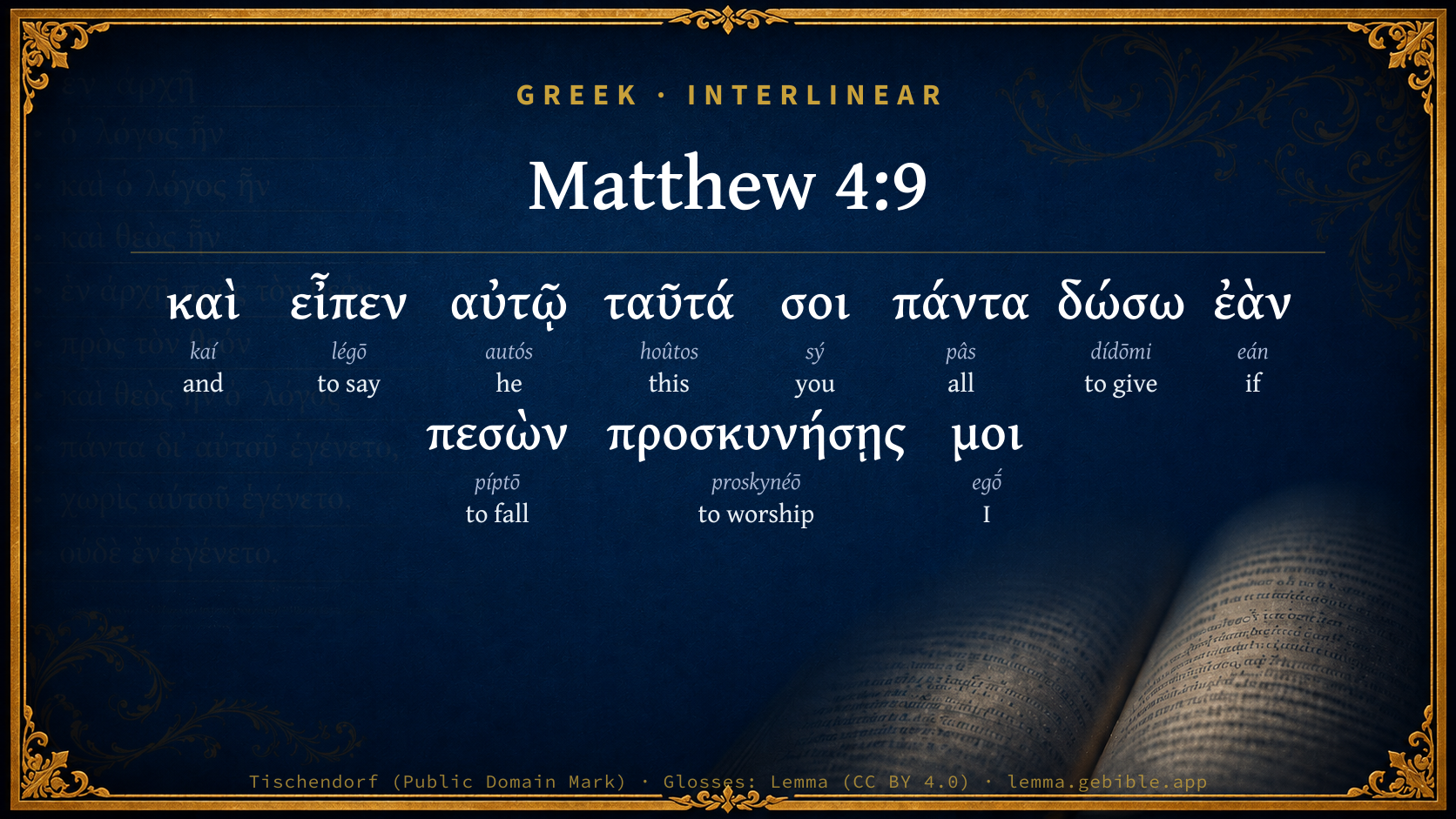
Download image
Cite this verse

Matthew 4:9 (World English Bible). Public Domain. Lemma interlinear Bible study tool, https://lemma.gebible.app/v/matthew/4/9.

Show BibTeX & RIS
BibTeX
RIS
English Translation
He said to him, "I will give you all of these things, if you will fall down and worship me."
World English Bible · Public Domain
Highlights
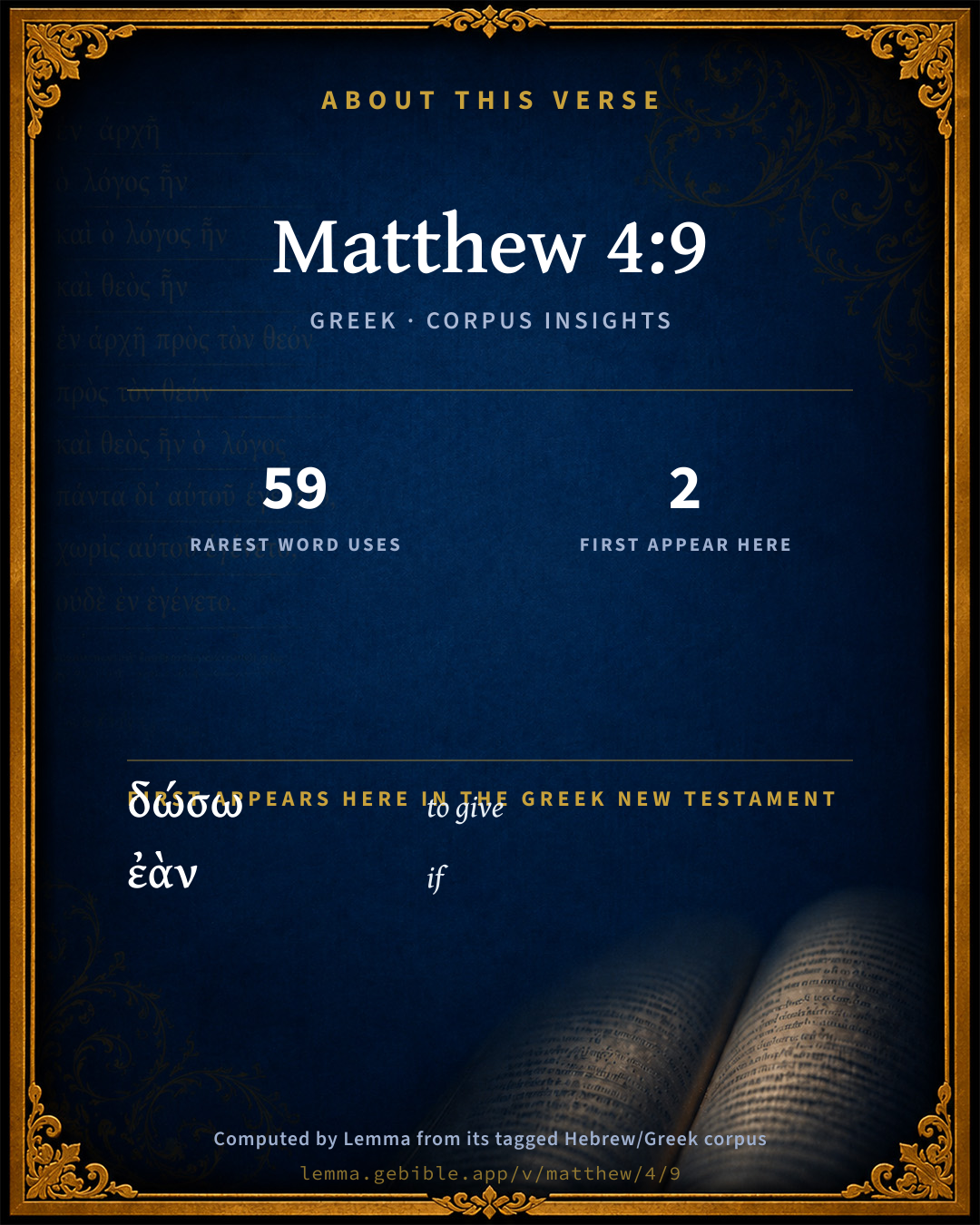
  • 2 first appearances in the Greek New Testament
Full analysis ↓
Download a study sheet

One document with this verse’s original text, its word-by-word gloss line, the meaning frame, cross-references with their text, attributed commentary, and full source and license credits — printable, and it pastes into notes with its structure intact.

This verse Autodidact and up

Study sheet (.html) Plain text (.txt)

A passage Seminary Student

Up to 50 verses in one chapter. A passage sheet keeps up to 6 commentary sources and 12 cross-references per verse, in the order this page ranks them, and says so on the sheet whenever that leaves anything out. Ask for a single verse and you get the Autodidact verse sheet above.

Everything on this page stays free to read, with no account — the sheet is a download of what is already on screen, not access to it.

Want to remove ads? Support Godless Engineer
Compare translations 3

The same verse in 3 English versions, stacked beneath the original-language interlinear above. Click any original word for its lexicon entry.

Each is an independent rendering of the whole verse — the interlinear is not word-aligned to these translations.

Highlighted words mark where these versions differ — a whole-verse word diff, not a word-by-word alignment.

  • World English Bible Public Domain
    He said to him, "I will give you all of these things, if you will fall down and worship me."
  • King James Version Public Domain
    And saith unto him, All these things will I give thee, if thou wilt fall down and worship me.
  • unfoldingWord Literal Text CC BY-SA 4.0
    And he said to him, “All these things I will give you, if having fallen down, you would worship me.”

unfoldingWord Literal Text — © unfoldingWord, licensed CC BY-SA 4.0. Word-aligned USFM3 via Door43 (git.door43.org/unfoldingWord/en_ult).

Versions to compare (up to 4)

3 of 4 selected

Show all 19 translations

Every available English version of this verse, each an independent rendering of the whole verse.

  • World English Bible Public Domain
    He said to him, "I will give you all of these things, if you will fall down and worship me."
  • Berean Standard Bible Public Domain
    “All this I will give You,” he said, “if You will fall down and worship me.”
  • Majority Standard Bible Public Domain
    “All this I will give You,” he said, “if You will fall down and worship me.”
  • King James Version Public Domain
    And saith unto him, All these things will I give thee, if thou wilt fall down and worship me.
  • American Standard Version (1901) Public Domain
    and he said unto him, All these things will I give thee, if thou wilt fall down and worship me.
  • Revised Version (1885) Public Domain
    and he said unto him, All these things will I give thee, if thou wilt fall down and worship me.
  • Geneva Bible (1599) Public Domain
    And sayd to him, All these will I giue thee, if thou wilt fall downe, and worship me.
  • Douay-Rheims (1899) Public Domain
    And said to him: All these will I give thee, if falling down thou wilt adore me.
  • Young's Literal Translation Public Domain
    and saith to him, `All these to thee I will give, if falling down thou mayest bow to me.'
  • Literal Standard Version CC BY-SA 4.0
    and says to Him, “All these I will give to You, if falling down You may worship me.”
  • Unlocked Literal Bible CC BY-SA 4.0
    He said to him, “All these things I will give you, if you fall down and worship me.”
  • unfoldingWord Literal Text CC BY-SA 4.0
    And he said to him, “All these things I will give you, if having fallen down, you would worship me.”
  • Darby Bible Public Domain
    and says to him, All these things will I give thee if, falling down, thou wilt do me homage.
  • World Messianic Bible Public Domain
    He said to him, “I will give you all of these things, if you will fall down and worship me.”
  • Webster's Bible Public Domain
    And saith to him, All these things will I give thee, if thou wilt fall down and worship me.
  • Free Bible Version CC BY-SA 4.0
    He said to Jesus, “I will give you all these if you fall down on your knees and worship me.”
  • Bible in Basic English Public Domain
    And he said to him, All these things will I give you, if you will go down on your face and give me worship.
  • Text-Critical English NT CC BY 4.0
    And he said to him, “All these things I will give yoʋ, if yoʋ will fall down and worship me.”
  • Tyndale New Testament (1534) Public Domain
    And sayde to hym: all these will I geue the if thou wilt faull doune and worship me.

Literal Standard Version (2020), Covenant Press — licensed CC BY-SA 4.0. Text via the HelloAO Bible API (eBible.org). Unlocked Literal Bible (unfoldingWord) — licensed CC BY-SA 4.0. Text via the HelloAO Bible API (eBible.org). unfoldingWord Literal Text — © unfoldingWord, licensed CC BY-SA 4.0. Word-aligned USFM3 via Door43 (git.door43.org/unfoldingWord/en_ult). Free Bible Version, Dr. Jonathan Gallagher — licensed CC BY-SA 4.0. Text via the HelloAO Bible API (eBible.org).

Word by word

More ways to search: Search by grammar → Find every occurrence → Compare this word →

Practice this passage: Drill this verse → Learn its vocabulary →

προσκυνήσῃς
proskynéō
G4352
“to worship”
Verb, Aorist, Active, Subjunctive, 2nd person, Singular
Part of Speech
Verb
Tense
Aorist
Voice
Active
Mood
Subjunctive
Person
2nd person
Number
Singular
Full Thayer's Definition

Origin: from G4314 and a probable derivative of G2965 (meaning to kiss, like a dog licking his master's hand)

TDNT: 18:38,9

1. to kiss the hand to (towards) one, in token of reverence 2. among the Orientals, esp. the Persians, to fall upon the knees and touch the ground with the forehead as an expression of profound reverence 3. in the NT by kneeling or prostration to do homage (to one) or make obeisance, whether in order to express respect or to make supplication a. used of homage shown to men and beings of superior rank 1. to the Jewish high priests 2. to God 3. to Christ 4. to heavenly beings 5. to demons
  1. καὶ kaí G2532 “and” Conjunction
  2. εἶπεν légō G3004 “to say” Verb, Aorist, Active, Indicative, 3rd person, Singular
  3. αὐτῷ autós G846 “he” Personal pronoun, Dative, Singular, Masculine
  4. ταῦτά hoûtos G3778 “this” Demonstrative pronoun, Accusative, Plural, Neuter
  5. σοι sý G4771 “you” Personal pronoun, 2nd person, Dative, Singular
  6. πάντα pâs G3956 “all” Adjective, Accusative, Plural, Neuter
  7. δώσω dídōmi G1325 “to give” Verb, Future, Active, Indicative, 1st person, Singular
  8. ἐὰν eán G1437 “if” Conditional
  9. πεσὼν píptō G4098 “to fall” Verb, Aorist, Active, Participle, Nominative, Singular, Masculine
  10. μοι egṓ G1473 “I” Personal pronoun, 1st person, Dative, Singular

About this verse

These counts appear in no published source. They are computed here, from the morphology-tagged text and Lemma’s own curated glosses. What Lemma adds →

11
words
11
distinct lemmas
Gospels
section

First appearance in Scripture

These words make their first canonical appearance in the Greek New Testament here:

Shared distinctive vocabulary

προσκυνήσῃς to worship G4352 occurs in 53 verses of the Greek New Testament. Also found in:
Cross-references

20

Topical passages linked to Matthew 4:9 in the Treasury of Scripture Knowledge — connected by theme and wording, ordered by reader-vote popularity; previews shown in the World English Bible.

  • 2 Corinthians 4:4 in whom the god of this world has blinded the minds of the unbelieving, that the light of the Gospel of the glory of Christ, who is the image of God, should not dawn on them.
  • Daniel 5:18–19 You king, the Most High God gave Nebuchadnezzar your father the kingdom, and greatness, and glory, and majesty:
  • John 16:11 about judgment, because the prince of this world has been judged.
  • Revelation 19:10 I fell down before his feet to worship him. He said to me, "Look! Don't do it! I am a fellow bondservant with you and with your brothers who hold the testimony of Jesus. Worship God, for the testimony of Jesus is the Spirit of Prophecy."
  • Revelation 22:8–9 Now I, John, am the one who heard and saw these things. When I heard and saw, I fell down to worship before the feet of the angel who had shown me these things.
  • Psalms 72:11 Yes, all kings shall fall down before him. All nations shall serve him.
  • 1 Corinthians 10:20–21 But I say that the things which the Gentiles sacrifice, they sacrifice to demons, and not to God, and I don't desire that you would have communion with demons.
  • 1 Samuel 2:7–8 Yahweh makes poor, and makes rich: He brings low, he also lifts up.
  • Psalms 113:7–8 He raises up the poor out of the dust. Lifts up the needy from the ash heap;
  • Proverbs 8:15 By me kings reign, And princes decree justice.
  • Jeremiah 27:5–6 I have made the earth, the men and the animals that are on the surface of the earth, by my great power and by my outstretched arm; and I give it to whom it seems right to me.
  • Daniel 2:37–38 You, O king, are king of kings, to whom the God of heaven has given the kingdom, the power, and the strength, and the glory;
  • Daniel 4:32 and you shall be driven from men; and they dwelling shall be with the animals of the field; you shall be made to eat grass as oxen; and seven times shall pass over you; until you know that the Most High rules in the kingdom of men, and gives it to whoever he will.
  • Daniel 5:26–28 This is the interpretation of the thing: MENE; God has numbered your kingdom, and brought it to an end;
  • Matthew 26:15 and said, "What are you willing to give me, that I should deliver him to you?" They weighed out for him thirty pieces of silver.
  • John 12:31 Now is the judgment of this world. Now the prince of this world will be cast out.
  • John 13:3 Jesus, knowing that the Father had given all things into his hands, and that he came forth from God, and was going to God,
  • John 14:30 I will no more speak much with you, for the prince of the world comes, and he has nothing in me.
  • 1 Timothy 3:6 not a new convert, lest being puffed up he fall into the same condemnation as the devil.
  • Revelation 19:16 He has on his garment and on his thigh a name written, "KING OF KINGS, AND LORD OF LORDS."

Cross-references courtesy of OpenBible.info (CC BY 4.0).

Commentary

Notes on Matthew 4:9 from classic Christian and Jewish commentators (each source and its license shown beneath its notes). The classic Christian expositions comment on the surrounding passage and are grouped to its opening verse, so a note may address several verses; the Jewish commentaries on the Tanakh (Rashi and others) are per-verse, so they appear only where the commentator wrote on this verse.

Lemma curates 59 commentaries, every one of them public domain or Creative Commons licensed, each selected and text-cleaned for this edition rather than reprinted as found. About our sources →

The Biblical Illustrator

Joseph S. Exell

Mat_4:9

Will I give.

-Abraham, when the king of Sodom offered him some part of his spoils, refused to take so much as a shoe-latchet of him, that the king of Sodom might not say another day that he had made Abraham rich; that men might not say that Abraham had been made rich, not by Gods blessing, but by the kings means, and that he might thank the king of Sodom for what he had. So a godly man will not gain, or desire to gain, so much as a shoe-string or a shoe-thread by profaning the Sabbath with the Sidonian merchant, by fraud or deceit, by oppression or extortion, by biting usury, the devils brokery, by rifling and plundering, or by any other unlawful or indirect means, that the devil may not one day say that he hath made him rich, as he said sometime to our Saviour. (Gataber.)

He never keeps his promises. (Wiseman.)

The Biblical Illustrator, edited by Joseph S. Exell (c. 1880s–1900s) — public domain. Text from a community e-Sword module.

Bengel's Gnomon

Johann Albrecht Bengel

Mat 4:9. Δώσω, I will give) But the Son is the heir of all things, and whatever authority Satan possessed on account of man’s defection from God, that, Christ, stronger than he,[141] took from him, not by compact, but by conquest. What the devil could not persuade Christ to do in his temptation, that he will effect by his vassal the Beast, see Rev 13:2. And what he offered to Christ, he will give to that adversary of His, viz., the kingdoms of the world.—ἐὰν, κ.τ.λ., if, etc.) Vast pride, to offer all the kingdoms of the earth as a gift, in return for one act of adoration acknowledging that gift.[142] Without doubt, he appeared in an august form.

[141] Luk 11:21-22.—(I. B.)

[142] “What the angel did not permit John to do, that the tempter demands of Jesus, the Lord of all (Rev 22:8-9).”—Vers. Germ.

Bengel's Gnomon of the New Testament — English translation (T&T Clark, Edinburgh, 1860) — public domain. Text from a community e-Sword module.

Expositor's Greek Testament

ed. W. Robertson Nicoll

Mat 4:9 . ἐὰν πεσὼν προσκυνήσῃς μοι . This is the condition, homage to Satan as the superior. A naïve suggestion, but pointing to a subtle form of temptation, to which all ambitious, self-seeking men succumb, that of gaining power by compromise with evil. The danger is greatest when the end is good . “The end sanctifies the means.” Nowhere is homage to Satan more common than in connection with sacred causes, the interests of truth, righteousness, and God. Nothing tests purity of motive so thoroughly as temptations of this class. Christ was proof against them. The prince of the world found nothing of this sort in Him (Joh 14:30 ). In practice this homage, if Jesus had been willing to render it, would have taken the form of conciliating the Pharisees and Sadducees, and pandering to the prejudices of the people. He took His own path, and became a Christ, neither after the type imagined by the Baptist, nor according to the liking of the Jews and their leaders. So He gained universal empire, but at a great cost.

The Expositor's Greek Testament, edited by W. Robertson Nicoll (1897–1910) — public domain. Text from a community e-Sword module.

Jamieson, Fausset & Brown

Robert Jamieson, A. R. Fausset & David Brown

And saith unto him, All these things will I give thee--"and the glory of them," adds Luke (Luk 4:6). But Matthew having already said that this was "showed Him," did not need to repeat it here. Luke (Luk 4:6) adds these other very important clauses, here omitted--"for that is," or "has been," "delivered unto me, and to whomsoever I will I give it." Was this wholly false? That were not like Satan's unusual policy, which is to insinuate his lies under cover of some truth. What truth, then, is there here? We answer, Is not Satan thrice called by our Lord Himself, "the prince of this world" (Joh 12:31; Joh 14:30; Joh 16:11)? Does not the apostle call him "the god of this world" (Co2 4:4)? And still further, is it not said that Christ came to destroy by His death "him that hath the power of death, that is, the devil" (Heb 2:14)? No doubt these passages only express men's voluntary subjection to the rule of the wicked one while they live, and his power to surround death to them, when it comes, with all the terrors of the wages of sin. But as this is a real and terrible sway, so all Scripture represents men as righteously sold under it. In this sense he speaks what is not devoid of truth, when he says, "All this is delivered unto me." But how does he deliver this "to whomsoever he will?" As employing whomsoever he pleases of his willing subjects in keeping men under his power. In this case his offer to our Lord was that of a deputed supremacy commensurate with his own, though as his gift and for his ends.

if thou wilt fall down and worship me--This was the sole but monstrous condition. No Scripture, it will be observed, is quoted now, because none could be found to support so blasphemous a claim. In fact, he has ceased now to present his temptations under the mask of piety, and he stands out unblushingly as the rival of God Himself in his claims on the homage of men. Despairing of success as an angel of light, he throws off all disguise, and with a splendid bribe solicits divine honor. This again shows that we are now at the last of the temptations, and that Matthew's order is the true one.

Jamieson, Fausset & Brown — Commentary Critical and Explanatory on the Whole Bible (1871) — public domain (CC PDM 1.0). Text via the HelloAO Bible API.

Adam Clarke's Commentary

Verse 9. If thou wilt fall dozen and worship me] As if he had said, "The whole of this land is now under my government; do me homage for it, and I will deliver it into thy hand."

Adam Clarke's Commentary on the Bible (1810–1826) — public domain. Text from a community e-Sword/MySword module.

Ellicott's Commentary for English Readers

(9) All these things will I give thee.—St. Luke’s addition, “For that is (has been) delivered unto me, and to whomsoever I will I give it,” is full of significance. The offer made by the Tempter rested on the apparent evidence of the world’s history. The rulers of the world, its Herods and its Cæsars, seemed to have attained their eminence by trampling the laws of God under foot, and accepting Evil as the Lord and Master of the world. In part, the claim is allowed by our Lord’s language and that of his Apostles. Satan is “the prince of this world” (Joh_12:31; Joh_14:30). His hosts are “the world-rulers (κοσμοκράτορας) of darkness” (Eph_6:12). In this case the temptation is no longer addressed to the sense of Sonship, but to the love of power. To be a King like other kings, mighty to deliver His people from their oppressors, and achieve the glory which the prophets had predicted for the Christ;—this was possible for Him if only He would go beyond the self-imposed limits of accepting whatsoever His Father ordered for Him.

Wilt fall down and worship me.—The latter word properly expresses, as apparently throughout the New Testament, the homage offered to a king rather than the adoration due to God.

A Bible Commentary for English Readers, edited by Charles John Ellicott (1878–1897) — public domain. Text from a community e-Sword module.

The Cambridge Bible for Schools and Colleges

gen. ed. J. J. S. Perowne

9. All these things will I give thee] Satan, the “prince of this world,” (Joh_7:31) claims the disposal of earthly thrones. This is more clearly brought out by St Luke (ch. Luk_4:6), “All this power will I give thee and the glory of them, for that is delivered unto me, and to whomsoever I will I give it.” The arrogance, selfishness, and cruelty of contemporary rulers would give force to such an assumption. A Tiberius or a Herod Antipas might indeed be thought to have worshipped Satan.

The Cambridge Bible for Schools and Colleges (gen. ed. J. J. S. Perowne; Cambridge University Press, 1878–1918) — public domain. Text from a community e-Sword module.

John Gill's Exposition

Then saith Jesus to him, get thee hence, Satan..... In Luk 4:8 it is "get thee behind me": and so some copies read here, and is expressive of indignation and abhorrence; see Mat 16:23 rebuking his impudence, and detesting his impiety: he had borne his insults and temptations with great patience; he had answered him with mildness and gentleness; but now his behaviour to him was intolerable, which obliged him to show his resentment, exert his power and authority, and rid himself at once of so vile a creature; giving this reason for it;

for it is written, thou shalt worship the Lord thy God, and him only shalt thou serve. The place referred to is in Deu 6:13

thou shalt fear the Lord thy God, and serve him: to fear the Lord, and to worship him, is the same thing. Worship includes both an internal and external reverence of God: the word "only" is not in the original text, but is added by our Lord; and that very justly; partly to express the emphasis which is on the word "him"; and in perfect agreement with the context, which requires it; since it follows,

ye shall not go after other Gods. Moreover, not to take notice of the Septuagint version, in which the word "only" is also added, Josephus (q), the Jewish historian, referring to this law, says, because God is one, , "therefore he only is to be worshipped". And Aben Ezra (r), a Jewish writer, explaining the last clause in the verse,

and thou shalt swear by his name, uses the word "only"; and which indeed, of right, belongs to every clause in it. The meaning of our Lord in citing it is; that since the Lord God is the alone object of worship, it was horrid blasphemy in Satan to desire it might be given to him, and which could not be done without the greatest impiety.

(q) Antiq. Jud. l. 3. c. 5. sect. 5. (r) In Deut. vi. 13.

John Gill's Exposition of the Whole Bible (1746–1763) — public domain (CC PDM 1.0). Text via the HelloAO Bible API.

Trapp's Complete Commentary

John Trapp

9 And saith unto him, All these things will I give thee, if thou wilt fall down and worship me.

Ver. 9. And he saith unto him, All these things will I give thee] A great catch sure: even just nothing; for he showed our Saviour only shows and shadows, apparitions and resemblances of things. The word also used in the former verse for "glory" signifieth an opinion or imagination (Δυξα.) So St Luke styles all Agrippa’s pomp, but a fantasy, Act 25:23, μετα πολλης φαντασιας. David tells us, that man walketh in a vain shadow, Psa 39:6. Now a shadow is something in appearance, nothing in substance. So the apostle calleth all these things that the devil proffers our Saviour, σχημα, an accidental mathematical figure, without solidity or substance; and further tells us that this figure passeth away, is ever in transitu, 1Co 7:31, παραγω, like the streams of a river, that passing by the sides of a city, no man can stop: or if we could retain the things of this life, yet, not the world only passeth away, saith the apostle, but the lusts thereof, 1Jn 2:17. So that a man cannot make his heart delight in the same thing still. Vota post usam fastidio sunt. We loathe after a while what we lusted after (as Amnon did Tamar), and quickly find a satiety, yea, a dissatisfaction in the creature. For he that loveth silver shall not be satisfied with silver, not though he could heap up his hoards to the stars, and engross a monopoly of all the wealth in the world, απαντων η πλησμονη, Ecc 5:10. Non plus satiatur cor auro, quam corpus aura. You may as soon fill a bag with wisdom, a chest with virtue, or a circle with a triangle, as the heart of man with anything here below. All that earth can afford is fumus aut funus, saith one; nugae et μορμολυκειν, saith another; vanity and vexation, saith Solomon the wise: to whose impartial verdict (grounded upon such good experience) we shall do well to subscribe, without believing the devil’s cracks, or trying any further conclusions. The Centurists interpret "all these things will I give thee," thus: I will make thee pope. And indeed many popes were advanced to that see immediately by the devil, as histories relate; who had they but observed what is usually done at their enthronization, would never have been so hasty. For before the pope is set in his chair, and puts on his triple crown, a piece of tow or wad of straw is set on fire before him, and one appointed to say, Sic transit gloria mundi the glory of this world is but a blaze. This is only matter of form and ceremony; as is also that, that one day in the year the pope’s alms giver rides before him, casting abroad to the poor certain pieces of brass and lead, saying, Silver and gold I have none, but such as I have I give you; whereas that scarlet whore holds a golden cup in her hand, and her merchants that trade with her are the nobles of the earth, Rev 18:9-17, and are made rich by her, Rev 18:15. (Pareus in Apoc.) The Cardinal of Toledo hath a hundred thousand pounds a year coming in; the archbishops of Germany are free princes, many of them, and have revenues accordingly. Petrarch reporteth that in the treasury of Pope John XXII were found after his death 250 tons of gold. And of Boniface VIII the story is told, that when he was taken by Philip the Fair, King of France, and his palace rifled, there was more treasure found than all the kings of the earth were able to show again. Otto, one of the Pope’s mice catchers ( muscipulatores), as the story calleth them, sent hither by Gregory IX, after three years raking together of money by most detestable arts, at last departing hence, he left not so much money in the whole kingdom as he either carried with him or sent before him. Judge by this what they did throughout all Christendom. The pope, saith one, could never want money so long as he could hold a pen in his hand. It was truly and trimly said by Pope Innocent IV, Vere hortus deliciarum Papis fuit tum Anglia, et puteus inexhaustns. Thus it was then; but how now? Bellarmine complains that since the pope was cried down for antichrist, his kingdom hath not only not increased, but every day more and more decreased. Non mode non crevit eius imperiam, sed semper magis ac magis decrevit. And Cotton the Jesuit confesseth that the authority of the pope of Rome is incomparably less than it was; and that now the Christian Church is but a diminutive. Hereupon also the cardinals (who were wont to meet more often) meet but once a week, because the businesses of the court of Rome grow fewer. And albeit the pope’s good and his blood, his honours and manners, rose together; yet abates he as little of his former pomp and pride as the devil doth since his fall ( Os Papae et oculus Diaboli, in eodem sunt praedicamento. Sphinx.), in taking upon him here to dispose of all the kingdoms of the earth as his, and requiring our Saviour (the true Lord of all) to fall down and worship him. The cardinals he still createth with these words, Estote fratres nostri et principes mundi, shall be our brothers and leaders of the world. And as another Diocletian (who was the first that affected that honour), he holdeth forth his feet to be kissed, having the sign of the cross shining with pearls and precious stones upon his shoe, Ut plenis faucibus crucem Christi derideat, So with a full gullet he mocks the cross of Christ, saith mine author. Stratagema nunc est Pontificium, ditare multos, ut pii esse desinant. In a word, with his pomp and primacy, gain and glory, rule and riches, fat bishoprics and cardinalships, as he sought to insnare Luther and gain him to his side, so he gets and binds not a few fast to that rotten religion. Pauper Lutherus multos fecit divites, Poor Luther made many rich men, said Erasmus; it being then the ready way to preferment to write and rail against Luther, as Eccius, Coccius, and others found it. But Christ will one day whip such money merchants and their customers out of his house, as he did those in the Gospel, Joh 2:15; chase them out of his presence, as Nehemiah did Sanballat’s son-in-law; curse them with a curse that "run greedily after the error of Balaam for reward," Jdg 1:11. Let the Romish Balak offer as large as the devil doth here, every one that hath anything of Christ in him will answer with that noble Italian convert (Galeaceus Caracciolus, Marquess of Vico in Naples), who being tempted by a Jesuit to revolt for money, cried out, "Let their money perish with them, who esteem all the gold in the world worth one day’s society with Jesus Christ, and his Holy Spirit. And cursed be that religion for ever," &c. At Augsburg there is a known price of ten florins a year to all who will turn Papists. (Crashaw’s Life of Sandys.)

If thou wilt fall down and worship me] Luke saith, "Worship before me." So that to worship before an idol is to worship the idol, whatever the Romanist pretend and plead to the contrary. And not only so, but to fall down, as the devil would have had our Saviour here (though it be not come to worshipping), is a grievous sin. St John had not yet worshipped the angel, but only fallen down, as desirous to worship, and is taken up by the angel for that idolatrous gesture, Rev 19:10. Woe then to those Rimmonites that plead for an upright soul in a prostrate body; and allege for their warrant that of Apocryphal Baruch, Apc Bar 6:5-6 "Wherefore when ye see the multitude of people worshipping them behind and before, say ye in your hearts, O Lord, it is thou that oughtest only to be worshipped." Serve we God with our bodies also; and say with David and Christ, "Lord, a body hast thou given me; Lo, I come to do thy will therewith," Psa 40:8. But what a desperate and detestable boldness was it in the devil to move speech of such a sin as this to our Saviour Christ. It was extreme sauciness in Satan to adjure our Saviour (whom he there calls the Son of the most high God) not to torment him; it was horrible impudence; but nothing comparable to this in the text, to worship the devil in person: than which what can be imagined more odious? We see then to what execrable sins the best may be tempted. A man is to expect (saith Capel on Temptation), if he lived out his days, to be urged to all sins, to the breach of every branch of the ten commandments; and to be put to it in respect of every article of our creed. Have you not been tempted, saith another, in this or that kind? it is because God in mercy would not lead you into temptation. (Bain’s Letters.) Yea, this is, in some sort, more to be acknowledged than victory, when ye were tempted. For not to be tempted is more immediately from God, and less in man’s power, than to prevail against temptation. For nothing doth overcome us without our will: but without our will doth God lead us into trial; for he knoweth we would taste little of these if we might be our own carvers. "Simon, Simon," saith our Saviour, "Satan hath desired to have you to minnow you," that is to trouble and hurt you, Luk 22:31, ταραξαι και βλαψαι, saith Theophylact, as a challenger desireth to have one of the other side to combat with; as Goliah called for a man to match him. Now either God denies him, or delivers us, so that evil one toucheth us not, 1Jn 5:18, viz. Tactu qualitavito, with a mortal touch, as Cajetan glosseth that text. "I have prayed for thee," saith our Saviour, "that thy faith fail not." He prayed for all, but especially for Peter, because more violently tempted, as because more shamefully foiled; therefore, "Go tell my disciples and Peter, that I am risen; and that thereby he is justified," Mar 16:7; Rom 4:25. I have prayed; so that the remedy was ready made before the disease, the salve before the sore, or else it might have come too late; as those that are stung by a scorpion, if they be not presently anointed with oil of scorpions, die for it: and as those that have drunk poison, if they take not an antidote immediately, ere it get to the vitals, perish infallibly. God in Christ hath all plaisters and pardons ready made and sealed, else we might die in our sins while the pardon is providing.

John Trapp, A Commentary or Exposition upon All the Books of the Old and New Testament (1647–1656) — public domain. Text from a community e-Sword module.

Albert Barnes' Notes on the Bible

All these things ... - All these kingdoms. All these dominions Satan claimed a right to bestow on whom he pleased, and with considerable justice. They were excessively wicked; and with no small degree of propriety, therefore, he asserted his claim to give them away. This temptation had much plausibility. Satan regarded Jesus as the king of the Jews. As the Messiah he supposed he had come to take possession of all that country. He was poor, and unarmed, and without followers or armies. Satan proposed to put him in possession of it at once, without any difficulty, if he would acknowledge him as the proper lord and disposer of that country; if he would trust to him rather than to God.

Worship me - See the notes at Mat 2:2. The word here seems to mean, to acknowledge Satan as having a right to give these kingdoms to him; to acknowledge his dependence on him rather than God; that is, really to render religious homage. We may be surprised at his boldness. But he had been twice foiled. He supposed it was an object dear to the heart of the Messiah to obtain these kingdoms. He claimed a right over them; and he seemed not to be asking too much, if he gave them to Jesus, that Jesus should be willing to acknowledge the gift and express gratitude for it. So plausible are Satan’s temptations, even when they are blasphemous; and so artfully does he present his allurements to the mind.

Albert Barnes' Notes on the Bible (1834–1885) — public domain. Text from a community e-Sword/MySword module.

Haydock's Catholic Bible Commentary

All these will I give thee. The father of lies here promised what was not his to give. For though he be called the prince of this world, (John xii. 31,) meaning of the wicked, who wilfully make themselves his slaves; yet so restrained is the devil’s power, that he could not go into the swine till Christ permitted it. (Matthew viii. 31.) (Witham) --- What arrogance! what pride! The devil promises earthly kingdoms, whilst Jesus promises a heavenly kingdom to his followers. (St. Remigius) Behold the pride of this heart; as he formerly wished to make himself God, so now he wishes to assume to himself divine honours. (St. Thomas Aquinas)

George Leo Haydock (1774–1849), Haydock's Catholic Family Bible and Commentary, 1859 edition — public domain. Excludes Psalms (Douay-Rheims chapter numbering differs from Protestant) and Deuterocanonical books (Catholic canon only).

The Pulpit Commentary

All these things will I give thee (tauta soi panta dwsw). The devil puts "these things" and "thee" in the sharpest contrast. In Luke the devil says, "To thee will I give all this authority, and the glory of them: for it i.e. the authority hath been delivered unto me; and to whomsoever I will I give it;" i.e. there the devil speaks of giving, not actual possession of the things themselves (Matthew), but the authority that this implied, "and the glory of them." According to St. Luke, he does not attempt to conceal the fact that he has not absolute possession, but he claims authority as delegated to him, and as capable of being delegated by him to another. His claim was false as absolutely stated, but is true relatively in so far that even his usurpation of power must have been permitted (of. our Lord"s term for him, "The prince of this world"). If thou wilt fall down and worship me; i.e. prostrate thyself in obeisance before me the Eastern method of acknowledging the superiority of a person. (cf. Gen_23:7 1Sa_20:41 2Sa_1:2 2Sa_9:6) The expression does not mean "worship me as God" (for this surely was far too coarse a temptation to overcome any even ordinarily pious Israelite; cf. Weiss), but "acknowledge my rights as over-lord." It is not a question of apostasy, (cf. 1Ki_18:21Jo 1Ki 24:15) but of submission to the methods inculcated by Satan, which placed the immediate and the visible above the future and the unseen. (Gen_3:5 Exo_32:4)

The Pulpit Commentary (1880–1919), ed. H.D.M. Spence-Jones & Joseph S. Exell — public domain. Text from a community e-Sword module.

John Wesley's Explanatory Notes

If thou wilt fall down and worship me - Here Satan clearly shows who he was. Accordingly Christ answering this suggestion, calls him by his own name, which he had not done before.

John Wesley, Explanatory Notes Upon the Whole Bible (1754–1765) — public domain. Text via the GEBible commentary corpus.

The People's New Testament

B. W. Johnson

9. All these things will I give thee. All disguise is laid aside. Satan claims to be the Prince of the world and the disposer of human kingdoms. Jesus came to be a King, but the pathway to the crown is weary, painful, beset with thorns and blood. Satan proposes an easier way. He will rally the Jewish nation around him, set him on the throne of David, make him the Messiah King of the world, if he will only consent to give up his idea of a spiritual kingdom, “not of this world,” and worship the god of this world by conforming his kingdom to the worldly ideas of Israel. The temptation is to turn away from the path of self-denial, the cross and the tomb, and to establish an outward, worldly domain.

B. W. Johnson's The People's New Testament with Notes (1889–1891) — public domain. Electronic text from the Christian Classics Ethereal Library (CCEL) ThML edition.

Cambridge Greek Testament for Schools and Colleges

9. εἶπεν for λέγει with the same weight of authority.

9. ταῦτά σοι πάντα δώσω. Satan, the ‘prince of this world’ (Joh 12:31), claims the disposal of earthly thrones. This is more clearly brought out by St Luke (Luk 4:6), ‘All this power will I give thee and the glory of them, for that is delivered unto me, and to whomsoever I will I give it.’ The arrogance, selfishness and cruelty of contemporary rulers would give force to such an assumption. A Tiberius or a Herod Antipas might indeed be thought to have worshipped Satan.

ἐὰν πεσὼν προσκυνήσῃς μοι, i.e. acknowledge as sovereign, as the lesser kings acknowledged Cæsar: jus imperiumque Phraates | Cæsaris accepit genibus minor. Hor. Ep. I. 12. 27.

Cambridge Greek Testament for Schools and Colleges (Cambridge University Press, 1896; 21 vols, various authors incl. Carr, Maclear, Plummer, Farrar, Lumby, Moule, M. R. James, Simcox) — public domain. Text from a community e-Sword module.

International Critical Commentary

9. And said to Him, All these things will I give Thee, if Thou wilt fall down and worship me.] Lk. has: “And the devil said to Him, To Thee I will give all this authority and their glory: because to me it has been delivered; and to whomsoever I will, I give it. Thou, therefore, if Thou wilt worship before me, all shall be Thine.”

(X)

9. S1 has: “And said to Him, These kingdoms and their glory Thou hast seen. To Thee will I give them, if,” etc.

International Critical Commentary — older volumes (1896–1929), various authors — public domain. Text from a community e-Sword module.

Lesson kit

Teaching starters — assembled from the data on this page, not authored interpretation. Every prompt links to the verse data it draws on. Edit before teaching.

Matthew, in the Gospels, opens this verse with 11 words (11 distinct Greek lemmas). Its most distinctive word is proskynéō (“to worship”). A historical commentator’s framing appears above. Read the whole chapter for the surrounding context.

Discussion questions

  1. The word proskynéō carries the sense “to worship.” How does it shape the verse?
  2. 2 words make their first appearance in Scripture here. What does this debut establish?
  3. How does Matthew 2:2, which shares the word «to worship», read alongside this verse?
  4. These translations render this verse differently; the difference is in the English rendering, not the original. What questions does that raise?
  5. Compare how The Biblical Illustrator and Bengel's Gnomon read this verse. Where do they agree or differ?

Things to notice

  • 2 words make their first canonical appearance in Scripture here.
  • These translations choose different wording for 7 words in this verse.
  • 11 distinct Greek lemmas span 11 words in this verse.

Reading settings

Reading text

Shown beneath each verse's original-language words.

Old Testament
Old Testament edition

Read the OT as the Masoretic Hebrew (MT) or the Greek Septuagint (LXX).

English shown for the Greek Septuagint (in the Hebrew ↔ Greek comparison).

Comparing translations? Open the Compare panel on any verse page to stack up to four side by side.