Mark 10:38

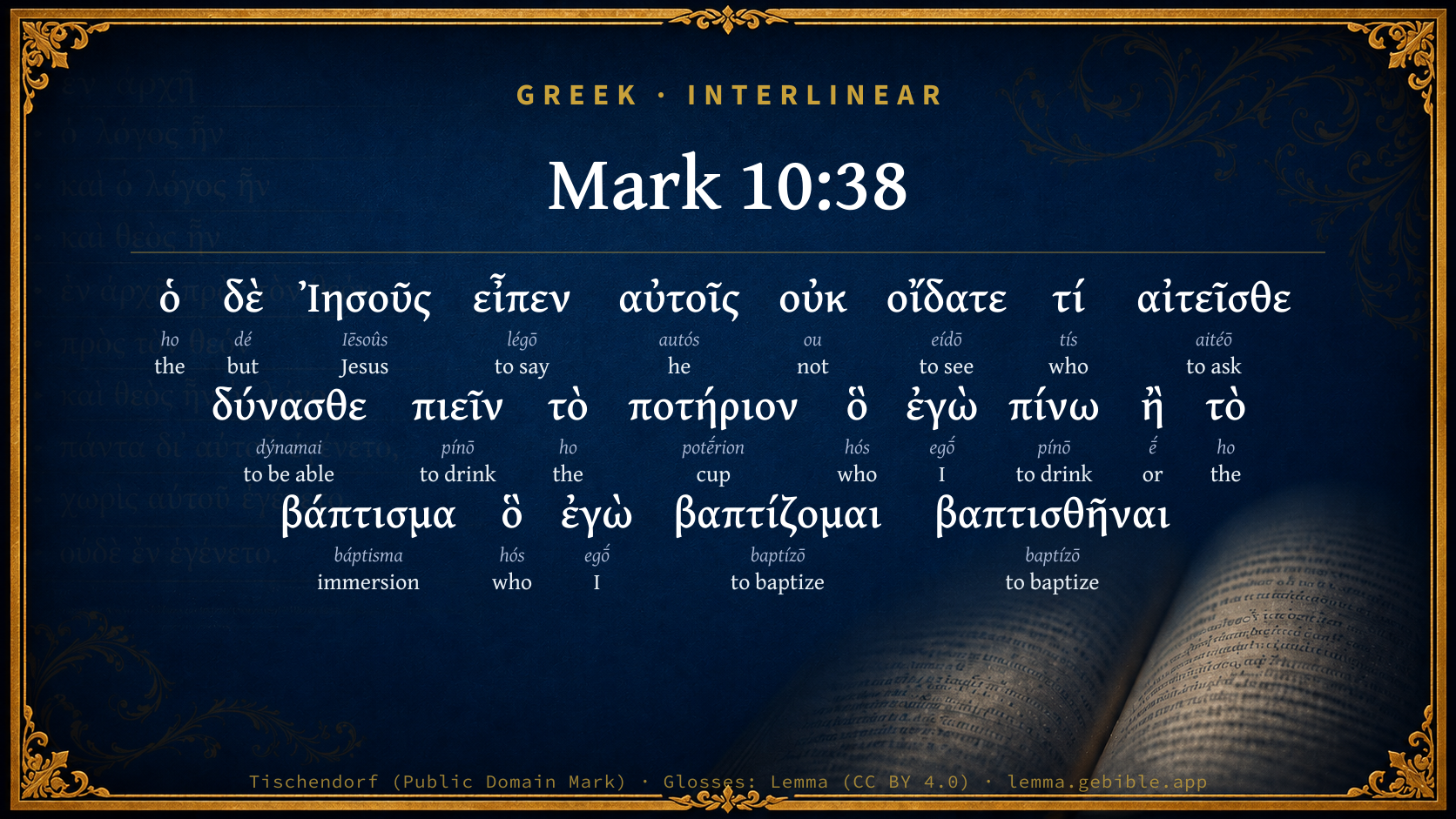
Greek (Tischendorf 8th ed.) Mark 10:38 appears in the Greek New Testament. The text above is from the Tischendorf 8th edition. Each word links to its Strong’s number and a concise gloss. Click any word for its full Thayer’s Greek Lexicon entry.
Download image
Cite this verse

Mark 10:38 (World English Bible). Public Domain. Lemma interlinear Bible study tool, https://lemma.gebible.app/v/mark/10/38.

Show BibTeX & RIS
BibTeX
RIS
English Translation
But Jesus said to them, "You don't know what you are asking. Are you able to drink the cup that I drink, and to be baptized with the baptism that I am baptized with?"
World English Bible · Public Domain
Download a study sheet

One document with this verse’s original text, its word-by-word gloss line, the meaning frame, cross-references with their text, attributed commentary, and full source and license credits — printable, and it pastes into notes with its structure intact.

This verse Autodidact and up

Study sheet (.html) Plain text (.txt)

A passage Seminary Student

Up to 50 verses in one chapter. A passage sheet keeps up to 6 commentary sources and 12 cross-references per verse, in the order this page ranks them, and says so on the sheet whenever that leaves anything out. Ask for a single verse and you get the Autodidact verse sheet above.

Everything on this page stays free to read, with no account — the sheet is a download of what is already on screen, not access to it.

Want to remove ads? Support Godless Engineer
Compare translations 3

The same verse in 3 English versions, stacked beneath the original-language interlinear above. Click any original word for its lexicon entry.

Each is an independent rendering of the whole verse — the interlinear is not word-aligned to these translations.

Highlighted words mark where these versions differ — a whole-verse word diff, not a word-by-word alignment.

  • World English Bible Public Domain
    But Jesus said to them, "You don't know what you are asking. Are you able to drink the cup that I drink, and to be baptized with the baptism that I am baptized with?"
  • King James Version Public Domain
    But Jesus said unto them, Ye know not what ye ask: can ye drink of the cup that I drink of? and be baptized with the baptism that I am baptized with?
  • unfoldingWord Literal Text CC BY-SA 4.0
    But Jesus said to them, “You do not know what you are asking. Are you able to drink the cup which I drink or to be baptized with the baptism with which I am being baptized?”

unfoldingWord Literal Text — © unfoldingWord, licensed CC BY-SA 4.0. Word-aligned USFM3 via Door43 (git.door43.org/unfoldingWord/en_ult).

Versions to compare (up to 4)

3 of 4 selected

Show all 19 translations

Every available English version of this verse, each an independent rendering of the whole verse.

  • World English Bible Public Domain
    But Jesus said to them, "You don't know what you are asking. Are you able to drink the cup that I drink, and to be baptized with the baptism that I am baptized with?"
  • Berean Standard Bible Public Domain
    “You do not know what you are asking,” Jesus replied. “Can you drink the cup I will drink, or be baptized with the baptism I will undergo?”
  • Majority Standard Bible Public Domain
    “You do not know what you are asking,” Jesus replied. “Can you drink the cup I will drink, and be baptized with the baptism I will undergo?”
  • King James Version Public Domain
    But Jesus said unto them, Ye know not what ye ask: can ye drink of the cup that I drink of? and be baptized with the baptism that I am baptized with?
  • American Standard Version (1901) Public Domain
    But Jesus said unto them, Ye know not what ye ask. Are ye able to drink the cup that I drink? or to be baptized with the baptism that I am baptized with?
  • Revised Version (1885) Public Domain
    But Jesus said unto them, Ye know not what ye ask. Are ye able to drink the cup that I drink? or to be baptized with the baptism that I am baptized with?
  • Geneva Bible (1599) Public Domain
    But Iesus sayd vnto them, Ye knowe not what ye aske. Can ye drinke of the cup that I shall drinke of, and be baptized with the baptisme that I shall be baptized with?
  • Douay-Rheims (1899) Public Domain
    And Jesus said to them: You know not what you ask. Can you drink of the chalice that I drink of: or be baptized with the baptism wherewith I am baptized
  • Young's Literal Translation Public Domain
    and Jesus said to them, `Ye have not known what ye ask; are ye able to drink of the cup that I drink of, and with the baptism that I am baptized with -- to be baptized?'
  • Literal Standard Version CC BY-SA 4.0
    and Jesus said to them, “You have not known what you ask; are you able to drink of the cup that I drink of, and with the immersion that I am immersed with—to be immersed?”
  • Unlocked Literal Bible CC BY-SA 4.0
    But Jesus replied to them, “You do not know what you are asking. Are you able to drink the cup which I will drink or endure the baptism with which I will be baptized?”
  • unfoldingWord Literal Text CC BY-SA 4.0
    But Jesus said to them, “You do not know what you are asking. Are you able to drink the cup which I drink or to be baptized with the baptism with which I am being baptized?”
  • Darby Bible Public Domain
    And Jesus said to them, Ye do not know what ye ask. Are ye able to drink the cup which *I* drink, or be baptised with the baptism that *I* am baptised with?
  • World Messianic Bible Public Domain
    But Yeshua said to them, “You don’t know what you are asking. Are you able to drink the cup that I drink, and to be immersed with the immersion that I am immersed with?”
  • Webster's Bible Public Domain
    But Jesus said to them, Ye know not what ye ask: can ye drink of the cup that I drink of? and be baptized with the baptism that I am baptized with?
  • Free Bible Version CC BY-SA 4.0
    “You don't know what you're asking,” replied Jesus. “Can you drink the cup I drink? Can you be baptized with the baptism of pain I will suffer?”
  • Bible in Basic English Public Domain
    But Jesus said to them, You have no knowledge of what you are saying. Are you able to take of my cup? or to undergo the baptism which I am to undergo?
  • Text-Critical English NT CC BY 4.0
    But Jesus said to them, “You do not know what you are asking. Are you able to drink the cup that I drink, and to be baptized with the baptism that I am baptized with?”
  • Tyndale New Testament (1534) Public Domain
    But Iesus sayd vnto the: Ye wot not what ye axe. Can ye dryncke of the cup that I shall dryncke of and be baptised in the baptisme that I shalbe baptised in?

Literal Standard Version (2020), Covenant Press — licensed CC BY-SA 4.0. Text via the HelloAO Bible API (eBible.org). Unlocked Literal Bible (unfoldingWord) — licensed CC BY-SA 4.0. Text via the HelloAO Bible API (eBible.org). unfoldingWord Literal Text — © unfoldingWord, licensed CC BY-SA 4.0. Word-aligned USFM3 via Door43 (git.door43.org/unfoldingWord/en_ult). Free Bible Version, Dr. Jonathan Gallagher — licensed CC BY-SA 4.0. Text via the HelloAO Bible API (eBible.org).

Word by word

More ways to search: Search by grammar → Find every occurrence → Compare this word →

Practice this passage: Drill this verse → Learn its vocabulary →

βάπτισμα
báptisma
G908
“immersion”
Noun, Accusative, Singular, Neuter
Part of Speech
Noun
Case
Accusative
Number
Singular
Gender
Neuter
Full Thayer's Definition

Origin: from G907

TDNT: 10:05,9

1. immersion, submersion a. of calamities and afflictions with which one is quite overwhelmed b. of John's baptism, that purification rite by which men on confessing their sins were bound to spiritual reformation, obtained the pardon of their past sins and became qualified for the benefits of the Messiah's kingdom soon to be set up. This was valid Christian baptism, as this was the only baptism the apostles received and it is not recorded anywhere that they were ever rebaptised after Pentecost. c. of Christian baptism; a rite of immersion in water as commanded by Christ, by which one after confessing his sins and professing his faith in Christ, having been born again by the Holy Spirit unto a new life, identifies publicly with the fellowship of Christ and the church. In Rom. 6:3 Paul states we are "baptised unto death" meaning that weare not only dead to our former ways, but they are buried. To returnto them is as unthinkable for a Christian as for one to dig up a deadcorpse! In Moslem countries a new believer has little trouble withMoslems until he is publicly baptised. It is then, that the Moslems'know he means business, and then the persecution starts. See alsodiscussion of baptism under No. 907.
  1. ὁ ho G3588 “the” Article, Nominative, Singular, Masculine
  2. δὲ dé G1161 “but” Conjunction
  3. Ἰησοῦς Iēsoûs G2424 “Jesus” Noun, Nominative, Singular, Masculine
  4. εἶπεν légō G3004 “to say” Verb, Aorist, Active, Indicative, 3rd person, Singular
  5. αὐτοῖς autós G846 “he” Personal pronoun, Dative, Plural, Masculine
  6. οὐκ ou G3756 “not” Particle, Negative
  7. οἴδατε eídō G1492 “to see” Verb, Perfect, Active, Indicative, 2nd person, Plural
  8. τί tís G5101 “who” Interrogative pronoun, Accusative, Singular, Neuter
  9. αἰτεῖσθε aitéō G154 “to ask” Verb, Present, Middle, Indicative, 2nd person, Plural
  10. δύνασθε dýnamai G1410 “to be able” Verb, Present, Middle or Passive deponent, Indicative, 2nd person, Plural
  11. πιεῖν pínō G4095 “to drink” Verb, Aorist, Active, Infinitive
  12. τὸ ho G3588 “the” Article, Accusative, Singular, Neuter
  13. ποτήριον potḗrion G4221 “cup” Noun, Accusative, Singular, Neuter
  14. ὃ hós G3739 “who” Relative pronoun, Accusative, Singular, Neuter
  15. ἐγὼ egṓ G1473 “I” Personal pronoun, 1st person, Nominative, Singular
  16. πίνω pínō G4095 “to drink” Verb, Present, Active, Indicative, 1st person, Singular
  17. ἢ ḗ G2228 “or” Particle
  18. τὸ ho G3588 “the” Article, Accusative, Singular, Neuter
  19. ὃ hós G3739 “who” Relative pronoun, Accusative, Singular, Neuter
  20. ἐγὼ egṓ G1473 “I” Personal pronoun, 1st person, Nominative, Singular
  21. βαπτίζομαι baptízō G907 “to baptize” Verb, Present, Passive, Indicative, 1st person, Singular
  22. βαπτισθῆναι baptízō G907 “to baptize” Verb, Aorist, Passive, Infinitive

About this verse

These counts appear in no published source. They are computed here, from the morphology-tagged text and Lemma’s own curated glosses. What Lemma adds →

23
words
17
distinct lemmas
Gospels
section

Notable vocabulary

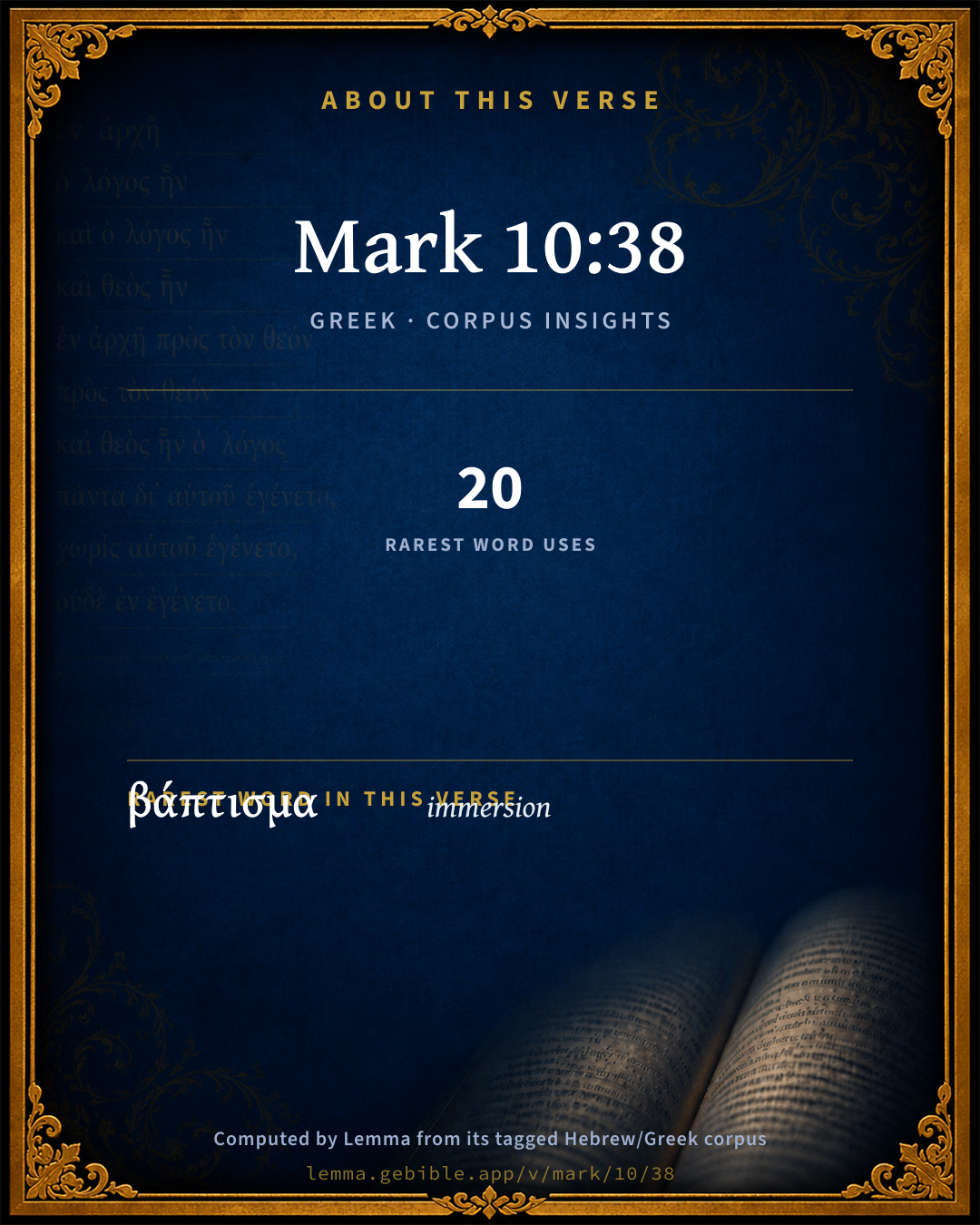
The rarest word here is βάπτισμα immersion G908 — appearing just 20 times in the whole Greek New Testament.

Shared distinctive vocabulary

βάπτισμα immersion G908 occurs in 20 verses of the Greek New Testament. Also found in:

Repetition

Words recur within this verse:

  • πιεῖν to drink G4095 ×2
  • βαπτίζομαι to baptize G907 ×2
  • ὁ the G3588 ×3
  • ὃ who G3739 ×2
  • ἐγὼ I G1473 ×2

Cross-references

10

Topical passages linked to Mark 10:38 in the Treasury of Scripture Knowledge — connected by theme and wording, ordered by reader-vote popularity; previews shown in the World English Bible.

  • Luke 12:50 But I have a baptism to be baptized with, and how distressed I am until it is accomplished!
  • Matthew 20:21–22 He said to her, "What do you want?" She said to him, "Command that these, my two sons, may sit, one on your right hand, and one on your left hand, in your Kingdom."
  • Psalms 75:8 For in the hand of Yahweh there is a cup, Full of foaming wine mixed with spices. He pours it out. Indeed the wicked of the earth drink and drink it to its very dregs.
  • John 18:11 Jesus therefore said to Peter, "Put the sword into its sheath. The cup which the Father has given me, shall I not surely drink it?"
  • James 4:3 You ask, and don't receive, because you ask with wrong motives, so that you may spend it for your pleasures.
  • 1 Kings 2:22 King Solomon answered his mother, Why do you ask Abishag the Shunammite for Adonijah? ask for him the kingdom also; for he is my elder brother; even for him, and for Abiathar the priest, and for Joab the son of Zeruiah.
  • Isaiah 51:22 Thus says your Lord Yahweh, and your God who pleads the cause of his people, Behold, I have taken out of your hand the cup of staggering, even the bowl of the cup of my wrath; you shall no more drink it again:
  • Luke 22:42 saying, "Father, if you are willing, remove this cup from me. Nevertheless, not my will, but yours, be done."
  • Romans 8:26 In the same way, the Spirit also helps our weaknesses, for we don't know how to pray as we ought. But the Spirit himself makes intercession for us with groanings which can't be uttered.
  • Mark 14:36 He said, "Abba, Father, all things are possible to you. Please remove this cup from me. However, not what I desire, but what you desire."

Cross-references courtesy of OpenBible.info (CC BY 4.0).

Commentary

Notes on Mark 10:38 from classic Christian and Jewish commentators (each source and its license shown beneath its notes). The classic Christian expositions comment on the surrounding passage and are grouped to its opening verse, so a note may address several verses; the Jewish commentaries on the Tanakh (Rashi and others) are per-verse, so they appear only where the commentator wrote on this verse.

Lemma curates 59 commentaries, every one of them public domain or Creative Commons licensed, each selected and text-cleaned for this edition rather than reprinted as found. About our sources →

The Biblical Illustrator

Joseph S. Exell

Mar_10:38

Ye know not what ye ask.

Prayers offered in ignorance answered in love

1. They did ask. Whatever be thy desire, go to Him.

2. These brothers had a definite purpose in coming to Him. Our prayers are often vague and indefinite.

3. These brothers were honest and sincere in their request. What, then, was there to be blamed in the matter? They had a false conception of Christs glory; also as to the things which were involved in the granting their request. Holiness is a character which is formed within a man; it is not a gift conferred from without. He is the highest in the peerage who has served his Master best. By the cross Christ was elevated to the throne. The text means, Ye do not know what is implied in the terms you employ in making your request, or what is involved in granting it to you. We may have a definite object in view, we may think it good and desirable; but we cannot trace it through all its bearings; we cannot see how it would affect us if bestowed; nor can we tell what may be required from us before it can be granted. The omniscient One alone can discern what is involved in our petitions. He will answer our prayers, if not in the letter, yet in the spirit. You ask for success in life, having in mind external prosperity. But Gods view of success is a very different affair; in His estimation, success consists in what a man is, not in what he has; and He gives you that success by denying you the other. You ask for forgiveness, and expect it in joy. God answers by showing you more thoroughly your sins. We pray for holiness; it comes through sore trial. Thus God answers the prayer for purity. (W. M. Taylor, D. D.)

Ignorance in prayers

A beautiful instance of this in the life of the great Church father, Augustine, has often given both consolation and light. He wished to leave Carthage, where he had become deeply entangled in the snares of sin, and to visit Rome, then the metropolis of the world; but his pious mother, Monica, restrained him with her tears, and would not let him go, being afraid that he would encounter still more dangerous snares in the great city. He promised to her to remain; but, forgetful of his duty, he embarked in a vessel under the cloud of night, and in that very Italy to which her affection was afraid to let him go, he found salvation and was converted. Pondering in his mind how the Eternal Love had conducted him to where he himself had thought of going only in the forwardness of his heart, he says, in his Confessions, But thou, my God, listening in Thy high and heavenly counsels to what was the scope of my mothers wishes, refused her what she prayed for, at that time, that Thou mightest grant her what was at all times the subject of her prayers. (W. M. Taylor, D. D.)

Mistaken prayer

A tradition current in Wales is a striking illustration of these words. It is said that an old woman, who was very ungodly, was once travelling from Cardiff to a neighbouring town, some twelve miles distant, for the purpose of selling her vegetables. It was a winters day, the east wind was blowing, and drove the hail and sleet right in her face, causing her to give vent to sundry curses and evil exclamations. When she was nearing the end of her journey, she began in a most irreverent manner to pray that the wind might turn to her back. Extraordinary to relate, the wind did turn, and for about five minutes she had the comfort of a tolerably easy journey. But, alas, poor short-sighted creature! she finished the sale of her goods, and at almost dark started to return home; but the wind, which she had been so anxious should change, had done so, and was therefore again in her face. She had forgotten, when she prayed in the morning that it might turn, that to go home she would have to turn too, and then be exposed to its violence during the cold and dark night. The storm, too, had increased in fury, and it was not till the next morning that the old woman reached her native town.

Christs cup of suffering

We cannot drink Christs cup of suffering so-

I. Willingly.

II. Intelligently.

III. With such bitter ingredients.

IV. So capacious.

V. Deadly. (Plans of Sermons.)

Can ye drink of the cup that I drink of

I. Consider the cup presented to our Saviour and the manner in which he drank it. David speaks of a cup of joy (Psa_23:5; Psa_116:13); but there is a cup of affliction (Isa_51:17; Jer_25:15).

1. It was a bitter cup, consisting of the bitter ingredients of sin and wrath.

2. It was deep and large, and contained much like that which was presented to Judah in her captivity (Eze_23:32).

3. It was a cup without mixture, it had torment without ease. In what manner did our Saviour drink this bitter cup?

(1) He did it not ignorantly, but knowingly.

(2) He did it not reluctantly, but freely.

(3) He drank it not partially, but entirely.

II. The share which believers take in the sufferings of Christ. Can ye drink, etc.

1. As no one can do what Christ did, so no one can suffer what He suffered.

2. Though no one can suffer what Christ suffered, yet His people must have some fellowship with Him in His sufferings, and be conformable to His death.

3. The people of God must expect trials. (B. Beddome, M. A.)

The Biblical Illustrator, edited by Joseph S. Exell (c. 1880s–1900s) — public domain. Text from a community e-Sword module.

Tyndale Open Study Notes

Tyndale Open Resources

10:38 The two brothers didn’t know what they were asking: To share in his glory, they must share in his suffering as servants. • to drink from the bitter cup: Drinking from a cup is often associated with suffering and death (Ps 75:8; Isa 51:17, 22; Jer 25:15; 49:12; Lam 4:21; see also Mark 14:24, 36). • The baptism of suffering recalls Jesus’ total commitment to God’s calling at his baptism, and it speaks of the believer’s own baptism into Jesus’ death, burial, and resurrection (Rom 6:3-5; Col 2:12).

Tyndale Open Study Notes — © Tyndale Open Resources, licensed CC BY-SA 4.0. Text via the HelloAO Bible API.

Bengel's Gnomon

Johann Albrecht Bengel

Mar 10:38. Τὸ ποτήριον—τὸ βάπτισμα, the cup—the baptism) To drink this cup was difficult (as often death itself is taken in the act of drinking). Baptism also, among the Jews, was a thing to be shuddered at, inasmuch as the whole body was dipped in a stream, however cold. Accordingly, by both words the passion of Christ is denoted: by the cup, His inward passion; the cup is therefore placed first: by the baptism, chiefly His external passion, He was distended inwardly with His passion [referring to the cup; He was filled with the cup of anguish]: He was covered over [as a person baptized is with water] with His passion. Moreover, both are appropriately employed; for they who take the sacraments, are partakers of the baptism and the cup of Christ; 1Co 12:13: and the baptism of Christ and our baptism, as also the Holy Supper, have a close connection with Christ’s passion and death, and with ours also.—πίεσθε—βαπτισθήσεσθε, ye shall drink—ye shall be baptized) James, when slain with the sword, drank the cup [Act 12:2]; afterwards John was baptized in boiling oil, as Ecclesiastical History represents. Boiling oil is in consonance with the term, baptism. Our Lord Himself, in Gethsemane, also calls His suffering of death a cup. It is in consonance with this, that the cup is placed before the baptism.[20]

[20] Just as Jesus’ and James’ cup of suffering was before John’s baptism in sufferings.—ED. and TRANSL.

Bengel's Gnomon of the New Testament — English translation (T&T Clark, Edinburgh, 1860) — public domain. Text from a community e-Sword module.

Expositor's Greek Testament

ed. W. Robertson Nicoll

Mar 10:38 . τὸ βάπτισμα : in Mk. there is a double symbolism for the Passion, a cup and a baptism; in Mt.’s true text only the former. The cup is an Old Testament emblem; the baptism not so obviously, yet it may rest on Psa 42:7 ; Psa 59:2 ; Psa 124:4-5 . The conception of Christian baptism as baptism into death is Pauline (Rom 6 ).

The Expositor's Greek Testament, edited by W. Robertson Nicoll (1897–1910) — public domain. Text from a community e-Sword module.

Ellicott's Commentary for English Readers

(38) And be baptized with the baptism.—The clause seems to have been found originally in St. Mark only, and to have been added afterwards by the transcribers of St. Matthew to bring the reports of the two Gospels into more entire agreement.

A Bible Commentary for English Readers, edited by Charles John Ellicott (1878–1897) — public domain. Text from a community e-Sword module.

John Gill's Exposition

And when the ten heard it,.... The request made by the sons of Zebedee or their mother for them:

they began to be much displeased with James and John; Matthew says "they were moved with indignation against them", Mat 20:24; they were filled with, wrath and were very angry with them; which they showed in their countenances and by their behaviour towards them as well as by words: the Syriac and Arabic versions, render it, "they began to murmur against them"; they highly resented it and were ready to break out into an open quarrel upon it; See Gill on Mat 20:24.

John Gill's Exposition of the Whole Bible (1746–1763) — public domain (CC PDM 1.0). Text via the HelloAO Bible API.

Trapp's Complete Commentary

John Trapp

38 But Jesus said unto them, Ye know not what ye ask: can ye drink of the cup that I drink of? and be baptized with the baptism that I am baptized with?

Ver. 38. {See Trapp on "Mat 20:22"}

John Trapp, A Commentary or Exposition upon All the Books of the Old and New Testament (1647–1656) — public domain. Text from a community e-Sword module.

The Pulpit Commentary

It will be observed that in St. Matthew. (Luk_20:20) He while Salome is represented as the person who makes the request, the answer is given, not to her, but to her sons. Ye know not what ye ask.

Our Lord knew that the sons had spoken in the mother and by the mother. They knew not what they asked

(1) because his kingdom was spiritual and heavenly, not carnal and earthly, as they supposed;

(2) because they sought the glory before they had gained the victory;

(3) because perhaps they thought that this kingdom was given in right of natural relationship (they were his cousins); whereas it is not given save to those who deserve it and take it by force. Are ye able to drink the cup that I drink? or to be baptized with the baptism that I am baptized with? It is as though he said, "It is by my cross and passion that I am to attain to the kingdom; therefore the same way must be trodden by you who seek the same end." Our Lord here describes his passion as his cup. The "cup" everywhere in Holy Scripture, as well as in profane writers, signifies a man"s portion, which is determined for him by God, and sent to him. The figure is derived from the ancient custom at feasts, by which the ruler of the feast tempered the wine according to his own will, and appointed to each guest his own portion, which it was his duty to drink. Our Lord then proceeds to describe his passion, which he had already spoken of as his cup, as his baptism. He uses this image because he would be totally buried, immersed, so to speak, in his passion. But it seems probable that the idea of purification entered into this image. It was a baptism of fire into which he was plunged, and out of which he came forth victorious. The fire of his bitter passion and death tried him. It was his "salting with fire." It pleased God thus to "make the Captain of our salvation perfect through sufferings." Our Lord asks these ambitious disciples whether they could drink his cup of suffering, and be baptized with his fiery baptism.

The Pulpit Commentary (1880–1919), ed. H.D.M. Spence-Jones & Joseph S. Exell — public domain. Text from a community e-Sword module.

John Wesley's Explanatory Notes

Ye know not what ye ask - Ye know not that ye ask for sufferings, which must needs pave the way to glory. The cup - Of inward; the baptism - Of outward sufferings. Our Lord was filled with sufferings within, and covered with them without.

John Wesley, Explanatory Notes Upon the Whole Bible (1754–1765) — public domain. Text via the GEBible commentary corpus.

Kretzmann's Popular Commentary

Paul E. Kretzmann

Christ’s gentle reprimand:

v. 38. But Jesus said unto them, Ye know not what ye ask; can ye drink of the cup that I drink of? and be baptized with the baptism that I am baptized with?

v. 39. And they said unto Him, We can. And Jesus said unto them, Ye shall indeed drink of the cup that I drink of; and with the baptism that I am baptized withal shall ye be baptized;

v. 40. but to sit on My right hand and on My left hand is not Mine to give, but it shall be given to them for whom it is prepared.

Jesus here shows a little of the wealth of kind consideration which He is always ready to give to those that sin from weakness. "He deals with them in the most gentle manner, does not give them a harsh word; but instructs them with all kindness that they desist from their request and have other thoughts of His kingdom and their ministry, as a father admonishes his children in all goodness. " In order to do this, He asks them whether they think they are able to drain the cup of suffering which would shortly be offered to Him, and be baptized with the baptism of blood which would soon be His lot. They answered in the affirmative, not knowing what they were affirming. "That is Christ the Lord’s kingdom, and He Himself, the King in this kingdom, opens the work. He drinks the cup, that is, He suffers, and suffers more and more severely than all His subjects, as we see from His gospel. Such example all those must follow who acknowledge Christ as their Head and Lord, as Paul says to the Rom 8:17, that we must become like to the image of the Son of God in suffering, and thereupon in glory. " The same cup they would not and could not drink, in spite of their protestations. But they would learn to imitate Him in following the road of suffering and death after Him, and for His sake, for that is the Christian’s lot and the Christian’s distinction, incidentally also his assurance that God is a loving, kind Father. "For when Christ, our dear Lord, offers us His cup and wants to baptize us with His baptism, that is, when He lays His cross upon us, we are apt to conclude that such cup and baptism is an indication that God is angry with us and does not mean well with us. For thus reason looks upon it: if one is happy and everything goes well, he has a gracious God; but he with whom things do not go well, he has an ungracious God. But here we see that this judgment is wrong. For Christ Himself drinks the cup and permits Himself to be baptized; and yet He is God’s dear child, in whom the Father has the highest and greatest pleasure, and with whom He cannot be angry. Now Christ has only the best and kindest intentions toward His Christians, for otherwise He would not have given Himself into death for them... Therefore the Christians should have no horror of the cross, but should rather (as it is in truth) accept it as a sure sign that they are God’s children and in the kingdom of Christ. " At the same time Christ, gently, but firmly, informs them that the fulfillment is a matter of the majestic counsel of God. He has prepared the places of honor and selected those that are to occupy them. As the entire salvation is a matter of God’s mercy, so also are the rewards of mercy. They cannot be distributed as earthly monarchs and rulers dispense their bounty, according to the whim of the moment.

Paul E. Kretzmann, Popular Commentary of the Bible (1921–1924) — public domain. Text from a community e-Sword module.

The People's New Testament

B. W. Johnson

38. Ye know not what you ask. Prayer is often unwise in its requests from ignorance. Before many days they saw places on his right and left occupied by two robbers on the cross.

B. W. Johnson's The People's New Testament with Notes (1889–1891) — public domain. Electronic text from the Christian Classics Ethereal Library (CCEL) ThML edition.

unfoldingWord translationNotes

Door43 World Missions Community

You do not know

"You do not understand"

drink the cup which I will drink

Here "cup" refers to what Jesus must suffer. Suffering is often referred to as drinking from a cup. AT: "drink the cup of suffering that I will drink" or "drink from the cup of suffering that I will drink from" (See: Metaphor)

endure the baptism with which I will be baptized

Here "baptism" and being baptized represent suffering. Just as water covers a person during baptism, suffering will overwhelm Jesus. AT: "endure the baptism of suffering which I will suffer" (See: Metaphor)

We are able

They respond this way, meaning that they are able to drink the same cup and endure the same baptism. (See: Ellipsis)

you will drink

"you will drink as well"

But who is to sit at my right hand ... is not mine to give

"But I am not the one who allows people to sit at my right hand or my left hand"

but it is for those for whom it has been prepared

"but those places are for those for whom they have been prepared." The word "it" refers to the places to his right hand and to his left hand.

it has been prepared

This can be stated in active form. AT: "God has prepared it" or "God has prepared them" (See: Active or Passive)

translationWords

endure

baptize

hand

unfoldingWord translationNotes — © Distant Shores Media and the Door43 World Missions Community, licensed CC BY-SA 4.0. Source: git.door43.org/Door43/en_tn.

Cambridge Greek Testament for Schools and Colleges

38. ἢ τὸ βάπτισμα ([2336][2337][2338][2339][2340][2341][2342]) rather than καὶ τὸ βάπτ. ([2343][2344]3[2345][2346][2347]).

[2336] Codex Sinaiticus. 4th cent. Discovered by Tischendorf in 1859 at the Monastery of St Katharine on Mount Sinai. Now at St Petersburg. The whole Gospel, ending at Mar 16:8. Photographic facsimile, 1911.

[2337] Codex Vaticanus. 4th cent., but perhaps a little later than א. In the Vatican Library almost since its foundation by Pope Nicolas V., and one of its greatest treasures. The whole Gospel, ending at Mar 16:8. Photographic facsimile, 1889.

[2338] Codex Ephraemi. 5th cent. A palimpsest: the original writing has been partially rubbed out, and the works of Ephraem the Syrian have been written over it; but a great deal of the original writing has been recovered; of Mark we have Mar 1:17 to Mar 6:31, Mar 8:5 to Mar 12:29, Mar 13:19 to Mar 16:20. In the National Library at Paris.

[2339] An asterisk denotes that the word is not found elsewhere in N.T., and such words are included in the index, even if there is no note on them in the commentary.

[2340] Codex Bezae. 6th cent. Has a Latin translation (d) side by side with the Greek text, and the two do not quite always agree. Presented by Beza to the University Library of Cambridge in 1581. Remarkable for its frequent divergences from other texts. Contains Mark, except Mar 16:15-20, which has been added by a later hand. Photographic facsimile, 1899.

[2341] Codex Regius. 8th cent. An important witness. At Paris. Contains Mar 1:1 to Mar 10:15; Mar 10:30 to Mar 15:1; Mar 15:20 to Mar 16:20, but the shorter ending is inserted between Mar 16:8 and Mar 16:9, showing that the scribe preferred it to the longer one.

[2342] Codex Sangallensis. 9th or 10th cent. Contains the Gospels nearly complete, with an interlinear Latin translation. The text of Mark is specially good, agreeing often with CL. At St Gall.

[2343] Codex Alexandrinus. 5th cent. Brought by Cyril Lucar, Patriarch of Constantinople, from Alexandria, and afterwards presented by him to King Charles I. in 1628. In the British Museum. The whole Gospel. Photographic facsimile, 1879.

[2344] Codex Ephraemi. 5th cent. A palimpsest: the original writing has been partially rubbed out, and the works of Ephraem the Syrian have been written over it; but a great deal of the original writing has been recovered; of Mark we have Mar 1:17 to Mar 6:31, Mar 8:5 to Mar 12:29, Mar 13:19 to Mar 16:20. In the National Library at Paris.

[2345] Codex Monacensis. 10th cent. Contains Mar 6:47 to Mar 16:20. Many verses in 14, 15, 16 are defective.

[2346] Codex Oxoniensis. 9th cent. Contains Mark, except Mar 3:35 to Mar 6:20.

[2347] Codex Petropolitanus. 9th cent. Gospels almost complete. Mar 16:18-20 is in a later hand.

38. Οὐκ οἴδατε. They little thought of the two crucified robbers. In spite of His declaration (Mar 8:34-35), they did not know that the entrance to the Kingdom is through suffering, and that those who would reign with Him must be ready to endure with Him (Act 14:22; Rom 8:17; 2Ti 2:12). On the change from αἰτήσωμεν (Mar 10:35) to αἰτεῖσθε, “ask for yourselves,” see J. H. Moulton, p. 160.

ὃ ἐγὼ πίνω. He does not reprove them for their carnal ideas about the Kingdom, but He proceeds to correct them. They do not understand the nature of His mission. “Can ye drink?” implies that the cup is no pleasant one, and it is one which He is already drinking. The process is a long one, and the bitterness increases. Mt. interprets it of the Agony, and has μέλλω πίνειν instead of πίνω. “Cup” in the sense of “the contents of the cup” is freq. in literature (Luk 22:20; 1Co 10:16; 1Co 10:21; 1Co 11:25-27). Cf. the “cup” in Gethsemane (Mar 14:36), the “cup of God’s fury” (Isa 51:17; Isa 51:22).

τὸ βάπτισμα. Regarding troubles as a flood in which one is plunged is also common in literature (Psa 18:16; Psa 69:1-2; etc.). But here more may be meant. Baptism is immersion with security against sinking; rising again follows. It was therefore a very fit metaphor for the Passion, and Christ had used it before (Luk 12:49-50); but Mk alone reproduces it here. Baptism into water inaugurated the earthly work of the Messiah; baptism into death is to inaugurate His return to glory. For the cogn. acc. see Rev 16:9.

Cambridge Greek Testament for Schools and Colleges (Cambridge University Press, 1896; 21 vols, various authors incl. Carr, Maclear, Plummer, Farrar, Lumby, Moule, M. R. James, Simcox) — public domain. Text from a community e-Sword module.

Alford’s Greek Testament

Henry Alford

38.] Observe the present tenses, πίνω and βαπτίζομαι. The Lord had already the cup of His suffering at His lips: was already, so to speak, sprinkled with the first drops of spray of His baptism of blood [or they may be merely official, ‘that I am to drink of and to be baptized with’].

Henry Alford, The Greek Testament (1849–1861) — public domain. Text from a community e-Sword module.

International Critical Commentary

38. Οὐκ οἴδατε τί αἰτεῖσθε—You know not what you ask. They did not know how absolutely this is a question of being first, and not of standing first, which makes it a question, not of appointment, but of achievement. Nor did they know that it meant suffering, instead of honor, and that this would increase with the advanced position attained. πιεῖν τὸ ποτήριον—drink the cup. The figurative use of the phrase to denote a man’s portion in life, his hard or easy lot, belongs to other languages than the Greek. See Isa 51:17, Jer 49:12, Psa 16:5, Psa 23:5. Christ means to ask them if they are able, if they have the necessary fortitude and proper appreciation of values, to share the sacrifices of his position. Being baptized with his baptism is another figurative expression of the same thought, coming from the power of calamity to overwhelm. Can you, he asks, be immersed in that which has overwhelmed me? They have looked at only the glory of the coming kingdom. Jesus directs their attention to the sacrifices incurred in establishing that kingdom.

ἢ, or, instead of Καὶ, and, before τὸ βάπτισμα, the baptism, Tisch. Treg. WH. RV. א BC* DLN Δ 1, 13, 28, 69, 124, 346, Latt. Memph. Harcl. marg.

International Critical Commentary — older volumes (1896–1929), various authors — public domain. Text from a community e-Sword module.

Lesson kit

Teaching starters — assembled from the data on this page, not authored interpretation. Every prompt links to the verse data it draws on. Edit before teaching.

Mark, in the Gospels, opens this verse with 23 words (17 distinct Greek lemmas). Its most distinctive word is báptisma (“immersion”). A historical commentator’s framing appears above. Read the whole chapter for the surrounding context.

Discussion questions

  1. The word báptisma carries the sense “immersion.” How does it shape the verse?
  2. How does Matthew 3:7, which shares the word «immersion», read alongside this verse?
  3. What does the repetition of “to drink” (2× in this one verse) do in this verse?
  4. These translations render this verse differently. What is at stake in choosing one wording over another?
  5. Compare how The Biblical Illustrator and Tyndale Open Study Notes read this verse. Where do they agree or differ?

Things to notice

  • These translations choose different wording for 9 words in this verse.
  • “to drink” occurs 2× in this single verse.
  • 17 distinct Greek lemmas span 23 words in this verse.

Reading settings

Reading text

Shown beneath each verse's original-language words.

Old Testament
Old Testament edition

Read the OT as the Masoretic Hebrew (MT) or the Greek Septuagint (LXX).

English shown for the Greek Septuagint (in the Hebrew ↔ Greek comparison).

Comparing translations? Open the Compare panel on any verse page to stack up to four side by side.