
Mark 8:29

Greek (Tischendorf 8th ed.) Mark 8:29 appears in the Greek New Testament. The text above is from the Tischendorf 8th edition. Each word links to its Strong’s number and a concise gloss. Click any word for its full Thayer’s Greek Lexicon entry.
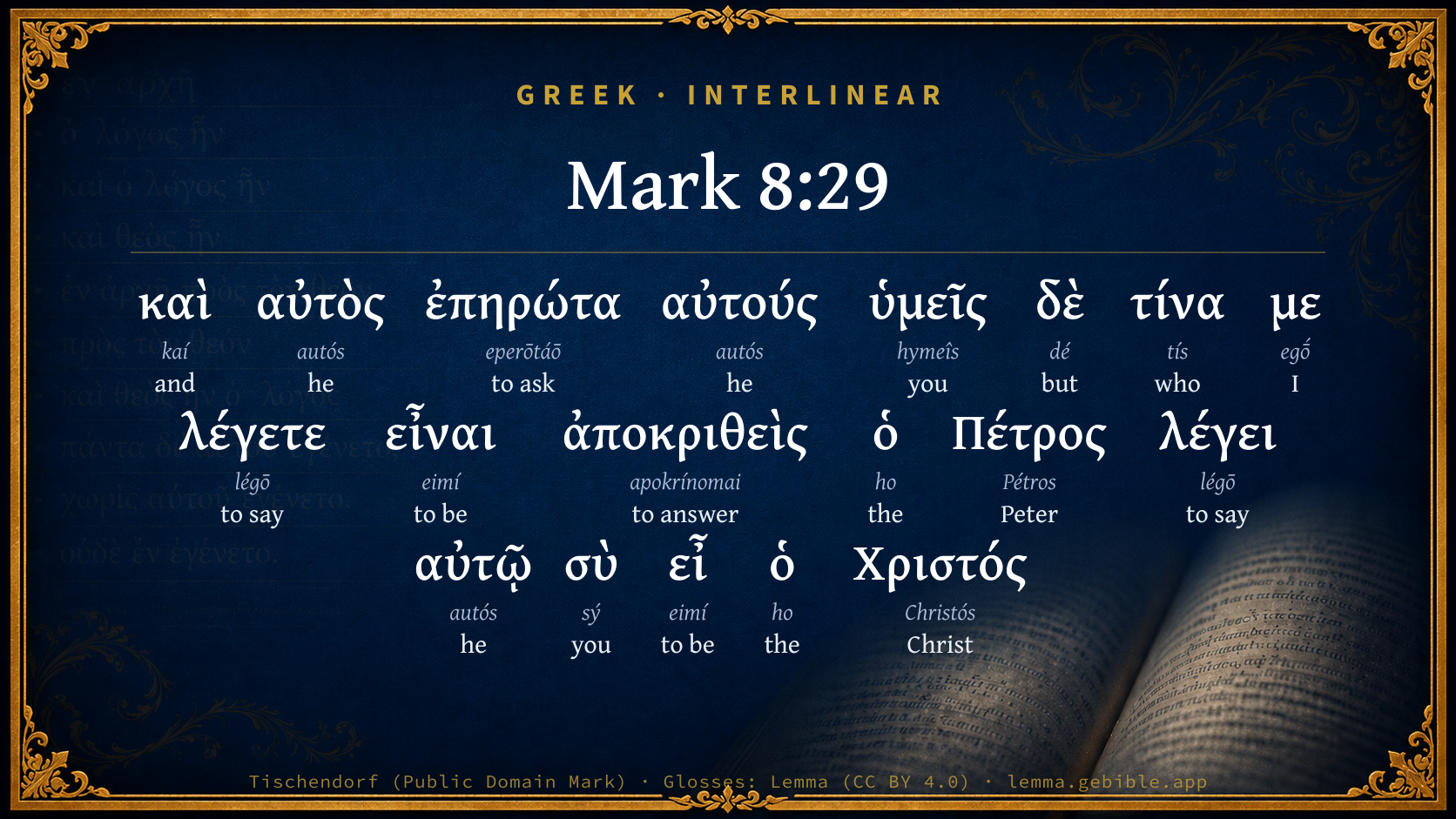
Download image
Cite this verse

Mark 8:29 (World English Bible). Public Domain. Lemma interlinear Bible study tool, https://lemma.gebible.app/v/mark/8/29.

Show BibTeX & RIS
BibTeX
RIS
English Translation
He said to them, "But who do you say that I am?" Peter answered, "You are the Christ."
World English Bible · Public Domain
Download a study sheet

One document with this verse’s original text, its word-by-word gloss line, the meaning frame, cross-references with their text, attributed commentary, and full source and license credits — printable, and it pastes into notes with its structure intact.

This verse Autodidact and up

Study sheet (.html) Plain text (.txt)

A passage Seminary Student

Up to 50 verses in one chapter. A passage sheet keeps up to 6 commentary sources and 12 cross-references per verse, in the order this page ranks them, and says so on the sheet whenever that leaves anything out. Ask for a single verse and you get the Autodidact verse sheet above.

Everything on this page stays free to read, with no account — the sheet is a download of what is already on screen, not access to it.

Want to remove ads? Support Godless Engineer
Compare translations 3

The same verse in 3 English versions, stacked beneath the original-language interlinear above. Click any original word for its lexicon entry.

Each is an independent rendering of the whole verse — the interlinear is not word-aligned to these translations.

Highlighted words mark where these versions differ — a whole-verse word diff, not a word-by-word alignment.

  • World English Bible Public Domain
    He said to them, "But who do you say that I am?" Peter answered, "You are the Christ."
  • King James Version Public Domain
    And he saith unto them, But whom say ye that I am? And Peter answereth and saith unto him, Thou art the Christ.
  • unfoldingWord Literal Text CC BY-SA 4.0
    And he was questioning them, “But who do you say that I am?” And answering, Peter says to him, “You are the Christ.”

unfoldingWord Literal Text — © unfoldingWord, licensed CC BY-SA 4.0. Word-aligned USFM3 via Door43 (git.door43.org/unfoldingWord/en_ult).

Versions to compare (up to 4)

3 of 4 selected

Show all 19 translations

Every available English version of this verse, each an independent rendering of the whole verse.

  • World English Bible Public Domain
    He said to them, "But who do you say that I am?" Peter answered, "You are the Christ."
  • Berean Standard Bible Public Domain
    “But what about you?” Jesus asked. “Who do you say I am?” Peter answered, “You are the Christ.”
  • Majority Standard Bible Public Domain
    “But what about you?” Jesus asked. “Who do you say I am?” Peter answered, “You are the Christ.”
  • King James Version Public Domain
    And he saith unto them, But whom say ye that I am? And Peter answereth and saith unto him, Thou art the Christ.
  • American Standard Version (1901) Public Domain
    And he asked them, But who say ye that I am? Peter answereth and saith unto him, Thou art the Christ.
  • Revised Version (1885) Public Domain
    And he asked them, But who say ye that I am? Peter answereth and saith unto him, Thou art the Christ.
  • Geneva Bible (1599) Public Domain
    And he said vnto them, But whome say ye that I am? Then Peter answered, and saide vnto him, Thou art that Christ.
  • Douay-Rheims (1899) Public Domain
    Then he saith to them: But whom do you say that I am Peter answering said to him: Thou art the Christ.
  • Young's Literal Translation Public Domain
    And he saith to them, `And ye -- who do ye say me to be?' and Peter answering saith to him, `Thou art the Christ.'
  • Literal Standard Version CC BY-SA 4.0
    And He says to them, “And you—who do you say I am?” And Peter answering says to him, “You are the Christ.”
  • Unlocked Literal Bible CC BY-SA 4.0
    He asked them, “But who do you say that I am?” Peter said to him, “You are the Christ.”
  • unfoldingWord Literal Text CC BY-SA 4.0
    And he was questioning them, “But who do you say that I am?” And answering, Peter says to him, “You are the Christ.”
  • Darby Bible Public Domain
    And he asked them, But *ye*, who do ye say that I am? And Peter answering says to him, *Thou* art the Christ.
  • World Messianic Bible Public Domain
    He said to them, “But who do you say that I am?” Peter answered, “You are the Messiah.”
  • Webster's Bible Public Domain
    And he saith to them, But who say ye that I am? And Peter answereth and saith to him, Thou art the Christ.
  • Free Bible Version CC BY-SA 4.0
    “But who do you say I am?” he asked them. “You are the Messiah!” Peter answered.
  • Bible in Basic English Public Domain
    And he said to them, But who do you say I am? Peter said in answer, You are the Christ.
  • Text-Critical English NT CC BY 4.0
    He said to them, “But who do you say that I am?” Peter answered him, “Yoʋ are the Christ.”
  • Tyndale New Testament (1534) Public Domain
    And he sayde vnto them: But whom saye ye that I am? Peter answered and sayd vnto him: Thou arte very Christe.

Literal Standard Version (2020), Covenant Press — licensed CC BY-SA 4.0. Text via the HelloAO Bible API (eBible.org). Unlocked Literal Bible (unfoldingWord) — licensed CC BY-SA 4.0. Text via the HelloAO Bible API (eBible.org). unfoldingWord Literal Text — © unfoldingWord, licensed CC BY-SA 4.0. Word-aligned USFM3 via Door43 (git.door43.org/unfoldingWord/en_ult). Free Bible Version, Dr. Jonathan Gallagher — licensed CC BY-SA 4.0. Text via the HelloAO Bible API (eBible.org).

Word by word

More ways to search: Search by grammar → Find every occurrence → Compare this word →

Practice this passage: Drill this verse → Learn its vocabulary →

ἐπηρώτα
eperōtáō
G1905
“to ask”
Verb, Imperfect, Active, Indicative, 3rd person, Singular
Part of Speech
Verb
Tense
Imperfect
Voice
Active
Mood
Indicative
Person
3rd person
Number
Singular
Full Thayer's Definition

Origin: from G1909 and G2065

TDNT: 13:27,3

1. to accost one with an enquiry, put a question to, enquiry of, ask, interrogate 2. to address one with a request or demand a. to ask of or demand of one
  1. καὶ kaí G2532 “and” Conjunction
  2. αὐτὸς autós G846 “he” Personal pronoun, Nominative, Singular, Masculine
  3. αὐτούς autós G846 “he” Personal pronoun, Accusative, Plural, Masculine
  4. ὑμεῖς hymeîs G5210 “you” Personal pronoun, 2nd person, Nominative, Plural
  5. δὲ dé G1161 “but” Conjunction
  6. τίνα tís G5101 “who” Interrogative pronoun, Accusative, Singular, Masculine
  7. με egṓ G1473 “I” Personal pronoun, 1st person, Accusative, Singular
  8. λέγετε légō G3004 “to say” Verb, Present, Active, Indicative, 2nd person, Plural
  9. εἶναι eimí G1510 “to be” Verb, Present, Active, Infinitive
  10. ἀποκριθεὶς apokrínomai G611 “to answer” Verb, Aorist, Passive deponent, Participle, Nominative, Singular, Masculine
  11. ὁ ho G3588 “the” Article, Nominative, Singular, Masculine
  12. Πέτρος Pétros G4074 “Peter” Noun, Nominative, Singular, Masculine
  13. λέγει légō G3004 “to say” Verb, Present, Active, Indicative, 3rd person, Singular
  14. αὐτῷ autós G846 “he” Personal pronoun, Dative, Singular, Masculine
  15. σὺ sý G4771 “you” Personal pronoun, 2nd person, Nominative, Singular
  16. εἶ eimí G1510 “to be” Verb, Present, Active, Indicative, 2nd person, Singular
  17. ὁ ho G3588 “the” Article, Nominative, Singular, Masculine
  18. Χριστός Christós G5547 “Christ” Noun, Nominative, Singular, Masculine

About this verse

These counts appear in no published source. They are computed here, from the morphology-tagged text and Lemma’s own curated glosses. What Lemma adds →

19
words
14
distinct lemmas
Gospels
section

Shared distinctive vocabulary

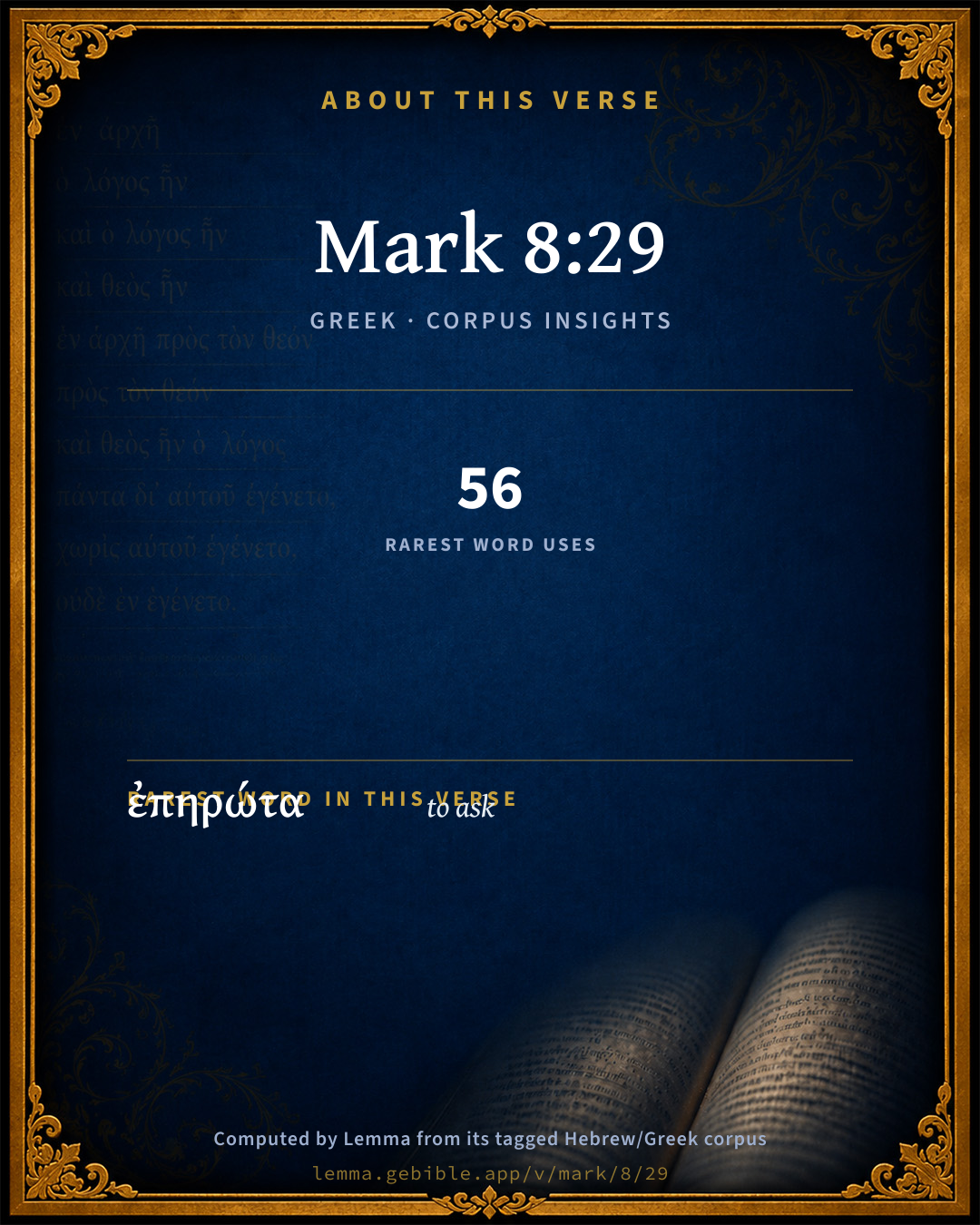
ἐπηρώτα to ask G1905 occurs in 56 verses of the Greek New Testament. Also found in:
Repetition

Words recur within this verse:

  • λέγετε to say G3004 ×2
  • εἶναι to be G1510 ×2
  • αὐτὸς he G846 ×3
  • ὁ the G3588 ×2

Cross-references

12

Topical passages linked to Mark 8:29 in the Treasury of Scripture Knowledge — connected by theme and wording, ordered by reader-vote popularity; previews shown in the World English Bible.

  • 1 John 4:15 Whoever confesses that Jesus is the Son of God, God remains in him, and he in God.
  • Matthew 16:15–16 He said to them, "But who do you say that I am?"
  • 1 John 5:1 Whoever believes that Jesus is the Christ is born of God. Whoever loves the father also loves the child who is born of him.
  • Luke 9:20 He said to them, "But who do you say that I am?" Peter answered, "The Christ of God."
  • John 11:27 She said to him, "Yes, Lord. I have come to believe that you are the Christ, God's Son, he who comes into the world."
  • John 4:42 They said to the woman, "Now we believe, not because of your speaking; for we have heard for ourselves, and know that this is indeed the Christ, the Savior of the world."
  • Acts 9:20 Immediately in the synagogues he proclaimed the Christ, that he is the Son of God.
  • John 1:41–49 He first found his own brother, Simon, and said to him, "We have found the Messiah!" (which is, being interpreted, Christ).
  • John 6:69 We have come to believe and know that you are the Christ, the Son of the living God."
  • 1 Peter 2:7 For you therefore who believe is the honor, but for such as are disobedient, "The stone which the builders rejected, Has become the chief cornerstone,"
  • Mark 4:11 He said to them, "To you is given the mystery of the Kingdom of God, but to those who are outside, all things are done in parables,
  • Acts 8:36 As they went on the way, they came to some water, and the eunuch said, "Behold, here is water. What is keeping me from being baptized?"

Cross-references courtesy of OpenBible.info (CC BY 4.0).

Commentary

Notes on Mark 8:29 from classic Christian and Jewish commentators (each source and its license shown beneath its notes). The classic Christian expositions comment on the surrounding passage and are grouped to its opening verse, so a note may address several verses; the Jewish commentaries on the Tanakh (Rashi and others) are per-verse, so they appear only where the commentator wrote on this verse.

Lemma curates 59 commentaries, every one of them public domain or Creative Commons licensed, each selected and text-cleaned for this edition rather than reprinted as found. About our sources →

Tyndale Open Study Notes

Tyndale Open Resources

8:29-30 But who do you say I am? In the Greek text, you is emphatic. Peter responded for the group, You are the Messiah. Peter’s confession was correct, as the command not to tell anyone about him indicates (see 3:11-12; see also 1:1; 14:61-62; Matt 16:17).

Tyndale Open Study Notes — © Tyndale Open Resources, licensed CC BY-SA 4.0. Text via the HelloAO Bible API.

Expositor's Greek Testament

ed. W. Robertson Nicoll

Mar 8:29 . ὑμεῖς δὲ , etc.: a very pointed question given by all the Synoptists in the same terms. The reply, on the other hand, is different in each. Vide on Mat 16:16 . ἀποκριθεὶς λέγει : we have here an aorist participle of identical action with a finite verb in the present tense . It usually goes with the aorist ( cf. Mat 16:17 , ἀποκριθεὶς εἶπεν ).

The Expositor's Greek Testament, edited by W. Robertson Nicoll (1897–1910) — public domain. Text from a community e-Sword module.

Adam Clarke's Commentary

Verse 29. Thou art the Christ.] Three MSS. and some versions add, the Son of the living God.

Adam Clarke's Commentary on the Bible (1810–1826) — public domain. Text from a community e-Sword/MySword module.

The Cambridge Bible for Schools and Colleges

gen. ed. J. J. S. Perowne

29. Thou art the Christ] To the momentous question, But whom say ye that I am? St Peter, as the ready spokesman of the rest of the Apostles, made the ever-memorable reply, Thou art the Christ, the Messiah (Mat_16:16; Luk_9:20), the Son of the living God (Mat_16:16), but in the Gospel written under his eye the great announcement respecting his own memorable confession and the promise of peculiar dignity in the Church the Lord was about to establish, find no place.

The Cambridge Bible for Schools and Colleges (gen. ed. J. J. S. Perowne; Cambridge University Press, 1878–1918) — public domain. Text from a community e-Sword module.

John Gill's Exposition

And he saith unto them, but whom say ye that I am?.... It was for the sake of this question he put the former; See Gill on Mat 16:15;

and Peter answereth and saith unto him, thou art the Christ; the Messiah that was long ago promised and so often prophesied of in the books of Moses and the prophets; and whom the Jews have so much and long expected. This confession of Peter's in which all the apostles agreed with him speaks out what Jesus really was, and exceeds the most exalted sentiments which the people had of him: he was not the harbinger of the Messiah but the Messiah himself; not Elias in whose Spirit his forerunner was to come and did come; nor any one of the prophets; but he who was spoken of by all the holy prophets; which have been since the beginning of the world. Not one of the various opinions of the people being just, and answering the true character of Jesus, he demands the sense of his disciples which is here given by Peter in their name, and which was right; and on account of which he declared Peter blessed and ascribed his knowledge of him not to flesh and blood but to the revelation of his Father. The Syriac and Persic versions add, "the Son of the living God"; and so Beza found it in one ancient copy; but it may be it is only taken from Mat_16:16; See Gill on Mat 16:16.

John Gill's Exposition of the Whole Bible (1746–1763) — public domain (CC PDM 1.0). Text via the HelloAO Bible API.

Trapp's Complete Commentary

John Trapp

29 And he saith unto them, But whom say ye that I am? And Peter answereth and saith unto him, Thou art the Christ.

Ver. 29. Thou art the Christ] This was much in few. Here is not Thou art Peter, and upon this rock, &c. Which if either St Mark or St Peter had esteemed (as Papists now do) the foundation of the Christian Church, it had not been here omitted (as Beza well observeth), since it goes for current among the ancients, that St Mark wrote this Gospel at St Peter’s mouth.

John Trapp, A Commentary or Exposition upon All the Books of the Old and New Testament (1647–1656) — public domain. Text from a community e-Sword module.

Matthew Poole's English Annotations

Luke reports no more of this than Mark, but Matthew reports it much larger, giving us a further reply of Christ to Peter; See Poole on "Mat 16:15", and following verses to Mat 16:20, which we have there discoursed largely upon. I shall only say here; That if so great a point as Peter’s primacy had been understood by Christ’s disciples of that age to have been settled by that answer of our Saviour, it is likely two of the evangelists would not have omitted an account of it. If they had forgotten it, there is no doubt but some or other of Christ’s disciples would have put them in mind of it. Our Saviour’s charge that they should tell no man of him, seemeth to him, that although our Saviour was willing to be taken notice of as a prophet, yet he was not willing as yet to be taken notice of as the Messiah, or Son of God, which latter Matthew reports as added to his confession; and perhaps both Mark and Luke, in their following words, give us the reason, for if we observe it, he immediately falls into a discourse of his suffering, and he might possibly think, that a weak faith of his Divine nature would be overthrown by the sight of his subsequent sufferings. So that he reserved the publication of himself to be the Son of God, until such time when (as the apostle said, Rom 1:4) he was declared so with power, according to the spirit of holiness, by his resurrection from the dead.

Matthew Poole's English Annotations on the Holy Bible (1683–1685) — public domain. Text from a community e-Sword/MySword module.

The Pulpit Commentary

By this second putting of the question, our Lord warned his disciples that they who had been better instructed ought to think greater things of him than these. It was necessary that he should show them that these current opinions and floating notions were far below his real claims. Therefore he says with emphasis, But who say ye that I am? ye, my disciples, who, being always with me, have seen me do far greater things than they; ye, who have listened to my teaching, confirmed as it has been by those miracles; ye, who yourselves also have been enabled to work many miracles in my name; who say ye that I am? Peter answereth and saith unto him, Thou art the Christ. St. Peter here spoke as the mouthpiece of the rest. The suddenness and terseness of the answer is eminently characteristic of St. Peter. In St. Matthew"s narrative it is given a little more in full, "Thou art the Christ, the Son of the living God." But the strength of the answer really lies in St. Mark"s words, "Thou art the Christ," that is, the promised Messiah. What, however, St. Mark does omit hero a circumstance not to be passed without notice is the great blessing pronounced by our Lord upon St. Peter (Mat_16:17-19) as the reward of his confession. The explanation of this omission is to be found in the fact that this Gospel is really for the most part St. Peter"s Gospel, recorded by St. Mark. It has already been observed, that, as far as it is possible to do so, considering Peter"s prominent position amongst the other apostles, he retires into the background. It was necessary that it should be recorded that he made the good confession of our Lord as the Messiah; but beyond this the evangelist suppresses all mention of the distinction subsequently conferred upon him, although the rebuke which he afterwards received is recorded in full. It is, moreover, a significant circumstance (noticed in the "Speaker"s Commentary") that this Gospel was written at Rome, and in the first instance for Roman readers.

Vers. 29, 32, 33. Peter"s self-contradiction.

I WHEREIN IT CONSISTED.

1. In identifying Jesus with the Messiah and yet deprecating his sufferings. That Messiah should suffer was abundantly declared by the prophets. His death was the greatest testimony he could give to the righteousness of God. A comfortable, earthly, prosperous king could never occupy the spiritual position of the Christ; moral influence, the essential feature of the latter"s reign, would be entirely wanting. To the thorough student of prophecy and contemporary life, Messiahship "connoted" suffering, not as an accidental but necessary qualification.

2. In identifying Jesus with the Messiah and yet assuming such an attitude and tone towards him. The utmost reverence and submission were not only due to his Lord, but would have been voluntarily rendered had he understood what was meant by his own declaration. In such a case he would never have presumed to dictate or chide.

II TO WHAT IT WAS DUE.

1. Insufficient realization of what he knew. He had divined the true dignity of his Master, but what it involved was not yet felt. The doctrine is often correct when the sense of obligation it ought to produce is not awakened. A great spiritual truth may be perceived and adopted long ere its relations to practical life are recognized; just as a principle in mechanics or a law of nature. Deeper spiritual experience and more sympathetic agreement with Christ in his desire to abolish sin were needed ere this could take place.

2. Impulse and thoughtlessness. This was his temperament. He was a man of impulse and affection, rather than of calm, spiritual intuition, or careful, painstaking reflection. It was due to his forward and impulsive temperament that he generally spoke for the others, and was so confident respecting himself in the future. Christianity owes much to such spirits, but they have to be kept in check by more sober thinkers, and disciplined by the lessons of providence.

3. Worldly conceptions of the kingdom of God. Had he entertained purer and more spiritual hopes respecting his Master"s work, the mischief of his impulsiveness might have been minimized, although it would still have been a source of danger. But with such habitual materialism of aim and desire (common to him with the others) he was constantly committing mistakes, and ready to compromise the cause of Christ. "This world has many Peters, who wish to be wiser than Christ, and to prescribe to him what it is needful to do" (Hofmeister). We ought riot to be too severe with Peter whilst we ourselves lean so much for the guidance of the Church to merely human wisdom, and set our own affections for particular persons, or for ourselves, above the well-being of the race; and estimate that well-being not from a spiritual but from a material standpoint. M.

The Pulpit Commentary (1880–1919), ed. H.D.M. Spence-Jones & Joseph S. Exell — public domain. Text from a community e-Sword module.

Kretzmann's Popular Commentary

Paul E. Kretzmann

The confession of Peter:

v. 29. And He saith unto them, But whom say ye that I am? And Peter answereth and saith unto Him, Thou art the Christ.

v. 30. And He charged them that they should tell no man of Him.

The first answer had been given willingly enough, for the information could be easily supplied. But now Christ puts the direct question to all disciples, emphasizing the pronoun: How about you? What is our opinion and confession? Note: The words are spoken to all apostles, not to a single one, nor to a group; Jesus wanted a frank, clear statement of their belief. The answer of Peter, therefore, can be understood properly only in this sense, as a confession of them all: Thou art the Christ. They hereby declared it as their firm conviction that their Master was the promised Messiah, and ascribed to Him all the attributes with which the prophets had endowed this greatest prophet of all. The confession of Peter is the confession of all true believers of all times. The question, What think ye of Jesus? is the great test question of the ages. By his personal relation to Jesus Christ, the Son of God, will the fate of every person be determined. It makes and posits the difference between believing Christians and unbelievers, the children of this world. People in general consider Christ a mere man, endowed, indeed, with many unusual virtues and with exceptional wisdom, but, after all, a mere man. But the Christians believe that this man is Jesus Christ, by God’s counsel and will the Savior and Redeemer of the world, that He is true God, born of the Father from eternity. After commending the confession very highly, Jesus charged His disciples, He spoke in a tone of menace, almost threateningly, as if expecting foolish talk in this sacred matter, or to prevent the spread of false ideas regarding the work of the Messiah. For that in itself was the most difficult problem, to keep the disciples and others from indulging in all kinds of carnal hopes of a worldly empire, of a kingdom of this world. In our days such an objurgation would be needed with double emphasis, since the work of the millennialists is advancing rapidly and their literature is being spread broadcast over the country. We need no new Gospel, but we need the right, the simple understanding of the old Gospel, unclouded and unspoiled by the dreams of men that have no proper conception either of the person or of the work of Christ.

Paul E. Kretzmann, Popular Commentary of the Bible (1921–1924) — public domain. Text from a community e-Sword module.

unfoldingWord translationNotes

Door43 World Missions Community

He asked them

"Jesus asked his disciples"

Jesus warned them not to tell anyone about him

Jesus did not want them to tell anyone that he was the Christ. This can be made more explicit. Also, this can also be written as a direct quote. AT: "Jesus warned them not to tell anyone that he is the Christ" or "Jesus warned them, 'Do not tell anyone that I am the Christ'" (See: Assumed Knowledge and Implicit Information and Direct and Indirect Quotations)

translationWords

Peter

Christ

Jesus

unfoldingWord translationNotes — © Distant Shores Media and the Door43 World Missions Community, licensed CC BY-SA 4.0. Source: git.door43.org/Door43/en_tn.

Cambridge Greek Testament for Schools and Colleges

29. ἐπηρώτα αὐτούς ([1740][1741][1742][1743][1744][1745][1746]) rather than λέγει αὐτοῖς ([1747][1748]2[1749][1750][1751][1752]).

[1740] Codex Sinaiticus. 4th cent. Discovered by Tischendorf in 1859 at the Monastery of St Katharine on Mount Sinai. Now at St Petersburg. The whole Gospel, ending at Mar 16:8. Photographic facsimile, 1911.

[1741] Codex Vaticanus. 4th cent., but perhaps a little later than א. In the Vatican Library almost since its foundation by Pope Nicolas V., and one of its greatest treasures. The whole Gospel, ending at Mar 16:8. Photographic facsimile, 1889.

[1742] Codex Ephraemi. 5th cent. A palimpsest: the original writing has been partially rubbed out, and the works of Ephraem the Syrian have been written over it; but a great deal of the original writing has been recovered; of Mark we have Mar 1:17 to Mar 6:31, Mar 8:5 to Mar 12:29, Mar 13:19 to Mar 16:20. In the National Library at Paris.

[1743] An asterisk denotes that the word is not found elsewhere in N.T., and such words are included in the index, even if there is no note on them in the commentary.

[1744] Codex Bezae. 6th cent. Has a Latin translation (d) side by side with the Greek text, and the two do not quite always agree. Presented by Beza to the University Library of Cambridge in 1581. Remarkable for its frequent divergences from other texts. Contains Mark, except Mar 16:15-20, which has been added by a later hand. Photographic facsimile, 1899.

[1745] Codex Regius. 8th cent. An important witness. At Paris. Contains Mar 1:1 to Mar 10:15; Mar 10:30 to Mar 15:1; Mar 15:20 to Mar 16:20, but the shorter ending is inserted between Mar 16:8 and Mar 16:9, showing that the scribe preferred it to the longer one.

[1746] Codex Sangallensis. 9th or 10th cent. Contains the Gospels nearly complete, with an interlinear Latin translation. The text of Mark is specially good, agreeing often with CL. At St Gall.

[1747] Codex Alexandrinus. 5th cent. Brought by Cyril Lucar, Patriarch of Constantinople, from Alexandria, and afterwards presented by him to King Charles I. in 1628. In the British Museum. The whole Gospel. Photographic facsimile, 1879.

[1748] Codex Ephraemi. 5th cent. A palimpsest: the original writing has been partially rubbed out, and the works of Ephraem the Syrian have been written over it; but a great deal of the original writing has been recovered; of Mark we have Mar 1:17 to Mar 6:31, Mar 8:5 to Mar 12:29, Mar 13:19 to Mar 16:20. In the National Library at Paris.

[1749] Codex Purpureus. 6th cent. Full text in Texts and Studies v. No. 4, 1899. Contains Mar 5:20 to Mar 7:4; Mar 7:20 to Mar 8:32; Mar 9:1 to Mar 10:43; Mar 11:7 to Mar 12:19; Mar 14:25 to Mar 15:23; Mar 15:33-42. See below on Ψ.

[1750] Codex Monacensis. 10th cent. Contains Mar 6:47 to Mar 16:20. Many verses in 14, 15, 16 are defective.

[1751] Codex Oxoniensis. 9th cent. Contains Mark, except Mar 3:35 to Mar 6:20.

[1752] Codex Petropolitanus. 9th cent. Gospels almost complete. Mar 16:18-20 is in a later hand.

29. Ὑμεῖς δέ. Here again Christ may be asking for information. But ye, who know so much of My teaching and work, who do ye say that I am? Their knowing the views of other people showed that the question had been raised in their minds; cf. Mar 4:41. He does not tell them who He is; He draws the truth from their reflexion, and He expects better things from them than from other men.

ὁ Πέτρος λέγει. Πάλιν ὁ Πέτρος, ὁ πανταχοῦ θερμός, προπηδᾷ καὶ προλαμβάνει (Euthym.). All three assign the reply to Peter, and it is in harmony with his character and position that he should answer for the Twelve—the first time in Mk that he does so. Cf. Joh 6:69. But there is divergence as to the wording of his reply; “Thou art the Christ” (Mk), “The Christ of God” (Lk.), “Thou art the Christ, the Son of the living God” (Mt.). Mt.’s expansion of the reply corresponds to his expansion of Christ’s question. In each case he interprets the words used; cf. Mar 10:18-19; Mar 10:28-30; Mar 10:40, Mar 13:24. There may be something of expansion and interpretation in the famous passage, Mat 16:17-19, which he alone records, but that the whole is invention is not probable. Mk’s omission of it is intelligible; ἵνα μὴ δόξῃ χαριζόμενος τῷ Πέτρῳ (Theoph.). It was not one of the things which Peter reproduced in his teaching. Salmon, The Human Element, p. 351. This cannot be regarded as a special revelation to Peter; Peter states the conviction of all, and Christ in the hearing of all accepts it as true. Again, we need not suppose that, until Peter made this confession, the Apostles had no idea that Jesus was the Messiah, but we are sure that from this point they know. The strange combination of the aor. ἀποκριθείς with the pres. λέγει is freq. in Mk (Mar 3:33, Mar 9:5; Mar 9:19, Mar 10:24, Mar 11:22; Mar 11:33, Mar 15:2). Mat 25:40 and Luk 13:25 have the still stranger ἀποκριθεὶς ἐρεῖ. Both occur in LXX. Here, as in Mar 3:33, Syr-Sin. omits ἀποκριθείς.

Cambridge Greek Testament for Schools and Colleges (Cambridge University Press, 1896; 21 vols, various authors incl. Carr, Maclear, Plummer, Farrar, Lumby, Moule, M. R. James, Simcox) — public domain. Text from a community e-Sword module.

International Critical Commentary

29. Καὶ αὐτὸς ἐπηρώτα αὐτούς—And he asked them.

ἐπηρώτα αύτούς, instead of λέγει αύτοῖς, he says to them, Tisch. Treg. WH. RV. א BC* DL Δ 53 mss. Lat. Vet.

Ὑμεῖς δὲ τίνα με λέγετε εἶναι;—But who do you say that I am? Ὑμεῖς is emphatic in itself, and by its position.1 When the announcement of Jesus’ Messianic character is made, it does not come from himself, but is drawn out of the disciples by this question. He would have them enjoy the blessedness of not receiving it from flesh and blood, i.e. by oral communication, even from himself, but of that inward reception by silent communication from the Father which is the only source of true knowledge of spiritual things. See Mat 16:17. He manifested himself to them, admitting them to an intimate companionship and intercourse with himself; and when he had made his impression on them, he drew from them the confession made under the guidance of the Spirit, that he was no inferior and preparatory personage in the Messianic Kingdom, but the King himself. Here, as everywhere, Jesus’ method is the truly spiritual one, that depends very little on external helps, but on the silent movings of the Spirit of God. ὁ Πέτρος λέγει—This is the first time in the Gospel that Peter appears as the spokesman of the disciples. Σὺ εἶ ὁ χριστός—thou art the Christ. On the meaning of χριστός, see on 1:1.

International Critical Commentary — older volumes (1896–1929), various authors — public domain. Text from a community e-Sword module.

Vincent's Word Studies in the New Testament

Marvin R. Vincent

He saith [επηρωτα] . More correctly, he questioned or asked. So Rev. Mark omits the commendation of Peter. See Introduction.

On verses 31 - 33, compare notes on Mt 16:21 - 28.

Marvin R. Vincent, Word Studies in the New Testament (1887–1900) — public domain. Text from a community e-Sword/MySword module.

Lesson kit

Teaching starters — assembled from the data on this page, not authored interpretation. Every prompt links to the verse data it draws on. Edit before teaching.

Mark, in the Gospels, opens this verse with 19 words (14 distinct Greek lemmas). Its most distinctive word is eperōtáō (“to ask”). A historical commentator’s framing appears above. Read the whole chapter for the surrounding context.

Discussion questions

  1. The word eperōtáō carries the sense “to ask.” How does it shape the verse?
  2. Matthew 12:10 shares the word «to ask» with this verse. How do the two illuminate each other?
  3. “to say” occurs 2× in this one verse. What is the effect of the repetition?
  4. These translations render this verse differently. What is at stake in choosing one wording over another?
  5. Reading how Tyndale Open Study Notes and Expositor's Greek Testament read this verse, where do the two commentators agree and where do they part?

Things to notice

Reading settings

Reading text

Shown beneath each verse's original-language words.

Old Testament
Old Testament edition

Read the OT as the Masoretic Hebrew (MT) or the Greek Septuagint (LXX).

English shown for the Greek Septuagint (in the Hebrew ↔ Greek comparison).

Comparing translations? Open the Compare panel on any verse page to stack up to four side by side.