Jeremiah 9:8

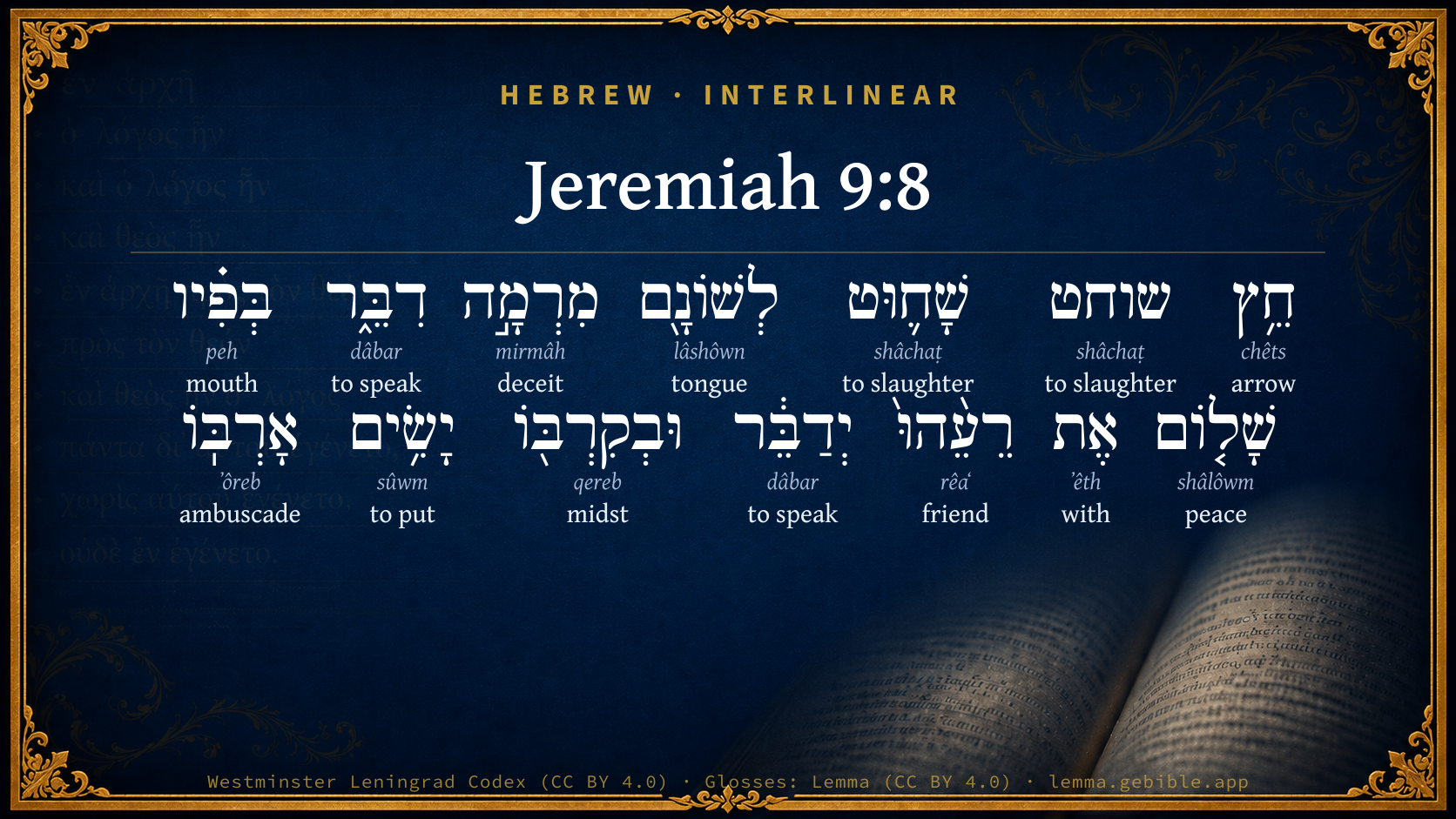
Hebrew (Westminster Leningrad Codex) Jeremiah 9:8 appears in the Hebrew Old Testament. The text above is from the Westminster Leningrad Codex. Each word links to its Strong’s number, a concise gloss, and parsing drawn from the Open Scriptures Hebrew Bible morphology. Click any word for its full Brown-Driver-Briggs (BDB) entry.
Download image
Cite this verse

Jeremiah 9:8 (World English Bible). Public Domain. Lemma interlinear Bible study tool, https://lemma.gebible.app/v/jeremiah/9/8.

Show BibTeX & RIS
BibTeX
RIS
English Translation
Their tongue is a deadly arrow; it speaks deceit: one speaks peaceably to his neighbor with his mouth, but in his heart he lays wait for him.
World English Bible · Public Domain
Highlights
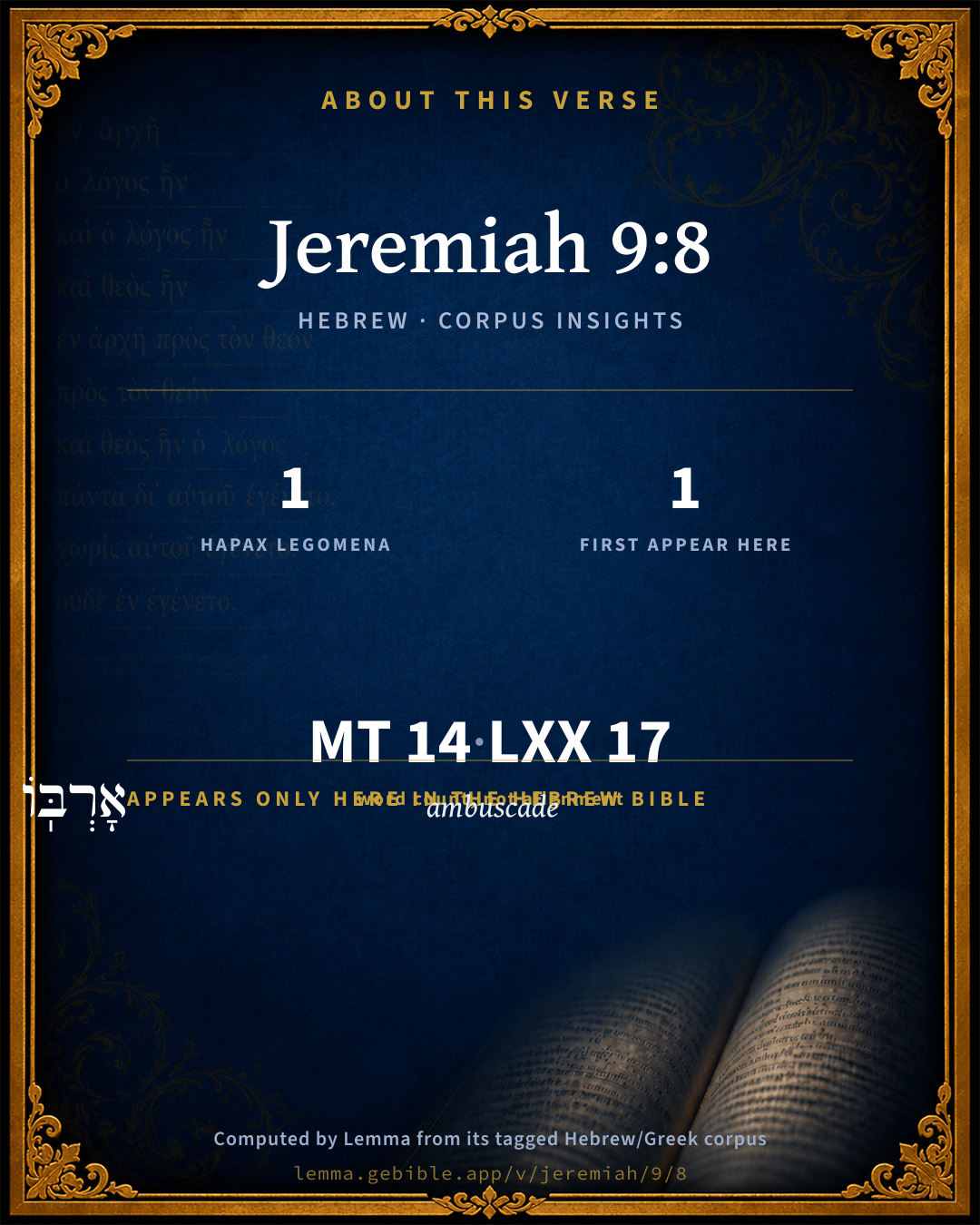
  • 1 hapax legomenon — only here in the Hebrew Bible
  • 1 first appearance in the Hebrew Bible
Full analysis ↓
Download a study sheet

One document with this verse’s original text, its word-by-word gloss line, the meaning frame, cross-references with their text, attributed commentary, and full source and license credits — printable, and it pastes into notes with its structure intact.

This verse Autodidact and up

Study sheet (.html) Plain text (.txt)

A passage Seminary Student

Up to 50 verses in one chapter. A passage sheet keeps up to 6 commentary sources and 12 cross-references per verse, in the order this page ranks them, and says so on the sheet whenever that leaves anything out. Ask for a single verse and you get the Autodidact verse sheet above.

Everything on this page stays free to read, with no account — the sheet is a download of what is already on screen, not access to it.

Want to remove ads? Support Godless Engineer
Compare translations 3

The same verse in 3 English versions, stacked beneath the original-language interlinear above. Click any original word for its lexicon entry.

Each is an independent rendering of the whole verse — the interlinear is not word-aligned to these translations.

Highlighted words mark where these versions differ — a whole-verse word diff, not a word-by-word alignment.

  • World English Bible Public Domain
    Their tongue is a deadly arrow; it speaks deceit: one speaks peaceably to his neighbor with his mouth, but in his heart he lays wait for him.
  • King James Version Public Domain
    Their tongue is as an arrow shot out; it speaketh deceit: one speaketh peaceably to his neighbour with his mouth, but in heart he layeth his wait.
  • unfoldingWord Literal Text CC BY-SA 4.0
    Their tongue is a murderous arrow, it speaks a deceitful thing. With his mouth he speaks peace with his neighbor, but in his midst he sets ambush of him.

unfoldingWord Literal Text — © unfoldingWord, licensed CC BY-SA 4.0. Word-aligned USFM3 via Door43 (git.door43.org/unfoldingWord/en_ult).

Versions to compare (up to 4)

3 of 4 selected

Show all 18 translations

Every available English version of this verse, each an independent rendering of the whole verse.

  • World English Bible Public Domain
    Their tongue is a deadly arrow; it speaks deceit: one speaks peaceably to his neighbor with his mouth, but in his heart he lays wait for him.
  • Berean Standard Bible Public Domain
    Their tongues are deadly arrows; they speak deception. With his mouth a man speaks peace to his neighbor, but in his heart he sets a trap for him.
  • Majority Standard Bible Public Domain
    Their tongues are deadly arrows; they speak deception. With his mouth a man speaks peace to his neighbor, but in his heart he sets a trap for him.
  • King James Version Public Domain
    Their tongue is as an arrow shot out; it speaketh deceit: one speaketh peaceably to his neighbour with his mouth, but in heart he layeth his wait.
  • American Standard Version (1901) Public Domain
    Their tongue is a deadly arrow; it speaketh deceit: one speaketh peaceably to his neighbor with his mouth, but in his heart he layeth wait for him.
  • Revised Version (1885) Public Domain
    Their tongue is a deadly arrow; it speaketh deceit: one speaketh peaceably to his neighbour with his mouth, but in his heart he layeth wait for him.
  • Geneva Bible (1599) Public Domain
    Their tongue is as an arow shot out, and speaketh deceite: one speaketh peaceably to his neighbour with his mouth, but in his heart hee layeth waite for him.
  • Douay-Rheims (1899) Public Domain
    Their tongue is a piercing arrow, it hath spoken deceit: with his mouth one speaketh peace with his friend, and secretly he lieth in wait for him.
  • Young's Literal Translation Public Domain
    A slaughtering arrow `is' their tongue, Deceit it hath spoken in its mouth, Peace with its neighbour it speaketh, And in its heart it layeth its ambush,
  • Literal Standard Version CC BY-SA 4.0
    Their tongue [is] a slaughtering arrow, || It has spoken deceit in its mouth, || It speaks peace with its neighbor, || And in its heart it lays its ambush,
  • Unlocked Literal Bible CC BY-SA 4.0
    Their tongues are sharpened arrows; they speak unfaithful things. With their mouths they proclaim peace with their neighbors, but with their hearts they lie in wait for them.
  • unfoldingWord Literal Text CC BY-SA 4.0
    Their tongue is a murderous arrow, it speaks a deceitful thing. With his mouth he speaks peace with his neighbor, but in his midst he sets ambush of him.
  • Darby Bible Public Domain
    Their tongue is a murderous arrow; it speaketh deceit. [A man] speaketh peaceably to his neighbour with his mouth, but in his heart he layeth his ambush.
  • World Messianic Bible Public Domain
    Their tongue is a deadly arrow. It speaks deceit. One speaks peaceably to his neighbor with his mouth, but in his heart, he waits to ambush him.
  • Webster's Bible Public Domain
    Their tongue is as an arrow shot out; it speaketh deceit: one speaketh peaceably to his neighbor with his mouth, but in heart he layeth his wait.
  • Free Bible Version CC BY-SA 4.0
    Their words are arrows that kill; they always tell lies. They're nice to their friends on the outside while plotting against them inside.
  • Bible in Basic English Public Domain
    His tongue is an arrow causing death; the words of his mouth are deceit: he says words of peace to his neighbour, but in his heart he is waiting secretly for him.
  • JPS Tanakh (1917) Public Domain
    (9-7) Their tongue is a sharpened arrow, it speaketh deceit; one speaketh peaceably to his neighbour with his mouth, but in his heart he layeth wait for him.

Literal Standard Version (2020), Covenant Press — licensed CC BY-SA 4.0. Text via the HelloAO Bible API (eBible.org). Unlocked Literal Bible (unfoldingWord) — licensed CC BY-SA 4.0. Text via the HelloAO Bible API (eBible.org). unfoldingWord Literal Text — © unfoldingWord, licensed CC BY-SA 4.0. Word-aligned USFM3 via Door43 (git.door43.org/unfoldingWord/en_ult). Free Bible Version, Dr. Jonathan Gallagher — licensed CC BY-SA 4.0. Text via the HelloAO Bible API (eBible.org).

Word by word

More ways to search: Search by grammar → Find every occurrence → Compare this word →

Practice this passage: Drill this verse → Learn its vocabulary →

אָרְבּֽוֹ
ʼôreb
H696
“ambuscade · his”
Noun, Common, Masculine, Singular, Construct + Suffix, Personal, 3rd Person, Masculine, Singular
Part of Speech
Noun
Type
Common
Gender
Masculine
Number
Singular
State
Construct
Full BDB Definition

Origin: the same as H695

TWOT: 156b

ambuscade, hiding place - treachery, deceit (figuratively)
  1. חֵ֥ץ chêts H2671 “arrow” Noun, Common, Masculine, Singular, Absolute
  2. שוחט shâchaṭ H7819 “slaughtering” Verb, Qal, Participle Active, Masculine, Singular, Absolute
  3. שָׁח֛וּט shâchaṭ H7819 “slaughtered” Verb, Qal, Participle Passive, Masculine, Singular, Absolute
  4. לְשׁוֹנָ֖ם lâshôwn H3956 “tongue · their” Noun, Common, Both, Singular, Construct + Suffix, Personal, 3rd Person, Masculine, Plural
  5. מִרְמָ֣ה mirmâh H4820 “deceit” Noun, Common, Feminine, Singular, Absolute
  6. דִבֵּ֑ר dâbar H1696 “to speak” Verb, Piel, Perfect, 3rd Person, Masculine, Singular
  7. בְּפִ֗יו peh H6310 “in/at · mouth · his” Preposition + Noun, Common, Masculine, Singular, Construct + Suffix, Personal, 3rd Person, Masculine, Singular
  8. שָׁל֤וֹם shâlôwm H7965 “peace” Noun, Common, Masculine, Singular, Absolute
  9. אֶת ʼêth H854 “with” Preposition
  10. רֵעֵ֨הוּ֙ rêaʻ H7453 “friend · his” Noun, Common, Masculine, Singular, Construct + Suffix, Personal, 3rd Person, Masculine, Singular
  11. יְדַבֵּ֔ר dâbar H1696 “to speak” Verb, Piel, Imperfect, 3rd Person, Masculine, Singular
  12. וּבְקִרְבּ֖וֹ qereb H7130 “and · in/at · midst · his” Conjunction + Preposition + Noun, Common, Masculine, Singular, Construct + Suffix, Personal, 3rd Person, Masculine, Singular
  13. יָשִׂ֥ים sûwm H7760 “to put” Verb, Qal, Imperfect, 3rd Person, Masculine, Singular

About this verse

These counts appear in no published source. They are computed here, from the morphology-tagged text and Lemma’s own curated glosses. What Lemma adds →

14
words
12
distinct lemmas
Prophets
section

Notable vocabulary

1 hapax legomenon — a word that appears only here in the entire Hebrew Bible:

  • אָרְבּֽוֹ ambuscade H696

First appearance in Scripture

This word makes its first canonical appearance in the Hebrew Bible here:

  • אָרְבּֽוֹ ambuscade H696

Shared distinctive vocabulary

מִרְמָ֣ה deceit H4820 occurs in 38 verses of the Hebrew Bible. Also found in:

Grammatical profile

  • 5 verbs
  • 8 nouns
  • 1 preposition

Verb forms

  • שוחט Qal · Participle Active
  • שָׁח֛וּט Qal · Participle Passive
  • דִבֵּ֑ר Piel · Perfect
  • יְדַבֵּ֔ר Piel · Imperfect
  • יָשִׂ֥ים Qal · Imperfect

Repetition

Words recur within this verse — often emphatic in Hebrew:

  • שוחט to slaughter H7819 ×2
  • דִבֵּ֑ר to speak H1696 ×2

Hebrew & Septuagint length

In the original languages it is 14 Hebrew tokens and 17 Greek tokens — but the two are counted differently (Hebrew bundles its prefixes and suffixes into one token; the Greek is in lemma form), so that isn’t a like-for-like length.

Cross-references

14

Topical passages linked to Jeremiah 9:8 in the Treasury of Scripture Knowledge — connected by theme and wording, ordered by reader-vote popularity; previews shown in the World English Bible.

  • Psalms 28:3 Don't draw me away with the wicked, With the workers of iniquity who speak peace with their neighbors, But mischief is in their hearts.
  • Proverbs 26:24–26 A malicious man disguises himself with his lips, But he harbors evil in his heart.
  • Psalms 120:3 What will be given to you, and what will be done more to you, You deceitful tongue?
  • 2 Samuel 3:27 When Abner was returned to Hebron, Joab took him aside into the midst of the gate to speak with him quietly, and struck him there in the body, so that he died, for the blood of Asahel his brother.
  • 2 Samuel 20:9–10 Joab said to Amasa, Is it well with you, my brother? Joab took Amasa by the beard with his right hand to kiss him.
  • Psalms 12:2 Everyone lies to his neighbor. They speak with flattering lips, and with a double heart.
  • Psalms 55:21 His mouth was smooth as butter, But his heart was war. His words were softer than oil, Yet they were drawn swords.
  • Psalms 57:4 My soul is among lions. I lie among those who are set on fire, Even the sons of men, whose teeth are spears and arrows, And their tongue a sharp sword.
  • Psalms 64:3–4 Who sharpen their tongue like a sword, And aim their arrows, deadly words,
  • Jeremiah 9:3 They bend their tongue, [as it were] their bow, for falsehood; and they are grown strong in the land, but not for truth: for they proceed from evil to evil, and they don't know me, says Yahweh.
  • Psalms 64:8 Their own tongues shall ruin them. All who see them will shake their heads.
  • Jeremiah 5:26 For among my people are found wicked men: they watch, as fowlers lie in wait; they set a trap, they catch men.
  • Jeremiah 9:5 They will deceive everyone his neighbor, and will not speak the truth: they have taught their tongue to speak lies; they weary themselves to commit iniquity.
  • Matthew 26:48–49 Now he who betrayed him gave them a sign, saying, "Whoever I kiss, he is the one. Seize him."

Cross-references courtesy of OpenBible.info (CC BY 4.0).

Hebrew and Greek witnesses Masoretic Hebrew ↔ Greek Septuagint

The same verse in the two great witnesses to the Old Testament, shown verse-for-verse.

These are two independent witnesses, not word-aligned to each other, and the Septuagint is shown in lemma (dictionary) form.

Hebrew Jeremiah 9:8 Masoretic · Westminster Leningrad Codex

חֵ֥ץ שוחט שָׁח֛וּט לְשׁוֹנָ֖ם מִרְמָ֣ה דִבֵּ֑ר בְּפִ֗יו שָׁל֤וֹם אֶת רֵעֵ֨הוּ֙ יְדַבֵּ֔ר וּבְקִרְבּ֖וֹ יָשִׂ֥ים אָרְבּֽוֹ

Their tongue is a deadly arrow; it speaks deceit: one speaks peaceably to his neighbor with his mouth, but in his heart he lays wait for him.

World English Bible · Public Domain

Greek LXX Structure differs

In the Septuagint, Jeremiah is about an eighth shorter than the Hebrew and arranges its material differently — the Oracles Against the Nations (Hebrew chapters 46–51) appear in the middle of the Greek book, after 25:13. Because the chapter and verse boundaries do not line up, a verse-for-verse comparison with the Hebrew is not shown.

A verse-for-verse comparison isn’t shown here because the chapters and verses don’t line up. Switch to the LXX edition with the MT / LXX toggle above to read the Greek directly.

On this verse, The Cambridge Bible for Schools and Colleges discusses the Septuagint’s reading. Read the note in Commentary ↓

Hebrew: Westminster Leningrad Codex (CC BY 4.0). Greek: Septuagint (public domain); English from a public-domain English Septuagint. How the Septuagint differs from the Hebrew →

Targum (Aramaic paraphrase)

1

The Targum is the ancient Jewish Aramaic paraphrase of the Hebrew Scriptures — an interpretive translation, not the Hebrew text itself. Onkelos (literal) and Pseudo-Jonathan (expansive) render the Torah, and Jonathan the Prophets. Coverage is partial: where no permissively-licensed English translation exists for a verse, only the Aramaic is shown. This is verse-level text, not a word-by-word alignment to the Hebrew.

  1. Targum Jonathan Prophets (Joshua–Malachi)
    הַעַל אִילֵין לָא אַסְעַר לְאַיְתָאָה עֲלֵיהוֹן בִּישְׁתָּא אֲמַר יְיָ אִם מִן עַמָא דִכְדֵין עוֹבָדוֹהִי לָא אִתְפְּרַע מִנְהוֹן כִּרְעוּתִי:

    (no public-domain English translation for this verse)

    Targum Jonathan — Aramaic: “Mikraot Gedolot” (public domain). English: “Sefaria Community Translation” (CC0 1.0 (public-domain dedication)); “London "Chaldee Paraphrase," 1871” (public domain). Text via Sefaria.

Commentary

Notes on Jeremiah 9:8 from classic Christian and Jewish commentators (each source and its license shown beneath its notes). The classic Christian expositions comment on the surrounding passage and are grouped to its opening verse, so a note may address several verses; the Jewish commentaries on the Tanakh (Rashi and others) are per-verse, so they appear only where the commentator wrote on this verse.

Lemma curates 59 commentaries, every one of them public domain or Creative Commons licensed, each selected and text-cleaned for this edition rather than reprinted as found. About our sources →

Trapp's Complete Commentary

John Trapp

Jer 9:8 Their tongue [is as] an arrow shot out; it speaketh deceit: [one] speaketh peaceably to his neighbour with his mouth, but in heart he layeth his wait.

Ver. 8. Their tongue is as an arrow shot out.] It is both a bow {Jer 9:3} and a shaft, and that a slaughtering shaft, as some copies have it here; Culter iugulans, a murdering knife, some render it. {a} So Psa 42:10. As with a murdering weapon in my bones, mine enemies reproach me. Reckon thou, saith one, Sennacherib and Rabshakeh among the first and chiefest kill Christs, because ever an honest mind is more afflicted with words than with blows.

It speaketh deceit.] See Psa 52:2. {See Trapp on "Psa 52:5"}

He speaketh peaceably, but in his heart he layeth his wait.] Such a one was the tyrant Tiberius and our Richard III, who would use most compliments and show greatest signs of love and courtesy, to him in the morning, whose throat he had taken order to be cut that evening. {b}

{a} Junius, Piscator.

{b} Dan. Hist., 249.

John Trapp, A Commentary or Exposition upon All the Books of the Old and New Testament (1647–1656) — public domain. Text from a community e-Sword module.

Jamieson, Fausset & Brown

Robert Jamieson, A. R. Fausset & David Brown

tongue . . . arrow shot out--rather, "a murdering arrow" [MAURER] (Jer 9:3).

speaketh peaceably . . . in heart . . . layeth . . . wait--layeth his ambush [HENDERSON], (Psa 55:21).

Jamieson, Fausset & Brown — Commentary Critical and Explanatory on the Whole Bible (1871) — public domain (CC PDM 1.0). Text via the HelloAO Bible API.

John Calvin's Commentaries

The Prophet again complains of the deceitfulness of their tongues; and he compares them to deadly, or drawn out arrows. Gold is said to be drawn out, when refined by repeated meltings; so also arrows, when sharpened, are more piercing. The Prophet then says, that their tongues were like deadly or sharpened arrows: how so? because they ever spoke guile, by either slandering or circumventing others. But the expression is general; and the Prophet no doubt meant to include all modes of deceiving.

For it afterwards follows, With the mouth they speak peace; that is, every one professed friendship, and his words were honey; and yet within he did set up, or concealed intrigues. Here in other words he sets forth their perfidy; for the tongue and the heart differed. They shewed by the tongue what was different from the sentiment of the heart. Hence he says, that they set up treacheries in the midst of them, or in their hearts, while they spoke peace with the mouth, that is, pretended brotherly kindness. At last he repeats again what he had said before, (Jeremiah 5:9) —

John Calvin's Commentaries (1540-1563) — public domain. Text from the Calvin Translation Society English edition (1840s-50s) via the Christian Classics Ethereal Library (ccel.org). Calvin's coverage is partial (roughly two-thirds of the Bible); uncommented books and verses are honest gaps, never fabricated. The 19th-century editor's footnotes and remarks are omitted so the notes are faithfully Calvin's own voice.

Ellicott's Commentary for English Readers

(8) An arrow shot out.—Better, an arrow that pierceth, or slayeth.

In heart.—More literally, inwardly.

A Bible Commentary for English Readers, edited by Charles John Ellicott (1878–1897) — public domain. Text from a community e-Sword module.

The Cambridge Bible for Schools and Colleges

gen. ed. J. J. S. Perowne

8. LXX, by a different arrangement of the words forming the second and third clauses, have the words of their mouth are deceitful, an improvement in symmetry, to which the original easily lends itself.

The Cambridge Bible for Schools and Colleges (gen. ed. J. J. S. Perowne; Cambridge University Press, 1878–1918) — public domain. Text from a community e-Sword module.

John Gill's Exposition

Their tongue is as an arrow shot out,.... As an arrow out of a bow, which moves swiftly, and comes with great force; or, "drawn out" (u); as out of a quiver. The word is used of gold, and rendered "beaten gold", Kg1 10:16, gold drawn out into plates; and here of an arrow drawn out of a quiver; and so it is interpreted in the Talmud (w); or is "wounding", as the Septuagint, or "slaying" (x); denoting the mischief and injury done to the characters of men, by a deceitful, detracting, and calumniating tongue. The Targum is, "as a sharp arrow their tongue"; which pierces deep, and is deadly; See Gill on Jer 9:3,

it speaketh deceit; deceitful words, by which men are imposed upon, and are led into wrong ways of thinking and acting:

one speaketh peaceably to his neighbour with his mouth; salutes him in a friendly manner; wishes him all health, peace, and prosperity; professes a sincere and cordial friendship for him, and pretends a strong affection to him:

but in his heart he layeth wait; to draw him into snares, and circumvent, trick, and defraud him.

(u) "extensa, vel tracta", Vatablus (w) T. Bab. Cholin, fol. 30. 2. & Gloss. in ib. (x) Jugulans, Junius & Tremellius, Piscator.

John Gill's Exposition of the Whole Bible (1746–1763) — public domain (CC PDM 1.0). Text via the HelloAO Bible API.

Matthew Poole's English Annotations

Their tongue is as an arrow: before, Jer 9:3, it was compared to a bow, i.e. ready prepared, and furnished with materials contriving their wickedness, Psa 11:2; and here to an arrow shot out, actually executing what they have designed. Some translate it a murdering arrow. It speaketh deceit; never speaking what they mean, that thereby they may the easier deceive the credulous; a double tongue, speaking fair when they mean to destroy, Psa 55:21, as the next words explain it, intending to do the greatest mischief when they speak fairest.

In heart he layeth his wait, Heb. in midst of him, i.e. in his very inwards, with his whole heart he contrives mischief.

Matthew Poole's English Annotations on the Holy Bible (1683–1685) — public domain. Text from a community e-Sword/MySword module.

Whedon's Commentary on the Bible

Daniel D. Whedon

8. An arrow shot out — This is founded on the Keri of the Masorites. But the English text a murderous arrow, is better.

Daniel D. Whedon (gen. ed.), Commentary on the Old and New Testaments (1874–1909) — public domain. Text from a community e-Sword module.

The Pulpit Commentary

Comp. Psa_55:21 As an arrow shot out; rather, as a sharpened arrow; but this is based on the marginal reading, and is itself a slightly forced rendering. The Hebrew text (i.e. the consonants), and also the Septuagint and Vulgate, have "as a murderous arrow."

The Pulpit Commentary (1880–1919), ed. H.D.M. Spence-Jones & Joseph S. Exell — public domain. Text from a community e-Sword module.

Lesson kit

Teaching starters — assembled from the data on this page, not authored interpretation. Every prompt links to the verse data it draws on. Edit before teaching.

Jeremiah, in the Prophets, opens this verse with 14 words (12 distinct Hebrew lemmas). Its most distinctive word is ʼôreb (“ambuscade”). A historical commentator’s framing appears above. Read the whole chapter for the surrounding context.

Discussion questions

  1. The word ʼôreb carries the sense “ambuscade.” How does it shape the verse?
  2. This verse holds 1 word here found nowhere else in the Hebrew Bible. What might the rare word draw attention to?
  3. The word “ambuscade” first appears here in Scripture. What is being introduced at this debut?
  4. Genesis 27:35 shares the word «deceit» with this verse. How do the two illuminate each other?
  5. “to slaughter” occurs 2× in this one verse. What is the effect of the repetition?
  6. The translations on this page render this verse differently — a whole-verse word diff, not a word-by-word alignment. What might account for the different wordings?
  7. The verb «שוחט» is Qal Participle Active. How does its form color the action?
  8. Reading how Trapp's Complete Commentary and Jamieson, Fausset & Brown read this verse, where do the two commentators agree and where do they part?

Things to notice

  • 1 word in this verse appears nowhere else in the Hebrew Bible.
  • 1 word makes its first canonical appearance in Scripture here.
  • This verse counts 14 Hebrew ↔ 17 Greek words.
  • These translations choose different wording for 22 words in this verse.
  • “to slaughter” occurs 2× in this single verse.

Reading settings

Reading text

Shown beneath each verse's original-language words.

Old Testament
Old Testament edition

Read the OT as the Masoretic Hebrew (MT) or the Greek Septuagint (LXX).

English shown for the Greek Septuagint (in the Hebrew ↔ Greek comparison).

Comparing translations? Open the Compare panel on any verse page to stack up to four side by side.