
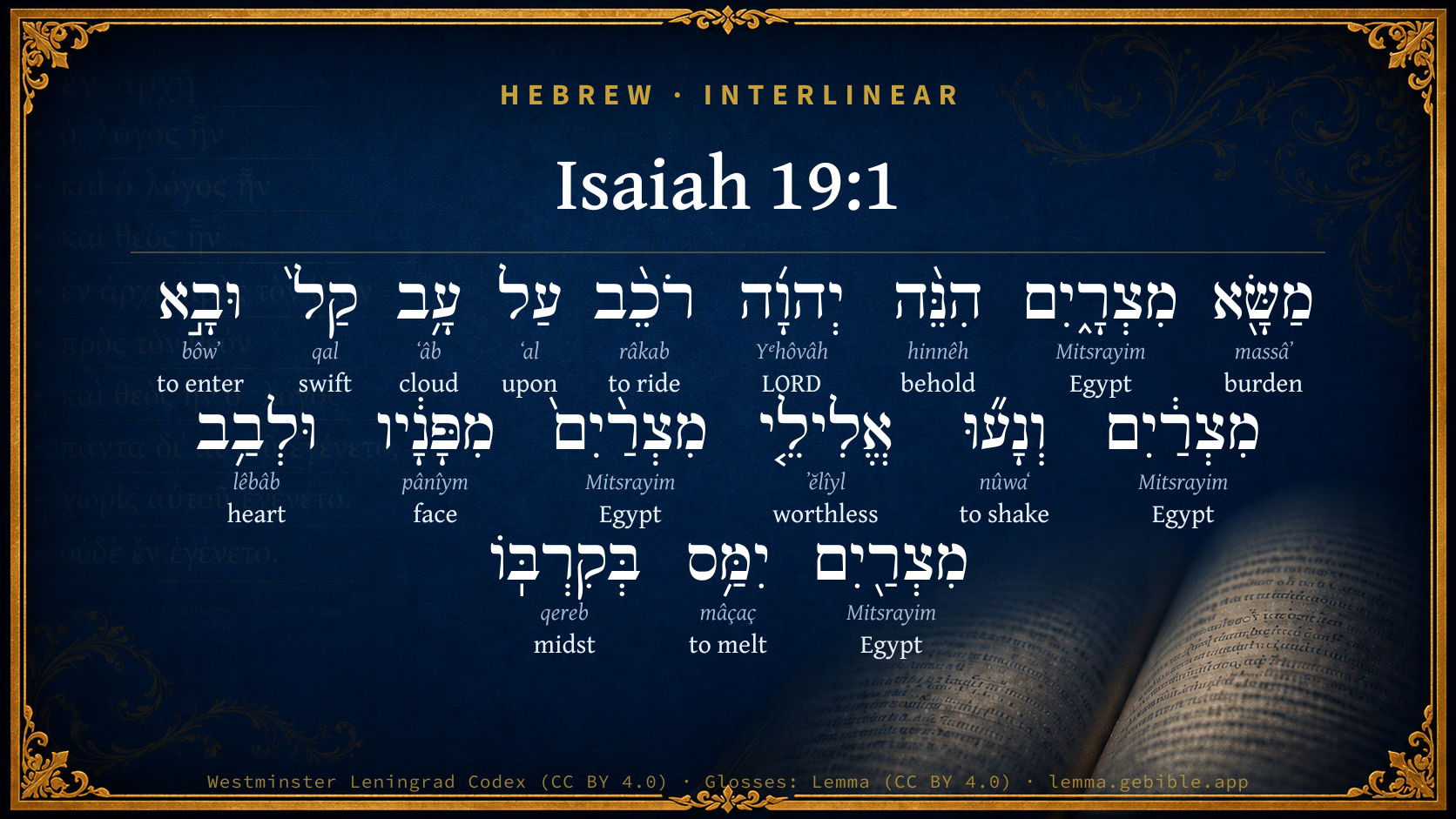
Isaiah 19:1

Hebrew (Westminster Leningrad Codex) Isaiah 19:1 appears in the Hebrew Old Testament. The text above is from the Westminster Leningrad Codex. Each word links to its Strong’s number, a concise gloss, and parsing drawn from the Open Scriptures Hebrew Bible morphology. Click any word for its full Brown-Driver-Briggs (BDB) entry.
Download image
Cite this verse

Isaiah 19:1 (World English Bible). Public Domain. Lemma interlinear Bible study tool, https://lemma.gebible.app/v/isaiah/19/1.

Show BibTeX & RIS
BibTeX
RIS
English Translation
The burden of Egypt. Behold, Yahweh rides on a swift cloud, and comes to Egypt: and the idols of Egypt shall tremble at his presence; and the heart of Egypt shall melt in the midst of it.
World English Bible · Public Domain
Download a study sheet

One document with this verse’s original text, its word-by-word gloss line, the meaning frame, cross-references with their text, attributed commentary, and full source and license credits — printable, and it pastes into notes with its structure intact.

This verse Autodidact and up

Study sheet (.html) Plain text (.txt)

A passage Seminary Student

Up to 50 verses in one chapter. A passage sheet keeps up to 6 commentary sources and 12 cross-references per verse, in the order this page ranks them, and says so on the sheet whenever that leaves anything out. Ask for a single verse and you get the Autodidact verse sheet above.

Everything on this page stays free to read, with no account — the sheet is a download of what is already on screen, not access to it.

Want to remove ads? Support Godless Engineer
Compare translations 3

The same verse in 3 English versions, stacked beneath the original-language interlinear above. Click any original word for its lexicon entry.

Each is an independent rendering of the whole verse — the interlinear is not word-aligned to these translations.

Highlighted words mark where these versions differ — a whole-verse word diff, not a word-by-word alignment.

  • World English Bible Public Domain
    The burden of Egypt. Behold, Yahweh rides on a swift cloud, and comes to Egypt: and the idols of Egypt shall tremble at his presence; and the heart of Egypt shall melt in the midst of it.
  • King James Version Public Domain
    The burden of Egypt. Behold, the LORD rideth upon a swift cloud, and shall come into Egypt: and the idols of Egypt shall be moved at his presence, and the heart of Egypt shall melt in the midst of it.
  • unfoldingWord Literal Text CC BY-SA 4.0
    The burden of Egypt: Behold Yahweh, riding on a swift cloud and coming Egypt. And the idols of Egypt will tremble from his face, and the heart of Egypt will melt in its midst.

unfoldingWord Literal Text — © unfoldingWord, licensed CC BY-SA 4.0. Word-aligned USFM3 via Door43 (git.door43.org/unfoldingWord/en_ult).

Versions to compare (up to 4)

3 of 4 selected

Show all 18 translations

Every available English version of this verse, each an independent rendering of the whole verse.

  • World English Bible Public Domain
    The burden of Egypt. Behold, Yahweh rides on a swift cloud, and comes to Egypt: and the idols of Egypt shall tremble at his presence; and the heart of Egypt shall melt in the midst of it.
  • Berean Standard Bible Public Domain
    This is the burden against Egypt: Behold, the LORD rides on a swift cloud; He is coming to Egypt. The idols of Egypt will tremble before Him, and the hearts of the Egyptians will melt within them.
  • Majority Standard Bible Public Domain
    This is the burden against Egypt: Behold, the LORD rides on a swift cloud; He is coming to Egypt. The idols of Egypt will tremble before Him, and the hearts of the Egyptians will melt within them.
  • King James Version Public Domain
    The burden of Egypt. Behold, the LORD rideth upon a swift cloud, and shall come into Egypt: and the idols of Egypt shall be moved at his presence, and the heart of Egypt shall melt in the midst of it.
  • American Standard Version (1901) Public Domain
    The burden of Egypt. Behold, Jehovah rideth upon a swift cloud, and cometh unto Egypt: and the idols of Egypt shall tremble at his presence; and the heart of Egypt shall melt in the midst of it.
  • Revised Version (1885) Public Domain
    The burden of Egypt. Behold, the LORD rideth upon a swift cloud, and cometh unto Egypt: and the idols of Egypt shall be moved at his presence, and the heart of Egypt shall melt in the midst of it.
  • Geneva Bible (1599) Public Domain
    The burden of Egypt. Beholde, the Lord rideth vpon a swift cloude, and shall come into Egypt, and the idoles of Egypt shall be moued at his presence, and the heart of Egypt shall melt in the middes of her.
  • Douay-Rheims (1899) Public Domain
    The burden of Egypt. Behold the Lord will ascend upon a swift cloud, and will enter into Egypt, and the idols of Egypt shall be moved at his presence, and the heart of Egypt shall melt in the midst thereof.
  • Young's Literal Translation Public Domain
    The burden of Egypt. Lo, Jehovah is riding on a swift thick cloud, And He hath entered Egypt, And moved have been the idols of Egypt at His presence, And the heart of Egypt melteth in its midst.
  • Literal Standard Version CC BY-SA 4.0
    The burden of Egypt. Behold, YHWH is riding on a swift thick cloud, || And He has entered Egypt, || And the idols of Egypt have been moved at His presence, || And the heart of Egypt melts in its midst.
  • Unlocked Literal Bible CC BY-SA 4.0
    A declaration about Egypt. See, Yahweh rides on a swift cloud and is coming to Egypt; the idols of Egypt quake before him, and the hearts of the Egyptians melt within themselves.
  • unfoldingWord Literal Text CC BY-SA 4.0
    The burden of Egypt: Behold Yahweh, riding on a swift cloud and coming Egypt. And the idols of Egypt will tremble from his face, and the heart of Egypt will melt in its midst.
  • Darby Bible Public Domain
    The burden of Egypt. Behold, Jehovah rideth upon a swift cloud, and cometh to Egypt; and the idols of Egypt are moved at his presence, and the heart of Egypt melteth in the midst of it.
  • World Messianic Bible Public Domain
    The burden of Egypt. “Behold, the LORD rides on a swift cloud, and comes to Egypt. The idols of Egypt will tremble at his presence; and the heart of Egypt will melt within it.
  • Webster's Bible Public Domain
    The burden of Egypt. Behold, the LORD rideth upon a swift cloud, and will come into Egypt: and the idols of Egypt shall be moved at his presence, and the heart of Egypt shall melt in the midst of it.
  • Free Bible Version CC BY-SA 4.0
    A message about Egypt. Look, the Lord is riding on a fast-moving cloud on his way to Egypt. The idols of Egypt will tremble before Him, and the Egyptians will become weak with fear.
  • Bible in Basic English Public Domain
    The word about Egypt. See, the Lord is seated on a quick-moving cloud, and is coming to Egypt: and the false gods of Egypt will be troubled at his coming, and the heart of Egypt will be turned to water.
  • JPS Tanakh (1917) Public Domain
    The burden of Egypt. Behold, the LORD rideth upon a swift cloud, and cometh unto Egypt; and the idols of Egypt shall be moved at His presence, and the heart of Egypt shall melt within it.

Literal Standard Version (2020), Covenant Press — licensed CC BY-SA 4.0. Text via the HelloAO Bible API (eBible.org). Unlocked Literal Bible (unfoldingWord) — licensed CC BY-SA 4.0. Text via the HelloAO Bible API (eBible.org). unfoldingWord Literal Text — © unfoldingWord, licensed CC BY-SA 4.0. Word-aligned USFM3 via Door43 (git.door43.org/unfoldingWord/en_ult). Free Bible Version, Dr. Jonathan Gallagher — licensed CC BY-SA 4.0. Text via the HelloAO Bible API (eBible.org).

Word by word

More ways to search: Search by grammar → Find every occurrence → Compare this word →

Practice this passage: Drill this verse → Learn its vocabulary →

קַל֙
qal
H7031
“swift”
Adjective, Adjective, Masculine, Singular, Absolute
Part of Speech
Adjective
Type
Adjective
Gender
Masculine
Number
Singular
State
Absolute
Full BDB Definition

Origin: contracted from H7043

TWOT: 2028a

swift, light, fleet - swift - one who is swift
  1. מַשָּׂ֖א massâʼ H4853 “burden of” Noun, Common, Masculine, Singular, Construct
  2. מִצְרָ֑יִם Mitsrayim H4714 “Egypt” Noun, Proper
  3. הִנֵּ֨ה hinnêh H2009 “behold” Particle, Demonstrative
  4. יְהוָ֜ה Yᵉhôvâh H3068 “LORD” Noun, Proper
  5. רֹכֵ֨ב râkab H7392 “riding” Verb, Qal, Participle Active, Masculine, Singular, Absolute
  6. עַל ʻal H5921 “upon” Preposition
  7. עָ֥ב ʻâb H5645 “cloud” Noun, Common, Both, Singular, Absolute
  8. וּבָ֣א bôwʼ H935 “and · entering” Conjunction + Verb, Qal, Participle Active, Masculine, Singular, Absolute
  9. מִצְרַ֔יִם Mitsrayim H4714 “Egypt” Noun, Proper
  10. וְנָע֞וּ nûwaʻ H5128 “and · to shake” Conjunction + Verb, Qal, Sequential Perfect, 3rd Person, Common, Plural
  11. אֱלִילֵ֤י ʼĕlîyl H457 “idols of” Noun, Common, Masculine, Plural, Construct
  12. מִצְרַ֨יִם֙ Mitsrayim H4714 “Egypt” Noun, Proper
  13. מִפָּנָ֔יו pânîym H6440 “from · face(s) · his” Preposition + Noun, Common, Both, Plural, Construct + Suffix, Personal, 3rd Person, Masculine, Singular
  14. וּלְבַ֥ב lêbâb H3824 “and · heart of” Conjunction + Noun, Common, Masculine, Singular, Construct
  15. מִצְרַ֖יִם Mitsrayim H4714 “Egypt” Noun, Proper
  16. יִמַּ֥ס mâçaç H4549 “to melt” Verb, Niphal, Imperfect, 3rd Person, Masculine, Singular
  17. בְּקִרְבּֽוֹ qereb H7130 “in/at · midst · his” Preposition + Noun, Common, Masculine, Singular, Construct + Suffix, Personal, 3rd Person, Masculine, Singular

About this verse

These counts appear in no published source. They are computed here, from the morphology-tagged text and Lemma’s own curated glosses. What Lemma adds →

18
words
15
distinct lemmas
Prophets
section

Notable vocabulary

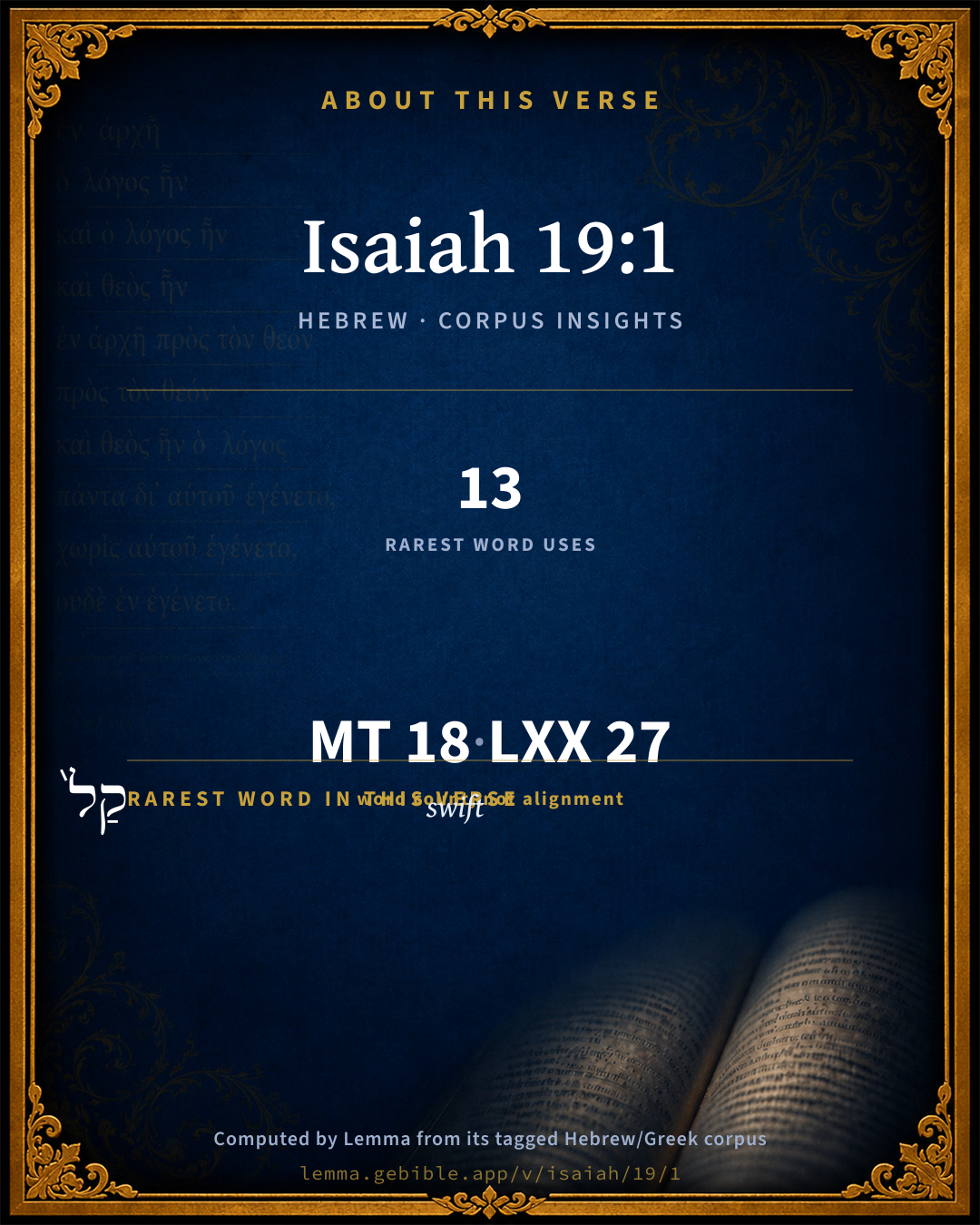
The rarest word here is קַל֙ swift H7031 — appearing just 13 times in the whole Hebrew Bible.

Shared distinctive vocabulary

קַל֙ swift H7031 occurs in 13 verses of the Hebrew Bible. Also found in:

Grammatical profile

  • 4 verbs
  • 11 nouns
  • 1 adjective
  • 1 preposition
  • 1 particle

Verb forms

  • רֹכֵ֨ב Qal · Participle Active
  • וּבָ֣א Qal · Participle Active
  • וְנָע֞וּ Qal · Sequential Perfect
  • יִמַּ֥ס Niphal · Imperfect

Repetition

A word recurs within this verse — often emphatic in Hebrew:

  • מִצְרָ֑יִם Egypt H4714 ×4

Hebrew & Septuagint length

In English translation the verse runs 37 words from the Hebrew and 35 from the Septuagint (LXX English) — closely comparable.

A rough comparison of the two English renderings, which tokenize alike — not a word-level alignment.

Word counts can differ between the Hebrew and the Greek without any difference in meaning — e.g. the Hebrew direct-object marker אֵת has no separate Greek word, and Greek often adds the article ὁ.

In the original languages it is 18 Hebrew tokens and 27 Greek tokens — but the two are counted differently (Hebrew bundles its prefixes and suffixes into one token; the Greek is in lemma form), so that isn’t a like-for-like length.

Cross-references

30

Topical passages linked to Isaiah 19:1 in the Treasury of Scripture Knowledge — connected by theme and wording, ordered by reader-vote popularity; previews shown in the World English Bible.

  • Exodus 12:12 For I will go through the land of Egypt in that night, and will strike all the firstborn in the land of Egypt, both man and animal. Against all the gods of Egypt I will execute judgments: I am Yahweh.
  • Revelation 1:7 Behold, he is coming with the clouds, and every eye will see him, including those who pierced him. All the tribes of the earth will mourn over him. Even so, Amen.
  • Joshua 2:11 As soon as we had heard it, our hearts did melt, neither did there remain any more spirit in any man, because of you: for Yahweh your God, he is God in heaven above, and on earth beneath.
  • Ezekiel 30:13 Thus says the Lord Yahweh: I will also destroy the idols, and I will cause the images to cease from Memphis; and there shall be no more a prince from the land of Egypt: and I will put a fear in the land of Egypt.
  • Joel 3:19 Egypt will be a desolation, And Edom will be a desolate wilderness, For the violence done to the children of Judah, Because they have shed innocent blood in their land.
  • Deuteronomy 33:26 There is none like God, Jeshurun, Who rides on the heavens for your help, In his excellency on the skies.
  • Psalms 104:3 He lays the beams of his chambers in the waters. He makes the clouds his chariot. He walks on the wings of the wind.
  • Isaiah 13:1 The burden of Babylon, which Isaiah the son of Amoz did see.
  • Jeremiah 50:2 Declare you among the nations and publish, and set up a standard; publish, and don't conceal: say, Babylon is taken, Bel is disappointed, Merodach is dismayed; her images are disappointed, her idols are dismayed.
  • Jeremiah 51:44 I will execute judgment on Bel in Babylon, and I will bring forth out of his mouth that which he has swallowed up; and the nations shall not flow any more to him: yes, the wall of Babylon shall fall.
  • Ezekiel 29:1–21 In the tenth year, in the tenth [month], in the twelfth [day] of the month, the word of Yahweh came to me, saying,
  • Exodus 15:14–16 The peoples have heard. They tremble. Pangs have taken hold on the inhabitants of Philistia.
  • Joshua 2:9 and she said to the men, I know that Yahweh has given you the land, and that the fear of you is fallen on us, and that all the inhabitants of the land melt away before you.
  • Joshua 2:24 They said to Joshua, Truly Yahweh has delivered into our hands all the land; and moreover all the inhabitants of the land do melt away before us.
  • 1 Samuel 5:2–4 The Philistines took the ark of God, and brought it into the house of Dagon, and set it by Dagon.
  • Psalms 18:10–12 He rode on a cherub, and flew. Yes, he soared on the wings of the wind.
  • Psalms 68:4 Sing to God! Sing praises to his name! Extol him who rides on the clouds: To Yah, his name! Rejoice before him!
  • Psalms 68:33–34 To him who rides on the heaven of heavens, which are of old; Behold, he utters his voice, a mighty voice.
  • Psalms 104:34 Let your meditation be sweet to him. I will rejoice in Yahweh.
  • Isaiah 13:7 Therefore shall all hands be feeble, and every heart of man shall melt:
  • Isaiah 19:16 In that day shall the Egyptians be like women; and they shall tremble and fear because of the shaking of the hand of Yahweh of Hosts, which he shakes over them.
  • Isaiah 21:9 and, behold, here comes a troop of men, horsemen in pairs. He answered, Fallen, fallen is Babylon; and all the engraved images of her gods are broken to the ground.
  • Isaiah 46:1–2 Bel bows down, Nebo stoops; their idols are on the animals, and on the cattle: the things that you carried about are made a load, a burden to the weary [animal].
  • Jeremiah 25:19 Pharaoh king of Egypt, and his servants, and his princes, and all his people;
  • Jeremiah 43:8–13 Then came the word of Yahweh to Jeremiah in Tahpanhes, saying,
  • Jeremiah 44:29–30 This shall be the sign to you, says Yahweh, that I will punish you in this place, that you may know that my words shall surely stand against you for evil:
  • Jeremiah 46:1–28 The word of Yahweh which came to Jeremiah the prophet concerning the nations.
  • Zechariah 10:11 He will pass through the sea of affliction, And will strike the waves in the sea, And all the depths of the Nile will dry up; And the pride of Assyria will be brought down, And the scepter of Egypt will depart.
  • Zechariah 14:18 If the family of Egypt doesn't go up, and doesn't come, neither will it rain on them. This will be the plague with which Yahweh will strike the nations that don't go up to keep the feast of tents.
  • Matthew 26:64–65 Jesus said to him, "You have said it. Nevertheless, I tell you, henceforth you will see the Son of Man sitting at the right hand of Power, and coming on the clouds of the sky."

Cross-references courtesy of OpenBible.info (CC BY 4.0).

Hebrew and Greek witnesses Masoretic Hebrew ↔ Greek Septuagint

The same verse in the two great witnesses to the Old Testament, shown verse-for-verse.

These are two independent witnesses, not word-aligned to each other, and the Septuagint is shown in lemma (dictionary) form.

Hebrew Isaiah 19:1 Masoretic · Westminster Leningrad Codex

מַשָּׂ֖א מִצְרָ֑יִם הִנֵּ֨ה יְהוָ֜ה רֹכֵ֨ב עַל עָ֥ב קַל֙ וּבָ֣א מִצְרַ֔יִם וְנָע֞וּ אֱלִילֵ֤י מִצְרַ֨יִם֙ מִפָּנָ֔יו וּלְבַ֥ב מִצְרַ֖יִם יִמַּ֥ס בְּקִרְבּֽוֹ

The burden of Egypt. Behold, Yahweh rides on a swift cloud, and comes to Egypt: and the idols of Egypt shall tremble at his presence; and the heart of Egypt shall melt in the midst of it.

World English Bible · Public Domain

Greek LXX Isaiah 19:1 Septuagint · lemma form

ὅρασις αἴγυπτος ἰδού κύριος καταἧμαι ἐπί νεφέλη κοῦφος καί ἥκω εἰς αἴγυπτος καί σείω ὁ χειροποίητος αἴγυπτος ἀπό πρόσωπον αὐτός καί ὁ καρδία αὐτός ἡττάω ἐν αὐτός

THE VISION OF EGYPT. Behold, the Lord sits on a swift cloud, and shall come to Egypt: and the idols of Egypt shall be moved at his presence, and their heart shall faint within them.

LXX2012 (modern English Septuagint) · Public Domain

On this verse, John Gill's Exposition discusses the Septuagint’s reading. Read the note in Commentary ↓

Hebrew: Westminster Leningrad Codex (CC BY 4.0). Greek: Septuagint (public domain); English from LXX2012 (modern English Septuagint) (Public Domain). How the Septuagint differs from the Hebrew →

Targum (Aramaic paraphrase)

1

The Targum is the ancient Jewish Aramaic paraphrase of the Hebrew Scriptures — an interpretive translation, not the Hebrew text itself. Onkelos (literal) and Pseudo-Jonathan (expansive) render the Torah, and Jonathan the Prophets. Coverage is partial: where no permissively-licensed English translation exists for a verse, only the Aramaic is shown. This is verse-level text, not a word-by-word alignment to the Hebrew.

  1. Targum Jonathan Prophets (Joshua–Malachi)
    מַטַל כַּס דִלְוָט לְאַשְׁקָאָה יַת מִצְרָאֵי הָא יְיָ מִתְגְלֵי בַּעֲנָן יְקָרֵהּ לְאִתְפְּרָעָא מִמִצְרַיִם וְיִתַּבְּרוּ טַעֲוַת מִצְרָאֵי מִן קֳדָמוֹהִי וְלִבָא דְמִצְרָאֵי יִתְמְסֵי בִּמְעֵיהוֹן:

    The Burden Of The Cup Of Cursing To Make The Egyptians To Drink. Behold, the Lord is revealed in the cloud of His glory, to take vengeance of the Egyptians; and the idols of the Egyptians shall be broken before His face, and the heart of the Egyptians shall be melted within them.

    Targum Jonathan — Aramaic: “Mikraot Gedolot” (public domain). English: “Sefaria Community Translation” (CC0 1.0 (public-domain dedication)); “London "Chaldee Paraphrase," 1871” (public domain). Text via Sefaria.

Commentary

Notes on Isaiah 19:1 from classic Christian and Jewish commentators (each source and its license shown beneath its notes). The classic Christian expositions comment on the surrounding passage and are grouped to its opening verse, so a note may address several verses; the Jewish commentaries on the Tanakh (Rashi and others) are per-verse, so they appear only where the commentator wrote on this verse.

Lemma curates 59 commentaries, every one of them public domain or Creative Commons licensed, each selected and text-cleaned for this edition rather than reprinted as found. About our sources →

Matthew Henry's Commentary

Though the land of Egypt had of old been a house of bondage to the people of God, where they had been ruled with rigour, yet among the unbelieving Jews there still remained much of the humour of their fathers, who said, Let us make us a captain and return into Egypt. Upon all occasions they trusted to Egypt for help (Isa 30:2), and thither they fled, in disobedience to God's express command, when things were brought to the last extremity in their own country, Jer 43:7. Rabshakeh upbraided Hezekiah with this, Isa 36:6. While they kept up an alliance with Egypt, and it was a powerful ally, they stood not in awe of the judgments of God; for against them they depended upon Egypt to protect them. Nor did they depend upon the power of God when at any time they were in distress; but Egypt was their confidence. To prevent all this mischief, Egypt must be mortified, and many ways God here tells them he will take to mortify them.

I. The gods of Egypt shall appear to them to be what they always really were, utterly unable to help them, Isa 19:1. "The Lord rides upon a cloud, a swift cloud, and shall come into Egypt. As a judge goes in state to the bench to try and condemn the malefactors, or as a general takes the field with his troops to crush the rebels, so shall God come into Egypt with his judgments; and when he comes he will certainly overcome." In all this burden of Egypt here is no mention of any foreign enemy invading them; but God himself will come against them, and raise up the causes of their destruction from among themselves. He comes upon a cloud, above the reach of the opposition or resistance. He comes apace upon a swift cloud; for their judgment lingers not when the time has come. He rides upon the wings of the wind, with a majesty far excelling the greatest pomp and splendour of earthly princes. He makes the clouds his chariots, Psa 18:9; Psa 104:3. When he comes the idols of Egypt shall be moved, shall be removed at his presence, and perhaps be made to fall as Dagon did before the ark. Isis, Osiris, and Apis, those celebrated idols of Egypt, being found unable to relieve their worshippers, shall be disowned and rejected by them. Idolatry had got deeper rooting in Egypt than in any land besides, even the most absurd idolatries; and yet now the idols shall be moved and they shall be ashamed of them. When the Lord brought Israel out of Egypt he executed judgments upon the gods of the Egyptians (Num 33:4); no marvel then if, when he comes, they begin to tremble. The Egyptians shall seek to the idols, when they are at their wits' end, and consult the charmers and wizards (Isa 19:3); but all in vain; they see their ruin hastening on them notwithstanding.

II. The militia of Egypt, that had been famed for their valour, shall be quite dispirited and disheartened. No kingdom in the world was ever in a better method of keeping up a standing army than the Egyptians were; but now their heroes, that used to be celebrated for courage, shall be posted for cowards: The heart of Egypt shall melt in the midst of it, like wax before the fire (Isa 19:1); the spirit of Egypt shall fail, Isa 19:3. They shall have no inclination, no resolution, to stand up in defence of their country, their liberty, and property; but shall tamely and ingloriously yield all to the invader and oppressor. The Egyptians shall be like women (Isa 19:16); they shall be frightened and put into confusion by the least alarm; even those that dwell in the heart of the country, in the midst of it, and therefore furthest from danger, will be as full of frights as those that are situate on the frontiers. Let not the bold and brave be proud or secure, for God can easily cut off the spirit of princes (Psa 76:12) and take away their hearts, Job 12:24.

III. The Egyptians shall be embroiled in endless dissensions and quarrels among themselves. There shall be no occasion to bring a foreign force upon them to destroy them; they shall destroy one another (Isa 19:2): I will set the Egyptians against the Egyptians. As these divisions and animosities are their sin, God is not the author of them, they come from men's lusts; but God, as a Judge, permits them for their punishment, and by their destroying differences corrects them for their sinful agreements. Instead of helping one another, and acting each in his place for the common good, they shall fight every one against his brother and neighbour, whom he ought to love as himself - city against city, and kingdom against kingdom. Egypt was then divided into twelve provinces, or dynasties; but Psammetichus, the governor of one of them, by setting them at variance with one another, at length made himself master of them all. A kingdom thus divided against itself would soon be brought to desolation. En quo discordi cives perduxit miseros! - Oh the wretchedness brought upon a people by their disagreements among themselves! It is brought to this by a perverse spirit, a spirit of contradiction, which the Lord would mingle, as an intoxicating draught made up of several ingredients, for the Egyptians, Isa 19:14. One party shall be for a thing for no other reason than because the other is against it; that is a perverse spirit, which, if it mingle with the public counsels, tends directly to the ruin of the public interests.

IV. Their politics shall be all blasted, and turned into foolishness. When God will destroy the nation he will destroy the counsel thereof (Isa 19:3), by taking away wisdom from the statesmen (Job 12:20), or setting them one against another (as Hushai and Ahithophel), or by his providence breaking their measures even when they seemed well laid; so that the princes of Zoan are fools: they make fools of one another, every one betrays his own folly, and divine Providence makes fools of them all, Isa 19:11. Pharaoh had his wise counsellors. Egypt was famous for such. But their counsel has all become brutish; they have lost all their forecast; one would think they had become idiots, and were bereaved of common sense. Let no man glory then in his own wisdom, nor depend upon that, nor upon the wisdom of those about him; for he that gives understanding can when he please take it away. And from those it is most likely to be taken away that boast of their policy, as Pharaoh's counsellors here did, and, to recommend themselves to places of public trust, boast of their great understanding ("I am the son of the wise, of the God of wisdom, of wisdom itself," says one; "my father was an eminent privy-counsellor of note in his day for wisdom"), or of the antiquity and dignity of their families: "I am," says another, "the son of ancient kings." The nobles of Egypt boasted much of their antiquity, producing fabulous records of their succession for above 10,000 years. This humour prevailed much among them about this time, as appears by Herodotus, their common boast being that Egypt was some thousands of years more ancient than any other nation. "But where are thy wise men? Isa 19:12. Let them now show their wisdom by foreseeing what ruin is coming upon their nation, and preventing it, if they can. Let them with all their skill know what the Lord of hosts has purposed upon Egypt, and arm themselves accordingly. Nay, so far are they from doing this that they themselves are, in effect, contriving the ruin of Egypt, and hastening it on, Isa 19:13. The princes of Noph are not only deceived themselves, but they have seduced Egypt, by putting their kings upon arbitrary proceedings" (by which both themselves and their people were soon undone); "the governors of Egypt, that are the stay and cornerstones of the tribes thereof, are themselves undermining it." It is sad with a people when those that undertake for their safety are helping forward their destruction, and the physicians of the state are her worst disease, when the things that belong to the public peace are so far hidden from the eyes of those that are entrusted with the public counsels that in every thing they blunder and take wrong measures; so here (Isa 19:14): They have caused Egypt to err in every work thereof. Every step they took was a false step. They always mistook either the end or the means, and their counsels were all unsteady and uncertain, like the staggerings and stammerings of a drunken man in his vomit, who knows not what he says nor where he goes. See what reason we have to pray for our privy-counsellors and ministers of state, who are the great supports and blessings of the state if God give them a spirit of wisdom, but quite the contrary if he hide their heart from understanding.

V. The rod of government shall be turned into the serpent of tyranny and oppression (Isa 19:4): "The Egyptians will I give over into the hand of a cruel lord, not a foreigner, but one of their own, one that shall rule over them by an hereditary right, but shall be a fierce king and rule them with rigour," either the twelve tyrants that succeeded Sethon, or rather Psammetichus that recovered the monarchy again; for he speaks of one cruel lord. Now the barbarous usage which the Egyptian task masters gave to God's Israel long ago was remembered against them and they were paid in their own coin by another Pharaoh. It is sad with a people when the powers that should be for edification are for destruction, and they are ruined by those by whom they should be ruled, when such as this is the manner of the king, as it is described (in terrorem - in order to impress alarm), Sa1 8:11.

VI. Egypt was famous for its river Nile, which was its wealth, and strength, and beauty, and was idolized by them. Now it is here threatened that the waters shall fail from the sea and the river shall be wasted and dried up, Isa 19:5. Nature shall not herein favour them as she has done. Egypt was never watered with the rain of heaven (Zac 14:18), and therefore the fruitfulness of their country depended wholly upon the overflowing of their river; if that therefore be dried up, their fruitful land will soon be turned into barrenness and their harvests cease: Every thing sown by the brooks will wither of course, will be driven away, and be no more, Isa 19:7. If the paper-reeds by the brooks, at the very mouth of them, wither, much more the corn, which lies at a greater distance, but derives its moisture from them. Yet this is not all; the drying up of their rivers is the destruction, 1. Of their fortifications, for they are brooks of defence (Isa 19:6), making the country difficult of access to an enemy. Deep rivers are the strongest lines, and most hardly forced. Pharaoh is said to be a great dragon lying in the midst of his rivers, and guarded by them, bidding defiance to all about him, Eze 29:3. But these shall be emptied and dried up, not by an enemy, as Sennacherib with the sole of his foot dried up mighty rivers (Isa 37:25), and as Cyrus, who took Babylon by drawing Euphrates into many streams, but by the providence of God, which sometimes turns water-springs into dry ground, Psa 107:33. 2. It is the destruction of their fish, which in Egypt was much of their food, witness that base reflection which the children of Israel made (Num 11:5): We remember the fish which we did eat in Egypt freely. The drying up of the rivers will kill the fish (Psa 105:29), and will thereby ruin those who make it their business, (1.) To catch fish, whether by angling or nets (Isa 19:8); they shall lament and languish, for their trade is at an end. There is nothing which the children of this world do more heartily lament than the loss of that which they used to get money by. Ploratur lachrymis amissa pecunia veris - Those are genuine tears which are shed over lost money. (2.) To keep fish, that it may be ready when it is called for. There were those that made sluices and ponds for fish (Isa 19:10), but they shall be broken in the purposes thereof; their business will fail, either for want of water to fill their ponds or for want of fish to replenish their waters. God can find ways to deprive a country even of that which is its staple commodity. The Egyptians may themselves remember the fish they have formerly eaten freely, but now cannot have for money. And that which aggravates the loss of these advantages by the river is that it is their own doing (Isa 19:6): They shall turn the rivers far away. Their kings and great men, to gratify their own fancy, will drain water from the main river to their own houses and grounds at a distance, preferring their private convenience before the public good, and so by degrees the force of the river is sensibly weakened. Thus many do themselves a greater prejudice at last than they think of, [1.] Who pretend to be wiser than nature, and to do better for themselves than nature has done. [2.] Who consult their own particular interest more than the common good. Such may gratify themselves, but surely they can never satisfy themselves, who to serve a turn contribute to a public calamity, which they themselves, in the long run, cannot avoid sharing in. Herodotus tells us that Pharaoh-Necho (who reigned not long after this), projecting to cut a free passage by water from Nilus into the Red Sea, employed a vast number of men to make a ditch or channel for that purpose, in which attempt he impaired the river, lost 120,000 of his people, and yet left the work unaccomplished.

VII. Egypt was famous for the linen manufacture; but that trade shall be ruined. Solomon's merchants traded with Egypt for linen-yarn, Kg1 10:28. Their country produced the best flax and the best hands to work it; but those that work in fine flax shall be confounded (Isa 19:9), either for want of flax to work on or for want of a demand for that which they have worked or opportunity to export it. The decay of trade weakens and wastes a nation and by degrees brings it to ruin. The trade of Egypt must needs sink, for (Isa 19:15) there shall not be any work for Egypt to be employed in; and where there is nothing to be done there is nothing to be got. There shall be a universal stop put to business, no work which either head or tail, branch or rush, may do; nothing for high or low, weak or strong, to do; no hire, Zac 8:10. Note, The flourishing of a kingdom depends much upon the industry of the people; and then things are likely to do well when all hands are at work, when the head and top-branch do not disdain to labour, and the labour of the tail and rush is not disdained. But when the learned professions are unemployed, the principal merchants have no stocks, and the handicraft tradesmen nothing to do, poverty comes upon a people as one that travaileth and as an armed man.

VIII. A general consternation shall seize the Egyptians; they shall be afraid and fear (Isa 19:16), which will be both an evidence of a universal decay and a means and presage of utter ruin. Two things will put them into this fright: - 1. What they hear from the land of Judah; that shall be a terror to Egypt, Isa 19:17. When they hear of the desolations made in Judah by the army of Sennacherib, considering both the near neighbourhood and the strict alliance that was between them and Judah, they will conclude it must be their turn next to become a prey to that victorious army. When their neighbour's house was on fire they could not but see their own in danger; and therefore every one of the Egyptians that makes mention of Judah shall be afraid of himself, expecting the bitter cup shortly to be put into his hands. 2. What they see in their own land. They shall fear (Isa 19:16) because of the shaking of the hand of the Lord of hosts, and (Isa 19:17) because of the counsel of the Lord of hosts, which from the shaking of his hand they shall conclude he has determined against Egypt as well as Judah. For, if judgment begin at the house of God, where will it end? If this be done in the green tree, what shall be done in the dry? See here, (1.) How easily God can make those a terror to themselves that have been, not only secure, but a terror to all about them. It is but shaking his hand over them, or laying it upon some of their neighbours, and the stoutest hearts tremble immediately. (2.) How well it becomes us to fear before God when he does but shake his hand over us, and to humble ourselves under his mighty hand when it does but threaten us, especially when we see his counsel determined against us; for who can change his counsel?

Matthew Henry's Commentary on the Whole Bible (1708–1710) — public domain (CC PDM 1.0). Text via the HelloAO Bible API.

Trapp's Complete Commentary

John Trapp

Isa 19:1 The burden of Egypt. Behold, the LORD rideth upon a swift cloud, and shall come into Egypt: and the idols of Egypt shall be moved at his presence, and the heart of Egypt shall melt in the midst of it.

Ver. 1. The burden of Egypt.] See Isa 13:1.

Behold the Lord rideth.] Heb., Riding - sc., as a judge, or general of an army.

Upon a swift cloud,] i.e., Speedily, suddenly, and irresistibly. Clouds are rarely seen in Egypt, where it raineth not; but in Eze 30:18 we read of a cloud that should cover Egypt. By "swift cloud" here some understand the Virgin Mary; others our Saviour’s body, or human nature. And they further tell us, that as soon as the child Jesus was brought into Egypt, down fell all the idols there, as Dagon did before the ark. {a} This they ground upon the following words: -

And the idols of Egypt shall be moved at his presence.] Whereby I conceive is only meant that their gods should not be able to help them, and should therefore lose their authority, be discredited and decried.

And the heart of Egypt shall melt.] As it did, first when Sennacherib, and then when Nebuchadnezzar came against it.

{a} Hist. Scholast.

John Trapp, A Commentary or Exposition upon All the Books of the Old and New Testament (1647–1656) — public domain. Text from a community e-Sword module.

The Biblical Illustrator

Joseph S. Exell

Isa_19:1

The burden of Egypt

The prophecies concerning Egypt

The kingdom to which all the three prophecies (chaps.

18, 19, 20) refer is the same, namely, the Egypto-Ethiopian kingdom; but it is so dealt with that chap. 18 refers to the ruling people, chap. 19 to the ruled people, and chap. 20 embraces them both together. (F. Delitzsch.)

Egypt interwoven with the history of the kingdom of God

The reason why the prophecy occupies itself so particularly with Egypt is that no people of the earth was so closely interwoven with the history of the kingdom of God from the patriarchal time as Egypt. (F. Delitzsch.)

The oracle concerning Egypt: promise as well as threatening

Because, as the Thora impresses it, Israel must never forget that it long resided in Egypt, and there grew great, and enjoyed much good; so prophecy, when it comes to speak to Egypt, is not less zealous in promising than in threatening. Accordingly, the Isaianic oracle falls into two distinct halves; one threatening, Isa_19:1-15, and one promising, Isa_19:18-25; and between judgment and salvation there stands the terror in Isa_19:16-17, as the bridge from the former to the latter. (F. Delitzsch.)

Behold, the Lord rideth upon a swift cloud

The way of the Lord

Here is one way in which the Lord comes, namely, upon a swift cloud (Isa_19:1). The intimation is one of mystery. No man can tell which way the Lord will come today. Let us keep our eyes upon every point of the horizon; let us distribute the watchmen wisely and assign to each his sphere of observation; for by what door the Lord may enter the field of vision no man can tell,--by a political event, by some new movement in foreign policy, by the discovery of new riches in the earth, by great shocks which try mens strength, by grim sorrow, by cruel death, by judgments that have no name, by mercies tender as the tenderest love, by compassions all tears, by providences that are surprises of gladness: watch all these doors, for by any one of them the Lord may come into the nation, the family, the heart of the individual. This Divine policy, if it may be so named, baffles the watchers who trust to their own sagacity. If men will say they will circumvent God and know all the ways of His providence, behold God forsakes all ways that are familiar and that lie within the calculation of the human mind; and He startles those who watch with light from unexpected quarters with shakings and tremblings never before felt in the vibrations of history. Clouds and darkness are round about Him: the cloud that appears to be nothing but vapour may enshrine the Deity; the bush, yesterday so common that any bird might have alighted upon it, today burns with unseen, infinite energy. The Lord will come by what way He pleases,--now as if from the depths of the earth, and now as from the heights of heaven; blessed is that servant who is ready to receive Him and to welcome Him to the hearts hospitality of love. (J. Parker, D. D.)

The Biblical Illustrator, edited by Joseph S. Exell (c. 1880s–1900s) — public domain. Text from a community e-Sword module.

Joseph Benson's Commentary

Isa 19:1. The burden of Egypt — Concerning the term burden, see on chap. 13:1. “Not many years after the destruction of Sennacherib’s army before Jerusalem, by which the Egyptians were freed from the yoke with which they were threatened by so powerful an enemy, who had carried on a successful war of three years’ continuance against them, the affairs of Egypt were again thrown into confusion by intestine broils among themselves, which ended in a perfect anarchy that lasted some years. This was followed by an aristocracy, or rather tyranny, of twelve princes, who divided the country between them, and at last by the sole dominion of Psammitichus, which he held for fifty-four years. Not long after that, followed the invasion and conquest of Egypt by Nebuchadnezzar; and then by the Persians under Cambyses, the son of Cyrus. The yoke of the Persians was so grievous, that the conquest of the Persians by Alexander may well be considered as a deliverance to Egypt; especially as he and his successors greatly favoured the people, and improved the country. To all these events the prophet seems to have had a view in this chapter;” which contains the fifth discourse of the second part of Isaiah’s prophecies, delivered at another time, and much later than the preceding, and copiously setting forth the fate of Egypt, a nation, from the remotest antiquity, famous in the East. See Bishop Lowth and Vitringa.

Behold, the Lord rideth on a swift cloud — As a general at the head of his army: or, as a judge going in state to the bench, to try and condemn malefactors. He makes the clouds his chariots, and rides upon the wings of the wind, with a power far above the reach of opposition or resistance, and with a majesty far excelling the greatest pomp and splendour of earthly princes. He is said to ride upon a swift cloud, to signify that the judgment should come speedily and unexpectedly: for God’s judgments do not linger when the time of his long-suffering is completed. And the idols of Egypt shall be moved at his presence — From their seats, and from their former reputation. Or they shall shake or tremble, as the word נעו, here used, properly signifies. So far shall they be from helping the Egyptians, as they expect, that they shall tremble for themselves. And the heart of Egypt shall melt in the midst of it — The Egyptians shall lose all their ancient strength and courage, and their very souls shall faint within them, through dread of their approaching calamities. From these particulars of the prediction we learn, that the prince who should come upon Egypt, as the executer of the decrees of the divine justice, should approach with the most swift and rapid motion; that he should throw down and destroy their idols, and fill all Egypt with the greatest consternation. Now it is certain that Cambyses, the son of Cyrus, the Persian, exactly fulfilled these things, particularly with respect to the idols of Egypt. “The first attempt made by Cambyses,” says Bishop Newton, “was upon Pelusium, a strong town at the entrance of Egypt, and the key of the kingdom; and he succeeded by the stratagem of placing before his army a great number of dogs, sheep, cats, and other animals, which being held sacred by the Egyptians, not one of them would cast a javelin or shoot an arrow that way: and so the town was stormed and taken, in a manner, without resistance. He treated the gods of Egypt with marvellous contempt, laughed at the people, and chastised the priests for worshipping such deities. He slew Apis, or the sacred ox which the Egyptians worshipped, with his own hand; and burned and demolished their other idols and temples; and would likewise, if he had not been prevented, have destroyed the famous temple of Jupiter Ammon. Ochus, too, who was another king of Persia, and subdued the Egyptians again, after they had revolted, plundered their temples, and caused Apis to be slain, and served up in a banquet to him and his friends.”

Joseph Benson's Commentary on the Old and New Testaments (1811–1818) — public domain. Text from a community e-Sword module.

The Preacher's Complete Homiletical Commentary

Joseph S. Exell (gen. ed.)

TRUE NATIONAL GREATNESS

Isa_19:1-3; Isa_19:14. The burden of Egypt, &c.

The prophecies of Isaiah take a wide range, embrace the fortunes of almost every nation, however remote, with whom the Israelites were brought into common relation, whether of policy or commerce—Moab, Damascus, Tyre, Babylon, Ethiopia, Egypt. The prophet records the political and social phenomena of his day, not with the eye of a mere statesman or diplomatist, but as reviewing the moral as well as the political aspects of things, the eternal governing laws as well as the fitful moods and changes of a nation’s life, the spiritual as well as the material forces of the world.

Israel, in their dread of the great Assyrian monarchy, often cast wistful eyes towards Egypt, where they hoped to find a sure and powerful ally. The Egyptians accepted their subsidies, but thought they consulted their own interests best by observing what has been called amongst ourselves a “masterly inactivity.” Their strength was to sit still. They had a large standing army; but, as Rabshakeh showed, on a memorable occasion, that he knew (chap. Isa_36:6) the nation, with all its outward semblance of prosperity, was being eaten up with a thousand moral and social cankers, which corrupted the very source of all national life. This chapter lays bare those wounds and bruises and putrefying sores.

1. There was a day when Egypt had been famous for its wisdom. This wisdom had become a thing of the past (Isa_19:11-12).

2. There was no unity of purpose, no coherence of action in the body politic. The true ideas of the family, of the municipality, of the nation, were lost. Every man was fighting against his brother (Isa_19:2). It is history eternally repeating itself; it is the lament of Thucydides over Greece; of Horace, Livy, and Tacitus over the corruption of guilty imperialism, and over the absence of the masculine, simple, republican virtues of ancient Rome.

3. With the decay of public virtue comes the decay of public spirit, and then soon follows the decay of national strength. Then comes what these old Hebrew seers called the “judgment;” God coming out of His place to visit the earth; anarchy, internal dissolution, collapse, conquest by the foreigner; the giving over of the nation into the hand of a cruel lord; the establishment of a military despotism.

It were easy to point these remarks elsewhere, but let us look at home. Many feel that during the last decade of years or more England has been parting with many of her old traditions. Some of those principles which were merely corrupt remnants of a social and political system which has passed away—feudalism—we have undoubtedly gained by losing. But there are others which we have lost, or are fast losing, to the great detriment of the commonwealth. The high sense of duty to the State overruling the sense of interest in the individual citizen; the true measure of a nation’s wealth and greatness, not by its revenue in pounds sterling, but by its revenue in the healthy bodies, and honest hearts, and pure, healthy homes of the people; the noble, self-sacrificing spirit of devotion to the call of duty; the principle of right recognised as a higher principle than that of expediency; a temper of loyalty in the strict sense of the word, of willing obedience to the law and those who represent the law; strict commercial integrity, and not the tricks of trade which have been generated by an unwholesome competition—these are maxims of ancient wisdom which made England great, and the loss of which will make England small. Our greatness, whatever it has been, has not rested so much upon material forces, but, like Israel’s of old, upon moral. We can only hope that our position among the peoples will be maintained as long as we hold fast the principles by which it was won. These privileges are not things of chance, but the direct result of moral laws as immutable and irreversible as the laws which govern the physical world. God send us statesmen who will turn the nation’s mind away from delusive and partisan aims, and direct them seriously to efforts which may unite us all in one great crusade against evil; in which every soldier might certainly feel that he was fighting under the banner of Christ, in a righteous war, for objects which surely have a place in the redemption which Christ accomplished for the world.—Bishop Fraser: Christian World Pulpit, vol. xvii. pp. 177, 178.

The Preacher's Complete Homiletical Commentary (gen. ed. Joseph S. Exell; Funk & Wagnalls, c. 1892) — public domain (pre-1929). A full-Bible homiletical/sermon-outline anthology covering 65 of 66 books (2 John is absent from the source module). Text from a community e-Sword module.

Lange's Commentary on the Holy Scriptures

b) Prophecies that give Warning not to Trust in False Help Against Assyria

Isaiah 19, 20

α) EGYPT NOW IN TIME TO COME

Isaiah 19

Various expositors from Eichhorn to Hitzig have attacked the genuineness of this chapter in whole or in part. But one may judge in advance how little valid the alleged reasons for this are, by the fact that Knobel rejects them all, and is decided in his recognition of Isaiah, as its author. We may therefore spare ourselves the investigation of these doubts, and so much the more as in our exposition of particulars, it will appear how very much the thoughts and expressions correspond to Isaiah’s way of thinking and speaking. The chapter is very artistically arranged. It evidently divides into three parts of which the first (Isa_19:1-15) shows how the Lord by His judgments reveals His arm to the Egyptians (Isa_52:10; Isa_53:1); the second (Isa_19:16-17), as a transition, sets forth how Egypt fears before Jehovah; finally the third (Isa_19:18-25) presents the prospect that Egypt will fear the Lord as third in the confederation with Assyria and Israel.

_________________

א) How the LORD reveals His arm to the Egyptians by severe judgments

Isa_19:1-15

1          The Burden of Egypt.

Behold, the Lord rideth upon a swift cloud,

And 1shall come into Egypt:

And the idols of Egypt 2shall be moved at his presence,

And the heart of Egypt 3shall melt in the midst of it.

2     And I will 4set 5the Egyptians against the Egyptians:

And they shall fight every one against his brother,

And every one against his 6neighbor;

City against city,

And kingdom against kingdom.

3     And the spirit of Egypt 7shall fail in the midst thereof;

And I will 8destroy the counsel thereof:

And they shall seek to the idols, and to the 9charmers,

And to 10them that have familiar spirits, and to the wizzards.

4     And 11the Egyptians will I 12give over into the hand of a 13cruel lord;

And a 14fierce king shall rule over them,

Saith the Lord, the Lord of hosts.

5     And the waters shall fail from the sea,

And the river shall be wasted and dried up.

6     And 15they shall turn the rivers far away;

And the brooks of 16defence shall be emptied and dried up:

17The reeds and flags shall wither.

7     The 18paper reeds by the brooks, 19by the mouth of the brooks,

And 20everything sown by the brooks,

Shall wither, be driven away, 21and be no more.

8     The fishers also shall mourn,

And all they that cast angle into the brooks shall lament,

And they that spread nets upon the waters shall languish..

9     Moreover they that work in fine flax,

And they that weave 22networks, shall be confounded.

10     And 23they shall be broken in the 24purposes thereof:

All that make sluices and ponds 25for fish.

11     26Surely the princes of Zoan are fools,

27The counsel of the wise counsellors of Pharaoh is become brutish:

How say ye unto Pharaoh,

I am the son of the wise,

The son of ancient kings?

12     Where are they? where are thy wise men?

And let them tell thee now, and let them know

What the Lord of hosts hath purposed upon Egypt.

13     The princes of Zoan are 28become fools,

The princes of Noph are deceived;

29They have also seduced Egypt, even they that are30 31the stay of the tribes thereof.

14     The Lord hath mingled 32a perverse spirit in the midst thereof:

And they have caused Egypt to err in every work thereof,

As a drunken man staggereth in his vomit.

15     Neither shall there be any work for Egypt,

Which the head or tail, branch or rush may do.

TEXTUAL AND GRAMMATICAL

Isa_19:1. נוע is one of the words that occur only in the first part of Isa_6:4; Isa_7:2; Isa_24:20; Isa_37:22.—קֶרֶב, in some sense as the enclosure that contains the לֵב or רוּחַ, frequent: Isa_26:9; Isa_63:11; Psa_39:4; Psa_51:12; Psa_55:5, etc.——אלילים, see on Isa_2:8.——ולב מ׳ ימם, see on Isa_13:7.

Isa_19:2. On סִכְסֵךְ comp. at Isa_9:10.

Isa_19:3. נבקה comp. Green Gr., § 141, 1; Isa_24:1; Isa_24:3.——אִטִּים, ἅπ. λεγ., probably kindred to לְאַט, which is used of the soft murmuring of a brook, Isa_8:6, and of soft, slow, gentle stepping or acting, Gen_33:14; 2Sa_18:5, etc.——אֹבוֹת and יִדְּעֹנִים, compare on Isa_8:19.

Isa_19:4. אֲדֹנִים, Plural, with the abstract notion of dominion, comp. Gen_39:20; Gen_42:30; Gen_42:33; in Isa. again only Isa_26:13.——עַז Isa_25:3; Isa_43:16; Isa_56:11.——סכר, properly “to shut up,” only here in Isaiah.

Isa_19:5. The form נִשְּׁתוּ, as also נָשָֽׁתָּה Isa_41:17, and נָֽשְׁתָה Jer_51:30 can be referred to שָׁתַת (comp. Psa_73:9; Psa_88:7), as is done by Hitzig, if the meaning “to seat oneself,” desidere suited our passage and Isa_41:17. But in both places (also Isa_19:5 on account of the מִן before הַיָּם) it is too evident that the meaning “exaruit, to become dry,” is demanded by the context. Moreover the whole of verse 5 is with little alteration taken from Job_14:11. For there it reads:—אָ‍ֽזְלוּ מַיִם מִנִּי־יָם וְנָהָר יֶֽחֱרַב וְיָבֵשׁ. It is seen that the expressions differ somewhat in the first clause, while in the second clause they are literally alike. Job employs the language as the figure for growing old and dying off, without any reference to the Nile. Isaiah applies it to the Nile particularly, and hence exchanges אזלו (diffluunt) for נשׁתו.

Isa_19:6. There is no substantive אֶזְנַח; so הֶֽאֶזְנִיחַ may not be taken as denominativum, though even Ewald (§ 126 b) adopts the view. Olshausen (§ 255 b) explains the form as simply a blunder; חִזְנִיחוּ is to be restored. The meaning must be “to produce, to spread a stench.”——The plural נהרות occurs only here in the first part of Isaiah; in the second part: Isa_41:18; Isa_42:15; Isa_43:2; Isa_43:19-20; Isa_44:27; Isa_47:2; Isa_50:2. נהרים Isa_18:1-2; Isa_18:7; Isa_33:21.——דָּלַל comp. Isa_38:14; Isa_17:4.——On מָצוֹר see Exeg. Com. on Isa_19:1.——יְאוֹר is an Egyptian word. According to Ebers (1. c. I. p. 338) the sacred name of the Nile in the hieroglyphic text is Hapi, the profane name, on the other hand, Aur. Along with the latter name often stands aa, i, e., “great,” therefore, Aur-aa = great river. The ancient hieratic form Aur became, in the mouth of the people, iar or ial (r and l are exchanged according to fancy in Egyptian, Ebers, p. 96). From Aur-aa came iaro. So the word sounds also in Koptic. The plural יארים occurs Isa_33:21, of water ditches, used for defence; Job_28:1 of the shafts that the miner digs. Otherwise the word is used only of the canals of the Nile: Exo_7:19; Exo_8:1, etc. Comp. Isa_7:18; Isa_37:25; 2Ki_19:24.——קָנֶה “cane,” hence κανών, canalis, Isa_35:7; Isa_36:6; Isa_42:3; Isa_43:24; Isa_46:6.——סוּף “a reed,” Exo_2:3; Exo_2:5; only here in Isaiah. קָמֵל (קָמַל kindred to אָמַל) “marcescere, to languish,” occurs again only Isa_33:9.

Isa_19:7. עָרוֹת (from עָרָה, nudum esse, loca nuda), occurs only in this place. These ערות evidently correspond to the Egyptian אָ‍ֽחוּ (Gen_41:2; Job_8:11), the Nile, or reed, or rush-meadow on the bank of the Nile. Comp. Ebers l. c. p. 338.——פי יאור can hardly signify “the mouthing.” For wherefore should only the meadows at the mouthing of the Nile wither? Rather (comp. Psa_133:2) the mouth of the Nile here is the same as the lips of the Nile elsewhere (שְׂפַת חַיְאֹר Gen_41:3, hieroglyphic sept., Ebers, l. c. p. 339.——מִזְרָע, ἅπ. λεγ. can mean here only “the place of sowing, the sowed field” (comp. זֶרַע שִׁהֹר Isa_23:3).——נדף, dispellere, dissipare, occurs again only Isa_41:2.——ואיננו a form of expression that occurs relatively the oftenest in Job_3:21; Job_23:8; Job_24:24; Job_27:19. Comp. beside Psa_37:10; Psa_103:16; Pro_23:5, etc.

Isa_19:8. אָנוּ comp. Isa_3:26.——חַכָּה and מכמרת are found only here in Isaiah; on the former compare Job 40:25; on the latter, Hab_1:15.——אֻמְלָלוּ comp. on Isa_16:8.

Isa_19:9. פשׁתים שׂריקות are lina pectinata, i.e., linen stuff made of hackeled, pure, fine flax. שׂריקות is ἅπ. λεγ.; so also is חוֹרַי. The root of the latter חָוַר (Isa_29:22) means candidum, then nobilem, splendidum esse. We encounter this meaning again in הֹר nobilis, הֹרִי “fine, white bread,” (Gen_40:16), probably, too, in the proper names חוּרָם (ingenuus) חִירָה (nobilitas). Accordingly הֹרַי would be “a fine white garment.” Whether the stuff was linen or cotton is not to be determined from the word itself. The distinction from פִשְׁתִּים rather favors the opinion that it was cotton. The ending ãj is an old singular ending; comp. Ewald, § 164, c; 177 a.

Isa_19:10. The word שָׁתוֹת occurs again only Psa_11:3; and there means undoubtedly “pillars, posts.” This meaning suits perfectly in this place also. Only verse 10 is not to be connected with what precedes, but is to be construed as the theme for what follows, yet in the sense that the following verses specify exclusively the notion שׁתות. Only at the end of Isa_19:15 the underlying thought of Isa_19:10 recurs. For “head and tail, palm branch and rush” is only another expression for that which is called “foundation pillars and hired laborers.”——שֶׂכֶר (compare שָׂכִיר, mercenarius) means “merces, pay,” and occurs again only Pro_11:18. They are, therefore, “quœstum facientes, hired laborers;” a comprehensive designation of the lower classes.——The expression אגמי נפשׂ recalls אַגְמֵי מַיִם Isa_14:23. The meaning “troubled,” which some give to אגמי in our text, would form a solitary instance. Everywhere else the word means “stagnum, palus” (Isa_35:7; Isa_41:18; Isa_42:15), or “arundinetum” (Jer_51:32). The word is used for the pools, puddles, swamps made by the Nile (Exo_7:19; Exo_8:1).

Isa_19:11. בָּעַר is verb. denom. from בָּעַר, brutus, stolidus. The Niph. only here in Isaiah; comp. Jer_10:14; Jer_10:21.——אֲנִי, this is said because the prophet has in mind a single priest: he thinks, perhaps, of the ʼαρχιερεύς, “the chief of the entire priesthood,” (Ebers, l. c. p. 344).

Isa_19:13. נואלו, “infatuated,” only here in Isa; comp. Num_12:11; Jer_5:4; Jer_50:36.——נִשָּׁא, “betrayed;” Niph. only here; Hiph. Isa_36:14; Isa_37:10.——נֹף is = מֹף. Memphis (comp. Delitzsch and Brugsch Hist. d’Egyptc).——פִנָּה “the corner;” then by metonymy for אֶבֶיּֽפ׳ “the corner-stone,” Job_38:6; comp. Isa_28:15; Jer_51:26; Psa_118:22.

Isa_19:14. עִוְעִים, “perverseness,” ἅπ. λεγ., compare רוּחַ שֶׁקֶר 1Ki_22:22 sq.——בקרבה see on Isa_19:1. מָּסַךְ, Isa_5:22.

Isa_19:15. וְ before זנב and אגמון is here equivalent to “or” (comp Ewald, § 352, a; Jer_44:28)

EXEGETICAL AND CRITICAL

1. Jehovah draws near to the judgment against Egypt: the idols flee, the nation is dispirited (Isa_19:1). This is the theme of the discourse. In what follows the Prophet lets the Lord Himself set forth how He means to carry out in detail what is announced in Isa_19:1. The Egyptians shall war on one another (Isa_19:2); bereft of all prudent deliberation, they shall seek counsel from the idols and wizards (Isa_19:3). But it is of no use. Egypt is subjected to a harsh rule (Isa_19:4). The Nile dries up; its rushes and canes wither (Isa_19:5-6), and also the meadows and fields on its banks (Isa_19:7); its fisheries come to a miserable end (Isa_19:8); the preparation of linen and cotton stuff ceases (Isa_19:9). The highest as well as the lowest classes are ruined (Isa_19:10); the priests and the wise men that boast an ancient royal descent are at an end with their wisdom; they know not what the Lord has determined concerning Egypt (Isa_19:11-12); they are altogether perplexed in their thoughts, so that they only lead Egypt about in a maze (Isa_19:13-14). Neither for the highest nor the lowest does labor for the general benefit succeed any more (Isa_19:15).

2. The burden——midst of it.

Isa_19:1. Mizraim, is not the native name for the land of Egypt. The ancient Egyptians never used it. It is neither to be found in the hieroglyphic inscriptions, nor can it be explained from the Koptic language. The Egyptians called their land (the Nile valley) Cham; Koptic, Keme, Kemi, Chemi (i.e. “black”). Mizraim is the name given to the land by its eastern, Semitic neighbors. Ebers (l. c., p. 71 sqq.) proceeds from מָצוֹר, which means coarctatio, and then munimentum, “fortification” (Psa_31:22; Psa_60:11; Mic_7:12; Hab_2:1, etc.). Egypt is so named, Isa_19:6; Isa_37:25; 2Ki_19:24; Mic_7:12. Ebers maintains that the eastern neighbors so named Lower Egypt primarily, from the circumvallation that extended through the entire Isthmus, from Sues of Pelusium to the Red Sea, and thus completely shut off Lower Egypt from the East; so that it was an אֶרֶץ מָצוֹר, “a land shut off by fortification” for those eastern neighbors. But when the Hyksos had forced an entrance into the land, they learned for the first that it was far larger than they had supposed, viz., that it extended beyond the southern extremity of the fortification far up the Nile to the cataracts: in other words they learned that there was a Lower and an Upper Egypt. Hence the dual מִצרַים. Although the normal dual of מָצוֹר would sound differently, yet Ebers is right in saying that the inflection of proper names often takes its own peculiar form (l. c., p. 86). It is debatable whether the original distinction between מָצוֹר and מִצְרַיִם was afterwards strictly adhered to. In Isa_11:11, מצרים is evidently used in the narrower sense in which מצור was originally used. [“מִצְרַיִם is here the name of the ancestor (Gen_10:6), put for his descendants.” J. A. A.—“Mizraim, or Misrim, the name given to Egypt in the Scriptures, is in the plural form, and is the Hebrew mode of expressing the ‘two regions of Egypt’ (so commonly met with in the hieroglyphics), or the ‘two Miser,’ a name still used by the Arabs, who call Egypt, as well as Cairo, Musk, or Misr.” Wilkinson’s Mann. and Cust. of Anc. Egypt, I. 2, quoted by Barnes in loc., who adds: “The origin of the name ‘Egypt’ is unknown. Egyptus is said by some to have been an ancient king of the country”].

Jehovah sets out for Egypt to hold an assize there. He rides swiftly thither on light clouds (Psa_18:11; Psa_68:34). Egypt’s idols flee before Him. They recognize in Him their lord and master, Luk_4:34. The people are dispirited; their courage sinks. One is involuntarily reminded of the visitation Egypt once before experienced on the part of Jehovah (Exo_12:12). Idols and people of Egypt have once before felt the power of Jehovah: just for this reason they flee and tremble before Him (comp. Jer_46:25; Eze_30:13; 1Sa_5:3).

3. And I will set——Lord of hosts.

Isa_19:2-4. Duncker (Gesch. des Alterth., I. p. 602) says: “It cannot be determined whether this passage refers to the anarchy that followed the expulsion of the Ethiopians (Diodor., I. 66) about the year 695, or the contests that preceded Psammetichus’ ascending the throne (between 678–670).” But it appears that the anarchy after the withdrawal of the Ethiopians was not considerable. Herodotus (II. 147) especially praises the beautiful harmony of the Dodecarche. And if misunderstandings did arise, they might be taken into the Prophet’s comprehensive glance as essentially of the same sort with those that soon after preceded the sole dominion of Psammetichus. Such periods of internal discord, any way, occurred often in Egypt. Thus a papyrus discovered by Harris in 1855, and belonging to the time of Ramses III., leaf 75 sqq. informs us: “The land of Egypt fell into a decline: every one did as he pleased, long years there was no sovereign for them, that had the supreme power over the rest of things. The land of Egypt belonged to the princes in the districts. One killed another in jealousy.” Comp. Eisenlohr, The great Harris Papyrus; a lecture, Leipzig, 1872. Thus even the disturbances with which Egypt was visited in consequence of the irruption of the Ethiopian king Pianchi Meramen may be included, which Stade (De Is. vatt. aeth., p. 30 sqq.) holds to be intended by the cruel lord and fierce king Isa_19:4. For when Isaiah wrote, if the date given above is correct, the events under Pianchi Meramen belonged to the past and not to the future. By the aid of Ionian and Karian pirates (Herod. II. 152) Psammetichus subdued his opponents, after an eight years’ contest, in the decisive battle of Momemphis.

What the Prophet says (Isa_19:3) of the emptying out of the spirit of Egypt and swallowing up its counsel (comp. Isa_3:12) indicates the impotence of the rulers to help the situation with such means as shall be at their command. In their extremity they will apply to their idols, their interpreters, i.e. “the mutterers.” But in vain. Egypt is handed over to a harsh rule and a stern king. It cannot be denied that these terms apply very well to Psammetichus and the subsequent kings of his race, Necho and Hophra, for they called in foreign help to the support of their dominion, and gave thereby a blow to the old Egyptian existence from which it never recovered. We are told by Diodorus (I. 67) and Herodotus (II. 30) that, in consequence of the favor that Psammetichus showed to foreigners, more than 200,000 Egyptians of the military caste emigrated to Ethiopia during the reign of that king. Under Necho, of the laborers on the canal that was to connect the Nile with the Red Sea, 120,000 perished (Her. II. 158). Hophra or Apries was dethroned because an expedition against Cyrene, for which he had employed an army composed only of Egyptians, ended in severe defeat. For his conduct was construed to be an intentional devotion of the Egyptians to destruction (Herod. II. 161–169; IV. 159). These and other historical events may be regarded as belonging to the fulfilment of our prophecy. But they do not exhaust it. Nothing was less in Isaiah’s mind than to make those transactions the subject of special prediction. How would we in that case apply what follows, where he speaks of the Nile drying up and vegetation ceasing? Can this, too, be meant literally? By both declarations the Prophet means only to announce to Egypt a judgment by which, on both sides of its life, the historical and the natural, it shall be reduced to extremities. This judgment has not been realized by only one or a few definite events. It is realized by every thing that precedes the conversion of Egypt to Jehovah (Isa_19:21 sqq.) and contributes to it; and to that belongs, above all, its oppression by a foe from without, that is by Assyria. This moment, it is true, does not appear especially in chapt. 19, but to the presentation of this the complementary chapt. 20 is exclusively devoted.

4. And the waters——confounded.

Isa_19:5-9. The Nile is called a sea (comp. Isa_18:2; Isa_27:1; Nah_3:8; Mic_7:12?), not merely because of its normal breadth within its own banks, but also because it really spreads out like a sea at the time of overflow, which to suit the context, must be regarded as the special allusion here. Hence Herodotus (II. 97) calls it “the sea of Egypt.” Comp. Plin. Hist. nat., 35, 11. “The water of the Nile resembles a sea.” Seneca Quaest. nat. IV. 2. “At first it abates, then by continued accession of waters it spreads out into the appearance of a broad and turbid sea,” Gesen. in loc. If יָם, “sea” designates the Nile in its overflow, then נהר means the stream within its normal bed, and the נהרות, “streams” and יארים “ditches,” mean the arms and canals of the Nile. With the drying up of the Nile and its branches perishes, of course, the vegetation that depends on them, and thus also the fisheries and the important manufacture of linen and cotton. On the extraordinary, productive fisheries of the Nile, comp. Wilkinson, l. c. I. and II. Linen garments were especially worn by the priests. In the temples they were allowed to wear only linen garments. All mummy bandages also were required to be of linen. On the manufacture of linen and cotton in Egypt, see Wilkinson II.

5. And they shall be broken——rush, may do.

Isa_19:10-15. In these verses the Prophet portrays the ruin of Egypt in another aspect of its national life, viz.: the division into castes, in which he especially sets forth the highest class as overtaken by the ruin. By שׁתות (see under Text. and Gram.), is not to be understood the lower classes (Hendewerk and Ewald) nor weaving (with a reference to שִׁית שַׁיִת, Roorda, Rosenmueller and others). They are the upper classes, the highest castes (comp. Isa_3:1). These shall be מדכאים i.e., “cast down, crumbled to ruins” (comp. Isa_53:5; Isa_53:10; Isa_3:15; Isa_57:15), what is thus predicated corresponding to the figurative meaning of the subject, in which I see an allusion to the ruins. For already in Isaiah’s time there were buildings in Egypt whose origin dated back more than a thousand years.

Is it not fitting that the Prophet compares the humiliation of the grandees of Egypt to the ruins of its ancient buildings, and the sorely visited lower classes to swamps of its Nile? (See Text, and Gram. on Isa_19:10).

In what follows he depicts further the coming to nought of the grandees, setting forth especially the bankruptcy of their wisdom, so celebrated of old (Act_7:22; Herod. IV. 6, 77, 160). The princes of Zoan are only fools. (Zoan = Tanis, the royal residence of Lower Egypt, situated in the Delta of the Nile, comp. Ebers, l. c., I. p. 272 sqq.; identical with Ramses, according to Brugsch, address before the Oriental Congress, London, 1874). “The sages among the counsellors of Pharaoh,” are properly those of the counsellors who alone deserve the predicate “wise.” The expression recalls חַכְמוֹת שָׂרוֹתֶיהָ “her wise ladies” in the song of Deborah (Jdg_5:29) which must also be translated: “the wisest among her princesses.” On the חֲכָמִים, the priestly counsellors of Pharaoh, see Ebers, l. c. I. p. 341 sqq.

As to the name Pharaoh, it reads in the hieroglyphic and hieratic writing “Peraa” or “Perâ,” which means literally “great house” (comp. sublime Porte). Comp. Ebers, p. 263 sqq. The word designates also simply the king’s palace (Ebers, ibid.).

The Prophet assumes that the Egyptian priests base their claim to wisdom on two circumstances: 1) on their antiquity, 2) on their high, royal origin. If the ancient kings were of a priestly race, which is correctly assumed, and if the wisdom of the priests was traditional, then the counsel which they gave the king originated from a source which must enjoy the highest consideration in his eyes. How lamentably, says Isaiah, must this counsel, proceeding from such high authority, come to confusion. Did they know what God had determined against Egypt, they could then take measures against it (Isa_19:12). As it is they are in a maze. They are themselves infatuated, and deceived; hence the “corner-stone of its tribes” (i.e., the tribe, viz.: the class on which the whole Egyptian body politic rests; the priestly class) leads the whole land astray (Isa_19:13). The Lord has, in fact, as it were, mingled a spirit of perverseness in the inward part of Egypt, so that by the very ones in whom, so to speak, the understanding of the land concentrated, the land is led astray in the most shameful manner. This shameful leading astray he expresses by a very revolting figure: he compares Egypt to a drunken man rolling about hither and thither in his own vomitings (Isa_19:14). Comp. Isa_28:8; Jer_48:26 uses the same figure of Moab.——Thus Egypt becomes poor in deeds. All it does is nothing done. Neither head nor tail; neither palm-branch nor rush, i.e., neither the highest nor the lowest (comp. on Isa_9:13) will accomplish anything. With this the Prophet returns back to the thought from which (Isa_19:9) he started out.

Footnotes:

[1]cometh.

[2]move, or flee.

[3]melts.

[4]Heb. mingle.

[5]Egypt against Egypt.

[6]of stern command and rough tread.

[7]Heb. shall be emptied.

[8]Heb. swallow up.

[9]mutterers.

[10]the necromancers.

[11]Egypt.

[12]Or, shut up.

[13]harsh dominion.

[14]stern.

[15]the rivers shall stink.

[16]of Egypt.

[17]Reed and rush.

[18]meadows.

[19]on the bank of the.

[20]all the sown ground of.

[21]Heb. and shall not be.

[22]Or, white works.

[23]her pillars shall be ruins, all laborers for hire soul-swamps.

[24]Heb. foundations.

[25]Or, of living things.

[26]Only fools are the.

[27]The wise among the counsellors of Pharaoh, their counsel is.

[28]infatuated.

[29]And the corner-stone of its castes has led Egypt astray.

[30]Or, governors.

[31]Heb. corners.

[32]Heb. a spirit of perverseness.

Lange's Commentary on the Holy Scriptures (Critical, Doctrinal, and Homiletical), ed. John Peter Lange, English translation edited by Philip Schaff (1864–1880) — public domain. Text from a community e-Sword module.

The Annotated Bible

Arno C. Gaebelein

CHAPTER 19

The Burden of Egypt

1. The judgment announced (Isa 19:1-15) 2. Egypt blest with Israel in the last days (Isa 19:16-25) Egypt has passed through many judgments. Hundreds of years after the divine predictions had been given the Word of the Lord was accomplished. The final judgment upon Egypt comes in that day when the Lord appears in visible glory. Egypt will come, like other nations, to the front once more at the close of the times of the Gentiles. But mercy is also in store for Egypt. Egypt will be called “His people.” When the Lord smites Egypt that land will return to Him. It will then be lifted out of the dust and receive a place of blessing only second to that which Israel will enjoy.

Arno C. Gaebelein, The Annotated Bible (1913–1922) — public domain. Text from a community e-Sword module.

Tyndale Open Study Notes

Tyndale Open Resources

19:1–20:6 See also Jer 46; Ezek 29–32.

19:1-10 Egypt was vulnerable, depending on the Nile for food, fish, and industry. When the Lord struck the Nile, Egypt would be in dire straits, and their gods would not be able to help.

19:1 Riding on a swift cloud shows God’s sovereignty and power over creation (Ps 104:3). He is coming in judgment against Judah’s enemies (see Deut 33:26; Pss 18:9-10; 68:4; 97:2-3). • The idols of Egypt tremble because they are weak and impotent, unable to help (see Isa 40:18; 45:16; 46:1).

Tyndale Open Study Notes — © Tyndale Open Resources, licensed CC BY-SA 4.0. Text via the HelloAO Bible API.

Geneva Bible (1599)

Geneva Bible translators

Because the Egyptians trusted in the defense of their country, in the multitude of their idols, and in the valiantness of their men, the Lord showeth that he will come over all their munitions in a swift cloud, and that their idols shall tremble at his coming and that men’s hearts shall faint.

Read Isa. 13:7.

Geneva Bible (1599) marginal notes — public domain. Text via Bolls.life.

Adam Clarke's Commentary

CHAPTER XIX

Prophecy concerning Egypt, in which her lamentable condition

under the Babylonians, Persians, c., is forcibly pointed out,

1-17.

The true religion shall be propagated in Egypt referring

primarily to the great spread of Judaism in that country in

the reign of the Ptolemies, and ultimately to its reception

of the Gospel in the latter days, 18-22.

Profound peace between Egypt, Assyria, and Israel, and their

blessed condition under the Gospel, 23-25.

Not many years after the destruction of Sennacherib's army before Jerusalem, by which the Egyptians were freed from the yoke with which they were threatened by so powerful an enemy, who had carried on a successful war of three years' continuance against them; the affairs of Egypt were again thrown into confusion by intestine broils among themselves, which ended in a perfect anarchy, that lasted some few years. This was followed by an aristocracy, or rather tyranny, of twelve princes, who divided the country between them, and at last by the sole dominion of Psammitichus, which he held for fifty-four years. Not long after that followed the invasion and conquest of Egypt by Nebuchadnezzar, and then by the Persians under Cambyses, the son of Cyrus. The yoke of the Persians was so grievous, that the conquest of the Persians by Alexander may well be considered as a deliverance to Egypt; especially as he and his successors greatly favoured the people and improved the country. To all these events the prophet seems to have had a view in this chapter; and in particular, from Isa 19:18, the prophecy of the propagation of the true religion in Egypt seems to point to the flourishing state of Judaism in that country, in consequence of the great favour shown to the Jews by the Ptolemies. Alexander himself settled a great many Jews in his new city Alexandria, granting them privileges equal to those of the Macedonians. The first Ptolemy, called Soter, carried great numbers of them thither, and gave them such encouragement that still more of them were collected there from different parts; so that Philo reckons that in his time there were a million of Jews in that country. These worshipped the God of their fathers; and their example and influence must have had a great effect in spreading the knowledge and worship of the true God through the whole country. See Bp. Newton on the Prophecies, Dissert. xii.

NOTES ON CHAP. XIX

Verse 1. The burden of Egypt.] That is, the prophet's declaration concerning Egypt.

Adam Clarke's Commentary on the Bible (1810–1826) — public domain. Text from a community e-Sword/MySword module.

Ellicott's Commentary for English Readers

XIX.

(1) The burden of Egypt.—In its political bearings, as Egypt and Ethiopia were at this time under the same ruler, Tirhakah, as they had been before under Piankhi-Mer-Amon, this prophecy presents nearly the same features as the preceding. Its chief characteristic is that it presents the condition of the conquered nation as distinct from that of the conqueror. The opening words declare that the long-delayed judgment is at last coming, swift as a cloud driven by the storm-wind, upon the idols of Egypt. Men shall feel that the presence of the Mighty One is among them.

A Bible Commentary for English Readers, edited by Charles John Ellicott (1878–1897) — public domain. Text from a community e-Sword module.

The Cambridge Bible for Schools and Colleges

gen. ed. J. J. S. Perowne

1. On the superscription, see on ch. Isa_13:1.

rideth upon a swift cloud] The same representation in Psa_18:10; Psa_104:3. It is based on the ancient conception of the thunder-storm as the emblem of Jehovah’s presence.

the idols] the “non-entities” as in ch. Isa_2:8, &c.

shall be moved at his presence] shall quake (ch. Isa_6:4, Isa_7:2) before him.

1–4. The dissolution of the Egyptian nationality by the judicial intervention of Jehovah.

The Cambridge Bible for Schools and Colleges (gen. ed. J. J. S. Perowne; Cambridge University Press, 1878–1918) — public domain. Text from a community e-Sword module.

John Gill's Exposition

The burden of Egypt;.... Or a prophecy concerning Egypt, as the Arabic version; a very grievous one, declaring many calamities that should come upon them. The Targum is,

"the burden of the cup of cursing, to make the Egyptians drink.''

The people of the Jews reposed great confidence in the Egyptians their allies; wherefore, in order to break this confidence, it was necessary they should be acquainted with the destruction that was coming upon them, which is the design of this prophecy.

Behold, the Lord rideth upon a swift cloud: or a "light" one (q) denoting the speed with which he came, he would come quickly, light clouds move swiftly; the suddenness and unexpectedness of his coming, clouds being rarely seen in Egypt, where was no rain; and the irresistible power with which he would come, for who or what can stop the clouds of heaven? not anything on earth, not armies, nor castles, and fortified places. The Lord is represented as riding in great state and majesty, as a general at the head of his army against his enemies; or as a judge going to try and condemn criminals; he rides upon the heavens, walks on the wings of the wind, and the clouds are his chariot, Psa 68:4 so Christ is represented as coming in the clouds of heaven, and as sitting on a white cloud, when he shall come to judge the world, Rev 1:7 though these words are not to be understood of that coming of his; and much less of his first coming in the flesh, to which they are weakly applied by Jerom and others; who, by the light cloud, understand the Virgin Mary, as the Christians of Syria; or the human nature of Christ, as Salmero, who relates, that upon Christ's flight into Egypt, and entering into Heliopolis, and the temple there, in which were as many idols as days of the year, they all fell, and so this prophecy was fulfilled (r) but of the Lord's coming to inflict punishment on the Egyptians; so the Targum,

"and, behold, the Lord shall be revealed in the cloud of his glory, to take vengeance on the Egyptians:''

and shall come into Egypt; not by Sennacherib king of Assyria, and his army, whom he should send to invade it, and enter into it, as some think; but rather by Cambyses and Ochus, kings of Persia; though it seems that what is here foretold should be done, was done, not by means of any foreign power, but by the Lord himself, who did by his own power and providence, or suffer to be done, what was done:

and the idols of Egypt shall be moved at his presence; or tremble before him; these were many, the chief of them were Osiris and Isis, Apis, Serapis, Vulcan, Bubastis, &c.; some were living creatures, as cats, dogs, oxen, sheep, &c. who might move and tremble, in a literal sense; and some were images, "made with hands", as the Septuagint here render the word; and which, as the Targum paraphrases it, should "be broken"; the sense is, that they could none of them save the Egyptians, or deliver them out of their distresses:

and the heart of Egypt shall melt in the midst of it; like wax before the fire; even the most courageous among them, their soldiers, their army, with their officers and generals; which were the heart of the people, and their defence, and who used to fight for them, and protect them, but now would be dispirited.

(q) "super nubem levem", V. L. Pagninus, &c. (r) Vid. Hackspan. Not. Philolog. in S. Scrip. par. 584.

John Gill's Exposition of the Whole Bible (1746–1763) — public domain (CC PDM 1.0). Text via the HelloAO Bible API.

Albert Barnes' Notes on the Bible

The burden of Egypt - This is the title to the prophecy. For the meaning of the word “burden,” see the note at Isa 13:1. The word ‘Egypt’ in the original is מצרים mı̂tserayı̂m; and it was so called after Mizraim the second son of Ham, and grandson of Noah. Sometimes it is called Mazor 2Ki 19:24; Isa 19:6; Isa 37:25; Mic 7:12; where, however, our English version has rendered the word by “besieged place or fortress.” The ancient name of the country among the inhabitants themselves was “Chimi or Chami” (Χημυ Chēmu). The Egyptian word signified “black,” and the name was probably given from the black deposit made by the slime of the Nile. ‘Mizraim, or Misrim, the name given to Egypt in the Scriptures, is in the plural form, and is the Hebrew mede of expressing the “two regions of Egypt” (so commonly met with in the hieroglyphics), or the “two Misr,” a name still used by the Arabs, who call all Egypt, as well as Cairo, Musr or Misr.’ (Wilkinson’s “Ancient Egyptians,” vol. i. p. 2). The origin of the name ‘Egypt’ is unknown. Egyptus is said by some to have been an ancient king of this country.

Behold, the Lord - This is a bold introduction. Yahweh is seen advancing to Egypt for the purpose of confounding its idols, and inflicting punishment. The leading idea which the prophet wishes probably to present is, that national calamities - anarchy, commotion, revolution, as well as physical sufferings - are under the government and direction of Yahweh.

Rideth upon a swift cloud - Yahweh is often thus represented as riding on a cloud, especially when he comes for purposes of vengeance or punishment:

And he rode upon a cherub and did fly,

Yea, he did fly upon the wings of the wind.

Psa 18:10

Who maketh the clouds his chariot,

Who walketh upon the wings of the wind.

Psa 104:3

‘I saw in the night visions, and behold, one like the Son of Man came with the clouds of heaven’ Dan 7:13. So the Saviour is represented as coming to judgment in the clouds of heaven Mat 24:30. Compare the sublime description in Hab 3:3-10.

And the idols of Egypt - It is well known that Egypt was celebrated for its idolatry. They worshipped chiefly the heavenly bodies; but they worshipped also all kinds of animals, probably as living symbols of their gods. “Shall be moved.” That is, shall tremble, be agitated, alarmed; or shall be removed from their place, and overthrown. The word will bear either construction. Vitringa inclines to the latter.

And the heart of Egypt - The strength; the courage; the rigor. We use the word “heart” in the same sense now, when we speak of a stout heart; a courageous heart, etc.

Shall melt - The word used here denotes “to dissolve;” and is applied to the heart when its courage fails - probably from the sensation of weakness or fainting. The fact alluded to here was probably the disheartening circumstances that attended the civil commotions in Egypt, when the people felt themselves oppressed by cruel rulers. See the Analysis of the chapter.

Albert Barnes' Notes on the Bible (1834–1885) — public domain. Text from a community e-Sword/MySword module.

Haydock's Catholic Bible Commentary

Egypt. Many refer this to the coming of Christ, (Calmet) at whose presence the idols fell down, and many saints adorned the country. (Worthington) --- But the prophet may also literally refer to the wars of the Assyrians against Egypt. Sabacon having retired, after reigning fifty years, Anysis, and afterwards the priest of Sethon, succeeded to the throne. The latter was attacked by Sennacherib. After his death, twelve kingdoms were formed, but Psammitichus reunited them, and had Nechao for his successor. (Herodotus ii. 141, 158.) --- Behold. The prophet speaks fourteen years before the attack of Sennacherib. --- Cloud. Psalm xvii. 11. Some Fathers explain it of the blessed Virgin [Mary]. (Calmet) --- Moved. Plundered by the Assyrians. (Menochius)

George Leo Haydock (1774–1849), Haydock's Catholic Family Bible and Commentary, 1859 edition — public domain. Excludes Psalms (Douay-Rheims chapter numbering differs from Protestant) and Deuterocanonical books (Catholic canon only).

Matthew Poole's English Annotations

The burden of Egypt. Some learned men conceive that what was said more generally and darkly in the foregoing chapter, is here more particularly. and clearly explained to be meant of Egypt; it being usual for the prophets to mix obscure and plain passages together, and to clear the one by the other. Others understand that chapter of Ethiopia, and this of Egypt. But this controversy must be decided by an exact consideration of all the passages of the former chapter.

The Lord rideth, as a general in the head of his army, or as a judge riding the circuit to execute judgment.

Upon a swift cloud; which phrase showeth that the judgment shall come speedily, unexpectedly, and unavoidably. And clouds being very unusual in Egypt, the appearance of a cloud was a kind of prodigy, and a prognostic of some grievous calamity. Shall be moved from their seats, and from their former reputation. Or, shall shake or tremble. So far shall they be from helping the Egyptians, as they expect, that they shall tremble for themselves; which divers of the Egyptian gods, being living creatures, might properly do.

The heart of Egypt shall melt in the midst of it; they shall lose all their ancient strength and courage, for which they had been famous formerly.

Matthew Poole's English Annotations on the Holy Bible (1683–1685) — public domain. Text from a community e-Sword/MySword module.

Dummelow's Commentary on the Holy Bible

J. R. Dummelow

The Judgment, on Egypt

A prophecy concerning Egypt, probably belonging to the same period as Isaiah 18, and designed to show the speedy collapse of Egypt's power, on which a strong political party in Judah in Hezekiah's reign had placed their hopes (see Intro.). Sargon defeated the Egyptians at Raphia in 720 b.c., and the prophet in Isa_19:2-3 may refer to the anarchy and confusion consequent upon that overthrow. At any rate, he shows a remarkable acquaintance both with the country and the people of Egypt.

1-10. The impending calamity of Egypt.

11-15. Its helplessness at the crisis.

16-25. The outcome of the judgment: (a) a state of terror (16, 17); (b) recognition of Jehovah (18-22); (c) followed by a call to share the blessings of God's chosen people (23-25).

1. Burden] see on Isa_13:1. Rideth] cp. Psa_18:9, Psa_18:10. The strength of Egypt is broken at Jehovah's approach.

2. Civil war rages between the petty princes of lower Egypt.

4. The Assyrian monarch Sargon may be the cruel lord in the prophet's thoughts; he defeated the Egyptians more than once (720, 711, b.c.).

6. RV 'And the rivers shall stink; the streams of Egypt shall be minished and dried up.'

7. RV 'The meadows by the Nile, by the brink of the Nile,' etc.

8. With the failure of the river the occupation of the fishermen will be gone. Brooks] RV 'Nile.'

9. Networks] RV 'white cloth.'

10. RV 'And her pillars shall be broken in pieces, all they that work for hire shall be grieved in soul.' Pillars] i.e. the foundations of society (Psa_11:3), or principal men (Gal_2:9).

11. Zoan] or Tanis, in the Delta.

12. The first proof of their folly; they cannot foresee the future.

13. A. second proof, by ill-judged counsel they have brought about disaster.

Noph] i.e. Memphis, a chief city of Lower Egypt. Stay] RV 'corner stone': cp. Zec_10:4.

15. Branch] RV 'palm branch': cp. Zec_9:14 the expressions in the v. are figurative of all classes of society.

16. In that day] the Day of God's judgment.

17. Egypt is filled with terror at the mention of Judah, because of Judah's God.

18. Five] a small number. Language of Canaan] Hebrew. Swear] i.e. swear allegiance. Shall be called] as deserving the name (Isa_1:26).

City of destruction] i.e. Heliopolis, the city of the sun (Irhacheres), but by a slight change in one letter (Irhaheres), the prophet symbolically indicates its fate—the place where the sun was worshipped will be destroyed. Somewhat similarly Beth-El ('house of God') is written Beth Aven ('house of nought'), Hos_4:15, and Bosheth ('shame') stands for Baal (Jer_11:13).

19. There will be visible signs of Egypt's allegiance to Jehovah. Pillar] or obelisk, such as were common in Egypt; the mark of a holy place.

20-22. Isaiah loots forward to a time when, instead of Egypt exercising an evil influence over the destiny of Judah, Judah shall be the means of spiritual blessing to Egypt.

23-25. The prophet in rapt vision sees the historic and traditional enemies of his nation joined with it in membership of one holy people of God, where all share equal privilege. A like wonderful catholic and missionary spirit is shown in Psalms 87.

Like Isaiah's other pictures of the ideal future, this prophecy (Isa_19:20-25) yet awaits its complete fulfilment. We may, however, trace partial and, as it were, preparatory fulfilments (a) in the influence of the Persian monarchy, which succeeded the Assyrian empire and did much for the spread of monotheism in the world. Cyrus himself, in his proclamations, recognised Jehovah as the God of heaven (Ezr_1:2); (b) the Jewish exiles in Egypt acted as leaven, and under the Ptolemies the Hebrew Scriptures were translated into Greek. Thus, in a wonderful manner was the way prepared for the extension of the gospel of Christ, and the bringing of the nations to the knowledge of the true God.

J. R. Dummelow, A Commentary on the Holy Bible (Macmillan, 1909) — public domain. Text from a community e-Sword module.

Whedon's Commentary on the Bible

Daniel D. Whedon

1. The Lord rideth… into Egypt — Not the first time, not a strange visitation. The colour of the expression shows a plain recalling of the old events of Moses in Egypt. Exodus, chapters x-xii.

Upon a swift cloud — This time the manner of Jehovah’s coming is beset with no hinderances, no hand-to-hand contest, as in old time. The almighty Providence glides easily, though swiftly, on to retribution. But retribution here is intended discipline. See Isa_19:22.

Idols… moved… presence — The first effective inroads upon the idols of Egypt were made by the Persian Cambyses, (SMITH’S History of the World, vol. i, page 287,) B.C. 525. Later, Jewish settlements in Egypt gradually effected a reaction upon the whole idol system. Judaism, still later reinforced by the new power of Christianity, and Mohammedanism later still, quite demolished the old Egyptian religions.

The chief of the Egyptian idols were the bull, crocodile, etc. These are said to be moved, that is, agitated, stirred up, at prospect of destruction.

Daniel D. Whedon (gen. ed.), Commentary on the Old and New Testaments (1874–1909) — public domain. Text from a community e-Sword module.

The Pulpit Commentary

Vers. 1-17. THE BURDEN OF EGYPT. It has been doubted whether this prophecy refers to the conquest of Egypt by Piankhi, as related in the monument which he set up at Napata, or to that by Esarhaddon, of which we gain our knowledge from the inscriptions of his son, Asshur-bani-pal. In the former case, we must suppose it written as early as B.C. 735; in the latter, its date might be as late as B.C. 690. The division of Egypt, "kingdom against kingdom," is a circumstance rather in favor of the earlier date; but the "cruel lord," and the mention of the "princes of Zoan and Noph," are decisive for the later. Piankhi is anything rather than a "cruel lord," being particularly mild and clement; Napata (Noph) is under him, and cannot be said to have been "deceived" or to have "seduced Egypt;" and Zoan plays no part in the history of the period. Esarhaddon, on the contrary, was decidedly a "cruel" prince, and treated Egypt with great severity, splitting it up into a number of governments. Zoan was one of the leading cities of the time, and Noph was the leading power on the Egyptian side, the head of the patriotic party which resisted the Assyrian monarch, but to no purpose. We may, therefore, regard this prophecy as one of Isaiah"s latest, placed where it is merely on account of its head-tug the compiler having placed all the "burdens" against foreign countries together.

The Lord rideth upon a swift cloud. Natural imagery to express the rapidity of Divine visitations. (comp. Psa_104:3) God, being about to visit Egypt with a judgment of extreme severity, is represented as entering the land in person. (so in Isa_13:5) The idols of Egypt shall be moved. Neither Piankhi nor any other Ethiopian conqueror made war on the Egyptian idols; but the Assyrians were always bent on humbling the gods of the hostile countries. (see above, Isa_10:10; and comp. Isa_36:18-20) We have no detailed account of Esarhaddon"s campaign; but we find Asshur-bani-pal"s first victory over Tirhakah immediately followed by the presentation to him in his camp of Egyptian deities (G. Smith, "History of Asshur-bani-pal," p. 20, 1. 1), i.e. of their images. These were probably taken to Nineveh, or else destroyed. At a later date, the same monarch deprived an Egyptian temple of two of its sacred obelisks (ibid., p. 54, 11. 4, 5). The heart of Egypt shall molt. (Isa_13:7 Psa_22:14)

Vers. 1-17. Egypt"s punishment, a proof both of God"s song-suffering and of His inexorable justice.

The punishment of Egypt by the Assyrian conquest, on which the prophet enlarges in this chapter, may be regarded in a double light.

I AS STRONGLY EXHIBITING THE LONG-SUFFERING AND MERCY OF GOD.

1. Consider the long persistence of Egypt in sins of various kinds idolatry, king-worship, practice of magic, kidnapping of slaves, cruel usage of captives, impurity, indecency; consider that her monarchy had lasted at least sixteen hundred years, and that both in religion and in morals she had continually grown worse.

2. Bear in mind her treatment of God"s people how she had first oppressed them, (Exo_1:8-14) then endeavored to exterminate them; (Exo_1:15-22) this failing, made their bondage harder; (Exo_5:6-19) repeatedly refused to let them go; sought to destroy them at the Red Sea; (Exo_15:9) plundered them in the time of Rehoboam; (1Ki_14:25, 1Ki_14:26) alternately encouraged and deserted them in their struggles against Assyria. (1Ki_17:4 1Ki_18:21, 1Ki_18:24)

3. Note also that she had helped to corrupt God"s people. In Egypt many Israelites had worshipped the Egyptian gods. (Jos_24:14 Eze_20:8) They had brought from Egypt an addiction to magical practices which had never left them. Manasseh, in calling his eldest son "Amon," intended to acknowledge the Egyptian god of that name. Under these circumstances, it is marvelous that Egypt had been allowed to exist so long, and, on the whole, to flourish; and the marvel can only be accounted for by the extreme long-suffering and extraordinary mercy of Almighty God.

II AS A DECISIVE PROOF OF GOD"S INEXORABLE JUSTICE. However long God defers the punishment of sin, it comes at last with absolute certainty. It might have seemed as if the hardships suffered by his people in Egypt had escaped God"s recollection, so many years was it since they had happened. It might have seemed as if all Egypt"s old sins were condoned as if she was to escape unpunished. Sixteen centuries of empire! Why, Rome herself, the "iron kingdom," that "broke in pieces and bruised" all things, (Dan_2:4) was not allowed more than twelve centuries of existence. But Egypt was allowed a far longer term, not only of existence, but of prosperity. Since the time of the shepherd-kings, four hundred years before the Exodus, she had suffered no great calamity. Even the Ethiopians had not been so much foreign conquerors, as princes connected by blood and identical in religion, who claimed the crown by right of descent from former Egyptian sovereigns. But God had all the time been waiting, with his eye upon the sinful nation, counting her offences, remembering them against her, and bent on taking vengeance. And the vengeance, when it came, was severe. First, internal discord and civil war against kingdom, and city against city" (ver. 2); then conquest by an alien nation conquest effected by at least three distinct expeditions, in which the whole land was overrun, the cities taken and plundered, and army after army slaughtered; finally, subjection to a "fierce king," a "cruel lord" (ver. 4). And the sufferings of war aggravated, apparently, by the natural calamity of a great drought a failure of the inundation either for one year, or possibly for several (vers. 5-8). Truly, when the day of vengeance came, Egypt was afflicted indeed! No wonder she "was afraid, and feared because of the shaking of the hand of the Lord of hosts" (ver. 16). It is, indeed, "a fearful thing to fall into the hands of the living God". (Heb_10:31)

HOMILIES BY E. JOHNSON Vers. 1-4. Coming judgment upon Egypt.

The historical allusions in this passage cannot be positively cleared up. So far as the discovery of inscriptions in recent years enables us to lift a little the veil which hangs over the land, we see it shaken to the center by the wars of rival chieftains. A victory of Sargon over the Egyptian king Shabatok, in B.C. 720, has been made out from Assyrian inscriptions; and, again, the conquest of Egypt by Esarhaddon in B.C. 672, who divided the land into twenty small tributary kingdoms. The chapter may refer to this event, and it may not (see Cheyne"s Introduction to the chapter).

I THE ADVENT OF JEHOVAH. "He rideth upon a swift cloud". (comp. Psa_18:10, "He rode upon a cherub, and did fly;" comp. Psa_104:3) To study those magnificent winged figures, which pass generally under the name of griffins, in our museums and works of art, and as they are described by Ezekiel in the land of captivity (1.), may be the best way to realize the significance of this poetry. We must throw ourselves into that mood of mind in which all life and movement in nature is symbolic of the infinite power and majesty of the Divine Being audibly the wind, visibly the strong gathering cloud upon the horizon. This picture, then, is a hint

(1) of the majesty of Jehovah;

(2) of his ascendency in the world of spirit.

The "not gods" of Egypt shall shake before him. He comes to judge them. The God of Israel is on his way to punish the teeming multitudes of Memphis, Pharaoh, and Egypt, and their gods and kings. The idols are to be destroyed, their images are to cease; and the secular power, which has been supported by a false religion, shall be laid low. (comp. Jer_46:25 Eze_30:13) A striking contrast is suggested between the pure sublime religion of Jehovah and the debased worship of the Egyptians, whose reverence for cats, and bulls, and crocodiles, and onions attracted the satire of later times. How could such worshippers do other than tremble, their heart melting within them at the approach of the light that reveals and judges the voluntary darknesses and confusions of the mind? As Calvin remarks, we should behold the same thing exemplified in all revolutions of kingdoms, which proceed solely from the hand of God. If the heart melts and the strength fails in men who are usually brave, and who had formerly displayed great courage, this ought to be ascribed to the judgment of God.

II THE JUDGMENTS DESCRIBED.

1. Internal dissension. One canton is set against another. There will be the feud of brother with brother, fellow with fellow, city with city, and kingdom with kingdom. Men"s hearts are in the hand of God. Whenever we see in a nation social dissension setting in, unity and co-operation no longer possible, it is a sign that a new force is at work, that a new light has come in, that existing customs are being criticized, in short, that "God has awoke to judgment." Such times are times for self-scrutiny, for thoughtful study, for earnest prayer.

2. The sense of the hollowness of existing institutions. Terrible is it when a nation suddenly awakens to find its strongest ideals reduced to empty and mocking delusions; terrible also for the individual. The "heart made empty." Sometimes it is a "science falsely so called;" sometimes a spurious faith, which is suddenly found to be a leaking cistern, and the water of life has fled. Under these conditions there will be a feverish outbreak of old superstition. Men will resort to the "not gods" and to the "spiritualists the "mutterers," who pretend to give voices and messages from the other world. So men have done in our time. The history of the heart repeats itself from age to age. If men have not genuine religion, they must have the counterfeit of it; and they will love the lie and cling to the cheat when the possibility of the truth is no longer within reach.

3. Subjection to the tyrant. The land will be shut up into the hand of a hard lord, and a fierce king shall rule over them. And is not tyranny the last sign of Divine displeasure, as viewed from another side it is the last sign of degeneracy and weakness in a nation"s manhood? "Hence we see how great is the folly of men who are desirous to have a powerful and wealthy king reigning over them, and how justly they are punished for their ambition, though it cannot be corrected by the experience of every day, which is everywhere to be seen in the world" (Calvin). J.

HOMILIES BY W. CLARKSON Ver. 1. God"s presence a trouble.

"Behold the Lord... shall come into Egypt... and the heart of Egypt shall melt in the midst of it." The presence of God would produce consternation among the people. This is significant enough. It need excite no wonder, indeed, that the coming of the holy and righteous One into the midst of those who had provoked him by their idolatries would result in quaking of spirit, in liveliest agitation. What could await such guilty ones but the most serious rebuke, the most distressing judgments? But the presence of God is not only troublous to idolatrous Egyptians, but to his own servants. So the prophet himself found. (Isa_6:5) The psalmist "remembered God, and was troubled". (Psa_77:3) Why is this? Concerning the trouble which the presence of God brings to the human spirit, we remark

I THAT HIS KNOWN NEARNESS TO US AND POWER OVER US MIGHT BE EXPECTED TO PRECLUDE SUCH ALARM. Why should we be concerned to find God appearing unto us? Do we not know well that he is "not far from any one of us;" that "in him we live and move and have our being?" Do we not know that he is judging our actions and our attitude toward himself every moment, and is, moreover, expressing his judgment by Divine bestowals and inflictions day by day? Why should terror or alarm, or even apprehension, seize us because he manifests himself to us, and constrains us to feel conscious that we are standing in his near presence? But, however we may reason thus, it is the fact

II THAT OBSERVATION AND EXPERIENCE UNITE TO PROVE THAT HIS FELT PRESENCE DOES TROUBLE US. Both Old Testament and New Testament history show that any visitant from the unseen world causes "the heart to melt;" and if any mere messenger (angel), how much more he who reigns over all that realm the Divine and eternal Spirit himself? And we find now that when men, in the full possession of their spiritual faculties, have believed themselves to be in, or to be about to pass into, the near presence of the Eternal, their spirit has shrunk and trembled at the thought. We ask

III THE EXPLANATION OF THE FACT. The explanation is found in two things.

1. In our sense of Gods greatness, and the corresponding consciousness of our own littleness. Those who move in a humble social sphere are agitated when they find themselves in the near presence of human rank, especially of high rank, more especially of royalty; how much more so when men feel themselves to be (or to be about to be) before the King of kings, the infinite God!

2. In our sense of Gods holiness and the corresponding consciousness of our own imperfection and sin.

(1) The Christian man may have his reason for apprehension; for has he not to bring his life of Christian service to the judgment of his Divine Master, for his approval or his disapproval; and is he not conscious that this his service has come short of his Lord"s desire, if it has not been blemished or even stained by many sins?

(2) The impenitent man has abundant reason for anxiety and even for alarm; for he is the child of privilege and opportunity; he has known his Lord"s will; he has heard many times the sacred summons; he has often felt the movings of the Divine Spirit in his heart. But he has "judged himself unworthy of eternal life;" he has striven to silence the voices which came to him from heaven. He is open to the most terrible and intolerable rebuke of; (Pro_1:24, etc.) he lies exposed to the penalty of deliberate disobedience, of persistent rejection of the grace of God. C. (Luk_12:47 Joh_3:18, Joh_3:19, 36 Heb_10:26-31 Heb_12:25)

The Pulpit Commentary (1880–1919), ed. H.D.M. Spence-Jones & Joseph S. Exell — public domain. Text from a community e-Sword module.

John Wesley's Explanatory Notes

The confusion of Egypt, their intestine dissention, their idols deceive them, cruel lords over them, waters fail them, their trade dead, their princes and counselors made foolish, their terror before the Lord, ver. 1-17. The calling of Egypt to the church, ver. 18-22. The covenant of Egypt, Assyria and Israel, ver. 23-25.

Rideth - As a general in the head of his army. A swift cloud - This phrase shews that the judgment should come speedily, unexpectedly, and unavoidably. Shall be moved - So far shall they be from helping the Egyptians, that they shall tremble for themselves.

John Wesley, Explanatory Notes Upon the Whole Bible (1754–1765) — public domain. Text via the GEBible commentary corpus.

Keil & Delitzsch

C. F. Keil & F. Delitzsch

The oracle opens with a short introduction, condensing the whole of the substance of the first half into a few weighty words - an art in which Isaiah peculiarly excelled. In this the name of Egypt, the land without an equal, occurs no less than three times. "Behold, Jehovah rideth upon a light cloud, and cometh to Egypt; and the idols of Egypt shake before Him, and the heart of Egypt melteth within it." Jehovah rides upon clouds when He is about to reveal Himself in His judicial majesty (Psa 18:11); and in this instance He rides upon a light cloud, because it will take place rapidly. The word kal signifies both light and swift, because what is light moves swiftly; and even a light cloud, which is light because it is thin, is comparatively עב, i.e., literally dense, opaque, or obscure. The idols of Egypt shake נוּע, as in Isa 6:4; Isa 7:2), because Jehovah comes over them to judgment (cf., Exo 12:12; Jer 46:25; Eze 30:13): they must shake, for they are to be thrown down; and their shaking for fear is a shaking to their fall נוּע, as in Isa 24:20; Isa 29:9). The Vav apodosis in ונעוּ together the cause and effect, as in Isa 6:7. - In what judgments the judgment will be fulfilled, is now declared by the majestic Judge Himself.

Keil & Delitzsch — Biblical Commentary on the Old Testament (1861–1891) — public domain (CC PDM 1.0). Text via the HelloAO Bible API. (Old Testament only.)

J. A. Alexander on Isaiah

Joseph Addison Alexander

“The Burden of Egypt. Behold! Jehovah riding on a light cloud, and He comes to (or into) Egypt, and the idols of Egypt move at His presence, and the heart of Egypt melts within him.” This verse describes God as the author of the judgments afterwards detailed. His visible appearance on a cloud, and the personification of the idols, prepare the mind for a poetical description. The act of riding on a light cloud implies that He comes from heaven, and that He comes swiftly. On the contemptuous import of the word translated idols, see above, Isa 2:8; on the meaning of burden, Isa 13:1-2.

Joseph Addison Alexander, The Prophecies of Isaiah (1846–1847; New York: Scribner, 1870–1878) — public domain. Text from a community e-Sword module.

Scofield Reference Notes

C. I. Scofield

burden

(See Scofield "Isa 13:1")

The Scofield Reference Bible (1917 edition), notes by C. I. Scofield — public domain. Text from a community e-Sword module.

Kretzmann's Popular Commentary

Paul E. Kretzmann

A Threat of Destruction

v. 1. The burden of Egypt, including both Lower and Upper Egypt: Behold, the Lord rideth upon a swift cloud, coming on light clouds as His chariots, in order to pass sentence, and shall come into Egypt; and the idols of Egypt shall be moved at His presence, trembling with terror at their approaching fall and doom, and the heart of Egypt shall melt in the midst of it, namely, for fear of the impending punishment. Thus the prophet summarizes his entire prophecy upon Egypt.

v. 2. And I will set the Egyptians against the Egyptians, inciting them to civil war and anarchy such as we are told of by secular historians; and they shall fight every one against his brother and every one against his neighbor; city against city and kingdom against kingdom. All this was fulfilled at the beginning of the seventh century before Christ, about the time before Nebuchadnezzar’s invasion, when Egypt was divided into twelve kingdoms and into forty-two nomes, or districts, between some of whom there was always dissension, and real peace was not established even after Psammetichus had become sole ruler of the country.

v. 3. And the spirit of Egypt shall fail in the midst thereof, so that the courage of the Egyptians would, literally, "be emptied out"; and I will destroy the counsel thereof, swallowing all their plans, so that the rulers would be helpless in the situation; and they shall seek to the idols, appealing to them for help, and to the charmers, literally, "the murmurers, or mutterers," those who professed to be in touch with the spirit world, and to them that have familiar spirits, the spiritists of those days, and to the wizards, those actually in league with the Evil One. Then, as now, people who refused to accept the true God resorted to superstitious rites and to the assistance of the spirits of darkness.

v. 4. And the Egyptians will I give over into the hand of a cruel lord, the reference being either to one of their own tyrannical rulers or to the Assyrian conquerors; and a fierce king shall rule over them, saith the Lord, the Lord of hosts. Three Pharaohs, namely, Psammetichus, Necho, and Hophra, oppressed the Egyptians so severely that the land never recovered from their tyranny.

v. 5. And the waters shall fail from the sea, the Nile itself being so called on account of its great width at the time of its annual overflow, which, however, would not take place now, and the river shall be wasted and dried up, this condition being a calamity for Egypt, since it depended entirely upon irrigation.

v. 6. And they shall turn the rivers far away, rather, "and the rivers shall produce a stench," being reduced to stagnating pools; and the brooks of defense shall be emptied and dried up, that is, the canals of the Nile, especially in its delta and in the irrigation systems, would carry no more water; the reeds and flags, principally the papyrus-plants depending altogether upon the moisture of the river, shall wither.

v. 7. The paper-reeds by the brooks, literally, "the naked places," the meadows on the Nile, by the mouth of the brooks, along the banks of the river, and everything sown by the brooks, the grain-fields along the very edge of the Nile, shall wither, be driven away, scattered by the wind in the form of dust, and be no more.

v. 8. The fishers also shall mourn, because they would be thrown out of employment, and all they that cast angle into the brooks, that is, the Nile, shall lament, and they that spread nets upon the waters shall languish, since the rich fisheries of the Nile would no longer exist.

v. 9. Moreover, they that work in fine flax, and they that weave networks, white cotton cloth, shall be confounded, since neither flax nor cotton would grow, and this important industry would thus be made impossible.

v. 10. And they shall be broken in the purposes thereof, all that make sluices and ponds for fish, literally, "and shall be her foundations ruins, all laborers for hire swamps of the soul," that is, the upper castes of the nation would lose their power, and the poorest people of the country would give way to hopelessness and despair.

v. 11. Surely the princes of Zoan, or Tanis, a city of Lower Egypt, at one time the capital of the country, are fools, the counsel of the wise counselors of Pharaoh is become brutish, the priestly counselors of the Egyptian king had lost all their wisdom. How say ye unto Pharaoh, I am the son of the wise, the son of ancient kings? In spite of the fact that they boasted their descent from wise and ancient counselors, even of royalty, they were unable to offer advice in the present crisis.

v. 12. Where are they? Where are thy wise men? And, let them tell thee now, in a certain prophecy, and let them know what the Lord of hosts hath purposed upon Egypt. But the challenge remains unanswered.

v. 13. The princes of Zoan are become fools, the princes of Noph, of Memphis, on the western bank of the Nile, capital of Lower Egypt, are deceived; they have also seduced Egypt, led its people astray by their false claims and foolish counsel, even they that are the stay of the tribes thereof, upon whom the people depended for leadership. The explanation for this condition is now given.

v. 14. The Lord hath mingled a perverse spirit in the midst thereof, for the false wisdom of the leading castes acted like a spirit of intoxication; and they have caused Egypt to err in every work thereof, as a drunken man staggereth in his vomit, unable to find his way out.

v. 15. Neither shall there be any work for Egypt which the head or tail, branch or rush, may do, that is, no person in Egypt, whether of the ruling or of the serving class, whether lofty or humble, will be able to do anything to stop the general destruction. Such is the effect of the Lord’s judgment upon Egypt.

Paul E. Kretzmann, Popular Commentary of the Bible (1921–1924) — public domain. Text from a community e-Sword module.

unfoldingWord translationNotes

Door43 World Missions Community

See

"Look" or "Listen" or "Pay attention to what I am about to tell you"

Yahweh rides on a swift cloud

Yahweh seems to be pictured here as riding on a cloud as if he was riding in a chariot. (See: Metaphor)

the idols of Egypt quake before him

The idols are described as having feelings of fear as Yahweh approaches. AT: "the idols of Egypt tremble in fear before Yahweh" (See: Personification)

the hearts of the Egyptians melt within themselves

The heart melting represents losing their courage. AT: "the Egyptians have no more courage" (See: Metaphor)

a man against his neighbor

The words "will fight" are understood from the previous phrase. AT: "a man will fight against his neighbor" (See: Ellipsis)

city will be against city

The word "city" represents the people of the city. AT: "people of one city will fight against people of another city" or "people from different cities will fight against one another" (See: Metonymy)

kingdom against kingdom

The words "will be" or "will fight" are understood from the previous phrases. AT: "kingdom will be against kingdom" or "kingdom will fight against kingdom" (See: Ellipsis)

kingdom against kingdom

The word "kingdom" refers to a smaller kingdom within Egypt. It may also be called a province. It represents the people of that kingdom or province. AT: "the people of one province will be against the people of another province" or "people from different provinces will fight against one another" (See: Metonymy)

translationWords

declare

Egypt

Yahweh

false god

heart

brother

neighbor

kingdom

unfoldingWord translationNotes — © Distant Shores Media and the Door43 World Missions Community, licensed CC BY-SA 4.0. Source: git.door43.org/Door43/en_tn.

Rashi

Rabbi Shlomo Yitzchaki (Rashi)

is riding on a light cloud quickly to send easily and quickly the decree of His word to punish Egypt.

and the idols of Egypt shall quake from before Him They will have no power to save their people from the messengers of the king of Assyria. The prophet presented the retribution of Egypt in this manner, unlike the way he presented it to other nations, because they are accustomed to being punished in this manner. (Exodus 12:12) “And I will pass through the land of Egypt...and upon all the gods of Egypt [will I execute punishment],” and it is customary to frighten a person with a misfortune from which he has already suffered.

Rashi on the Tanakh — English translations: “The Judaica Press complete Tanach with Rashi, translated by A. J. Rosenberg” (CC BY 4.0); “Pentateuch with Rashi's commentary by M. Rosenbaum and A.M. Silbermann, 1929-1934” (public domain); “The Metsudah Tanach series, Lakewood, N.J” (CC BY 4.0); and “The Book of Joshua, Metsudah Publications, 1997” (CC BY 4.0). Text via Sefaria.

Ibn Ezra

Rabbi Abraham ibn Ezra

The Lord rideth upon a swift cloud. This figure signifies the imminent fulfilment of the divine decrees.

Ibn Ezra on the Tanakh — English translations: “Sefaria Community Translation” (CC0 1.0 (public-domain dedication)); “Yalkut, Sifsei Chachomim Chumash, Metsudah Publications, 2009” (CC BY 4.0); and “Commentary of Ibn Ezra on Isaiah - trans. by M. Friedlander, 1873” (public domain). Text via Sefaria.

Lesson kit

Teaching starters — assembled from the data on this page, not authored interpretation. Every prompt links to the verse data it draws on. Edit before teaching.

Isaiah, in the Prophets, opens this verse with 18 words (15 distinct Hebrew lemmas). Its most distinctive word is qal (“swift”). A historical commentator’s framing appears above. Read the whole chapter for the surrounding context.

Discussion questions

  1. What does “swift” (qal) contribute to the verse as a whole?
  2. 2 Samuel 2:18 shares the word «swift» with this verse. How do the two illuminate each other?
  3. “Egypt” occurs 4× in this one verse. What is the effect of the repetition?
  4. The translations on this page render this verse differently — a whole-verse word diff, not a word-by-word alignment. What might account for the different wordings?
  5. The verb «רֹכֵ֨ב» is Qal Participle Active. How does its form color the action?
  6. Reading how Matthew Henry's Commentary and Trapp's Complete Commentary read this verse, where do the two commentators agree and where do they part?

Things to notice

Reading settings

Reading text

Shown beneath each verse's original-language words.

Old Testament
Old Testament edition

Read the OT as the Masoretic Hebrew (MT) or the Greek Septuagint (LXX).

English shown for the Greek Septuagint (in the Hebrew ↔ Greek comparison).

Comparing translations? Open the Compare panel on any verse page to stack up to four side by side.