
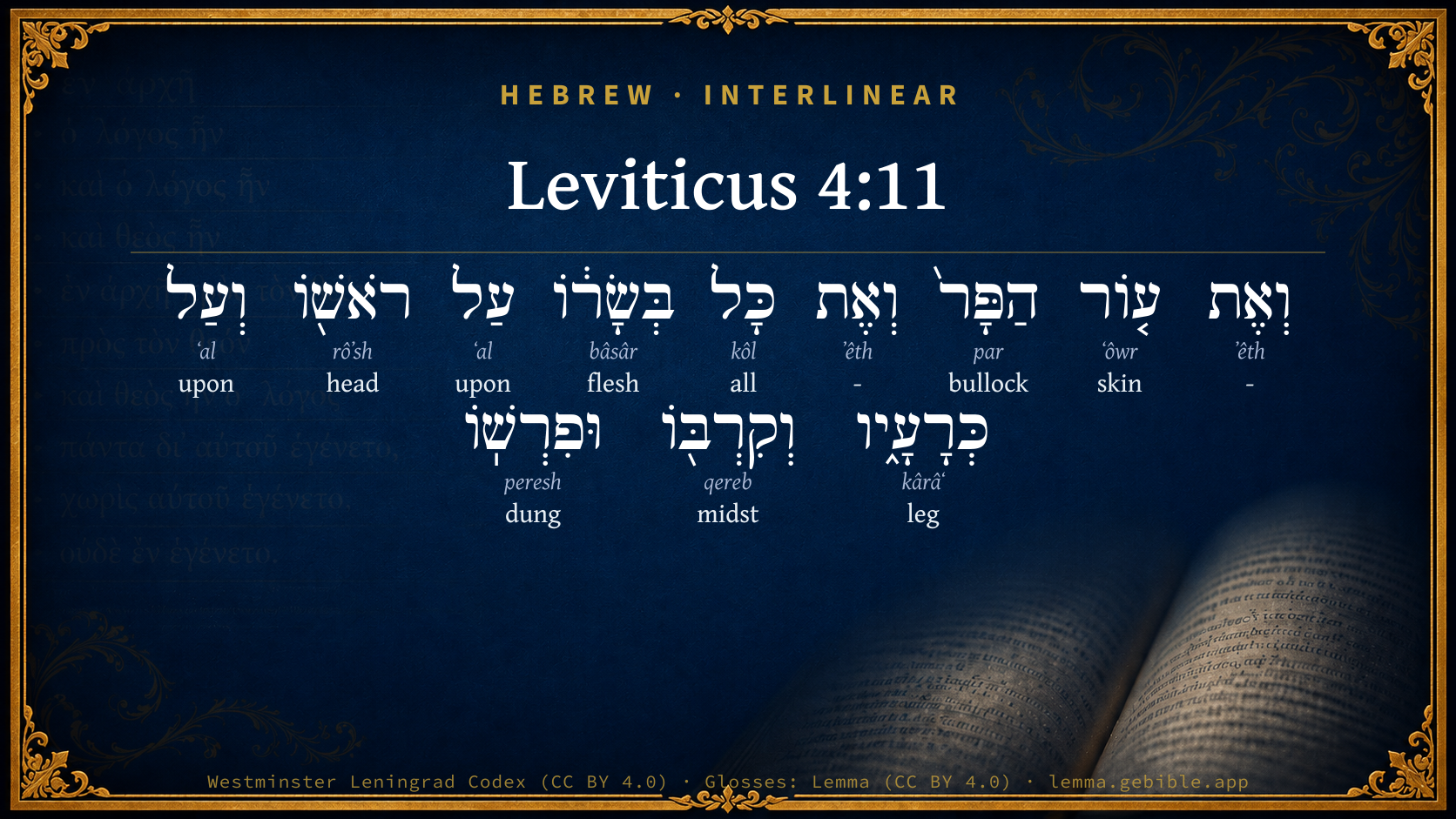
Leviticus 4:11

Hebrew (Westminster Leningrad Codex) Leviticus 4:11 appears in the Hebrew Old Testament. The text above is from the Westminster Leningrad Codex. Each word links to its Strong’s number, a concise gloss, and parsing drawn from the Open Scriptures Hebrew Bible morphology. Click any word for its full Brown-Driver-Briggs (BDB) entry.
Download image
Cite this verse

Leviticus 4:11 (World English Bible). Public Domain. Lemma interlinear Bible study tool, https://lemma.gebible.app/v/leviticus/4/11.

Show BibTeX & RIS
BibTeX
RIS
English Translation
The bull's skin, all its flesh, with its head, and with its legs, its innards, and its dung,
World English Bible · Public Domain
Download a study sheet

One document with this verse’s original text, its word-by-word gloss line, the meaning frame, cross-references with their text, attributed commentary, and full source and license credits — printable, and it pastes into notes with its structure intact.

This verse Autodidact and up

Study sheet (.html) Plain text (.txt)

A passage Seminary Student

Up to 50 verses in one chapter. A passage sheet keeps up to 6 commentary sources and 12 cross-references per verse, in the order this page ranks them, and says so on the sheet whenever that leaves anything out. Ask for a single verse and you get the Autodidact verse sheet above.

Everything on this page stays free to read, with no account — the sheet is a download of what is already on screen, not access to it.

Want to remove ads? Support Godless Engineer
Compare translations 3

The same verse in 3 English versions, stacked beneath the original-language interlinear above. Click any original word for its lexicon entry.

Each is an independent rendering of the whole verse — the interlinear is not word-aligned to these translations.

Highlighted words mark where these versions differ — a whole-verse word diff, not a word-by-word alignment.

  • World English Bible Public Domain
    The bull's skin, all its flesh, with its head, and with its legs, its innards, and its dung,
  • King James Version Public Domain
    And the skin of the bullock, and all his flesh, with his head, and with his legs, and his inwards, and his dung,
  • unfoldingWord Literal Text CC BY-SA 4.0
    And the skin of the bull and all its flesh, with its head and with its legs and its innards and its dung

unfoldingWord Literal Text — © unfoldingWord, licensed CC BY-SA 4.0. Word-aligned USFM3 via Door43 (git.door43.org/unfoldingWord/en_ult).

Versions to compare (up to 4)

3 of 4 selected

Show all 18 translations

Every available English version of this verse, each an independent rendering of the whole verse.

  • World English Bible Public Domain
    The bull's skin, all its flesh, with its head, and with its legs, its innards, and its dung,
  • Berean Standard Bible Public Domain
    But the hide of the bull and all its flesh, with its head and legs and its entrails and dung—
  • Majority Standard Bible Public Domain
    But the hide of the bull and all its flesh, with its head and legs and its entrails and dung—
  • King James Version Public Domain
    And the skin of the bullock, and all his flesh, with his head, and with his legs, and his inwards, and his dung,
  • American Standard Version (1901) Public Domain
    And the skin of the bullock, and all its flesh, with its head, and with its legs, and its inwards, and its dung,
  • Revised Version (1885) Public Domain
    And the skin of the bullock, and all its flesh, with its head, and with its legs, and its inwards, and its dung,
  • Geneva Bible (1599) Public Domain
    But the skinne of the bullocke, and all his flesh, with his heade, and his legs, and his inwardes, and his dung shall he beare out.
  • Douay-Rheims (1899) Public Domain
    But the skin and all the flesh with the head and the feet and the bowels and the dung,
  • Young's Literal Translation Public Domain
    `And the skin of the bullock, and all its flesh, besides its head, and besides its legs, and its inwards, and its dung --
  • Literal Standard Version CC BY-SA 4.0
    And the skin of the bullock, and all its flesh, with its head, and with its legs, and its innards, and its dung—
  • Unlocked Literal Bible CC BY-SA 4.0
    The skin of the bull and any remaining meat, with its head and with its legs and its inner parts and its dung,
  • unfoldingWord Literal Text CC BY-SA 4.0
    And the skin of the bull and all its flesh, with its head and with its legs and its innards and its dung
  • Darby Bible Public Domain
    And the skin of the bullock, and all its flesh, with its head, and with its legs, and its inwards, and its dung,
  • World Messianic Bible Public Domain
    He shall carry the bull’s skin, all its meat, with its head, and with its legs, its innards, and its dung
  • Webster's Bible Public Domain
    And the skin of the bullock, and all his flesh, with his head, and with his legs, and his inwards, and his dung,
  • Free Bible Version CC BY-SA 4.0
    But the skin of the bull, all its flesh, head, legs, insides and waste—
  • Bible in Basic English Public Domain
    And the skin of the ox and all its flesh, with its head and its legs and its inside parts and its waste,
  • JPS Tanakh (1917) Public Domain
    But the skin of the bullock, and all its flesh, with its head, and with its legs, and its inwards, and its dung,

Literal Standard Version (2020), Covenant Press — licensed CC BY-SA 4.0. Text via the HelloAO Bible API (eBible.org). Unlocked Literal Bible (unfoldingWord) — licensed CC BY-SA 4.0. Text via the HelloAO Bible API (eBible.org). unfoldingWord Literal Text — © unfoldingWord, licensed CC BY-SA 4.0. Word-aligned USFM3 via Door43 (git.door43.org/unfoldingWord/en_ult). Free Bible Version, Dr. Jonathan Gallagher — licensed CC BY-SA 4.0. Text via the HelloAO Bible API (eBible.org).

Word by word

More ways to search: Search by grammar → Find every occurrence → Compare this word →

Practice this passage: Drill this verse → Learn its vocabulary →

וּפִרְשֽׁוֹ
peresh
H6569
“and · dung · his”
Conjunction + Noun, Common, Masculine, Singular, Construct + Suffix, Personal, 3rd Person, Masculine, Singular
Part of Speech
Conjunction + Noun
Type
Common
Gender
Masculine
Number
Singular
State
Construct
Full BDB Definition

Origin: from H6567

TWOT: 1835a

faecal matter, dung, offal
  1. וְאֶת ʼêth H853 “and · -” Conjunction + Particle, Direct Object
  2. ע֤וֹר ʻôwr H5785 “skin of” Noun, Common, Masculine, Singular, Construct
  3. הַפָּר֙ par H6499 “the · bullock” Particle, Definite Article + Noun, Common, Masculine, Singular, Absolute
  4. וְאֶת ʼêth H853 “and · -” Conjunction + Particle, Direct Object
  5. כָּל kôl H3605 “all of” Noun, Common, Masculine, Singular, Construct
  6. בְּשָׂר֔וֹ bâsâr H1320 “flesh · his” Noun, Common, Masculine, Singular, Construct + Suffix, Personal, 3rd Person, Masculine, Singular
  7. עַל ʻal H5921 “upon” Preposition
  8. רֹאשׁ֖וֹ rôʼsh H7218 “head · his” Noun, Common, Masculine, Singular, Construct + Suffix, Personal, 3rd Person, Masculine, Singular
  9. וְעַל ʻal H5921 “and · upon” Conjunction + Preposition
  10. כְּרָעָ֑יו kârâʻ H3767 “legs · his” Noun, Common, Both, Dual, Construct + Suffix, Personal, 3rd Person, Masculine, Singular
  11. וְקִרְבּ֖וֹ qereb H7130 “and · midst · his” Conjunction + Noun, Common, Masculine, Singular, Construct + Suffix, Personal, 3rd Person, Masculine, Singular

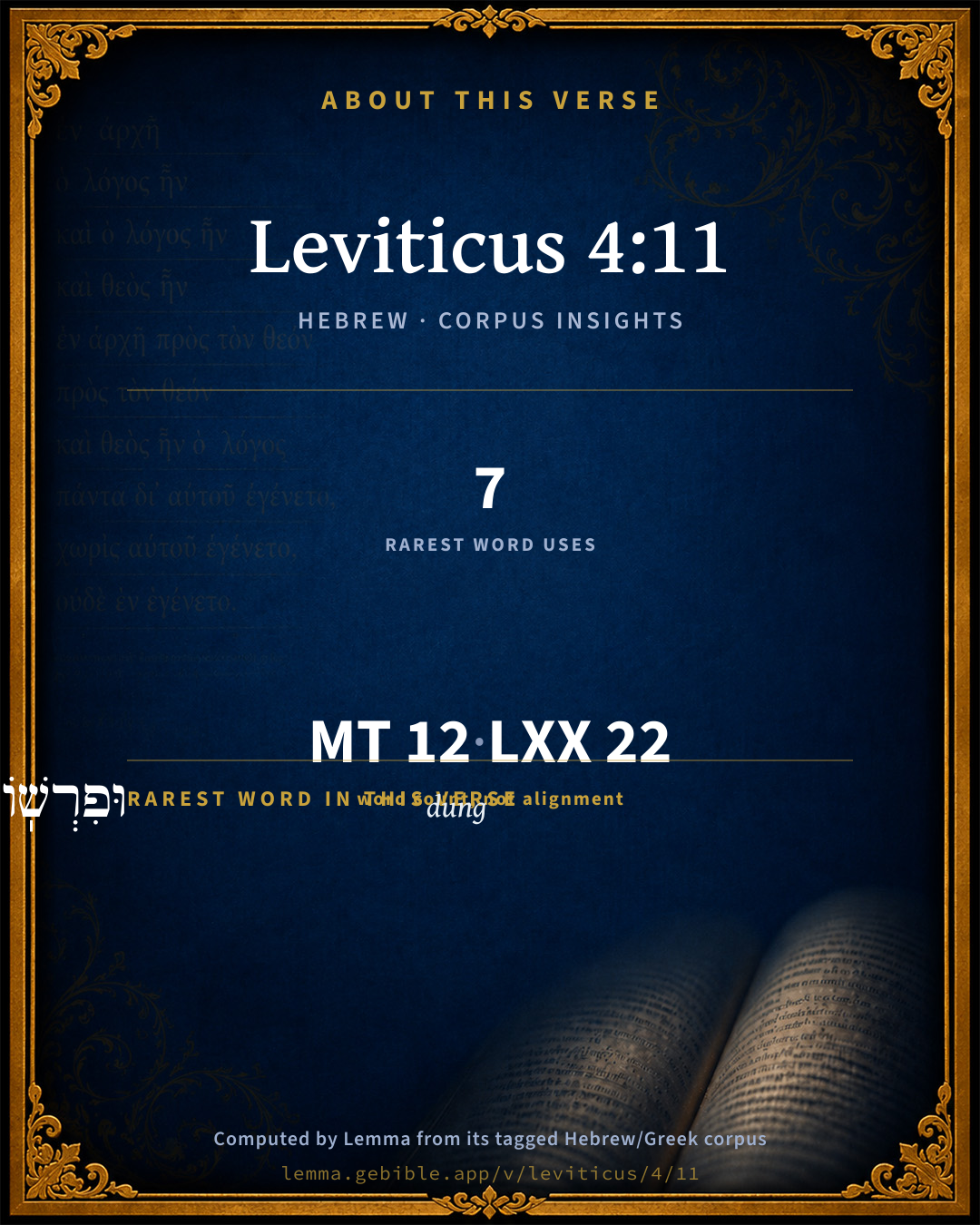
About this verse

These counts appear in no published source. They are computed here, from the morphology-tagged text and Lemma’s own curated glosses. What Lemma adds →

12
words
10
distinct lemmas
Pentateuch
section

Notable vocabulary

The rarest word here is וּפִרְשֽׁוֹ dung H6569 — appearing just 7 times in the whole Hebrew Bible.

Shared distinctive vocabulary

וּפִרְשֽׁוֹ dung H6569 occurs in 6 verses of the Hebrew Bible. Also found in:

Grammatical profile

  • 8 nouns
  • 2 prepositions
  • 2 particles

Repetition

A word recurs within this verse — often emphatic in Hebrew:

Hebrew & Septuagint length

In English translation the verse runs 18 words from the Hebrew and 25 from the Septuagint (LXX English) — closely comparable.

A rough comparison of the two English renderings, which tokenize alike — not a word-level alignment.

Word counts can differ between the Hebrew and the Greek without any difference in meaning — e.g. the Hebrew direct-object marker אֵת has no separate Greek word, and Greek often adds the article ὁ.

In the original languages it is 12 Hebrew tokens and 22 Greek tokens — but the two are counted differently (Hebrew bundles its prefixes and suffixes into one token; the Greek is in lemma form), so that isn’t a like-for-like length.

Cross-references

9

Topical passages linked to Leviticus 4:11 in the Treasury of Scripture Knowledge — connected by theme and wording, ordered by reader-vote popularity; previews shown in the World English Bible.

  • Numbers 19:5 One shall burn the heifer in his sight; her skin, and her flesh, and her blood, with her dung, shall he burn:
  • Exodus 29:14 But the flesh of the bull, and its skin, and its dung, you shall burn with fire outside of the camp: it is a sin-offering.
  • Leviticus 4:21 He shall carry forth the bull outside the camp, and burn it as he burned the first bull. It is the sin offering for the assembly.
  • Leviticus 6:30 No sin offering, of which any of the blood is brought into the Tent of Meeting to make atonement in the Holy Place, shall be eaten: it shall be burned with fire.
  • Leviticus 8:14–17 He brought the bull of the sin offering, and Aaron and his sons laid their hands on the head of the bull of the sin offering.
  • Leviticus 9:8–11 So Aaron drew near to the altar, and killed the calf of the sin offering, which was for himself.
  • Leviticus 16:27 The bull for the sin offering, and the goat for the sin offering, whose blood was brought in to make atonement in the Holy Place, shall be carried forth outside the camp; and they shall burn their skins, their flesh, and their dung with fire.
  • Psalms 103:12 As far as the east is from the west, So far has he removed our transgressions from us.
  • Hebrews 13:11–13 For the bodies of those animals, whose blood is brought into the holy place by the high priest as an offering for sin, are burned outside of the camp.

Cross-references courtesy of OpenBible.info (CC BY 4.0).

Hebrew and Greek witnesses Masoretic Hebrew ↔ Greek Septuagint

The same verse in the two great witnesses to the Old Testament, shown verse-for-verse.

These are two independent witnesses, not word-aligned to each other, and the Septuagint is shown in lemma (dictionary) form.

Hebrew Leviticus 4:11 Masoretic · Westminster Leningrad Codex

וְאֶת ע֤וֹר הַפָּר֙ וְאֶת כָּל בְּשָׂר֔וֹ עַל רֹאשׁ֖וֹ וְעַל כְּרָעָ֑יו וְקִרְבּ֖וֹ וּפִרְשֽׁוֹ

The bull's skin, all its flesh, with its head, and with its legs, its innards, and its dung,

World English Bible · Public Domain

Greek LXX Leviticus 4:11 Septuagint · lemma form

καί ὁ δέρμα ὁ μόσχος καί πᾶς αὐτός ὁ σάρξ σύν ὁ κεφαλή καί ὁ ἀκρωτήριον καί ὁ κοιλία καί ὁ κόπρος

And they shall take the skin of the calf, and all his flesh with the head and the extremities and the belly and the dung,

LXX2012 (modern English Septuagint) · Public Domain

Hebrew: Westminster Leningrad Codex (CC BY 4.0). Greek: Septuagint (public domain); English from LXX2012 (modern English Septuagint) (Public Domain). How the Septuagint differs from the Hebrew →

Targum (Aramaic paraphrase)

2

The Targum is the ancient Jewish Aramaic paraphrase of the Hebrew Scriptures — an interpretive translation, not the Hebrew text itself. Onkelos (literal) and Pseudo-Jonathan (expansive) render the Torah, and Jonathan the Prophets. Coverage is partial: where no permissively-licensed English translation exists for a verse, only the Aramaic is shown. This is verse-level text, not a word-by-word alignment to the Hebrew.

  1. Targum Onkelos Torah (Genesis–Deuteronomy)
    וְיָת מְשַׁךְ תּוֹרָא וְיָת כָּל בִּסְרֵהּ עַל רֵישֵׁיהּ וְעַל כְּרָעוֹהִי וְגַוֵהּ וְאוּכְלֵהּ

    (no public-domain English translation for this verse)

    Targum Onkelos — Aramaic: “Onkelos Genesis” (public domain); “Onkelos Exodus” (public domain); “Onkelos Leviticus” (public domain); “Onkelos Numbers” (public domain); “Onkelos Deuteronomy” (public domain). English: “Sefaria Community Translation” (CC0 1.0 (public-domain dedication)); “J.W. Etheridge. The Targums of Onkelos and Jonathan Ben Uzziel on the Pentateuch. London: Longmans, Green, 1862” (public domain). Text via Sefaria.

  2. Targum Pseudo-Jonathan Torah (Genesis–Deuteronomy)
    וְיַת כָּל מְשַׁךְ תּוֹרָא וְיַת בִּישְרֵיהּ עַל רֵישֵׁיהּ וְעַל רִיגְלוֹי וְעַל בְּנֵי גַוֵּיהּ וְרַעֲיֵהּ

    And all the skin of the bullock, and his flesh with his head and with his legs, and his inward parts and his dung,

    Targum Pseudo-Jonathan — Aramaic: “Targum Jonathan on Genesis” (public domain); “Targum Jonathan on Exodus” (public domain); “Targum Jonathan on Leviticus” (public domain); “Targum Jonathan on Numbers” (public domain); “Targum Jonathan on Deuteronomy” (public domain). English: “The Targum of Jonathan ben Uzziel, trans. J. W. Etheridge, London, 1862” (public domain). Text via Sefaria.

Commentary

Notes on Leviticus 4:11 from classic Christian and Jewish commentators (each source and its license shown beneath its notes). The classic Christian expositions comment on the surrounding passage and are grouped to its opening verse, so a note may address several verses; the Jewish commentaries on the Tanakh (Rashi and others) are per-verse, so they appear only where the commentator wrote on this verse.

Lemma curates 59 commentaries, every one of them public domain or Creative Commons licensed, each selected and text-cleaned for this edition rather than reprinted as found. About our sources →

Trapp's Complete Commentary

John Trapp

Lev 4:11 And the skin of the bullock, and all his flesh, with his head, and with his legs, and his inwards, and his dung,

Ver. 11. And the skin, &c.] {See Trapp on "Lev 1:9"}

John Trapp, A Commentary or Exposition upon All the Books of the Old and New Testament (1647–1656) — public domain. Text from a community e-Sword module.

The Biblical Illustrator

Joseph S. Exell

Lev_4:11-12

The whole bullock shall he carry forth.

Why the skin, flesh, and other parts of the bullock was carried out of the host

1. The legal reason was because it was a sacrifice for sin, and therefore unmeet to be burnt as other sacrifices upon the altar.

2. The historical reason, because the Lord suffered without the gate of the city.

3. The moral reason, to show that the skin with the flesh was carried forth so the priest should be far off, not only from sin, but the occasion thereof.

4. The mystical reason, that Christ doth cast out-of-doors, and remove far away from us our sins.

5. Now further, the sin-offering for the priest, and for the whole congregation were burnt without, to show the horror and greatness of their sin; and though it were unclean, being a sacrifice for sin, yet because some part thereof, namely the fat, was burnt upon the altar, the remaining part was with reverence to be burned, and in a clean place, and therefore without the camp, because it was separated from the common pollutions which might happen within the camp.

6. The Hebrews further observe that the high priests sin-offering was commanded to be burnt openly without the camp, to the end that no man might be ashamed to confess his sin. (A. Willet, D. D.)

To bear patiently the momentary afflictions of this life

Whereas Lev_4:12, the bullock was to be carried out of the host, the apostle applieth it to Christ suffering without the gate, making this further use of it--Let us go forth therefore out of the camp, bearing His reproach, for we have no continuing city (Heb_13:13). We should in our meditation and desire go out of the world as out of the camp, and be content to bear reproach for Christs sake, seeing we shall have no long continuance here, but look for an everlasting habitation in heaven; by this reason taken from the shortness of our afflictions the apostle exhorteth thus (2Co_4:17). The imitation of the saints, shortness of time, fragility of the body do persuade to perseverance, nature hath well provided that grief if it be great cannot be long, for a short danger thou shalt receive an everlasting reward. (A. Willet, D. D.)

The Biblical Illustrator, edited by Joseph S. Exell (c. 1880s–1900s) — public domain. Text from a community e-Sword module.

Tyndale Open Study Notes

Tyndale Open Resources

4:11-12 Only the offerings for the priest or the entire community were burned outside the camp. Perhaps this was commanded because the offering had figuratively absorbed the contamination of the high priest or the community and therefore had to be disposed of outside the camp. Those guilty were not to partake of or reap any benefit from their own sin offerings, even if they were priests (6:19-23).

Tyndale Open Study Notes — © Tyndale Open Resources, licensed CC BY-SA 4.0. Text via the HelloAO Bible API.

Jamieson, Fausset & Brown

Robert Jamieson, A. R. Fausset & David Brown

the skin of the bullock, and all his flesh--In ordinary circumstances, these were perquisites of the priests. But in the expiation necessary for a sin of the high priest, after the fat of the sacrifice was offered on the altar, the carcass was carried without the camp [Lev 4:12], in order that the total combustion of it in the place of ashes might the more strikingly indicate the enormity of the transgression, and the horror with which he regarded it (compare Heb 13:12-13).

Jamieson, Fausset & Brown — Commentary Critical and Explanatory on the Whole Bible (1871) — public domain (CC PDM 1.0). Text via the HelloAO Bible API.

Ellicott's Commentary for English Readers

(11) And the skin of the bullock.—Unlike other burnt offerings, the skins of which were taken off, and became the perquisite of the priests (Lev_7:8), this sin offering was not flayed at all, but was cut to pieces with its skin.

A Bible Commentary for English Readers, edited by Charles John Ellicott (1878–1897) — public domain. Text from a community e-Sword module.

John Gill's Exposition

Even the whole bullock shall he carry forth without the camp,.... The Jewish writers interpret it without the three camps (b), the camp of the tabernacle, the camp of the Levites, and the camp of the Israelites; when the temple was built, such sacrifices were carried and burnt without the city of Jerusalem; there were three places for burning; one was in the midst of the court, where they burnt such sacrifices as were unfit and rejected; the other was in the mountain of the house called Birah, where they burnt such as any accident befell them, after the carrying of them out of the court; and the third place was without Jerusalem, called the place of ashes (c): this was typical of Christ being had out of the city of Jerusalem, and suffering without the gates of it, Heb 13:11,

unto a clean place, where the ashes are poured out; the ashes of the burnt offerings. This, according to Ainsworth, answered to the place where Christ was crucified, being a place of skulls, or dead men's ashes, Joh 19:17,

and burn him on the wood with fire; any wood might be used for the burning of it, even straw or stubble, which in the Hebrew language are called wood, as Gersom on the place observes, and so Maimonides (d); and it is added, "with fire", as the last writer says (e), to exclude lime and cinder coals:

where the ashes are poured out shall he be burnt; openly without; and seeing it is not said, that the priest shall carry forth the bullock, and shall burn it, it is concluded by Gersom on the place, that both may be done lawfully by a stranger, and so Maimonides (f).

(b) T. Bab. Yoma, fol. 68. 1. 2. & Sanhedrin, fol. 42. 2. Maimon. & Bartenora in Misn. Zebachim, c. 12. sect. 5. Jarchi in loc. (c) Maimon. Maaseh Hakorbanot, c. 7. sect. 3, 4. (d) Maimon. Hilchot Maaseh Hakorbanot, c. 7. sect. 5. (e) Ib. Vid. T. Bab. Pesachim, fol. 75. 1. (f) Maimon. ib.

John Gill's Exposition of the Whole Bible (1746–1763) — public domain (CC PDM 1.0). Text via the HelloAO Bible API.

Whedon's Commentary on the Bible

Daniel D. Whedon

11. The skin — This, in the whole burnt offering, was the perquisite of the priest. See note on Lev_7:8. In the sin offering for a priest or the congregation it was to be burned. But in the sin offering for a prince or a private person it is left doubtful.

Daniel D. Whedon (gen. ed.), Commentary on the Old and New Testaments (1874–1909) — public domain. Text from a community e-Sword module.

The Pulpit Commentary

Vers. 11, 12. Full acceptance with God.

The carrying away of all the offered animal (save that part which had been presented to God in sacrifice) and the burning of it in "a clean place" (verse 12), was probably meant to represent the full and perfect acceptance of the offerer by the Holy One of Israel. When the victim had been slain and its blood outpoured on the altar and its richest part accepted in sacrifice, there might seem to have been sufficient indication of Divine mercy. But one sign more was added: the animal which represented the worshipper having shed its blood, and that shed blood having been received as an expiation, it became holy; when, therefore, its flesh was not eaten by the priest (Lev_6:26) in token of its sanctity, every part of the animal was solemnly and reverently consumed, in "a clean place" Nothing, pertaining to that which had become holy through the shed blood should be treated as an unholy thing. Looked at in this light, we gain the valuable thought that when sin has been forgiven through faith in the shed blood of the Redeemer, the sinner is regarded as holy in the sight of God. As everything was thus done by pictorial representation to express the thought of the fullness of Divine forgiveness, so everything was stated in explicit language through the psalmists and prophets to the same effect. (Exo_34:6, 7 Psa_86:5, 15 103:8 145:8 Isa_1:18 Isa_55:7) So, also, our Lord, in the "prince of parables," included everything that could be introduced the robe, the ring, the shoes, the fatted calf to present in the strongest colouring the precious truth that God does not grudgingly or imperfectly forgive, but that he abundantly pardons." The subject demands our consideration of two things

I THE FULNESS OF GOD"S ACCEPTANCE. God"s mercy in Christ Jesus embraces:

1. The entire forgiveness of all past sins, so that all our numerous transgressions of his Law, both the more heinous and the less guilty, are "blotted out" of his "book of remembrance," and no more regarded by him; and so that all our more numerous shortcomings, our failure to be and to do that which the heavenly Father looked for from his children, are entirely forgiven.

2. The overlooking of our present unworthiness; so that the scantiness of our knowledge, the imperfection of our penitence, the feebleness of our faith, the poverty of our resolutions, and our general unworthiness do not stand in the way of his "benign regard.

3. The bestowment of his Divine complacency; so that he not only "receives us graciously," but "loves us freely". (Hos_14:2, Hos_14:4) He feels toward us the love and the delight which a father feels toward the children of his heart and his home. But to gain this inestimable blessing, let us be sure that we have fulfilled

II THE CONDITIONS ON WHICH IT IS BESTOWED. These are twofold. Paul has expressed them thus:

(1) repentance toward God; and

(2) faith toward our Lord Jesus Christ. (Act_20:21)

He who inspired Paul has taught us the same truth in his own words. (Luk_24:47 Act_26:18) There must be the turning of the heart, in shame and sorrow, from sin unto God, and the cordial acceptance of the Lord Jesus Christ as the Divine Teacher, the all-sufficient Saviour, the rightful Lord of heart and life, which he claims to be. C.

The Pulpit Commentary (1880–1919), ed. H.D.M. Spence-Jones & Joseph S. Exell — public domain. Text from a community e-Sword module.

unfoldingWord translationNotes

Door43 World Missions Community

The skin ... the parts of the bull—he will carry all these parts outside

The statement "he will carry all these parts" can be placed at the beginning of the sentence. AT: "The priest will carry the skin ... the parts of the bull outside"

a place that they have cleansed for me

A place being ritually pure and suitable to use for serving God is spoken of as if it were physically clean. (See: Metaphor)

they have cleansed for me

Here "they" refers to the priests, and "me" refers to Yahweh.

translationWords

cow

dung

clean

unfoldingWord translationNotes — © Distant Shores Media and the Door43 World Missions Community, licensed CC BY-SA 4.0. Source: git.door43.org/Door43/en_tn.

Lesson kit

Teaching starters — assembled from the data on this page, not authored interpretation. Every prompt links to the verse data it draws on. Edit before teaching.

Leviticus, in the Pentateuch, opens this verse with 12 words (10 distinct Hebrew lemmas). Its most distinctive word is peresh (“dung”). A historical commentator’s framing appears above. Read the whole chapter for the surrounding context.

Discussion questions

  1. What does “dung” (peresh) contribute to the verse as a whole?
  2. Exodus 29:14 shares the word «dung» with this verse. How do the two illuminate each other?
  3. “upon” occurs 2× in this one verse. What is the effect of the repetition?
  4. These translations render this verse differently. What is at stake in choosing one wording over another?
  5. Reading how Trapp's Complete Commentary and The Biblical Illustrator read this verse, where do the two commentators agree and where do they part?

Things to notice

Reading settings

Reading text

Shown beneath each verse's original-language words.

Old Testament
Old Testament edition

Read the OT as the Masoretic Hebrew (MT) or the Greek Septuagint (LXX).

English shown for the Greek Septuagint (in the Hebrew ↔ Greek comparison).

Comparing translations? Open the Compare panel on any verse page to stack up to four side by side.