Joshua 24:5

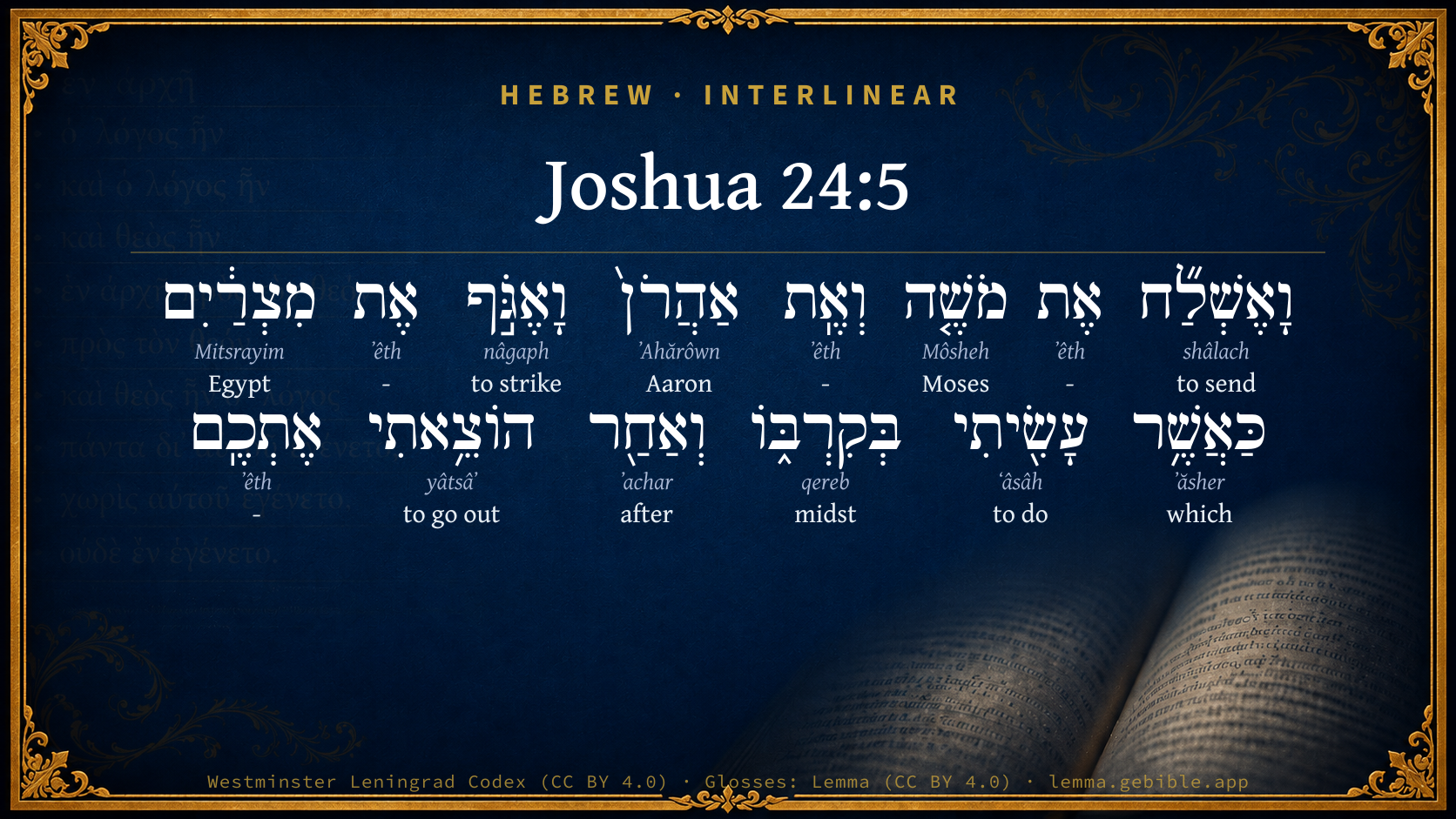
Hebrew (Westminster Leningrad Codex) Joshua 24:5 appears in the Hebrew Old Testament. The text above is from the Westminster Leningrad Codex. Each word links to its Strong’s number, a concise gloss, and parsing drawn from the Open Scriptures Hebrew Bible morphology. Click any word for its full Brown-Driver-Briggs (BDB) entry.
Download image
Cite this verse

Joshua 24:5 (World English Bible). Public Domain. Lemma interlinear Bible study tool, https://lemma.gebible.app/v/joshua/24/5.

Show BibTeX & RIS
BibTeX
RIS
English Translation
I sent Moses and Aaron, and I plagued Egypt, according to that which I did in the midst of it: and afterward I brought you out.
World English Bible · Public Domain
Download a study sheet

One document with this verse’s original text, its word-by-word gloss line, the meaning frame, cross-references with their text, attributed commentary, and full source and license credits — printable, and it pastes into notes with its structure intact.

This verse Autodidact and up

Study sheet (.html) Plain text (.txt)

A passage Seminary Student

Up to 50 verses in one chapter. A passage sheet keeps up to 6 commentary sources and 12 cross-references per verse, in the order this page ranks them, and says so on the sheet whenever that leaves anything out. Ask for a single verse and you get the Autodidact verse sheet above.

Everything on this page stays free to read, with no account — the sheet is a download of what is already on screen, not access to it.

Want to remove ads? Support Godless Engineer
Compare translations 3

The same verse in 3 English versions, stacked beneath the original-language interlinear above. Click any original word for its lexicon entry.

Each is an independent rendering of the whole verse — the interlinear is not word-aligned to these translations.

Highlighted words mark where these versions differ — a whole-verse word diff, not a word-by-word alignment.

  • World English Bible Public Domain
    I sent Moses and Aaron, and I plagued Egypt, according to that which I did in the midst of it: and afterward I brought you out.
  • King James Version Public Domain
    I sent Moses also and Aaron, and I plagued Egypt, according to that which I did among them: and afterward I brought you out.
  • unfoldingWord Literal Text CC BY-SA 4.0
    And I sent Moses and Aaron, and I struck Egypt according to what I did in the midst of it. And afterward I brought you out.

unfoldingWord Literal Text — © unfoldingWord, licensed CC BY-SA 4.0. Word-aligned USFM3 via Door43 (git.door43.org/unfoldingWord/en_ult).

Versions to compare (up to 4)

3 of 4 selected

Show all 18 translations

Every available English version of this verse, each an independent rendering of the whole verse.

  • World English Bible Public Domain
    I sent Moses and Aaron, and I plagued Egypt, according to that which I did in the midst of it: and afterward I brought you out.
  • Berean Standard Bible Public Domain
    Then I sent Moses and Aaron, and I afflicted the Egyptians by what I did there, and afterward I brought you out.
  • Majority Standard Bible Public Domain
    Then I sent Moses and Aaron, and I afflicted the Egyptians by what I did there, and afterward I brought you out.
  • King James Version Public Domain
    I sent Moses also and Aaron, and I plagued Egypt, according to that which I did among them: and afterward I brought you out.
  • American Standard Version (1901) Public Domain
    And I sent Moses and Aaron, and I plagued Egypt, according to that which I did in the midst thereof: and afterward I brought you out.
  • Revised Version (1885) Public Domain
    And I sent Moses and Aaron, and I plagued Egypt, according to that which I did in the midst thereof: and afterward I brought you out.
  • Geneva Bible (1599) Public Domain
    I sent Moses also and Aaron, and I plagued Egypt: and when I had so done among them, I brought you out.
  • Douay-Rheims (1899) Public Domain
    And I sent Moses and Aaron, and I struck Egypt with many signs and wonders.
  • Young's Literal Translation Public Domain
    And I send Moses and Aaron, and plague Egypt, as I have done in its midst, and afterwards I have brought you out.
  • Literal Standard Version CC BY-SA 4.0
    And I send Moses and Aaron, and plague Egypt, as I have done in its midst, and afterward I have brought you out.
  • Unlocked Literal Bible CC BY-SA 4.0
    I sent Moses and Aaron, and I afflicted the Egyptians with plagues. After that, I brought you out.
  • unfoldingWord Literal Text CC BY-SA 4.0
    And I sent Moses and Aaron, and I struck Egypt according to what I did in the midst of it. And afterward I brought you out.
  • Darby Bible Public Domain
    And I sent Moses and Aaron, and I plagued Egypt, according to that which I did among them; and afterwards I brought you out.
  • World Messianic Bible Public Domain
    “‘I sent Moses and Aaron, and I plagued Egypt, according to that which I did among them: and afterward I brought you out.
  • Webster's Bible Public Domain
    I sent Moses also and Aaron, and I plagued Egypt, according to that which I did among them: and afterward I brought you out.
  • Free Bible Version CC BY-SA 4.0
    I sent Moses and Aaron, and I brought plagues on the people of Egypt, and I brought you out.
  • Bible in Basic English Public Domain
    And I sent Moses and Aaron, troubling Egypt by all the signs I did among them: and after that I took you out.
  • JPS Tanakh (1917) Public Domain
    And I sent Moses and Aaron, and I plagued Egypt, according to that which I did in the midst thereof; and afterward I brought you out.

Literal Standard Version (2020), Covenant Press — licensed CC BY-SA 4.0. Text via the HelloAO Bible API (eBible.org). Unlocked Literal Bible (unfoldingWord) — licensed CC BY-SA 4.0. Text via the HelloAO Bible API (eBible.org). unfoldingWord Literal Text — © unfoldingWord, licensed CC BY-SA 4.0. Word-aligned USFM3 via Door43 (git.door43.org/unfoldingWord/en_ult). Free Bible Version, Dr. Jonathan Gallagher — licensed CC BY-SA 4.0. Text via the HelloAO Bible API (eBible.org).

Word by word

More ways to search: Search by grammar → Find every occurrence → Compare this word →

Practice this passage: Drill this verse → Learn its vocabulary →

וָאֶגֹּ֣ף
nâgaph
H5062
“and · to strike”
Conjunction + Verb, Qal, Sequential Imperfect, 1st Person, Common, Singular
Part of Speech
Conjunction + Verb
Stem
Qal
Form
Sequential Imperfect
Person
1st Person
Gender
Common
Number
Singular
Full BDB Definition

Origin: a primitive root

TWOT: 1294

to strike, smite - (Qal) to strike, smite - (Niphal) to be stricken, be smitten - (Hithpael) to stumble
  1. וָאֶשְׁלַ֞ח shâlach H7971 “and · to send” Conjunction + Verb, Qal, Sequential Imperfect, 1st Person, Common, Singular
  2. אֶת ʼêth H853 “-” Particle, Direct Object
  3. מֹשֶׁ֤ה Môsheh H4872 “Moses” Noun, Proper
  4. וְאֶֽת ʼêth H853 “and · -” Conjunction + Particle, Direct Object
  5. אַהֲרֹן֙ ʼAhărôwn H175 “Aaron” Noun, Proper
  6. אֶת ʼêth H853 “-” Particle, Direct Object
  7. מִצְרַ֔יִם Mitsrayim H4714 “Egypt” Noun, Proper
  8. כַּאֲשֶׁ֥ר ʼăsher H834 “like/as · which” Preposition + Particle, Relative
  9. עָשִׂ֖יתִי ʻâsâh H6213 “to do” Verb, Qal, Perfect, 1st Person, Common, Singular
  10. בְּקִרְבּ֑וֹ qereb H7130 “in/at · midst · his” Preposition + Noun, Common, Masculine, Singular, Construct + Suffix, Personal, 3rd Person, Masculine, Singular
  11. וְאַחַ֖ר ʼachar H310 “and · after” Conjunction + Adverb
  12. הוֹצֵ֥אתִי yâtsâʼ H3318 “to go out” Verb, Hiphil, Perfect, 1st Person, Common, Singular
  13. אֶתְכֶֽם ʼêth H853 “- · you” Particle, Direct Object + Suffix, Personal, 2nd Person, Masculine, Plural

About this verse

These counts appear in no published source. They are computed here, from the morphology-tagged text and Lemma’s own curated glosses. What Lemma adds →

14
words
11
distinct lemmas
Historical
section

Shared distinctive vocabulary

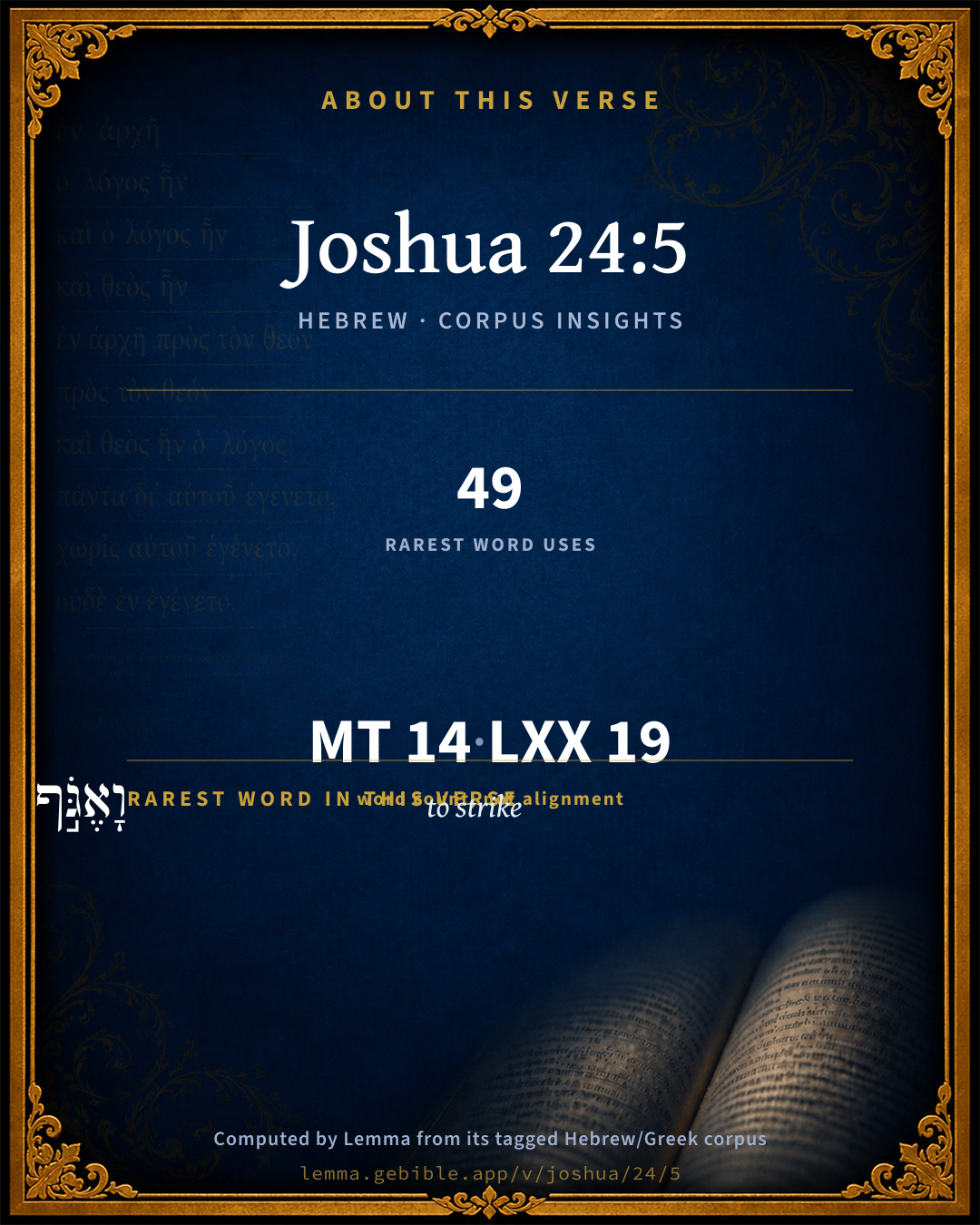
וָאֶגֹּ֣ף to strike H5062 occurs in 46 verses of the Hebrew Bible. Also found in:

Grammatical profile

  • 4 verbs
  • 4 nouns
  • 1 adverb
  • 5 particles

Verb forms

  • וָאֶשְׁלַ֞ח Qal · Sequential Imperfect
  • וָאֶגֹּ֣ף Qal · Sequential Imperfect
  • עָשִׂ֖יתִי Qal · Perfect
  • הוֹצֵ֥אתִי Hiphil · Perfect

Hebrew & Septuagint length

In English translation the verse runs 26 words from the Hebrew and 12 from the Septuagint (LXX English) — the Septuagint runs noticeably shorter here. See the side-by-side →

A rough comparison of the two English renderings, which tokenize alike — not a word-level alignment.

Word counts can differ between the Hebrew and the Greek without any difference in meaning — e.g. the Hebrew direct-object marker אֵת has no separate Greek word, and Greek often adds the article ὁ.

In the original languages it is 14 Hebrew tokens and 19 Greek tokens — but the two are counted differently (Hebrew bundles its prefixes and suffixes into one token; the Greek is in lemma form), so that isn’t a like-for-like length.

Cross-references

9

Topical passages linked to Joshua 24:5 in the Treasury of Scripture Knowledge — connected by theme and wording, ordered by reader-vote popularity; previews shown in the World English Bible.

  • Exodus 3:10 Come now therefore, and I will send you to Pharaoh, that you may bring forth my people, the children of Israel, out of Egypt."
  • Exodus 7:1–12 Yahweh said to Moses, "Behold, I have made you as God to Pharaoh; and Aaron your brother shall be your prophet.
  • Exodus 4:12–14 Now therefore go, and I will be with your mouth, and teach you what you shall speak."
  • Exodus 12:37 The children of Israel traveled from Rameses to Succoth, about six hundred thousand on foot who were men, besides children.
  • Exodus 12:51 It happened the same day, that Yahweh brought the children of Israel out of the land of Egypt by their hosts.
  • Psalms 78:43–51 How he set his signs in Egypt, His wonders in the field of Zoan,
  • Psalms 105:26–36 He sent Moses, his servant, And Aaron, whom he had chosen.
  • Psalms 135:8–9 Who struck the firstborn of Egypt, Both of man and animal;
  • Psalms 136:10 To him who struck down the Egyptian firstborn; For his loving kindness endures forever;

Cross-references courtesy of OpenBible.info (CC BY 4.0).

Hebrew and Greek witnesses Masoretic Hebrew ↔ Greek Septuagint

The same verse in the two great witnesses to the Old Testament, shown verse-for-verse.

Here the Septuagint runs noticeably shorter than the Hebrew — LXX2012 (modern English Septuagint) 12 words vs World English Bible 26. A rough length comparison of the two English translations, not a word-level alignment — read both below.

These are two independent witnesses, not word-aligned to each other, and the Septuagint is shown in lemma (dictionary) form.

Hebrew Joshua 24:5 Masoretic · Westminster Leningrad Codex

וָאֶשְׁלַ֞ח אֶת מֹשֶׁ֤ה וְאֶֽת אַהֲרֹן֙ וָאֶגֹּ֣ף אֶת מִצְרַ֔יִם כַּאֲשֶׁ֥ר עָשִׂ֖יתִי בְּקִרְבּ֑וֹ וְאַחַ֖ר הוֹצֵ֥אתִי אֶתְכֶֽם

I sent Moses and Aaron, and I plagued Egypt, according to that which I did in the midst of it: and afterward I brought you out.

World English Bible · Public Domain

Greek LXX Joshua 24:5 Septuagint · lemma form

καί κακόω αὐτός ὁ αἰγύπτιος καί πατάσσω κύριος ὁ αἴγυπτος ἐν ὅς ποιέω αὐτός καί μετά οὗτος ἐκἄγω σύ

And I struck Egypt with the wonders that I wrought among them.

LXX2012 (modern English Septuagint) · Public Domain

Hebrew: Westminster Leningrad Codex (CC BY 4.0). Greek: Septuagint (public domain); English from LXX2012 (modern English Septuagint) (Public Domain). How the Septuagint differs from the Hebrew →

Targum (Aramaic paraphrase)

1

The Targum is the ancient Jewish Aramaic paraphrase of the Hebrew Scriptures — an interpretive translation, not the Hebrew text itself. Onkelos (literal) and Pseudo-Jonathan (expansive) render the Torah, and Jonathan the Prophets. Coverage is partial: where no permissively-licensed English translation exists for a verse, only the Aramaic is shown. This is verse-level text, not a word-by-word alignment to the Hebrew.

  1. Targum Jonathan Prophets (Joshua–Malachi)
    וְשַׁלְחֵית יַת מֹשֶׁה וְיַת אַהֲרֹן וּמָחִית יַת מִצְרָאֵי כְּמָא דְעַבְדִית בֵּינֵיהוֹן וּבָתַר כֵּן אַפְקֵית יַתְכוֹן:

    (no public-domain English translation for this verse)

    Targum Jonathan — Aramaic: “Mikraot Gedolot” (public domain). English: “Sefaria Community Translation” (CC0 1.0 (public-domain dedication)); “London "Chaldee Paraphrase," 1871” (public domain). Text via Sefaria.

Commentary

Notes on Joshua 24:5 from classic Christian and Jewish commentators (each source and its license shown beneath its notes). The classic Christian expositions comment on the surrounding passage and are grouped to its opening verse, so a note may address several verses; the Jewish commentaries on the Tanakh (Rashi and others) are per-verse, so they appear only where the commentator wrote on this verse.

Lemma curates 59 commentaries, every one of them public domain or Creative Commons licensed, each selected and text-cleaned for this edition rather than reprinted as found. About our sources →

Trapp's Complete Commentary

John Trapp

Jos 24:5 I sent Moses also and Aaron, and I plagued Egypt, according to that which I did among them: and afterward I brought you out.

Ver. 5. And I brought you out.] As brands out of the fire; as many of you here present as were then under twenty years of age: and a great mercy it was to be pulled out of such a superstitious place. Gregory Nazianzen reporteth of Athens, that it was the most plagueful place in the world for superstition, even another Egypt. And he acknowledgeth it a great mercy that God did deliver him and Basil from those infections.

John Trapp, A Commentary or Exposition upon All the Books of the Old and New Testament (1647–1656) — public domain. Text from a community e-Sword module.

Tyndale Open Study Notes

Tyndale Open Resources

24:5-7 The Exodus, which culminated with the crossing of the Red Sea, was the climactic salvation event of ancient Israel’s history. A number of psalms, several of the later prophets, and several New Testament writers all celebrated this defining event.

Tyndale Open Study Notes — © Tyndale Open Resources, licensed CC BY-SA 4.0. Text via the HelloAO Bible API.

The Cambridge Bible for Schools and Colleges

gen. ed. J. J. S. Perowne

5. I sent Moses also and Aaron] Comp. Exo_3:10. This is the second proof of the Divine favour, the deliverance of Israel out of Egypt. The chief incidents of this great event are succinctly alluded to; (1) the mission of Moses and Aaron; (2) the infliction of the plagues upon Egypt; (3) the destruction of the Egyptians in the Red Sea.

I plagued Egypt] See Exodus 7-12. “Y smoot Egipt with many signes and wondris,” Wyclif. (1) The turning the water into blood; (2) frogs; (3) lice, or gnats; (4) flies; (5) murrain; (6) boils and blains; (7) thunder, lightning, and hail; (8) locusts; (9) darkness; (10) slaying of the firstborn.

The Cambridge Bible for Schools and Colleges (gen. ed. J. J. S. Perowne; Cambridge University Press, 1878–1918) — public domain. Text from a community e-Sword module.

John Gill's Exposition

I sent Moses also and Aaron,.... To demand Israel's dismission of Pharaoh, king of Egypt, and to be the deliverers of them:

and I plagued Egypt according to that which I did amongst them; inflicting ten plagues upon them for refusing to let Israel go:

and afterwards I brought you out; that is, out of Egypt, with an high hand, and outstretched arm.

John Gill's Exposition of the Whole Bible (1746–1763) — public domain (CC PDM 1.0). Text via the HelloAO Bible API.

Matthew Poole's English Annotations

According to that which I did, i.e. in such manner, and with such plagues as I inflicted, and are recorded.

Matthew Poole's English Annotations on the Holy Bible (1683–1685) — public domain. Text from a community e-Sword/MySword module.

Whedon's Commentary on the Bible

Daniel D. Whedon

5. Afterward I brought you out — The nation is contemplated as having a continuous life, so that the word you does not refer to the Hebrews then alive, as the term fathers in the next verse sufficiently indicates.

Daniel D. Whedon (gen. ed.), Commentary on the Old and New Testaments (1874–1909) — public domain. Text from a community e-Sword module.

The Pulpit Commentary

And I plagued Egypt, according to that which I did among them. This verse implies that the Israelites possessed some authentic record which rendered it unnecessary to enter into detail. Add to this the fact that this speech is ascribed to Joshua, and that the historian, as we have seen, had access to authentic sources of information, and we cannot avoid the conclusion that the hypothesis of the existence of the written law of Moses at the time of the death of Joshua has a very high degree of probability. The word rendered "plagued" is literally smote, but usually with the idea of a visitation from God. And afterward I brought you out. The absence of any mention of the plagues here is noteworthy. It cannot be accounted for on the supposition that our author was ignorant of them, for we have ample proof that the Book of Joshua was compiled subsequently to the Pentateuch. This is demonstrated by the quotations, too numerous to specify here, which have been noticed in their place. We can only, therefore, regard the omission made simply for the sake of brevity, and because they were so well known to all, as a sign of that tendency, noticed under ver. 1, to abstain from that amplification of marvels common to all mythical histories. Had Joshua desired to indulge a poetic imagination, an admirable opportunity was here afforded him.

The Pulpit Commentary (1880–1919), ed. H.D.M. Spence-Jones & Joseph S. Exell — public domain. Text from a community e-Sword module.

unfoldingWord translationNotes

Door43 World Missions Community

General Information:

Joshua continues quoting what Yahweh said about his dealings with his people.

brought you out ... brought your ancestors out

Yahweh continually alternates between these two phrases, which both refer to all the Israelites, past and present. The word "you" is plural throughout this speech and refers to the entire nation of Israel. (See: Forms of You)

translationWords

Moses

Aaron

afflicted

Egypt

plague

chariot

horseman

Sea of Reeds

unfoldingWord translationNotes — © Distant Shores Media and the Door43 World Missions Community, licensed CC BY-SA 4.0. Source: git.door43.org/Door43/en_tn.

Lesson kit

Teaching starters — assembled from the data on this page, not authored interpretation. Every prompt links to the verse data it draws on. Edit before teaching.

Joshua, in the Historical, opens this verse with 14 words (11 distinct Hebrew lemmas). Its most distinctive word is nâgaph (“to strike”). The Greek Septuagint runs shorter here. A historical commentator’s framing appears above. Read the whole chapter for the surrounding context.

Discussion questions

  1. What does “to strike” (nâgaph) contribute to the verse as a whole?
  2. How does Exodus 8:2, which shares the word «to strike», read alongside this verse?
  3. The Septuagint runs shorter here than the Hebrew. What might account for the difference?
  4. The translations on this page render this verse differently — a whole-verse word diff, not a word-by-word alignment. What might account for the different wordings?
  5. «וָאֶשְׁלַ֞ח» is a Qal Sequential Imperfect verb. How does that grammatical form shape the action described?
  6. Compare how Trapp's Complete Commentary and Tyndale Open Study Notes read this verse. Where do they agree or differ?

Things to notice

Reading settings

Reading text

Shown beneath each verse's original-language words.

Old Testament
Old Testament edition

Read the OT as the Masoretic Hebrew (MT) or the Greek Septuagint (LXX).

English shown for the Greek Septuagint (in the Hebrew ↔ Greek comparison).

Comparing translations? Open the Compare panel on any verse page to stack up to four side by side.