
Judges 1:33

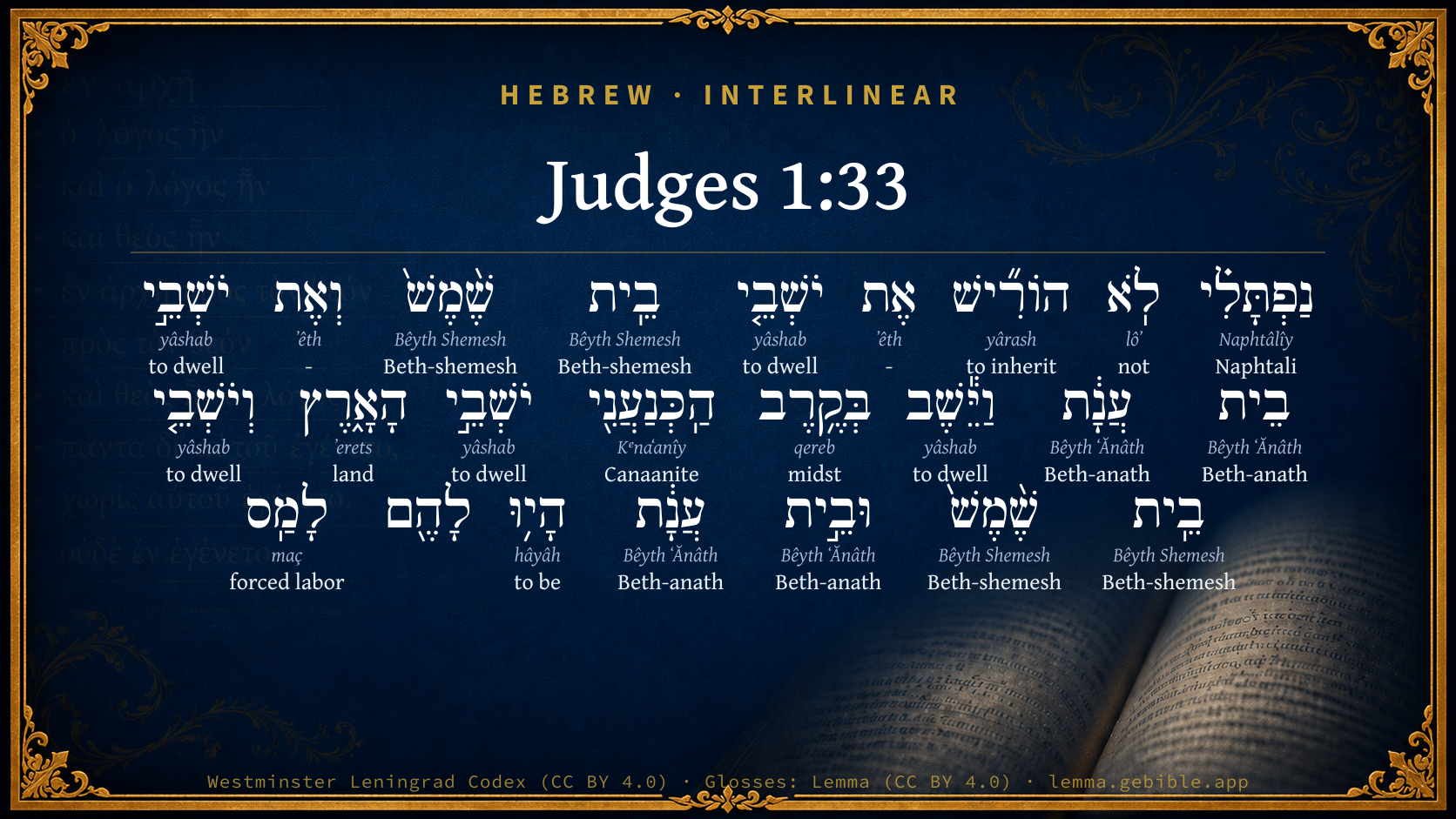
Hebrew (Westminster Leningrad Codex) Judges 1:33 appears in the Hebrew Old Testament. The text above is from the Westminster Leningrad Codex. Each word links to its Strong’s number, a concise gloss, and parsing drawn from the Open Scriptures Hebrew Bible morphology. Click any word for its full Brown-Driver-Briggs (BDB) entry.
Download image
Cite this verse

Judges 1:33 (World English Bible). Public Domain. Lemma interlinear Bible study tool, https://lemma.gebible.app/v/judges/1/33.

Show BibTeX & RIS
BibTeX
RIS
English Translation
Naphtali didn't drive out the inhabitants of Beth-shemesh, nor the inhabitants of Beth Anath; but he lived among the Canaanites, the inhabitants of the land: nevertheless the inhabitants of Beth-shemesh and of Beth Anath became subject to forced labor.
World English Bible · Public Domain
Download a study sheet

One document with this verse’s original text, its word-by-word gloss line, the meaning frame, cross-references with their text, attributed commentary, and full source and license credits — printable, and it pastes into notes with its structure intact.

This verse Autodidact and up

Study sheet (.html) Plain text (.txt)

A passage Seminary Student

Up to 50 verses in one chapter. A passage sheet keeps up to 6 commentary sources and 12 cross-references per verse, in the order this page ranks them, and says so on the sheet whenever that leaves anything out. Ask for a single verse and you get the Autodidact verse sheet above.

Everything on this page stays free to read, with no account — the sheet is a download of what is already on screen, not access to it.

Want to remove ads? Support Godless Engineer
Compare translations 3

The same verse in 3 English versions, stacked beneath the original-language interlinear above. Click any original word for its lexicon entry.

Each is an independent rendering of the whole verse — the interlinear is not word-aligned to these translations.

Highlighted words mark where these versions differ — a whole-verse word diff, not a word-by-word alignment.

  • World English Bible Public Domain
    Naphtali didn't drive out the inhabitants of Beth-shemesh, nor the inhabitants of Beth Anath; but he lived among the Canaanites, the inhabitants of the land: nevertheless the inhabitants of Beth-shemesh and of Beth Anath became subject to forced labor.
  • King James Version Public Domain
    Neither did Naphtali drive out the inhabitants of Bethshemesh, nor the inhabitants of Bethanath; but he dwelt among the Canaanites, the inhabitants of the land: nevertheless the inhabitants of Bethshemesh and of Bethanath became tributaries unto them.
  • unfoldingWord Literal Text CC BY-SA 4.0
    Naphtali did not dispossess the dwellers of Beth Shemesh or the dwellers of Beth Anath. So he dwelled in the midst of the Canaanite, the dwellers of the land. But the dwellers of Beth Shemesh and Beth Anath became forced labor for them.

unfoldingWord Literal Text — © unfoldingWord, licensed CC BY-SA 4.0. Word-aligned USFM3 via Door43 (git.door43.org/unfoldingWord/en_ult).

Versions to compare (up to 4)

3 of 4 selected

Show all 18 translations

Every available English version of this verse, each an independent rendering of the whole verse.

  • World English Bible Public Domain
    Naphtali didn't drive out the inhabitants of Beth-shemesh, nor the inhabitants of Beth Anath; but he lived among the Canaanites, the inhabitants of the land: nevertheless the inhabitants of Beth-shemesh and of Beth Anath became subject to forced labor.
  • Berean Standard Bible Public Domain
    Naphtali failed to drive out the inhabitants of Beth-shemesh and Beth-anath. So the Naphtalites also lived among the Canaanite inhabitants of the land, but the inhabitants of Beth-shemesh and Beth-anath served them as forced laborers.
  • Majority Standard Bible Public Domain
    Naphtali failed to drive out the inhabitants of Beth-shemesh and Beth-anath. So the Naphtalites also lived among the Canaanite inhabitants of the land, but the inhabitants of Beth-shemesh and Beth-anath served them as forced laborers.
  • King James Version Public Domain
    Neither did Naphtali drive out the inhabitants of Bethshemesh, nor the inhabitants of Bethanath; but he dwelt among the Canaanites, the inhabitants of the land: nevertheless the inhabitants of Bethshemesh and of Bethanath became tributaries unto them.
  • American Standard Version (1901) Public Domain
    Naphtali drove not out the inhabitants of Beth-shemesh, nor the inhabitants of Beth-anath; but he dwelt among the Canaanites, the inhabitants of the land: nevertheless the inhabitants of Beth-shemesh and of Beth-anath became subject to taskwork.
  • Revised Version (1885) Public Domain
    Naphtali drave not out the inhabitants of Beth-shemesh, nor the inhabitants of Beth-anath; but he dwelt among the Canaanites, the inhabitants of the land: nevertheless the inhabitants of Beth-shemesh and of Beth-anath became tributary unto them.
  • Geneva Bible (1599) Public Domain
    Neither did Naphtali driue out the inhabitants of Beth-shemesh, nor the inhabitants of Beth-anath, but dwelt among the Canaanites the inhabitants of the lande: neuerthelesse the inhabitantes of Beth-shemesh, and of Beth-anath became tributaries vnto them.
  • Douay-Rheims (1899) Public Domain
    Nephtali also destroyed not the inhabitants of Bethsames, and of Bethanath: and he dwelt in the midst of the Chanaanites the inhabitants of the land, and the Bethsamites and Bethanites were tributaries to him.
  • Young's Literal Translation Public Domain
    Naphtali hath not dispossessed the inhabitants of Beth-Shemesh, and the inhabitants of Beth-Anath, and he dwelleth in the midst of the Canaanite, the inhabitants of the land; and the inhabitants of Beth-Shemesh and of Beth-Anath have become tributary to them.
  • Literal Standard Version CC BY-SA 4.0
    Naphtali has not dispossessed the inhabitants of Beth-Shemesh, and the inhabitants of Beth-Anath, and he dwells in the midst of the Canaanite, the inhabitants of the land; and the inhabitants of Beth-Shemesh and of Beth-Anath were for forced labor for them.
  • Unlocked Literal Bible CC BY-SA 4.0
    The tribe of Naphtali did not drive out those who were living in Beth Shemesh, or those living in Beth Anath. So the tribe of Naphtali lived among the Canaanites (the people who were living in that land). However, the inhabitants of Beth Shemesh and Beth Anath were forced into hard labor for Naphthali.
  • unfoldingWord Literal Text CC BY-SA 4.0
    Naphtali did not dispossess the dwellers of Beth Shemesh or the dwellers of Beth Anath. So he dwelled in the midst of the Canaanite, the dwellers of the land. But the dwellers of Beth Shemesh and Beth Anath became forced labor for them.
  • Darby Bible Public Domain
    Naph'tali did not drive out the inhabitants of Beth-she'mesh, or the inhabitants of Beth-anath, but dwelt among the Canaanites, the inhabitants of the land; nevertheless the inhabitants of Beth-she'mesh and of Beth-anath became subject to forced labor for them.
  • World Messianic Bible Public Domain
    Naphtali didn’t drive out the inhabitants of Beth Shemesh, nor the inhabitants of Beth Anath; but he lived among the Canaanites, the inhabitants of the land. Nevertheless the inhabitants of Beth Shemesh and of Beth Anath became subject to forced labor.
  • Webster's Bible Public Domain
    Neither did Naphtali expel the inhabitants of Beth-shemesh, nor the inhabitants of Beth-anath; but he dwelt among the Canaanites, the inhabitants of the land: nevertheless, the inhabitants of Beth-shemesh and of Beth-anath became tributaries to them.
  • Free Bible Version CC BY-SA 4.0
    Naphtali didn't drive out the people living in the towns of Beth-shemesh and Beth-anath. So the people of Asher went on living there among the Canaanite inhabitants of the land because they hadn't driven them out. However, the people of Beth-shemesh and Beth-anath were made to do forced labor for the people of Naphtali.
  • Bible in Basic English Public Domain
    Naphtali did not take the land of the people of Beth-shemesh or of Beth-anath, driving them out; but he was living among the Canaanites in the land; however, the people of Beth-shemesh and Beth-anath were put to forced work.
  • JPS Tanakh (1917) Public Domain
    Naphtali drove not out the inhabitants of Beth-shemesh, nor the inhabitants of Beth-anath; but he dwelt among the Canaanites, the inhabitants of the land; nevertheless the inhabitants of Beth-shemesh and of Beth-anath became tributary unto them.

Literal Standard Version (2020), Covenant Press — licensed CC BY-SA 4.0. Text via the HelloAO Bible API (eBible.org). Unlocked Literal Bible (unfoldingWord) — licensed CC BY-SA 4.0. Text via the HelloAO Bible API (eBible.org). unfoldingWord Literal Text — © unfoldingWord, licensed CC BY-SA 4.0. Word-aligned USFM3 via Door43 (git.door43.org/unfoldingWord/en_ult). Free Bible Version, Dr. Jonathan Gallagher — licensed CC BY-SA 4.0. Text via the HelloAO Bible API (eBible.org).

Word by word

More ways to search: Search by grammar → Find every occurrence → Compare this word →

Practice this passage: Drill this verse → Learn its vocabulary →

בֵית
Bêyth ʻĂnâth
H1043
“Beth-anath”
Noun, Proper
Part of Speech
Noun
Type
Proper
Full BDB Definition

Origin: an orthographical variation for H1042

TWOT: None

Beth-anath = "house of response (or affliction)" - a place in Naphtali
  1. נַפְתָּלִ֗י Naphtâlîy H5321 “Naphtali” Noun, Proper
  2. לֹֽא lôʼ H3808 “not” Particle, Negative
  3. הוֹרִ֞ישׁ yârash H3423 “to inherit” Verb, Hiphil, Perfect, 3rd Person, Masculine, Singular
  4. אֶת ʼêth H853 “-” Particle, Direct Object
  5. יֹשְׁבֵ֤י yâshab H3427 “dwelling” Verb, Qal, Participle Active, Masculine, Plural, Construct
  6. בֵֽית Bêyth Shemesh H1053 “Beth-shemesh” Noun, Proper
  7. שֶׁ֨מֶשׁ֙ Bêyth Shemesh H1053 “Beth-shemesh” Noun, Proper
  8. וְאֶת ʼêth H853 “and · -” Conjunction + Particle, Direct Object
  9. יֹשְׁבֵ֣י yâshab H3427 “dwelling” Verb, Qal, Participle Active, Masculine, Plural, Construct
  10. עֲנָ֔ת Bêyth ʻĂnâth H1043 “Beth-anath” Noun, Proper
  11. וַיֵּ֕שֶׁב yâshab H3427 “and · to dwell” Conjunction + Verb, Qal, Sequential Imperfect, 3rd Person, Masculine, Singular
  12. בְּקֶ֥רֶב qereb H7130 “in/at · midst of” Preposition + Noun, Common, Masculine, Singular, Construct
  13. הַֽכְּנַעֲנִ֖י Kᵉnaʻanîy H3669 “the · Canaanite” Particle, Definite Article + Noun, Gentilic, Masculine, Singular, Absolute
  14. יֹשְׁבֵ֣י yâshab H3427 “dwelling” Verb, Qal, Participle Active, Masculine, Plural, Construct
  15. הָאָ֑רֶץ ʼerets H776 “the · land” Particle, Definite Article + Noun, Common, Both, Singular, Absolute
  16. וְיֹשְׁבֵ֤י yâshab H3427 “and · dwelling” Conjunction + Verb, Qal, Participle Active, Masculine, Plural, Construct
  17. בֵֽית Bêyth Shemesh H1053 “Beth-shemesh” Noun, Proper
  18. שֶׁ֨מֶשׁ֙ Bêyth Shemesh H1053 “Beth-shemesh” Noun, Proper
  19. וּבֵ֣ית Bêyth ʻĂnâth H1043 “and · Beth-anath” Conjunction + Noun, Proper
  20. עֲנָ֔ת Bêyth ʻĂnâth H1043 “Beth-anath” Noun, Proper
  21. הָי֥וּ hâyâh H1961 “to be” Verb, Qal, Perfect, 3rd Person, Common, Plural
  22. לָמַֽס maç H4522 “to/for · forced labor” Preposition + Noun, Common, Masculine, Singular, Absolute

About this verse

These counts appear in no published source. They are computed here, from the morphology-tagged text and Lemma’s own curated glosses. What Lemma adds →

24
words
12
distinct lemmas
Historical
section

Notable vocabulary

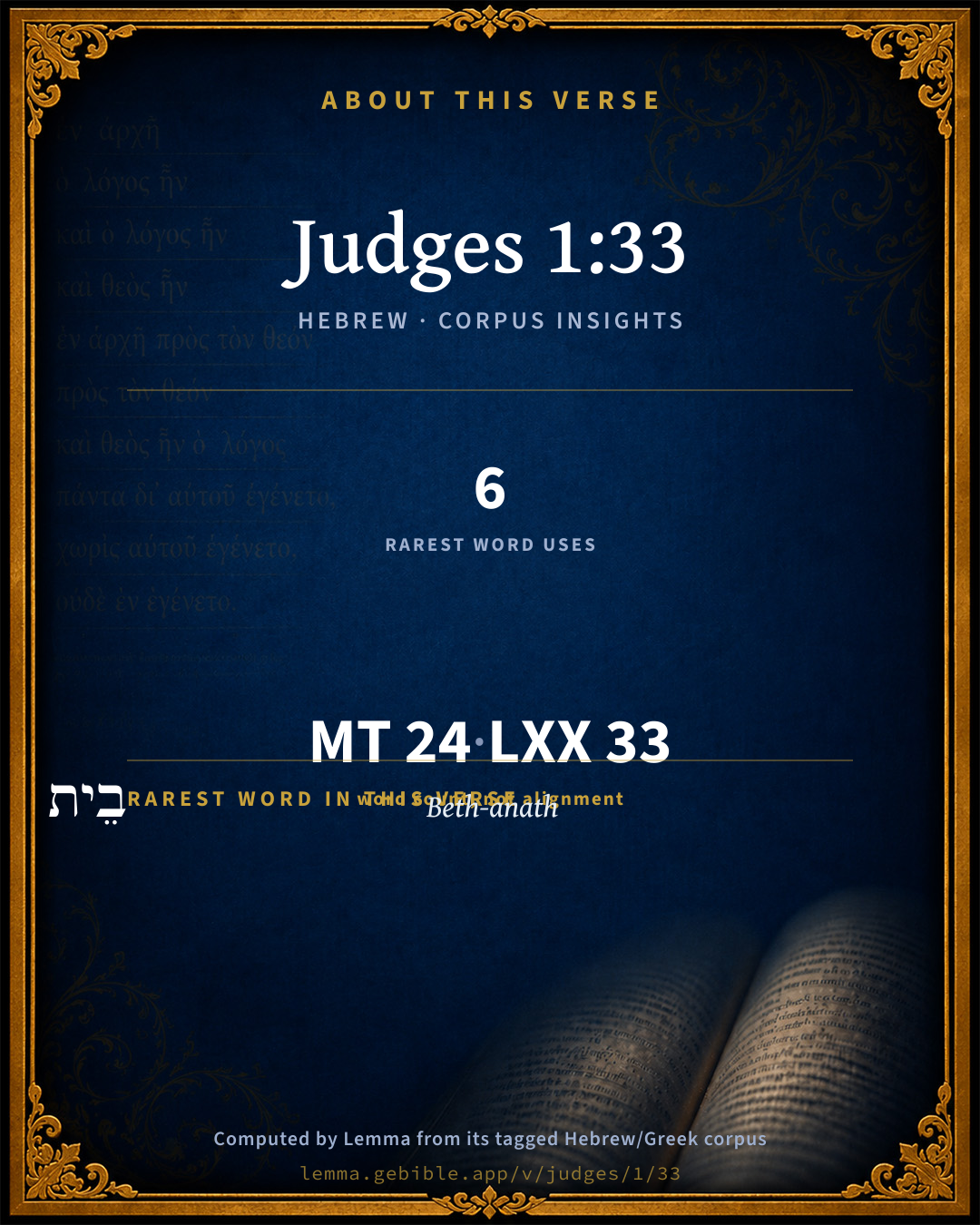
The rarest word here is בֵית Beth-anath H1043 — appearing just 6 times in the whole Hebrew Bible.

Shared distinctive vocabulary

בֵית Beth-anath H1043 occurs in 2 verses of the Hebrew Bible. Also found in:

Grammatical profile

  • 7 verbs
  • 13 nouns
  • 1 preposition
  • 3 particles

Verb forms

  • הוֹרִ֞ישׁ Hiphil · Perfect
  • יֹשְׁבֵ֤י Qal · Participle Active
  • יֹשְׁבֵ֣י Qal · Participle Active
  • וַיֵּ֕שֶׁב Qal · Sequential Imperfect
  • יֹשְׁבֵ֣י Qal · Participle Active
  • וְיֹשְׁבֵ֤י Qal · Participle Active
  • הָי֥וּ Qal · Perfect

Repetition

Words recur within this verse — often emphatic in Hebrew:

  • יֹשְׁבֵ֤י to dwell H3427 ×5
  • בֵֽית Beth-shemesh H1053 ×4
  • בֵית Beth-anath H1043 ×4

Hebrew & Septuagint length

In English translation the verse runs 39 words from the Hebrew and 40 from the Septuagint (LXX English) — closely comparable.

A rough comparison of the two English renderings, which tokenize alike — not a word-level alignment.

Word counts can differ between the Hebrew and the Greek without any difference in meaning — e.g. the Hebrew direct-object marker אֵת has no separate Greek word, and Greek often adds the article ὁ.

In the original languages it is 24 Hebrew tokens and 33 Greek tokens — but the two are counted differently (Hebrew bundles its prefixes and suffixes into one token; the Greek is in lemma form), so that isn’t a like-for-like length.

Cross-references

4

Topical passages linked to Judges 1:33 in the Treasury of Scripture Knowledge — connected by theme and wording, ordered by reader-vote popularity; previews shown in the World English Bible.

  • Joshua 19:32–38 The sixth lot came out for the children of Naphtali, even for the children of Naphtali according to their families.
  • Psalms 18:24 Therefore Yahweh has rewarded me according to my righteousness, According to the cleanness of my hands in his eyesight.
  • Judges 1:30 Zebulun didn't drive out the inhabitants of Kitron, nor the inhabitants of Nahalol; but the Canaanites lived among them, and became subject to forced labor.
  • Judges 1:35 but the Amorites would dwell in Mount Heres, in Aijalon, and in Shaalbim: yet the hand of the house of Joseph prevailed, so that they became subject to forced labor.

Cross-references courtesy of OpenBible.info (CC BY 4.0).

Hebrew and Greek witnesses Masoretic Hebrew ↔ Greek Septuagint

The same verse in the two great witnesses to the Old Testament, shown verse-for-verse.

These are two independent witnesses, not word-aligned to each other, and the Septuagint is shown in lemma (dictionary) form.

Hebrew Judges 1:33 Masoretic · Westminster Leningrad Codex

נַפְתָּלִ֗י לֹֽא הוֹרִ֞ישׁ אֶת יֹשְׁבֵ֤י בֵֽית שֶׁ֨מֶשׁ֙ וְאֶת יֹשְׁבֵ֣י בֵית עֲנָ֔ת וַיֵּ֕שֶׁב בְּקֶ֥רֶב הַֽכְּנַעֲנִ֖י יֹשְׁבֵ֣י הָאָ֑רֶץ וְיֹשְׁבֵ֤י בֵֽית שֶׁ֨מֶשׁ֙ וּבֵ֣ית עֲנָ֔ת הָי֥וּ לָהֶ֖ם לָמַֽס

Naphtali didn't drive out the inhabitants of Beth-shemesh, nor the inhabitants of Beth Anath; but he lived among the Canaanites, the inhabitants of the land: nevertheless the inhabitants of Beth-shemesh and of Beth Anath became subject to forced labor.

World English Bible · Public Domain

Greek LXX Judges 1:33 Septuagint · lemma form

καί νεφθαλι οὐ ἐκαἴρω ὁ καταοἰκέω βαιθσαμυς καί ὁ καταοἰκέω βαιθαναθ καί καταοἰκέω νεφθαλι ἐν μέσος ὁ χαναναῖος ὁ καταοἰκέω ὁ γῆ ὁ δέ καταοἰκέω βαιθσαμυς καί ὁ βαιθενεθ γίγνομαι αὐτός εἰς φόρος

And Nephthali did not drive out the inhabitants of Baethsamys, nor the inhabitants of Baethanach; and Nephthali lived in the midst of the Chananite who inhabited the land: but the inhabitants of Bethsamys and of Baetheneth became tributary to them.

LXX2012 (modern English Septuagint) · Public Domain

Hebrew: Westminster Leningrad Codex (CC BY 4.0). Greek: Septuagint (public domain); English from LXX2012 (modern English Septuagint) (Public Domain). How the Septuagint differs from the Hebrew →

Targum (Aramaic paraphrase)

1

The Targum is the ancient Jewish Aramaic paraphrase of the Hebrew Scriptures — an interpretive translation, not the Hebrew text itself. Onkelos (literal) and Pseudo-Jonathan (expansive) render the Torah, and Jonathan the Prophets. Coverage is partial: where no permissively-licensed English translation exists for a verse, only the Aramaic is shown. This is verse-level text, not a word-by-word alignment to the Hebrew.

  1. Targum Jonathan Prophets (Joshua–Malachi)
    דְבֵית נַפְתָּלִי לָא תָרִיכוּ יַת יַתְבֵי בֵית שֶׁמֶשׁ וְיַת יַתְבֵי בֵית עֲנָת וִיתִיבוּ בְּגוֹ כְנַעֲנָאֵי יַתְבֵי אַרְעָא וְיַתְבֵי בֵית שֶׁמֶשׁ וּבֵית עֲנָת הֲווֹ לְהוֹן לְמַסְקֵי מִסִין:

    (no public-domain English translation for this verse)

    Targum Jonathan — Aramaic: “Mikraot Gedolot” (public domain). English: “Sefaria Community Translation” (CC0 1.0 (public-domain dedication)); “London "Chaldee Paraphrase," 1871” (public domain). Text via Sefaria.

Commentary

Notes on Judges 1:33 from classic Christian and Jewish commentators (each source and its license shown beneath its notes). The classic Christian expositions comment on the surrounding passage and are grouped to its opening verse, so a note may address several verses; the Jewish commentaries on the Tanakh (Rashi and others) are per-verse, so they appear only where the commentator wrote on this verse.

Lemma curates 59 commentaries, every one of them public domain or Creative Commons licensed, each selected and text-cleaned for this edition rather than reprinted as found. About our sources →

Adam Clarke's Commentary

Verse 33. Neither did Naphtali] See the notes on Jos 19:32-39.

Adam Clarke's Commentary on the Bible (1810–1826) — public domain. Text from a community e-Sword/MySword module.

Ellicott's Commentary for English Readers

(33) Neither did Naphtali.—See Jos_19:32-38. Beth-shemesh.—The name means “house of the sun,” and the place was probably a great centre of Baal-worship; but this Beth-shemesh in Naphtali is not the same as Ir-shemesh (“city of the sun”) in Jos_15:10, which was on the borders of Judah. It is the “mount of the sun” (Har-cheres) in Jdg_1:35. In Isa_19:18, alluding to another “city of the sun” (On, i.e., Heliopolis), the prophet calls it not Is-ha-Cheres, “the city of the sun,” but Ir-ha-Heres, “the city of overthrow,” with one of those scornful plays on words of which the Jews were fond.

Beth-anath.—Nothing is known of this town. The name perhaps means “house of echo,” and some identify it with Baneas or Paneas, a place at which the echo was famous.

Nevertheless.—The tribe of Naphtali was in the same unhappy condition as that of Asher, living in the midst of a Canaanite population of superior strength to themselves. They had, however, so far succeeded as to reduce the two chief towns (out of nineteen—Jos_19:38) to a tributary condition.

A Bible Commentary for English Readers, edited by Charles John Ellicott (1878–1897) — public domain. Text from a community e-Sword module.

The Cambridge Bible for Schools and Colleges

gen. ed. J. J. S. Perowne

33. Naphtali] inhabited the eastern part of Upper Galilee; Jdg_1:18. On the S. the territory was bounded by Zebulun and Issachar, on the W. by Asher. It is curious that only two cities are named as having stood out against Naphtali; perhaps the list is not complete, cf. Jdg_4:2 ff. (Hazor). Beth-shemesh and Beth-anath (Jos_19:38) i.e. ‘temple of the sun(-god),’ ‘temple of (the goddess) Anath,’ were Canaanite sanctuaries, as the names shew; their sites are unknown; possibly ‘Ainîtha, 6 m. N.W. of Ḳades (Kadesh of Naphtali), may be Beth-anath. Both names occur also in Judah, Jos_15:10; Jos_15:59; Jdg_1:35 n.

became tributary unto them] had to do forced labour for them.

The Cambridge Bible for Schools and Colleges (gen. ed. J. J. S. Perowne; Cambridge University Press, 1878–1918) — public domain. Text from a community e-Sword module.

John Gill's Exposition

Neither did Naphtali drive out the inhabitants of Bethshemesh, nor the inhabitants of Bethanath,.... Of which places See Gill on Jos 19:38,

but he dwelt among the Canaanites, the inhabitants of the land; in the same disgraceful manner as Asher did, owing to cowardice or sloth:

nevertheless, the inhabitants of Bethshemesh, and of Bethanath, became tributaries unto them; these two cities did at length exert themselves, and got the mastery over the Canaanites, as to make them pay tribute to them; though they ought to have expelled them, and even destroyed them, according to the command of God, but avarice prevailed over them.

John Gill's Exposition of the Whole Bible (1746–1763) — public domain (CC PDM 1.0). Text via the HelloAO Bible API.

Haydock's Catholic Bible Commentary

CHAPTER I.

George Leo Haydock (1774–1849), Haydock's Catholic Family Bible and Commentary, 1859 edition — public domain. Excludes Psalms (Douay-Rheims chapter numbering differs from Protestant) and Deuterocanonical books (Catholic canon only).

Matthew Poole's English Annotations

Beth-shemesh; a place differing from that Beth-shemesh, Jos 15:10.

Matthew Poole's English Annotations on the Holy Bible (1683–1685) — public domain. Text from a community e-Sword/MySword module.

Whedon's Commentary on the Bible

Daniel D. Whedon

33. Beth-shemesh (house of the sun) and Beth-anath (house of echo) are unknown.

Daniel D. Whedon (gen. ed.), Commentary on the Old and New Testaments (1874–1909) — public domain. Text from a community e-Sword module.

unfoldingWord translationNotes

Door43 World Missions Community

Beth Shemesh ... Beth Anath

These are names of cities. (See: How to Translate Names)

the inhabitants of Beth Shemesh and Beth Anath were forced into hard labor for Naphthali

This can be stated in active form. AT: "the people of Naphtali forced the people of Beth Shemesh and Beth Anath to work for them as slaves" (See: Active or Passive)

translationWords

Naphtali

cast out

life

Beth Shemesh

Canaan

labor

unfoldingWord translationNotes — © Distant Shores Media and the Door43 World Missions Community, licensed CC BY-SA 4.0. Source: git.door43.org/Door43/en_tn.

Lesson kit

Teaching starters — assembled from the data on this page, not authored interpretation. Every prompt links to the verse data it draws on. Edit before teaching.

Judges, in the Historical, opens this verse with 24 words (12 distinct Hebrew lemmas). Its most distinctive word is Bêyth ʻĂnâth (“Beth-anath”). A historical commentator’s framing appears above. Read the whole chapter for the surrounding context.

Discussion questions

  1. What does “Beth-anath” (Bêyth ʻĂnâth) contribute to the verse as a whole?
  2. How does Joshua 19:38, which shares the word «Beth-anath», read alongside this verse?
  3. What does the repetition of “to dwell” (5× in this one verse) do in this verse?
  4. These translations render this verse differently; the difference is in the English rendering, not the original. What questions does that raise?
  5. «הוֹרִ֞ישׁ» is a Hiphil Perfect verb. How does that grammatical form shape the action described?
  6. Compare how Adam Clarke's Commentary and Ellicott's Commentary for English Readers read this verse. Where do they agree or differ?

Things to notice

Reading settings

Reading text

Shown beneath each verse's original-language words.

Old Testament
Old Testament edition

Read the OT as the Masoretic Hebrew (MT) or the Greek Septuagint (LXX).

English shown for the Greek Septuagint (in the Hebrew ↔ Greek comparison).

Comparing translations? Open the Compare panel on any verse page to stack up to four side by side.