
Deuteronomy 4:5

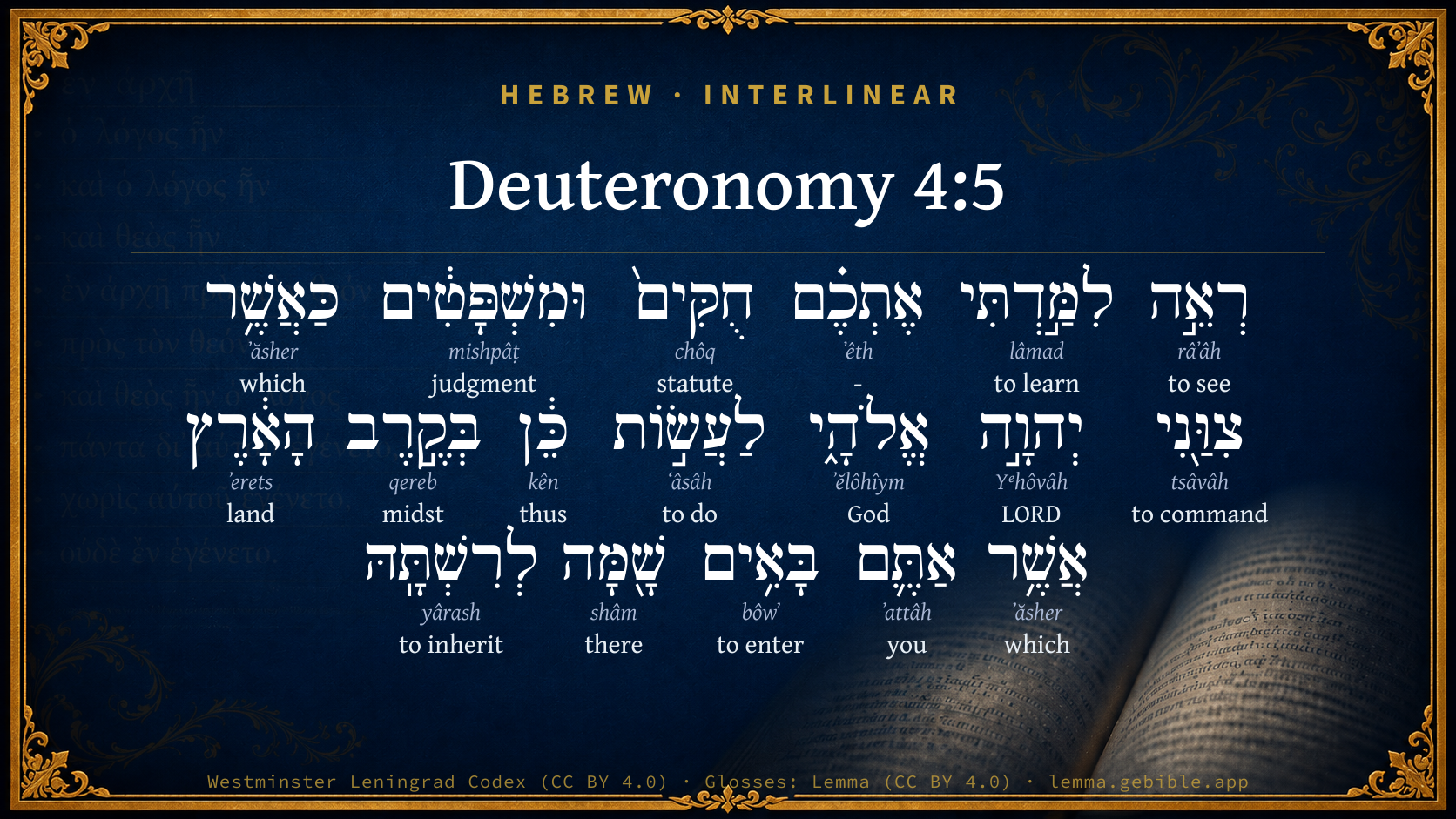
Hebrew (Westminster Leningrad Codex) Deuteronomy 4:5 appears in the Hebrew Old Testament. The text above is from the Westminster Leningrad Codex. Each word links to its Strong’s number, a concise gloss, and parsing drawn from the Open Scriptures Hebrew Bible morphology. Click any word for its full Brown-Driver-Briggs (BDB) entry.
Download image
Cite this verse

Deuteronomy 4:5 (World English Bible). Public Domain. Lemma interlinear Bible study tool, https://lemma.gebible.app/v/deuteronomy/4/5.

Show BibTeX & RIS
BibTeX
RIS
English Translation
Behold, I have taught you statutes and ordinances, even as Yahweh my God commanded me, that you should do so in the midst of the land where you go in to possess it.
World English Bible · Public Domain
Download a study sheet

One document with this verse’s original text, its word-by-word gloss line, the meaning frame, cross-references with their text, attributed commentary, and full source and license credits — printable, and it pastes into notes with its structure intact.

This verse Autodidact and up

Study sheet (.html) Plain text (.txt)

A passage Seminary Student

Up to 50 verses in one chapter. A passage sheet keeps up to 6 commentary sources and 12 cross-references per verse, in the order this page ranks them, and says so on the sheet whenever that leaves anything out. Ask for a single verse and you get the Autodidact verse sheet above.

Everything on this page stays free to read, with no account — the sheet is a download of what is already on screen, not access to it.

Want to remove ads? Support Godless Engineer
Compare translations 3

The same verse in 3 English versions, stacked beneath the original-language interlinear above. Click any original word for its lexicon entry.

Each is an independent rendering of the whole verse — the interlinear is not word-aligned to these translations.

Highlighted words mark where these versions differ — a whole-verse word diff, not a word-by-word alignment.

  • World English Bible Public Domain
    Behold, I have taught you statutes and ordinances, even as Yahweh my God commanded me, that you should do so in the midst of the land where you go in to possess it.
  • King James Version Public Domain
    Behold, I have taught you statutes and judgments, even as the LORD my God commanded me, that ye should do so in the land whither ye go to possess it.
  • unfoldingWord Literal Text CC BY-SA 4.0
    Look, I have taught you statutes and ordinances, as Yahweh my God had commanded me, to do so in the midst of the land which you are going into to possess it.

unfoldingWord Literal Text — © unfoldingWord, licensed CC BY-SA 4.0. Word-aligned USFM3 via Door43 (git.door43.org/unfoldingWord/en_ult).

Versions to compare (up to 4)

3 of 4 selected

Show all 18 translations

Every available English version of this verse, each an independent rendering of the whole verse.

  • World English Bible Public Domain
    Behold, I have taught you statutes and ordinances, even as Yahweh my God commanded me, that you should do so in the midst of the land where you go in to possess it.
  • Berean Standard Bible Public Domain
    See, I have taught you statutes and ordinances just as the LORD my God has commanded me, so that you may follow them in the land that you are about to enter and possess.
  • Majority Standard Bible Public Domain
    See, I have taught you statutes and ordinances just as the LORD my God has commanded me, so that you may follow them in the land that you are about to enter and possess.
  • King James Version Public Domain
    Behold, I have taught you statutes and judgments, even as the LORD my God commanded me, that ye should do so in the land whither ye go to possess it.
  • American Standard Version (1901) Public Domain
    Behold, I have taught you statutes and ordinances, even as Jehovah my God commanded me, that ye should do so in the midst of the land whither ye go in to possess it.
  • Revised Version (1885) Public Domain
    Behold, I have taught you statutes and judgments, even as the LORD my God commanded me, that ye should do so in the midst of the land whither ye go in to possess it.
  • Geneva Bible (1599) Public Domain
    Behold, I haue taught you ordinances, and lawes, as the Lord my God commanded me, that ye should doe euen so within the land whither ye goe to possesse it.
  • Douay-Rheims (1899) Public Domain
    You know that I have taught you statutes and justices, as the Lord my God hath commanded me: so shall you do them in the land which you shall possess:
  • Young's Literal Translation Public Domain
    `See, I have taught you statutes and judgments, as Jehovah my God hath commanded me -- to do so, in the midst of the land whither ye are going in to possess it;
  • Literal Standard Version CC BY-SA 4.0
    See, I have taught you statutes and judgments, as my God YHWH has commanded me, to do so in the midst of the land to where you are going in to possess it;
  • Unlocked Literal Bible CC BY-SA 4.0
    Look, I have taught you laws and decrees, as Yahweh my God had commanded me, that you should do so in the midst of the land which you are going into in order to possess it.
  • unfoldingWord Literal Text CC BY-SA 4.0
    Look, I have taught you statutes and ordinances, as Yahweh my God had commanded me, to do so in the midst of the land which you are going into to possess it.
  • Darby Bible Public Domain
    See, I have taught you statutes and ordinances, even as Jehovah my God commanded me, that ye may do so in the land into which ye enter to possess it.
  • World Messianic Bible Public Domain
    Behold, I have taught you statutes and ordinances, even as the LORD my God commanded me, that you should do so in the middle of the land where you go in to possess it.
  • Webster's Bible Public Domain
    Behold, I have taught you statutes, and judgments, even as the LORD my God commanded me, that ye should do so in the land whither ye go to possess it.
  • Free Bible Version CC BY-SA 4.0
    Listen, I have taught you the rules and regulations just as the Lord my God ordered me to do, so you can follow them in the country that you are about to enter and take over.
  • Bible in Basic English Public Domain
    I have been teaching you laws and decisions, as I was ordered to do by the Lord my God, so that you might keep them in the land to which you are going to take it for your heritage.
  • JPS Tanakh (1917) Public Domain
    Behold, I have taught you statutes and ordinances, even as the LORD my God commanded me, that ye should do so in the midst of the land whither ye go in to possess it.

Literal Standard Version (2020), Covenant Press — licensed CC BY-SA 4.0. Text via the HelloAO Bible API (eBible.org). Unlocked Literal Bible (unfoldingWord) — licensed CC BY-SA 4.0. Text via the HelloAO Bible API (eBible.org). unfoldingWord Literal Text — © unfoldingWord, licensed CC BY-SA 4.0. Word-aligned USFM3 via Door43 (git.door43.org/unfoldingWord/en_ult). Free Bible Version, Dr. Jonathan Gallagher — licensed CC BY-SA 4.0. Text via the HelloAO Bible API (eBible.org).

Word by word

More ways to search: Search by grammar → Find every occurrence → Compare this word →

Practice this passage: Drill this verse → Learn its vocabulary →

לִמַּ֣דְתִּי
lâmad
H3925
“to learn”
Verb, Piel, Perfect, 1st Person, Common, Singular
Part of Speech
Verb
Stem
Piel
Form
Perfect
Person
1st Person
Gender
Common
Number
Singular
Full BDB Definition

Origin: a primitive root

TWOT: 1116

to learn. teach, exercise in - (Qal) to learn - (Piel) to teach - (Pual) to be taught, be trained
  1. רְאֵ֣ה râʼâh H7200 “see” Verb, Qal, Imperative, 2nd Person, Masculine, Singular
  2. אֶתְכֶ֗ם ʼêth H853 “- · you” Particle, Direct Object + Suffix, Personal, 2nd Person, Masculine, Plural
  3. חֻקִּים֙ chôq H2706 “statutes” Noun, Common, Masculine, Plural, Absolute
  4. וּמִשְׁפָּטִ֔ים mishpâṭ H4941 “and · judgments” Conjunction + Noun, Common, Masculine, Plural, Absolute
  5. כַּאֲשֶׁ֥ר ʼăsher H834 “like/as · which” Preposition + Particle, Relative
  6. צִוַּ֖נִי tsâvâh H6680 “to command · me” Verb, Piel, Perfect, 3rd Person, Masculine, Singular + Suffix, Personal, 1st Person, Common, Singular
  7. יְהוָ֣ה Yᵉhôvâh H3068 “LORD” Noun, Proper
  8. אֱלֹהָ֑י ʼĕlôhîym H430 “God(s) · my” Noun, Common, Masculine, Plural, Construct + Suffix, Personal, 1st Person, Common, Singular
  9. לַעֲשׂ֣וֹת ʻâsâh H6213 “to do” Preposition + Verb, Qal, Infinitive Construct
  10. כֵּ֔ן kên H3651 “thus” Particle, Demonstrative
  11. בְּקֶ֣רֶב qereb H7130 “in/at · midst of” Preposition + Noun, Common, Masculine, Singular, Construct
  12. הָאָ֔רֶץ ʼerets H776 “the · land” Particle, Definite Article + Noun, Common, Both, Singular, Absolute
  13. אֲשֶׁ֥ר ʼăsher H834 “which” Particle, Relative
  14. אַתֶּ֛ם ʼattâh H859 “you” Pronoun, Personal, 2nd Person, Masculine, Plural
  15. בָּאִ֥ים bôwʼ H935 “entering” Verb, Qal, Participle Active, Masculine, Plural, Absolute
  16. שָׁ֖מָּה shâm H8033 “there · toward” Adverb + Suffix, Demonstrative
  17. לְרִשְׁתָּֽהּ yârash H3423 “to inherit · her” Preposition + Verb, Qal, Infinitive Construct + Suffix, Personal, 3rd Person, Feminine, Singular

About this verse

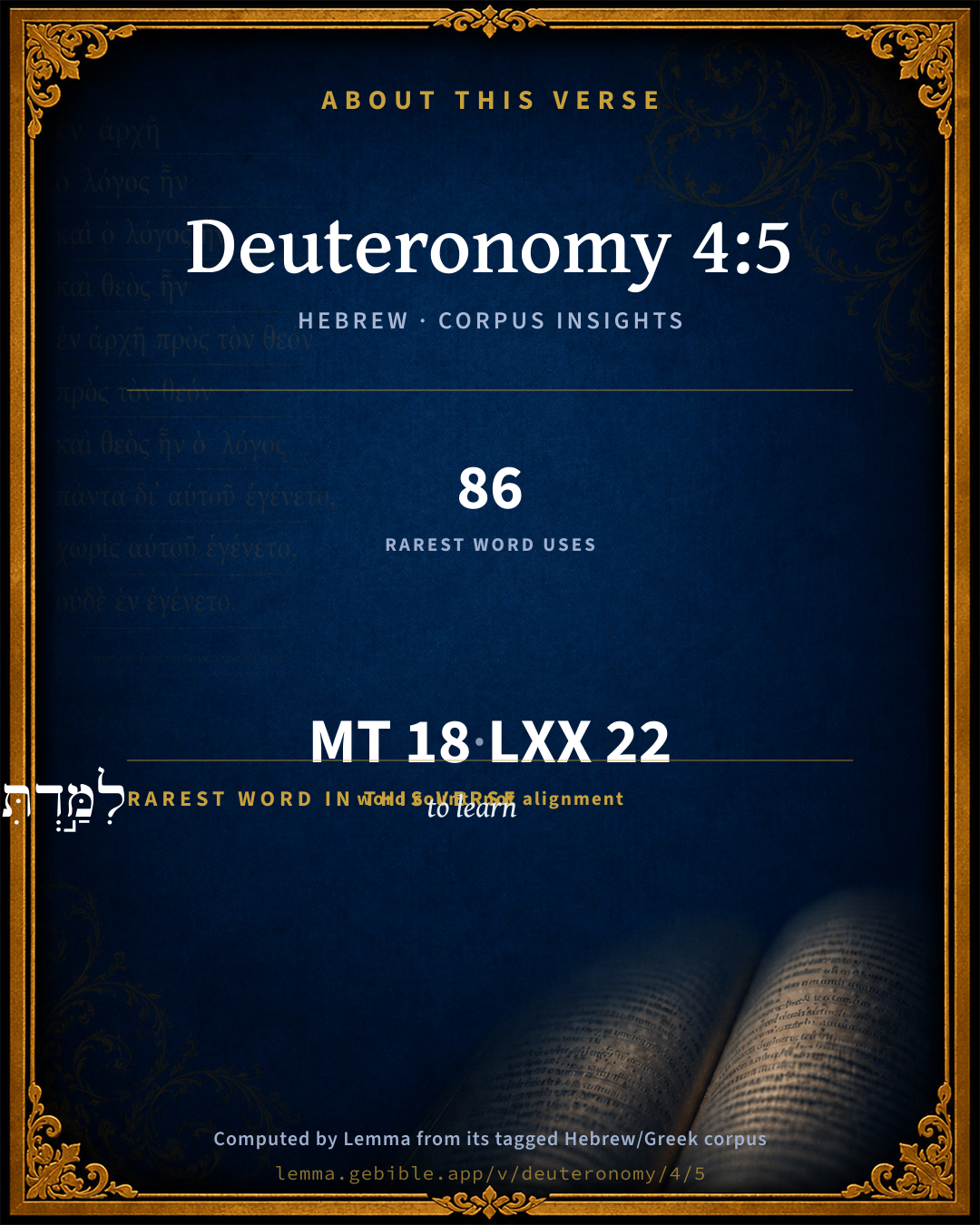
These counts appear in no published source. They are computed here, from the morphology-tagged text and Lemma’s own curated glosses. What Lemma adds →

18
words
17
distinct lemmas
Pentateuch
section

Grammatical profile

  • 6 verbs
  • 6 nouns
  • 1 pronoun
  • 1 adverb
  • 4 particles

Verb forms

  • רְאֵ֣ה Qal · Imperative
  • לִמַּ֣דְתִּי Piel · Perfect
  • צִוַּ֖נִי Piel · Perfect
  • לַעֲשׂ֣וֹת Qal · Infinitive Construct
  • בָּאִ֥ים Qal · Participle Active
  • לְרִשְׁתָּֽהּ Qal · Infinitive Construct

Repetition

A word recurs within this verse — often emphatic in Hebrew:

  • כַּאֲשֶׁ֥ר which H834 ×2

Hebrew & Septuagint length

In English translation the verse runs 33 words from the Hebrew and 28 from the Septuagint (LXX English) — closely comparable.

A rough comparison of the two English renderings, which tokenize alike — not a word-level alignment.

Word counts can differ between the Hebrew and the Greek without any difference in meaning — e.g. the Hebrew direct-object marker אֵת has no separate Greek word, and Greek often adds the article ὁ.

In the original languages it is 18 Hebrew tokens and 22 Greek tokens — but the two are counted differently (Hebrew bundles its prefixes and suffixes into one token; the Greek is in lemma form), so that isn’t a like-for-like length.

Cross-references

8

Topical passages linked to Deuteronomy 4:5 in the Treasury of Scripture Knowledge — connected by theme and wording, ordered by reader-vote popularity; previews shown in the World English Bible.

  • Matthew 28:20 teaching them to observe all things that I commanded you. Behold, I am with you always, even to the end of the age." Amen.
  • 1 Thessalonians 4:1–2 Finally then, brothers, we beg and exhort you in the Lord Jesus, that as you received from us how you ought to walk and to please God, that you abound more and more.
  • Deuteronomy 4:1 Now, Israel, listen to the statutes and to the ordinances, which I teach you, to do them; that you may live, and go in and possess the land which Yahweh, the God of your fathers, gives you.
  • Hebrews 3:5 Moses indeed was faithful in all his house as a servant, for a testimony of those things which were afterward to be spoken,
  • Proverbs 22:19–20 That your trust may be in Yahweh, I teach you today, even you.
  • Acts 20:27 for I didn't shrink from declaring to you the whole counsel of God.
  • 1 Corinthians 15:3 For I delivered to you first of all that which I also received: that Christ died for our sins according to the Scriptures,
  • 1 Corinthians 11:28 But let a man examine himself, and so let him eat of the bread, and drink of the cup.

Cross-references courtesy of OpenBible.info (CC BY 4.0).

Hebrew and Greek witnesses Masoretic Hebrew ↔ Greek Septuagint

The same verse in the two great witnesses to the Old Testament, shown verse-for-verse.

These are two independent witnesses, not word-aligned to each other, and the Septuagint is shown in lemma (dictionary) form.

Hebrew Deuteronomy 4:5 Masoretic · Westminster Leningrad Codex

רְאֵ֣ה לִמַּ֣דְתִּי אֶתְכֶ֗ם חֻקִּים֙ וּמִשְׁפָּטִ֔ים כַּאֲשֶׁ֥ר צִוַּ֖נִי יְהוָ֣ה אֱלֹהָ֑י לַעֲשׂ֣וֹת כֵּ֔ן בְּקֶ֣רֶב הָאָ֔רֶץ אֲשֶׁ֥ר אַתֶּ֛ם בָּאִ֥ים שָׁ֖מָּה לְרִשְׁתָּֽהּ

Behold, I have taught you statutes and ordinances, even as Yahweh my God commanded me, that you should do so in the midst of the land where you go in to possess it.

World English Bible · Public Domain

Greek LXX Deuteronomy 4:5 Septuagint · lemma form

ὁράω δεικνύω σύ δικαίωμα καί κρίσις καθά ἐντέλλομαι ἐγώ κύριος ποιέω οὕτως ἐν ὁ γῆ εἰς ὅς σύ εἰςπορεύομαι ἐκεῖ κληρονομέω αὐτός

Behold, I have shown you ordinances and judgments as the Lord commanded me, that you⌃ should do so in the land into which you⌃ go to inherit it.

LXX2012 (modern English Septuagint) · Public Domain

On this verse, The Cambridge Bible for Schools and Colleges discusses the Septuagint’s reading. Read the note in Commentary ↓

Hebrew: Westminster Leningrad Codex (CC BY 4.0). Greek: Septuagint (public domain); English from LXX2012 (modern English Septuagint) (Public Domain). How the Septuagint differs from the Hebrew →

Targum (Aramaic paraphrase)

2

The Targum is the ancient Jewish Aramaic paraphrase of the Hebrew Scriptures — an interpretive translation, not the Hebrew text itself. Onkelos (literal) and Pseudo-Jonathan (expansive) render the Torah, and Jonathan the Prophets. Coverage is partial: where no permissively-licensed English translation exists for a verse, only the Aramaic is shown. This is verse-level text, not a word-by-word alignment to the Hebrew.

  1. Targum Onkelos Torah (Genesis–Deuteronomy)
    חֲזוֹ דְאַלֵפִית יָתְכוֹן קְיָמַיָא וְדִינַיָא כְּמָא דִי פַקְדַנִי יְיָ אֱלָהָי לְמֶעְבַּד כֵּן בְּגוֹ אַרְעָא דִי אַתּוּן עַלִין תַּמָן לְמֵירְתַהּ

    (no public-domain English translation for this verse)

    Targum Onkelos — Aramaic: “Onkelos Genesis” (public domain); “Onkelos Exodus” (public domain); “Onkelos Leviticus” (public domain); “Onkelos Numbers” (public domain); “Onkelos Deuteronomy” (public domain). English: “Sefaria Community Translation” (CC0 1.0 (public-domain dedication)); “J.W. Etheridge. The Targums of Onkelos and Jonathan Ben Uzziel on the Pentateuch. London: Longmans, Green, 1862” (public domain). Text via Sefaria.

  2. Targum Pseudo-Jonathan Torah (Genesis–Deuteronomy)
    חָמוּן דְּאַלֵיפִית יַתְכוֹן קְיָימִין וְדִינִין הֵיכְמָא דְפַקְדַנִי יְיָ אֱלהִים לְמֶעֱבַד הֵיכְנָא בְגוֹ אַרְעָא דְאַתּוּן עָאלִין לְתַמָּן לְמֵירְתָהּ

    See, I teach you statutes and judgments, as the Lord God hath taught me, that you may so do in the land which you are entering to possess it.

    Targum Pseudo-Jonathan — Aramaic: “Targum Jonathan on Genesis” (public domain); “Targum Jonathan on Exodus” (public domain); “Targum Jonathan on Leviticus” (public domain); “Targum Jonathan on Numbers” (public domain); “Targum Jonathan on Deuteronomy” (public domain). English: “The Targum of Jonathan ben Uzziel, trans. J. W. Etheridge, London, 1862” (public domain). Text via Sefaria.

Commentary

Notes on Deuteronomy 4:5 from classic Christian and Jewish commentators (each source and its license shown beneath its notes). The classic Christian expositions comment on the surrounding passage and are grouped to its opening verse, so a note may address several verses; the Jewish commentaries on the Tanakh (Rashi and others) are per-verse, so they appear only where the commentator wrote on this verse.

Lemma curates 59 commentaries, every one of them public domain or Creative Commons licensed, each selected and text-cleaned for this edition rather than reprinted as found. About our sources →

The Cambridge Bible for Schools and Colleges

gen. ed. J. J. S. Perowne

5. Behold, I have taught you] The perf. of the verb in contrast with the fut. in Deu_4:1 raises questions. Does Moses now refer to laws which he has already promulgated from Ḥoreb onward (so Driver)? Hardly, for the rest of the verse implies the same statutes and judgements as Deu_4:1. Or is this verse out of place here, and borrowed from an address by Moses after the promulgation of the deuteronomic laws (Dillm., Westphal, Steuern., etc.)? Or is it the mistake of a scribe (Kosters)? Bertholet seeks a solution in the fact that when the Heb. verb for behold (re’eh, sing. but Sam. and LXX plur.) is followed by a finite verb the perfect is used even where we should expect a future (e.g. Gen_41:41, 1Ch_21:23). Thus the action in view is represented as if it were already past (for a similar idiom cp. ‘the prophetic perfect’). There is, therefore, no reason to question that Deu_4:5 refers like Deu_4:1 to the legislation imminent in Israel; alternatively it may include the laws given on Ḥoreb, cp. Deu_4:14. In any case the chief objection to taking Deu_4:5-8 along with 1–4 is removed.

whither ye go in to possess it] The only Pl. passage which gives this phrase (though Deu_4:1 has a variant) so distinctive of the Sg. passages that in them it occurs 10 times. See on Deu_6:1.

The Cambridge Bible for Schools and Colleges (gen. ed. J. J. S. Perowne; Cambridge University Press, 1878–1918) — public domain. Text from a community e-Sword module.

The Biblical Illustrator

Joseph S. Exell

Deu_4:5-6

Keep therefore and do them; for this is your wisdom and your understanding.

The wisdom of being holy

Moses, the man of God, having, by the appointment of heaven, delivered to the Israelites most excellent laws and commandments, pathetically exhorts them in this chapter to keep those laws and observe those commandments.

1. That these laws and statutes, which God gave the Israelites, contained in them an inestimable treasure of wisdom, for those words, This is your wisdom, may refer to the statutes and judgments, the wise and well-ordered laws which were given to the people. Or, secondly, these words may be applied to the keeping of those laws and statutes, Keep them and do them, for this, i.e. this keeping and doing of them, is your wisdom and your understanding. Your diligent observing and practising of these laws and statutes are an eminent part of wisdom. The best and chiefest wisdom is to be religious, and to live in the fear of God. And this is the sense of the great Lawgiver in my text, Keep and do the statutes and judgments which I have taught you, saith he, for this is your wisdom and understanding. As much as to say, he that lives a holy and godly life, he that walks innocently and uprightly, and conscientiously observes the Divine laws, doth truly deserve the name of a wise man. I will show you that a virtuous and righteous man is master of the greatest understanding and highest prudence, and that to be good and wise are one and the same thing. I premise this, then, that there are two essential parts of true wisdom. The first is to understand and judge aright of things, to think of them as indeed they are; the second is to act according to the appreciation and judgment of things, to shun the evil which we discover to be such, and to choose and embrace what we know to be right and good. This I offer as an exact idea of true wisdom; and accordingly you shall see that the person who leads a virtuous and holy life is the only wise man. First, then, he hath the truest notions and conceptions of things, he hath arrived unto a right discerning of what is just and good. His understanding (which is the basis of all religion) is duly informed, and his principles are the best and truest. Error and a depraved judgment being the source of the greatest immoralities in the world, a wise man first of all endeavours to lay aside all vitiated opinions. His care is therefore to remove all wrong opinions and mistakes about things. He labours to think aright, and to bring himself as soon as may be to true apprehensions. New, then, holy and righteous men may be believed to have attained to this first part of true wisdom, because they have right notions of themselves, their souls and bodies, of the things of this world, and of God the Supreme Governor of all. The other essential part of wisdom is to act according to this apprehension and judgment of things, to live according to these excellent notions and maxims. And here I shall further demonstrate to you that piety and wisdom are terms convertible, and that it is impossible to be wise unless we be religious. In general, then, I say this, for a man to act according to his knowledge, to live according to what he possesseth, is all argument of a wise man, and the contrary is great folly and weakness. Certainly, the Author of the Christian religion would not institute anything that is contradictory and inconsistent with itself; and yet such should Christianity be after the rate of some mens behaviour, who, glorying in the name of Christians, act in opposition to the laws and rules of Christianity. That is the best religion, and worthy of its heavenly Author, which displays itself in the actions and deportments of men, which restrains them from beloved vices, checks their most pleasurable lusts, and is ever visible and operative in their lives. Most men know and every day experience the world to be vain, vice to be dangerous, and integrity and honesty to be the choicest possessions; and yet herein they betray their prodigious folly, that their lives and practices are no ways suitable to those notions; for they inordinately love the world, and prosecute its vanities; they live as if there were no danger at all in the commission of sin, and they act as if honesty were the blemish of a mans life. Thus they walk antipodes to themselves, they run counter to their own persuasions, they baffle their own judgments, they contradict their own apprehensions. This is the guide of the world, and it savours of the highest imprudence and folly imaginable. It must be an act, then, of great wisdom to walk accurately and circumspectly.

1. He must needs be voted for a wise man who makes choice of the greatest good, and pitcheth on the chief and best end, and minds the things of the highest concernment. This no sober and intelligent person can deny; and by this it is that a godly man proves himself to be the possessor of true wisdom (Psa_4:6). The folly of men is seen in nothing more than in their huge mistakes about their chief good; and therefore here every good man is exceeding cautious, and with great deliberation chooseth that which he knows to be absolutely good and indispensably necessary. And what is that? Happiness. And what is that happiness? It is briefly this, to live in the enjoyment of God, to love Him and to be loved by Him, to partake of His favour here and of His glory hereafter.

2. He that is truly wise after he hath propounded to himself and chosen the chiefest good, will find out, and then use the best and fittest means for the attaining of that end. And on this account likewise, holiness is the best wisdom. The Christian man sits down and seriously considers the method which is prescribed him, in order to his happiness, recollecting that peremptory decision of St. Peter, Neither is there salvation in any other, for there is no other name under heaven given among men, whereby they must be saved. This is the method which the Gospel prescribes, this is the plain road to heaven, and he resolves to continue in it to the end of his days.

3. True wisdom teacheth us to regard this end and these means in the first place, and to employ ourselves about them betimes. Where delays and demurs may prove exceedingly dangerous a wise man counts it his interest to make haste, and to make sure of his happiness the first thing he doth. No prudent person will trust to that which is uncertain, frail, and flitting.

4. It is approved wisdom to part with a lesser good that we may make ourselves sure of a far greater, and to undergo some lighter evils to put ourselves out of danger of falling into those which are more heavy and grievous. The fencer receives a blow on his arm to save his head. In a great tempest the richest lading is cast into the sea, to secure the vessel and the passengers lives. We are willing to recover health and prolong life by abstinence and great severity on the body. We are contented to be sick that we may be well. We submit, to save our life, to the loss of a limb; we let a part go to save the whole. All these actions are thought to be regulated by right reason, and were ever recorded as instances of human prudence. And on the same score must he that is truly religious be concluded to be the owner of singular prudence and discretion. He denieth himself the sinful pleasures of the world, and by that means assures to himself those pleasures which are at Gods right hand for evermore.

5. It is certain, and it will hardly meet with any gainsayer, that that person proves himself to be wise and prudent who, seeing the uncertainty and changeableness of this present state, makes certain provision for the future.

This is the wisdom of a godly man; he takes a prospect of the other world whilst he stands upon this.

1. The poor pretenders to wisdom are baffled, and the mere shows and semblances of it in the world are utterly disgraced. You must know, then, that there is a seeming counterfeit wisdom; and there is a real and substantial wisdom, which justly deserves that name.

2. From what hath been said there is a plain discovery of true and substantial wisdom. I have let you see that it is a very large and comprehensive thing: it consists both in knowledge and practice. It is not only a right judgment of those things which are Divine, and appertain to faith and obedience, but it is acting according to that knowledge and judgment of those Divine matters.

3. That hence we have a demonstration of the excellency of religion and a holy life, and consequently a prevalent motive to the embracing of them. There cannot be a greater incentive to godliness than this, that it is the greatest wisdom. This doctrine concerns us all. Seeing the fear of the Lord is the beginning, the head, the main part of wisdom, let it be our chief study how we may fear and worship God aright, and walk uprightly in the whole course of our lives, and let us be afraid of nothing so much as offending God and doing that which is sinful. (J. Edwards, D. D.)

The influence of revealed truth upon a nation

I. That the possession of the revealed truth of God is the most distinguished privilege of a nation.

1. It is the duty of every man thus possessing the revelation which God has given to acquaint himself with it.

2. As God has thus made it the duty of every individual to inquire and to learn, so has He secured to them the means of instruction, by raising up an order of men whose business it is to teach; to make known the statutes and judgments which He has given.

3. We see this, likewise, in the solemn duty, binding on every parent, to teach these statutes and judgments to his children.

II. That from the general diffusion of this truth those practical results can alone be expected which shall make these solemn words applicable: Surely this great nation is a wise and understanding people.

1. You will all allow, that in proportion as a nation is made righteous, in that proportion it becomes wise and great.

2. We may calculate with certainty on another effect. Whenever the truth of God is extensively diffused through a nation its morality will be improved.

3. A nation will be thus made wise and understanding, because it will be preserved from dangerous errors, and especially from wasting infidelity.

4. Another great effect of the general diffusion of the truth of God is the establishment of civil order and peace.

5. The greatest happiness will result from this general diffusion of the revealed truth of God. (R. Watson.)

Britains privileges and obligations

I. As a nation we enjoy valuable advantages and blessings.

1. Liberty.

2. Political power and eminence.

3. Diffusion of Gods Word. Number and influence of pious and holy men.

II. That our valuable advantages and blessings as a nation place us under momentous obligations to the God by whom they were bestowed.

1. An obligation to gratitude.

2. An obligation to repentance.

3. An obligation to the maintenance and diffusion of Divine truth. (Dr. Parsons.)

The Bible the wisdom of a nation

Parting words are generally impressive words. In this, the last of the books of the Pentateuch, Moses delivered to the people of Israel his parting counsels. He sets before them, in words of expostulation and warning, good and evil--life and death. And not only does he give them these impressive exhortations, but, foreseeing--for God was pleased to give him a revelation of it (Deu_31:16)--that their deceitful hearts would turn aside, he utters the plainest predictions of the judgments which have since overtaken them. We see, then, that Israels safety was identified with her adherence to pure and undefiled religion. At the time when all the nations of the earth beside were in darkness, she was made the depository of the knowledge of the true and only God. Still, while these things are so, and while we cannot admit the idea of a peculiar people in the sense in which Israel was, it is impossible for those who acknowledge that the Lord is King, and that He is Judge of all the earth, to doubt that, as with individuals, so with nations, a high measure of Divine favour involves of necessity a proportionate degree of national responsibility. Holding those feelings, we shall be brought to acknowledge that, nationally, we have ourselves much in the sight of God to answer for.

I. In the first place, then, the Bible brings greatness to a nation, because, when received and obeyed, it brings Gods blessing with it. The glory of Israel was the presence of Jehovah amongst them. There was no nation--to use the words of Moses in the text--that had God so nigh them as had they. In their journeys through the wilderness He was visibly present in the pillar of cloud; and afterwards, in the temple which was founded on Mount Moriah to His praise, the Holy of holies sufficiently indicated to them His special abode with them. When He departed from them their safeguard was withdrawn: the enemy made Jerusalem, hitherto invincible, a heap of stones. Similarly, our own land, at the period of the Reformation, received the Holy Scriptures, and since then, in their possession and use, has obtained from God innumerable blessings: religion has extended itself in renewed vitality amongst us; and this great nation has become a wise and understanding people. But, apart from the security which the fear of the Lord brings with it, we shall see that--

II. The Bible brings greatness to a nation because it elevates the national character. I do not seek to palliate our multitudinous sins. Still, even now, Britain I do believe to be the stronghold of pure, because scriptural, religion. The Bible is not yet dethroned from the affections of her people; and, for tiffs reason, the basis of the national character is yet sound.

III. The duty of personal acquaintance with the Scriptures and of instructing the young out of them. (S. Hayman, B. A.)

Security of the established religion the wisdom of the nation

I. The exercise of religion is the principal end of every government and consequently an act of the truest wisdom.

1. It is of no small advantage to the mutual correspondence of the members of a community that religion is agreeable both to the natural tendency of every particular mans mind, and the general consent of all nations interweaving it in their several constitutions. Because as, on the one hand, whatever notion is so universal cannot be destroyed without the greatest violence to human nature; so, on the other hand, it is an obvious fixed point in which all the members may the most easily be supposed to centre, and will in course, if duly cultivated, be not only a bond of union between God and man, but also between one man and another.

2. The many happy consequences and natural good effects of religion are so serviceable to a state as upon the most cogent arguments to recommend the exercise of it to every wise government as its principal end.

(1) It was wisely ordained of our ancestors, that as well great pleadings as noble actions should begin with devotion, because without the aid of heaven nothing can be prudently undertaken or ever rightly succeed. For certainly as it is evident from reason that the power of the Almighty extends to the rewarding or punishing, the advancing or destroying every nation, as their actions please or displease Him, so will ordinary reading, and even common experience, assure us that God does actually interpose in all governments.

(2) But further, religion is not only the truest support, and therefore ought to be the chief end of every government with respect to the unforeseen and unaccountable blessings of Providence which attend it, but also with respect to its own natural good effects in the influence which it has upon the several members of a society.

(a) If we consider the governing part of a nation. As nothing can temper the greatness and power of a prince more than a just sense of religion, so neither can anything more recommend him to the love and reverence of his people.

(b) If we consider what shall render people most tractable and obedient to governors, we shall find that Christianity must certainly have the most beneficial effect.

II. A settled form of religion is, as the means, most conducive to that end, and therefore an improvement of the wisdom. For however religion, naturally speaking, may not consist in form, and we may allow that a person supposed separate from all community may practise it without any form; yet, besides that, even in that case the want of a fixed method may create many inconsistencies, and in time destroy his religion. So that though forms are not always of the essence of the thing formed, yet, at least, they are the means of promoting and even preserving it; and accordingly in all acts of government, in the sessions of all great councils, there are settled methods of proceeding; and particularly in the practice of the law, there are forms of process, terms, garb, rules of court, and other formalities which, though not the essence of the law, yet are the means of the execution of it. The same reason therefore which prescribes a settled form to all other acts of society prescribes it to religion also.

1. It is to be feared lest too great a latitude of worship should destroy religion itself, and the liberty, as nowadays stretched beyond the design of the toleration of every man serving God in his own way, should end in not serving Him at all.

2. Supposing Christianity in general were not endangered from a boundless latitude, nor liable to be lost in the confusion; yet, at least, the better part of it, Protestantism, must needs run a mighty hazard from so unlimited a variety.

3. A boundless latitude of worship may not only prove destructive to religion in general, and Protestantism in particular, but, what even men of the loosest principles ought to be concerned for, will also disturb the peace of a nation. For as religion has not only the most universal, but even the most powerful sway over mens minds, so it will be heard wherever it pleases to exert its voice; and the very calves of Dan and Bethel shall be able to divide the kingdom of Israel from that of Judah.

III. A due provision for the security and advancement of such a settled form is the only completion of that wisdom. With regard to this notion was it that our pious reformers established it by law, and for a further security did their successors appoint penalties and settle a test. (John Savage, M. A.)

The national greatness of Britain, its causes, dangers, and preservation

Canaan was evidently the glory of all the earth, and Israel the most renowned of all people; in wealth, in intelligence, in honour, and in victory the Hebrew nation exceeded all the nations by which it was surrounded. Now, England is a great nation, and compared even with enlightened countries, it assumes an imposing splendour; and if viewed in contrast even with the cultivated nations of the continent of Europe, it stands at the head of them all. Its commercial enterprise, its civil and religious character, its indomitable industry, its multiplied comforts, and the distinguished reputation which it has in all the nations of the earth, place it alone--far above any other country. It is natural for a man to look at England, and to ask, How is this? And having discovered the fact of this greatness, and the causes of it, the inquiry naturally suggests itself, How is this greatness to be perpetuated and increased?

I. The causes of Britains greatness.

1. The first thing mentioned in the text, and which is presented throughout this book, is that the nations greatness consists in having the knowledge of the true God; and this is peculiar in respect to England. God is nigh unto this nation, and has given it the knowledge of Himself, and this is the foundation of our prosperity.

2. Another cause mentioned in the text, and which may also be ascribed to Britain, is our multitudinous and wonderful deliverances. If anyone will open the pages of history and read them, he will see how this country has risen among the nations of the earth by the remarkable power of the hand of the Lord.

3. Another means which this text prescribes is the institution and preservation of the Christian ministry. This agency has distributed knowledge--this has nerved the people with right principles--this has taught them industry, benevolence, and all the social virtues--and, above all, it has exhibited to the people the way of salvation by Christ, and furnished motives to holiness, and to every kind benevolent act, of which even the learned amongst the heathen were all ignorant.

4. Again, the text points out another means of promoting this greatness, and that is the communication of religious knowledge to the young.

5. Another point is the influence of a praying community; for what nation is there so great, who hath God so nigh unto them, as the Lord our God is, in all things that we call upon Him for? What a multitude of praying people--formed by the Gospel--live in Britain! This has doubtless been a greater security to her than all her wooden walls, or than all her large armies. Prayer is a benevolence which any man can confer on kings or on statesmen, and the only thing very many have to do with them is to pray for them.

6. I will mention one other source of her greatness, and that is her unrestricted possession of the Divine Word, and the laws of the land being largely founded on the laws of that book. What a blessing has the Bible been! Among our mercies are the statutes and laws by which we are governed taken principally from this book. Much imperfection, it is true, still remains in these laws; and many of us have grievous complaints to make about them; but, viewed as a nation amongst other nations, there are no laws like those of Britain, because they more closely conform to the laws of God than those of any existing nation; and they are being brought nearer to the blessed book of God; but still, as they are, they are looked upon with envy as the glory of the world.

II. The dangers to which the possession of this greatness exposes us. The first which Moses presents to them was self-conceit. If not very watchful over prosperity, luxuriousness, the indulgence of fleshly appetites, indolence, and neglect of others, come in with it taking rest, and lying down in the nest which we have made so comfortable for ourselves, and never looking over it to see the miseries of those who have not got a nest, and for whom it is our duty to assist in making one, that they may be as happy as we are. See how these sins are abroad amongst us!--how prevalent are pride and forgetfulness of God, Sabbath profanation, rejection of the Gospel, luxuriousness, prodigality, and many other sins.

III. The means of preserving and of perpetuating this greatness. There are two modes of doing this, which are particularly referred to in the text. The first is personal piety, and the second the instruction of the rising generation.

1. Amidst the greatness and dignity of Britain there is reason to fear that personal piety is falling off. Never, as a nation, was Britain more exalted; yet observe, while this exaltation continues, all sections of the Church are complaining of the want of vital fire. With a few exceptions the Churches represent trees that have not been rained upon--they want those showers from heaven which fill the heart with gladness and piety. It is of the utmost moment that your piety should be of the highest stamp, and that you may maintain and improve it, you must labour; it must be your ambition--your holy joy--to be a sort of being above everybody else in the Church. Nothing can compensate for the loss of communion with God in the closet; and if you are addicting yourselves to any of the fond pleasures of the day--misspending your time which has been taken by popular opinion from your employers, and, instead of devoting yourselves to the work of God, enjoying pleasures and amusements--if you are doing this, your poor soul will suffer, and you will require more heavenly grace to sustain you than before.

2. Another thing the text proposes is religious instruction in the family: Teach thy sons, and thy sons sons. The way to pardon and peace through the Cross must be made known; this great subject must not be kept back from the children. (James Sherman.)

The conditions of national greatness

You see from this that the fame and wisdom of Israel are to be tested solely by her obedience to the laws of God. For every nation under the sun there is no other criterion. Mankind has many tests: God has but one. If the ideal of the nation be righteous, she will be great and strong. If the ideal of the nation be base or evil, she will sooner or later perish because of her iniquity.

I. The ideal of many nations has been delight in war. They have not cared to have any annals which were not written in blood. Such a people were the Assyrians of Scripture. In the hall of Sargon, that king has had himself represented stabbing and butchering his captives with his own hands; and, in the one domestic scene found among these sculpturings of horror and bloodshed (you may see it in the British Museum), the son of Sennacherib is seated in a vine-clad arbour at a feast, opposite to him is his queen among her maidens, and close behind the queen hangs from the branch of a palm tree a ghastly human head, with an iron ring driven through the lip. Well, did it prosper, this bloody city? Read the prophet Nahum for answer, and you will see how soon it passed away in fire and sword, amid the wrath and hatred of the nations. And did war-loving Egypt fare better? We see the serried ranks of the numberless archers, we read the pompous enumeration of the victories of her Rameses; but Egypt snapped like one of her own river reeds before the might of Persia, and the fellaheen have scooped their millstones out of the face of the Rameses, the most colossal statue in the world.

II. But there has been another ideal of nations--not war in its cruelty, but general glory; not the tyranny and vengeance of armies, but their pomp and fame. This, until she learnt wisdom by bitterly humiliating experience, was the ideal of France. The nation which follows glory follows a will-o-the-wisp which flickers over the marshes of death; the nation which follows duty has its eye fixed on the polar star.

III. Again, any nations in the East, from natural slavishness and insolence of temperament, in the West from unwarrantable fetish worship of the mere letter of Scripture, and even that grossly misinterpreted, have cherished the grovelling idea of absolutism--the crawling at the feet of some royal house, the deification of some human divinity. So it was under the cruel despotisms of Asia; so it was under the wicked deified Caesars; so it was for whole cycles in China; so it was till quite recently in Russia. From this debased notion--that mankind has no nobler destiny than to be made the footstool of a few families; that kings have a right Divine to govern wrong; that nations ought to deliver themselves, bound hand and foot, to the arbitrary caprices of men who may chance to be as despicable as a Sardanapalus, a Nero, or a John--the blood, and the good sense, and the God-fearing manhood, and the mighty passion for liberty in the breasts of our fathers saved us.

IV. Other nations, again, many of them, have had as their ideal the gaining of wealth and thirst for gold. Of all false gods, at once the meanest, and the one who most assumes the air of injured innocence and perfect respectability, is Mammon. What has this kind of wealth ever done for men and for nations? Was ever any man the better for having coffers full of gold? But who shall measure the guilt that is often incurred to fill them? Men do not disbelieve Christ, but they sell Him. By individual superiority to Mammon, let us help England to rise superior to this base idolatry. You glory. said Oliver Cromwell, in the ditch which guards your shores. I tell you, your ditch will not save you if you do not reform yourselves.

V. Once more; it some nations have had a false idea of absolutism, many, and especially modern nations, have had a false ideal of liberty. There is no ideal more grand and inspiring than that of true freedom. But what is freedom? It is the correlative of order; it is the function of righteousness. Its home, too, like that of law, is the bosom of God; its voice the harmony of the world. Liberty is not the liberty to do wrong unchecked. To be free is not synonymous with infinite facilities for drunkenness, any more than it is synonymous with infinite facilities for burglary; but to be free, as Milton said, is the same thing as to be pious, to be temperate, and to be magnanimous--

He is a freeman whom the truth makes free;

And all are slaves beside.

The description every man did that which was right in his own eyes, which is rapidly becoming our national ideal, is a description not of heroic freedom, but of hideous anarchy. A mans liberty ends, and ought to end, when that liberty becomes the curse of his neighbours. Oh Liberty, what crimes are committed in thy name!

VI. What, then, is a great nations one and only true ideal, if it is to be indeed a wise and understanding people? The frivolous may sneer and the faithless may deride, but it is duty and it is righteousness. That is as much the law of Christ as it is the law of Sinai. If a nation be not the uplifter of this banner it is nothing, and it is doomed in due time to fall. And that is why the Bible, when men will read it by the light of truth and not of pseudo-religious theories, is still the best statesmans manual. For it will teach him several things. It will teach him that progress is the appointed, inevitable law of human life, and that it is a deadly error to suppose that we are sent into the world only to preserve and not to improve; and it will teach him to honour man simply as man, and to regard all men, from the highest to the lowest, as absolutely equal before the bar of justice. It will teach him that always and invariably the unjust gains and the immoral practices of the class must be put down in the interests of the community, and that the interests of the community are subordinate always to those of the nation. And it will teach him that the true glory of nations lies, not in the splendid misery of war, but in the dissemination of honourable happiness, and the encouragement of righteousness, and the suppression of vice. And it will teach him that the true wealth of a nation is not in gold and silver, but in the souls of strong, contented, and self-respecting men. When statesmen have learnt all these lessons they will not be long in learning others. Nations will aim at only such conditions of life and government as shall make it easy to do right and difficult to do wrong. Statesmen will not toil for reward; they will hold allegiance to the loftiest ideal of their faith in Christ dearer than all the glories of place and all the claims of party. Like Edmund Burke, they will bring to politics a horror of clime, a deep humanity, a keen sensibility, a singular vivacity and sincerity of conscience. Like Sir Robert Peel, they will, amid all the chequered fortunes of their career, be able to turn from the storm without to the sunshine of an approving heart within. They will not be afraid to cut against the grain of godless prejudice; they will not be sophisticated by the prudential maxims of an immoral acquiescence: they will sweeten with words of justice and gentleness the conflicts of party; they will be quick to the encouragement of virtue; and they will be firm and fearless to the prompt, inflexible suppression and extirpation--so far as powers of government can do it--of all open and soul destroying vice. (Dean Farrar.)

The Biblical Illustrator, edited by Joseph S. Exell (c. 1880s–1900s) — public domain. Text from a community e-Sword module.

Jamieson, Fausset & Brown

Robert Jamieson, A. R. Fausset & David Brown

this is your wisdom and your understanding in the sight of the nations, which shall hear all these statutes--Moses predicted that the faithful observance of the laws given them would raise their national character for intelligence and wisdom. In point of fact it did do so; for although the heathen world generally ridiculed the Hebrews for what they considered a foolish and absurd exclusiveness, some of the most eminent philosophers expressed the highest admiration of the fundamental principle in the Jewish religion--the unity of God; and their legislators borrowed some laws from the constitution of the Hebrews.

Jamieson, Fausset & Brown — Commentary Critical and Explanatory on the Whole Bible (1871) — public domain (CC PDM 1.0). Text via the HelloAO Bible API.

Ellicott's Commentary for English Readers

(5) That ye should do so in the land.—It should never be forgotten that there is a special connection between the law of Moses and the land of Canaan. It cannot be kept in many of its precepts, except by a chosen people in a protected land.

A Bible Commentary for English Readers, edited by Charles John Ellicott (1878–1897) — public domain. Text from a community e-Sword module.

John Gill's Exposition

Behold, I have taught you statutes and judgments, even as the Lord my God commanded me,.... He had faithfully delivered them, without adding them, or diminishing from them, and had diligently instructed the Israelites in them, had taken pains to lead them into a thorough knowledge and understanding them:

that ye should do so in the land whither ye go possess it; do in like manner as the commandments the Lord direct to; or that which is right (e); proper and fitting to be done, by doing which they continue in the land they were about to possess, therefore when in it were to be careful to them; some of them could not be done till they came into it, and all were to be done in it.

(e) "rectum".

John Gill's Exposition of the Whole Bible (1746–1763) — public domain (CC PDM 1.0). Text via the HelloAO Bible API.

The Pulpit Commentary

Vers. 5, 6. The institutes of Moses were the commandments of Jehovah, and therefore obedience to them was imperative. By this was conditioned the enjoyment by Israel of the Promised Land; and this would be their wisdom and understanding in the sight of the nations; to themselves it would be life, and to the nations it would convey an impression of their being the depositories of true wisdom and knowledge, so that they should be constrained to say, Surely a wise and understanding people is this great nation. "The fruit of the righteous is a tree of life; and he that is wise winneth souls". (Pro_11:30) God"s statutes make wise the simple; (Psa_19:8 Psa_119:98, Psa_119:99) and they who are thus made wise attract the attention of others by the fame of their wisdom. Thus the Queen of Sheba heard in her distant country of the wisdom of Solomon, and came to him to commune with him of all that was in her heart; (1Ki_10:1, etc.) and many throughout the ages who were seeking after truth among the heathen, were drawn to Israel by seeing how with them was the true knowledge of God. Israel was thus exalted because God was nigh to them, ready to hear their cry and to give them what they needed; which none of the gods of the nations were or could be to their votaries; and because, in the Law which God had given them, they had such instruction and direction as no heathen nation possessed.

Vers. 5-9. National greatness dependent on obedience to God.

In these verses we have a continuation of the address of Moses to the people. He had previously reminded them of incidents which had occurred.

He here points out to them the advantageous position they are privileged to occupy, and shows them how to maintain and perpetuate it. He reminds them of the following points:

1. That theirs was the very special privilege of having God nigh unto them as the Lord their God (see also vers. 32-34).

2. That they would occupy a prominent place among the nations round about (cf. Exo_9:16 Exo_15:14; Num_14:13-21; Deu_28:10)

3. That the cornerstone of their national life and honor was the worship of God and the practice of righteousness. Their" statutes and judgments" were characterized by this special mark they were righteous above those of any other nation (ver. 8).

4. That the carrying out into action of these precepts was their only wise course (ver. 6).

5. That such wisdom would be their true greatness, and such greatness would win them regard and honor from surrounding peoples (ver. 6). This was actually the case to a very large extent. Our space will not allow us even to touch on the matter here; but careful research will show the student how Israel"s greatness has manifested itself in the influence exerted by them in modifying the religion, philosophy, literature, politics, institutions, and moral judgments of the world. First, among the Egyptians, Canaanites, and Phoenicians; and then among the Assyrians, Persians, Greeks, and Romans, See Wines, Gale, Stillingfleet, and others.

6. That it behooves them to "keep and do" these precepts, to retain them in their heart, to hand them down to their children, and to take constant care of themselves. In turning all this to pulpit use for modern times, observe

I THERE ARE CERTAIN PRINCIPLES, THE APPLICATION OF WHICH WILL SECURE THE TRUE GREATNESS OF A PEOPLE. It is becoming to a true patriot to think of his country as being renowned among the nations of the earth, Jehovah evidently meant the people to be moved by such an ambition. It is far more healthful to direct natural desires into a right channel than to try to suppress them. Let a man cherish the most fervent wish to see his country unsurpassed among the people. God promises this as the result of his blessing. Thou shalt be "the head, and not the tail." But observe: No conspicuousness is so much to be desired as that arising from wisdom and understanding. The prominence which arises from moral influence is that alone which is worth striving after. Any influence by which we help to lift up other nations in virtue and power, is worth infinitely more than that which comes of martial valor, or diplomatic tactics, or such supremacy over a people as shall simply make them stand amazed at the length of our purse, or the precision and deadly fire of out arms. To be known as the wisest people, so that others seek in friendly emulation to learn from us this is an eminence any patriot well may desire for the land he loves. But observe: This will depend on the amount of moral culture in a people, i.e. on the degree of clearness with which a people see what is right, on the measure of force they put forth in the pursuit of it, and on the firmness with which they insist on the right being paramount to any considerations of power, expediency, or gain. "The throne shall be established in righteousness." "Righteousness exalteth a nation; but sin is a reproach to any people." Not only in the individual, the family, and the social life must righteousness be the chief corner-stone of a common weal, but in those acts in which a man has to play the part of a citizen, and in which a nation has to do with other nations. Righteousness may not be eliminated from politics, nor may it play a subordinate part. Universal, eternal, unchangeable, are the laws of righteousness, and by whomsoever they are violated by individuals, families, Churches, or nations such violation will surely be followed by remorse and shame.

The truest form of moral culture is loyalty to the Divine Being and his commands. No nation ever has or ever can thrive without the recognition of a Great Supreme. It is only the fool, the nabal," the withered one, who says there is no God. And no nation which ignores the duty of loyalty to God will ever be great. But then in the Book, as the world"s grandest moral text-book, there are statutes, precepts, testimonies, judgments, for the regulation of life, both individually and collectively. The appeal of ver. 8 is still valid, "What nation is there... that hath statutes and judgments so righteous as all this Law, which I set before you this day?" We know how the Law may be summed up: "All the Law is fulfilled in one word, even in this: Thou shalt love thy neighbor as thyself. Love worketh no ill to his neighbor; therefore love is the fulfilling of the Law." And this principle of love to all, carried out in loyalty to God, will ensure that greatness which is most worth having. The Egyptians were at one time renowned for learning, the Phoenicians for their commerce; the men of Bashan for their giant strength; Greece for its philosophy; Rome for her "imperium et libertas." Their sway has gone. But the Hebrew race, by whom first and alone this law of love was proclaimed as the one guiding principle of a nation"s life, is living in its literature the grandest of all lives, and swaying, with the scepter of its one Perfect Man, men of different nations, tribes, and tongues in every quarter of the globe. Yes, this one law of love has given to the Hebrew race a greatness it will never lose. The brightest streaks of light on the globe now are to be discerned only where the law of love is known and obeyed; that law given by Moses, brought in by Jesus Christ. And in proportion as nations follow and act out this law, will they attain to the only greatness on which heaven smiles. "The world passeth away and the lusts thereof; but he that doeth the will of God abideth forever." This righteousness is in itself an armor of light a nation"s best defense. For on the righteous nation which keepeth the truth" will God"s blessing rest, and, next to the Divine blessing, the good will of the nations is our surest and happiest guard.

II HERE IS AN APPEAL TO THE PEOPLE AS INDIVIDUALS TO TAKE HEED TO THESE PRINCIPLES. The appeal is fourfold in this paragraph.

1. "Keep therefore and do them." There is as much obedience to God in the nation as is rendered to him by individual souls, and no more. Hence it is the part of the true patriot who desires his nation"s greatness to see that he is living the life which will help to make the nation great.

2. This is not to be superficial work, but the Law is to be in the heart. Not an accidental, surface life, but an intelligent and designed direction of the inner and outer life according to God"s ways and Word.

3. This law of righteousness, truth, and love is to be handed down from sire to son, and so on to generation after generation. The parent is to be the true depositor, conservator, teacher, and transmitter of God"s Law. He is to live after he has gone in the truth he has taught, and, when he is dead, his speech is to be molding the young hearts of a nation.

4. Each one is to put a careful guard around himself, lest any of the baneful influences around him should destroy or weaken his loyalty to God and the right. "Take care of thyself; such is the meaning of the phrase in ver. 9. (Pro_4:23, "Keep thy heart with all diligence; for out of it are the issues of life It is easy to gather from the Book of Deuteronomy against what influences the ancient Hebrews would have to guard. These influences, hostile to unswerving loyalty, vary with each land and race and age. A careful observation and knowledge of the times will show us against what foes we have at all points to be armed. Let us take the whole armor of God. Let us save ourselves from this untoward generation. Let us play the man and the citizen, with hearts loyal to our Savior, jealous for the right and the true, fearing God, but having no fear beside!

The Pulpit Commentary (1880–1919), ed. H.D.M. Spence-Jones & Joseph S. Exell — public domain. Text from a community e-Sword module.

unfoldingWord translationNotes

Door43 World Missions Community

General Information:

Moses continues speaking to the people of Israel.

Look

"Pay attention"

that you should do so in the midst of the land

"that you should obey them when you live in the land"

keep them and do them

These two phrases mean basically the same thing and emphasize that they are to obey them. AT: "obey them carefully" (See: Doublet)

this is your wisdom and your understanding in the sight of the peoples

The abstract nouns "wisdom" and "understanding" can be translated as adjective phrases, and the abstract noun "sight" refers to how the peoples judge or decide on the value of something. AT: "this is what will show the peoples that you are wise and that you understand what is important" (See: Abstract Nouns and Metaphor)

this great nation is a wise and understanding people

The word "nation" is a metonym for the people of that nation. AT: "the people of this great nation are wise and understanding" (See: Metonymy)

translationWords

law

decree

Yahweh

God

command

possess

wise

understand

people group

statute

nation

unfoldingWord translationNotes — © Distant Shores Media and the Door43 World Missions Community, licensed CC BY-SA 4.0. Source: git.door43.org/Door43/en_tn.

Ramban (Nachmanides)

Rabbi Moshe ben Nachman (Ramban / Nachmanides)

BEHOLD, I HAVE TAUGHT YOU. The meaning thereof is: “Behold, I teach you today,” just as he said, which I command you this day, and which I set before you this day. Or the meaning of the expression I have taught you may be that since he mentioned that ye should do so in the midst of the Land whither ye go in to possess it he is then saying: “Behold, at the time when you come into the Land, that I had already taught you statutes and ordinances, even as the Eternal my G-d commanded me.” Now Moses spoke first of a matter which is basic to all positive and negative commandments [namely, idolatry, which as mentioned above, is “the root of all” the commandments], etc. and now he admonished them concerning “the statutes,” which are His decrees, and “the ordinances,” which are the laws, for these need greater reinforcement because the reason for the statutes is hidden from us and also because it is by mishpat (justice) — [ordinances] — that they will establish the Land. And then he states that ye should do so in the midst of the Land in order to admonish concerning all [commandments], for there are many statutes and ordinances which do not apply outside of the Land; or perhaps it suggests that the primary duty [of the fulfillment] of the commandments is in the Land, as I have hinted concerning the secret of [the sanctity of] the Land. He states further that in the statutes and ordinances there are great benefits that bring honor from men to those who observe them. Even their enemies will praise them for [observing the commandments]. Moreover, a great, incomparable benefit is that G-d would be near to them whensoever they call upon Him. The nations also will contemplate this and know that the statutes were ordained in wisdom and understanding so as to bring the people near to G-d, and they will fear them [i.e., the Israelites], this being the purport of what he said, For what great nation is there that hath G-d so nigh unto them? Additionally, the statutes and ordinances are righteous in themselves, fair and good for the welfare of society and countries.

Ramban (Nachmanides) on the Tanakh — English translation: “Commentary on the Torah by Ramban (Nachmanides). Translated and annotated by Charles B. Chavel. New York, Shilo Pub. House, 1971-1976” (CC BY 4.0). Text via Sefaria.

Lesson kit

Teaching starters — assembled from the data on this page, not authored interpretation. Every prompt links to the verse data it draws on. Edit before teaching.

Deuteronomy, in the Pentateuch, opens this verse with 18 words (17 distinct Hebrew lemmas). Its most distinctive word is lâmad (“to learn”). A historical commentator’s framing appears above. Read the whole chapter for the surrounding context.

Discussion questions

  1. What does “to learn” (lâmad) contribute to the verse as a whole?
  2. Matthew 28:20 shares this passage’s theme. How do the two illuminate each other?
  3. “which” occurs 2× in this one verse. What is the effect of the repetition?
  4. The translations on this page render this verse differently — a whole-verse word diff, not a word-by-word alignment. What might account for the different wordings?
  5. The verb «רְאֵ֣ה» is Qal Imperative. How does its form color the action?
  6. Reading how The Cambridge Bible for Schools and Colleges and The Biblical Illustrator read this verse, where do the two commentators agree and where do they part?

Things to notice

Reading settings

Reading text

Shown beneath each verse's original-language words.

Old Testament
Old Testament edition

Read the OT as the Masoretic Hebrew (MT) or the Greek Septuagint (LXX).

English shown for the Greek Septuagint (in the Hebrew ↔ Greek comparison).

Comparing translations? Open the Compare panel on any verse page to stack up to four side by side.