
Deuteronomy 26:11

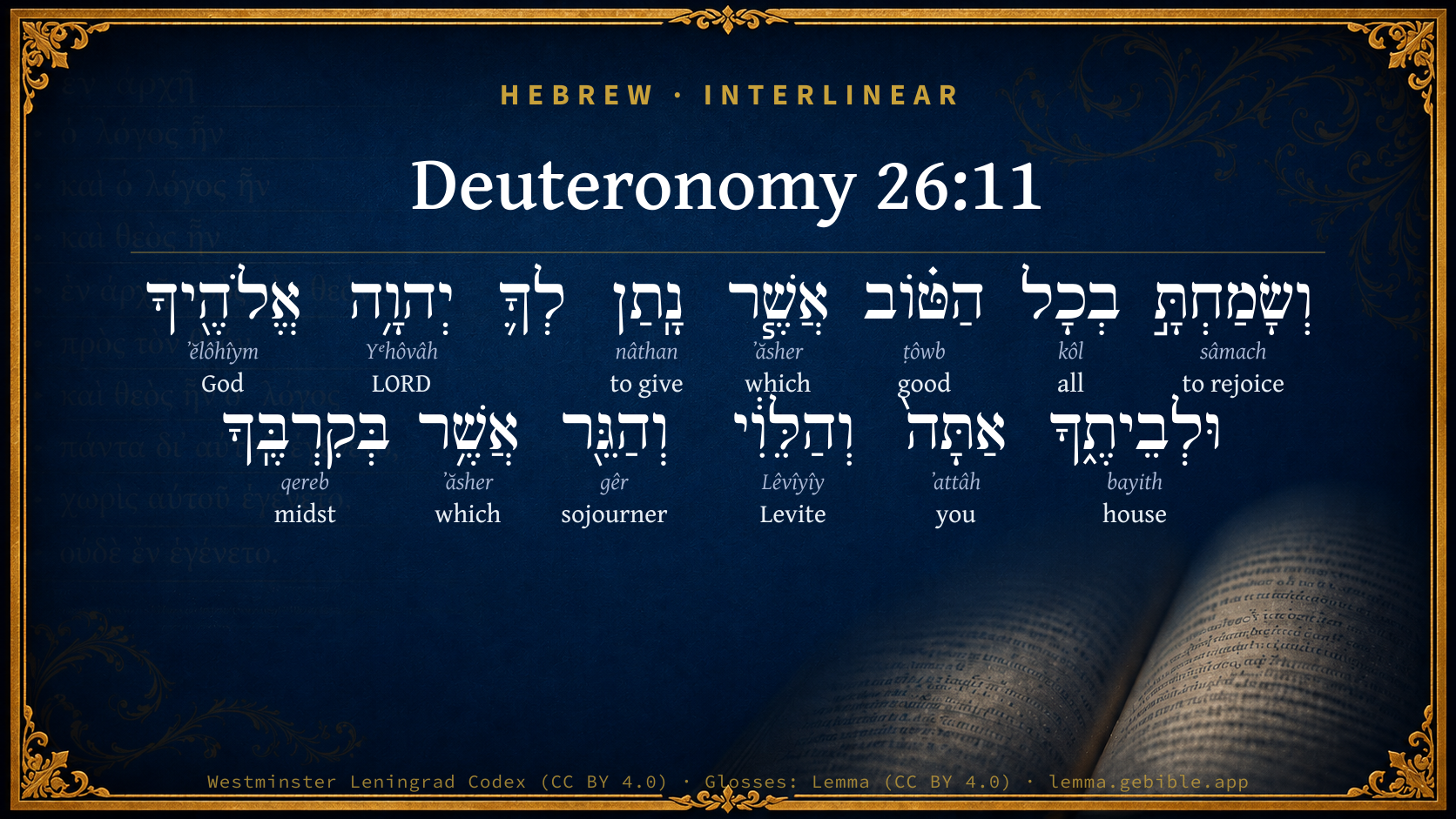
Hebrew (Westminster Leningrad Codex) Deuteronomy 26:11 appears in the Hebrew Old Testament. The text above is from the Westminster Leningrad Codex. Each word links to its Strong’s number, a concise gloss, and parsing drawn from the Open Scriptures Hebrew Bible morphology. Click any word for its full Brown-Driver-Briggs (BDB) entry.
Download image
Cite this verse

Deuteronomy 26:11 (World English Bible). Public Domain. Lemma interlinear Bible study tool, https://lemma.gebible.app/v/deuteronomy/26/11.

Show BibTeX & RIS
BibTeX
RIS
English Translation
and you shall rejoice in all the good which Yahweh your God has given to you, and to your house, you, and the Levite, and the foreigner who is in the midst of you.
World English Bible · Public Domain
Download a study sheet

One document with this verse’s original text, its word-by-word gloss line, the meaning frame, cross-references with their text, attributed commentary, and full source and license credits — printable, and it pastes into notes with its structure intact.

This verse Autodidact and up

Study sheet (.html) Plain text (.txt)

A passage Seminary Student

Up to 50 verses in one chapter. A passage sheet keeps up to 6 commentary sources and 12 cross-references per verse, in the order this page ranks them, and says so on the sheet whenever that leaves anything out. Ask for a single verse and you get the Autodidact verse sheet above.

Everything on this page stays free to read, with no account — the sheet is a download of what is already on screen, not access to it.

Want to remove ads? Support Godless Engineer
Compare translations 3

The same verse in 3 English versions, stacked beneath the original-language interlinear above. Click any original word for its lexicon entry.

Each is an independent rendering of the whole verse — the interlinear is not word-aligned to these translations.

Highlighted words mark where these versions differ — a whole-verse word diff, not a word-by-word alignment.

  • World English Bible Public Domain
    and you shall rejoice in all the good which Yahweh your God has given to you, and to your house, you, and the Levite, and the foreigner who is in the midst of you.
  • King James Version Public Domain
    And thou shalt rejoice in every good thing which the LORD thy God hath given unto thee, and unto thine house, thou, and the Levite, and the stranger that is among you.
  • unfoldingWord Literal Text CC BY-SA 4.0
    and you shall rejoice in all the good that Yahweh your God has given to you and to your house—you and the Levite and the foreigner who among you.

unfoldingWord Literal Text — © unfoldingWord, licensed CC BY-SA 4.0. Word-aligned USFM3 via Door43 (git.door43.org/unfoldingWord/en_ult).

Versions to compare (up to 4)

3 of 4 selected

Show all 18 translations

Every available English version of this verse, each an independent rendering of the whole verse.

  • World English Bible Public Domain
    and you shall rejoice in all the good which Yahweh your God has given to you, and to your house, you, and the Levite, and the foreigner who is in the midst of you.
  • Berean Standard Bible Public Domain
    So you shall rejoice—you, the Levite, and the foreigner dwelling among you—in all the good things the LORD your God has given to you and your household.
  • Majority Standard Bible Public Domain
    So you shall rejoice—you, the Levite, and the foreigner dwelling among you—in all the good things the LORD your God has given to you and your household.
  • King James Version Public Domain
    And thou shalt rejoice in every good thing which the LORD thy God hath given unto thee, and unto thine house, thou, and the Levite, and the stranger that is among you.
  • American Standard Version (1901) Public Domain
    and thou shalt rejoice in all the good which Jehovah thy God hath given unto thee, and unto thy house, thou, and the Levite, and the sojourner that is in the midst of thee.
  • Revised Version (1885) Public Domain
    and thou shalt rejoice in all the good which the LORD thy God hath given unto thee, and unto thine house, thou, and the Levite, and the stranger that is in the midst of thee.
  • Geneva Bible (1599) Public Domain
    And thou shalt reioyce in all the good things which the Lord thy God hath giuen vnto thee and to thine houshold, thou and the Leuite, and the stranger that is among you.
  • Douay-Rheims (1899) Public Domain
    And therefore now I offer the firstfruits of the land which the Lord hath given me. And thou shalt leave them in the sight of the ford thy God, adoring the Lord thy God.
  • Young's Literal Translation Public Domain
    and rejoiced in all the good which Jehovah thy God hath given to thee, and to thy house, thou, and the Levite, and the sojourner who `is' in thy midst.
  • Literal Standard Version CC BY-SA 4.0
    and rejoiced in all the good which your God YHWH has given to you and to your house—you, and the Levite, and the sojourner who [is] in your midst.)
  • Unlocked Literal Bible CC BY-SA 4.0
    and you must rejoice in all the good that Yahweh your God has done for you, for your house—you, and the Levite, and the foreigner who is among you.
  • unfoldingWord Literal Text CC BY-SA 4.0
    and you shall rejoice in all the good that Yahweh your God has given to you and to your house—you and the Levite and the foreigner who among you.
  • Darby Bible Public Domain
    And thou shalt rejoice in all the good that Jehovah thy God hath given to thee, and to thy house, thou, and the Levite, and the stranger that is in thy midst.
  • World Messianic Bible Public Domain
    You shall rejoice in all the good which the LORD your God has given to you, and to your house, you, and the Levite, and the foreigner who is among you.
  • Webster's Bible Public Domain
    And thou shalt rejoice in every good thing which the LORD thy God hath given to thee, and to thy house, thou, and the Levite, and the stranger that is among you.
  • Free Bible Version CC BY-SA 4.0
    Then you, the Levites, and the foreigners who live with you are to celebrate all the good things the Lord your God has given to you and your family.
  • Bible in Basic English Public Domain
    And you will have joy in every good thing which the Lord your God has given to you and to your family; and the Levite, and the man from a strange land who is with you, will take part in your joy.
  • JPS Tanakh (1917) Public Domain
    And thou shalt rejoice in all the good which the LORD thy God hath given unto thee, and unto thy house, thou, and the Levite, and the stranger that is in the midst of thee.

Literal Standard Version (2020), Covenant Press — licensed CC BY-SA 4.0. Text via the HelloAO Bible API (eBible.org). Unlocked Literal Bible (unfoldingWord) — licensed CC BY-SA 4.0. Text via the HelloAO Bible API (eBible.org). unfoldingWord Literal Text — © unfoldingWord, licensed CC BY-SA 4.0. Word-aligned USFM3 via Door43 (git.door43.org/unfoldingWord/en_ult). Free Bible Version, Dr. Jonathan Gallagher — licensed CC BY-SA 4.0. Text via the HelloAO Bible API (eBible.org).

Word by word

More ways to search: Search by grammar → Find every occurrence → Compare this word →

Practice this passage: Drill this verse → Learn its vocabulary →

וְהַגֵּ֖ר
gêr
H1616
“and · the · sojourner”
Conjunction + Particle, Definite Article + Noun, Common, Masculine, Singular, Absolute
Part of Speech
Conjunction + Particle + Noun
Type
Common
Gender
Masculine
Number
Singular
State
Absolute
Full BDB Definition

Origin: from H1481

TWOT: 330a

sojourner - a temporary inhabitant, a newcomer lacking inherited rights - of foreigners in Israel, though conceded rights
  1. וְשָׂמַחְתָּ֣ sâmach H8055 “and · to rejoice” Conjunction + Verb, Qal, Sequential Perfect, 2nd Person, Masculine, Singular
  2. בְכָל kôl H3605 “in/at · all of” Preposition + Noun, Common, Masculine, Singular, Construct
  3. הַטּ֗וֹב ṭôwb H2896 “the · good” Particle, Definite Article + Adjective, Adjective, Masculine, Singular, Absolute
  4. אֲשֶׁ֧ר ʼăsher H834 “which” Particle, Relative
  5. נָֽתַן nâthan H5414 “to give” Verb, Qal, Perfect, 3rd Person, Masculine, Singular
  6. יְהוָ֥ה Yᵉhôvâh H3068 “LORD” Noun, Proper
  7. אֱלֹהֶ֖יךָ ʼĕlôhîym H430 “God(s) · your” Noun, Common, Masculine, Plural, Construct + Suffix, Personal, 2nd Person, Masculine, Singular
  8. וּלְבֵיתֶ֑ךָ bayith H1004 “and · to/for · house · your” Conjunction + Preposition + Noun, Common, Masculine, Singular, Construct + Suffix, Personal, 2nd Person, Masculine, Singular
  9. אַתָּה֙ ʼattâh H859 “you” Pronoun, Personal, 2nd Person, Masculine, Singular
  10. וְהַלֵּוִ֔י Lêvîyîy H3881 “and · the · Levite” Conjunction + Particle, Definite Article + Noun, Gentilic, Masculine, Singular, Absolute
  11. אֲשֶׁ֥ר ʼăsher H834 “which” Particle, Relative
  12. בְּקִרְבֶּֽךָ qereb H7130 “in/at · midst · your” Preposition + Noun, Common, Masculine, Singular, Construct + Suffix, Personal, 2nd Person, Masculine, Singular

About this verse

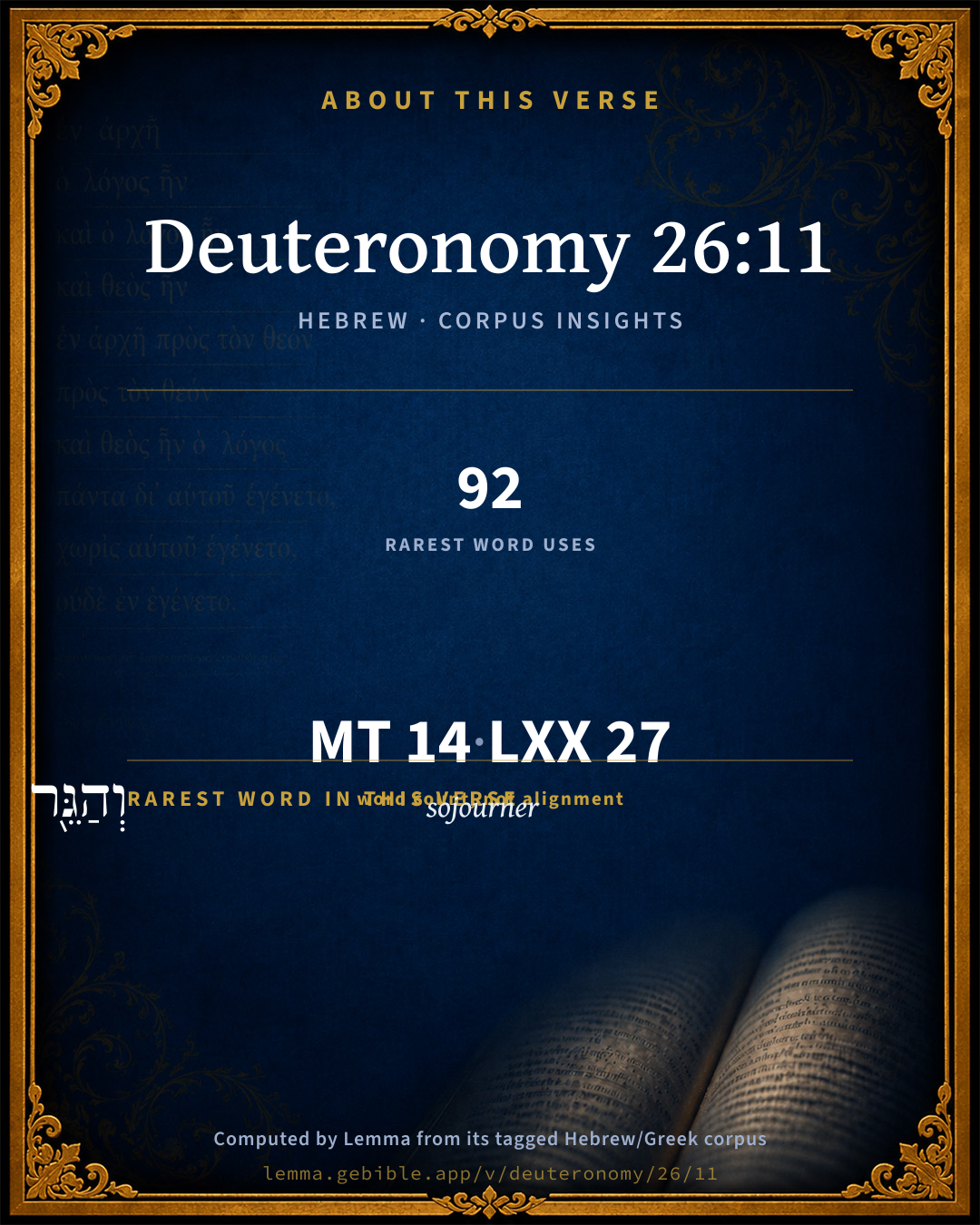
These counts appear in no published source. They are computed here, from the morphology-tagged text and Lemma’s own curated glosses. What Lemma adds →

14
words
12
distinct lemmas
Pentateuch
section

Grammatical profile

  • 2 verbs
  • 7 nouns
  • 1 adjective
  • 1 pronoun
  • 1 preposition
  • 2 particles

Verb forms

  • וְשָׂמַחְתָּ֣ Qal · Sequential Perfect
  • נָֽתַן Qal · Perfect

Repetition

A word recurs within this verse — often emphatic in Hebrew:

  • אֲשֶׁ֧ר which H834 ×2

Hebrew & Septuagint length

In English translation the verse runs 34 words from the Hebrew and 31 from the Septuagint (LXX English) — closely comparable.

A rough comparison of the two English renderings, which tokenize alike — not a word-level alignment.

Word counts can differ between the Hebrew and the Greek without any difference in meaning — e.g. the Hebrew direct-object marker אֵת has no separate Greek word, and Greek often adds the article ὁ.

In the original languages it is 14 Hebrew tokens and 27 Greek tokens — but the two are counted differently (Hebrew bundles its prefixes and suffixes into one token; the Greek is in lemma form), so that isn’t a like-for-like length.

Cross-references

13

Topical passages linked to Deuteronomy 26:11 in the Treasury of Scripture Knowledge — connected by theme and wording, ordered by reader-vote popularity; previews shown in the World English Bible.

  • Deuteronomy 16:11 and you shall rejoice before Yahweh your God, you, and your son, and your daughter, and your man-servant, and your maid-servant, and the Levite who is within your gates, and the foreigner, and the fatherless, and the widow, who are in the midst of you, in the place which Yahweh your God shall choose, to cause his name to dwell there.
  • Deuteronomy 12:7 and there you shall eat before Yahweh your God, and you shall rejoice in all that you put your hand to, you and your households, in which Yahweh your God has blessed you.
  • Philippians 4:4 Rejoice in the Lord always! Again I will say, Rejoice!
  • Deuteronomy 28:47 Because you didn't serve Yahweh your God with joyfulness, and with gladness of heart, by reason of the abundance of all things;
  • Psalms 100:1–2 Shout for joy to Yahweh, all you lands!
  • Isaiah 65:14 behold, my servants shall sing for joy of heart, but you shall cry for sorrow of heart, and shall wail for vexation of spirit.
  • Deuteronomy 12:12 You shall rejoice before Yahweh your God, you, and your sons, and your daughters, and your men-servants, and your maid-servants, and the Levite who is within your gates, because he has no portion nor inheritance with you.
  • Psalms 63:3–5 Because your loving kindness is better than life, My lips shall praise you.
  • Zechariah 9:17 For how great is his goodness, And how great is his beauty! Grain will make the young men flourish, And new wine the virgins.
  • Deuteronomy 12:18 but you shall eat them before Yahweh your God in the place which Yahweh your God shall choose, you, and your son, and your daughter, and your man-servant, and your maid-servant, and the Levite who is within your gates: and you shall rejoice before Yahweh your God in all that you put your hand to.
  • Acts 2:46–47 Day by day, continuing steadfastly with one accord in the temple, and breaking bread at home, they took their food with gladness and singleness of heart,
  • 1 Corinthians 9:11 If we sowed to you spiritual things, is it a great thing if we reap your fleshly things?
  • 1 Timothy 6:17–18 Charge those who are rich in this present world that they not be haughty, nor have their hope set on the uncertainty of riches, but on the living God, who richly provides us with everything to enjoy;

Cross-references courtesy of OpenBible.info (CC BY 4.0).

Hebrew and Greek witnesses Masoretic Hebrew ↔ Greek Septuagint

The same verse in the two great witnesses to the Old Testament, shown verse-for-verse.

These are two independent witnesses, not word-aligned to each other, and the Septuagint is shown in lemma (dictionary) form.

Hebrew Deuteronomy 26:11 Masoretic · Westminster Leningrad Codex

וְשָׂמַחְתָּ֣ בְכָל הַטּ֗וֹב אֲשֶׁ֧ר נָֽתַן לְךָ֛ יְהוָ֥ה אֱלֹהֶ֖יךָ וּלְבֵיתֶ֑ךָ אַתָּה֙ וְהַלֵּוִ֔י וְהַגֵּ֖ר אֲשֶׁ֥ר בְּקִרְבֶּֽךָ

and you shall rejoice in all the good which Yahweh your God has given to you, and to your house, you, and the Levite, and the foreigner who is in the midst of you.

World English Bible · Public Domain

Greek LXX Deuteronomy 26:11 Septuagint · lemma form

καί εὐφραίνω ἐν πᾶς ὁ ἀγαθός ὅς δίδωμι σύ κύριος ὁ θεός σύ καί ὁ οἰκία σύ σύ καί ὁ λευίτης καί ὁ προσήλυτος ὁ ἐν σύ

and you shall rejoice in all the good things, which the Lord your God has given you, you and your family, and the Levite, and the stranger that is within you.

LXX2012 (modern English Septuagint) · Public Domain

Hebrew: Westminster Leningrad Codex (CC BY 4.0). Greek: Septuagint (public domain); English from LXX2012 (modern English Septuagint) (Public Domain). How the Septuagint differs from the Hebrew →

Targum (Aramaic paraphrase)

2

The Targum is the ancient Jewish Aramaic paraphrase of the Hebrew Scriptures — an interpretive translation, not the Hebrew text itself. Onkelos (literal) and Pseudo-Jonathan (expansive) render the Torah, and Jonathan the Prophets. Coverage is partial: where no permissively-licensed English translation exists for a verse, only the Aramaic is shown. This is verse-level text, not a word-by-word alignment to the Hebrew.

  1. Targum Onkelos Torah (Genesis–Deuteronomy)
    וְתֶחֱדֵי בְכָל טַבְתָא דִי יְהַב לָךְ יְיָ אֱלָהָךְ וְלֶאֱנַשׁ בֵּיתָךְ אַתְּ וְלֵוָאֵי וְגִיוֹרָא דִי בֵינָךְ

    (no public-domain English translation for this verse)

    Targum Onkelos — Aramaic: “Onkelos Genesis” (public domain); “Onkelos Exodus” (public domain); “Onkelos Leviticus” (public domain); “Onkelos Numbers” (public domain); “Onkelos Deuteronomy” (public domain). English: “Sefaria Community Translation” (CC0 1.0 (public-domain dedication)); “J.W. Etheridge. The Targums of Onkelos and Jonathan Ben Uzziel on the Pentateuch. London: Longmans, Green, 1862” (public domain). Text via Sefaria.

  2. Targum Pseudo-Jonathan Torah (Genesis–Deuteronomy)
    וְתֶחֱדֵי בְּכָל טַבְתָּא דִיהַב לָךְ יְיָ אֱלָהָךְ וּלְאֵינַשׁ בָּתֵּיכוֹן וְתֶהֱנוּן וְתֵיכְלוּן אַתּוּן וְלֵיוָאֵי וְגִיוֹרֵי דְבֵינֵיכוֹן

    and rejoice in all the good which the Lord thy God giveth thee, thou and the men of thy house, and enjoy and eat, you, the Levites and the sojourners who are among you.

    Targum Pseudo-Jonathan — Aramaic: “Targum Jonathan on Genesis” (public domain); “Targum Jonathan on Exodus” (public domain); “Targum Jonathan on Leviticus” (public domain); “Targum Jonathan on Numbers” (public domain); “Targum Jonathan on Deuteronomy” (public domain). English: “The Targum of Jonathan ben Uzziel, trans. J. W. Etheridge, London, 1862” (public domain). Text via Sefaria.

Commentary

Notes on Deuteronomy 26:11 from classic Christian and Jewish commentators (each source and its license shown beneath its notes). The classic Christian expositions comment on the surrounding passage and are grouped to its opening verse, so a note may address several verses; the Jewish commentaries on the Tanakh (Rashi and others) are per-verse, so they appear only where the commentator wrote on this verse.

Lemma curates 59 commentaries, every one of them public domain or Creative Commons licensed, each selected and text-cleaned for this edition rather than reprinted as found. About our sources →

The Biblical Illustrator

Joseph S. Exell

Deu_26:11

Thou shalt rejoice in every good thing.

Rejoice in every good thing

It is our duty to give unstinted welcome to every visit of enjoyment with which we may be favoured. We frequently allow streams of refreshment or exhilaration to run past us without dipping into or tasting them; we blunderingly overlook many a cup of soothing and pleasing that is offered to us as we go trudging by. We are slow to discover and seize our golden chances, and hardly know how to make the most of them. At times we are afraid, it would seem, pausing now and then to squeeze a drop or two of severe or melancholy reflection into the goblet, as if there might be sin in having it too rich and sweet. The angel descending to solace us in our Gethsemane with a brief pleasant thrill, with a brief glimpse and gust of pleasure, flashes by under the sombre, wailing olives in vain, is allowed to vanish unharboured and un-utilised.

I. Never turn, in your bitterness of spirit, from any ministry of temporal enjoyment that may intervene; never be so wedded to your woes, so shut up and sunk down in them, that you cannot issue forth to accept such ministry. For, remember, we want to be made joyful for our education quite as much as we need to be tried and troubled. To laugh, to luxuriate, to ripple and glow with delight, at times is just as essential for us as it is at times to weep and suffer.

II. At times some of us may have had the feeling that there is so much misery in the world that it is hardly right to ignore and forget it for a moment in rejoicing. But let us reflect that, since God is our Father and we His children, we are justified in losing sight of trouble for a time when He gives us a joy to taste. Being only a child, however, I must feel about His world, and share in His travail concerning it; I need not be afraid at intervals to cast the entire load upon Him and let Him carry it alone. Souls must turn aside at times to bask in what sunshine they can find, and be mellowed, and warmed, and raised with it, in order to be of service in the darkness and to help to soften and relieve. (S. A. Tipple.)

Rejoice with a rejoicing universe

Rejoice with the morning stars, and let your adoring spirit march to the music of hymning spheres. Rejoice with the jocund spring in its gush of hope, and its dancing glory, with its swinging insect clouds and its suffusion of multitudinous song; and rejoice with golden autumn, as he rustles his grateful sheaves, and clasps his purple hands, as he breathes his story of fruition, his anthem of promises fulfilled; as he breathes it softly in the morning stillness of ripened fields, or flings it in AEolian sweeps from lavish orchards and from branches tossing bounty into mellow winds. Rejoice with infancy, as it guesses its wondering way into more and more existence, and laughs and carols as the field of pleasant life enlarges on it, and new secrets of delight flow in through fresh and open senses. Rejoice with the second youth of the heaven-born soul, as the revelations of a second birth pour in upon it, and the glories of a new world amaze it. Rejoice with the joyful believer when he sings, O Lord! I will praise Thee; though Thou wast angry with me, Thine anger is turned away, and Thou comfortedst me. Behold, God is my salvation. Rejoice with him whose incredulous ecstasy has alighted on the great Gospel secret, whoso eye is beaming as none can beam save that which for the first time beholds the Lamb; whose awe-struck countenance and uplifted hands are evidently exclaiming, This is my beloved, and this is my friend. Rejoice with saints and angels, as they rejoice in a sight like this. Rejoice with Immanuel, whose soul now sees of its travail. Rejoice with the ever blessed Three, and with a heaven whose work is joy. Be glad in the Lord, and rejoice, ye righteous; and shout for joy, all ye that are upright in heart. (J. Hamilton.)

.

The Biblical Illustrator, edited by Joseph S. Exell (c. 1880s–1900s) — public domain. Text from a community e-Sword module.

Tyndale Open Study Notes

Tyndale Open Resources

26:11 In Israelite society, foreigners (literally sojourners) were resident aliens; see also study note on 10:18.

Tyndale Open Study Notes — © Tyndale Open Resources, licensed CC BY-SA 4.0. Text via the HelloAO Bible API.

Geneva Bible (1599)

Geneva Bible translators

Signifying that God giveth us not goods for ourselves only, but for their uses also which are committed to our charge.

Geneva Bible (1599) marginal notes — public domain. Text via Bolls.life.

Jamieson, Fausset & Brown

Robert Jamieson, A. R. Fausset & David Brown

thou shalt rejoice--feasting with friends and the Levites, who were invited on such occasions to share in the cheerful festivities that followed oblations (Deu 12:7; Deu 16:10-15).

Jamieson, Fausset & Brown — Commentary Critical and Explanatory on the Whole Bible (1871) — public domain (CC PDM 1.0). Text via the HelloAO Bible API.

Adam Clarke's Commentary

Verse 11. Thou shalt rejoice] God intends that his followers shall be happy; that they shall eat their bread with gladness and singleness of heart, praising him. Those who eat their meat grudgingly, under the pretence of their unworthiness, &c., profane God's bounties and shall have no thanks for their voluntary humility.

Thou, and the Levite, and the stranger] They were to take care to share God's bounties among all those who were dependent on them. The Levite has no inheritance, let him rejoice with thee. The stranger has no home, let him feel thee to be his friend and his father.

Adam Clarke's Commentary on the Bible (1810–1826) — public domain. Text from a community e-Sword/MySword module.

The Cambridge Bible for Schools and Colleges

gen. ed. J. J. S. Perowne

11. and thou shalt rejoice, etc.] See Deu_12:6 f., 11 f., 17 f., Deu_16:11; Deu_16:14. It is not said that the worshippers shall eat the reshîth, for that has already been given to the Deity. See introd. note.

and unto thine house, thou] With Luc. read thou and thine house.

The Cambridge Bible for Schools and Colleges (gen. ed. J. J. S. Perowne; Cambridge University Press, 1878–1918) — public domain. Text from a community e-Sword module.

John Gill's Exposition

And thou shalt rejoice in every good thing,.... In all the blessings of goodness and mercies of life, which God in his kind providence had favoured them with:

which the Lord thy God hath given unto thee, and unto thine house; to them and their families, by which they were comfortably provided for:

thou and the Levite, and the stranger that is among you; by which it seems that not only a basket of firstfruits was brought and presented to the Lord, which is the perquisite of the priest, but there were others also brought, or bought with their money at Jerusalem, and a sort of a kept, which the Levite, and stranger or proselyte, of along with the owner; see Deu 12:11; though Jarchi understands it of the Levite and stranger being obliged to bring the firstfruits: the Levite, he says, is bound to the firstfruits of the plants in the midst of his cities, though he had no part in the division of the land; and the same writer says, the stranger brings the firstfruits, but does not proclaim, because he cannot say, "which he sware to our fathers", Deu 26:3; but it is said (f), if his mother was an Israelitess he might proclaim; yea, Maimonides (g) says, on account of what is said of Abraham, Gen 17:5; who is the father of the whole world; see Rom 4:10; because mention is made of rejoicing; hence it is concluded, as Jarchi says, that the proclamation of the firstfruits was only made in the time of joy, from Pentecost unto the feast that a man gathers in his increase, and his fruits, and his wine, and his oil; though from that feast and onward he may bring, but not proclaim; to the same purpose, says the Misnah (h), from Pentecost to the feast of tabernacles a man may bring the firstfruits, and proclaim; and even from the feast of tabernacles to the dedication of the temple, he may bring, but not proclaim; the reason given in Siphri (i) is, because proclamation is only to be performed in time of joy--and the joy of the year is finished at the end of the feast of tabernacles, as in Lev 23:40.

(f) Misn. Biccurim, c. 1. sect. 4. (g) Maimon. Hilchot Biccurim, c. 4. sect. 3. (h) Ut supra, (f)) sect. 6. (i) Apud Maimon. Hilchot Biccurim, c. 4. sect. 6.

John Gill's Exposition of the Whole Bible (1746–1763) — public domain (CC PDM 1.0). Text via the HelloAO Bible API.

Haydock's Catholic Bible Commentary

Feast. The Jews could not yet be required with propriety to raise themselves to delights purely spiritual, chap. xii. 7. Strabo (x.) observes, that the Greeks and barbarians accompanied their sacrifices with feasting and music, which served to take off their thoughts from worldly concerns, and gave them a sort of foretaste of the divinity. (Calmet)

George Leo Haydock (1774–1849), Haydock's Catholic Family Bible and Commentary, 1859 edition — public domain. Excludes Psalms (Douay-Rheims chapter numbering differs from Protestant) and Deuterocanonical books (Catholic canon only).

Matthew Poole's English Annotations

Thou shalt rejoice; i.e. either,

1. Thou shalt hereby be enabled to rejoice and take comfort in all thy enjoyments, when thou hast sanctified them by giving God his portion. Or,

2. Thou shalt feast (which is oft expressed by rejoicing) with the Levites and strangers upon the oblations which at these solemn times were offered; which exposition is confirmed by comparing Deu 16:10-11,14-15.

Matthew Poole's English Annotations on the Holy Bible (1683–1685) — public domain. Text from a community e-Sword/MySword module.

The Pulpit Commentary

And thou shalt rejoice in every good thing, etc.; i.e. with these bounties of God"s providence make a feast for yourself and your household, and omit not to invite the Levite and the stranger to partake of it with you. As with the yearly tithe (Deu_14:23) and the firstlings, (Deu_15:20) so with this portion of the firstfruits, a festive meal was to consummate the service. According to the Law, the firstfruits were the perquisite of the priest (Deu_18:4; Num_18:12, etc.) but of these a portion was to be taken for this special service, and of that a feast was to be made.

The Pulpit Commentary (1880–1919), ed. H.D.M. Spence-Jones & Joseph S. Exell — public domain. Text from a community e-Sword module.

John Wesley's Explanatory Notes

Thou shalt rejoice - Thou shalt hereby enabled to take comfort in all thy employments, when thou hast sanctified them by giving God his portion. It is the will of God, that we should be chearful not only in our attendance upon his holy ordinances, but in our enjoyment of the gifts of his providence. Whatever good thing God gives us, we should make the most comfortable use of it we can, still tracing the streams to the fountain of all consolation.

John Wesley, Explanatory Notes Upon the Whole Bible (1754–1765) — public domain. Text via the GEBible commentary corpus.

Rashi

Rabbi Shlomo Yitzchaki (Rashi)

ושמחת בכל הטוב AND THOU SHALT REJOICE IN EVERY GOOD THING — From this they (the Rabbis) derived the law that the recital on the occasion of bringing the first fruits is made only during the joyful period of the year — from Pentecost till the Feast of Tabernacles — when a man is gathering in his grain, his fruits, his wine and his oil; but from Tabernacles onwards until Chanucah if he brings these, he does not make the recital (Pesachim 36b).

אתה והלוי THOU AND THE LEVITE — the Levites are also bound to bring the first fruits to the priest if they planted anything in the fields attached to their cities.

והגר אשר בקרבך AND THE STRANGER THAT IS AMONG YOU — he, too, brings the first fruits to the priest but does not make the recital, for he cannot truly say, as is prescribed, “[I profess this day … that I have come into the land which the Lord sware] unto our fathers” (v. 3) since his fathers were not Israelites (cf. Sifrei Devarim 301:37; Mishnah Bikkurim 1:4; Talmud Yerushalmi Maaser Sheni 5:5).

Rashi on the Tanakh — English translations: “The Judaica Press complete Tanach with Rashi, translated by A. J. Rosenberg” (CC BY 4.0); “Pentateuch with Rashi's commentary by M. Rosenbaum and A.M. Silbermann, 1929-1934” (public domain); “The Metsudah Tanach series, Lakewood, N.J” (CC BY 4.0); and “The Book of Joshua, Metsudah Publications, 1997” (CC BY 4.0). Text via Sefaria.

Lesson kit

Teaching starters — assembled from the data on this page, not authored interpretation. Every prompt links to the verse data it draws on. Edit before teaching.

Deuteronomy, in the Pentateuch, opens this verse with 14 words (12 distinct Hebrew lemmas). Its most distinctive word is gêr (“sojourner”). A historical commentator’s framing appears above. Read the whole chapter for the surrounding context.

Discussion questions

  1. How does “sojourner” (gêr) shape what this verse is saying?
  2. How does Deuteronomy 16:11, which shares this passage’s theme, read alongside this verse?
  3. What does the repetition of “which” (2× in this one verse) do in this verse?
  4. These translations render this verse differently. What is at stake in choosing one wording over another?
  5. «וְשָׂמַחְתָּ֣» is a Qal Sequential Perfect verb. How does that grammatical form shape the action described?
  6. Compare how The Biblical Illustrator and Tyndale Open Study Notes read this verse. Where do they agree or differ?

Things to notice

Reading settings

Reading text

Shown beneath each verse's original-language words.

Old Testament
Old Testament edition

Read the OT as the Masoretic Hebrew (MT) or the Greek Septuagint (LXX).

English shown for the Greek Septuagint (in the Hebrew ↔ Greek comparison).

Comparing translations? Open the Compare panel on any verse page to stack up to four side by side.