
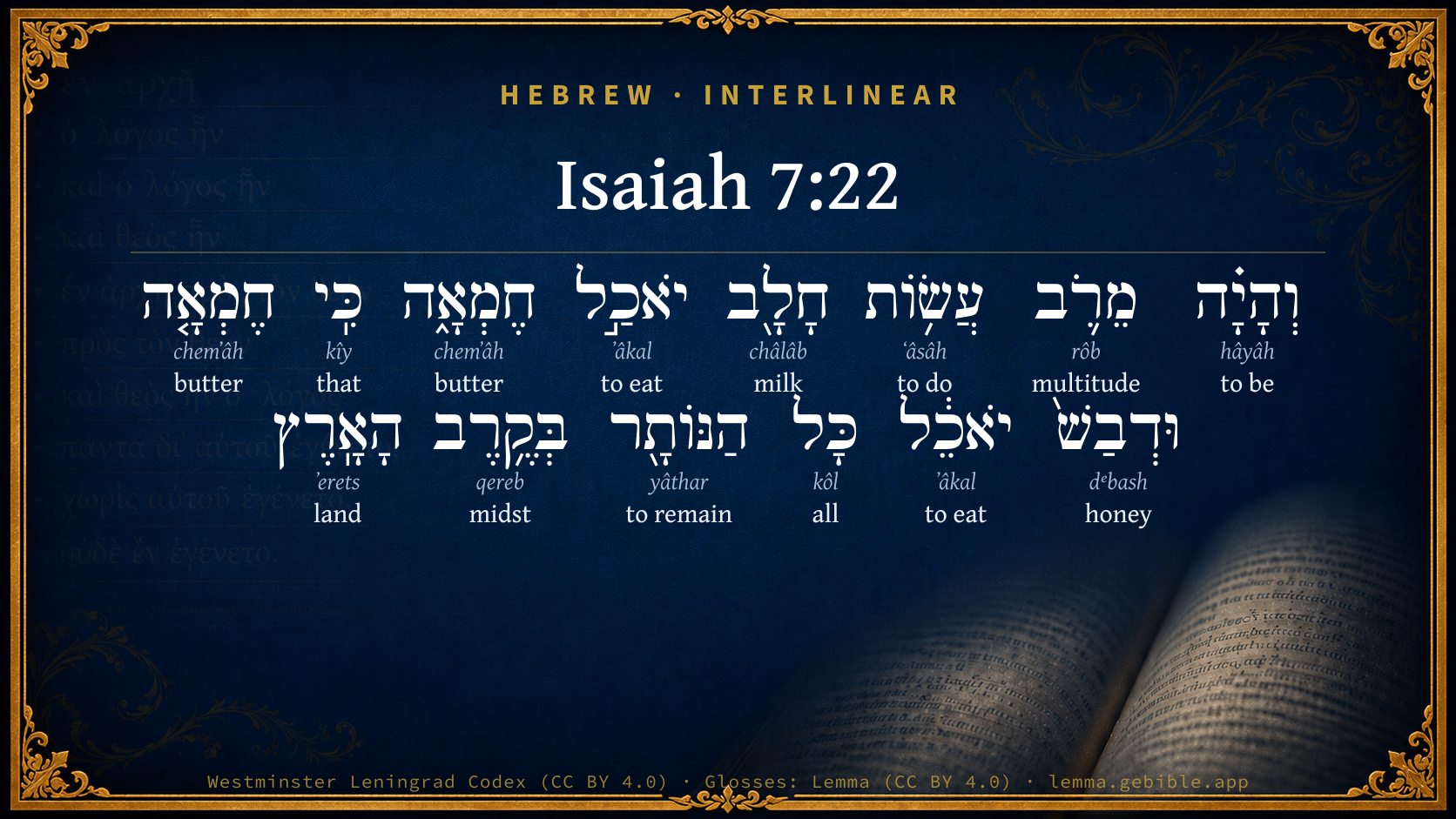
Isaiah 7:22

Hebrew (Westminster Leningrad Codex) Isaiah 7:22 appears in the Hebrew Old Testament. The text above is from the Westminster Leningrad Codex. Each word links to its Strong’s number, a concise gloss, and parsing drawn from the Open Scriptures Hebrew Bible morphology. Click any word for its full Brown-Driver-Briggs (BDB) entry.
Download image
Cite this verse

Isaiah 7:22 (World English Bible). Public Domain. Lemma interlinear Bible study tool, https://lemma.gebible.app/v/isaiah/7/22.

Show BibTeX & RIS
BibTeX
RIS
English Translation
and it shall happen, that because of the abundance of milk which they shall give he shall eat butter: for everyone will eat butter and honey that is left in the midst of the land.
World English Bible · Public Domain
Download a study sheet

One document with this verse’s original text, its word-by-word gloss line, the meaning frame, cross-references with their text, attributed commentary, and full source and license credits — printable, and it pastes into notes with its structure intact.

This verse Autodidact and up

Study sheet (.html) Plain text (.txt)

A passage Seminary Student

Up to 50 verses in one chapter. A passage sheet keeps up to 6 commentary sources and 12 cross-references per verse, in the order this page ranks them, and says so on the sheet whenever that leaves anything out. Ask for a single verse and you get the Autodidact verse sheet above.

Everything on this page stays free to read, with no account — the sheet is a download of what is already on screen, not access to it.

Want to remove ads? Support Godless Engineer
Compare translations 3

The same verse in 3 English versions, stacked beneath the original-language interlinear above. Click any original word for its lexicon entry.

Each is an independent rendering of the whole verse — the interlinear is not word-aligned to these translations.

Highlighted words mark where these versions differ — a whole-verse word diff, not a word-by-word alignment.

  • World English Bible Public Domain
    and it shall happen, that because of the abundance of milk which they shall give he shall eat butter: for everyone will eat butter and honey that is left in the midst of the land.
  • King James Version Public Domain
    And it shall come to pass, for the abundance of milk that they shall give he shall eat butter: for butter and honey shall every one eat that is left in the land.
  • unfoldingWord Literal Text CC BY-SA 4.0
    And it will happen, from the abundance of making milk, he will eat curds, for every one left in the midst of the land will eat curds and honey.

unfoldingWord Literal Text — © unfoldingWord, licensed CC BY-SA 4.0. Word-aligned USFM3 via Door43 (git.door43.org/unfoldingWord/en_ult).

Versions to compare (up to 4)

3 of 4 selected

Show all 18 translations

Every available English version of this verse, each an independent rendering of the whole verse.

  • World English Bible Public Domain
    and it shall happen, that because of the abundance of milk which they shall give he shall eat butter: for everyone will eat butter and honey that is left in the midst of the land.
  • Berean Standard Bible Public Domain
    and from the abundance of milk they give, he will eat curds; for all who remain in the land will eat curds and honey.
  • Majority Standard Bible Public Domain
    and from the abundance of milk they give, he will eat curds; for all who remain in the land will eat curds and honey.
  • King James Version Public Domain
    And it shall come to pass, for the abundance of milk that they shall give he shall eat butter: for butter and honey shall every one eat that is left in the land.
  • American Standard Version (1901) Public Domain
    and it shall come to pass, that because of the abundance of milk which they shall give he shall eat butter: for butter and honey shall every one eat that is left in the midst of the land.
  • Revised Version (1885) Public Domain
    and it shall come to pass, for the abundance of milk that they shall give he shall eat butter: for butter and honey shall every one eat that is left in the midst of the land.
  • Geneva Bible (1599) Public Domain
    And for the abundance of milke, that they shall giue, hee shall eate butter: for butter and hony shall euery one eate, which is left within the land.
  • Douay-Rheims (1899) Public Domain
    And for the abundance of milk he shall eat butter: for butter and honey shall every one eat that shall be left in the midst of the land.
  • Young's Literal Translation Public Domain
    And it hath come to pass, From the abundance of the yielding of milk he eateth butter, For butter and honey doth every one eat Who is left in the heart of the land.
  • Literal Standard Version CC BY-SA 4.0
    And it has come to pass, || He eats butter from the abundance of the yielding of milk, || For everyone who is left in the heart of the land eats butter and honey.
  • Unlocked Literal Bible CC BY-SA 4.0
    and because of the abundance of milk which they shall give, he will eat curds, for everyone left in the land will eat curds and honey.
  • unfoldingWord Literal Text CC BY-SA 4.0
    And it will happen, from the abundance of making milk, he will eat curds, for every one left in the midst of the land will eat curds and honey.
  • Darby Bible Public Domain
    and it shall come to pass, from the abundance of milk they shall give, [that] he shall eat butter; for every one that remaineth in the midst of the land shall eat butter and honey.
  • World Messianic Bible Public Domain
    It shall happen, that because of the abundance of milk which they shall give he shall eat butter, for everyone will eat butter and honey that is left within the land.
  • Webster's Bible Public Domain
    And it shall come to pass, for the abundance of milk that they shall give, he shall eat butter: for butter and honey shall every one eat that is left in the land.
  • Free Bible Version CC BY-SA 4.0
    will eat curds, because they produce so much milk—for everyone who survives in the land will eat curds and honey.
  • Bible in Basic English Public Domain
    And they will give so much milk that he will be able to have butter for his food: for butter and honey will be the food of all who are still living in the land.
  • JPS Tanakh (1917) Public Domain
    and it shall come to pass, for the abundance of milk that they shall give, he shall eat curd; for curd and honey shall every one eat that is left in the midst of the land.

Literal Standard Version (2020), Covenant Press — licensed CC BY-SA 4.0. Text via the HelloAO Bible API (eBible.org). Unlocked Literal Bible (unfoldingWord) — licensed CC BY-SA 4.0. Text via the HelloAO Bible API (eBible.org). unfoldingWord Literal Text — © unfoldingWord, licensed CC BY-SA 4.0. Word-aligned USFM3 via Door43 (git.door43.org/unfoldingWord/en_ult). Free Bible Version, Dr. Jonathan Gallagher — licensed CC BY-SA 4.0. Text via the HelloAO Bible API (eBible.org).

Word by word

More ways to search: Search by grammar → Find every occurrence → Compare this word →

Practice this passage: Drill this verse → Learn its vocabulary →

חֶמְאָ֑ה
chemʼâh
H2529
“butter”
Noun, Common, Feminine, Singular, Absolute
Part of Speech
Noun
Type
Common
Gender
Feminine
Number
Singular
State
Absolute
Full BDB Definition

Origin: from the same root as H2346

TWOT: 672a

curd, butter
  1. וְהָיָ֗ה hâyâh H1961 “and · to be” Conjunction + Verb, Qal, Sequential Perfect, 3rd Person, Masculine, Singular
  2. מֵרֹ֛ב rôb H7230 “from · multitude of” Preposition + Noun, Common, Both, Singular, Construct
  3. עֲשׂ֥וֹת ʻâsâh H6213 “to do” Verb, Qal, Infinitive Construct
  4. חָלָ֖ב châlâb H2461 “milk” Noun, Common, Masculine, Singular, Absolute
  5. יֹאכַ֣ל ʼâkal H398 “to eat” Verb, Qal, Imperfect, 3rd Person, Masculine, Singular
  6. כִּֽי kîy H3588 “that” Conjunction
  7. חֶמְאָ֤ה chemʼâh H2529 “butter” Noun, Common, Feminine, Singular, Absolute
  8. וּדְבַשׁ֙ dᵉbash H1706 “and · honey” Conjunction + Noun, Common, Masculine, Singular, Absolute
  9. יֹאכֵ֔ל ʼâkal H398 “to eat” Verb, Qal, Imperfect, 3rd Person, Masculine, Singular
  10. כָּל kôl H3605 “all of” Noun, Common, Masculine, Singular, Construct
  11. הַנּוֹתָ֖ר yâthar H3498 “the · remaining” Particle, Definite Article + Verb, Niphal, Participle Active, Masculine, Singular, Absolute
  12. בְּקֶ֥רֶב qereb H7130 “in/at · midst of” Preposition + Noun, Common, Masculine, Singular, Construct
  13. הָאָֽרֶץ ʼerets H776 “the · land” Particle, Definite Article + Noun, Common, Both, Singular, Absolute

About this verse

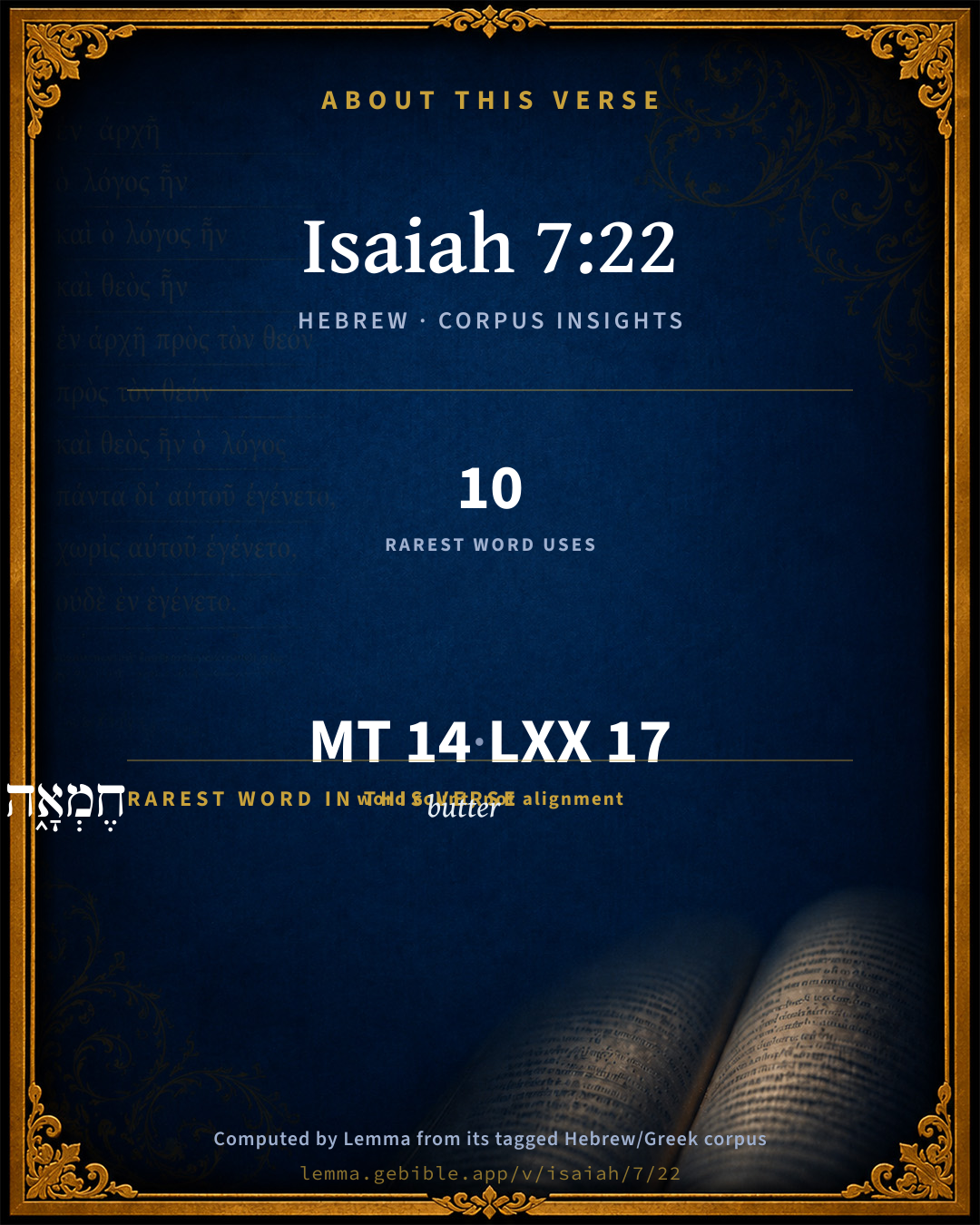
These counts appear in no published source. They are computed here, from the morphology-tagged text and Lemma’s own curated glosses. What Lemma adds →

14
words
12
distinct lemmas
Prophets
section

Notable vocabulary

The rarest word here is חֶמְאָ֑ה butter H2529 — appearing just 10 times in the whole Hebrew Bible.

Shared distinctive vocabulary

חֶמְאָ֑ה butter H2529 occurs in 9 verses of the Hebrew Bible. Also found in:

Grammatical profile

  • 5 verbs
  • 8 nouns
  • 1 conjunction

Verb forms

  • וְהָיָ֗ה Qal · Sequential Perfect
  • עֲשׂ֥וֹת Qal · Infinitive Construct
  • יֹאכַ֣ל Qal · Imperfect
  • יֹאכֵ֔ל Qal · Imperfect
  • הַנּוֹתָ֖ר Niphal · Participle Active

Repetition

Words recur within this verse — often emphatic in Hebrew:

  • יֹאכַ֣ל to eat H398 ×2
  • חֶמְאָ֑ה butter H2529 ×2

Hebrew & Septuagint length

In English translation the verse runs 35 words from the Hebrew and 27 from the Septuagint (LXX English) — closely comparable.

A rough comparison of the two English renderings, which tokenize alike — not a word-level alignment.

Word counts can differ between the Hebrew and the Greek without any difference in meaning — e.g. the Hebrew direct-object marker אֵת has no separate Greek word, and Greek often adds the article ὁ.

In the original languages it is 14 Hebrew tokens and 17 Greek tokens — but the two are counted differently (Hebrew bundles its prefixes and suffixes into one token; the Greek is in lemma form), so that isn’t a like-for-like length.

Cross-references

3

Topical passages linked to Isaiah 7:22 in the Treasury of Scripture Knowledge — connected by theme and wording, ordered by reader-vote popularity; previews shown in the World English Bible.

  • Isaiah 7:15 He shall eat butter and honey when he knows to refuse the evil, and choose the good.
  • 2 Samuel 17:29 and honey, and butter, and sheep, and cheese of the herd, for David, and for the people who were with him, to eat: for they said, The people are hungry, and weary, and thirsty, in the wilderness.
  • Matthew 3:4 Now John himself wore clothing made of camel's hair, with a leather belt around his waist. His food was locusts and wild honey.

Cross-references courtesy of OpenBible.info (CC BY 4.0).

Hebrew and Greek witnesses Masoretic Hebrew ↔ Greek Septuagint

The same verse in the two great witnesses to the Old Testament, shown verse-for-verse.

These are two independent witnesses, not word-aligned to each other, and the Septuagint is shown in lemma (dictionary) form.

Hebrew Isaiah 7:22 Masoretic · Westminster Leningrad Codex

וְהָיָ֗ה מֵרֹ֛ב עֲשׂ֥וֹת חָלָ֖ב יֹאכַ֣ל חֶמְאָ֑ה כִּֽי חֶמְאָ֤ה וּדְבַשׁ֙ יֹאכֵ֔ל כָּל הַנּוֹתָ֖ר בְּקֶ֥רֶב הָאָֽרֶץ

and it shall happen, that because of the abundance of milk which they shall give he shall eat butter: for everyone will eat butter and honey that is left in the midst of the land.

World English Bible · Public Domain

Greek LXX Isaiah 7:22 Septuagint · lemma form

καί εἰμί ἀπό ὁ πολύς ποιέω γάλα βούτυρον καί μέλι ἐσθίω πᾶς ὁ καταλείπω ἐπί ὁ γῆ

And it shall come to pass from their drinking an abundance of milk, that every one that is left on the land shall eat butter and honey.

LXX2012 (modern English Septuagint) · Public Domain

Hebrew: Westminster Leningrad Codex (CC BY 4.0). Greek: Septuagint (public domain); English from LXX2012 (modern English Septuagint) (Public Domain). How the Septuagint differs from the Hebrew →

Targum (Aramaic paraphrase)

1

The Targum is the ancient Jewish Aramaic paraphrase of the Hebrew Scriptures — an interpretive translation, not the Hebrew text itself. Onkelos (literal) and Pseudo-Jonathan (expansive) render the Torah, and Jonathan the Prophets. Coverage is partial: where no permissively-licensed English translation exists for a verse, only the Aramaic is shown. This is verse-level text, not a word-by-word alignment to the Hebrew.

  1. Targum Jonathan Prophets (Joshua–Malachi)
    וִיהֵי מִסְגֵי טוּב מְשַׁח יֵכוֹל שְׁמַן אֲרֵי שְׁמַן וּדְבַשׁ יִתְפַּרְנְסוּן כָּל צַדִיקַיָא דְאִשְׁתָּאֲרוּן בְּגוֹ אַרְעָא:

    And it shall come to pass on account of the abundance of the goodness of fatness, one shall eat oil; because with oil and honey shall all the righteous be fed, who are left in the midst of the land.

    Targum Jonathan — Aramaic: “Mikraot Gedolot” (public domain). English: “Sefaria Community Translation” (CC0 1.0 (public-domain dedication)); “London "Chaldee Paraphrase," 1871” (public domain). Text via Sefaria.

Commentary

Notes on Isaiah 7:22 from classic Christian and Jewish commentators (each source and its license shown beneath its notes). The classic Christian expositions comment on the surrounding passage and are grouped to its opening verse, so a note may address several verses; the Jewish commentaries on the Tanakh (Rashi and others) are per-verse, so they appear only where the commentator wrote on this verse.

Lemma curates 59 commentaries, every one of them public domain or Creative Commons licensed, each selected and text-cleaned for this edition rather than reprinted as found. About our sources →

Trapp's Complete Commentary

John Trapp

Isa 7:22 And it shall come to pass, for the abundance of milk [that] they shall give he shall eat butter: for butter and honey shall every one eat that is left in the land.

Ver. 22. For the abundance of milk.] Yielded him by his two cows, through the paucity of people, and plenty of grass.

He shall eat butter.] Eat his fill, since there are none to buy it from him; none to pull it out of his mouth.

For butter and honey shall every one eat.] Not delicacies and dainties, {as Isa 5:12} but mean fare, such as he can get; as wild honey, such as the Baptist fed on.

John Trapp, A Commentary or Exposition upon All the Books of the Old and New Testament (1647–1656) — public domain. Text from a community e-Sword module.

Geneva Bible (1599)

Geneva Bible translators

The number of men shall be so small, that a few beasts shall be able to nourish all abundantly.

Geneva Bible (1599) marginal notes — public domain. Text via Bolls.life.

Jamieson, Fausset & Brown

Robert Jamieson, A. R. Fausset & David Brown

abundance--by reason of the wide range of land lying desolate over which the cows and sheep (including goats) may range.

butter--thick milk, or cream.

honey--(See on Isa 7:15). Food of spontaneous growth will be the resource of the few inhabitants left. Honey shall be abundant as the bees will find the wild flowers abounding everywhere.

Jamieson, Fausset & Brown — Commentary Critical and Explanatory on the Whole Bible (1871) — public domain (CC PDM 1.0). Text via the HelloAO Bible API.

The Cambridge Bible for Schools and Colleges

gen. ed. J. J. S. Perowne

22. butter and honey become the staple food of the country; in normal circumstances they were only eaten as delicacies along with bread and flesh (Gen_18:8; 2Sa_17:29). Immanuel is the representative of the young generation nourished on this frugal fare (Isa_7:15).

The Cambridge Bible for Schools and Colleges (gen. ed. J. J. S. Perowne; Cambridge University Press, 1878–1918) — public domain. Text from a community e-Sword module.

John Gill's Exposition

And it shall come to pass, for the abundance of milk that they shall give,.... The cow and the two sheep, having large pastures, and few cattle to feed upon them, those few would give such abundance of milk, that the owner of them would make butter of it, and live upon it, having no occasion to eat milk; and there being few or none to sell it to:

he shall eat butter; the milk producing a sufficient quantity of it for himself and his family:

for butter and honey shall everyone eat that is left in the land: signifying that though they would be few, they would enjoy a plenty of such sort of food as their small flocks and herds would furnish them with, and the bees produce. The Targum and Jarchi interpret this of the righteous that shall be left in the land; but it is rather to be extended unto all, righteous and unrighteous.

John Gill's Exposition of the Whole Bible (1746–1763) — public domain (CC PDM 1.0). Text via the HelloAO Bible API.

Albert Barnes' Notes on the Bible

For the abundance of milk ... - On account, or by means of the great quantity of milk. This image also denotes that the land should be desolate, and abandoned by its inhabitants. Such a range would the cow and sheep have in the lands lying waste and uncultivated, that they would yield abundance of milk.

For butter and honey - This shall be the condition of all who are left in the land. Agriculture shall be abandoned, The land shall be desolate. The few remaining inhabitants shall be dependent on what a very few cows and sheep shah produce, and on the subsistence which may be derived from honey obtained from the rocks where bees would lodge. Perhaps, also, the swarms of bees would be increased, by the fact that the land would be forsaken, and that it would produce abundance of wild flowers for their subsistence. The general idea is plain, that the land would be desolate. Butter and honey, that is, butter mingled with honey, is a common article of food in the East; see the note at Isa 7:15. D’Arvieux being in the camp of an Arab prince who lived in much splendor, and who treated him with great regard, was entertained, he tells us, the first morning of his being there, with little loaves, honey, new-churned butter, and cream more delicate than any he ever saw, together with coffee. - “Voy. dans la Pal.,” p. 24. And in another place, he assures us that one of the principal things with which the Arabs regale themselves at breakfast is cream, or new butter mingled with honey. - p. 197. The statement of the prophet here, that the poor of the land should eat butter and honey, is not inconsistent with this account of D’Arvieux, that it is regarded as an article of food with which even princes treat their guests, for the idea of the prophet is, that when the land should be desolate and comparatively uninhabited, the natural luxuriant growth of the soil would produce an abundance to furnish milk, and that honey would abound where the bees would be allowed to multiply, almost without limit; see Harmer’s Obs., vol. ii. p. 55. Ed. Lond. 1808.

Albert Barnes' Notes on the Bible (1834–1885) — public domain. Text from a community e-Sword/MySword module.

Haydock's Catholic Bible Commentary

Land. Pastures shall be so large, (Menochius) though uncultivated, the greatest part of the inhabitants being removed.

George Leo Haydock (1774–1849), Haydock's Catholic Family Bible and Commentary, 1859 edition — public domain. Excludes Psalms (Douay-Rheims chapter numbering differs from Protestant) and Deuterocanonical books (Catholic canon only).

Matthew Poole's English Annotations

For the abundance of milk that they shall give; because they shall have excellent and large pastures, by reason of the great scarcity of cattle; whereas formerly their lands were ofttimes overstocked with cattle.

Butter and honey may be here mentioned, either,

1. As mean and vulgar food, being very common in those parts; which are opposed to that flesh and corn, and other excellent fruits of the earth, wherewith their land formerly abounded. Or,

2. As very good and pleasant food, which the poorer sort had formerly used to sell, to procure more necessary and cheaper food for themselves; but now the land should be so destitute of people, that there were none to whom they could sell them, and those few who did survive might freely eat all sorts of provisions.

Matthew Poole's English Annotations on the Holy Bible (1683–1685) — public domain. Text from a community e-Sword/MySword module.

The Pulpit Commentary

For the abundance of milk that they shall give. The small number of the cattle will allow of each having abundant pasture. Hence they will give an abundance of milk. He shall eat butter; rather, curds the solid food most readily obtained from milk (comp. above, ver. 15). Curdled milk and wild honey should form the simple diet of the remnant left in the land. It is, of course, possible to understand this in a spiritual sense, of simple doctrine and gospel honey out of the flinty rock of the Law; but there is no reason to think that the prophet intended his words in any but the most literal sense.

The Pulpit Commentary (1880–1919), ed. H.D.M. Spence-Jones & Joseph S. Exell — public domain. Text from a community e-Sword module.

John Wesley's Explanatory Notes

Abundance - Because they shall have large pastures, by reason of the great scarcity of cattle. Butter - Which the poorer sort had formerly used to sell, to procure them cheaper food for themselves: but now the land should be so destitute of people, that there were none to whom they could sell them.

John Wesley, Explanatory Notes Upon the Whole Bible (1754–1765) — public domain. Text via the GEBible commentary corpus.

J. A. Alexander on Isaiah

Joseph Addison Alexander

The abundance is of course to be relatively understood, with respect to the small number of persons to be fed, and is therefore an additional and necessary stroke in the prophetic picture - few cattle left, and yet those few sufficient to afford milk in abundance to the few inhabitants. This abundance is expressed still more strongly by describing them as eating not the milk itself, but that which is produced from it, and which of course must bear a small proportion to the whole; and as this is the essential idea meant to be conveyed it matters little whether it be understood to mean butter, cheese, cream, or curds, though the last seems to agree best with what we know of oriental usages. It is here mentioned neither as a delicacy nor as plain and ordinary food, but as a kind of diet independent of the cultivation of the earth, and therefore implying a neglect of tillage and a pastoral mode of life, as well as an unusual extent of pasturage, which may have reference, not only to the milk but to the honey.

Boswell, in the journal of his tour with Dr. Johnson to the Hebrides, observes of the inhabitants of one of the poor islands, that "they lived all the spring without meal, upon milk and curds and whey alone." This verse, then, is descriptive of abundance only as connected with a paucity of people and a general neglect of tillage. It was designed indeed to be directly expressive neither of abundance nor of poverty, but of a change in the condition of the country and of the remaining people, which is further described in the ensuing context.

Joseph Addison Alexander, The Prophecies of Isaiah (1846–1847; New York: Scribner, 1870–1878) — public domain. Text from a community e-Sword module.

Rashi

Rabbi Shlomo Yitzchaki (Rashi)

And it shall be, because of the plentiful milk that these two sheep will produce, they will despise the milk and eat the cream, which is the fat of the milk.

everyone left The righteous who were saved from the sword of Sennacheribhe is bringing them good news, that sustenance will be prepared for them after that desolation.

Rashi on the Tanakh — English translations: “The Judaica Press complete Tanach with Rashi, translated by A. J. Rosenberg” (CC BY 4.0); “Pentateuch with Rashi's commentary by M. Rosenbaum and A.M. Silbermann, 1929-1934” (public domain); “The Metsudah Tanach series, Lakewood, N.J” (CC BY 4.0); and “The Book of Joshua, Metsudah Publications, 1997” (CC BY 4.0). Text via Sefaria.

Ibn Ezra

Rabbi Abraham ibn Ezra

And it shall come, etc. God will send a blessing, so that plenty will spring out of little; therefore the sign was given, He will eat butter and honey.

Ibn Ezra on the Tanakh — English translations: “Sefaria Community Translation” (CC0 1.0 (public-domain dedication)); “Yalkut, Sifsei Chachomim Chumash, Metsudah Publications, 2009” (CC BY 4.0); and “Commentary of Ibn Ezra on Isaiah - trans. by M. Friedlander, 1873” (public domain). Text via Sefaria.

Lesson kit

Teaching starters — assembled from the data on this page, not authored interpretation. Every prompt links to the verse data it draws on. Edit before teaching.

Isaiah, in the Prophets, opens this verse with 14 words (12 distinct Hebrew lemmas). Its most distinctive word is chemʼâh (“butter”). A historical commentator’s framing appears above. Read the whole chapter for the surrounding context.

Discussion questions

  1. What does “butter” (chemʼâh) contribute to the verse as a whole?
  2. Genesis 18:8 shares the word «butter» with this verse. How do the two illuminate each other?
  3. “to eat” occurs 2× in this one verse. What is the effect of the repetition?
  4. The translations on this page render this verse differently — a whole-verse word diff, not a word-by-word alignment. What might account for the different wordings?
  5. The verb «וְהָיָ֗ה» is Qal Sequential Perfect. How does its form color the action?
  6. Reading how Trapp's Complete Commentary and Geneva Bible (1599) read this verse, where do the two commentators agree and where do they part?

Things to notice

Reading settings

Reading text

Shown beneath each verse's original-language words.

Old Testament
Old Testament edition

Read the OT as the Masoretic Hebrew (MT) or the Greek Septuagint (LXX).

English shown for the Greek Septuagint (in the Hebrew ↔ Greek comparison).

Comparing translations? Open the Compare panel on any verse page to stack up to four side by side.