Judges 1:29

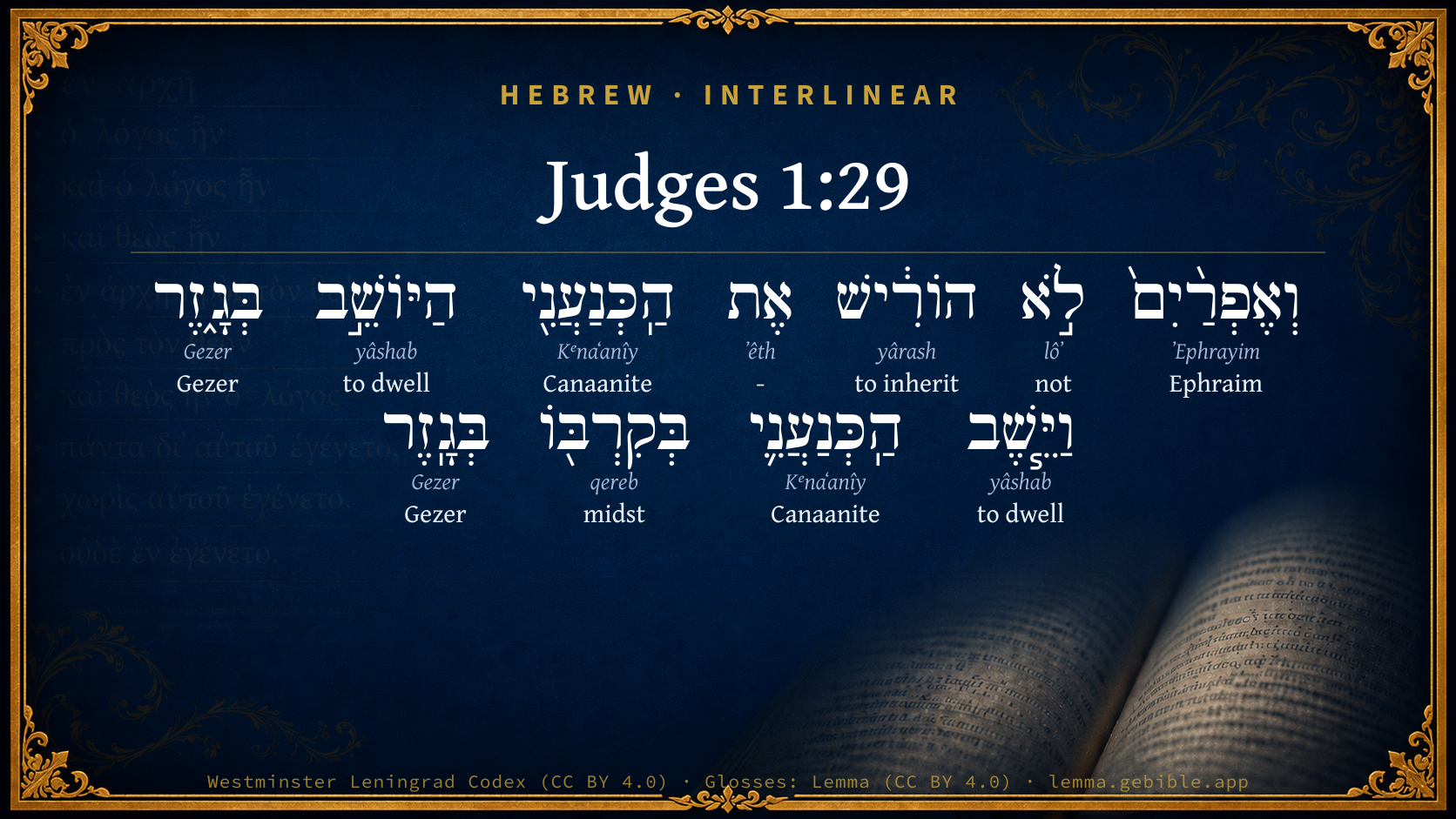
Hebrew (Westminster Leningrad Codex) Judges 1:29 appears in the Hebrew Old Testament. The text above is from the Westminster Leningrad Codex. Each word links to its Strong’s number, a concise gloss, and parsing drawn from the Open Scriptures Hebrew Bible morphology. Click any word for its full Brown-Driver-Briggs (BDB) entry.
Download image
Cite this verse

Judges 1:29 (World English Bible). Public Domain. Lemma interlinear Bible study tool, https://lemma.gebible.app/v/judges/1/29.

Show BibTeX & RIS
BibTeX
RIS
English Translation
Ephraim didn't drive out the Canaanites who lived in Gezer; but the Canaanites lived in Gezer among them.
World English Bible · Public Domain
Download a study sheet

One document with this verse’s original text, its word-by-word gloss line, the meaning frame, cross-references with their text, attributed commentary, and full source and license credits — printable, and it pastes into notes with its structure intact.

This verse Autodidact and up

Study sheet (.html) Plain text (.txt)

A passage Seminary Student

Up to 50 verses in one chapter. A passage sheet keeps up to 6 commentary sources and 12 cross-references per verse, in the order this page ranks them, and says so on the sheet whenever that leaves anything out. Ask for a single verse and you get the Autodidact verse sheet above.

Everything on this page stays free to read, with no account — the sheet is a download of what is already on screen, not access to it.

Want to remove ads? Support Godless Engineer
Compare translations 3

The same verse in 3 English versions, stacked beneath the original-language interlinear above. Click any original word for its lexicon entry.

Each is an independent rendering of the whole verse — the interlinear is not word-aligned to these translations.

Highlighted words mark where these versions differ — a whole-verse word diff, not a word-by-word alignment.

  • World English Bible Public Domain
    Ephraim didn't drive out the Canaanites who lived in Gezer; but the Canaanites lived in Gezer among them.
  • King James Version Public Domain
    Neither did Ephraim drive out the Canaanites that dwelt in Gezer; but the Canaanites dwelt in Gezer among them.
  • unfoldingWord Literal Text CC BY-SA 4.0
    And Ephraim did not dispossess the Canaanite, the dweller of Gezer, so the Canaanite dwelled in the midst of him in Gezer.

unfoldingWord Literal Text — © unfoldingWord, licensed CC BY-SA 4.0. Word-aligned USFM3 via Door43 (git.door43.org/unfoldingWord/en_ult).

Versions to compare (up to 4)

3 of 4 selected

Show all 18 translations

Every available English version of this verse, each an independent rendering of the whole verse.

  • World English Bible Public Domain
    Ephraim didn't drive out the Canaanites who lived in Gezer; but the Canaanites lived in Gezer among them.
  • Berean Standard Bible Public Domain
    Ephraim also failed to drive out the Canaanites living in Gezer; so the Canaanites continued to dwell among them in Gezer.
  • Majority Standard Bible Public Domain
    Ephraim also failed to drive out the Canaanites living in Gezer; so the Canaanites continued to dwell among them in Gezer.
  • King James Version Public Domain
    Neither did Ephraim drive out the Canaanites that dwelt in Gezer; but the Canaanites dwelt in Gezer among them.
  • American Standard Version (1901) Public Domain
    And Ephraim drove not out the Canaanites that dwelt in Gezer; but the Canaanites dwelt in Gezer among them.
  • Revised Version (1885) Public Domain
    And Ephraim drave not out the Canaanites that dwelt in Gezer; but the Canaanites dwelt in Gezer among them.
  • Geneva Bible (1599) Public Domain
    Likewise Ephraim expelled not the Canaanites that dwelt in Gezer, but the Canaanites dwelt in Gezer among them.
  • Douay-Rheims (1899) Public Domain
    Ephraim also did not slay the Chanaanite that dwelt in Gazer, but dwelt with him.
  • Young's Literal Translation Public Domain
    And Ephraim hath not dispossessed the Canaanite who is dwelling in Gezer, and the Canaanite dwelleth in its midst, in Gezer.
  • Literal Standard Version CC BY-SA 4.0
    And Ephraim has not dispossessed the Canaanite who is dwelling in Gezer, and the Canaanite dwells in its midst, in Gezer.
  • Unlocked Literal Bible CC BY-SA 4.0
    Ephraim did not drive out the Canaanites who lived in Gezer, so the Canaanites continued to live in Gezer among them.
  • unfoldingWord Literal Text CC BY-SA 4.0
    And Ephraim did not dispossess the Canaanite, the dweller of Gezer, so the Canaanite dwelled in the midst of him in Gezer.
  • Darby Bible Public Domain
    And E'phraim did not drive out the Canaanites who dwelt in Gezer; but the Canaanites dwelt in Gezer among them.
  • World Messianic Bible Public Domain
    Ephraim didn’t drive out the Canaanites who lived in Gezer, but the Canaanites lived in Gezer among them.
  • Webster's Bible Public Domain
    Neither did Ephraim expel the Canaanites that dwelt in Gezer; but the Canaanites dwelt in Gezer among them.
  • Free Bible Version CC BY-SA 4.0
    Ephraim didn't drive out the Canaanites living in the town of Gezer, so the Canaanites went on living there among them.
  • Bible in Basic English Public Domain
    And Ephraim did not make the Canaanites who were living in Gezer go out; but the Canaanites went on living in Gezer among them.
  • JPS Tanakh (1917) Public Domain
    And Ephraim drove not out the Canaanites that dwelt in Gezer; but the Canaanites dwelt in Gezer among them.

Literal Standard Version (2020), Covenant Press — licensed CC BY-SA 4.0. Text via the HelloAO Bible API (eBible.org). Unlocked Literal Bible (unfoldingWord) — licensed CC BY-SA 4.0. Text via the HelloAO Bible API (eBible.org). unfoldingWord Literal Text — © unfoldingWord, licensed CC BY-SA 4.0. Word-aligned USFM3 via Door43 (git.door43.org/unfoldingWord/en_ult). Free Bible Version, Dr. Jonathan Gallagher — licensed CC BY-SA 4.0. Text via the HelloAO Bible API (eBible.org).

Word by word

More ways to search: Search by grammar → Find every occurrence → Compare this word →

Practice this passage: Drill this verse → Learn its vocabulary →

בְּגָ֑זֶר
Gezer
H1507
“in/at · Gezer”
Preposition + Noun, Proper
Part of Speech
Preposition + Noun
Type
Proper
Full BDB Definition

Origin: the same as H1506

TWOT: None

Gazer or Gezer = "portion" - a Levitical city on the border of Ephraim
  1. וְאֶפְרַ֨יִם֙ ʼEphrayim H669 “and · Ephraim” Conjunction + Noun, Proper
  2. לֹ֣א lôʼ H3808 “not” Particle, Negative
  3. הוֹרִ֔ישׁ yârash H3423 “to inherit” Verb, Hiphil, Perfect, 3rd Person, Masculine, Singular
  4. אֶת ʼêth H853 “-” Particle, Direct Object
  5. הַֽכְּנַעֲנִ֖י Kᵉnaʻanîy H3669 “the · Canaanite” Particle, Definite Article + Noun, Gentilic, Masculine, Singular, Absolute
  6. הַיּוֹשֵׁ֣ב yâshab H3427 “the · dwelling” Particle, Definite Article + Verb, Qal, Participle Active, Masculine, Singular, Absolute
  7. וַיֵּ֧שֶׁב yâshab H3427 “and · to dwell” Conjunction + Verb, Qal, Sequential Imperfect, 3rd Person, Masculine, Singular
  8. הַֽכְּנַעֲנִ֛י Kᵉnaʻanîy H3669 “the · Canaanite” Particle, Definite Article + Noun, Gentilic, Masculine, Singular, Absolute
  9. בְּקִרְבּ֖וֹ qereb H7130 “in/at · midst · his” Preposition + Noun, Common, Masculine, Singular, Construct + Suffix, Personal, 3rd Person, Masculine, Singular
  10. בְּגָֽזֶר Gezer H1507 “in/at · Gezer” Preposition + Noun, Proper

About this verse

These counts appear in no published source. They are computed here, from the morphology-tagged text and Lemma’s own curated glosses. What Lemma adds →

11
words
8
distinct lemmas
Historical
section

Notable vocabulary

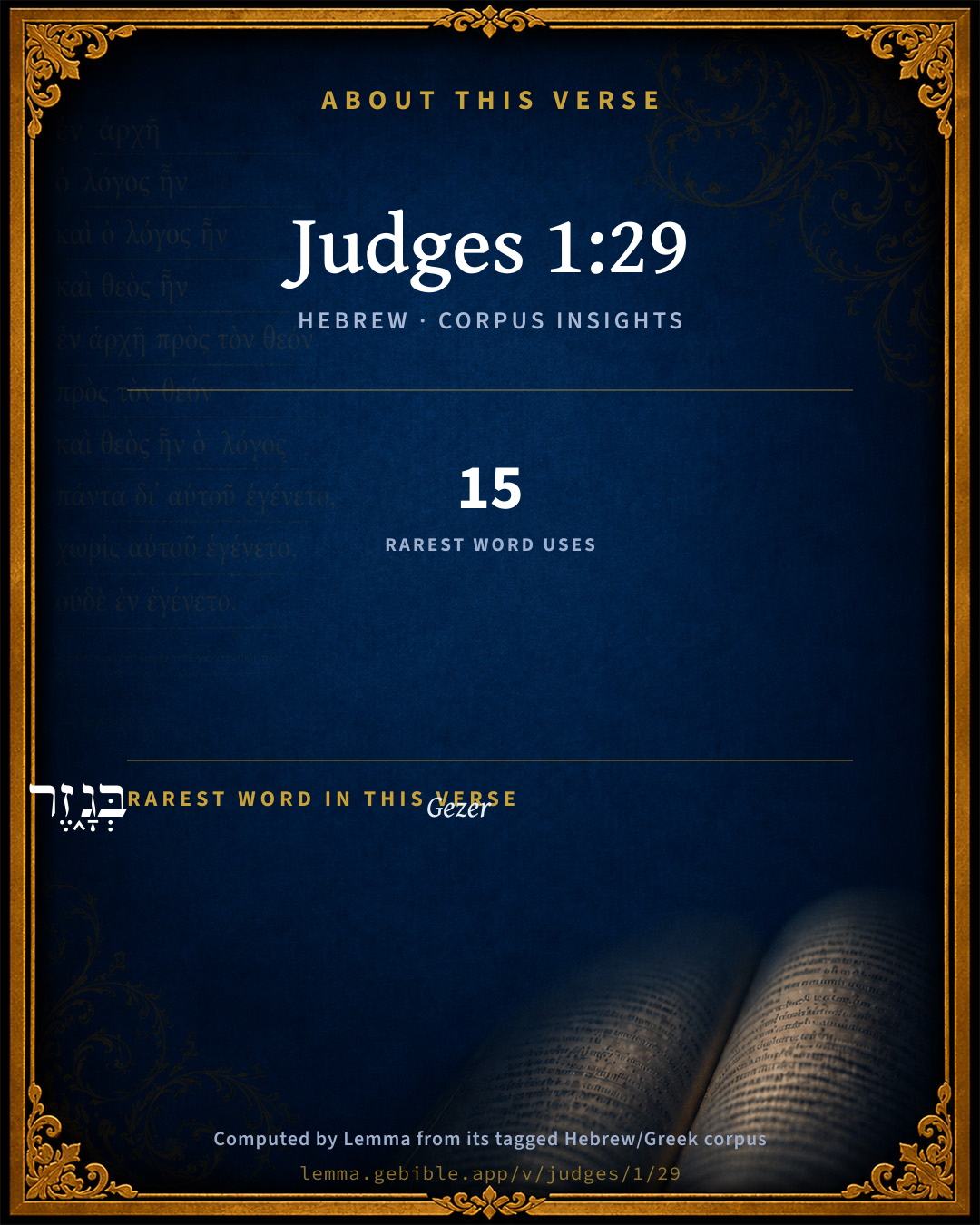
The rarest word here is בְּגָ֑זֶר Gezer H1507 — appearing just 15 times in the whole Hebrew Bible.

Shared distinctive vocabulary

בְּגָ֑זֶר Gezer H1507 occurs in 14 verses of the Hebrew Bible. Also found in:

Grammatical profile

  • 3 verbs
  • 6 nouns
  • 2 particles

Verb forms

  • הוֹרִ֔ישׁ Hiphil · Perfect
  • הַיּוֹשֵׁ֣ב Qal · Participle Active
  • וַיֵּ֧שֶׁב Qal · Sequential Imperfect

Repetition

Words recur within this verse — often emphatic in Hebrew:

  • הַֽכְּנַעֲנִ֖י Canaanite H3669 ×2
  • הַיּוֹשֵׁ֣ב to dwell H3427 ×2
  • בְּגָ֑זֶר Gezer H1507 ×2

Hebrew & Septuagint length

In English translation the verse runs 18 words from the Hebrew and 26 from the Septuagint (LXX English) — the Septuagint runs noticeably longer here. See the side-by-side →

A rough comparison of the two English renderings, which tokenize alike — not a word-level alignment.

Word counts can differ between the Hebrew and the Greek without any difference in meaning — e.g. the Hebrew direct-object marker אֵת has no separate Greek word, and Greek often adds the article ὁ.

Cross-references

2

Topical passages linked to Judges 1:29 in the Treasury of Scripture Knowledge — connected by theme and wording, ordered by reader-vote popularity; previews shown in the World English Bible.

  • Joshua 16:10 They didn't drive out the Canaanites who lived in Gezer: but the Canaanites dwell in the midst of Ephraim to this day, and are become servants to do forced labor.
  • 1 Kings 9:16 Pharaoh king of Egypt had gone up, and taken Gezer, and burnt it with fire, and slain the Canaanites who lived in the city, and given it for a portion to his daughter, Solomon's wife.

Cross-references courtesy of OpenBible.info (CC BY 4.0).

Hebrew and Greek witnesses Masoretic Hebrew ↔ Greek Septuagint

The same verse in the two great witnesses to the Old Testament, shown verse-for-verse.

Here the Septuagint runs noticeably longer than the Hebrew — LXX2012 (modern English Septuagint) 26 words vs World English Bible 18. A rough length comparison of the two English translations, not a word-level alignment — read both below.

These are two independent witnesses, not word-aligned to each other, and the Septuagint is shown in lemma (dictionary) form.

Hebrew Judges 1:29 Masoretic · Westminster Leningrad Codex

וְאֶפְרַ֨יִם֙ לֹ֣א הוֹרִ֔ישׁ אֶת הַֽכְּנַעֲנִ֖י הַיּוֹשֵׁ֣ב בְּגָ֑זֶר וַיֵּ֧שֶׁב הַֽכְּנַעֲנִ֛י בְּקִרְבּ֖וֹ בְּגָֽזֶר

Ephraim didn't drive out the Canaanites who lived in Gezer; but the Canaanites lived in Gezer among them.

World English Bible · Public Domain

Greek LXX Judges 1:29 Septuagint · lemma form

καί ἐφράιμ οὐ ἐκαἴρω ὁ χαναναῖος ὁ καταοἰκέω ἐν γαζερ καί καταοἰκέω ὁ χαναναῖος ἐν μέσος αὐτός ἐν γαζερ καί γίγνομαι εἰς φόρος

And Ephraim did not drive out the Chananite that lived in Gazer; and the Chananite lived in the midst of him in Gazer, and became tributary.

LXX2012 (modern English Septuagint) · Public Domain

Hebrew: Westminster Leningrad Codex (CC BY 4.0). Greek: Septuagint (public domain); English from LXX2012 (modern English Septuagint) (Public Domain). How the Septuagint differs from the Hebrew →

Targum (Aramaic paraphrase)

1

The Targum is the ancient Jewish Aramaic paraphrase of the Hebrew Scriptures — an interpretive translation, not the Hebrew text itself. Onkelos (literal) and Pseudo-Jonathan (expansive) render the Torah, and Jonathan the Prophets. Coverage is partial: where no permissively-licensed English translation exists for a verse, only the Aramaic is shown. This is verse-level text, not a word-by-word alignment to the Hebrew.

  1. Targum Jonathan Prophets (Joshua–Malachi)
    וּדְבֵית אֶפְרַיִם לָא תָרִיךְ יַת כְּנַעֲנָאֵי דְיַתְבִין בְּגָזֶר וִיתִבוּ כְּנַעֲנָאֵי בֵינֵיהוֹן בְּגָזֶר:

    (no public-domain English translation for this verse)

    Targum Jonathan — Aramaic: “Mikraot Gedolot” (public domain). English: “Sefaria Community Translation” (CC0 1.0 (public-domain dedication)); “London "Chaldee Paraphrase," 1871” (public domain). Text via Sefaria.

Commentary

Notes on Judges 1:29 from classic Christian and Jewish commentators (each source and its license shown beneath its notes). The classic Christian expositions comment on the surrounding passage and are grouped to its opening verse, so a note may address several verses; the Jewish commentaries on the Tanakh (Rashi and others) are per-verse, so they appear only where the commentator wrote on this verse.

Lemma curates 59 commentaries, every one of them public domain or Creative Commons licensed, each selected and text-cleaned for this edition rather than reprinted as found. About our sources →

Joseph Benson's Commentary

Jdg 1:29. Neither did Ephraim drive out the Canaanites — So far from it, that it appears they did not so much as exact any tribute from them, but made a covenant of friendship with them, which was a still greater crime. The Canaanites dwelt in Gezer — Which they possessed till Solomon’s time; 1Ki 9:6. And to dwell among a people often signifies to have a quiet settlement, as 2Ki 4:13.

Joseph Benson's Commentary on the Old and New Testaments (1811–1818) — public domain. Text from a community e-Sword module.

Keil & Delitzsch

C. F. Keil & F. Delitzsch

Ephraim did not root out the Canaanites in Gezer (Jdg 1:29), as has already been stated in Jos 16:10.

Jdg 1:30

Zebulun did not root out the Canaanites in Kitron and Nahalol.

Jdg 1:31-32

Asher did not root out those in Acco, etc. Acco: a seaport town to the north of Carmel, on the bay which is called by its name; it is called Ake by Josephus, Diod. Sic., and Pliny, and was afterwards named Ptolemais from one of the Ptolemys (1 Macc. 5:15, 21; 10:1, etc.; Act 21:7). The Arabs called it Akka, and this was corrupted by the crusaders into Acker or Acre. During the crusades it was a very flourishing maritime and commercial town; but it subsequently fell into decay, and at the present time has a population of about 5000, composed of Mussulmans, Druses, and Christians (see C. v. Raumer, Pal. p. 119; Rob. Bibl. Res.; and Ritter, Erdk. xvi. pp. 725ff.). Sidon, now Saida: see at Jos 11:8. Achlab is only mentioned here, and is not known. Achzib, i.e., Ecdippa: see at Jos 19:29. Helbah is unknown. Aphek is the present Afkah: see Jos 13:4; Jos 19:30. Rehob is unknown: see at Jos 19:28, Jos 19:30. As seven out of the twenty-two towns of Asher (Jos 19:30) remained in the hands of the Canaanites, including such important places as Acco and Sidon, it is not stated in Jdg 1:32, as in Jdg 1:29, Jdg 1:30, that "the Canaanites dwelt among them," but that "the Asherites dwelt among the Canaanites," to show that the Canaanites held the upper hand. And for this reason the expression "they became tributaries" (Jdg 1:30, Jdg 1:35, etc.) is also omitted.

Jdg 1:33

Naphtali did not root out the inhabitants of Beth-shemesh and Beth-anath, two fortified towns, the situation of which is still unknown (see at Jos 19:38); so that this tribe also dwelt among the Canaanites, but did not make them tributary.

Jdg 1:34-35

Still less were the Danites able to drive the Canaanites out of their inheritance. On the contrary, the Amorites forced Dan up into the mountains, and would not suffer them to come down into the plain. But the territory allotted to the Danytes was almost all in the plain (see at Jos 19:40). If, therefore, they were forced out of that, they were almost entirely excluded from their inheritance. The Amorites emboldened themselves (see at Deu 1:5) to dwell in Har-cheres, Ajalon, and Shaalbim. On the last two places see Jos 19:42, where Ir-shemesh is also mentioned. This combination, and still more the meaning of the names Har-cheres, i.e., sun-mountain, and Ir-shemesh, i.e., sun-town, make the conjecture a very probable one, that Har-cheres is only another name for Ir-shemesh, i.e., the present Ain Shems (see at Jos 15:10, and Rob. Pal. iii. pp. 17, 18). This pressure on the part of the Amorites induced a portion of the Danites to emigrate, and seek for an inheritance in the north of Palestine (see Judg 18). On the other hand, the Amorites were gradually made tributary by the powerful tribes of Ephraim and Manasseh, who bounded Dan on the north. "The hand of the house of Joseph lay heavy," sc., upon the Amorites in the towns already named on the borders of Ephraim. For the expression itself, comp. Sa1 5:6; Psa 32:4.

Keil & Delitzsch — Biblical Commentary on the Old Testament (1861–1891) — public domain (CC PDM 1.0). Text via the HelloAO Bible API. (Old Testament only.)

Adam Clarke's Commentary

Verse 29. Neither did Ephraim] See the notes on the parallel passages, Jos 16:5-10.

Adam Clarke's Commentary on the Bible (1810–1826) — public domain. Text from a community e-Sword/MySword module.

Ellicott's Commentary for English Readers

(29) Neither did Ephraim.—See Jos_16:10. Gezer.—This town was not won from the Canaanites till its capture by Pharaoh, who gave it as a present to his daughter, the wife of Solomon (1Ki_9:16).

A Bible Commentary for English Readers, edited by Charles John Ellicott (1878–1897) — public domain. Text from a community e-Sword module.

The Cambridge Bible for Schools and Colleges

gen. ed. J. J. S. Perowne

29. Cf. Jos_16:10.

Gezer] An ancient Canaanite city mentioned in the list of Thothmes III, in the ‘Israel Inscription’ of Merenptah (see Ency. Bibl. 1242), and as Gazri in the Amarna tablets (163 etc.), situated on the S.W. border of Ephraim (Jos_16:3), near the Philistine territory (2Sa_5:25). It remained Canaanite until conquered by Pharaoh Shishak, who gave it to his daughter, Solomon’s wife (1Ki_9:16). Solomon rebuilt the city as a frontier fortress against the Philistines (1Ki_9:15; 1Ki_9:17). It was an important place during the Maccabaean wars (Gazara, 1Ma_4:15; 1Ma_9:52; 1Ma_14:34; 1Ma_15:28; 1Ma_15:35 etc.). The site, = the mod. Tell el-Jezer, a little S. of the Jaffa-Jerusalem road and 13 m. from Jerusalem, was recovered by Clermont-Ganneau in 1871. Several bilingual inscriptions in Hebr. and Gk. have been found near the Tell containing the words “boundary of Gezer [Hebr.]: of Alkios [Gk.],” supposed to refer to the sabbatic limits and the local governor who thus defined them. See Cl.-Ganneau, Rec. d’arch. Orientale iii. §§ 25, 47. The excavations recently conducted on the site have thrown much light on the past history of Canaan; seven strata of successive occupations have been ascertained; the area of the Canaanite temple or high place, much pottery, and, in the Israelite stratum, the bones of infants built into the foundations of houses (cf. 1Ki_16:34), and what has been identified as Solomon’s work of fortification, are among the most important discoveries; see Palest. Explor. Fund Qtly. Statements for 1903, and Driver, Schweich Lectures, pp. 46–59.

in Gezer among them] Jos_16:10 b reads ‘in the midst of Ephraim unto this day and became subject to forced labour,’ probably representing the original form of J; cf. Jdg_1:28; Jdg_1:30; Jdg_1:33; Jdg_1:35.

The Cambridge Bible for Schools and Colleges (gen. ed. J. J. S. Perowne; Cambridge University Press, 1878–1918) — public domain. Text from a community e-Sword module.

John Gill's Exposition

Neither did Ephraim drive out the Canaanites that dwelt in Gezer,.... Not so much as made them tributaries, but made a covenant with them, it is probable, contrary to the express will of God:

but the Canaanites dwelt in Gezer among them; the Ephraimites agreeing to it, and here they dwelt to the times of Solomon; See Gill on Jos 16:10; where indeed they are said to be under tribute; but that seems to respect some later time, and not when they were first admitted to dwell among them, since no mention is made of it here.

John Gill's Exposition of the Whole Bible (1746–1763) — public domain (CC PDM 1.0). Text via the HelloAO Bible API.

Matthew Poole's English Annotations

Which they possessed till Solomon’s time.

Matthew Poole's English Annotations on the Holy Bible (1683–1685) — public domain. Text from a community e-Sword/MySword module.

Whedon's Commentary on the Bible

Daniel D. Whedon

29. Gezer — See Jos_10:33, note.

Daniel D. Whedon (gen. ed.), Commentary on the Old and New Testaments (1874–1909) — public domain. Text from a community e-Sword module.

John Wesley's Explanatory Notes

In Gezer - Which they possessed 'till Solomon's time, 1 Kings ix, 16.

John Wesley, Explanatory Notes Upon the Whole Bible (1754–1765) — public domain. Text via the GEBible commentary corpus.

unfoldingWord translationNotes

Door43 World Missions Community

Ephraim did not

Here "Ephraim" the men or the soldiers of the tribe of Ephraim. (See: Metonymy)

Gezer

The name of one of the cities in the Ephraim area. (See: How to Translate Names)

translationWords

Ephraim

cast out

Canaan

life

unfoldingWord translationNotes — © Distant Shores Media and the Door43 World Missions Community, licensed CC BY-SA 4.0. Source: git.door43.org/Door43/en_tn.

Lesson kit

Teaching starters — assembled from the data on this page, not authored interpretation. Every prompt links to the verse data it draws on. Edit before teaching.

Judges, in the Historical, opens this verse with 11 words (8 distinct Hebrew lemmas). Its most distinctive word is Gezer (“Gezer”). The Greek Septuagint runs longer here. A historical commentator’s framing appears above. Read the whole chapter for the surrounding context.

Discussion questions

  1. What does “Gezer” (Gezer) contribute to the verse as a whole?
  2. Joshua 10:33 shares the word «Gezer» with this verse. How do the two illuminate each other?
  3. “Canaanite” occurs 2× in this one verse. What is the effect of the repetition?
  4. Compared with the Hebrew, the Septuagint runs longer here. What questions does that raise?
  5. These translations render this verse differently. What is at stake in choosing one wording over another?
  6. The verb «הוֹרִ֔ישׁ» is Hiphil Perfect. How does its form color the action?
  7. Reading how Joseph Benson's Commentary and Keil & Delitzsch read this verse, where do the two commentators agree and where do they part?

Things to notice

  • These translations choose different wording for 16 words in this verse.
  • “Canaanite” occurs 2× in this single verse.
  • 8 distinct Hebrew lemmas span 11 words in this verse.

Reading settings

Reading text

Shown beneath each verse's original-language words.

Old Testament
Old Testament edition

Read the OT as the Masoretic Hebrew (MT) or the Greek Septuagint (LXX).

English shown for the Greek Septuagint (in the Hebrew ↔ Greek comparison).

Comparing translations? Open the Compare panel on any verse page to stack up to four side by side.