Exodus 3:20

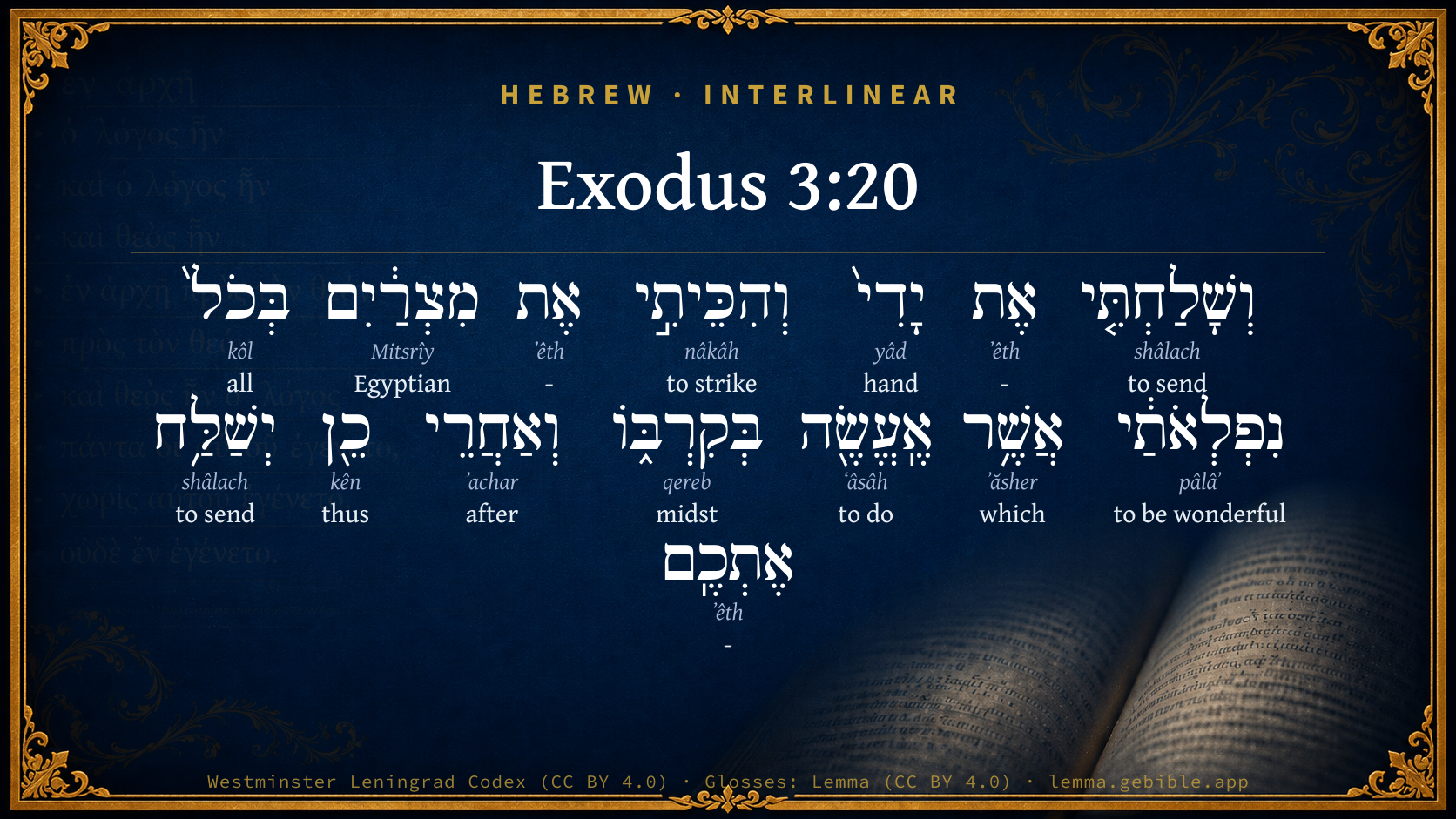
Hebrew (Westminster Leningrad Codex) Exodus 3:20 appears in the Hebrew Old Testament. The text above is from the Westminster Leningrad Codex. Each word links to its Strong’s number, a concise gloss, and parsing drawn from the Open Scriptures Hebrew Bible morphology. Click any word for its full Brown-Driver-Briggs (BDB) entry.
Download image
Cite this verse

Exodus 3:20 (World English Bible). Public Domain. Lemma interlinear Bible study tool, https://lemma.gebible.app/v/exodus/3/20.

Show BibTeX & RIS
BibTeX
RIS
English Translation
I will put forth my hand and strike Egypt with all my wonders which I will do in the midst of it, and after that he will let you go.
World English Bible · Public Domain
Download a study sheet

One document with this verse’s original text, its word-by-word gloss line, the meaning frame, cross-references with their text, attributed commentary, and full source and license credits — printable, and it pastes into notes with its structure intact.

This verse Autodidact and up

Study sheet (.html) Plain text (.txt)

A passage Seminary Student

Up to 50 verses in one chapter. A passage sheet keeps up to 6 commentary sources and 12 cross-references per verse, in the order this page ranks them, and says so on the sheet whenever that leaves anything out. Ask for a single verse and you get the Autodidact verse sheet above.

Everything on this page stays free to read, with no account — the sheet is a download of what is already on screen, not access to it.

Want to remove ads? Support Godless Engineer
Compare translations 3

The same verse in 3 English versions, stacked beneath the original-language interlinear above. Click any original word for its lexicon entry.

Each is an independent rendering of the whole verse — the interlinear is not word-aligned to these translations.

Highlighted words mark where these versions differ — a whole-verse word diff, not a word-by-word alignment.

  • World English Bible Public Domain
    I will put forth my hand and strike Egypt with all my wonders which I will do in the midst of it, and after that he will let you go.
  • King James Version Public Domain
    And I will stretch out my hand, and smite Egypt with all my wonders which I will do in the midst thereof: and after that he will let you go.
  • unfoldingWord Literal Text CC BY-SA 4.0
    And I shall send out my hand, and I shall strike Egypt with all my wonders, which I shall do within him. And after that, he will send you out.

unfoldingWord Literal Text — © unfoldingWord, licensed CC BY-SA 4.0. Word-aligned USFM3 via Door43 (git.door43.org/unfoldingWord/en_ult).

Versions to compare (up to 4)

3 of 4 selected

Show all 18 translations

Every available English version of this verse, each an independent rendering of the whole verse.

  • World English Bible Public Domain
    I will put forth my hand and strike Egypt with all my wonders which I will do in the midst of it, and after that he will let you go.
  • Berean Standard Bible Public Domain
    So I will stretch out My hand and strike the Egyptians with all the wonders I will perform among them. And after that, he will release you.
  • Majority Standard Bible Public Domain
    So I will stretch out My hand and strike the Egyptians with all the wonders I will perform among them. And after that, he will release you.
  • King James Version Public Domain
    And I will stretch out my hand, and smite Egypt with all my wonders which I will do in the midst thereof: and after that he will let you go.
  • American Standard Version (1901) Public Domain
    And I will put forth my hand, and smite Egypt with all my wonders which I will do in the midst thereof: and after that he will let you go.
  • Revised Version (1885) Public Domain
    And I will put forth my hand, and smite Egypt with all my wonders which I will do in the midst thereof: and after that he will let you go.
  • Geneva Bible (1599) Public Domain
    Therefore will I stretch out mine hande and smite Egypt with all my wonders, which I will doe in the middes thereof: and after that shall he let you goe.
  • Douay-Rheims (1899) Public Domain
    For I will stretch forth my hand and will strike Egypt with all my wonders which I will do in the midst of them: after these he will let you go.
  • Young's Literal Translation Public Domain
    and I have put forth My hand, and have smitten Egypt with all My wonders, which I do in its midst -- and afterwards he doth send you away.
  • Literal Standard Version CC BY-SA 4.0
    and I have put forth My hand, and have struck Egypt with all My wonders, which I do in its midst—and afterward he sends you away.
  • Unlocked Literal Bible CC BY-SA 4.0
    I will reach out with my hand and attack the Egyptians with all the miracles that I will do among them. After that, he will let you go.
  • unfoldingWord Literal Text CC BY-SA 4.0
    And I shall send out my hand, and I shall strike Egypt with all my wonders, which I shall do within him. And after that, he will send you out.
  • Darby Bible Public Domain
    And I will stretch out my hand and smite Egypt with all my wonders which I will do in the midst thereof; and after that he will let you go.
  • World Messianic Bible Public Domain
    I will reach out my hand and strike Egypt with all my wonders which I will do among them, and after that he will let you go.
  • Webster's Bible Public Domain
    And I will stretch out my hand, and smite Egypt with all my wonders which I will do in the midst thereof: and after that he will let you go.
  • Free Bible Version CC BY-SA 4.0
    So I will use my power to inflict on Egypt all the terrifying things that I'm about to do to them. After that he'll let you go.
  • Bible in Basic English Public Domain
    But I will put out my hand and overcome Egypt with all the wonders which I will do among them: and after that he will let you go.
  • JPS Tanakh (1917) Public Domain
    And I will put forth My hand, and smite Egypt with all My wonders which I will do in the midst thereof. And after that he will let you go.

Literal Standard Version (2020), Covenant Press — licensed CC BY-SA 4.0. Text via the HelloAO Bible API (eBible.org). Unlocked Literal Bible (unfoldingWord) — licensed CC BY-SA 4.0. Text via the HelloAO Bible API (eBible.org). unfoldingWord Literal Text — © unfoldingWord, licensed CC BY-SA 4.0. Word-aligned USFM3 via Door43 (git.door43.org/unfoldingWord/en_ult). Free Bible Version, Dr. Jonathan Gallagher — licensed CC BY-SA 4.0. Text via the HelloAO Bible API (eBible.org).

Word by word

More ways to search: Search by grammar → Find every occurrence → Compare this word →

Practice this passage: Drill this verse → Learn its vocabulary →

נִפְלְאֹתַ֔י
pâlâʼ
H6381
“being wonderful · me”
Verb, Niphal, Participle Active, Feminine, Plural, Construct + Suffix, Personal, 1st Person, Common, Singular
Part of Speech
Verb
Stem
Niphal
Form
Participle Active
Gender
Feminine
Number
Plural
State
Construct
Full BDB Definition

Origin: a primitive root

TWOT: 1768

to be marvellous, be wonderful, be surpassing, be extraordinary, separate by distinguishing action - (Niphal) - to be beyond one's power, be difficult to do - to be difficult to understand - to be wonderful, be extraordinary - marvellous (participle) - (Piel) to separate (an offering) - (Hiphil) - to do extraordinary or hard or difficult thing - to make wonderful, do wondrously - (Hithpael) to show oneself wonderful or marvellous
  1. וְשָׁלַחְתִּ֤י shâlach H7971 “and · to send” Conjunction + Verb, Qal, Sequential Perfect, 1st Person, Common, Singular
  2. אֶת ʼêth H853 “-” Particle, Direct Object
  3. יָדִי֙ yâd H3027 “hand · my” Noun, Common, Both, Singular, Construct + Suffix, Personal, 1st Person, Common, Singular
  4. וְהִכֵּיתִ֣י nâkâh H5221 “and · to strike” Conjunction + Verb, Hiphil, Sequential Perfect, 1st Person, Common, Singular
  5. אֶת ʼêth H853 “-” Particle, Direct Object
  6. מִצְרַ֔יִם Mitsrîy H4713 “Egyptian” Noun, Proper
  7. בְּכֹל֙ kôl H3605 “in/at · all of” Preposition + Noun, Common, Masculine, Singular, Construct
  8. אֲשֶׁ֥ר ʼăsher H834 “which” Particle, Relative
  9. אֶֽעֱשֶׂ֖ה ʻâsâh H6213 “to do” Verb, Qal, Imperfect, 1st Person, Common, Singular
  10. בְּקִרְבּ֑וֹ qereb H7130 “in/at · midst · his” Preposition + Noun, Common, Masculine, Singular, Construct + Suffix, Personal, 3rd Person, Masculine, Singular
  11. וְאַחֲרֵי ʼachar H310 “and · after” Conjunction + Preposition
  12. כֵ֖ן kên H3651 “thus” Adverb
  13. יְשַׁלַּ֥ח shâlach H7971 “to send” Verb, Piel, Imperfect, 3rd Person, Masculine, Singular
  14. אֶתְכֶֽם ʼêth H853 “- · you” Particle, Direct Object + Suffix, Personal, 2nd Person, Masculine, Plural

About this verse

These counts appear in no published source. They are computed here, from the morphology-tagged text and Lemma’s own curated glosses. What Lemma adds →

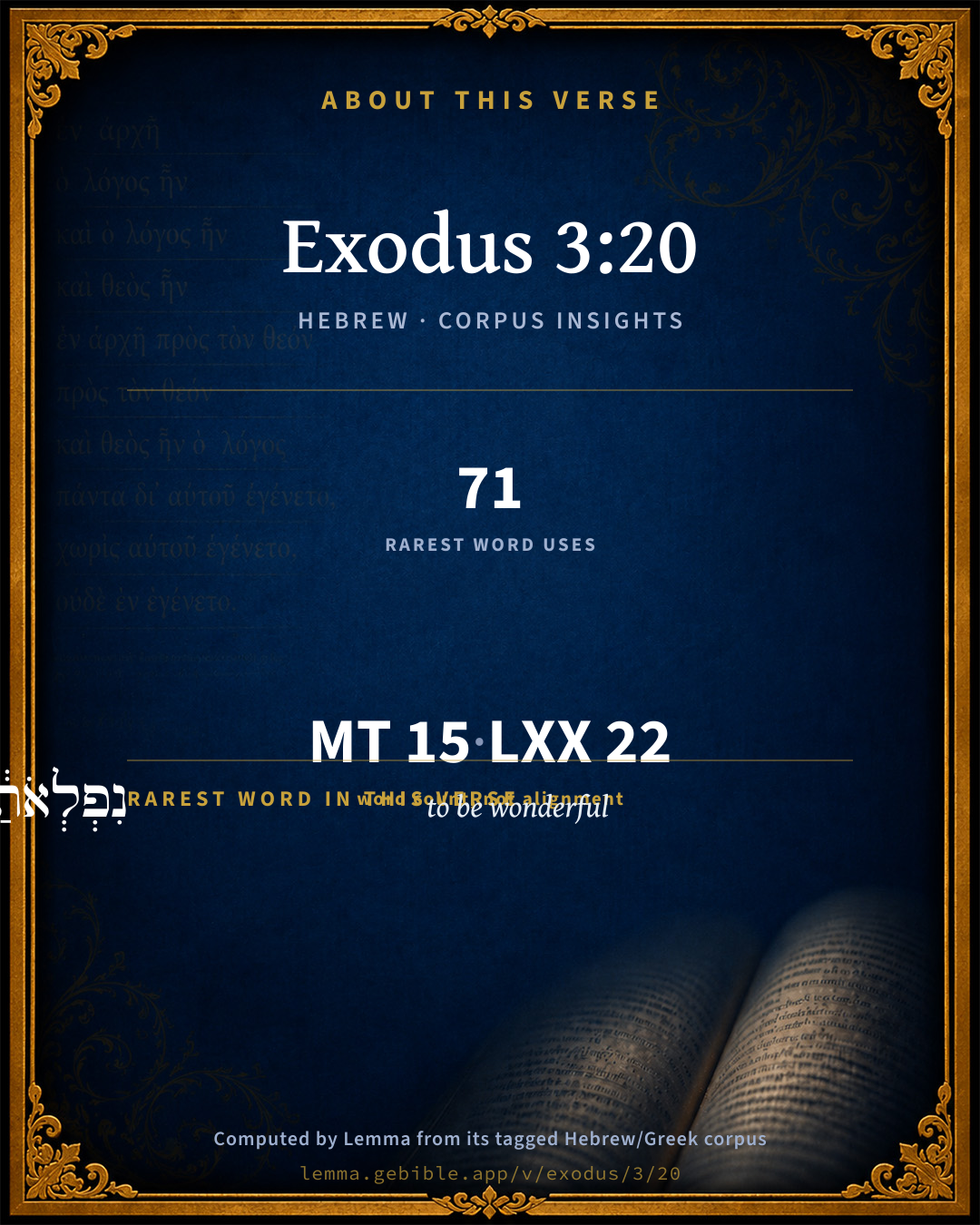
15
words
12
distinct lemmas
Pentateuch
section

Grammatical profile

  • 5 verbs
  • 4 nouns
  • 1 preposition
  • 1 adverb
  • 4 particles

Verb forms

  • וְשָׁלַחְתִּ֤י Qal · Sequential Perfect
  • וְהִכֵּיתִ֣י Hiphil · Sequential Perfect
  • נִפְלְאֹתַ֔י Niphal · Participle Active
  • אֶֽעֱשֶׂ֖ה Qal · Imperfect
  • יְשַׁלַּ֥ח Piel · Imperfect

Repetition

A word recurs within this verse — often emphatic in Hebrew:

  • וְשָׁלַחְתִּ֤י to send H7971 ×2

Hebrew & Septuagint length

In English translation the verse runs 30 words from the Hebrew and 29 from the Septuagint (LXX English) — closely comparable.

A rough comparison of the two English renderings, which tokenize alike — not a word-level alignment.

Word counts can differ between the Hebrew and the Greek without any difference in meaning — e.g. the Hebrew direct-object marker אֵת has no separate Greek word, and Greek often adds the article ὁ.

In the original languages it is 15 Hebrew tokens and 22 Greek tokens — but the two are counted differently (Hebrew bundles its prefixes and suffixes into one token; the Greek is in lemma form), so that isn’t a like-for-like length.

Cross-references

24

Topical passages linked to Exodus 3:20 in the Treasury of Scripture Knowledge — connected by theme and wording, ordered by reader-vote popularity; previews shown in the World English Bible.

  • Acts 7:36 This man led them out, having worked wonders and signs in Egypt, in the Red Sea, and in the wilderness for forty years.
  • Exodus 9:15 For now I would have put forth my hand, and struck you and your people with pestilence, and you would have been cut off from the earth;
  • Deuteronomy 6:22 and Yahweh shown signs and wonders, great and sore, on Egypt, on Pharaoh, and on all his house, before our eyes;
  • Nehemiah 9:10 and shown signs and wonders on Pharaoh, and on all his servants, and on all the people of his land; for you knew that they dealt proudly against them, and did get you a name, as it is this day.
  • Exodus 6:6 Therefore tell the children of Israel, 'I am Yahweh, and I will bring you out from under the burdens of the Egyptians, and I will rid you out of their bondage, and I will redeem you with an outstretched arm, and with great judgments:
  • Exodus 12:31–33 He called for Moses and Aaron by night, and said, "Rise up, get out from among my people, both you and the children of Israel; and go, serve Yahweh, as you have said!
  • Exodus 11:8–9 All these your servants shall come down to me, and bow down themselves to me, saying, 'Get out, and all the people who follow you; and after that I will go out.'" He went out from Pharaoh in hot anger.
  • Psalms 105:27 They performed miracles among them, And wonders in the land of Ham.
  • Genesis 15:14 I will also judge that nation, whom they will serve. Afterward they will come out with great substance.
  • Exodus 6:1 Yahweh said to Moses, "Now you shall see what I will do to Pharaoh, for by a strong hand he shall let them go, and by a strong hand he shall drive them out of his land."
  • Exodus 7:3–5 I will harden Pharaoh's heart, and multiply my signs and my wonders in the land of Egypt.
  • Exodus 11:1 Yahweh said to Moses, "Yet one plague more will I bring on Pharaoh, and on Egypt; afterwards he will let you go. When he lets you go, he will surely thrust you out altogether.
  • Exodus 12:39 They baked unleavened cakes of the dough which they brought forth out of Egypt; for it wasn't leavened, because they were thrust out of Egypt, and couldn't wait, neither had they prepared for themselves any food.
  • Deuteronomy 4:34 Or has God tried to go and take him a nation from the midst of [another] nation, by trials, by signs, and by wonders, and by war, and by a mighty hand, and by an outstretched arm, and by great terrors, according to all that Yahweh your God did for you in Egypt before your eyes?
  • Judges 6:8 that Yahweh sent a prophet to the children of Israel: and he said to them, Thus says Yahweh, the God of Israel, I brought you up from Egypt, and brought you forth out of the house of bondage;
  • Judges 8:16 He took the elders of the city, and thorns of the wilderness and briers, and with them he taught the men of Succoth.
  • Psalms 105:38 Egypt was glad when they departed, For the fear of them had fallen on them.
  • Psalms 106:22 Wondrous works in the land of Ham, And awesome things by the Red Sea.
  • Psalms 135:8–9 Who struck the firstborn of Egypt, Both of man and animal;
  • Isaiah 19:22 Yahweh will strike Egypt, smiting and healing; and they shall return to Yahweh, and he will be entreated of them, and will heal them.
  • Isaiah 26:11 Yahweh, your hand is lifted up, yet they don't see: but they shall see [your] zeal for the people, and be disappointed; yes, fire shall devour your adversaries.
  • Jeremiah 32:20–21 who performed signs and wonders in the land of Egypt, even to this day, both in Israel and among [other] men; and made you a name, as in this day;
  • Ezekiel 20:33 As I live, says the Lord Yahweh, surely with a mighty hand, and with an outstretched arm, and with wrath poured out, will I be king over you:
  • Acts 7:1–13 The high priest said, "Are these things so?"

Cross-references courtesy of OpenBible.info (CC BY 4.0).

Hebrew and Greek witnesses Masoretic Hebrew ↔ Greek Septuagint

The same verse in the two great witnesses to the Old Testament, shown verse-for-verse.

These are two independent witnesses, not word-aligned to each other, and the Septuagint is shown in lemma (dictionary) form.

Hebrew Exodus 3:20 Masoretic · Westminster Leningrad Codex

וְשָׁלַחְתִּ֤י אֶת יָדִי֙ וְהִכֵּיתִ֣י אֶת מִצְרַ֔יִם בְּכֹל֙ נִפְלְאֹתַ֔י אֲשֶׁ֥ר אֶֽעֱשֶׂ֖ה בְּקִרְבּ֑וֹ וְאַחֲרֵי כֵ֖ן יְשַׁלַּ֥ח אֶתְכֶֽם

I will put forth my hand and strike Egypt with all my wonders which I will do in the midst of it, and after that he will let you go.

World English Bible · Public Domain

Greek LXX Exodus 3:20 Septuagint · lemma form

καί κτείνω ὁ χείρ πατάσσω ὁ αἰγύπτιος ἐν πᾶς ὁ θαυμάσιος ἐγώ ὅς ποιέω ἐν αὐτός καί μετά οὗτος ἐκ ἀποστέλλω σύ

and I will stretch out my hand, and strike the Egyptians with all my wonders, which I shall work among them, and after that he will send you forth.

LXX2012 (modern English Septuagint) · Public Domain

Hebrew: Westminster Leningrad Codex (CC BY 4.0). Greek: Septuagint (public domain); English from LXX2012 (modern English Septuagint) (Public Domain). How the Septuagint differs from the Hebrew →

Targum (Aramaic paraphrase)

2

The Targum is the ancient Jewish Aramaic paraphrase of the Hebrew Scriptures — an interpretive translation, not the Hebrew text itself. Onkelos (literal) and Pseudo-Jonathan (expansive) render the Torah, and Jonathan the Prophets. Coverage is partial: where no permissively-licensed English translation exists for a verse, only the Aramaic is shown. This is verse-level text, not a word-by-word alignment to the Hebrew.

  1. Targum Onkelos Torah (Genesis–Deuteronomy)
    וָאֲשַׁלַח פּוֹן יָת מְחַת גְבֻרְתִּי וְאֶמְחֵי יָת מִצְרָאֵי בְּכֹל פְּרִשְׁוָתִי דִי אַעְבֵּד בֵּינֵיהוֹן וּבָתַר כֵּן יְשַׁלַח יָתְכוֹן:

    (no public-domain English translation for this verse)

    Targum Onkelos — Aramaic: “Onkelos Genesis” (public domain); “Onkelos Exodus” (public domain); “Onkelos Leviticus” (public domain); “Onkelos Numbers” (public domain); “Onkelos Deuteronomy” (public domain). English: “Sefaria Community Translation” (CC0 1.0 (public-domain dedication)); “J.W. Etheridge. The Targums of Onkelos and Jonathan Ben Uzziel on the Pentateuch. London: Longmans, Green, 1862” (public domain). Text via Sefaria.

  2. Targum Pseudo-Jonathan Torah (Genesis–Deuteronomy)
    וְתִתְעַכְּבוּן תַּמָן עַד דְאֵשַׁדַר יַת מְחַת גְבוּרְתִּי וְאִמְחֵי יַת מִצְרָאֵי בְּכָל פְּרִשְׁוָותִי דְאֶעְבַּד בֵּינֵיהוֹן וּמִבָּתַר כֵּן יִפְטוֹר יַתְכוֹן

    And ye will be hindered there until I have sent forth the stroke of My power, and have smitten Mizraee with all My wonders, that I will do among them; and afterward he will release you.

    Targum Pseudo-Jonathan — Aramaic: “Targum Jonathan on Genesis” (public domain); “Targum Jonathan on Exodus” (public domain); “Targum Jonathan on Leviticus” (public domain); “Targum Jonathan on Numbers” (public domain); “Targum Jonathan on Deuteronomy” (public domain). English: “The Targum of Jonathan ben Uzziel, trans. J. W. Etheridge, London, 1862” (public domain). Text via Sefaria.

Commentary

Notes on Exodus 3:20 from classic Christian and Jewish commentators (each source and its license shown beneath its notes). The classic Christian expositions comment on the surrounding passage and are grouped to its opening verse, so a note may address several verses; the Jewish commentaries on the Tanakh (Rashi and others) are per-verse, so they appear only where the commentator wrote on this verse.

Lemma curates 59 commentaries, every one of them public domain or Creative Commons licensed, each selected and text-cleaned for this edition rather than reprinted as found. About our sources →

Trapp's Complete Commentary

John Trapp

Exo 3:20 And I will stretch out my hand, and smite Egypt with all my wonders which I will do in the midst thereof: and after that he will let you go.

Ver. 20. And after that he will let you go.] When he dare hold you no longer; when I have sufficiently tamed him and taught him, as Gideon "taught the men of Succoth with thorns and briers of the wilderness." {Jdg 8:16}

John Trapp, A Commentary or Exposition upon All the Books of the Old and New Testament (1647–1656) — public domain. Text from a community e-Sword module.

Tyndale Open Study Notes

Tyndale Open Resources

3:20-21 God’s power would be obvious, and the Egyptians would not only allow the Hebrews to leave, they would pay them to do so.

Tyndale Open Study Notes — © Tyndale Open Resources, licensed CC BY-SA 4.0. Text via the HelloAO Bible API.

Ellicott's Commentary for English Readers

(20) I will stretch out my hand.—Hands are stretched out to help and save. God promises here more than He had promised before (Exo_3:12). He shows how He will “be with” Moses. He will lend him miraculous aid, performing in his behalf “all his wonders,” and with them “smiting the Egyptians.”

A Bible Commentary for English Readers, edited by Charles John Ellicott (1878–1897) — public domain. Text from a community e-Sword module.

The Cambridge Bible for Schools and Colleges

gen. ed. J. J. S. Perowne

20. wonders] Exo_34:10, Jos_3:5.

The Cambridge Bible for Schools and Colleges (gen. ed. J. J. S. Perowne; Cambridge University Press, 1878–1918) — public domain. Text from a community e-Sword module.

John Gill's Exposition

And I will stretch out my hand,.... Or "therefore" (e) he would stretch out his mighty hand, exert his almighty power; and for this purpose was Pharaoh raised up, and his heart hardened, that God might show his power in him, and on him:

and smite Egypt with all my wonders, which I will do in the midst thereof: with those wondrous plagues, the amazing effects of his almighty power, which were wrought by him in the midst of Egypt, by which their land, their rivers, their persons, and their cattle, were smitten:

and after that he will let you go; this is said for their encouragement, that their faith and patience might hold out, who otherwise seeing him so obstinate and inflexible, might be ready to despair of ever succeeding.

(e) "ideo", "propterea", Noldius, p. 279.

John Gill's Exposition of the Whole Bible (1746–1763) — public domain (CC PDM 1.0). Text via the HelloAO Bible API.

The Pulpit Commentary

I will stretch out my hand. To encourage Moses and the people, to support them in what was, humanly speaking, a most unequal contest, this important promise is made. It is a confirmation, and to some extent, an explanation of the pledge, already, given, "Certainly I will be with thee" (ver. 12). It shows how God would be with himhe would smite Egypt with all his wonders what those would be was left obscure. He would come to his people"s aid, and openly assert himself, and afflict and strike terror into their enemies-until at last even Pharaoh"s stubborn spirit would be broken, and he would consent to let them go.

The Pulpit Commentary (1880–1919), ed. H.D.M. Spence-Jones & Joseph S. Exell — public domain. Text from a community e-Sword module.

Lesson kit

Teaching starters — assembled from the data on this page, not authored interpretation. Every prompt links to the verse data it draws on. Edit before teaching.

Exodus, in the Pentateuch, opens this verse with 15 words (12 distinct Hebrew lemmas). Its most distinctive word is pâlâʼ (“to be wonderful”). A historical commentator’s framing appears above. Read the whole chapter for the surrounding context.

Discussion questions

  1. What does “to be wonderful” (pâlâʼ) contribute to the verse as a whole?
  2. How does Acts 7:36, which shares this passage’s theme, read alongside this verse?
  3. What does the repetition of “to send” (2× in this one verse) do in this verse?
  4. These translations render this verse differently; the difference is in the English rendering, not the original. What questions does that raise?
  5. «וְשָׁלַחְתִּ֤י» is a Qal Sequential Perfect verb. How does that grammatical form shape the action described?
  6. Compare how Trapp's Complete Commentary and Tyndale Open Study Notes read this verse. Where do they agree or differ?

Things to notice

Reading settings

Reading text

Shown beneath each verse's original-language words.

Old Testament
Old Testament edition

Read the OT as the Masoretic Hebrew (MT) or the Greek Septuagint (LXX).

English shown for the Greek Septuagint (in the Hebrew ↔ Greek comparison).

Comparing translations? Open the Compare panel on any verse page to stack up to four side by side.