
Proverbs 26:24

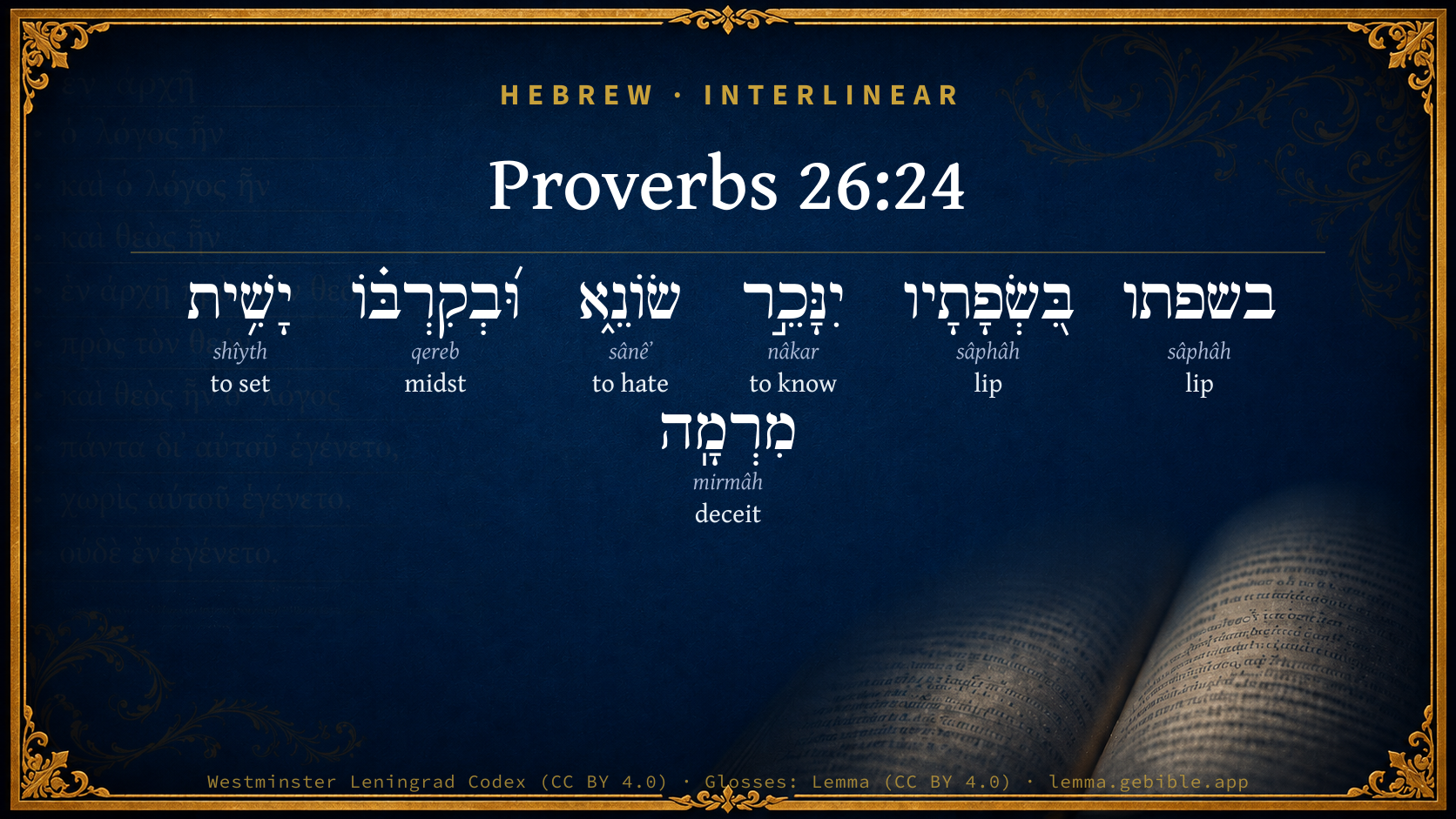
Hebrew (Westminster Leningrad Codex) Proverbs 26:24 appears in the Hebrew Old Testament. The text above is from the Westminster Leningrad Codex. Each word links to its Strong’s number, a concise gloss, and parsing drawn from the Open Scriptures Hebrew Bible morphology. Click any word for its full Brown-Driver-Briggs (BDB) entry.
Download image
Cite this verse

Proverbs 26:24 (World English Bible). Public Domain. Lemma interlinear Bible study tool, https://lemma.gebible.app/v/proverbs/26/24.

Show BibTeX & RIS
BibTeX
RIS
English Translation
A malicious man disguises himself with his lips, But he harbors evil in his heart.
World English Bible · Public Domain
Download a study sheet

One document with this verse’s original text, its word-by-word gloss line, the meaning frame, cross-references with their text, attributed commentary, and full source and license credits — printable, and it pastes into notes with its structure intact.

This verse Autodidact and up

Study sheet (.html) Plain text (.txt)

A passage Seminary Student

Up to 50 verses in one chapter. A passage sheet keeps up to 6 commentary sources and 12 cross-references per verse, in the order this page ranks them, and says so on the sheet whenever that leaves anything out. Ask for a single verse and you get the Autodidact verse sheet above.

Everything on this page stays free to read, with no account — the sheet is a download of what is already on screen, not access to it.

Want to remove ads? Support Godless Engineer
Compare translations 3

The same verse in 3 English versions, stacked beneath the original-language interlinear above. Click any original word for its lexicon entry.

Each is an independent rendering of the whole verse — the interlinear is not word-aligned to these translations.

Highlighted words mark where these versions differ — a whole-verse word diff, not a word-by-word alignment.

  • World English Bible Public Domain
    A malicious man disguises himself with his lips, But he harbors evil in his heart.
  • King James Version Public Domain
    He that hateth dissembleth with his lips, and layeth up deceit within him;
  • unfoldingWord Literal Text CC BY-SA 4.0
    With his lips one who hates disguises himself, but within him he sets deceit.

unfoldingWord Literal Text — © unfoldingWord, licensed CC BY-SA 4.0. Word-aligned USFM3 via Door43 (git.door43.org/unfoldingWord/en_ult).

Versions to compare (up to 4)

3 of 4 selected

Show all 18 translations

Every available English version of this verse, each an independent rendering of the whole verse.

  • World English Bible Public Domain
    A malicious man disguises himself with his lips, But he harbors evil in his heart.
  • Berean Standard Bible Public Domain
    A hateful man disguises himself with his speech, but he lays up deceit in his heart.
  • Majority Standard Bible Public Domain
    A hateful man disguises himself with his speech, but he lays up deceit in his heart.
  • King James Version Public Domain
    He that hateth dissembleth with his lips, and layeth up deceit within him;
  • American Standard Version (1901) Public Domain
    He that hateth dissembleth with his lips; But he layeth up deceit within him:
  • Revised Version (1885) Public Domain
    He that hateth dissembleth with his lips, but he layeth up deceit within him:
  • Geneva Bible (1599) Public Domain
    He that hateth, will counterfaite with his lips, but in his heart he layeth vp deceite.
  • Douay-Rheims (1899) Public Domain
    An enemy is known by his lips, when in his heart he entertaineth deceit.
  • Young's Literal Translation Public Domain
    By his lips doth a hater dissemble, And in his heart he placeth deceit,
  • Literal Standard Version CC BY-SA 4.0
    A hater pretends by his lips, || And he places deceit in his heart,
  • Unlocked Literal Bible CC BY-SA 4.0
    One who hates others disguises his feelings with his lips and he lays up deceit within himself.
  • unfoldingWord Literal Text CC BY-SA 4.0
    With his lips one who hates disguises himself, but within him he sets deceit.
  • Darby Bible Public Domain
    He that hateth dissembleth with his lips, but he layeth up deceit within him:
  • World Messianic Bible Public Domain
    A malicious man disguises himself with his lips, but he harbors evil in his heart.
  • Webster's Bible Public Domain
    He that hateth dissembleth with his lips, and layeth up deceit within him;
  • Free Bible Version CC BY-SA 4.0
    People say nice things to you even though they hate you; deep down they're just lying to you.
  • Bible in Basic English Public Domain
    With his lips the hater makes things seem what they are not, but deceit is stored up inside him;
  • JPS Tanakh (1917) Public Domain
    He that hateth dissembleth with his lips, but he layeth up deceit within him.

Literal Standard Version (2020), Covenant Press — licensed CC BY-SA 4.0. Text via the HelloAO Bible API (eBible.org). Unlocked Literal Bible (unfoldingWord) — licensed CC BY-SA 4.0. Text via the HelloAO Bible API (eBible.org). unfoldingWord Literal Text — © unfoldingWord, licensed CC BY-SA 4.0. Word-aligned USFM3 via Door43 (git.door43.org/unfoldingWord/en_ult). Free Bible Version, Dr. Jonathan Gallagher — licensed CC BY-SA 4.0. Text via the HelloAO Bible API (eBible.org).

Word by word

More ways to search: Search by grammar → Find every occurrence → Compare this word →

Practice this passage: Drill this verse → Learn its vocabulary →

About this verse

These counts appear in no published source. They are computed here, from the morphology-tagged text and Lemma’s own curated glosses. What Lemma adds →

7
words
6
distinct lemmas
Wisdom
section

Shared distinctive vocabulary

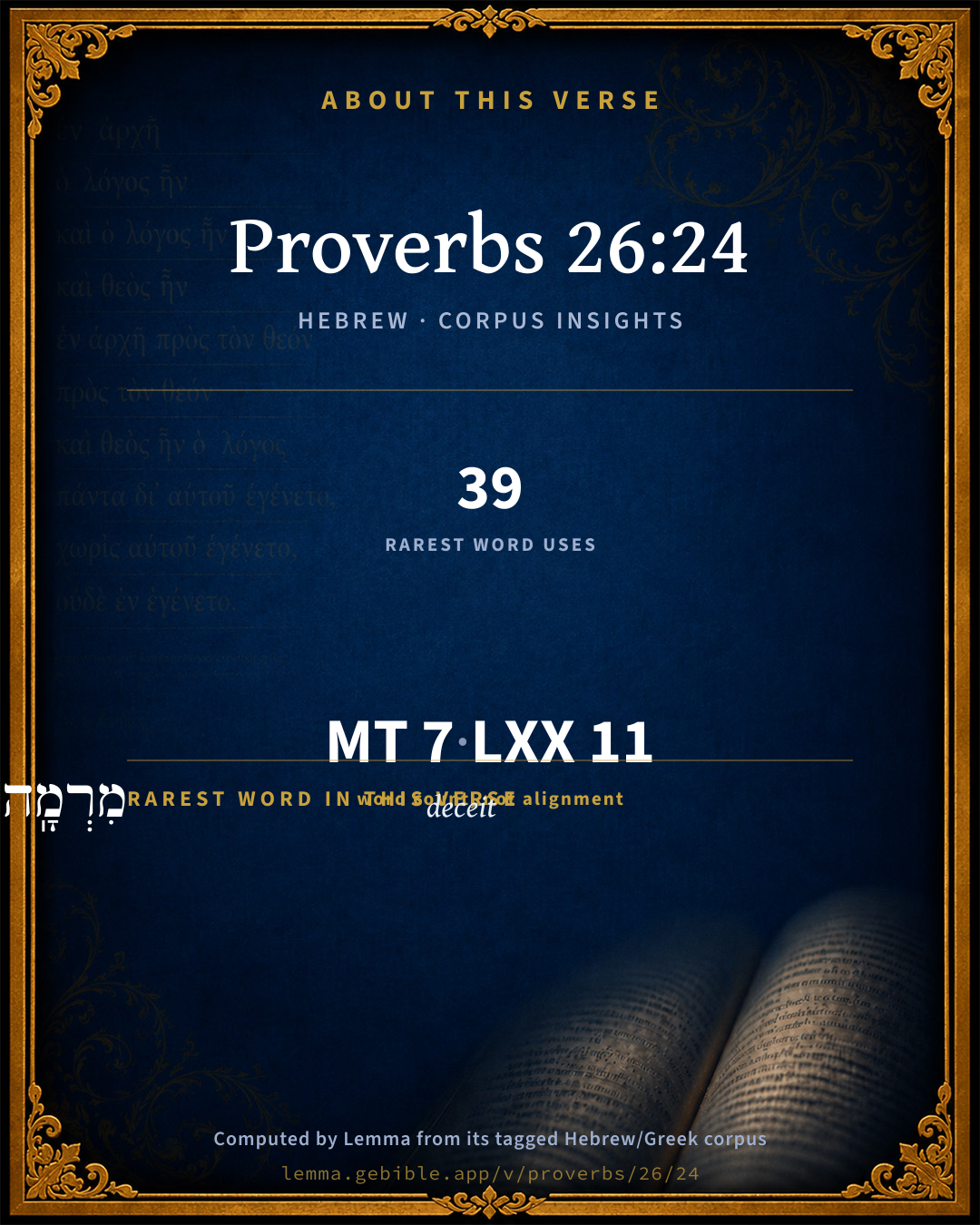
מִרְמָֽה deceit H4820 occurs in 38 verses of the Hebrew Bible. Also found in:

Grammatical profile

  • 3 verbs
  • 4 nouns

Verb forms

  • יִנָּכֵ֣ר Niphal · Imperfect
  • שׂוֹנֵ֑א Qal · Participle Active
  • יָשִׁ֥ית Qal · Imperfect

Repetition

A word recurs within this verse — often emphatic in Hebrew:

  • בשפתו lip H8193 ×2

Hebrew & Septuagint length

In English translation the verse runs 15 words from the Hebrew and 16 from the Septuagint (LXX English) — closely comparable.

A rough comparison of the two English renderings, which tokenize alike — not a word-level alignment.

Word counts can differ between the Hebrew and the Greek without any difference in meaning — e.g. the Hebrew direct-object marker אֵת has no separate Greek word, and Greek often adds the article ὁ.

In the original languages it is 7 Hebrew tokens and 11 Greek tokens — but the two are counted differently (Hebrew bundles its prefixes and suffixes into one token; the Greek is in lemma form), so that isn’t a like-for-like length.

Cross-references

7

Topical passages linked to Proverbs 26:24 in the Treasury of Scripture Knowledge — connected by theme and wording, ordered by reader-vote popularity; previews shown in the World English Bible.

  • Proverbs 12:20 Deceit is in the heart of those who plot evil, But joy comes to the promoters of peace.
  • Psalms 41:6 If he comes to see me, he speaks falsehood. His heart gathers iniquity to itself. When he goes abroad, he tells it.
  • Proverbs 10:18 He who hides hatred has lying lips. He who utters a slander is a fool.
  • Proverbs 12:5 The thoughts of the righteous are just, But the advice of the wicked is deceitful.
  • Proverbs 12:17 He who is truthful testifies honestly, But a false witness lies.
  • Proverbs 14:8 The wisdom of the prudent is to think about his way, But the folly of fools is deceit.
  • Proverbs 11:1 A false balance is an abomination to Yahweh, But accurate weights are his delight.

Cross-references courtesy of OpenBible.info (CC BY 4.0).

Hebrew and Greek witnesses Masoretic Hebrew ↔ Greek Septuagint

The same verse in the two great witnesses to the Old Testament, shown verse-for-verse.

These are two independent witnesses, not word-aligned to each other, and the Septuagint is shown in lemma (dictionary) form.

Hebrew Proverbs 26:24 Masoretic · Westminster Leningrad Codex

בשפתו בִּ֭שְׂפָתָיו יִנָּכֵ֣ר שׂוֹנֵ֑א וּ֝בְקִרְבּ֗וֹ יָשִׁ֥ית מִרְמָֽה

A malicious man disguises himself with his lips, But he harbors evil in his heart.

World English Bible · Public Domain

Greek LXX Proverbs 26:24 Septuagint · lemma form

χεῖλος πᾶς ἐπινεύω ἀποκλαίω ἐχθρός ἐν δέ ὁ καρδία τεκταίνω δόλος

A weeping enemy promises all things with his lips, but in his heart he contrives deceit.

LXX2012 (modern English Septuagint) · Public Domain

On this verse, Keil & Delitzsch discusses the Septuagint’s reading. Read the note in Commentary ↓

Hebrew: Westminster Leningrad Codex (CC BY 4.0). Greek: Septuagint (public domain); English from LXX2012 (modern English Septuagint) (Public Domain). How the Septuagint differs from the Hebrew →

Commentary

Notes on Proverbs 26:24 from classic Christian and Jewish commentators (each source and its license shown beneath its notes). The classic Christian expositions comment on the surrounding passage and are grouped to its opening verse, so a note may address several verses; the Jewish commentaries on the Tanakh (Rashi and others) are per-verse, so they appear only where the commentator wrote on this verse.

Lemma curates 59 commentaries, every one of them public domain or Creative Commons licensed, each selected and text-cleaned for this edition rather than reprinted as found. About our sources →

Matthew Henry's Commentary

There is cause to complain, not only of the want of sincerity in men's profession of friendship, and that they do not love so well as they pretend nor will serve their friends so much as they promise, but, which is much worse, of wicked designs in the profession of friendship, and the making of it subservient to the most malicious intentions. This is here spoken of as a common thing (Pro 26:24): He that hates his neighbour, and is contriving to do him a mischief, yet dissembles with his lips, professes to have a respect for him and to be ready to serve him, talks kindly with him, as Cain with Abel, asks, Art thou in health, my brother? as Joab to Amasa, that his malice may not be suspected and guarded against, and so he may have the fairer opportunity to execute the purposes of it, this man lays up deceit within him, that is, he keeps in his mind the mischief he intends to do his neighbour till he catches him at an advantage. This is malice which has no less of the subtlety than it has of the venom of the old serpent in it. Now, as to this matter, we are here cautioned, 1. Not to be so foolish as to suffer ourselves to be imposed upon by the pretensions of friendship. Remember to distrust when a man speaks fair; be not too forward to believe him unless you know him well, for it is possible there may be seven abominations in his heart, a great many projects of mischief against you, which he is labouring so industriously to conceal with his fair speech. Satan is an enemy that hates us, and yet in his temptations speaks fair, as he did to Eve, but it is madness to give credit to him, for there are seven abominations in his heart; seven other spirits does one unclean spirit bring more wicked than himself. 2. Not to be so wicked as to impose upon any with a profession of friendship; for, though the fraud may be carried on plausibly awhile, it will be brought to light, Pro 26:26. He whose hatred is covered by deceit will one time or other be discovered, and his wickedness shown, to his shame and confusion, before the whole congregation; and nothing will do more to make a man odious to all companies. Love (says one) is the best armour, but the worst cloak, and will serve dissemblers as the disguise which Ahab put on and perished in.

Matthew Henry's Commentary on the Whole Bible (1708–1710) — public domain (CC PDM 1.0). Text via the HelloAO Bible API.

Trapp's Complete Commentary

John Trapp

Pro 26:24 He that hateth dissembleth with his lips, and layeth up deceit within him;

Ver. 24. He that hateth dissembleth with his lips.] And so heaps sin upon sin, till he be transformed into a breathing devil. This is meant not so much of the passion of hatred as of the habit of it; when it hath wholly leavened the heart, and lies watching its opportunity of doing mischief. The devil is at inn with such, as Mr Bradford {a} phraseth it, and was as great a master, long before the Florentine secretary was born, as since.

{a} Serm. of Repent.

John Trapp, A Commentary or Exposition upon All the Books of the Old and New Testament (1647–1656) — public domain. Text from a community e-Sword module.

The Biblical Illustrator

Joseph S. Exell

Pro_26:24-27

He that hateth dissembleth with his lips.

Clandestine hatred

I. It is often greatly disguised. Burning lips and a wicked heart are like a potsherd covered with silver dross.

II. It is excessively corrupt. When he speaketh fair, believe him not: for there are seven abominations in his heart. The word number seven, in Scripture, denotes fulness or completeness. The idea here is, that such a mans heart is full of abominations.

III. It is liable to exposure. Whose hatred is covered by deceit, his wickedness shall be shewed before the whole congregation. Dissembling never answers in the end. The Providence of God brings dark deeds to light. All sin will one day be stripped of its mask, and laid bare in all its putrescent hideousness to the open eye of the universe.

IV. It is self-ruinous. Whoso diggeth a pit shall fall therein. Evil is a hard worker. It digs pits and rolls stones. And what is worse, all its hard work is self-ruinous. Into the pit which they have dug they shall tumble. Those who plot mischief for others will be overwhelmed with it themselves. Moab, in attempting to curse Israel, fell himself under the curse of God. Hamans gallows for Mordecai was his own promotion of shame. The enemies of Daniel were devoured in the ruin which they plotted against him. Thus does God take the wise in his craftiness, the wicked in his wickedness. The malice that meditates the evil is often the cause of its own overthrow.

V. It is socially pernicious. A lying tongue hateth those that are afflicted by it; and a flattering mouth worketh ruin.

1. It injures by its slanders. A lying tongue hateth those that are afflicted by it.

2. It injures by its flatteries. Flattery is a social curse. (D. Thomas, D. D.)

By injuring others we are ourselves often the greatest sufferers

The wasps sting is provided with a barb, and when he feels particularly vicious, and drives the sting into the flesh, it becomes so firmly imbedded that the only way for him to escape is to leave the sting behind. This, however, is sure to cause his death. He receives himself such a wound that he cannot recover. We sometimes forget that when we hurt others by stinging words and treacherous acts, we ourselves, in the long run, are generally the greatest sufferers. (W. Judson.)

The Biblical Illustrator, edited by Joseph S. Exell (c. 1880s–1900s) — public domain. Text from a community e-Sword module.

Joseph Benson's Commentary

Pro 26:24-26. He that hateth dissembleth with his lips — Hebrew, ינכר, carries himself like another man, that is, pretends love and kindness; and layeth up deceit within him — Means, by counterfeiting kindness, only the more easily and securely to deceive thee. When he speaketh fair —

Hebrew, יחנן קולו, uses gracious or supplicating language, gives thee the kindest words, and assures thee he is sincere; believe him not — Give no credit to his flatteries and professions of esteem and regard; for there are seven abominations in his heart — That is, a great variety of base and wicked designs. Whose hatred is covered by deceit — With false professions of love; his wickedness shall be showed before the whole congregation — Instead of that secrecy and impunity which, by this art, he designs and promises to himself, he shall be brought to public shame and punishment.

Joseph Benson's Commentary on the Old and New Testaments (1811–1818) — public domain. Text from a community e-Sword module.

Keil & Delitzsch

C. F. Keil & F. Delitzsch

Pro 26:24 and Pro 26:25 form a tetrastich.

24 With his lips the hater dissembleth,

And in his heart he museth deceit.

25 If he maketh his voice agreeable, believe him not,

For seven abominations are in his heart.

All the old translators (also the Venet. and Luther) give to יגּכר the meaning, to become known; but the Niph. as well as the Hithpa. (vid., at Pro 20:11; Gen 47:17) unites with this meaning also the meaning to make oneself known: to make oneself unknown, unrecognisable = (Arab.) tanakkr, e.g., by means of clothing, or by a changed expression of countenance.

(Note: Vid., de Goeje's Fragmenta Hist. Arab. ii. (1871), p. 94. The verb נכר, primarily to fix one's attention, sharply to contemplate anything, whence is derived the meanings of knowing and of not knowing, disowning. The account of the origin of these contrasted meanings, in Gesenius-Dietrich's Lexicon, is essentially correct; but the Arab. nakar there referred to means, not sharpness of mind, from nakar = הכּיר, but from the negative signification prevailing in the Arab. alone, a property by which one makes himself worthy of being disowned: craftiness, cunning, and then also in bonam partem: sagacity.)

The contrast demands here this latter signification: labiis suis alium se simulat osor, intus in pectore autem reconditum habet dolum (Fleischer). This rendering of ישׁית מרמה is more correct than Hitzig's ("in his breast) he prepares treachery;" for שׁית מרמה is to be rendered after שׁית עצות, Psa 13:3 (vid., Hupfeld's and also our comm. on this passage), not after Jer 9:7; for one says שׁית מוקשׁים, to place snares, שׁית ארב, to lay an ambush, and the like, but not to place or to lay deceit. If such a dissembler makes his voice agreeable (Piel of חנן only here, for the form Psa 9:14 is, as it is punctuated, Kal), trust not thyself to him (האמין, with ב: to put firm trust in anything, vid., Genesis, p. 312)

(Note: The fundamental idea of firmness in האמין is always in the subject, not the object. The Arabic interpreters remark that âman with ב expresses recognition, and with ל submission (vid., Lane's Lexicon under âman); but in Hebr. האמין with ב fiducia fidei, with ל assensus fidei; the relation is thus not altogether the same.)

for seven abominations, i.e., a whole host of abominable thoughts and designs, are in his heart; he is, if one may express it, after Mat 12:45, possessed inwardly of seven devils. The lxx makes a history of 24a: an enemy who, under complaints, makes all possible allowances, but in his heart τεκταίνεται δόλους. The history is only too true, but it has no place in the text.

Keil & Delitzsch — Biblical Commentary on the Old Testament (1861–1891) — public domain (CC PDM 1.0). Text via the HelloAO Bible API. (Old Testament only.)

Jamieson, Fausset & Brown

Robert Jamieson, A. R. Fausset & David Brown

dissembleth--though an unusual sense of the word (compare Margin), is allowable, and better suits the context, which sets forth hypocrisy.

Jamieson, Fausset & Brown — Commentary Critical and Explanatory on the Whole Bible (1871) — public domain (CC PDM 1.0). Text via the HelloAO Bible API.

The Cambridge Bible for Schools and Colleges

gen. ed. J. J. S. Perowne

24. and] But he layeth up &c. (R.V.) gives the sense more forcibly. Comp. 2Sa_3:27.

The Cambridge Bible for Schools and Colleges (gen. ed. J. J. S. Perowne; Cambridge University Press, 1878–1918) — public domain. Text from a community e-Sword module.

John Gill's Exposition

When he speaketh fair, believe him not,.... Gives good words, flatters with his lips, pretends great kindness and favour, expresses himself in a very gracious and amiable manner, in order to gain attention and respect; or when he delivers himself in a submissive and suppliant way, with great humility and deference; or in a mournful and pitiful strain, as if he had the most tender affection and concern; be not too credulous; do not suffer yourselves to be imposed upon by him; be upon your guard, distrust him, suspect a snake in the grass;

for there are seven abominations in his heart; a multitude of wicked purposes, schemes, and designs, which he has formed there against you, and which he only waits a proper time to put in execution; things abominable to God and men. Aben Ezra thinks reference is had to the seven abominations in Pro 6:16.

John Gill's Exposition of the Whole Bible (1746–1763) — public domain (CC PDM 1.0). Text via the HelloAO Bible API.

Haydock's Catholic Bible Commentary

Lips. He will speak of what he hates much.

George Leo Haydock (1774–1849), Haydock's Catholic Family Bible and Commentary, 1859 edition — public domain. Excludes Psalms (Douay-Rheims chapter numbering differs from Protestant) and Deuterocanonical books (Catholic canon only).

Matthew Poole's English Annotations

Dissembleth, or, carrieth himself like another man; pretends love and kindness; which sense seems to agree best both with the next clause of this verse, and with the two following verses,

Matthew Poole's English Annotations on the Holy Bible (1683–1685) — public domain. Text from a community e-Sword/MySword module.

Whedon's Commentary on the Bible

Daniel D. Whedon

24. He that… dissembleth — This seems to be the counterpart of the preceding, and is rendered: “By his lips shall the hater be known, that he putteth deceit within him;” that is, that he cherishes it. — Gesenius. The hater, however smooth spoken, can hardly so dissemble as to escape detection. Most interpreters, however, follow the Authorized Version.

Daniel D. Whedon (gen. ed.), Commentary on the Old and New Testaments (1874–1909) — public domain. Text from a community e-Sword module.

The Pulpit Commentary

He that hateth dissembleth with his lips. This and the next verse form a tetrastich. St. Jerome, Labiis suis intelligitur inimicus. But the verb here used, rkn, bears the meaning "to make one"s self unknown," as well as "to make one"s self known," and hence "to make one"s self unrecognizable" by dress or change of countenance. (1Ki_14:5) This is much more appropriate in the present connection than the other explanation. The man cloaks his hatred with honeyed words. And layeth up deceit within him; meditating all the time treachery in his heart. (Jer_9:8) Septuagint, "An enemy weeping promises all things with his lips, but in his heart he contriveth deceits." The tears in this case are hypocritical signs of sorrow, intended to deceive the dupe.

The Pulpit Commentary (1880–1919), ed. H.D.M. Spence-Jones & Joseph S. Exell — public domain. Text from a community e-Sword module.

unfoldingWord translationNotes

Door43 World Missions Community

disguises his feelings with his lips

Disguising his feelings represents keeping people from knowing what his feelings are. The phrase "his lips" is a metonym for what he says. AT: "hides his feelings with what he says" or "speaks in such a way that people cannot know his true feelings" (See: Metaphor and Metonymy)

he lays up deceit within himself

Being deceitful is spoken of as if he were storing deceit within himself. Possible meanings are that "deceit" refers to lies. AT: "he likes his many lies" or 2) deceit refers secret plans to harm people. AT: "he secretly plans to harm people" (See: Metaphor)

but do not believe him

"but do not believe what he says"

for there are seven abominations in his heart

The number seven represents completeness. Possible meanings are 1) "abominations" refers to attitudes that God hates. AT: "for his heart is completely filled with hateful things" or 2) "abominations" refers to his hatred for people. AT: "for his heart is completely filled with hatred" (See: Metaphor)

Though his hatred is covered with deception

This can be stated actively. AT: "Though deception covers his hatred" or "Though he covers his hatred with deception" (See: Active or Passive)

Though his hatred is covered with deception

Keeping people from knowing that he hates them is spoken of as covering his hatred. AT: "Though he lies to keep people from knowing that he hates them" or "Though he lies so that people will not know that he hates them" (See: Metaphor)

his wickedness will be exposed in the assembly

Being exposed represents being discovered or becoming known. AT: "his wickedness will become known in the assembly" or "the assembly will discover his wickedness" (See: Metaphor and Active or Passive)

the assembly

"the community of Israel"

translationWords

deceive

grace

believe

abomination

heart

evil

assembly

unfoldingWord translationNotes — © Distant Shores Media and the Door43 World Missions Community, licensed CC BY-SA 4.0. Source: git.door43.org/Door43/en_tn.

Rashi

Rabbi Shlomo Yitzchaki (Rashi)

An enemy dissembles With his speech, an enemy dissembles, so that it is not recognizable that he is an enemy. ינכר, deconnoitre in French, [verkennen in German, and so did Redak write, that it is an expression of denial and making oneself strange, the opposite of recognition (הכרה)].

Rashi on the Tanakh — English translations: “The Judaica Press complete Tanach with Rashi, translated by A. J. Rosenberg” (CC BY 4.0); “Pentateuch with Rashi's commentary by M. Rosenbaum and A.M. Silbermann, 1929-1934” (public domain); “The Metsudah Tanach series, Lakewood, N.J” (CC BY 4.0); and “The Book of Joshua, Metsudah Publications, 1997” (CC BY 4.0). Text via Sefaria.

Lesson kit

Teaching starters — assembled from the data on this page, not authored interpretation. Every prompt links to the verse data it draws on. Edit before teaching.

Proverbs, in the Wisdom, opens this verse with 7 words (6 distinct Hebrew lemmas). Its most distinctive word is mirmâh (“deceit”). A historical commentator’s framing appears above. Read the whole chapter for the surrounding context.

Discussion questions

  1. How does “deceit” (mirmâh) shape what this verse is saying?
  2. How does Genesis 27:35, which shares the word «deceit», read alongside this verse?
  3. What does the repetition of “lip” (2× in this one verse) do in this verse?
  4. These translations render this verse differently. What is at stake in choosing one wording over another?
  5. «יִנָּכֵ֣ר» is a Niphal Imperfect verb. How does that grammatical form shape the action described?
  6. Compare how Matthew Henry's Commentary and Trapp's Complete Commentary read this verse. Where do they agree or differ?

Things to notice

Reading settings

Reading text

Shown beneath each verse's original-language words.

Old Testament
Old Testament edition

Read the OT as the Masoretic Hebrew (MT) or the Greek Septuagint (LXX).

English shown for the Greek Septuagint (in the Hebrew ↔ Greek comparison).

Comparing translations? Open the Compare panel on any verse page to stack up to four side by side.