
Isaiah 25:11

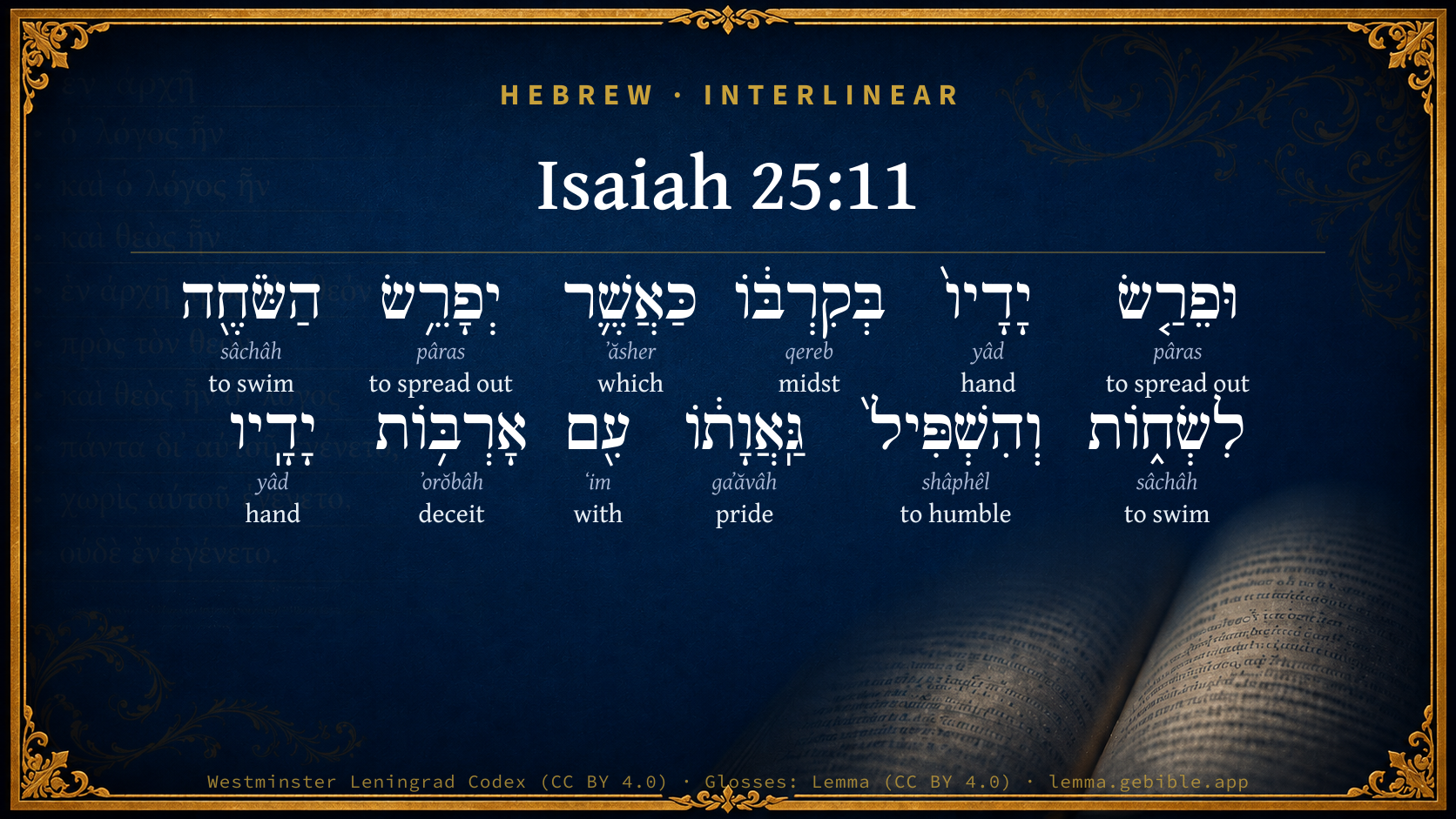
Hebrew (Westminster Leningrad Codex) Isaiah 25:11 appears in the Hebrew Old Testament. The text above is from the Westminster Leningrad Codex. Each word links to its Strong’s number, a concise gloss, and parsing drawn from the Open Scriptures Hebrew Bible morphology. Click any word for its full Brown-Driver-Briggs (BDB) entry.
Download image
Cite this verse

Isaiah 25:11 (World English Bible). Public Domain. Lemma interlinear Bible study tool, https://lemma.gebible.app/v/isaiah/25/11.

Show BibTeX & RIS
BibTeX
RIS
English Translation
He shall spread forth his hands in the midst of it, as he who swims spreads forth [his hands] to swim; but [Yahweh] will lay low his pride together with the craft of his hands.
World English Bible · Public Domain
Highlights
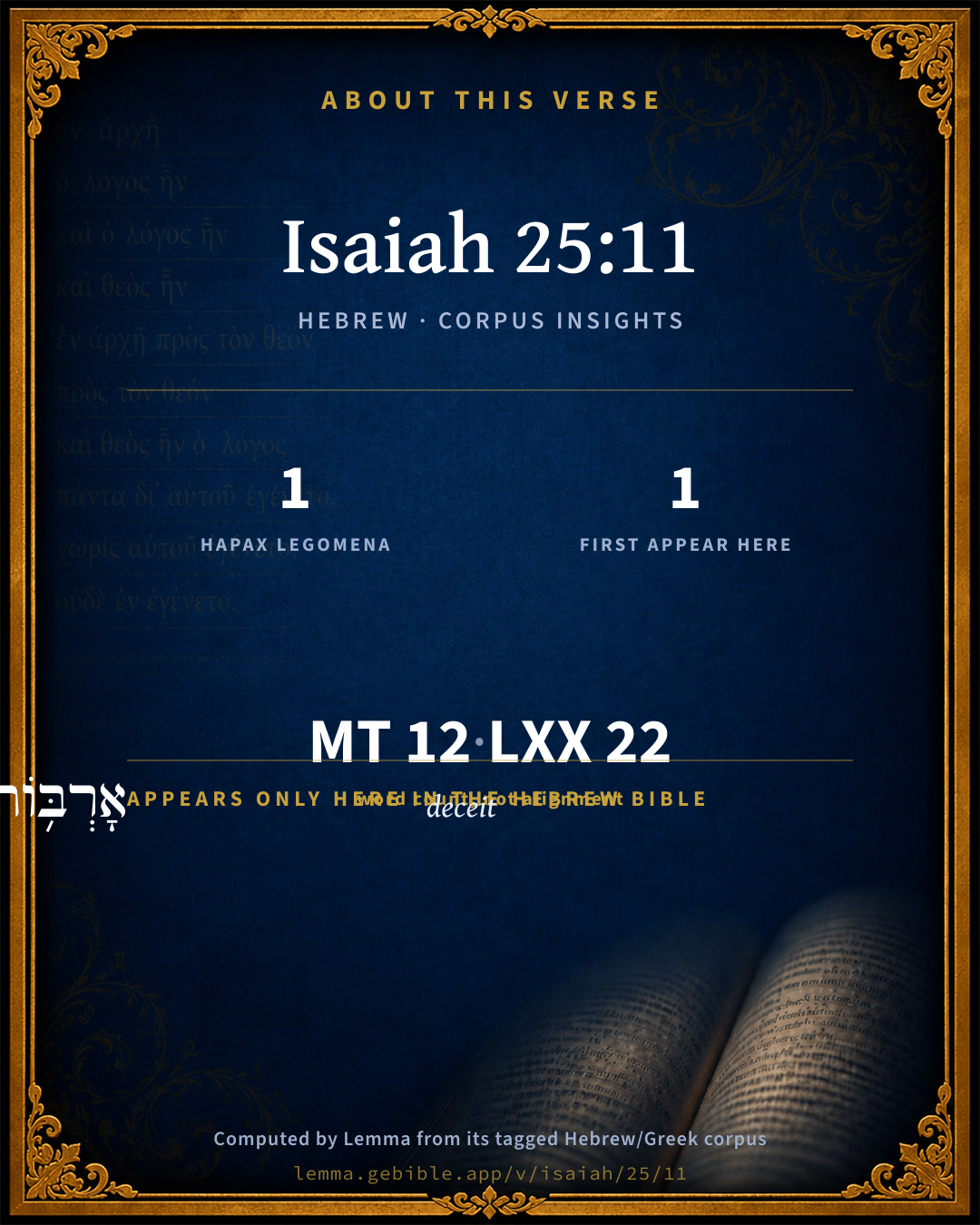
  • 1 hapax legomenon — only here in the Hebrew Bible
  • 1 first appearance in the Hebrew Bible
Full analysis ↓
Download a study sheet

One document with this verse’s original text, its word-by-word gloss line, the meaning frame, cross-references with their text, attributed commentary, and full source and license credits — printable, and it pastes into notes with its structure intact.

This verse Autodidact and up

Study sheet (.html) Plain text (.txt)

A passage Seminary Student

Up to 50 verses in one chapter. A passage sheet keeps up to 6 commentary sources and 12 cross-references per verse, in the order this page ranks them, and says so on the sheet whenever that leaves anything out. Ask for a single verse and you get the Autodidact verse sheet above.

Everything on this page stays free to read, with no account — the sheet is a download of what is already on screen, not access to it.

Want to remove ads? Support Godless Engineer
Compare translations 3

The same verse in 3 English versions, stacked beneath the original-language interlinear above. Click any original word for its lexicon entry.

Each is an independent rendering of the whole verse — the interlinear is not word-aligned to these translations.

Highlighted words mark where these versions differ — a whole-verse word diff, not a word-by-word alignment.

  • World English Bible Public Domain
    He shall spread forth his hands in the midst of it, as he who swims spreads forth [his hands] to swim; but [Yahweh] will lay low his pride together with the craft of his hands.
  • King James Version Public Domain
    And he shall spread forth his hands in the midst of them, as he that swimmeth spreadeth forth his hands to swim: and he shall bring down their pride together with the spoils of their hands.
  • unfoldingWord Literal Text CC BY-SA 4.0
    And he will spread out his hands in the midst of it as a swimmer spreads to swim, but he will bring low his pride with the craftiness of his hands.

unfoldingWord Literal Text — © unfoldingWord, licensed CC BY-SA 4.0. Word-aligned USFM3 via Door43 (git.door43.org/unfoldingWord/en_ult).

Versions to compare (up to 4)

3 of 4 selected

Show all 18 translations

Every available English version of this verse, each an independent rendering of the whole verse.

  • World English Bible Public Domain
    He shall spread forth his hands in the midst of it, as he who swims spreads forth [his hands] to swim; but [Yahweh] will lay low his pride together with the craft of his hands.
  • Berean Standard Bible Public Domain
    He will spread out his hands within it, as a swimmer spreads his arms to swim. His pride will be brought low, despite the skill of his hands.
  • Majority Standard Bible Public Domain
    He will spread out his hands within it, as a swimmer spreads his arms to swim. His pride will be brought low, despite the skill of his hands.
  • King James Version Public Domain
    And he shall spread forth his hands in the midst of them, as he that swimmeth spreadeth forth his hands to swim: and he shall bring down their pride together with the spoils of their hands.
  • American Standard Version (1901) Public Domain
    And he shall spread forth his hands in the midst thereof, as he that swimmeth spreadeth forth `his hands' to swim; but `Jehovah' will lay low his pride together with the craft of his hands.
  • Revised Version (1885) Public Domain
    And he shall spread forth his hands in the midst thereof, as he that swimmeth spreadeth forth his hands to swim: and he shall lay low his pride together with the craft of his hands.
  • Geneva Bible (1599) Public Domain
    And he shall stretche out his hande in the middes of them (as he that swimmeth, stretcheth them out to swimme) and with the strength of his handes shall he bring downe their pride.
  • Douay-Rheims (1899) Public Domain
    And he shall stretch forth his hands under him, as he that swimmeth stretcheth forth his hands to swim: and he shall bring down his glory with the dashing of his hands.
  • Young's Literal Translation Public Domain
    And he spread out his hands in its midst, As spread out doth the swimmer to swim; And He hath humbled his excellency With the machinations of his hands.
  • Literal Standard Version CC BY-SA 4.0
    And He spread out His hands in its midst, || As the swimmer spreads out to swim; And He has humbled his excellence || With the machinations of his hands.
  • Unlocked Literal Bible CC BY-SA 4.0
    They will spread their hands in the midst of it, as a swimmer spreads his hands to swim. But Yahweh will bring down their pride in spite of the skill of their hands.
  • unfoldingWord Literal Text CC BY-SA 4.0
    And he will spread out his hands in the midst of it as a swimmer spreads to swim, but he will bring low his pride with the craftiness of his hands.
  • Darby Bible Public Domain
    and he shall spread forth his hands in the midst of them, as he that swimmeth spreadeth them forth to swim; and he shall bring down their pride together with the plots of their hands.
  • World Messianic Bible Public Domain
    He will spread out his hands in the middle of it, like one who swims spreads out hands to swim, but his pride will be humbled together with the craft of his hands.
  • Webster's Bible Public Domain
    And he will spread forth his hands in the midst of them, as he that swimmeth spreadeth forth his hands to swim: and he will bring down their pride together with the spoils of their hands.
  • Free Bible Version CC BY-SA 4.0
    They will reach out their hands to try and save themselves, like swimmers using their hands to swim, but their pride will be humbled however much they thrash about.
  • Bible in Basic English Public Domain
    And if he puts out his hands, like a man stretching out his hands in swimming, the Lord will make low his pride, however expert his designs.
  • JPS Tanakh (1917) Public Domain
    And when he shall spread forth his hands in the midst thereof, as he that swimmeth spreadeth forth his hands to swim, his pride shall be brought down together with the cunning of his hands.

Literal Standard Version (2020), Covenant Press — licensed CC BY-SA 4.0. Text via the HelloAO Bible API (eBible.org). Unlocked Literal Bible (unfoldingWord) — licensed CC BY-SA 4.0. Text via the HelloAO Bible API (eBible.org). unfoldingWord Literal Text — © unfoldingWord, licensed CC BY-SA 4.0. Word-aligned USFM3 via Door43 (git.door43.org/unfoldingWord/en_ult). Free Bible Version, Dr. Jonathan Gallagher — licensed CC BY-SA 4.0. Text via the HelloAO Bible API (eBible.org).

Word by word

More ways to search: Search by grammar → Find every occurrence → Compare this word →

Practice this passage: Drill this verse → Learn its vocabulary →

אָרְבּ֥וֹת
ʼorŏbâh
H698
“deceits of”
Noun, Common, Feminine, Plural, Construct
Part of Speech
Noun
Type
Common
Gender
Feminine
Number
Plural
State
Construct
Full BDB Definition

Origin: from H696 (only in the plural)

TWOT: 156c

artifice, deceit, trick
  1. וּפֵרַ֤שׂ pâras H6566 “and · to spread out” Conjunction + Verb, Piel, Sequential Perfect, 3rd Person, Masculine, Singular
  2. יָדָיו֙ yâd H3027 “hands · his” Noun, Common, Both, Dual, Construct + Suffix, Personal, 3rd Person, Masculine, Singular
  3. בְּקִרְבּ֔וֹ qereb H7130 “in/at · midst · his” Preposition + Noun, Common, Masculine, Singular, Construct + Suffix, Personal, 3rd Person, Masculine, Singular
  4. כַּאֲשֶׁ֛ר ʼăsher H834 “like/as · which” Preposition + Particle, Relative
  5. יְפָרֵ֥שׂ pâras H6566 “to spread out” Verb, Piel, Imperfect, 3rd Person, Masculine, Singular
  6. הַשֹּׂחֶ֖ה sâchâh H7811 “the · swimming” Particle, Definite Article + Verb, Qal, Participle Active, Masculine, Singular, Absolute
  7. לִשְׂח֑וֹת sâchâh H7811 “to swim” Preposition + Verb, Qal, Infinitive Construct
  8. וְהִשְׁפִּיל֙ shâphêl H8213 “and · to humble” Conjunction + Verb, Hiphil, Sequential Perfect, 3rd Person, Masculine, Singular
  9. גַּֽאֲוָת֔וֹ gaʼăvâh H1346 “pride · his” Noun, Common, Feminine, Singular, Construct + Suffix, Personal, 3rd Person, Masculine, Singular
  10. עִ֖ם ʻim H5973 “with” Preposition
  11. יָדָֽיו yâd H3027 “hands · his” Noun, Common, Both, Dual, Construct + Suffix, Personal, 3rd Person, Masculine, Singular

About this verse

These counts appear in no published source. They are computed here, from the morphology-tagged text and Lemma’s own curated glosses. What Lemma adds →

12
words
9
distinct lemmas
Prophets
section

Notable vocabulary

1 hapax legomenon — a word that appears only here in the entire Hebrew Bible:

  • אָרְבּ֥וֹת deceit H698

First appearance in Scripture

This word makes its first canonical appearance in the Hebrew Bible here:

  • אָרְבּ֥וֹת deceit H698

Shared distinctive vocabulary

הַשֹּׂחֶ֖ה to swim H7811 occurs in 2 verses of the Hebrew Bible. Also found in:

Grammatical profile

  • 5 verbs
  • 5 nouns
  • 1 preposition
  • 1 particle

Verb forms

  • וּפֵרַ֤שׂ Piel · Sequential Perfect
  • יְפָרֵ֥שׂ Piel · Imperfect
  • הַשֹּׂחֶ֖ה Qal · Participle Active
  • לִשְׂח֑וֹת Qal · Infinitive Construct
  • וְהִשְׁפִּיל֙ Hiphil · Sequential Perfect

Repetition

Words recur within this verse — often emphatic in Hebrew:

  • וּפֵרַ֤שׂ to spread out H6566 ×2
  • יָדָיו֙ hand H3027 ×2
  • הַשֹּׂחֶ֖ה to swim H7811 ×2

Hebrew & Septuagint length

In English translation the verse runs 35 words from the Hebrew and 36 from the Septuagint (LXX English) — closely comparable.

A rough comparison of the two English renderings, which tokenize alike — not a word-level alignment.

Word counts can differ between the Hebrew and the Greek without any difference in meaning — e.g. the Hebrew direct-object marker אֵת has no separate Greek word, and Greek often adds the article ὁ.

In the original languages it is 12 Hebrew tokens and 22 Greek tokens — but the two are counted differently (Hebrew bundles its prefixes and suffixes into one token; the Greek is in lemma form), so that isn’t a like-for-like length.

Cross-references

22

Topical passages linked to Isaiah 25:11 in the Treasury of Scripture Knowledge — connected by theme and wording, ordered by reader-vote popularity; previews shown in the World English Bible.

  • Isaiah 2:11 The lofty looks of man will be brought low, The haughtiness of men will be bowed down, And Yahweh alone will be exalted in that day.
  • Isaiah 5:25 Therefore Yahweh's anger burns against his people, And he has stretched out his hand against them, and has struck them. The mountains tremble, And their dead bodies are as refuse in the midst of the streets. For all this, his anger is not turned away, But his hand is still stretched out.
  • Isaiah 14:26 This is the purpose that is purposed on the whole earth; and this is the hand that is stretched out on all the nations.
  • Isaiah 16:6 We have heard of the pride of Moab, [that] he is very proud; even of his arrogance, and his pride, and his wrath; his boastings are nothing.
  • Isaiah 16:14 But now Yahweh has spoken, saying, Within three years, as the years of a hireling, the glory of Moab shall be brought into contempt, with all his great multitude; and the remnant shall be very small and of no account.
  • Isaiah 65:2 I have spread out my hands all the day to a rebellious people, who walk in a way that is not good, after their own thoughts;
  • Jeremiah 48:42 Moab shall be destroyed from being a people, because he has magnified himself against Yahweh.
  • Jeremiah 50:31–32 Behold, I am against you, you proud one, says the Lord, Yahweh of Hosts; for your day is come, the time that I will visit you.
  • Jeremiah 51:44 I will execute judgment on Bel in Babylon, and I will bring forth out of his mouth that which he has swallowed up; and the nations shall not flow any more to him: yes, the wall of Babylon shall fall.
  • Daniel 4:37 Now I, Nebuchadnezzar, praise and extol and honor the King of heaven; for all his works are truth, and his ways justice; and those who walk in pride he is able to abase.
  • Colossians 2:15 having stripped the principalities and the powers, he made a show of them openly, triumphing over them in it.
  • James 4:6 But he gives more grace. Therefore it says, "God resists the proud, but gives grace to the humble."
  • Psalms 2:5 Then he will speak to them in his anger, And terrify them in his wrath:
  • Isaiah 10:33 Behold, the Lord, Yahweh of Hosts, will lop the boughs with terror: and the high of stature shall be hewn down, and the lofty shall be brought low.
  • Isaiah 13:11 I will punish the world for [their] evil, and the wicked for their iniquity: and I will cause the arrogance of the proud to cease, and will lay low the haughtiness of the terrible.
  • Isaiah 25:5 As the heat in a dry place will you bring down the noise of strangers; as the heat by the shade of a cloud, the song of the awesome ones shall be brought low.
  • Isaiah 53:12 Therefore will I divide him a portion with the great, and he shall divide the spoil with the strong; because he poured out his soul to death, and was numbered with the transgressors: yet he bore the sin of many, and made intercession for the transgressors.
  • Psalms 2:8–12 Ask of me, and I will give the nations for your inheritance, The uttermost parts of the earth for your possession.
  • Psalms 110:1–7 Yahweh says to my Lord, "Sit at my right hand, Until I make your enemies your footstool for your feet."
  • Jeremiah 48:29 We have heard of the pride of Moab, [that] he is very proud; his loftiness, and his pride, and his arrogance, and the haughtiness of his heart.
  • Revelation 18:6–8 Return to her just as she returned, and repay her double as she did, and according to her works. In the cup which she mixed, mix to her double.
  • Revelation 19:18–20 that you may eat the flesh of kings, the flesh of captains, the flesh of mighty men, and the flesh of horses and of those who sit on them, and the flesh of all men, both free and slave, and small and great."

Cross-references courtesy of OpenBible.info (CC BY 4.0).

Hebrew and Greek witnesses Masoretic Hebrew ↔ Greek Septuagint

The same verse in the two great witnesses to the Old Testament, shown verse-for-verse.

These are two independent witnesses, not word-aligned to each other, and the Septuagint is shown in lemma (dictionary) form.

Hebrew Isaiah 25:11 Masoretic · Westminster Leningrad Codex

וּפֵרַ֤שׂ יָדָיו֙ בְּקִרְבּ֔וֹ כַּאֲשֶׁ֛ר יְפָרֵ֥שׂ הַשֹּׂחֶ֖ה לִשְׂח֑וֹת וְהִשְׁפִּיל֙ גַּֽאֲוָת֔וֹ עִ֖ם אָרְבּ֥וֹת יָדָֽיו

He shall spread forth his hands in the midst of it, as he who swims spreads forth [his hands] to swim; but [Yahweh] will lay low his pride together with the craft of his hands.

World English Bible · Public Domain

Greek LXX Isaiah 25:11 Septuagint · lemma form

καί ἀναἵημι ὁ χείρ αὐτός ὅς τρόπος καί αὐτός ταπεινόω ὁ ἀποὀλλύω καί ταπεινόω ὁ ὕβρις αὐτός ἐπί ὅς ὁ χείρ ἐπιβάλλω

And he shall spread forth his hands, even as he also brings down man to destroy him: and he shall bring low his pride in regard to the thing on which he has laid his hands.

LXX2012 (modern English Septuagint) · Public Domain

On this verse, Adam Clarke's Commentary discusses the Septuagint’s reading. Read the note in Commentary ↓

Hebrew: Westminster Leningrad Codex (CC BY 4.0). Greek: Septuagint (public domain); English from LXX2012 (modern English Septuagint) (Public Domain). How the Septuagint differs from the Hebrew →

Targum (Aramaic paraphrase)

1

The Targum is the ancient Jewish Aramaic paraphrase of the Hebrew Scriptures — an interpretive translation, not the Hebrew text itself. Onkelos (literal) and Pseudo-Jonathan (expansive) render the Torah, and Jonathan the Prophets. Coverage is partial: where no permissively-licensed English translation exists for a verse, only the Aramaic is shown. This is verse-level text, not a word-by-word alignment to the Hebrew.

  1. Targum Jonathan Prophets (Joshua–Malachi)
    וְיַפְרֵיס מְחַת גְבוּרְתֵּהּ בֵּינֵיהוֹן כְּמָא דְמַפְרֵיס שַׁיְטָא לְמֵישַׁט וְיַמְאִיךְ יְקָרֵהּ עִם אַשְׁוַת יְדוֹהִי:

    And he shall extend the stroke of his power among them, as the swimmer extends himself to swim; and he shall humble his glory, together with the wiles of his hands.

    Targum Jonathan — Aramaic: “Mikraot Gedolot” (public domain). English: “Sefaria Community Translation” (CC0 1.0 (public-domain dedication)); “London "Chaldee Paraphrase," 1871” (public domain). Text via Sefaria.

Commentary

Notes on Isaiah 25:11 from classic Christian and Jewish commentators (each source and its license shown beneath its notes). The classic Christian expositions comment on the surrounding passage and are grouped to its opening verse, so a note may address several verses; the Jewish commentaries on the Tanakh (Rashi and others) are per-verse, so they appear only where the commentator wrote on this verse.

Lemma curates 59 commentaries, every one of them public domain or Creative Commons licensed, each selected and text-cleaned for this edition rather than reprinted as found. About our sources →

Trapp's Complete Commentary

John Trapp

Isa 25:11 And he shall spread forth his hands in the midst of them, as he that swimmeth spreadeth forth [his hands] to swim: and he shall bring down their pride together with the spoils of their hands.

Ver. 11. And he shall spread forth his hands, &c., ] i.e., He shall destroy them with greatest facility. The motion in swimming is easy, not strong; for strong strokes in the water would rather sink than support. Vatablus refers this to Christ stretching out his hands upon the cross, whereby he overcame Satan and his imps.

Together with the spoils.] Or, Wiles of his hands, i.e., his wealth gotten by wrench and wile, as we say.

John Trapp, A Commentary or Exposition upon All the Books of the Old and New Testament (1647–1656) — public domain. Text from a community e-Sword module.

The Biblical Illustrator

Joseph S. Exell

Isa_25:11

And He shall spread forth His hands in the midst of them

Explanation

In Isa_25:11 a the figure is Moab, vainly struggling to save himself in the water of the dung pit; in 11 b he is, of course, Jehovah, who frustrates the efforts made by Moab.

(Prof. S. R. Driver, D. D.)

Swimming to save

This text represents God as a strong swimmer, striking out to push down iniquity and save the souls of men.

I. OUR RACE IS IN A SINKING CONDITION. You sometimes hear people talking of what they consider the most beautiful words in our language. One man says it is home, another man says it is mother, another says it is Jesus; but I will tell you the bitterest word in all our language, the word saturated with the most trouble, the word that accounts for all the loathsomeness and the pang, and the outrage, and the harrowing; and that word is Sin. Give it a fair chance, and it will swamp you, body, mind, and soul forever.

II. THEN WHAT DO WE WANT? A SWIMMER, a strong, swift swimmer! In my text we have Him announced.

1. You have noticed that when a swimmer goes out to rescue anyone he puts off his heavy apparel. And when Christ stepped forth to save us He shook off the sandals of heaven, and His feet were free; He laid aside the robe of eternal royalty, and His arms were free; then He stepped down into the wave of our transgression, and it came up over His wounded feet, and it came above the spear stab in His side--ay, it dashed to the lacerated temple, the high-water mark of His anguish. Then, rising above the flood, He stretched forth His hands in the midst of them, as he that swimmeth spreadeth forth his hands to swim.

2. If you have ever watched a swimmer, you notice that his whole body is brought into platy. The arms are flexed, the hands drive the water back, the knees are active, the head is tossed back to escape strangulation, the whole body is in propulsion. And when Christ sprang out into the deep to save us He threw His entire nature in it. We were so far out on the sea, and so deep down in the waves, and so far out from the shore, that nothing short of an entire God could save us.

3. If anyone is going to rescue the drowning, he must be independent, self-reliant, able to go alone. When Christ sprang out into the sea to deliver us, He had no life buoy. Of the people there was none to help. All forsook Him and fled. Oh, it was not a flotilla that sailed down and saved us. It was one Person, independent and alone.

4. When one is in peril, help must come very quickly, or it will be of no use. That is just the kind of relief the sinner wants. The case is urgent, imminent, instantaneous. (T. De Witt Talmage, D. D.)

.

The Biblical Illustrator, edited by Joseph S. Exell (c. 1880s–1900s) — public domain. Text from a community e-Sword module.

Joseph Benson's Commentary

Isa 25:11-12. And he — Either, 1st, Moab, who, being plunged into a sea of troubles, shall endeavour to swim out of it, but to no purpose; or, 2d, The Lord, (who is designed by this pronoun he, both in the latter clause of this verse, and in the following verse,) whose power they shall be no more able to resist than the waters can resist a man that swims, who, with great facility, divides them hither and thither. The former sense is adopted by Bishop Lowth, who says, “I cannot conceive that the stretching out the hands of a swimmer can be any illustration of the action of God stretching out his hands over Moab to destroy it.” The latter, however, is preferred by, most interpreters, as connecting best with the following clause. And they consider the comparison as implying, that God should extend his powerful hands on every side, to the utmost limits of Moab, to bring down his enemies, as a swimmer stretches out his hands to beat down with them the opposing waters.

Joseph Benson's Commentary on the Old and New Testaments (1811–1818) — public domain. Text from a community e-Sword module.

Tyndale Open Study Notes

Tyndale Open Resources

25:11 Isaiah used the image of a swimmer forcibly kept under water to illustrate that Moab’s people are hopelessly doomed and their human pride will be conquered.

Tyndale Open Study Notes — © Tyndale Open Resources, licensed CC BY-SA 4.0. Text via the HelloAO Bible API.

Jamieson, Fausset & Brown

Robert Jamieson, A. R. Fausset & David Brown

he--Jehovah shall spread His hands to strike the foe on this side and on that, with as little effort as a swimmer spreads forth his arms to cleave a passage through the water [CALVIN]. (Zac 5:3). LOWTH takes "he" as Moab, who, in danger of sinking, shall strain every nerve to save himself; but Jehovah (and "he") shall cause him to sink ("bring down the pride" of Moab, Isa 16:6).

with the spoils of . . . hands--literally, "the craftily acquired spoils" of his (Moab's) hands [BARNES]. Moab's pride, as well as the sudden gripe of his hands (namely, whereby he tries to save himself from drowning) [LOWTH]. "Together with the joints of his hands," that is, though Moab struggle against Jehovah hand and foot [MAURER].

Jamieson, Fausset & Brown — Commentary Critical and Explanatory on the Whole Bible (1871) — public domain (CC PDM 1.0). Text via the HelloAO Bible API.

Adam Clarke's Commentary

Verse 11. As he that swimmeth spreadeth forth his hands to swim - "As he that sinketh stretcheth out his hands to swim"] There is great obscurity in this place: some understand God as the agent; others, Moab. I have chosen the latter sense, as I cannot conceive that the stretching out of the hands of a swimmer in swimming can be any illustration of the action of God stretching out his hands over Moab to destroy it. I take השחה hashshocheh, altering the point on the ש sin. on the authority of the Septuagint, to be the participle of שחה shachah, the same with שוח shuach, and שחח shachach, to bow down, to be depressed; and that the prophet designed a paronomasia here, a figure which he frequently uses between the similar words שהח shachah, and שחות shechoth. As תחתיו tachtaiv, in his place, or on the spot, as we say in the preceding verse, gives us an idea of the sudden and complete destruction of Moab; so בקרבו bekirbo, in the midst of him, means that this destruction shall be open, and exposed to the view of all: the neighbouring nations shall plainly see him struggling against it, as a man in the midst of the deep waters exerts all his efforts by swimming, to save himself from drowning. - L.

Adam Clarke's Commentary on the Bible (1810–1826) — public domain. Text from a community e-Sword/MySword module.

Ellicott's Commentary for English Readers

(11) As he that swimmeth spreadeth forth his hands to swim.—The structure of the sentence leaves it uncertain whether the comparison applies (1) to Jehovah spreading forth His hands with the swimmer’s strength to repress the pride of Moab, or (2) to the outstretched hands upon the Cross, or (3) to Moab vainly struggling in the deep waters of calamity. Each view has the support of commentators. The last seems beyond question most in harmony with the context. Ineffective struggles for preservation naturally suggest the parallel, “like some strong swimmer in his agony” (Psa_69:1-2; Psa_69:14). In the second clause there is, of course, no reason for doubt. It is Jehovah who “brings down the pride” of the guilty nation.

A Bible Commentary for English Readers, edited by Charles John Ellicott (1878–1897) — public domain. Text from a community e-Sword module.

The Cambridge Bible for Schools and Colleges

gen. ed. J. J. S. Perowne

11. The figure of Moab trying to swim in the dung-pit is sufficiently graphic, if somewhat repulsive.

in the midst of them] should be (as in R.V.) in the midst thereof, i.e. of the dung-pit, although there is an enallage generis.

and he (Jehovah) shall bring down his pride] See on ch. Isa_16:6.

together with the spoils of their hands] Perhaps: in spite of the wiles of his hands. The expression is strange.

The Cambridge Bible for Schools and Colleges (gen. ed. J. J. S. Perowne; Cambridge University Press, 1878–1918) — public domain. Text from a community e-Sword module.

John Gill's Exposition

And he shall spread forth his hands in the midst of them,.... In the midst of Moab, in the midst of the enemies of the church of God; and so it denotes the utter destruction of them; for the spreading forth of the hands is to be understood of the Lord, that should do so:

as he that swimmeth spreadeth forth his hands to swim; signifying, that as he should exert the power of his might, in the midst of them, he should strike on both sides, as a swimmer does; and as easily and utterly destroy them as the swimmer parts the waters, and has the command of them; though some interpret this of Moab stretching out his hands as the swimmer, either in a way of submission and supplication, or as catching, as men drowning do, at anything, to save them. But the former sense agrees best with what follows:

and he shall bring down their pride; that is, God shall bring down the pride of Moab, which was notorious in them, and hateful to God, and was the cause of their ruin, Isa 16:6 with this compare the pride of the Romish antichrist, which God will humble, Rev 17:7,

together with the spoils of their hands; which their hands are full of; and which they have spoiled or robbed others of; or, "with the wiles of their hands" (o), as some, which they had by craft and insidious methods taken from others; these shall be taken from them, and they be stripped of them; or the words may, be rendered, "with the elbows", or "armholes of his hands" (p); as the swimmer with his arms keeps the water under him, and himself above it, so the Lord with the strength of his arm would bring down and destroy those enemies of his.

(o) "insidiis, vel cum insidiis manuum suarum", Montanus, Piscator. (p) "Cum cubitis, vel axillis manuum suarum", Pagninus, Tigurine version; and Ben Melech, who mentions both senses.

John Gill's Exposition of the Whole Bible (1746–1763) — public domain (CC PDM 1.0). Text via the HelloAO Bible API.

Albert Barnes' Notes on the Bible

And he shall spread forth his hands - The sense is, that Yahweh would stretch out his hands everywhere, prostrating his enemies, and the enemies of his people. Lowth, however, applies this to Moab, and supposes that it is designed to represent the action of one who is in danger of sinking, and who, in swimming, stretches out his hands to sustain himself. In order to this, he supposes that there should be a slight alteration of a single letter in the Hebrew. His main reason for suggesting this change is, that he cannot conceive how the act of the stretch out of the hands of a swimmer can be any illustration of the action of God in extending his hands ever Moab to destroy it. It must be admitted that the figure is one that is very unusual. Indeed it does not anywhere else occur. But it is the obvious meaning of the Hebrew text; it is so understood in the Vulgate, the Chaldee, the Syriac, and the figure is one that is net unintelligible. It is that of a swimmer who extends his hands and arms as far as possible, and who by force removes all that is in his way in passing through the water. So Yahweh would extend his hands over all Moab. He would not confine the desolation to any one place, but it would be complete and entire. He would subject all to himself, as easily as a swimmer makes his way through the waters.

With the spoils of their hands - The word rendered here ‘spoils’ ( ארבות 'ârebôth), Lowth renders, ‘The sudden gripe.’ The Chaldee renders it substantially in the same manner, ‘With the laying on of his hands,’ that is, with all his might. Kimchi also understands it of the gripe of the hands or the arms. The Septuagint renders it, ‘Upon whatsoever he lays his hands,’ that is, God shall humble the pride of Moab in respect to everything on which he shall lay his hands. The word properly and usually signifies snares, ambushes, craft; and then, by a natural metonymy, the plunder or spoils which he had obtained by snares and ambushes - which seems to be the sense here. It would all perish with Moab, and the land would thus be completely subdued.

Albert Barnes' Notes on the Bible (1834–1885) — public domain. Text from a community e-Sword/MySword module.

Haydock's Catholic Bible Commentary

Hands. All his exertions and fury will prove useless. (Haydock) --- Moab shall lie prostrate.

George Leo Haydock (1774–1849), Haydock's Catholic Family Bible and Commentary, 1859 edition — public domain. Excludes Psalms (Douay-Rheims chapter numbering differs from Protestant) and Deuterocanonical books (Catholic canon only).

Matthew Poole's English Annotations

He; either,

1. Moab, who being plunged into a sea of troubles, shall endeavour to swim out of it, but to no purpose; or rather,

2. The Lord, who is designed by this very pronoun he, both in the latter clause of this verse, and in the following verse; whose power they shall be no more able to resist, than the waters can resist a man that swims, who with great facility divides them hither and thither.

Shall spread forth his hands in the midst of them; or, stretch forth his hands to the utmost, to smite and destroy them.

As he that swimmeth spreadeth forth his hands, which he doth to the uttermost.

With the spoils of their hands; with all that wealth which they have gained by rapine, and spoiling of God’s people, and others. But the words are otherwise rendered by others, with or by (as this Hebrew particle is used, Est 9:25) the arms of his hands; which he may mention, because the strength of a man, and of his hands, consisteth in his arms; whence also the arm in Scripture is oft put for strength: or, by the motion or stroke of his hands, as all the ancient translators do in effect render it. And this seems to agree best with the metaphor here borrowed from one that swimmeth, which is performed in that manner.

Matthew Poole's English Annotations on the Holy Bible (1683–1685) — public domain. Text from a community e-Sword/MySword module.

Whedon's Commentary on the Bible

Daniel D. Whedon

11, 12. He shall spread forth his hands — The subject “he” is supposed by some to be Moab; by those especially who take במו, b’mo, Isa_25:10, (a poetic preposition,)as the incorrect reading for נמי, (in water.) I prefer to think the subject here is Jehovah. His hands are put forth as the swimmer puts out his hands both ways, and he sweeps Moab on the right and left and lays him sprawling. So the Chaldee Targum, also the Septuagint and the Vulgate. The figure is that of the complete prostration of the enemy. Moab, as seen from the hills of Judea, looks like a very high wall abutting on the Dead Sea and capped by a broad plateau beyond. And it is as if Jehovah extended his hands to level this wall to the lowest ground below, thus to accomplish its irrecoverable desolation. So shall all enemies of Zion go the way of the lost Moab. So shall all arrogance taking on the likeness of a fortress, and pride, that of a towering wall, be leveled forever.

Daniel D. Whedon (gen. ed.), Commentary on the Old and New Testaments (1874–1909) — public domain. Text from a community e-Sword module.

The Pulpit Commentary

He shall spread forth his hands... as he that swimmeth. Moab will endeavor to save himself from sinking in the water of the dung-pit; but in vain. God will bring down his pride, or abase his haughtiness, together with all the plots and snares that he contrives. A continued plotting of the enemies of God against his Church seems to be assumed, even after the Church is established in the spiritual Zion under the direct protection and rule of Jehovah.

The Pulpit Commentary (1880–1919), ed. H.D.M. Spence-Jones & Joseph S. Exell — public domain. Text from a community e-Sword module.

John Wesley's Explanatory Notes

He - The Lord, whose power they shall be no more able to resist, than the waters can resist a man that swims. Spread - To smite and destroy them. The spoils - With all their wealth which they have gained by rapine, and spoiling of God's people.

John Wesley, Explanatory Notes Upon the Whole Bible (1754–1765) — public domain. Text via the GEBible commentary corpus.

J. A. Alexander on Isaiah

Joseph Addison Alexander

“And he shall spread forth his hands in the midst of it, as the swimmer spreadeth forth his hands to swim; and he shall humble his pride, together with the spoils (or devices) of his hands.” From this ignominious doom Moab shall try in vain to save himself; his pride shall be humbled, and his struggles only serve to precipitate his ruin. Having compared the fall of Moab to the treading down of straw in a filthy pool, the Prophet carries out his figure here, but with a change so slight and at the same time so natural as almost to escape observation, while it greatly adds to the life of the description. The down-trodden straw now becomes a living person, and struggles in the filthy pool to save himself from drowning, but in vain.

Joseph Addison Alexander, The Prophecies of Isaiah (1846–1847; New York: Scribner, 1870–1878) — public domain. Text from a community e-Sword module.

unfoldingWord translationNotes

Door43 World Missions Community

They will spread their hands ... his hands to swim

This simile emphasizes how badly Yahweh will humiliate the people of Moab. They will spread their hands in dung like a swimmer spreads his hands in water. (See: Simile)

They will spread their hands in the midst of it

"The people of Moab will push their hands through the dung"

as a swimmer spreads his hands to swim

"as if they were swimming"

will bring down their pride

Yahweh humiliating a proud person is spoken of as if pride were something high and Yahweh would cause it to be low. (See: Metaphor)

in spite of the skill of their hands

Here "hands" represents the power to do or make something. AT: "in spite of the great things they have built" or "in spite of the great things they have done" (See: Metonymy)

Your high fortress walls he will bring down to the ground, to the dust

This speaks of Yahweh causing armies to bring down the walls as if he himself were going to bring them down. AT: "He will send an army to bring your high fortress walls to the ground, to the dust" (See: Metonymy)

Your high fortress

Here "Your" refers to the people of Moab. It can be stated in third person to be consistent with the previous verse. AT: "Their high fortress" (See: First, Second, or Third Person)

translationWords

Yahweh

proud

stronghold

unfoldingWord translationNotes — © Distant Shores Media and the Door43 World Missions Community, licensed CC BY-SA 4.0. Source: git.door43.org/Door43/en_tn.

Rashi

Rabbi Shlomo Yitzchaki (Rashi)

And he shall spread out his hands (וּפֵרַשׂ) He shall break his hands and his arms by clapping his hands in weeping.

the swimmer (הַשׂחֶה) the one who floats upon the water.

to swim (לִשְׂחוֹת) to float, as: (Ezekiel 47:5) “Water fit to swim in (מֵי שָׂחוּ).”

and He shall humble the One Who humbles his haughtiness.

with the cunning of His hands (אָרְבוֹת,) an expression similar to (Deut. 19:11): “And he lay in wait for him (וְאָרַב).” Jonathan renders: The layings of His hands. The place where He lays His hands to lie in wait. These are the high towers. אַשְׁוַת is an expression of walls and towers, as: (Jer. 50: 15) “Her walls fell (אָשְׁיוֹתֶיהָ).”

Rashi on the Tanakh — English translations: “The Judaica Press complete Tanach with Rashi, translated by A. J. Rosenberg” (CC BY 4.0); “Pentateuch with Rashi's commentary by M. Rosenbaum and A.M. Silbermann, 1929-1934” (public domain); “The Metsudah Tanach series, Lakewood, N.J” (CC BY 4.0); and “The Book of Joshua, Metsudah Publications, 1997” (CC BY 4.0). Text via Sefaria.

Ibn Ezra

Rabbi Abraham ibn Ezra

And he shall spread forth. The Lord shall spread forth. In the midst of them. In the midst of Moab.

השוחה He that swimmeth. Comp. שחו to swim (Ez. 47:5).

His pride. The pride of Moab.

ארבות Hap. leg.; the meaning must be found from the context.16a Some compare it with ארבות windows (Gen. 7:11), but their explanation is far-fetched.

Ibn Ezra on the Tanakh — English translations: “Sefaria Community Translation” (CC0 1.0 (public-domain dedication)); “Yalkut, Sifsei Chachomim Chumash, Metsudah Publications, 2009” (CC BY 4.0); and “Commentary of Ibn Ezra on Isaiah - trans. by M. Friedlander, 1873” (public domain). Text via Sefaria.

Lesson kit

Teaching starters — assembled from the data on this page, not authored interpretation. Every prompt links to the verse data it draws on. Edit before teaching.

Isaiah, in the Prophets, opens this verse with 12 words (9 distinct Hebrew lemmas). Its most distinctive word is ʼorŏbâh (“deceit”). A historical commentator’s framing appears above. Read the whole chapter for the surrounding context.

Discussion questions

  1. How does “deceit” (ʼorŏbâh) shape what this verse is saying?
  2. This verse holds 1 word here found nowhere else in the Hebrew Bible. What might the rare word draw attention to?
  3. The word “deceit” first appears here in Scripture. What is being introduced at this debut?
  4. Psalms 6:6 shares the word «to swim» with this verse. How do the two illuminate each other?
  5. “to spread out” occurs 2× in this one verse. What is the effect of the repetition?
  6. These translations render this verse differently. What is at stake in choosing one wording over another?
  7. The verb «וּפֵרַ֤שׂ» is Piel Sequential Perfect. How does its form color the action?
  8. Reading how Trapp's Complete Commentary and The Biblical Illustrator read this verse, where do the two commentators agree and where do they part?

Things to notice

  • 1 word in this verse appears nowhere else in the Hebrew Bible.
  • 1 word makes its first canonical appearance in Scripture here.
  • This verse counts 12 Hebrew ↔ 22 Greek words.
  • These translations choose different wording for 19 words in this verse.
  • “to spread out” occurs 2× in this single verse.

Reading settings

Reading text

Shown beneath each verse's original-language words.

Old Testament
Old Testament edition

Read the OT as the Masoretic Hebrew (MT) or the Greek Septuagint (LXX).

English shown for the Greek Septuagint (in the Hebrew ↔ Greek comparison).

Comparing translations? Open the Compare panel on any verse page to stack up to four side by side.