
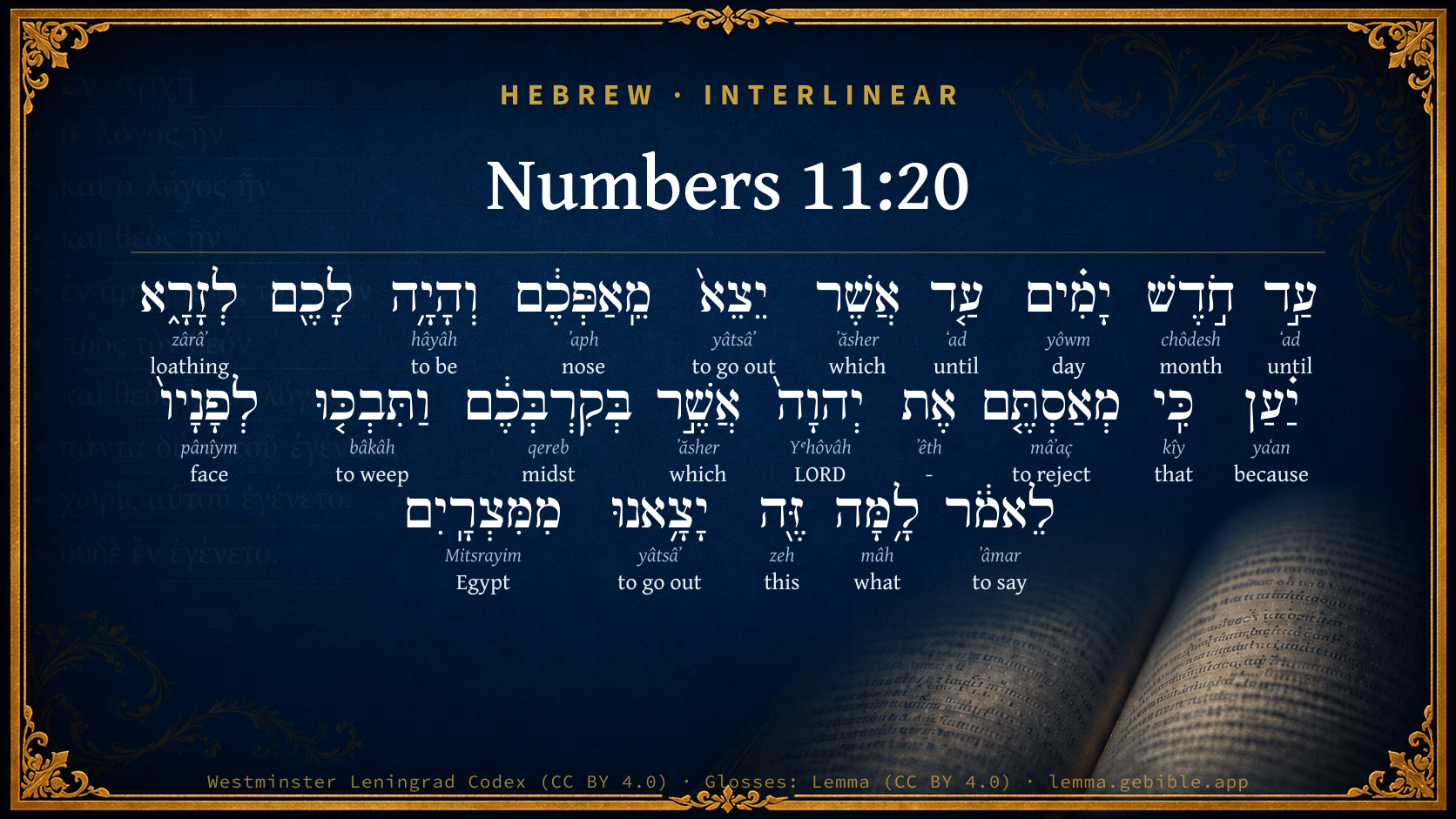
Numbers 11:20

Hebrew (Westminster Leningrad Codex) Numbers 11:20 appears in the Hebrew Old Testament. The text above is from the Westminster Leningrad Codex. Each word links to its Strong’s number, a concise gloss, and parsing drawn from the Open Scriptures Hebrew Bible morphology. Click any word for its full Brown-Driver-Briggs (BDB) entry.
Download image
Cite this verse

Numbers 11:20 (World English Bible). Public Domain. Lemma interlinear Bible study tool, https://lemma.gebible.app/v/numbers/11/20.

Show BibTeX & RIS
BibTeX
RIS
English Translation
but a whole month, until it come out at your nostrils, and it be loathsome to you; because that you have rejected Yahweh who is among you, and have wept before him, saying, Why came we forth out of Egypt?
World English Bible · Public Domain
Highlights
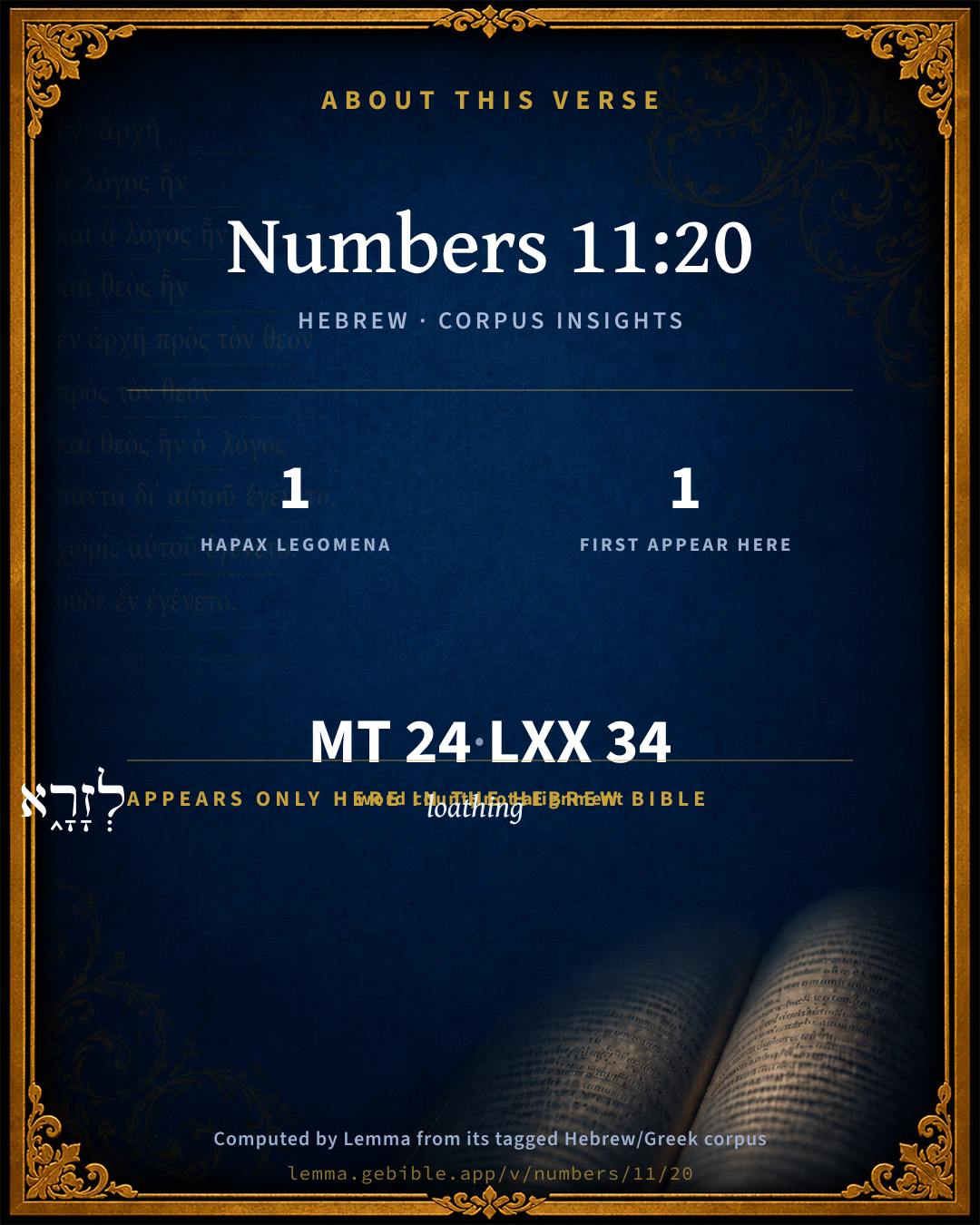
  • 1 hapax legomenon — only here in the Hebrew Bible
  • 1 first appearance in the Hebrew Bible
Full analysis ↓
Download a study sheet

One document with this verse’s original text, its word-by-word gloss line, the meaning frame, cross-references with their text, attributed commentary, and full source and license credits — printable, and it pastes into notes with its structure intact.

This verse Autodidact and up

Study sheet (.html) Plain text (.txt)

A passage Seminary Student

Up to 50 verses in one chapter. A passage sheet keeps up to 6 commentary sources and 12 cross-references per verse, in the order this page ranks them, and says so on the sheet whenever that leaves anything out. Ask for a single verse and you get the Autodidact verse sheet above.

Everything on this page stays free to read, with no account — the sheet is a download of what is already on screen, not access to it.

Want to remove ads? Support Godless Engineer
Compare translations 3

The same verse in 3 English versions, stacked beneath the original-language interlinear above. Click any original word for its lexicon entry.

Each is an independent rendering of the whole verse — the interlinear is not word-aligned to these translations.

Highlighted words mark where these versions differ — a whole-verse word diff, not a word-by-word alignment.

  • World English Bible Public Domain
    but a whole month, until it come out at your nostrils, and it be loathsome to you; because that you have rejected Yahweh who is among you, and have wept before him, saying, Why came we forth out of Egypt?
  • King James Version Public Domain
    But even a whole month, until it come out at your nostrils, and it be loathsome unto you: because that ye have despised the LORD which is among you, and have wept before him, saying, Why came we forth out of Egypt?
  • unfoldingWord Literal Text CC BY-SA 4.0
    until a month of days, until when it goes out from your nose. And it shall be for nausea for you because you rejected Yahweh who is in your midst, and you wept to his face, saying, “Why this: we went out from Egypt?”’”

unfoldingWord Literal Text — © unfoldingWord, licensed CC BY-SA 4.0. Word-aligned USFM3 via Door43 (git.door43.org/unfoldingWord/en_ult).

Versions to compare (up to 4)

3 of 4 selected

Show all 18 translations

Every available English version of this verse, each an independent rendering of the whole verse.

  • World English Bible Public Domain
    but a whole month, until it come out at your nostrils, and it be loathsome to you; because that you have rejected Yahweh who is among you, and have wept before him, saying, Why came we forth out of Egypt?
  • Berean Standard Bible Public Domain
    but for a whole month—until it comes out of your nostrils and makes you nauseous—because you have rejected the LORD, who is among you, and have cried out before Him, saying, ‘Why did we ever leave Egypt?’”
  • Majority Standard Bible Public Domain
    but for a whole month—until it comes out of your nostrils and makes you nauseous—because you have rejected the LORD, who is among you, and have cried out before Him, saying, ‘Why did we ever leave Egypt?’”
  • King James Version Public Domain
    But even a whole month, until it come out at your nostrils, and it be loathsome unto you: because that ye have despised the LORD which is among you, and have wept before him, saying, Why came we forth out of Egypt?
  • American Standard Version (1901) Public Domain
    but a whole month, until it come out at your nostrils, and it be loathsome unto you; because that ye have rejected Jehovah who is among you, and have wept before him, saying, Why came we forth out of Egypt?
  • Revised Version (1885) Public Domain
    but a whole month, until it come out at your nostrils, and it be loathsome unto you: because that ye have rejected the LORD which is among you, and have wept before him, saying, Why came we forth out of Egypt?
  • Geneva Bible (1599) Public Domain
    But a whole moneth, vntill it come out at your nostrels, and bee lothesome vnto you, because ye haue contemned the Lord, which is among you, and haue wept before him, saying, Why came we hither out of Egypt?
  • Douay-Rheims (1899) Public Domain
    But even for a month of days, till it come out at your nostrils, and become loathsome to you, because you have cast off the Lord, who is in the midst of you, and have wept before him, saying: Why came we out of Egypt?
  • Young's Literal Translation Public Domain
    unto a month of days, till that it come out from your nostrils, and it hath become to you an abomination; because that ye have loathed Jehovah, who `is' in your midst, and weep before Him, saying, Why is this? -- we have come out of Egypt!'
  • Literal Standard Version CC BY-SA 4.0
    [but] even to a month of days, until it comes out from your nostrils, and it has become an abomination to you, because that you have loathed YHWH, who [is] in your midst, and weep before Him, saying, Why is this [that] we have come out of Egypt!”
  • Unlocked Literal Bible CC BY-SA 4.0
    but you will eat meat for a whole month until it comes out of your nostrils. It will disgust you because you have rejected Yahweh, who is among you. You have wept before him. You said, “Why did we leave Egypt?”'”
  • unfoldingWord Literal Text CC BY-SA 4.0
    until a month of days, until when it goes out from your nose. And it shall be for nausea for you because you rejected Yahweh who is in your midst, and you wept to his face, saying, “Why this: we went out from Egypt?”’”
  • Darby Bible Public Domain
    [but] for a whole month, until it come out at your nostrils, and it become loathsome unto you; because that ye have despised Jehovah who is among you, and have wept before him, saying, Why came we forth out of Egypt?
  • World Messianic Bible Public Domain
    but a whole month, until it comes out at your nostrils, and it is loathsome to you; because you have rejected the LORD who is among you, and have wept before him, saying, “Why did we come out of Egypt?”’”
  • Webster's Bible Public Domain
    But even a whole month, until it shall come out at your nostrils, and it be lothsome to you; because ye have despised the LORD who is among you, and have wept before him, saying, Why came we forth out of Egypt?
  • Free Bible Version CC BY-SA 4.0
    You're going to eat it for a whole month until it makes you vomit and it comes out through your nostrils, because you have rejected the Lord who is right here with you, complaining to him by saying, ‘Why on earth did we ever leave Egypt?’”
  • Bible in Basic English Public Domain
    But every day for a month, till you are tired of it, turning from it in disgust: because you have gone against the Lord who is with you, and have been weeping before him saying, Why did we come out of Egypt?
  • JPS Tanakh (1917) Public Domain
    but a whole month, until it come out at your nostrils, and it be loathsome unto you; because that ye have rejected the LORD who is among you, and have troubled Him with weeping, saying: Why, now, came we forth out of Egypt?'

Literal Standard Version (2020), Covenant Press — licensed CC BY-SA 4.0. Text via the HelloAO Bible API (eBible.org). Unlocked Literal Bible (unfoldingWord) — licensed CC BY-SA 4.0. Text via the HelloAO Bible API (eBible.org). unfoldingWord Literal Text — © unfoldingWord, licensed CC BY-SA 4.0. Word-aligned USFM3 via Door43 (git.door43.org/unfoldingWord/en_ult). Free Bible Version, Dr. Jonathan Gallagher — licensed CC BY-SA 4.0. Text via the HelloAO Bible API (eBible.org).

Word by word

More ways to search: Search by grammar → Find every occurrence → Compare this word →

Practice this passage: Drill this verse → Learn its vocabulary →

לְזָרָ֑א
zârâʼ
H2214
“to/for · loathing”
Preposition + Noun, Common, Masculine, Singular, Absolute
Part of Speech
Preposition + Noun
Type
Common
Gender
Masculine
Number
Singular
State
Absolute
Full BDB Definition

Origin: from H2114 (sense of estrangement) [compare H2219 ]

TWOT: 542a

nausea, loathing, loathsome thing
  1. עַ֣ד ʻad H5704 “until” Preposition
  2. חֹ֣דֶשׁ chôdesh H2320 “month of” Noun, Common, Masculine, Singular, Construct
  3. יָמִ֗ים yôwm H3117 “days” Noun, Common, Masculine, Plural, Absolute
  4. עַ֤ד ʻad H5704 “until” Preposition
  5. אֲשֶׁר ʼăsher H834 “which” Particle, Relative
  6. יֵצֵא֙ yâtsâʼ H3318 “to go out” Verb, Qal, Imperfect, 3rd Person, Masculine, Singular
  7. מֵֽאַפְּכֶ֔ם ʼaph H639 “from · nose · your” Preposition + Noun, Common, Masculine, Singular, Construct + Suffix, Personal, 2nd Person, Masculine, Plural
  8. וְהָיָ֥ה hâyâh H1961 “and · to be” Conjunction + Verb, Qal, Sequential Perfect, 3rd Person, Masculine, Singular
  9. יַ֗עַן yaʻan H3282 “because” Conjunction
  10. כִּֽי kîy H3588 “that” Conjunction
  11. מְאַסְתֶּ֤ם mâʼaç H3988 “to reject” Verb, Qal, Perfect, 2nd Person, Masculine, Plural
  12. אֶת ʼêth H853 “-” Particle, Direct Object
  13. יְהוָה֙ Yᵉhôvâh H3068 “LORD” Noun, Proper
  14. אֲשֶׁ֣ר ʼăsher H834 “which” Particle, Relative
  15. בְּקִרְבְּכֶ֔ם qereb H7130 “in/at · midst · your” Preposition + Noun, Common, Masculine, Singular, Construct + Suffix, Personal, 2nd Person, Masculine, Plural
  16. וַתִּבְכּ֤וּ bâkâh H1058 “and · to weep” Conjunction + Verb, Qal, Sequential Imperfect, 2nd Person, Masculine, Plural
  17. לְפָנָיו֙ pânîym H6440 “to/for · face(s) · his” Preposition + Noun, Common, Both, Plural, Construct + Suffix, Personal, 3rd Person, Masculine, Singular
  18. לֵאמֹ֔ר ʼâmar H559 “to say” Preposition + Verb, Qal, Infinitive Construct
  19. לָ֥מָּה mâh H4100 “to/for · what” Preposition + Particle, Interrogative
  20. זֶּ֖ה zeh H2088 “this” Pronoun, Demonstrative, Masculine, Singular
  21. יָצָ֥אנוּ yâtsâʼ H3318 “to go out” Verb, Qal, Perfect, 1st Person, Common, Plural
  22. מִמִּצְרָֽיִם Mitsrayim H4714 “from · Egypt” Preposition + Noun, Proper

About this verse

These counts appear in no published source. They are computed here, from the morphology-tagged text and Lemma’s own curated glosses. What Lemma adds →

24
words
20
distinct lemmas
Pentateuch
section

Notable vocabulary

1 hapax legomenon — a word that appears only here in the entire Hebrew Bible:

  • לְזָרָ֑א loathing H2214

First appearance in Scripture

This word makes its first canonical appearance in the Hebrew Bible here:

  • לְזָרָ֑א loathing H2214

Grammatical profile

  • 6 verbs
  • 8 nouns
  • 1 pronoun
  • 3 prepositions
  • 2 conjunctions
  • 4 particles

Verb forms

  • יֵצֵא֙ Qal · Imperfect
  • וְהָיָ֥ה Qal · Sequential Perfect
  • מְאַסְתֶּ֤ם Qal · Perfect
  • וַתִּבְכּ֤וּ Qal · Sequential Imperfect
  • לֵאמֹ֔ר Qal · Infinitive Construct
  • יָצָ֥אנוּ Qal · Perfect

Repetition

Words recur within this verse — often emphatic in Hebrew:

  • עַ֣ד until H5704 ×2
  • יֵצֵא֙ to go out H3318 ×2
  • אֲשֶׁר which H834 ×2

Hebrew & Septuagint length

In English translation the verse runs 40 words from the Hebrew and 46 from the Septuagint (LXX English) — closely comparable.

A rough comparison of the two English renderings, which tokenize alike — not a word-level alignment.

Word counts can differ between the Hebrew and the Greek without any difference in meaning — e.g. the Hebrew direct-object marker אֵת has no separate Greek word, and Greek often adds the article ὁ.

In the original languages it is 24 Hebrew tokens and 34 Greek tokens — but the two are counted differently (Hebrew bundles its prefixes and suffixes into one token; the Greek is in lemma form), so that isn’t a like-for-like length.

Cross-references

13

Topical passages linked to Numbers 11:20 in the Treasury of Scripture Knowledge — connected by theme and wording, ordered by reader-vote popularity; previews shown in the World English Bible.

  • Psalms 106:15 He gave them their request, But sent leanness into their soul.
  • Numbers 21:5 The people spoke against God, and against Moses, Why have you brought us up out of Egypt to die in the wilderness? for there is no bread, and there is no water; and our soul loathes this light bread.
  • Psalms 78:27–30 He rained also flesh on them as the dust; Winged birds as the sand of the seas.
  • 1 Samuel 10:19 but you have this day rejected your God, who himself saves you out of all your calamities and your distresses; and you have said to him, [No], but set a king over us. Now therefore present yourselves before Yahweh by your tribes, and by your thousands.
  • Exodus 16:8 Moses said, "Now Yahweh shall give you meat to eat in the evening, and in the morning bread to satisfy you; because Yahweh hears your murmurings which you murmur against him. And who are we? Your murmurings are not against us, but against Yahweh."
  • Exodus 16:13 It happened at evening that quail came up and covered the camp; and in the morning the dew lay around the camp.
  • Joshua 24:27 Joshua said to all the people, Behold, this stone shall be a witness against us; for it has heard all the words of Yahweh which he spoke to us: it shall be therefore a witness against you, lest you deny your God.
  • 1 Samuel 2:30 Therefore Yahweh, the God of Israel, says, I said indeed that your house, and the house of your father, should walk before me forever: but now Yahweh says, Be it far from me; for those who honor me I will honor, and those who despise me shall be lightly esteemed.
  • 2 Samuel 12:10 Now therefore the sword will never depart from your house, because you have despised me, and have taken the wife of Uriah the Hittite to be your wife.'
  • Proverbs 27:7 A full soul loathes a honeycomb; But to a hungry soul, every bitter thing is sweet.
  • Malachi 1:6 "A son honors his father, and a servant his master. If I am a father, then where is my honor? And if I am a master, where is the respect due me? Says Yahweh of Hosts to you, priests, who despise my name. You say, 'How have we despised your name?'
  • Acts 13:41 'Behold, you scoffers, and wonder, and perish; For I work a work in your days, A work which you will in no way believe, if one declares it to you.'"
  • 1 Thessalonians 4:8 Therefore he who rejects doesn't reject man, but God, who has also given his Holy Spirit to you.

Cross-references courtesy of OpenBible.info (CC BY 4.0).

Hebrew and Greek witnesses Masoretic Hebrew ↔ Greek Septuagint

The same verse in the two great witnesses to the Old Testament, shown verse-for-verse.

These are two independent witnesses, not word-aligned to each other, and the Septuagint is shown in lemma (dictionary) form.

Hebrew Numbers 11:20 Masoretic · Westminster Leningrad Codex

עַ֣ד חֹ֣דֶשׁ יָמִ֗ים עַ֤ד אֲשֶׁר יֵצֵא֙ מֵֽאַפְּכֶ֔ם וְהָיָ֥ה לָכֶ֖ם לְזָרָ֑א יַ֗עַן כִּֽי מְאַסְתֶּ֤ם אֶת יְהוָה֙ אֲשֶׁ֣ר בְּקִרְבְּכֶ֔ם וַתִּבְכּ֤וּ לְפָנָיו֙ לֵאמֹ֔ר לָ֥מָּה זֶּ֖ה יָצָ֥אנוּ מִמִּצְרָֽיִם

but a whole month, until it come out at your nostrils, and it be loathsome to you; because that you have rejected Yahweh who is among you, and have wept before him, saying, Why came we forth out of Egypt?

World English Bible · Public Domain

Greek LXX Numbers 11:20 Septuagint · lemma form

ἕως μήν ἡμέρα ἐσθίω ἕως ἄν ἐκἔρχομαι ἐκ ὁ μυκτήρ σύ καί εἰμί σύ εἰς χολέρα ὅτι ἀπειθέω κύριος ὅς εἰμί ἐν σύ καί κλαίω ἐναντίον αὐτός λέγω ἵνα τίς ἐγώ ἐκἔρχομαι ἐκ αἴγυπτος

you⌃ shall eat for a full month, until the flesh come out at your nostrils; and it shall be nausea to you, because you⌃ disobeyed the Lord, who is among you, and wept before him, saying, What had we to do to come out of Egypt?

LXX2012 (modern English Septuagint) · Public Domain

On this verse, Haydock's Catholic Bible Commentary discusses the Septuagint’s reading. Read the note in Commentary ↓

Hebrew: Westminster Leningrad Codex (CC BY 4.0). Greek: Septuagint (public domain); English from LXX2012 (modern English Septuagint) (Public Domain). How the Septuagint differs from the Hebrew →

Targum (Aramaic paraphrase)

2

The Targum is the ancient Jewish Aramaic paraphrase of the Hebrew Scriptures — an interpretive translation, not the Hebrew text itself. Onkelos (literal) and Pseudo-Jonathan (expansive) render the Torah, and Jonathan the Prophets. Coverage is partial: where no permissively-licensed English translation exists for a verse, only the Aramaic is shown. This is verse-level text, not a word-by-word alignment to the Hebrew.

  1. Targum Onkelos Torah (Genesis–Deuteronomy)
    עַד יְרַח יוֹמִין עַד דִי תְקוּצוּן בֵּהּ וִיהֵי לְכוֹן לְתַקְלָא חֲלַף דְקַצְתּוּן יָת מֵימְרָא דַיְיָ דִשְׁכִנְתֵּהּ שַׁרְיַת בֵּינֵיכוֹן וּבְכִיתוּן קֳדָמוֹהִי לְמֵימַר לְמָא דְנַן נְפַקְנָא מִמִצְרָיִם

    (no public-domain English translation for this verse)

    Targum Onkelos — Aramaic: “Onkelos Genesis” (public domain); “Onkelos Exodus” (public domain); “Onkelos Leviticus” (public domain); “Onkelos Numbers” (public domain); “Onkelos Deuteronomy” (public domain). English: “Sefaria Community Translation” (CC0 1.0 (public-domain dedication)); “J.W. Etheridge. The Targums of Onkelos and Jonathan Ben Uzziel on the Pentateuch. London: Longmans, Green, 1862” (public domain). Text via Sefaria.

  2. Targum Pseudo-Jonathan Torah (Genesis–Deuteronomy)
    עַד יֶרַח יוֹמִין עַד דְתִפּוֹק סַרְיוּתָא מִנְחִירֵיכוֹן וְתֶהֱוֵי לְכוֹן לְרִיחוּק חוֹלַף דְקַצְתּוּן בְּמֵימְרָא דַיְיָ דְאִיקַר שְׁכִינְתֵּיהּ שַׁרְיָא בֵּינֵיכוֹן וּבְכִיתוּן קֳדָמוֹי לְמֵימָר לְמָא דְנַן נַפְקָנָא מִמִצְרָיִם

    for a month of days, until the smell of it cometh forth from your nostrils, and it become a loathing to you; because you have been contemptuous against the Word of the Lord, whose glorious Shekinah dwelleth among you, and because you have wept before Him, saying, Why should we have come out from Mizraim?

    Targum Pseudo-Jonathan — Aramaic: “Targum Jonathan on Genesis” (public domain); “Targum Jonathan on Exodus” (public domain); “Targum Jonathan on Leviticus” (public domain); “Targum Jonathan on Numbers” (public domain); “Targum Jonathan on Deuteronomy” (public domain). English: “The Targum of Jonathan ben Uzziel, trans. J. W. Etheridge, London, 1862” (public domain). Text via Sefaria.

Commentary

Notes on Numbers 11:20 from classic Christian and Jewish commentators (each source and its license shown beneath its notes). The classic Christian expositions comment on the surrounding passage and are grouped to its opening verse, so a note may address several verses; the Jewish commentaries on the Tanakh (Rashi and others) are per-verse, so they appear only where the commentator wrote on this verse.

Lemma curates 59 commentaries, every one of them public domain or Creative Commons licensed, each selected and text-cleaned for this edition rather than reprinted as found. About our sources →

Trapp's Complete Commentary

John Trapp

Num 11:20 [But] even a whole month, until it come out at your nostrils, and it be loathsome unto you: because that ye have despised the LORD which [is] among you, and have wept before him, saying, Why came we forth out of Egypt?

Ver. 20. But even a whole month.] Deus saepe dat iratus quod negat propitius. Patientia Dei quo diuturnior, eo minacior -

“ Poena venit gravior quo magis sera venit. ”

God’s forbearance is no quittance: fatted beasts are but fitted for the slaughter: wicked men are killed with kindnesses: "Ease slayeth the fool." {Pro 1:32}

John Trapp, A Commentary or Exposition upon All the Books of the Old and New Testament (1647–1656) — public domain. Text from a community e-Sword module.

Joseph Benson's Commentary

Num 11:20. Until it come out at your nostrils — That is, till your impatient appetites be glutted; and by another instance of divine power, you be convinced to your shame how irreligiously, distrustfully, and ungratefully you have acted toward God amidst all his merciful providences toward you. The expression presents a very strong, though disagreeable idea of satiety and surfeit, when the overloaded stomach disburdens itself at the mouth and nostrils. Ye have despised the Lord — You have lightly esteemed his bounty and manifold blessings; you have slighted and distrusted his promises and providence after so long and large experience of it. The Lord who is among you — Who is present and resident with you, to observe all your carriage, and to punish your offences. This is added as a great aggravation of the crime, to sin in the presence of the judge. Why came we forth out of Egypt? — Why did God do us such an injury? Why did we so foolishly obey him in coming forth?

Joseph Benson's Commentary on the Old and New Testaments (1811–1818) — public domain. Text from a community e-Sword module.

Geneva Bible (1599)

Geneva Bible translators

Or, cast him off, because ye refused Manna, which he appointed as most meet for you.

Who leadeth and governeth you.

Geneva Bible (1599) marginal notes — public domain. Text via Bolls.life.

John Gill's Exposition

But even a whole month,.... So long the Israelites continued at Taberah or Kibrothhattaavah, as the Jews (o) conclude from this clause:

until it come out at your nostrils; being vomited up, through a nausea of it, the stomach being overfilled and glutted with it; in which case, it will make its way through the nostrils, as well as out of the mouth:

and it be loathsome unto you; being surfeited with it; or it shall be for "dispersion" (p), scattered about from the mouth and nostrils:

because that ye have despised the Lord which is among you; who dwelt in the tabernacle that was in the midst of them, whom they despised by treating the manna with contempt he so plentifully spread about their camp, and by distrusting his power to give them flesh, and by murmuring and complaining against him on the account of their having none: the Targums of Onkelos and Jonathan are,"because ye have loathed the Word of the Lord, whose Shechinah (or the glory of whose Shechinah, as Jonathan) dwelleth among you;''the essential Word, and who was figured by the manna they tasted and despised:

and have wept before him; complaining of him, and murmuring against him:

saying, why came we forth out of Egypt? suggesting it would have been better for them if they had stayed there; thus reflecting on the wisdom, power, and goodness of God, displayed in the deliverance of them, and for which they had the utmost reason to be thankful.

(o) Seder Olam Rabba, c. 8. p. 24. (p) "in dispersionem", Munster, Fagius, Montanus: so R. Joseph Kimchi, apud Kimchi Sepher Shorash rad. "et Aben dana".

John Gill's Exposition of the Whole Bible (1746–1763) — public domain (CC PDM 1.0). Text via the HelloAO Bible API.

Haydock's Catholic Bible Commentary

Of days complete. So two years of days, means two full years. (1 Machabees i. 30.) --- Loathsome to you. "Indigestible," Symmachus. "Bilious," Septuagint. "Till it become loathsome to you, and a source of scandal, (Chaldean) or of dispersion, as some translate the Hebrew.

George Leo Haydock (1774–1849), Haydock's Catholic Family Bible and Commentary, 1859 edition — public domain. Excludes Psalms (Douay-Rheims chapter numbering differs from Protestant) and Deuterocanonical books (Catholic canon only).

Matthew Poole's English Annotations

Till it come out at your nostrils; which meat loathed and violently vomited up frequently doth;

and it be loathsome unto you, being glutted with the abundance of it. Thus God destroys them by granting their desires, and turns even their blessings into curses; whilst he deals much more favourably with Moses, though he also fell into the same sin with the people, i.e. impatience and murmuring. But God will make a great difference between persons and persons, and between Moses’s sins of infirmity and the people’s presumptuous and oft-repeated provocations.

Ye have despised the Lord, i.e. you have lightly esteemed his bounty and manifold blessings in manna and other things, and have preferred the leeks, onions, &c. of Egypt before them all; you have slighted and distrusted his promises and providence after so long and large experience of it.

Which is among you; who is present and resident with you to observe all your carriages, and to punish your offences. This is added as a great aggravation of the crime, to sin in the presence of the Judge.

Why came we forth out of Egypt? Why did God do us such an injury? Why did we so foolishly follow and obey him in coming forth?

Matthew Poole's English Annotations on the Holy Bible (1683–1685) — public domain. Text from a community e-Sword/MySword module.

Whedon's Commentary on the Bible

Daniel D. Whedon

20. Until it come out at your nostrils — We cannot agree with Bishop Patrick that this is a prediction of copious vomiting, but rather that so great a quantity would be eaten day after day that the digestive power would fail, and the stench of the foul stomach would pour forth through the nose.

Says the Targum of Palestine, “Until the smell of it come forth from your nostrils.”

Loathsome — Offensive even to themselves. Because ye…

despised the Lord — Complaining of providential allotments may include contempt of God. Great is the guilt of grumblers!

Which is among you — The Chaldee elucidates the heinousness of the sin: “whose divine majesty dwells among you,” in the shekinah. Under Tiberius the offence of majestas (treason) was extended to all acts and words which might appear to be disrespectful to the emperor.

Daniel D. Whedon (gen. ed.), Commentary on the Old and New Testaments (1874–1909) — public domain. Text from a community e-Sword module.

The Pulpit Commentary

But even a whole month. There is some little difficulty about these words, because the Israelites do not seem to have made a long stay at Kibroth-Hattaavah, and the miraculous supply does not seem to have followed them. The words are words of stern irony and displeasure, and need not be literally pressed: it was enough that animal food was given them in quantity sufficient to have gorged the whole nation for a month, if they had eared to go on eating it (see below on verse 33).

The Pulpit Commentary (1880–1919), ed. H.D.M. Spence-Jones & Joseph S. Exell — public domain. Text from a community e-Sword module.

John Wesley's Explanatory Notes

At your nostrils - Which meat violently vomited up frequently doth. Thus God destroys them by granting their desires, and turns even their blessings into curses. Ye have despised the Lord - You have lightly esteemed his bounty and manifold blessings, you have slighted and distrusted his promises and providence after so long and large experience of it. Who is among you - Who is present and resident with you to observe all your carriage, and to punish your offenses. This is added as a great aggravation of the crime, to sin in the presence of the judge. Why came we forth out of Egypt? - Why did God do us such an injury? Why did we so foolishly obey him in coming forth?

John Wesley, Explanatory Notes Upon the Whole Bible (1754–1765) — public domain. Text via the GEBible commentary corpus.

Rashi

Rabbi Shlomo Yitzchaki (Rashi)

עד חדש ימים BUT EVEN A WHOLE MONTH [SHALL YE EAT] — This was said in reference to the comparatively virtuous, who languish on their beds and only afterwards their soul departs from them; in reference to the wicked, however, it states, (v. 33) “and while the flesh was yet between their teeth [the wrath of the Lord glowed against the people]”. Thus is it taught in the Sifrei Bamidbar 94. But in the Mechilta d'Rabbi Yishmael 16:13:1 (on Exodus 16:13) just the opposite is taught: the wicked ate the flesh and were in agony thirty days, while as for the comparatively virtuous, “the flesh was yet between their teeth, etc.” (they suffered no prolonged agony, but died immediately).

עד אשר יצא מאפכם UNTIL IT COME OUT AT YOUR NOSTRILS — Understand this as the Targum does: until that you feel a loathing for it; i.e. it will seem to you that you have eaten more than enough of it, so that it will come out and be ejected by way of the nose.

והיה לכם לזרא AND BECOME SOMETHING STRANGE UNTO YOU — This means, that you will cast it away from you even more readily than you previously welcomed it (Sifrei Bamidbar 94). But in the work of Rabbi Moses the Preacher, I have seen it stated that there exists a language in which they call a sword "זרא".

את ה’ אשר בקרבכם [BECAUSE THAT YE HAVE SCORNED] THE LORD WHO IS AMONG YOU — The latter words appear superfluous, but they are taken to suggest: Unless I had planted my Shechinah among you your heart would not have become so arrogant as to engage in all these matters (Sifrei Bamidbar 94).

Rashi on the Tanakh — English translations: “The Judaica Press complete Tanach with Rashi, translated by A. J. Rosenberg” (CC BY 4.0); “Pentateuch with Rashi's commentary by M. Rosenbaum and A.M. Silbermann, 1929-1934” (public domain); “The Metsudah Tanach series, Lakewood, N.J” (CC BY 4.0); and “The Book of Joshua, Metsudah Publications, 1997” (CC BY 4.0). Text via Sefaria.

Lesson kit

Teaching starters — assembled from the data on this page, not authored interpretation. Every prompt links to the verse data it draws on. Edit before teaching.

Numbers, in the Pentateuch, opens this verse with 24 words (20 distinct Hebrew lemmas). Its most distinctive word is zârâʼ (“loathing”). A historical commentator’s framing appears above. Read the whole chapter for the surrounding context.

Discussion questions

  1. The word zârâʼ carries the sense “loathing.” How does it shape the verse?
  2. This verse holds 1 word here found nowhere else in the Hebrew Bible. What might the rare word draw attention to?
  3. The word “loathing” first appears here in Scripture. What is being introduced at this debut?
  4. Psalms 106:15 shares this passage’s theme. How do the two illuminate each other?
  5. “until” occurs 2× in this one verse. What is the effect of the repetition?
  6. These translations render this verse differently; the difference is in the English rendering, not the original. What questions does that raise?
  7. The verb «יֵצֵא֙» is Qal Imperfect. How does its form color the action?
  8. Reading how Trapp's Complete Commentary and Joseph Benson's Commentary read this verse, where do the two commentators agree and where do they part?

Things to notice

  • 1 word in this verse appears nowhere else in the Hebrew Bible.
  • 1 word makes its first canonical appearance in Scripture here.
  • This verse counts 24 Hebrew ↔ 34 Greek words.
  • These translations choose different wording for 26 words in this verse.
  • “until” occurs 2× in this single verse.

Reading settings

Reading text

Shown beneath each verse's original-language words.

Old Testament
Old Testament edition

Read the OT as the Masoretic Hebrew (MT) or the Greek Septuagint (LXX).

English shown for the Greek Septuagint (in the Hebrew ↔ Greek comparison).

Comparing translations? Open the Compare panel on any verse page to stack up to four side by side.