Deuteronomy 18:2

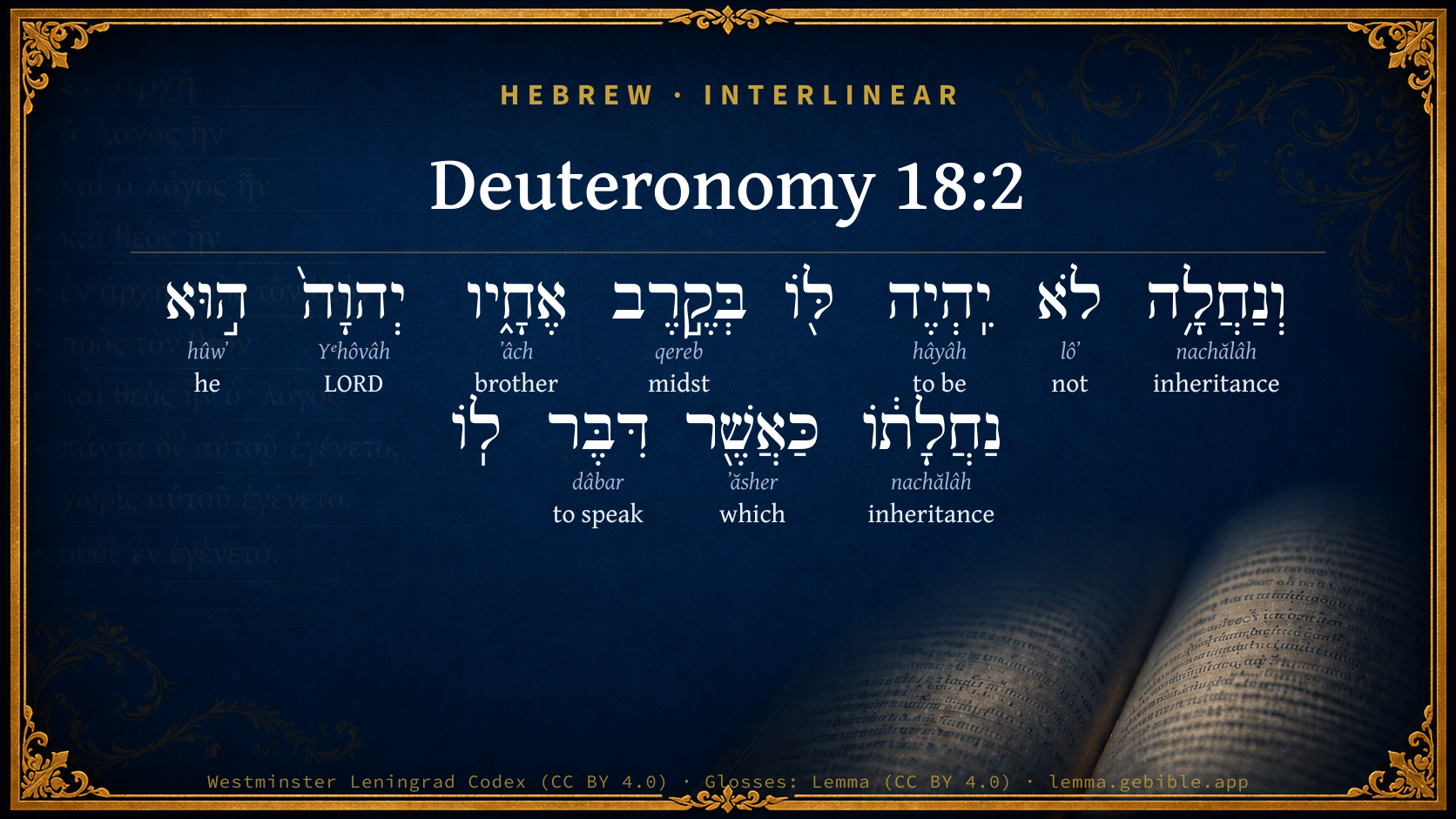
Hebrew (Westminster Leningrad Codex) Deuteronomy 18:2 appears in the Hebrew Old Testament. The text above is from the Westminster Leningrad Codex. Each word links to its Strong’s number, a concise gloss, and parsing drawn from the Open Scriptures Hebrew Bible morphology. Click any word for its full Brown-Driver-Briggs (BDB) entry.
Download image
Cite this verse

Deuteronomy 18:2 (World English Bible). Public Domain. Lemma interlinear Bible study tool, https://lemma.gebible.app/v/deuteronomy/18/2.

Show BibTeX & RIS
BibTeX
RIS
English Translation
They shall have no inheritance among their brothers: Yahweh is their inheritance, as he has spoken to them.
World English Bible · Public Domain
Download a study sheet

One document with this verse’s original text, its word-by-word gloss line, the meaning frame, cross-references with their text, attributed commentary, and full source and license credits — printable, and it pastes into notes with its structure intact.

This verse Autodidact and up

Study sheet (.html) Plain text (.txt)

A passage Seminary Student

Up to 50 verses in one chapter. A passage sheet keeps up to 6 commentary sources and 12 cross-references per verse, in the order this page ranks them, and says so on the sheet whenever that leaves anything out. Ask for a single verse and you get the Autodidact verse sheet above.

Everything on this page stays free to read, with no account — the sheet is a download of what is already on screen, not access to it.

Want to remove ads? Support Godless Engineer
Compare translations 3

The same verse in 3 English versions, stacked beneath the original-language interlinear above. Click any original word for its lexicon entry.

Each is an independent rendering of the whole verse — the interlinear is not word-aligned to these translations.

Highlighted words mark where these versions differ — a whole-verse word diff, not a word-by-word alignment.

  • World English Bible Public Domain
    They shall have no inheritance among their brothers: Yahweh is their inheritance, as he has spoken to them.
  • King James Version Public Domain
    Therefore shall they have no inheritance among their brethren: the LORD is their inheritance, as he hath said unto them.
  • unfoldingWord Literal Text CC BY-SA 4.0
    And he shall have no inheritance among his brothers; Yahweh is his inheritance, as he spoke to him.

unfoldingWord Literal Text — © unfoldingWord, licensed CC BY-SA 4.0. Word-aligned USFM3 via Door43 (git.door43.org/unfoldingWord/en_ult).

Versions to compare (up to 4)

3 of 4 selected

Show all 18 translations

Every available English version of this verse, each an independent rendering of the whole verse.

  • World English Bible Public Domain
    They shall have no inheritance among their brothers: Yahweh is their inheritance, as he has spoken to them.
  • Berean Standard Bible Public Domain
    Although they have no inheritance among their brothers, the LORD is their inheritance, as He promised them.
  • Majority Standard Bible Public Domain
    Although they have no inheritance among their brothers, the LORD is their inheritance, as He promised them.
  • King James Version Public Domain
    Therefore shall they have no inheritance among their brethren: the LORD is their inheritance, as he hath said unto them.
  • American Standard Version (1901) Public Domain
    And they shall have no inheritance among their brethren: Jehovah is their inheritance, as he hath spoken unto them.
  • Revised Version (1885) Public Domain
    And they shall have no inheritance among their brethren: the LORD is their inheritance, as he hath spoken unto them.
  • Geneva Bible (1599) Public Domain
    Therefore shall they haue no inheritance among their brethren: for the Lord is their inheritance, as he hath sayd vnto them.
  • Douay-Rheims (1899) Public Domain
    And they shall receive nothing else. of the possession of their brethren: for the Lord himself is their inheritance, as he hath said to them.
  • Young's Literal Translation Public Domain
    and he hath no inheritance in the midst of his brethren; Jehovah Himself `is' his inheritance, as He hath spoken to him.
  • Literal Standard Version CC BY-SA 4.0
    and he has no inheritance in the midst of his brothers; YHWH Himself [is] his inheritance, as He has spoken to him.
  • Unlocked Literal Bible CC BY-SA 4.0
    They must have no inheritance among their brothers; Yahweh is their inheritance, as he said to them.
  • unfoldingWord Literal Text CC BY-SA 4.0
    And he shall have no inheritance among his brothers; Yahweh is his inheritance, as he spoke to him.
  • Darby Bible Public Domain
    but they shall have no inheritance among their brethren: Jehovah, he is their inheritance, as he hath said unto them.
  • World Messianic Bible Public Domain
    They shall have no inheritance among their brothers. The LORD is their inheritance, as he has spoken to them.
  • Webster's Bible Public Domain
    Therefore shall they have no inheritance among their brethren: the LORD is their inheritance, as he hath said to them.
  • Free Bible Version CC BY-SA 4.0
    While they don't own land among the other tribes, the Lord takes care of them, as he promised.
  • Bible in Basic English Public Domain
    And they will have no heritage among their countrymen: the Lord is their heritage, as he has said to them.
  • JPS Tanakh (1917) Public Domain
    And they shall have no inheritance among their brethren; the LORD is their inheritance, as He hath spoken unto them.

Literal Standard Version (2020), Covenant Press — licensed CC BY-SA 4.0. Text via the HelloAO Bible API (eBible.org). Unlocked Literal Bible (unfoldingWord) — licensed CC BY-SA 4.0. Text via the HelloAO Bible API (eBible.org). unfoldingWord Literal Text — © unfoldingWord, licensed CC BY-SA 4.0. Word-aligned USFM3 via Door43 (git.door43.org/unfoldingWord/en_ult). Free Bible Version, Dr. Jonathan Gallagher — licensed CC BY-SA 4.0. Text via the HelloAO Bible API (eBible.org).

Word by word

More ways to search: Search by grammar → Find every occurrence → Compare this word →

Practice this passage: Drill this verse → Learn its vocabulary →

וְנַחֲלָ֥ה
nachălâh
H5159
“and · inheritance”
Conjunction + Noun, Common, Feminine, Singular, Absolute
Part of Speech
Conjunction + Noun
Type
Common
Gender
Feminine
Number
Singular
State
Absolute
Full BDB Definition

Origin: from H5157 (in its usual sense)

TWOT: 1342a

possession, property, inheritance, heritage - property - portion, share - inheritance, portion
  1. לֹא lôʼ H3808 “not” Particle, Negative
  2. יִֽהְיֶה hâyâh H1961 “to be” Verb, Qal, Imperfect, 3rd Person, Masculine, Singular
  3. בְּקֶ֣רֶב qereb H7130 “in/at · midst of” Preposition + Noun, Common, Masculine, Singular, Construct
  4. אֶחָ֑יו ʼâch H251 “brothers · his” Noun, Common, Masculine, Plural, Construct + Suffix, Personal, 3rd Person, Masculine, Singular
  5. יְהוָה֙ Yᵉhôvâh H3068 “LORD” Noun, Proper
  6. ה֣וּא hûwʼ H1931 “he” Pronoun, Personal, 3rd Person, Masculine, Singular
  7. נַחֲלָת֔וֹ nachălâh H5159 “inheritance · his” Noun, Common, Feminine, Singular, Construct + Suffix, Personal, 3rd Person, Masculine, Singular
  8. כַּאֲשֶׁ֖ר ʼăsher H834 “like/as · which” Preposition + Particle, Relative
  9. דִּבֶּר dâbar H1696 “to speak” Verb, Piel, Perfect, 3rd Person, Masculine, Singular

About this verse

These counts appear in no published source. They are computed here, from the morphology-tagged text and Lemma’s own curated glosses. What Lemma adds →

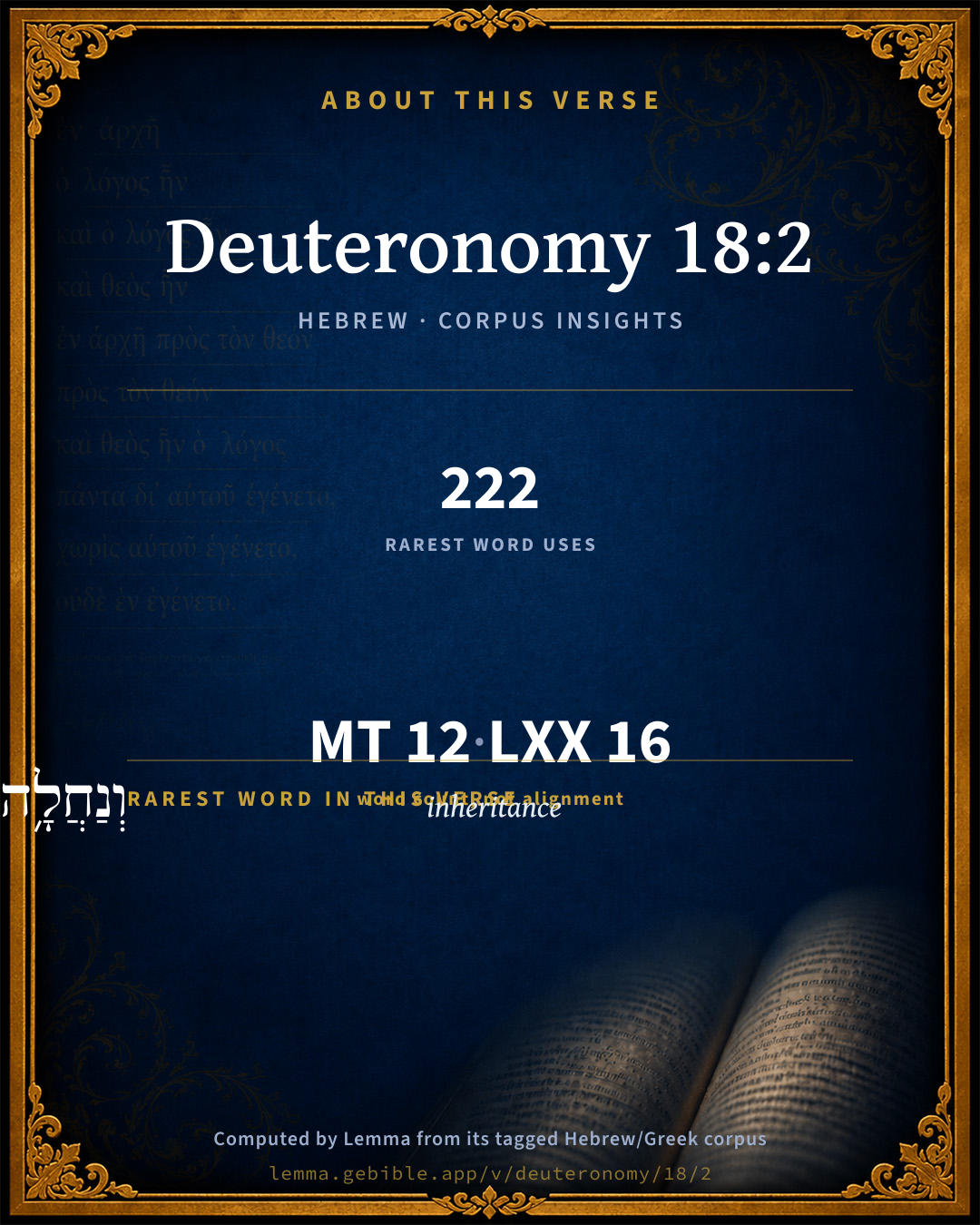
12
words
9
distinct lemmas
Pentateuch
section

Grammatical profile

  • 2 verbs
  • 5 nouns
  • 1 pronoun
  • 2 prepositions
  • 2 particles

Verb forms

  • יִֽהְיֶה Qal · Imperfect
  • דִּבֶּר Piel · Perfect

Repetition

A word recurs within this verse — often emphatic in Hebrew:

  • וְנַחֲלָ֥ה inheritance H5159 ×2

Hebrew & Septuagint length

In English translation the verse runs 18 words from the Hebrew and 20 from the Septuagint (LXX English) — closely comparable.

A rough comparison of the two English renderings, which tokenize alike — not a word-level alignment.

Word counts can differ between the Hebrew and the Greek without any difference in meaning — e.g. the Hebrew direct-object marker אֵת has no separate Greek word, and Greek often adds the article ὁ.

In the original languages it is 12 Hebrew tokens and 16 Greek tokens — but the two are counted differently (Hebrew bundles its prefixes and suffixes into one token; the Greek is in lemma form), so that isn’t a like-for-like length.

Cross-references

10

Topical passages linked to Deuteronomy 18:2 in the Treasury of Scripture Knowledge — connected by theme and wording, ordered by reader-vote popularity; previews shown in the World English Bible.

  • Genesis 15:1 After these things the word of Yahweh came to Abram in a vision, saying, "Don't be afraid, Abram. I am your shield, your exceedingly great reward."
  • Psalms 16:5 Yahweh assigned my portion and my cup. You made my lot secure.
  • Psalms 73:24–26 You will guide me with your counsel, And afterward receive me to glory.
  • Psalms 84:11 For Yahweh God is a sun and a shield. Yahweh will give grace and glory. He withholds no good thing from those who walk blamelessly.
  • Psalms 119:57 Yahweh is my portion. I promised to obey your words.
  • Isaiah 61:6 But you shall be named the priests of Yahweh; men shall call you the ministers of our God: you shall eat the wealth of the nations, and in their glory shall you boast yourselves.
  • Lamentations 3:24 Yahweh is my portion, says my soul; therefore will I hope in him.
  • 1 Peter 2:5 You also, as living stones, are built up as a spiritual house, to be a holy priesthood, to offer up spiritual sacrifices, acceptable to God through Jesus Christ.
  • 1 Peter 2:9 But you are a chosen race, a royal priesthood, a holy nation, a people for God's own possession, that you may show forth the excellencies of him who called you out of darkness into his marvelous light:
  • Revelation 1:5–6 and from Jesus Christ, the faithful witness, the firstborn of the dead, and the ruler of the kings of the earth. To him who loves us, and washed us from our sins by his blood;

Cross-references courtesy of OpenBible.info (CC BY 4.0).

Hebrew and Greek witnesses Masoretic Hebrew ↔ Greek Septuagint

The same verse in the two great witnesses to the Old Testament, shown verse-for-verse.

These are two independent witnesses, not word-aligned to each other, and the Septuagint is shown in lemma (dictionary) form.

Hebrew Deuteronomy 18:2 Masoretic · Westminster Leningrad Codex

וְנַחֲלָ֥ה לֹא יִֽהְיֶה לּ֖וֹ בְּקֶ֣רֶב אֶחָ֑יו יְהוָה֙ ה֣וּא נַחֲלָת֔וֹ כַּאֲשֶׁ֖ר דִּבֶּר לֽוֹ

They shall have no inheritance among their brothers: Yahweh is their inheritance, as he has spoken to them.

World English Bible · Public Domain

Greek LXX Deuteronomy 18:2 Septuagint · lemma form

κλῆρος δέ οὐ εἰμί αὐτός ἐν ὁ ἀδελφός αὐτός κύριος αὐτός κλῆρος αὐτός καθότι εἶπον αὐτός

And they shall have no inheritance among their brethren; the Lord himself is his portion, as he said to him.

LXX2012 (modern English Septuagint) · Public Domain

Hebrew: Westminster Leningrad Codex (CC BY 4.0). Greek: Septuagint (public domain); English from LXX2012 (modern English Septuagint) (Public Domain). How the Septuagint differs from the Hebrew →

Targum (Aramaic paraphrase)

2

The Targum is the ancient Jewish Aramaic paraphrase of the Hebrew Scriptures — an interpretive translation, not the Hebrew text itself. Onkelos (literal) and Pseudo-Jonathan (expansive) render the Torah, and Jonathan the Prophets. Coverage is partial: where no permissively-licensed English translation exists for a verse, only the Aramaic is shown. This is verse-level text, not a word-by-word alignment to the Hebrew.

  1. Targum Onkelos Torah (Genesis–Deuteronomy)
    וְאַחֲסָנָא לָא יְהֵי לֵהּ בְּגוֹ אֲחוֹהִי מַתְּנָן דִיהַב לֵהּ יְיָ אִנוּן אַחֲסַנְתֵּהּ כְּמָא דִי מַלִיל לֵהּ

    (no public-domain English translation for this verse)

    Targum Onkelos — Aramaic: “Onkelos Genesis” (public domain); “Onkelos Exodus” (public domain); “Onkelos Leviticus” (public domain); “Onkelos Numbers” (public domain); “Onkelos Deuteronomy” (public domain). English: “Sefaria Community Translation” (CC0 1.0 (public-domain dedication)); “J.W. Etheridge. The Targums of Onkelos and Jonathan Ben Uzziel on the Pentateuch. London: Longmans, Green, 1862” (public domain). Text via Sefaria.

  2. Targum Pseudo-Jonathan Torah (Genesis–Deuteronomy)
    וְאַחֲסָנַת חֲקַל וּכְרַם לָא תְהֵי לֵיהּ בֵּינֵי אָחוֹי עֶשְרִין וְאַרְבַּע מוֹהֲבוּתָא דִכְהוּנְתָּא דִיהַב לֵיהּ יְיָ הִינוּן אַחְסַנְתֵּיהּ הֵיכְמָא דְמַלִּיל לֵיהּ

    but an inheritance in field or vineyard they will not have among their brethren. The twenty and four gifts of the priesthood which the Lord will give to him are his heritage; as He said to him,

    Targum Pseudo-Jonathan — Aramaic: “Targum Jonathan on Genesis” (public domain); “Targum Jonathan on Exodus” (public domain); “Targum Jonathan on Leviticus” (public domain); “Targum Jonathan on Numbers” (public domain); “Targum Jonathan on Deuteronomy” (public domain). English: “The Targum of Jonathan ben Uzziel, trans. J. W. Etheridge, London, 1862” (public domain). Text via Sefaria.

Commentary

Notes on Deuteronomy 18:2 from classic Christian and Jewish commentators (each source and its license shown beneath its notes). The classic Christian expositions comment on the surrounding passage and are grouped to its opening verse, so a note may address several verses; the Jewish commentaries on the Tanakh (Rashi and others) are per-verse, so they appear only where the commentator wrote on this verse.

Lemma curates 59 commentaries, every one of them public domain or Creative Commons licensed, each selected and text-cleaned for this edition rather than reprinted as found. About our sources →

Tyndale Open Study Notes

Tyndale Open Resources

18:2 The Lord himself is their special possession: The allotment of the Levites was spiritual, not territorial or material. They possessed the Lord by giving their whole lives to his service. This idea is a remarkable inverse of the idea that Israel was the Lord’s possession (see 7:6).

Tyndale Open Study Notes — © Tyndale Open Resources, licensed CC BY-SA 4.0. Text via the HelloAO Bible API.

Adam Clarke's Commentary

Verse 2. The Lord is their inheritance] He is the portion of their souls; and as to their bodies, they shall live by the offerings of the Lord made by fire, i. e., the meat-offering, the sin-offering, and the trespass-offering; and whatever was the Lord's right, in these or other offerings, he gave to the priests.

Adam Clarke's Commentary on the Bible (1810–1826) — public domain. Text from a community e-Sword/MySword module.

The Cambridge Bible for Schools and Colleges

gen. ed. J. J. S. Perowne

2. As in Deu_10:9 : read with Heb. he, his, him for they, their, them and see introd. to this law.

The Cambridge Bible for Schools and Colleges (gen. ed. J. J. S. Perowne; Cambridge University Press, 1878–1918) — public domain. Text from a community e-Sword module.

John Gill's Exposition

Therefore shall they have none inheritance among their brethren,.... Neither of the field, nor of the vineyard, as the above Targum, because provision was made for them otherwise, and especially because

the Lord is their inheritance, as he hath said unto them; see Gill on Num 18:20, which as it may be understood in a spiritual sense of their interest in God, as their covenant God, and of their enjoyment of him, and communion with him; so chiefly in a temporal sense of all those things in the sacrifices which the Lord claimed to himself, and these he gave unto them; so the same Targum interprets this of the twenty four gifts of the priesthood, enumerated Num 18:1.

John Gill's Exposition of the Whole Bible (1746–1763) — public domain (CC PDM 1.0). Text via the HelloAO Bible API.

Matthew Poole's English Annotations

i.e. The Lord’s part and right, as was now said.

Matthew Poole's English Annotations on the Holy Bible (1683–1685) — public domain. Text from a community e-Sword/MySword module.

The Pulpit Commentary

Vers. 2, 3. As he hath said unto them (cf. Num_18:20) The shoulder, and the two cheeks, and the maw; i.e. the front leg, the two jaw-bones, and the rough stomach of ruminants, in which the digestion is completed. These were regarded as the choice parts of the animal, and were to be given to the priests in addition to the wave breast and heave leg of the peace offerings (Lev_7:32, etc.; Num_18:11) which belonged to the firings of Jehovah, mentioned in ver. 1. To these the priest had a rightful claim; they were his due (fpvmi, mishpat, right). "This right was probably accorded to the priests as a compensation for the falling off which would take place in their incomes in consequence of the repeal of the law that every animal was to be slaughtered at the sanctuary as a sacrifice. (Le 17; vide"(Keil) Deu_12:15. sqq.) According to Josephus ("Antiq," 4:4, 4), Philo ("De Praemiis. Sacerdot.," p. 832, Opp., tom. 2. p. 235, edit. Maugey), the Talmud, etc., this injunction relates to the slaying of animals at home for private use, and not such as were killed for sacrifice. But the use here of the sacrificial phraseology, who offer a sacrifice (jbZh yjebzO, who slay victims for sacrifice a phrase nowhere found except in connection with sacrificial rites) is adverse to this; and besides, how could such an enactment be carried out? How could people, residing at a distance, convey to the priests the portions due to them every time they slaughtered an animal for domestic use? At the same time, the sacrifices here referred to do not seem to be included in the offerings by fire above mentioned; and these gifts to the priest seem to have been something over and above his ordinary dues. There is probability, therefore, in the suggestion that "the reference is to the slaughtering of oxen, sheep, or goats, which were not intended for shelamim in the more limited sense, i.e. for one of the three species of peace offerings, (Lev_7:15, Lev_7:16) but for festal meals in the broader sense, which were held in connection with the sacrificial meals prepared from the shelamim" (Keil).

The Pulpit Commentary (1880–1919), ed. H.D.M. Spence-Jones & Joseph S. Exell — public domain. Text from a community e-Sword module.

Rashi

Rabbi Shlomo Yitzchaki (Rashi)

כאשר דבר לו AS HE SPOKE TO HIM i.e., to Aaron [saying],“You shall not inherit in their land… I am your portion [and your inheritance, among the children of Israel].”- (Numbers 18:20)

Rashi on the Tanakh — English translations: “The Judaica Press complete Tanach with Rashi, translated by A. J. Rosenberg” (CC BY 4.0); “Pentateuch with Rashi's commentary by M. Rosenbaum and A.M. Silbermann, 1929-1934” (public domain); “The Metsudah Tanach series, Lakewood, N.J” (CC BY 4.0); and “The Book of Joshua, Metsudah Publications, 1997” (CC BY 4.0). Text via Sefaria.

Lesson kit

Teaching starters — assembled from the data on this page, not authored interpretation. Every prompt links to the verse data it draws on. Edit before teaching.

Deuteronomy, in the Pentateuch, opens this verse with 12 words (9 distinct Hebrew lemmas). Its most distinctive word is nachălâh (“inheritance”). A historical commentator’s framing appears above. Read the whole chapter for the surrounding context.

Discussion questions

  1. The word nachălâh carries the sense “inheritance.” How does it shape the verse?
  2. Genesis 15:1 shares this passage’s theme. How do the two illuminate each other?
  3. “inheritance” occurs 2× in this one verse. What is the effect of the repetition?
  4. These translations render this verse differently; the difference is in the English rendering, not the original. What questions does that raise?
  5. The verb «יִֽהְיֶה» is Qal Imperfect. How does its form color the action?
  6. Reading how Tyndale Open Study Notes and Adam Clarke's Commentary read this verse, where do the two commentators agree and where do they part?

Things to notice

Reading settings

Reading text

Shown beneath each verse's original-language words.

Old Testament
Old Testament edition

Read the OT as the Masoretic Hebrew (MT) or the Greek Septuagint (LXX).

English shown for the Greek Septuagint (in the Hebrew ↔ Greek comparison).

Comparing translations? Open the Compare panel on any verse page to stack up to four side by side.